





Abstract
The extant literature suggests the Lee Silverman Voice Treatment BIG® (LSVT BIG) program is an effective intervention for persons with Parkinson’s disease; however, no literature or research on the use of this program as an intervention for persons with stroke exists. We examined the effects of the LSVT BIG program for a 52-yr-old community-dwelling woman with mild to moderate upper extremity hemiparesis 2 yr after a stroke and the feasibility of delivering the home exercise component of the program in a game-based format. We made measurements at pretest, posttest, and 6-wk follow-up. The participant demonstrated self-reported improvements in occupational performance and satisfaction and large improvements in upper extremity motor function. The next step in this research is to deliver LSVT BIG and a home game-based program with a larger, more diverse population of persons with chronic stroke to further determine the effectiveness and appropriateness of this intervention.
Stroke is the leading cause of disability in the United States, affecting more than 795,000 people per year (Mozaffarian et al., 2016). One common challenge of this condition often addressed by occupational therapy practitioners is motor impairment of the upper extremity. An estimated 65%–70% of persons with stroke experience upper extremity dysfunction that results in an inability to incorporate the impaired upper extremity into various activities, significantly affecting the ability to engage in meaningful occupations (Cha et al., 2015; Doman et al., 2016).
Upper extremity interventions for persons with stroke range from bottom-up approaches with a focus on impairment to top-down approaches that focus on occupational deficits. Moderate to high levels of evidence support task-oriented approaches (Wolf & Nilsen, 2015). Unfortunately, many persons with stroke are unable to benefit from these approaches because of limited movement in the hand, wrist, and elbow. In addition, some of these interventions often fail in clinical practice; the Accelerated Skill Acquisition Program was tested in the multisite Interdisciplinary Comprehensive Arm Rehabilitation Evaluation randomized clinical trial and showed no difference in outcomes compared with dose-matched usual care (Winstein et al., 2016).
Lee Silverman Voice Treatment BIG® (LSVT BIG; LSVT Global, 2015) is a therapeutic technique aimed to improve motor performance of persons with Parkinson’s disease (PD; Ebersbach et al., 2014, 2015). Derived from an evidence-based speech treatment of individuals with PD (LSVT LOUD®; LSVT Global, 2015), this standardized protocol uses principles that promote neuroplasticity and brain reorganization to recalibrate the sensory system through high-amplitude movements (Ebersbach et al., 2014, 2015; Janssens et al., 2014). Several recent studies have shown promising results supporting the effectiveness of this intervention in improving motor performance in persons with mild to moderate PD (Ebersbach et al., 2014, 2015; Janssens et al., 2014). Treatment principles such as intensity, complexity, repetition, saliency, and specificity underlie LSVT BIG treatment and are well supported in the neuroplasticity literature (Nudo et al., 1996). Unfortunately, no literature currently exists on the use of LSVT BIG with persons with stroke.
Persons with stroke often have low adherence to traditional paper-based home exercise programs (Jurkiewicz et al., 2011), and game-based approaches have shown good promise in increasing adherence and motivation (Combs et al., 2012). Proffitt and Lange (2015) previously used virtual reality tools to deliver home exercise programs for persons with chronic stroke in the home setting. Given the limitations of existing interventions for upper extremity motor recovery after stroke, the low adherence to home exercise programs, and the potential implications of the use of LSVT BIG for persons with stroke, we sought to explore the feasibility of this program in the chronic stroke population. The purpose of this study was to determine whether participation in the LSVT BIG program had an effect for a client with stroke and whether it was feasible to deliver the LSVT BIG program home exercises using a game-based virtual reality platform.
Method
Case Study Participant
Brenda (a pseudonym) was recruited from the TigerOT Clinic at the University of Missouri. She was a 56-yr-old woman who had experienced an ischemic stroke 29 mo before her enrollment. Brenda had mild to moderate hemiparesis that affected her dominant left upper extremity. She was independent in most of her activities of daily living, and she ran a restaurant, where she spent the majority of her time. She did not receive any rehabilitation services during the time period of this study. This study was approved by the University of Missouri Health Sciences institutional review board.
Intervention
Lee Silverman Voice Training BIG Protocol.
A member of the investigative team, Whitney Henderson, is certified in and delivered the LSVT BIG intervention. The intervention had two components: an in-clinic and a home exercise program. The in-clinic portion of the intervention is delivered on 4 consecutive days of the week for 4 wk. The intervention modules of the 1-hr sessions are detailed in Table 1.
Components of LSVT BIG Treatment Sessions
Note. LSVT = Lee Silverman Voice Treatment.
Mystic Isle: Home Exercise Delivery.
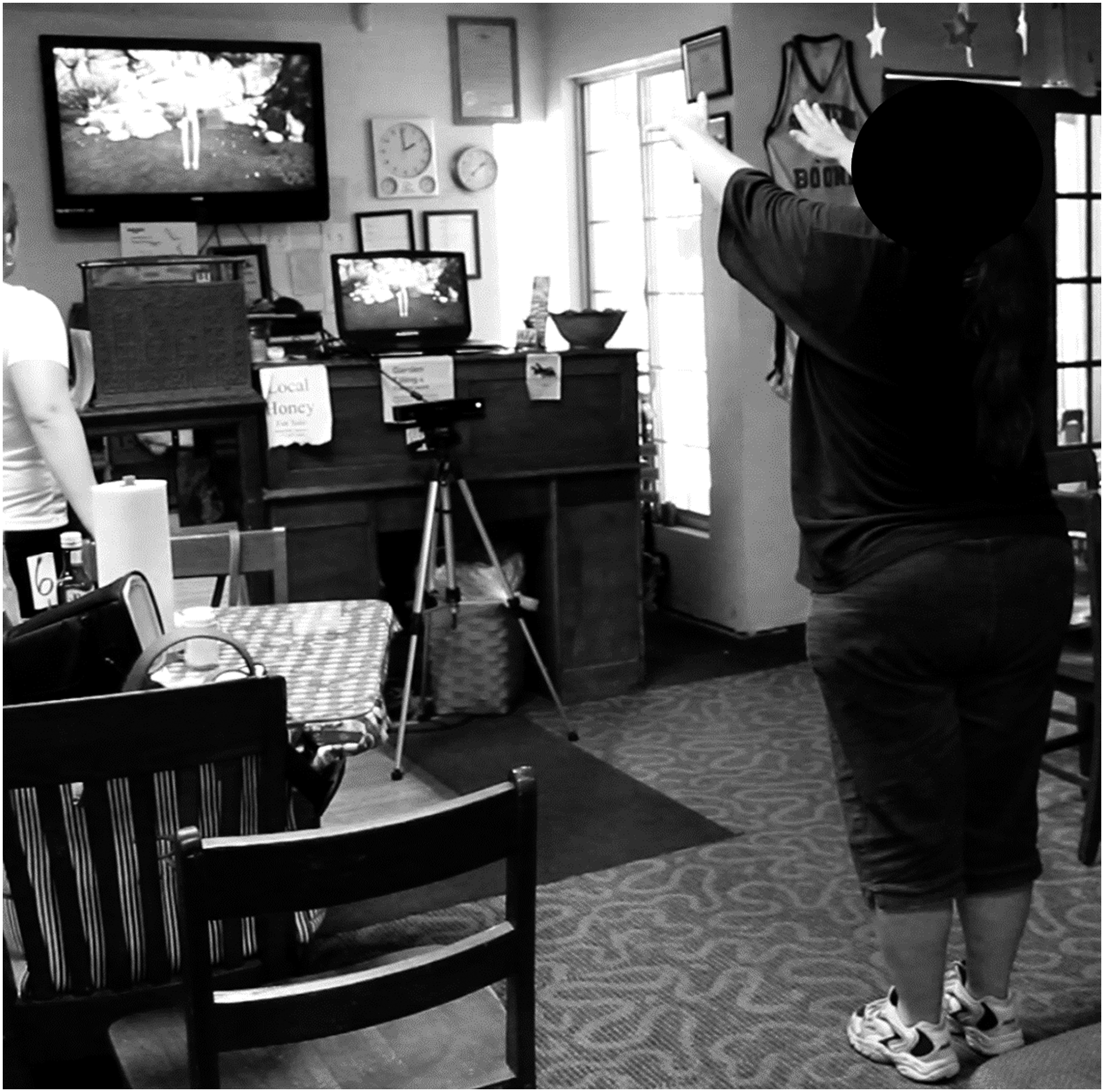
In addition to these sessions, the participant completes 1 hr of home exercise, and on nonclinic days (3 days/wk), he or she completes 2 hr of home exercise (LSVT Global, 2015). The exercises are incorporated into the Mystic Isle platform, which uses the Microsoft Kinect sensor (Microsoft Corp., Redmond, WA) as the input device (Figure 1). Virtual targets were placed at the endpoints of the large-amplitude movements, and eight specific exercises and one functional activity (sit-to-stand) were calibrated specifically to Brenda’s movement abilities (see Figure 1).
Assessment Measures and Procedures
Outcomes were assessed preintervention, postintervention, and at a 6-wk follow-up. The focus of the LSVT BIG program is on whole body movements, including walking. For the purposes of this study, we focused on occupational performance and upper extremity function as outcomes. The primary outcome assessment was the Canadian Occupational Performance Measure (COPM; Cup et al., 2003; Law et al., 2014), and the secondary outcome assessments were the Wolf Motor Function Test (Wolf et al., 2001), the Performance Assessment of Self-Care Skills (Rogers et al., 2008), the Stroke-Specific Quality of Life Scale (Williams et al., 1999), the Modified Ashworth Scale (Gregson et al., 1999), goniometry, and manual muscle tests. A semistructured interview was conducted postintervention and at the 6-wk follow-up.
Data Analysis
Data from all paper questionnaires were input into a REDCap (REDCap Consortium, Nashville, TN) database hosted at the University of Missouri. Mystic Isle data were extracted and analyzed. All interviews were audio recorded and transcribed verbatim. Qualitative data were explored for themes and then member-checked with Brenda for accuracy and confirmation.
Results
Clinical Outcomes
Brenda completed 100% of in-clinic visits and 80% of the home program. The time spent on the home exercise program in Mystic Isle was an average of 27 min per session. Data from the COPM demonstrated that LSVT BIG had a positive effect on satisfaction with (post – pre = 5.2) and performance of (post – pre = 4.0) occupations (Table 2). This is above the minimal detectable change for performance (1.7 points) and satisfaction (2.7) on the COPM. Upper extremity function data revealed that LSVT BIG had a positive effect (45% decrease in average pre–post Wolf Motor Function Test task time); this percentage change is above the minimal detectable level (16%) for persons with stroke (Wolf et al., 2001). In addition, Brenda’s active range of motion improved to either within normal limits or within functional limits, muscle strength at her shoulder and wrist showed small improvements, and spasticity in her elbow decreased (see Table 2).
Results of the Outcome Assessments for Brenda: Baseline, Postintervention, and 6-Wk Follow-Up
Note. WFL = within functional limits; WNL = within normal limits.
Average score across five independently assessed tasks.
Qualitative Outcomes
Perceived Value of the Intervention and Quality of Movement.
Brenda identified the intensity of the intervention as a factor in improvement in her motor function and participation in occupations. She also described the quality of movement of the affected upper extremity and how this improved movement contributed to the automaticity of the affected upper extremity to participate in and complete a task. She mentioned that her movements became smoother and more controlled, and she began to initiate bilateral movements in her daily life.
Impact on Daily Life.
As a result of the improvements she saw in her movement abilities, Brenda reported engaging in new occupations and in other smaller tasks, such as pouring a glass of iced tea for a customer with her left hand. Daily life presented Brenda with opportunities to continue making improvements in her movement abilities: “What I’m finding is that I have so much more motion that it’s just making my everyday life kind of a therapy thing.”
Mystic Isle.
The game-based nature of Mystic Isle appealed to Brenda and was part of her motivation for completing the home exercises. She reported that Mystic Isle seemed more like “playing” and less like exercise. Although Brenda was highly motivated to complete the program and do the exercises, time was a large barrier for her; she frequently had to complete the exercises on her own without the game, ducking into a side room of the restaurant for privacy.
Discussion
The purpose of this study was to examine the feasibility of using the LSVT BIG protocol with a person with chronic stroke. This protocol has thus far been investigated only in persons with PD (Ebersbach et al., 2014). We found that we were able to deliver the LSVT BIG protocol for a person with chronic stroke, and she demonstrated improved outcomes in several key areas. Also, we were successfully able to use a game-based platform, Mystic Isle, to deliver the home exercise portion of the protocol. Each of these points, along with study limitations and directions for future research, is discussed here.
The improvements Brenda made in her performance of occupations and engagement in new occupations reflect the saliency of the LSVT BIG intervention. Because saliency is a foundational principle of LSVT, in which components of the standardized protocol are tailored to include tasks that are meaningful and motivating, this finding was expected and consistent with previous research that has used client-centered goals. Moreover, in general, research has suggested that when a task is more meaningful or rewarding, greater neuroplasticity and brain reorganization occur (Nudo et al., 1996; Taub et al., 1993), and this notion is consistent in the PD and stroke literature. In addition, these salient tasks are practiced throughout the 4-wk LSVT standardized protocol. Therefore, improved satisfaction and performance were expected given that current evidence in regard to persons with chronic stroke suggests that practicing a task facilitates learning, improved performance, and neuroplasticity (Nudo et al., 1996; Taub et al., 1993; Wolf & Nilsen, 2015).
Virtual reality and video games have long been recognized as being more engaging or more motivating than traditional rehabilitation practices, specifically for repetitive exercises (Lange et al., 2012). However, what specifically in virtual reality–based interventions leads to these reports of increased engagement is still unclear (Levac et al., 2012). The findings from this study suggest that the novelty of the game in combination with the nature of delivery (viz., through a computer) appealed to Brenda and led to her motivation to engage with the system. The time barrier Brenda experienced in completing her home program is a common theme that is echoed across treatment settings in neurological rehabilitation (Jurkiewicz et al., 2011; Proffitt, 2016). However, game-based exercise programs have been shown to deliver a high number of quality repetitions in a short period of time (Fluet & Deutsch, 2013). Even if levels of adherence to virtual reality–based programs are only marginally improved from traditional practice, the impact on motor recovery is potentially much higher. Future research should further explore the effect of virtual reality–based interventions on establishing home exercise routines and increasing levels of adherence to home programs.
This study has a few limitations. First, it involved a single participant who was highly motivated to participate. There was likely significant selection bias that affects the external validity of the study. We plan to conduct a study with a larger sample to further investigate the feasibility of using LSVT BIG with the chronic stroke population and impact on participant performance. Second, Brenda used Mystic Isle for only about half of the home exercise sessions; therefore, we could not fully examine the utility of the software for program delivery. Finally, we did not establish a consistent baseline of performance (preintervention) for Brenda but relied on data from only three time points. We will modify our protocol for future studies to include collection of multiple baselines before initiating the intervention.
Conclusion
The intensity of the LSVT BIG intervention coupled with the integrated neuroplasticity principles and the game-based delivery of the home program led to the participant making gains beyond what was expected. Moreover, she was able maintain most of those gains after 6 wk of no intervention. Future research should evaluate the feasibility and effect with larger samples of individuals with chronic stroke. These studies should also examine the differential effect of individual home exercise training versus the game-based platform.
Footnotes
Acknowledgments
We express our sincerest gratitude to the participant for her time, effort, and enthusiasm throughout this study. This study was funded by the Department of Occupational Therapy at the University of Missouri. This study was also supported by Grant UL1 TR000448 from the National Institutes of Health (NIH) National Center for Advancing Translational Sciences, components of the NIH, and the NIH Roadmap for Medical Research. Findings from this study were presented in 2016 as a poster at the 93rd American Congress of Rehabilitation Medicine Conference, Chicago.