





Abstract
The growing number of older adults is changing the demographic landscape. Occupational therapy can better serve the older adult population by helping them maintain their functional ability, which is the ability to engage in occupations. This special issue includes both studies of interventions to evaluate and support functional ability in community-dwelling older adults and systematic reviews of such studies. This editorial highlights the six systematic reviews, which were completed in collaboration with the American Occupational Therapy Association’s Evidence-Based Practice Project. These reviews compile evidence for the effectiveness of interventions within the scope of occupational therapy practice to promote occupational performance in community-dwelling older adults. The distinct value of occupational therapy in supporting the functional ability of community-dwelling older adults with stable or declining health is discussed using the World Health Organization’s framework for healthy aging.
Chiung-ju (CJ) Liu, PhD, OTR, FGSA

For the first time in history, the majority of the world’s population has the opportunity to live into old age. The number of older adults has increased substantially in recent years, and this growth is expected to accelerate in the coming decades, changing the demographic landscape nationally and globally (United Nations, 2017). This increased longevity reflects health care advances that have added years to life.
With increasing life expectancy comes the challenge of disability associated with aging. Three in five older Americans have two or more chronic conditions (Ward, Schiller, & Goodman, 2014). Having multiple chronic conditions is associated with disability and frailty (Fried, Ferrucci, Darer, Williamson, & Anderson, 2004). Medicare beneficiaries who are identified as high need and high cost are those who both have multiple chronic conditions and experience difficulty in performing activities of daily living (ADLs; Hayes et al., 2016). Health care spending for high-need, high-cost beneficiaries is three times higher than for beneficiaries who have multiple chronic conditions but do not have ADL difficulty. High-need, high-cost beneficiaries have higher rates of doctor visits and frequency of home health care use. How to decrease health care spending by reducing late-life disability and adding life to extended years will be the next health care advance.
Nexus of Health, Functional Ability, and Occupational Therapy
The majority of older people would like to reside in their home for as long as possible (Keenan, 2010). The profession of occupational therapy can help older people live independently, safely, and comfortably in their own home by promoting functional ability. The World Report on Ageing and Health published by the World Health Organization (WHO; 2015) suggested that functional ability, rather than presence of disease, determines health in older age. Functional ability allows older people to be and to do what they value in spite of infirmities.
WHO (2015) conceptualized functional ability as comprising the intrinsic capacity of the individual (including physical and mental capacities), his or her environments (home, community, society), and the interactions between intrinsic capacity and extrinsic environment. This conceptual framework of healthy aging has many similarities with occupational therapy theoretical models including the Person–Environment–Occupational–Performance Model, the Model of Human Occupation, and the Ecological Model of Occupation (Hinojosa, Kramer, & Royeen, 2017). These models consider client factors, environmental support, and the interaction between the two as contributing to occupational performance, corresponding to the WHO conceptualization of intrinsic capacity, environments, and interactions between the two as contributing to functional ability. In other words, the ability to engage in occupations, the meaningful, necessary, and familiar activities of everyday life, constitutes functional ability. Preserving functional ability is fundamental to support autonomy, quality of life, and aging in place.
Outlook of This Special Issue on Promoting Functional Ability
This special issue on productive aging features studies that address functional ability. These studies examined home safety (Gutman et al., 2018), everyday technology use (Walsh et al., 2018), the feasibility of integrating occupational therapy into a long-term service and support care coordination program (Dickson & Toto, 2018), and issues in implementing evidence-based interventions with community-dwelling older adults (Juckett & Robinson, 2018).
In addition, this special issue includes six systematic reviews that were part of the Evidence-Based Practice Project initiated by the American Occupational Therapy Association (AOTA). Four of the reviews evaluated studies on interventions within the scope of occupational therapy to address five areas of occupation: (1) ADLs (Liu, Chang, & Chang, 2018), (2) instrumental activities of daily living (IADLs; Hunter & Kearney, 2018), (3) sleep (Smallfield & Molitor, 2018a), and (4) social participation and (5) leisure engagement (Smallfield & Molitor, 2018b). Multicomponent is the common denominator of effective interventions identified in these reviews. This intervention feature reflects the complex nature of occupations. To effectively help older adults continue to engage in occupations, intervention plans should combine components to increase knowledge (e.g., sleep education, leisure education), improve skills (e.g., problem solving), restore or maintain intrinsic capacity (e.g., physical exercise, cognitive training), and modify the task or environment (e.g., assistive devices, home modifications). The most effective interventions were delivered through a self-management program or a multidisciplinary team. In particular, the effects of interventions to promote ADLs and IADLs were more robust when the intervention was delivered at home.
The other two reviews examined the effect of two intervention approaches on the outcomes of occupational performance, quality of life, and health care utilization or hospital readmissions. One review focused on the approach of health promotion, management, and maintenance (Berger, Escher, Mengle, & Sullivan, 2018). This approach increased older adults’ ability to manage their health by learning new skills, habits, or routines. Moreover, setting individualized goals was a key component of the approach. The other review focused on the approach of fall prevention (Elliott & Leland, 2018). The risk of falls is multifactorial (Deandrea et al., 2010), and strong evidence was found supporting multicomponent fall prevention programs that addressed both intrinsic risk factors (e.g., decreased balance) and extrinsic risk factors (e.g., improper footwear, mobility aids). Although the combination of intervention components varied from program to program, effective programs commonly included exercise and education.
However, the two reviews did not identify sufficient evidence to support the use of such interventions to decrease health care utilization. Prior reviews also reported only small effects of self-management approaches on health care utilization (Brady et al., 2013; Panagioti et al., 2014). Several perspectives may account for this finding. One is that studies on community-based interventions often do not collect data on health care utilization as an immediate outcome because the intervention was designed to improve specific health factors or conditions. The impact on health care utilization may take 2 to 4 years to show (Ozminkowski et al., 2002), which is usually long past the study period. Second, participants may become more aware of preventive health services and appropriately increase their use after the intervention. Thus, such interventions may actually increase health care utilization in the short term but reduce utilization in the long run. Third, objective measures of health care utilization require use of administrative claims data. These data are hard to access and complex to analyze. Therefore, research tends to rely on self-report information, which is not always reliable.
I encourage readers to access the online supplemental materials for the systematic reviews to learn more about the studies included. In addition, summaries of these reviews are available as Critically Appraised Topics on the AOTA website (AOTA, 2018). Findings of these reviews will be used to update the Occupational Therapy Practice Guidelines for Productive Aging for Community-Dwelling Older Adults (Leland, Elliott, & Johnson, 2012).
Practice guidelines based on systematic review findings are bridges to cross the research–practice gap. However, there are known barriers to use of these bridges. One well-recognized barrier is time constraints on those who seek to learn, implement, and document evidence-based interventions, particularly when the interventions are multicomponent or complex. In this issue, Juckett and Robinson (2018) identify strategies to help administrators and practitioners effectively adopt evidence-based practice. Their scoping review synthesized 13 studies related to the implementation of occupational therapy interventions for older adults and their caregivers. Interestingly, the process of translating evidence into practice mirrors the process occupational therapy practitioners use to teach their clients self-management skills—integrating research into daily practice versus integrating skills into daily routines. Interactive workshops, manualized training modules, regular follow-ups, and fidelity checks are effective strategies to empower occupational therapy practice.
Occupational Therapy’s Distinct Value in Promoting Functional Ability
Promoting functional ability is imperative to help older adults continue to enjoy doing what they value. This notion is shared by occupational therapy researchers worldwide and reflected in the recent literature on reablement projects and restorative home care services (de Almeida Mello et al., 2016; De Vriendt, Peersman, Florus, Verbeke, & Van de Velde, 2016; Johansson & Björklund, 2016; Kjerstad & Tuntland, 2016; Nielsen, Andersen, Petersen, Polatajko, & Nielsen, 2018; Whitehead et al., 2016).
As the older adult population continues to grow, the WHO (2015) public health framework for healthy aging is applicable for the profession of occupational therapy to demonstrate its distinct value in promoting functional ability. Figure 1 shows the framework, which outlines health services, long-term care, and environments to support functional ability in older adults with high and stable intrinsic capacity, declining intrinsic capacity, and significantly reduced intrinsic capacity. For older adults with high and stable intrinsic capacity, occupational therapy’s role is in building age-friendly environments and implementing preventive programs to promote capacity-enhancing behaviors, such as physical, social, and leisure activities. For older adults with declining intrinsic capacity, especially those who are high-need, high-cost patients, occupational therapy’s role is in early identification of functional decline and implementation of cost-effective and evidence-based programs to slow the decline. For older adults with significantly reduced intrinsic capacity, occupational therapy’s role is in delaying the need for long-term care. In addition, occupational therapy practitioners can synergize their efforts by working effectively with other health care professionals and community stakeholders to harness and build the functional ability of community-dwelling older adults and integrate community resources to better support them in aging in place.
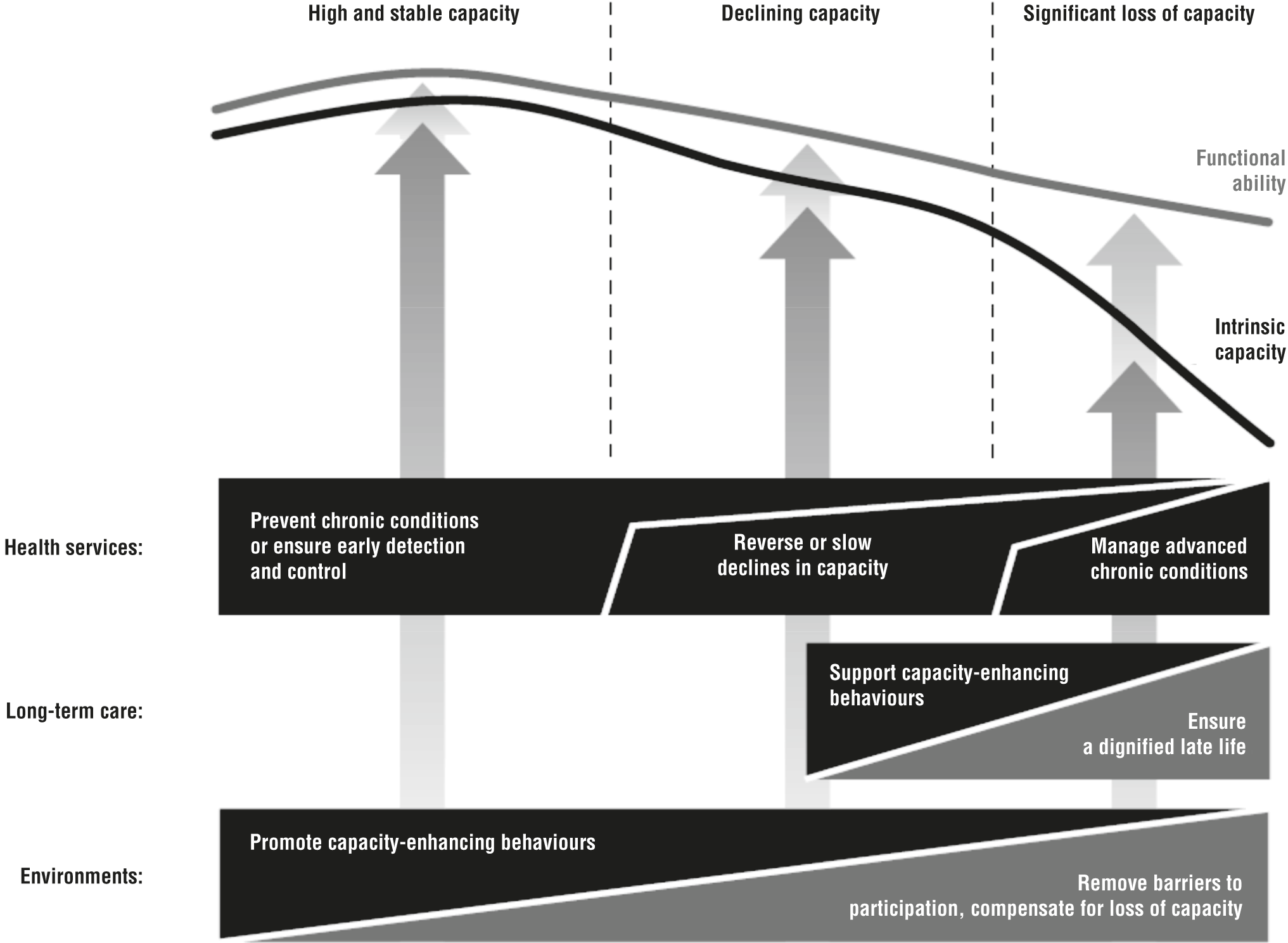
World Health Organization public health framework for healthy aging.