





Abstract
Change is inevitable, progress is not. As we work to lay the foundation for the second century of occupational therapy it is important to explore how our perspective adds distinct value to the people, populations, and communities we serve. Speak up; be heard; be the spark of change.
Amy J. Lamb, OTD, OT/L, FAOTA
Welcome to the second century of occupational therapy! I’m delighted to have all of you here with us in Utah, and I’m so proud to be leading the American Occupational Therapy Association (AOTA) as we continue our journey together. And believe me when I say, we are in this work together.
A lot can happen in a year, and for AOTA a lot has happened. For many of you, the issue of educational requirements for occupational therapists and occupational therapy assistants is on your mind. Believe me, it’s been on mine, and on the minds of all of AOTA’s leadership. It’s challenging us as a profession.
Last month I recorded a short video explaining the AOTA Board of Directors’ position and next steps (AOTA, 2018). In summary, we are engaging in a national dialogue with all of our members, and I encourage you to participate. Bring your points of view, your experiences, what we stand to gain by changing our educational requirements, and what we stand to lose. We want to hear it all so that we can determine whether and how the Board’s position may change.
While we are grappling with how to address this issue, I am reminded of how our association pulls together in times of need. Our colleagues in Texas, Florida, and Puerto Rico were heavily affected by hurricanes in 2017. We paired up academic programs seeking to help with programs affected by the hurricanes. We were able to collaborate with state associations and are still working to support the advocacy efforts of our colleagues in Puerto Rico as they continue to rebuild the most basic elements of their everyday lives. This is a demonstration of the power of community and being part of a larger network: of being part of the AOTA family.
Last year we celebrated our 100th anniversary as a profession. That’s no small thing. As is only natural, we did quite a bit of reflection . . . how we got started, how far we’ve come, the impact we’ve had on people’s lives.
This year, I really want to talk about our future as an organization and as professionals and about the incredible responsibility we have to continue to transform the lives of people, populations, and communities in ways that we have not yet envisioned—emphasis on the word yet there. I’ll come back to that later.
Whether you are just entering the field of occupational therapy or have been doing this for more than 50 years, you hold the power to thrust the profession forward to Vision 2025 (AOTA, 2017a). You hold the power to innovate.
Innovation
Innovation is a word that can excite one person and create anxiety for another. Or maybe it’s a little bit of both. An academic definition of innovation might be the process of implementing new ideas to create value, whether for an individual person, a particular group of people, or an organization (Skillicorn, 2016). If you think any of that applies to what you do as an occupational therapy practitioner, you’re right—this is what we do every day!
It’s important to acknowledge that innovation in and of itself is not the goal. It is the means to an end. We begin by asking questions, exploring possibilities, and taking action. It is how we get from problem to solution for our clients. And it can take a lot of forms.
Take, for example, Reed Hastings’s question, “Why do we have to pay late fees at Blockbuster?” Through his innovation, Netflix was born. Or how about Jack Dorsey, who asked, “Why can only companies accept credit cards?” Jack is the founder of Square, which allows anyone, anywhere, to accept credit card payments with a mobile device. And what about Martin Cooper, who asked, “Why is it that when we want to talk to a person, we have to call a place?” Martin led the team that built the first portable cellular phone and made the first cellular call.
Can you imagine life today without cell phones? Without mobile credit card transactions? Without Netflix?!
The people in the systems that surround occupational therapy are looking to us to innovate in much the same way. Occupational therapy practitioners are in the perfect position to do so because we touch people in real time. We see challenges up close and personal. We have the front-row seat, and we’re using it to do our jobs better. From this vantage point, we are better able than anyone to formulate and ask the key questions that will drive innovation.
Questions allow us to take unresolved tensions in our mind and identify problems and opportunities (Berger, 2014). They give us a platform from which we can challenge assumptions, shift people’s thinking, and serve as a catalyst for meaningful change. Questions without action leave us with philosophy, yet questions combined with action produce innovation.
Interestingly, the evidence suggests that children are best suited for questioning between the ages of 4 and 5. As reading and writing skills continue to grow, we see questioning decline drastically. How can we rekindle the questioning spark we had as children and use it to challenge assumptions and shift our thinking about real problems we see around us?
The Right Question Institute (http://rightquestion.org) has produced a systematic approach to innovative questioning: why, what if, and how. When we encounter a situation that is less than ideal, we ask, “Why?” Then we ask, “What if?” as we begin to come up with ideas for possible improvements or solutions. Then we work to figure out the “How?” taking action on one of the possibilities and trying to implement it.
How do we ask the big and powerful why questions that can be a platform for innovation? We first must step back, then stop doing and knowing in order to start asking. It is in the process of stepping back that we can see the things we may have missed; patterns and relationships between things we thought were separate now can be seen differently. This also gives us the opportunity to challenge our own assumptions and bias to gain a deeper understanding of the situation, question the question itself, and take ownership.
A tool to do this process is called the five whys. Why do I run? Because it’s good for me. Why is it good for me? Because it releases stress and builds fitness. Why is that important? Because I want to be mentally and physically fit. Why do I want to do that? To maintain my ability to function. Why do I want to maintain my ability to function? So I can be independent as long as possible.
Then comes the what of brainstorming. Consider a wide range of new possibilities, and see where your creativity takes you.
Then the rubber meets the road with the how. How is about action—it’s the point at which all things come together, sometimes fall apart, and then come together again, all in the effort to solve the big why we started with in the beginning.
From the inception of our profession, we have been grappling with and indeed mastering the why, what, and how. We have seen practitioners transform empty spaces into centers for healing, and we have used common materials to create adaptations that foster independence and enhance quality of life.
Earlier this year, I had the pleasure of meeting with occupational therapy assistant students at Kapi'olani Community College in Honolulu, and at the end of my visit they gave me a handcrafted tablet holder. They designed it to meet a need in their community. It is functional and more affordable than those purchased in traditional retail outlets. This simple device can be used by a child to support participation in school, it can be used by an adult trying new recipes in the kitchen to support diabetes self-management, or it can be used by an older adult who needs assistance to hold a book or tablet to read for pleasure.
This encounter reminded me of the creativity that has long been a part of occupational therapy practice. As we enter this second century of our profession, taking our occupational therapy lens and creativity to larger population challenges has never been more important. I have every confidence that occupational therapy has value to add as we identify solutions to these challenges.
Limitations as Creative Spark to Innovation
I do think it’s possible that people can confuse a challenge with a limitation. The word limit itself suggests a lack of capacity. But limitations in the context of a challenge can spark the creation of some really beautiful things.
Take artist Phil Hansen. I met Phil last year at the AOTA Annual Conference & Expo, and his ability to turn a perceived limitation into a work of art has stayed with me all year.
Phil was in art school focusing on pointillism. After years of making art with tiny dots, he developed a shake in his hand. Struggling with pain, joint issues, and frustration, he left art school. After a few years, he missed this meaningful occupation and went to see a neurologist, where he learned he had permanent nerve damage.
The doctor’s advice? Embrace the shake.
Phil did just that and began searching for what art he could create given this limitation (Figure 1). He tried creating art with only a dollar’s worth of supplies. He made a masterpiece of Bruce Lee by using karate chops with his hands on a massive canvas. He used a pushpin to tattoo a banana. And my favorite: For one project, he used the grease from hundreds of hamburgers to paint the Mona Lisa. In short, he innovated. Incredible.
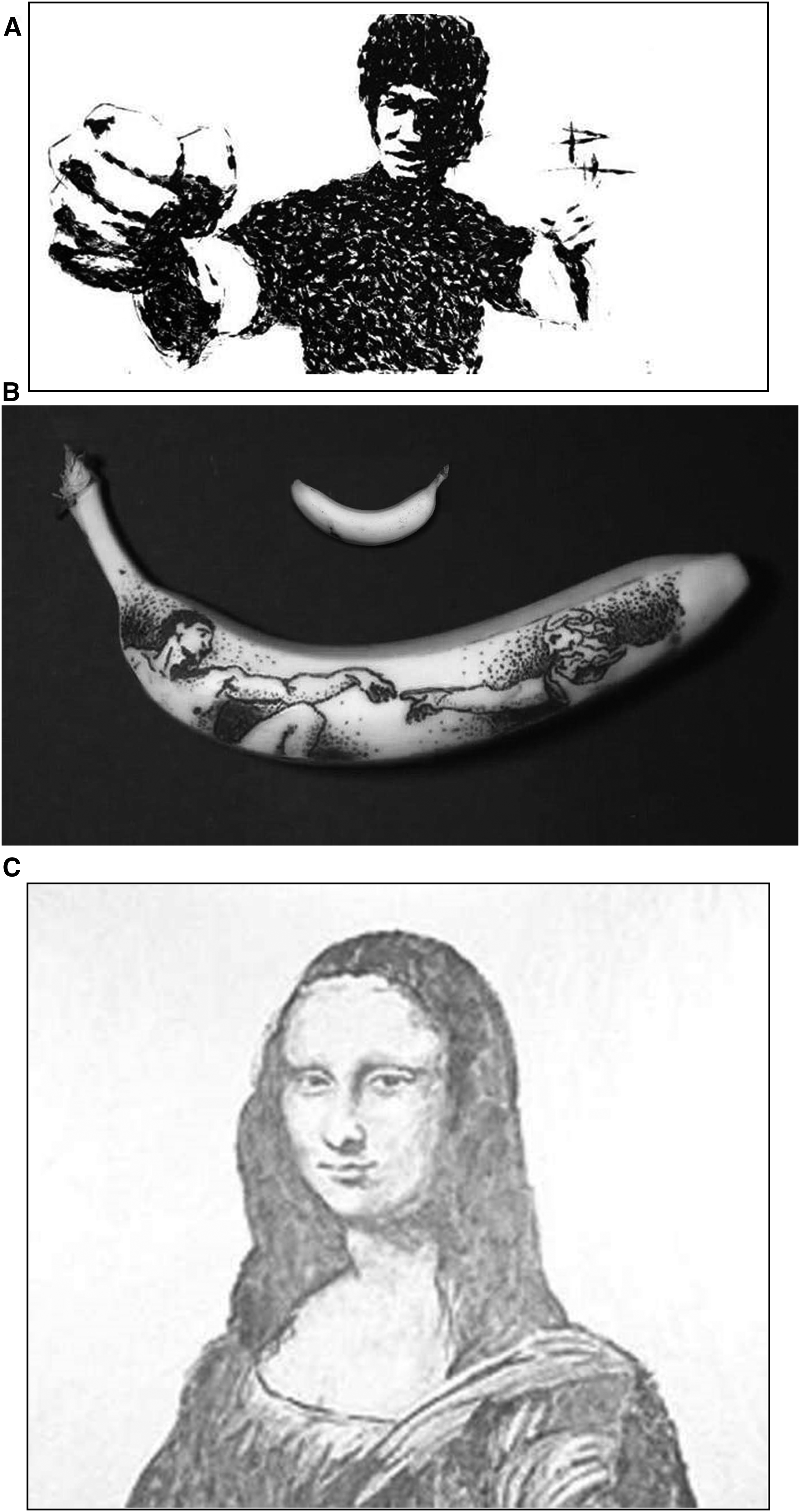
“Embrace the shake”: Examples of art by Phil Hansen. (A) “Bruce Lee”; (B) “Tattoo Banana”; (C) “Mona Lisa.”
Phil spoke eloquently about self-limiting beliefs. In a 2013 TED Talk (Hansen, 2013), he said, “We need to first be limited in order to become limitless.” I love that.
I walked away from the conference not only inspired by Phil’s story but also with a completely different lens through which to observe the profession of occupational therapy. I was eager to share this knowledge with all of you and see how we might be able to flip the script and see our own limitless opportunities.
Let’s talk for a moment about a few self-limiting beliefs that we as occupational therapy professionals might be holding onto. The one perhaps I hear most frequently is that no one knows what occupational therapy is!
We are not alone there. I would say there are many professions that we do not truly understand until we see how what they do can be meaningful to us personally.
I would say we have made great strides in defining our profession, especially in the past 20 years. We have worked really hard to spread the message about the distinct value that occupational therapy brings to clients and organizations. We have made such awareness a key strategy of our overall public relations work.
As a result, we have more legislative champions in federal and state governments than ever before. Organizations are recognizing the value occupational therapy brings to their mission. The number of people who have experienced occupational therapy continues to grow exponentially.
The point here is that we cannot be paralyzed as a profession because not everyone understands us inside and out. Instead, we must find ways to connect our work with their needs and interests. We have to take every opportunity to demonstrate how occupational therapy is a difference maker for clients, organizations, systems, and communities. We matter.
Schools are looking for ways to improve mental health and resilience among all students, and the occupational therapy skill set is a valuable piece of the puzzle. Our communities are looking to support people who want to age in place; the occupational therapy skill set is needed. Health care seeks to be more client centered, reduce the impact of chronic health conditions, and enhance the quality of life of the clients that providers serve. Occupational therapy practitioners know how to make all of this happen.
So when you are at the next neighborhood gathering or your kid’s baseball game and are asked, “What do you do for a living?” paint the picture. Give them these examples . . . tell them how you have solved a problem.
As occupational therapy professionals, we know our work is never quite done. To realize true innovation, we must embrace a growth mindset. So, back to the word yet.
For those of you familiar with psychologist Carol Dweck’s (2007) work on the mindset psychological trait, you know that yet is a powerful word. As a profession, we may not be where we’d like to be, yet. In your daily work, you may not be where you’d like to be, yet. The growth mindset helps us embrace challenges, persist in the face of setbacks, see the effort as part of the path, and learn from failures. Failures are learning opportunities; they become an obstacle only when we keep making the same mistakes over and over.
Perspective is key. By embracing failure as a way to grow, and with persistence in finding a solution, we pave the way for success. Fail fast, fail forward. We may not be where we want to be . . . yet.
As artist Phil Hansen discovered, “Limitations may be the most unlikely of places to harness creativity, but perhaps one of the best way to get ourselves out of ruts, rethink categories, and challenge accepted norms.” And instead of telling each other to seize the day, maybe we can reframe this to live the advice we give to our clients—that it’s OK to stumble. Instead, let’s seize the stumble! Get up and move on. Keep pushing. Try a new tactic. Find a workaround. Be fearless. Innovate.
As you do this in your practice, let AOTA know where you are succeeding and where you are stumbling. We want to learn right along with you.
Designing the Future With Vision 2025
As you know, this year serves as the launching pad for the occupational therapy profession to achieve the societal impact set forth in Vision 2025: “Occupational therapy maximizes health, well-being, and quality of life for all people, populations, and communities through effective solutions that facilitate participation in everyday living” (AOTA, 2017a, p. 1).
As we finalized Vision 2025, I recall reviewing the feedback from members. This vision spoke to frontline practitioners. It was a spark to create new ways of doing and being. It was built on an understanding of how we as occupational therapy professionals think, feel, and see the world. It was conceived by imagining how we as a profession could transform the lives of those we serve by hearing what they desire to achieve and identifying solutions that facilitate its reality. When you understand the people you are trying to reach and design from their perspective, not only do you arrive with unexpected answers, but you can also identify solutions they will embrace.
Vision 2025 is in the inspiration phase. In the words of IDEO.org (2015), an organization seeking to spread human-centered design to social sector practitioners around the world, we are “learning on the fly, opening up to creative possibilities, and trusting that as long as we remain grounded in desires of the people, populations, and communities we serve, our ideas will evolve into the right solutions” (p. 29). We need to observe and interview and do everything possible to understand what our clients’ experience is really like. It is through this exploration that we will identify patterns of behavior and points where clients have a particularly difficult time. This will serve as the fuel for our work on the path to Vision 2025.
As we better understand clients’ experience, we will move into ideation and generate lots of ideas based on what we learn. Some ideas might seem too outrageous to work, but others will have too much potential not to try.
We will refine our ideas, tossing out the bad and building on the good. We can make the ideas tangible by building prototypes, sharing them with the people from whom we’ve learned, and getting their feedback to see whether our solution is on target. This is where I encourage you to remember that failures and missteps are opportunities to learn something new and make it better.
The really exciting part is next: putting our new ideas and solutions to the test. Let’s take a few minutes to see how some of our colleagues are showcasing the power of innovation in their daily work.
Innovation in Action
Debbie Schwind is an occupational therapist with Loudoun County Public Schools (2016) in Northern Virginia. She’s been an occupational therapist for 27 years and has spent about 14 years in the school system. Debbie sees the full continuum in her practice, from early childhood special education to elementary and middle school classrooms to young adult programming offered through the schools.
The unemployment rate for students with special needs who are graduating from high school is very high. The U.S. Department of Labor Statistics states that 83% of those with disabilities are unemployed (National Center for Education Statistics, 2017). So Debbie asked, “What skills do our students need to be successful in life?” Debbie built on community-based instruction, which is an evidence-based practice that her school uses in which students get to apply classroom knowledge to the community. She adapted this model to create a program that allows elementary school students with autism to be valued members of the school community. They perform jobs within the school community that allow them to apply classroom knowledge such as literacy and numeracy skills.
Work is so essential for mental and physical well-being and quality of life, not just for people with disabilities but also for their families. There can be various reasons for the high unemployment rate, but research is showing that work behaviors, social skills, self-determination skills, and a match among skills, interests, and strengths all contribute to increased job performance and satisfaction. These are all areas that can be addressed by occupational therapy! Debbie found a way to innovate (see https://vimeo.com/161837834; Loudon County Public Schools, 2016.).
When we think about our purpose in education, we find that it is really for us to develop opportunities for all of our students to be contributing members of society. It is about meaningful inclusion in the larger community. It is about purpose and relevance and self-worth and personal value. It is about roles and self-identity. It is occupational therapy stepping forward to tackle the tough questions and plan not just for this week or this quarter, but for the future.
Ray Cendejas entered practice 6 years ago after graduating from South Suburban College in Holland, Illinois (AOTA, 2017b). He is an occupational therapy assistant at Alexian Brothers Housing and Health Alliance in Chicago, where he works with people who have been diagnosed with HIV/AIDS and have a history of chronic homelessness. These people also typically have a history of substance abuse as well as mental health needs.
As Ray says, working in community mental health puts him in a position where “occupation is everything” in his daily practice. Ray meets his clients where they are to better understand their experience and identify solutions that will work for them (see https://www.youtube.com/watch?v=QdhBco4cAyU&feature=youtu.be; AOTA, 2017b). Ray sees practitioners shy away from “occupation” in practice and sometimes rely on more rote or preparatory activities. In his words, “We must own who we are and be proud to do so”:
The people we serve put their faith in us to help them get better. If someone receives occupational therapy that doesn’t center around occupation, that is what they leave with as their impression of [occupational therapy]. However, when we honor what their occupations are and provide them with genuine opportunities to practice those skills, they will forever know what occupational therapy is and just how powerful it can be. (AOTA, 2017b)
Stephen Kern is an occupational therapist, a professor of occupational therapy, and director of the master of science program at Thomas Jefferson University (TJU) in Philadelphia. About 9 years ago, Stephen was hearing people in his community talking about the challenges refugees experience. Eight years ago, he approached the Nationalities Services Center (NSC) in Philadelphia and said, “I think you have a need for occupational therapy.”
Stephen’s grandparents were immigrants, which has been a big part of who he is as a person. He had questions about the freedoms that we are allowed as U.S. citizens; as he observed how others live without these freedoms, it pushed him to act. As an occupational therapist, he knew he could do something to help refugee populations.
Stephen began a partnership with the NSC through a class he taught at TJU that focuses on the environment. Using an occupational justice practice framework, Stephen and his students work with individuals and families, some of whom had full lives before being displaced, so they have knowledge of life experience in other parts of the world. Other individuals and families grew up in camps where they were deprived of opportunities to engage in work, play, and leisure. So their experiences with the notion of “occupation” were quite different. NSC prepares and empowers immigrants and refugees in the Philadelphia region to transcend challenging circumstances by providing comprehensive client-centered services to build a solid foundation for a self-sustaining and dignified future.
The average length of time someone is displaced and lacking human rights is 26 years (U.S. Department of State, n.d.). Students learn that making really small changes can be significant and can make each day of those years a little better. Occupation is central to everything Stephen and his team do with this population. One of Stephen’s students spoke of their mission so elegantly. He said,
NSC’s mission statement plainly states its client-centered approach. Yet, that’s the only place you’ll come across that phrase here. Why? When every action, every encounter, no matter how small, aims to help refugees transcend survival and live, describing anything as client-centered would be oddly truistic. At NSC, it’s understood that grand ideals will only be achieved through each successful job search, school enrollment, doctor visit, or friendship. (Burba, 2017, para. 5)
As they move forward with the partnership, Stephen is about to engage his first doctoral residents, who will tackle one of the biggest challenges at NSC. With only language-based outcome measures, observation is the primary way to measure progress against the organization’s goals and objectives. Challenge accepted: Stephen and his team are creating a non–language-based occupational performance assessment tool that would expand the organization’s reach beyond the Philadelphia community to all parts of the United States where occupational therapy practitioners work to support non–English-speaking people live their lives to the fullest. They are taking a problem and creating a solution. They are indeed innovating!
AOTA Support for the Journey
In January, as part of its Member Appreciation Plus Webinars, AOTA launched a series focused on innovation. I invited Sue Bazyk to join me in exploring how to build capacity among the occupational therapy profession and create change leaders in knowledge translation, community building, and innovation (Lamb & Bazyk, 2018).
Sue is an excellent example of how one person can spark much larger change. In 2011, she invited 13 school-based occupational therapists from her area to join her for 6 months to read, reflect, and think about how to apply a public health approach to mental health in schools. Their combined experiences, creative thinking, and knowledge of evidence led to the development of Every Moment Counts (n.d.), a mental health promotion initiative developed to help all children and youth become mentally healthy to succeed in school, at home, and in the community. This group continues to serve as change leaders, developing and implementing model programs, creating tool kits, and educating other occupational therapy practitioners throughout the country. The process for capacity building works. Occupational therapists and occupational therapy assistants are well equipped to be change leaders.
I invite you to watch the webinar recording (Lamb & Bazyk, 2018) and think about what you would like to change in your daily work, then reach out to others and ask them whether they’re interested in joining you. What you may find on the other side of the process, as Sue and her team did, is better outcomes for individuals and organizations as well as increased job satisfaction among practitioners.
In addition, the Member Appreciation Plus Webinar series for 2018 features examples of how your colleagues are seizing the limitations around them to create and implement better solutions. Much like you saw and heard from your peers Debbie, Ray, and Stephen, we have great stories in our field, and I want everyone to know about them. I hope you will be a part of the dialogue as we innovate with occupational therapy to drive our societal impact.
As your professional home, AOTA wants to support and enhance membership experiences that will lead us to Vision 2025. This is our responsibility, our future, and our legacy. We all have an important role to play as we expand our reach and impact in advocating and promoting the distinct value that occupational therapy has to offer.
Call to Action
Our world moves quickly and often does not give us the time and space to question. I ask you to take a few minutes to write out some of the questions you have. As we face the uncertainty that surrounds our practice, classrooms, and research, these questions will help us organize our thinking around what we don’t know and will serve as a light for our path forward. These questions can shift our thinking about what is happening around us and can be a catalyst for change.
As practice environments work to improve quality, enhance system efficiency, and decrease costs, how might occupational therapy have value to add? How might we reduce costly hospital readmissions? How might we improve the client experience in skilled nursing facilities? How might we promote meaningful participation in nursing homes? How might we promote health and wellness among people with chronic conditions? How might we challenge unrealistic productivity standards to promote quality of care for clients? How might we better address the needs of our aging population? How might we design communities that are accessible? How might we design classroom spaces that support all children to learn and engage with peers? How might we promote mental health and resilience in children and youth? How might we facilitate responsible technology use in a world dominated by its presence?
As higher education experiences challenges with rising student loan debt, declining enrollments, modernizing teaching techniques, and managing an antiquated business model—all of which combine to create financial distress in some universities today—the environment is ripe for disruption. How might we need to prepare for Generation Z to enter college? How might we need to change delivery models to meet the needs of incoming students? How might we use technology to enhance programs?
As we work to expand the integration of evidence in occupational therapy practice, we must make sure there is a way in which we can support the development of career scientists and venues to collaborate with practitioners. How might we show the impact of occupational therapy in health care systems? How might we show the impact of occupational therapy in public schools? How might we show the impact of occupational therapy in the communities in which we live?
As your president, I have some questions I’m playing with as well. How might we create an improved member experience? How might we create strategic partnerships that make Vision 2025 a reality? How might we partner with companies like Amazon, JPMorgan Chase, and Berkshire Hathaway as they design a new and improved health care experience (Bomey, 2018; O’Brien, 2018)?
I’ve always loved questions. As Dan Rothstein of the Right Question Institute said so eloquently, questions are flashlights that “shine a light on where you need to go” (as quoted in Berger, 2014, p. 15).
Closing
There is no question, however, that the profession of occupational therapy is powerful and strong. The question is where we will use our power moving forward. Together we will work to innovate around challenges and obstacles to design programs, products, and services that better meet the needs and wants of those we serve.
Ask questions . . . why. Explore possibilities . . . what. Take action . . . how. Fail forward . . . seize the stumble. Design occupational therapy’s future because we are not done . . . yet!