





Abstract
Performance of many activities of daily living and instrumental activities of daily living involve technology, such as an electric toothbrush or a self-checkout register at the grocery store. Unfortunately, more than 60 million people with disabilities in the United States struggle to use these technologies because of inaccessible designs. Occupational therapy practitioners have a unique expertise in the design of accessible equipment. Practitioners have been involved in the design of adaptive and assistive equipment targeting use by people with disabilities since occupational therapy’s beginnings. However, few occupational therapy professionals currently work in the research and development of everyday technologies. This article explores the role of the occupational therapy practitioner on the technology design team, discusses barriers to current practice, and makes recommendations to the profession.
Engaging with technology is a vital component of regular life. A recent survey of adults in the United States found that 68% own a smartphone, 73% own a computer, and 56% own a gaming console (Anderson, 2015). Adults use these technologies to complete their activities of daily living (ADLs) and instrumental activities of daily living (IADLs). Another study of U.S. adults found that 61% bank online, 15% use online dating websites and apps, and 79% use the Internet for job seeking (Fox, 2013; Smith, 2015, 2016). Quantifications of technology use soar when one accounts for technology embedded in the foundation of everyday activities such as using automatic teller and self-checkout machines.
Like most people, people with disabilities use technology to accomplish their ADLs and IADLs. At roughly 19% of the U.S. population, people with disabilities make up one of the largest consumer groups (Brault, 2012). Unfortunately, many people with disabilities find common technological devices riddled with barriers. The Xbox Kinect® (Microsoft, Redmond, WA) gaming console is one example. The Kinect sensor uses a person’s bodily gestures and voice commands to control games and software. Although this mass-produced motion-tracking technology was a substantial innovation in the field of gaming technology, the developers created it based on ableist assumptions. The Kinect identifies people by spotting the user’s “two arms, two legs, and a head” (Microsoft, n.d.). When people lack this number of limbs, such as amputees, or when people cannot make the appropriate gestures, such as those with motor impairments, they are unable to engage with this technology (Barber, 2013; Yuan et al., 2011). Unfortunately, this issue is not specific to one device, brand, or technology; games and websites are often inaccessible to people with disabilities (Harrison et al., 2013; Marinelli & Rogers, 2014; Sullivan & Matson, 2000; Yuan et al., 2011). Subsequently, people with disabilities are less likely than their nondisabled peers to engage with technology, such as a computer (Harris Interactive, 2010).
Occupational therapy practitioners are experts at adapting technologies to the unique abilities of people with disabilities. For example, a practitioner may adapt the tip of an upper extremity prosthesis so that the touch registers on a smartphone screen. As the number of people with disabilities grows and technology is further integrated into daily life, working in a one-on-one model for aftermarket adaptations is unsustainable. To enable the full inclusion of people with disabilities in society, new technological products must be designed to be accessible to all users before entering the market. In this article, we reflect on the role of the occupational therapy practitioner in technology research and development (R&D), discuss the necessity of increased occupational therapy presence on technology development teams, and suggest solutions for increasing the capacity of practitioners in the exponentially growing field of technology.
Occupational Therapy’s Role in Technology Research and Development
Expertise in disability-related design is foundational in the education of occupational therapy practitioners. Practitioners receive training on technology adaptation and development in their entry-level professional education. In the accreditation standards for occupational therapy programs, the Accreditation Council for Occupational Therapy Education (ACOTE®; American Occupational Therapy Association [AOTA], 2012) mandates that practitioners must demonstrate, understand, use, and teach the use of technology:
Standard B.1.8: Demonstrate an understanding of the use of technology to support performance, participation, health and well-being. This technology may include, but is not limited to, electronic documentation systems, distance communication, virtual environments, and telehealth technology. (pp. S34–S35)
Standard B.5.24: Select and teach compensatory strategies, such as use of technology and adaptations to the environment, which support performance, participation, and well-being. (p. S48)
Whereas ACOTE describes the minimal standards, AOTA’s (2016) Assistive Technology and Occupational Performance describes best practice in developing competency for entry-level practitioners, including suggestions regarding the development of new technologies.
The scope of occupational therapy’s role in technology development is described in the profession’s core documents. For example, the Occupational Therapy Practice Framework: Domain and Process (3rd ed.; AOTA, 2014) describes how occupational therapy practitioners facilitate engagement in occupation, including occupations associated with technology. Selected specialized knowledge and skills in technology and environmental interventions for occupational therapy practice include
Evaluate the relationship of materials and different design choices, including advantages, trade-offs, and constraints within complex technology and environmental plants.
Use design and fabrication principles within basic technology and environment applications, including consideration of mechanics and strength of materials, mechanical components, systems, and electrical circuits and components.
Perform product trials, recommend product specifications, order technologies and environmental solutions, and install and train individuals in use, maintenance, and repair.
Participate in the design, fabrication, and customization of basic technology and environmental applications within a defensible level of competence as appropriate to the case and level of expertise required, with referral to advanced expertise as indicated.
Technology Development Challenges for Practitioners
Despite the expertise of occupational therapy practitioners and the need for this expertise on product R&D teams, few occupational therapy practitioners work in technology development. According to the U.S. Patent and Trademark Office (2017), 288,335 new patent applications were made in 2015; however, only 4 of them matched the search term occupational therapy. The lack of occupational therapy expertise in technology development is outlined by four inherent challenges to occupational therapy practitioner involvement in the design and development process for rehabilitation technologies.
First, the general process of bringing technology to the largest markets commonly fails to incorporate the needs of people with disabilities. The existing process is already complex (Figure 1), and many inventors do not intentionally exclude people with disabilities; however, they lack the training to include the needs of this population in their design.
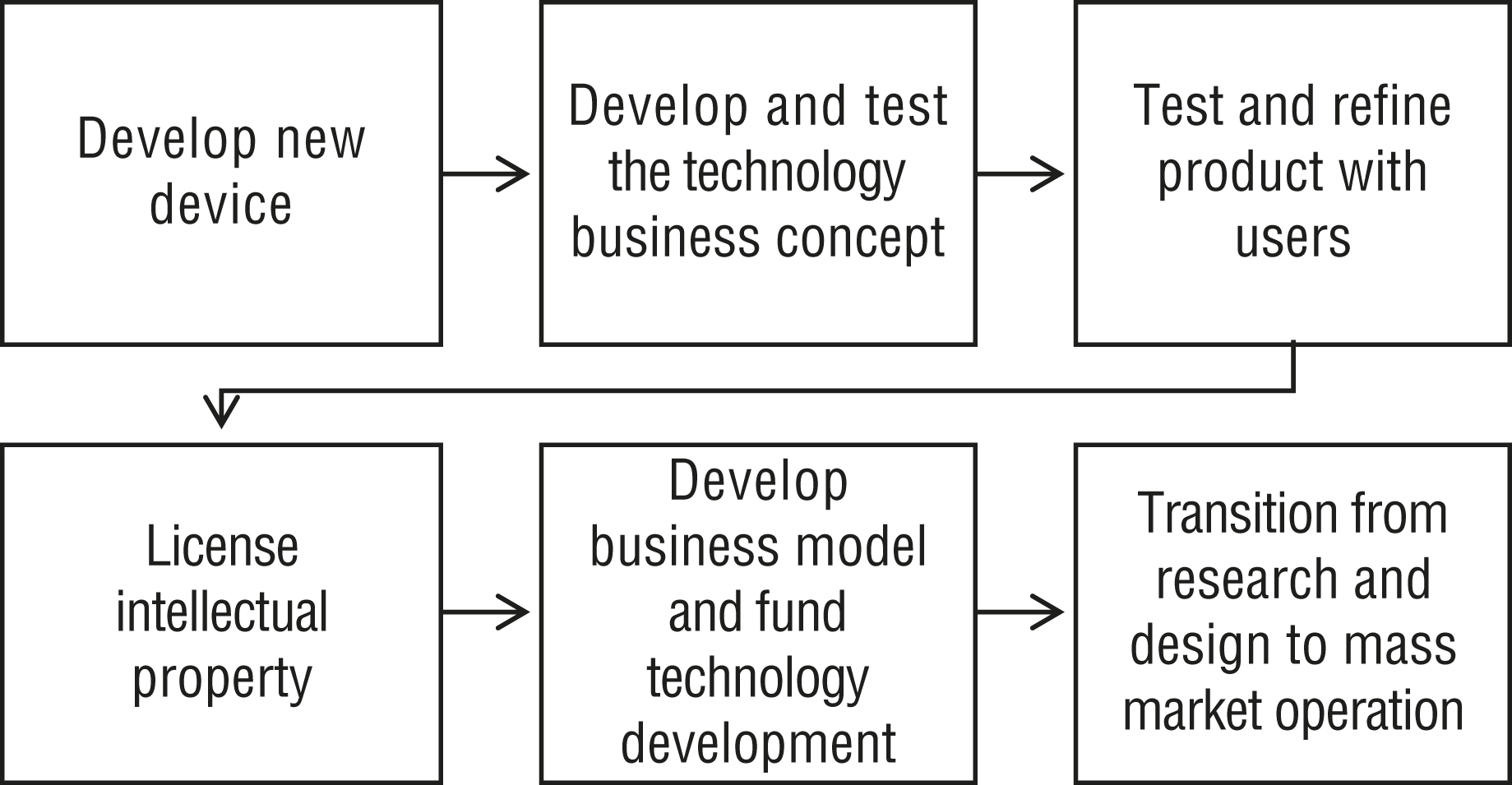
Process of moving a piece of technology through the research and development process.
Second, engineers and computer scientists have their own jargon, similar to occupational therapy practitioners (e.g., ADLs, ROM, FIM™). This language barrier may make it difficult for occupational therapy practitioners to communicate effectively with potential collaborators.
Third, health care professionals approach problems or issues in a holistic manner, seeking to understand all opinions and accounts of the client or caregiver in their natural context before making a decision. Engineers and scientists, through their training, often approach problems by finding the source and developing a very specific solution or hypothesis to be tested in a laboratory context. Both methods have their advantages, and it is likely that a strategy combining both may prove more useful.
Finally, although both engineers and occupational therapy practitioners may approach teamwork with an open mind and a positive attitude, it is common for people to make assumptions about what they do not know. Natural, fluid interactions that should occur among team members are often strained when different worldviews, knowledge bases, and vocabularies collide (Hitch et al., 2012). If care is not taken to ensure adequate training and education among all involved in the R&D process, the end result is a product that is doomed to fail.
Successful Occupational Therapy Involvement in Technology Research and Development
Despite the challenges, several occupational therapy practitioners have designed and developed technologies for decades. Fred Sammons first practiced as an occupational therapist and began building devices to assist the patients he saw in practice. Today, Patterson Medical (Frederick, MD; formerly Sammons Preston) is a multimillion-dollar business providing rehabilitation equipment and assistive technologies to providers and clients. In the academic setting, occupational therapists have actively participated in or directed rehabilitation engineering research centers at schools such as the University of Southern California, University of Florida, University of Alabama–Birmingham, University of Illinois–Chicago, University of Wisconsin–Milwaukee, University at Buffalo, and University of Pittsburgh. As a result of these centers and other grant funding, engineers and occupational therapists have collaborated to develop a variety of assistive technologies.
Several research teams have developed customizable, effective virtual reality–based intervention tools for gait, balance, and upper extremity training (Dukes et al., 2013; Lauterbach et al., 2013; Proffitt & Lange, 2015). At Washington University in St. Louis (2014), a group of engineering students collaborated with health professionals to successfully 3D print a robotic prosthesis for a child amputee. At the University of Wisconsin–Milwaukee, occupational therapists have led the development of mobile apps to measure and document the accessibility of public buildings (Edyburn et al., 2013). Occupational therapists have also developed countless apps with their engineering counterparts, including standardized assessments, such as Dexteria (Binary Labs, 2014) and the Standardized Touchscreen Assessment of Cognition (Cognitive Innovations, 2013); apps to support clinicians and students, such as TherapyWhiz (Addison, 2016b), TherapyGuide (Addison, 2016a), and NeuroWhiz (Addison, 2015); and intervention approaches, such as the SnapType handwriting intervention (SnapType, 2016).
Implications for Occupational Therapy Practice
Given the background, development challenges, and success stories, we provide three recommendations for occupational therapy practice. These recommendations are for all levels and practice settings, including academia and administration. Students are also encouraged to note and help implement these recommendations, to the extent possible, during didactic coursework and fieldwork.
Contribute to Research and Development in Disability-Related Technology Design
Including end users in the process of technology product design has been a designer keystone for decades. Unfortunately, people with disabilities are often omitted from the design formula (Monk et al., 1992). Several existing design frameworks and methodologies are conducive to including disability perspectives (Figure 2). Iterative design is a methodology for developing a product or process. It ensures that the final product (or process) is not released until identified issues are at a minimal acceptable level. User-centered design (Norman & Draper, 1986), in most of its forms, uses iterative design to ensure that the needs of the end user are incorporated frequently in the design and testing process and that this process is repeated a sufficient number of times.
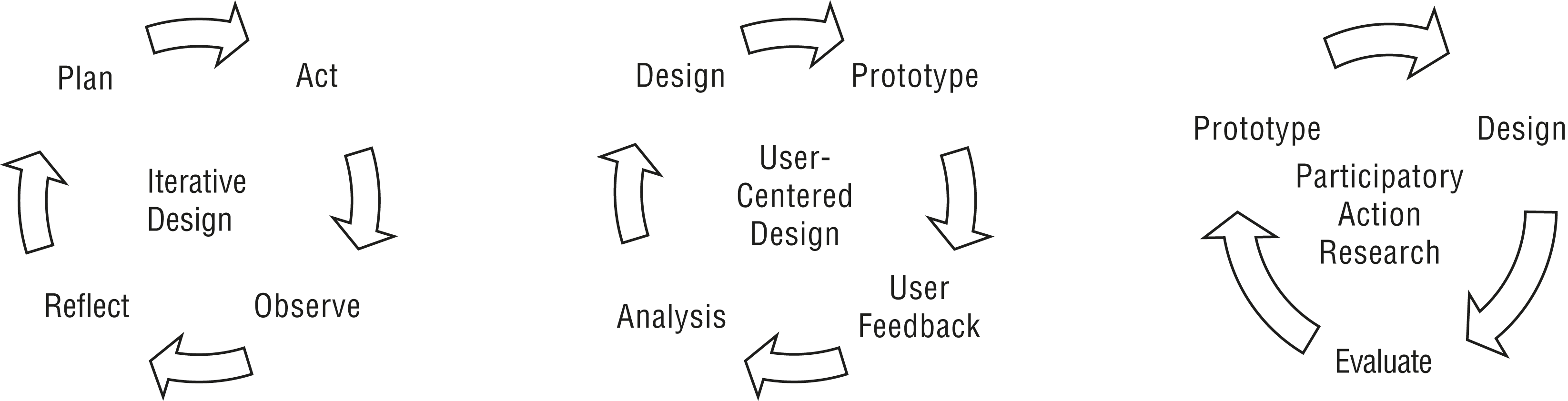
Three design methodologies and frameworks that include disability perspectives. L to R: basic iterative design methodology, user-centered design, and basic participatory action research approach.
Although user-centered design incorporates the end user into the process, to obtain more in-depth involvement by people with disabilities and occupational therapy practitioners, participatory action research is a feasible and comprehensive approach (Letts, 2003). It is grounded in the experience of the participants (in this case, people with disabilities) and is a collaborative research approach. Last, the universal design approach is the most inclusive of all people with disabilities and has an obvious role for occupational therapy practitioners (Smith, 2002; Steinfeld & Smith, 2012). Unlike the other approaches, which require expert users that represent disability, universal design requires the expertise of professionals who understand all types of impairments and how they present across functional tasks.
Stimulate Professional Development With a Technology Focus
Students are shaped by professional educational programs. Faculty, administrators, and clinical instructors should provide students with opportunities for interprofessional education and collaboration with their engineering and design peers. This approach provides students with chances to develop respect for other professions and assists them in developing good working relationships with those in a field divergent from their own. Hitch and colleagues (2012) noted that exposing occupational therapy students and architectural design students to each other’s professions at the undergraduate level enhanced long-term communication and collaboration in universal design in the community.
Provide Administrative Leadership to Support the Role of Occupational Therapy in Technology Research and Development
Technology is growing rapidly within rehabilitation and beyond. For example, Appy Hour, sponsored by the Technology Special Interest Section of AOTA, is now a fixture at the Annual AOTA Conference, drawing a crowd of more than 500 attendees. The Rehabilitation Engineering and Assistive Technology Society of North America serves the occupational therapy community with an active professional specialty group. Although these groups provide an opportunity for practitioners and researchers to convene and discuss technology, they do not strategically advance or formalize the role of occupational therapy in technology R&D. To do so requires occupational therapy leaders, that is, academic program directors, principal investigators, and clinical administrators, to encourage and facilitate their occupational therapy staff and team members to participate in technology R&D. Practitioners need to learn about the R&D process; actively and assertively offer their involvement across each of the R&D phases; and participate on teams as inventors, formal product evaluators, and consultants. Technology design teams that include occupational therapy practitioners will be of benefit to people with disabilities and society as a whole.
Conclusion
To achieve full inclusion of people with disabilities in society, all technology must be accessible and usable to people regardless of their abilities. Although new developments in technology, such as the Internet of Things, create new opportunities for people with disabilities, they also create an increased risk that everyday technologies, such as a refrigerator, will become both more technologically complex and less accessible.
Unfortunately, the current process for technology development often fails to be sensitive to the unique abilities of special populations. Neglecting the 19% of Americans with disabilities in technology development is not only ethically wrong but also makes poor financial sense. Subsequently, it is no longer sufficient for occupational therapy practitioners solely to assess, adapt, provide, and train people on assistive technology devices. The profession of occupational therapy is a valuable partner to technology developers because practitioners can ensure accessibility of devices during the development process. Supports such as inclusive design methodologies, preprofessional training, and administrative supports can enable occupational therapy practitioners to bring their distinct value to the technology development team.