





Abstract
Bowel management (bowel control, managing toileting materials and clothing, defecating in the toilet, and cleaning up afterward) is an important activity of daily living (ADL; American Occupational Therapy Association, 2014). Atypical defecation habits in children are complex and often the result of an interaction of physiological, social, and behavioral processes (Freeman et al., 2014). In many cases, no known organic cause or underlying factor can be identified, and the defecation disorder is considered functional (Tabbers et al., 2014). Childhood functional defecation concerns have a high prevalence worldwide (0.7%–29%; Mugie et al., 2011; van den Berg et al., 2006) and are considered a public health problem (Rajindrajith et al., 2016). Irrespective of cause, defecation disorders can have a significant impact on child and family participation and quality of life.
At present, approaches to identification of factors involved in the emergence of functional defecation disorders are inconsistent. An extensive body of research exists describing a range of medical and behavioral interventions (Pijpers et al., 2010; Tabbers et al., 2014; van Ginkel et al., 2003). Medical interventions range from increasing fiber or fluids and adding pre- and probiotics to the diet to anal dilation and surgical disimpaction (see Tabbers et al., 2011, 2014). Behavioral interventions include approaches such as biofeedback, parent education, reward systems, and psychotherapy (Pijpers et al., 2010; van Dijk et al., 2007). Unfortunately, treatment efficacy remains limited. Sound comprehension of all factors involved in the emergence of the disorder along with greater understanding of salient treatment elements are needed to optimize treatment outcomes (Freeman et al., 2014; Galos et al., 2015).
Occupational therapy practitioners offer a unique perspective on ADLs that can be of use in understanding and treating functional defecation concerns. For example, identifying and treating underlying sensory concerns that may affect the development of healthy toileting habits or adapting the toileting environment to better fit the child’s ability may be useful. A recent systematic review focused on defecation-specific behaviors (Beaudry-Bellefeuille et al., 2017) and identified an array of common behaviors associated with these issues. Some of these defecation-specific behaviors reflect both sensory reactivity and perception concerns.
Both sensory reactivity and sensory perception are components of sensory integration, as defined by Ayres (1972), and serve as a foundation for participation in daily life tasks. Ayres identified sensory reactivity disorders, using terms such as sensory defensiveness and hyper-responsivity, to reflect behavioral discomfort with sensation and a desire to escape (Ayres, 1964; Ayres & Tickle, 1980). Ayres (1966) defined sensory perception as the organization and interpretation of sensory input and indicated that it is often followed by a motor act.
Sensory integration concerns related to defecation include responses such as expressing pain with defecation even when stool size and consistency are normal, being fearful of the sound associated with toilet flushing, resisting wiping after a bowel movement because it feels painful to the skin (indicators of sensory hyperreactivity), and being unaware of the need to defecate (indicators of sensory hyporeactivity, poor sensory perception, or both). Although it has been documented that children with and without medical and behavioral diagnoses can demonstrate problems with sensory reactivity and perception (Baranek et al., 2002; Ben-Sasson et al., 2007; Lane et al., 2012; Rogers et al., 2003; Roley et al., 2015), the interface between these sensory issues and bowel management issues has not been sufficiently investigated.
The limited research available has provided some insight into the link between sensory reactivity and perception and elimination disorders or gastrointestinal issues. Pollock et al. (2014) studied the prevalence of sensory reactivity issues in children with dysfunctional elimination syndrome (DES). DES includes a variety of urinary and bowel elimination difficulties (Nevéus et al., 2006). The study revealed that 52.6% of participants with DES (n = 19) had sensory reactivity issues based on Short Sensory Profile (SSP; McIntosh et al., 1999) scores, compared with 7.3% of the control group (n = 55). Although the types of reactivity issues were not specified, sensory hyperreactivity is discussed in relation to acceptance of the toileting environment and sensory hyporeactivity in relation to the awareness of the need to void.
Cupelli and colleagues (2014) found that 44% of a group of children with urinary incontinence (UI; n = 209) had either probable or definite differences in sensory reactivity, based on SSP scores. In particular, tactile and auditory sensitivity and sensory underresponsiveness and sensory seeking were strongly related to UI. The fact that 28% of the children in this sample also had constipation supports the existence of sensory reactivity difficulties for this subgroup of children. Other investigations have indicated that children with autism spectrum disorder (ASD) and attention deficit hyperactivity disorder (ADHD) experience more defecation and sensory reactivity issues than typically developing peers (Ben-Sasson et al., 2009; Johnston & Wright, 1993; Lane et al., 2010; McElhanon et al., 2014; McKeown et al., 2013). Extending these findings to children with ASD, Mazurek et al. (2013) indicated that children with any type of gastrointestinal problem had higher levels of sensory hyperreactivity than children without such problems.
There is a general consensus that pain, avoidance, and withdrawal from sensations and sensory-laden activities are common symptoms of sensory hyperreactivity (Dunn, 2014; Schaaf & Lane, 2015). Several authors have described similar behaviors in children with functional defecation issues in relation to toileting and bowel movements (Bellman, 1966; Blum et al., 2004; Loening-Baucke, 2005; Schmitt, 1991; Taubman, 1997; Taubman et al., 2003; Taubman & Buzby, 1997; Vitito, 2000). A clear relationship between the avoidance of bowel toileting and sensory hyperreactivity has yet to be made; however, some preliminary reports support this hypothesis (Beaudry-Bellefeuille & Lane, 2017; Beaudry-Bellefeuille & Ramos-Polo, 2011; Beaudry-Bellefeuille et al., 2013).
The literature suggests that sensory reactivity issues may be related to functional defecation disorders characterized by problems participating in healthy toileting routines. Available studies lay a foundation for further investigation of the relationship between sensory integration and issues with defecation in children with and without medical or behavioral diagnoses. Preliminary reports describe hyperreactivity to touch, smell, and sound as possible factors interfering with acceptance of aspects of toileting and bowel management such as sitting on the toilet, wiping, hearing the toilet flush, or smelling one’s feces (Beaudry-Bellefeuille & Ramos-Polo, 2011; Beaudry-Bellefeuille et al., 2013; Handley-More et al., 2009). However, a comprehensive review of sensory-based defecation behaviors is lacking, and defecation-specific behaviors that reflect concerns about sensory reactivity and perception are not well delineated.
This study examined the literature to identify reports of sensory integration concerns in children with functional defecation issues. It also explored whether sensory reactivity and perception difficulties may be related to the challenging bowel management behaviors of children with functional defecation issues.
Method
A scoping review was identified as the most appropriate approach to address the research question because prior synthesis of this literature is limited. We followed the scoping review guidelines proposed by Arksey and O’Malley (2005):
Identify the research question
Identify and select relevant studies
Chart pertinent data
Analyze, summarize, and report findings on the chosen topic.
Consultation with stakeholders is considered essential by more recent researchers (e.g., Levac et al., 2010) and was also included.
Identify the Research Question
We identified the following research question: In children with functional constipation, functional fecal incontinence, or stool toileting refusal, which challenging behaviors potentially related to sensory reactivity and perception issues are identified?
Identify and Select Relevant Studies
We searched CINAHL, EMBASE, PsycINFO, MEDLINE, Cochrane Library, and SCOPUS to retrieve relevant articles. Key terms included sensory responsiveness, sensory integration, sensory processing, sensitivity, sensitiv*, sensitiv?, sensory, constipation, faecal incontinence, faecal incontinence, elimination disorder*, dysfunctional elimination syndrome, encopresis, toileting, stool toileting refusal, soiling, and defecation. The search strategy and the chosen keywords were reviewed by all of the authors and by an experienced librarian. Reference lists of included studies and additional studies identified through discussion with content experts were reviewed and assessed for relevance. A PRISMA (Preferred Reporting Items for Systematic Reviews and Meta-Analyses) flowchart (Liberati et al., 2009) of the search is shown in Figure 1.
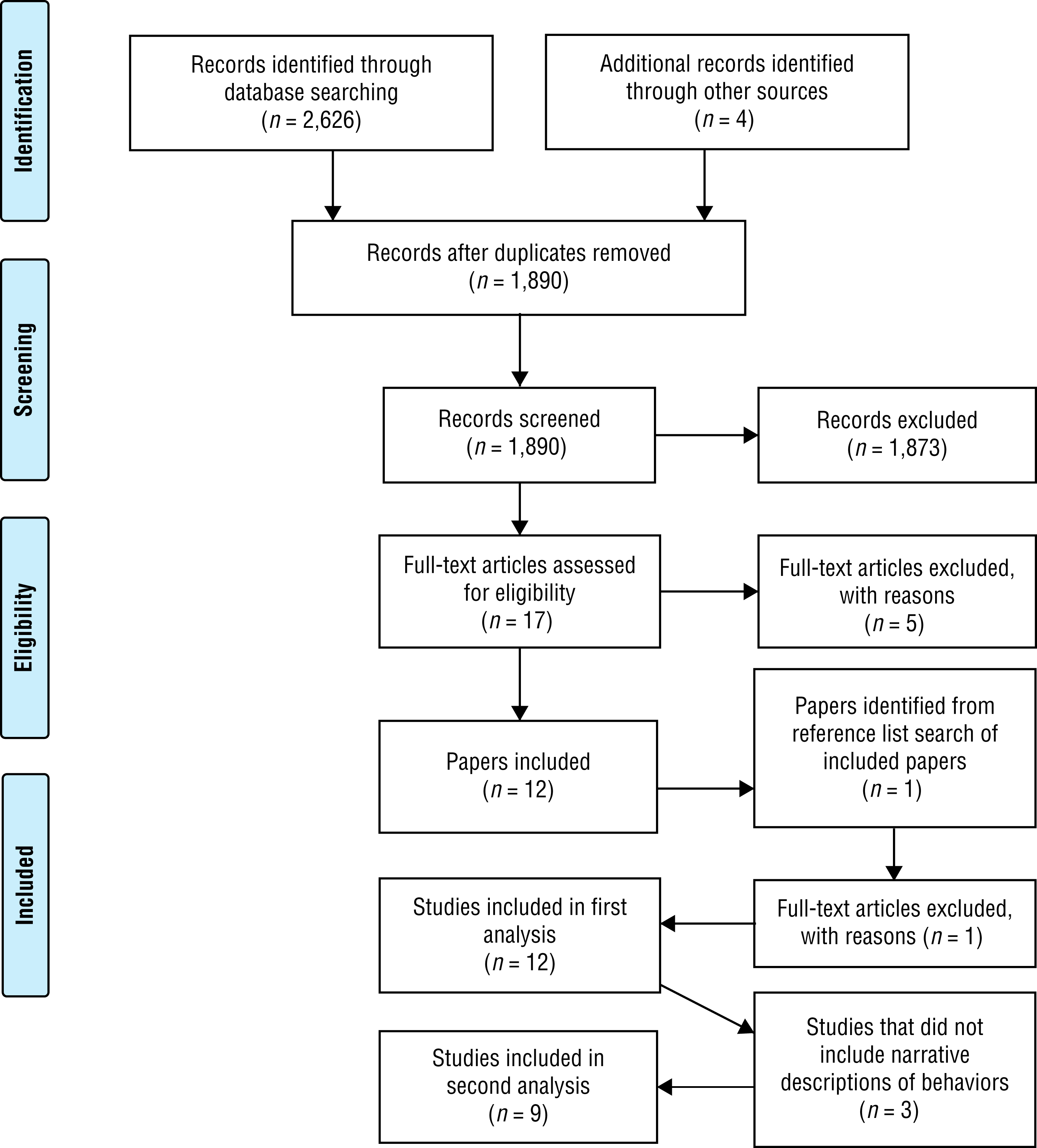
PRISMA (Preferred Reporting Items for Systematic Reviews and Meta-Analyses) flowchart of the search.
The review was limited to studies of children (0–18 yr) diagnosed with functional defecation issues (constipation, fecal incontinence, stool toileting refusal) and written in English, Spanish, or French with an English abstract. Studies with children with autism, ADHD, or both were included because of the high incidence of defecation concerns in these populations. Given that no prior review of this type had been conducted, we included all articles since the inception date of each database through November 2016. Only studies that described sensory reactivity or perception, documented with behavioral measures, in children with functional defecation issues were retained. Studies that focused on other types of elimination or gastrointestinal issues or documented sensory perception using exclusively technical diagnostic procedures (e.g., anorectal manometry) were not included. Original published and unpublished research at all levels of evidence was included. Expert opinion and reviews were excluded.
Chart Data
The first author (IBB) performed the initial comprehensive literature search and filtered for duplicates. Afterward, IBB and a research assistant screened study titles and abstracts for inclusion, retaining all articles considered grossly relevant. Retained abstracts were independently considered by IBB, SJL, and AEL. Disagreements were resolved after retrieving and reviewing the full text of each article and discussing the article until consensus was reached. All three authors kept a log of all reviewed abstracts with reasons for inclusion or exclusion of studies. A full-text review was conducted by IBB to determine final inclusion. A data extraction table was used to organize the information extracted from each selected study (Table 1).
Data Extraction Table
Note. ADHD = attention deficit hyperactivity disorder; ASD = autism spectrum disorder; DES = dysfunctional elimination syndrome; M = mean; SD = standard deviation.
Analysis
The analysis included identifying sensory reactivity and perception concerns in children with functional defecation issues and identifying challenging behaviors potentially related to sensory reactivity and perception issues. For the former, studies were classified according to three types of sensory issues reported: (1) sensory hyperreactivity, (2) sensory hyporeactivity or poor perception, and (3) unspecified atypical sensory reactivity or combined sensory issues. Grouping hyporeactivity and poor perception together was done because they can be difficult to distinguish, and there is no consensus on how to clearly separate these issues based exclusively on descriptions of behavior. Reactivity is assessed mostly with self-reports or proxy reports of behavioral responses to sensation; however, use of standardized testing, specialized techniques, or both is needed to assess perception (Schaaf & Lane, 2015). The third group was created after a preliminary review identified studies that reported reactivity issues without specifying hyper- or hyporeactivity or that reported a combination of sensory issues.
To identify challenging behaviors potentially related to sensory reactivity and perception issues, we used conventional content analysis (Hsieh & Shannon, 2005). This approach makes it possible to excerpt words into content-specific categories and enabled us to categorize behaviors according to an initial coding scheme. PDF files of all included studies were imported into NVivo® (Melbourne, Australia) to facilitate analysis and compilation of narrative descriptions of challenging behaviors.
Ayres Sensory Integration® (ASI) theory served as the theoretical framework for this study and was used to determine the initial coding scheme. Within this framework, problematic behaviors related to the sensory aspects of daily occupations are considered possible manifestations of sensory reactivity and perception difficulties (Ayres, 1964; Ayres & Tickle, 1980; Parham et al., 2007; Schaaf & Lane, 2015). Hence, challenging defecation-related behaviors potentially reflecting sensory issues were coded in accordance to two predetermined categories: (1) sensory hyperreactivity (avoiding, withdrawing, feeling pain, or experiencing negative emotional reactions to sensory stimuli), expressing dislike or repulsion toward sensory stimuli, and following rituals in personal hygiene (Dunn, 2014; Schaaf & Lane, 2015) and (2) sensory hyporeactivity or poor perception (difficulties perceiving and interpreting the qualities of sensory information) and diminished awareness or lack of reaction to sensory stimuli (Schaaf & Lane, 2015). The coding was done by IBB and independently verified by SJL. Challenging behaviors not related to sensory reactivity and perception were not coded.
Validating Findings With a Stakeholder Group
A summary of findings and identified behaviors were presented to 11 parents of children with functional defecation disorders. Two parents had a child with autism. All children had sensory reactivity issues that had been identified by means of a standardized questionnaire. Six parents had a child with stool toileting refusal, four with constipation, and one with fecal incontinence.
During a private audio-recorded meeting, parents were asked to read the summary and consider the identified behaviors. Then, they were asked to answer the following questions: Have you ever observed in your child something that is not mentioned in this review? Do you think these terms/phrases correctly describe sensory characteristics of children with defecation issues?
Results
A total of 12 articles published between 1998 and 2016 were included in the final synthesis of the search (see Figure 1). Details concerning the included publications can be found in Table 1.
Identifying Sensory Reactivity and Perception Concerns
The articles identifying sensory reactivity and perception concerns fell into all three identified categories: (1) sensory hyperreactivity, (2) sensory hyporeactivity or poor perception, and (3) unspecified atypical sensory reactivity or combined sensory issues. Most articles (i.e. Beaudry-Bellefeuille & Lane, 2017; Beaudry-Bellefeuille & Ramos-Polo, 2011; Beaudry-Bellefeuille et al., 2013; Mazurek et al., 2013; Radford & Anderson, 2003; Stadtler & Burke, 1998) identified sensory hyperreactivity as a concern. Others (i.e., Beaudry-Bellefeuille & Ramos-Polo, 2011; Firestone Baum et al., 2013; Foo et al., 2015, 2016) identified sensory hyporeactivity or perception concerns. Three articles (i.e., Cupelli et al., 2014; Pollock et al., 2014; Silva et al., 2007) discussed unspecified atypical sensory reactivity or combined sensory issues.
Identifying Challenging Behaviors
Of the 12 articles included in the final selection, 3 (i.e., Cupelli et al., 2014; Mazurek et al., 2013; Silva et al., 2007) did not include narrative descriptions of challenging defecation behaviors. By repeated reading of the 9 remaining articles, IBB grouped together narrative descriptions of children’s behaviors based on common content into two categories (hyperreactivity and hyporeactivity/perception concerns).
Through discussion between IBB and SJL, classification was refined to accurately capture the behaviors described and their potential relationship to sensory reactivity and perception. This process yielded 15 challenging defecation-related behaviors; defecation-related manifestations of pain was the most common. Other common behaviors with a potential relationship to sensory hyperreactivity included adopting a retentive posture until the urge to defecate subsides and asking for a diaper to avoid defecation in the toilet. All can have a significant impact on participating in age-appropriate toileting routines. A complete list of the behaviors, their potential relationship to sensory concerns, and the number of studies identified that addressed these behaviors are presented in Table 2 (for more details, see Table 1).
Challenging Defecation-Related Behaviors Potentially Related to Sensory Reactivity and Perception Issues
Note. Hyper = sensory hyperreactivity; Hypo/P = sensory hyporeactivity, perception issues, or both.
Review by Parent Stakeholder Group
All parents interviewed reported that they had observed in their child several of the listed behaviors. In response to the first question (Have you ever observed in your child something that is not mentioned in this review?), some additional behaviors were identified (Table 3). In response to a second question (Do you think these terms/phrases correctly describe sensory characteristics of children with defecation issues?), parents unanimously responded “yes.” All agreed with the relevancy of the findings and their relationship to sensory reactivity and perception. No behaviors on our list were deemed irrelevant.
Additional Behaviors Identified by Parents
Concomitant Diagnosis of ADHD or ASD
Among the articles retained for the review, no studies were identified that included children with ADHD, whereas 4 included children with ASD (i.e., Mazurek et al., 2013; Radford & Anderson, 2003; Silva et al., 2007; Stadtler & Burke, 1998). Only 2 of these articles (i.e., Radford & Anderson, 2003; Stadtler & Burke, 1998), both case studies, documented behaviors that could be related to sensory responsivity issues such as fear of sitting on the potty or insisting on being given a diaper to defecate. The behaviors mentioned in these case studies were not unique to their diagnostic group.
Discussion
To our knowledge, this is the first review to examine the reported coexistence between sensory reactivity and perception and functional defecation concerns. The key findings of this review are twofold. First, through the identification of 12 articles that reported sensory concerns in children with functional defection issues, we have mapped an area of study that had not previously been assessed. Second, we have identified 15 behaviors that reflect the coexistence of sensory reactivity and perception concerns with functional defecation disorders in children. Together, these findings set the stage for further research better defining functional defecation concerns and examining the impact of sensory issues on the acquisition of healthy and age-appropriate defecation habits.
Sensory reactivity and perception concerns as a manifestation of functional defecation disorders are a relatively recent area of study. The constructs of sensory perception and reactivity, including hyper- and hyporeactivity, are well established within the ASI framework (Ayres, 1964; Ayres & Tickle, 1980; Lane et al., 2010; Mailloux et al., 2011; Parham et al., 2007; Schaaf et al., 2014; Su & Parham, 2014). Similarly, functional defecation concerns in children have been extensively characterized by the medical and mental health fields (American Psychiatric Association, 2013; Drossman & Hasler, 2016; Tabbers et al., 2014). However, besides the publication of a few case studies (i.e., Beaudry-Bellefeuille et al., 2013; Radford & Anderson, 2003; Stadtler & Burke, 1998) and program evaluations (i.e., Beaudry-Bellefeuille & Ramos-Polo, 2011; Silva et al., 2007), only recently has the relationship between sensory issues and elimination concerns been formally jointly considered (Beaudry-Bellefeuille & Lane, 2017; Cupelli et al., 2014; Foo et al., 2016; Mazurek et al., 2013; Pollock et al., 2014). Given that occupational participation can be affected by sensory concerns and that many children with functional defecation issues struggle with participation in healthy and socially appropriate bowel management routines, clearly identifying the sensory issues related to defecation disorders is of utmost importance to guide the assessment and intervention process of occupational therapy practitioners working with this population.
Our second key finding is the identification of 15 behaviors associated with functional defecation issues and sensory concerns. These behaviors reflect the literature and have been added to and vetted by parent “experts,” all with children experiencing bowel management concerns. Because these behaviors are specific to bowel management, they add depth to the growing understanding of emotional and behavioral reactions to the sensory aspects of daily occupations. In addition, they enhance the understanding of the impact that issues with sensory reactivity and perception can have on childhood participation.
Beaudry-Bellefeuille et al. (2016) substantiated the relationship between defecation-related behaviors and sensory reactivity using a small panel of experts and a newly developed tool, the Toileting Habit Profile Questionnaire. Experts indicated that behaviors such as refusing to sit on the potty to defecate and refusing to use the toilet outside of the home reflected both defecation-related and sensory reactivity–related concerns. The current study identifies additional indicators of atypical sensory reactivity and perception for children with bowel management concerns and provides a more substantive foundation for assessment and intervention.
Implications for Occupational Therapy Practice
Findings suggest that occupational therapy practitioners familiar with assessment and treatment of sensory reactivity and perception concerns should consider becoming part of the interdisciplinary teams assessing and treating children with functional defecation issues. Implications for occupational therapy practice include
Understanding of childhood functional defecation issues may be augmented by considering sensory reactivity and perception.
Sensory reactivity and perception concerns affect many daily occupations. Toileting and bowel management concerns should be included in the assessment process when sensory reactivity and perception concerns are identified.
The identified behaviors add to the understanding of emotional and behavioral reactions to the sensory aspects of daily occupations.
Conclusion
This review summarizes research using behavioral measures to document sensory reactivity and perception concerns in children with functional defecation issues, providing researchers and clinicians with an overview of the current state of understanding. We have substantiated that the concerns are jointly identified and addressed in some investigations and that behaviors identified in the literature reflect those observed by parents. These findings summon reflection from several perspectives.
Health practitioners working with children with defecation concerns do not usually consider sensory issues as potentially contributing to the overall difficulties of the child; therefore, routine screening for these issues seems reasonable. Additionally, the behaviors identified in this review could represent additional manifestations of atypical sensory reactivity and perception to be considered in all children undergoing assessment for sensory or bowel management concerns. Current tools used to assess sensory responsivity consider reactions to sensation in the context of a variety of ADLs but not usually reactions to sensory input during bowel management.
In summary, although it is encouraging to see some research emerging in this area, this review emphasizes the need for further studies that will support a greater understanding of the relationship between sensory concerns and functional defecation issues. This understanding should lead to more insight into this frequent childhood disorder and contribute to more effective treatment programs.
Supplemental Material
Supplementary material for Sensory Integration Concerns in Children With Functional Defecation Disorders: A Scoping Review
Supplementary material, sj-pdf-1-aot-10.5014_ajot.2019.030387.pdf for Sensory Integration Concerns in Children With Functional Defecation Disorders: A Scoping Review by Isabelle Beaudry-Bellefeuille, Shelly J. Lane and Alison E. Lane in The American Journal of Occupational Therapy
Footnotes
Acknowledgments
Many thanks to all the parents who kindly participated in this study and to Sandra Scholte for her help in screening abstracts.
*
Indicates article included in the scoping review.
References
Supplementary Material
Please find the following supplemental material available below.
For Open Access articles published under a Creative Commons License, all supplemental material carries the same license as the article it is associated with.
For non-Open Access articles published, all supplemental material carries a non-exclusive license, and permission requests for re-use of supplemental material or any part of supplemental material shall be sent directly to the copyright owner as specified in the copyright notice associated with the article.
