





Abstract
What is an occupation? “Occupations are all the things I need to do, like doing homework, going to school or taking a dancing class. Some occupations are pleasant, and some are not. When my mother asks me to organize my backpack, I don’t like it, but I must do it. There are also good occupations, such as playing with my Sony PlayStation®, which calms me down.”—Rachel, an 8-yr-old girl
What are the most important occupations to you? “To learn, to be smart and successful in life. To meet people and play, not to be bored and lonely. To sleep, we cannot live without sleeping.”—Dan, a 10-yr-old boy
Participation in everyday activities and occupations promotes development, health, and subjective well-being. This core assumption within the literature of occupational therapy as a health profession and as an academic discipline (American Occupational Therapy Association [AOTA], 2014) has been qualitatively and quantitatively studied among adults with various health statuses (e.g., Eakman et al., 2010; Eklund & Leufstadius, 2007; Erlandsson et al., 2011). Yet, the way in which this process occurs among children still needs to be explored.
Scholars have suggested that the subjective meaning people attach to their occupations may explain how participation, health, and well-being are associated. Meaningful occupations are those that are preferably self-initiated as well as important to and valued by the person (Fossey et al., 2016). Self-reward value is related to a sense of enjoyment that arises while performing an activity (Erlandsson et al., 2011). The meaning attached to an occupation also depends on achieving a sense of control, arising from choice and autonomy (Hammell, 2004; Poulsen et al., 2006), and on balancing between the challenges and demands and the person’s skills (Csikszentmihalyi, 1997; Jonsson & Persson, 2006). Moreover, engaging in a meaningful occupation may be characterized by an altered sense of time (Emerson, 1998).
Among adults, occupational values and perceived meaning are elicited through interviews or self-report questionnaires. For example, Erlandsson et al. (2011) developed the Occupational Value Assessment With Predefined Items, a structured questionnaire for occupational values. The questionnaire revealed correlations between occupational values and subjective health among working adults. Eakman et al. (2010) developed the Meaningful Activity Participation Assessment to assess the frequency of participation and meaningfulness experienced during activities. They found correlations between perceived meaning and health-related quality of life among older adults.
To date, the perceived meaning of occupation among children has mostly been studied through qualitative studies (Chapparo & Hooper, 2002, 2005; Howard, 2002; Miller & Kuhaneck, 2008). The findings revealed that even at a young age, healthy children recognize the unique characteristics of self-care, play, and work. They also recognize the contribution of everyday activities to their health and development. Among children with physical disabilities, engagement in everyday activities contributes to a sense of belonging and pride in accomplishment and serves as a source of enjoyment (Phelan & Kinsella, 2014). To the best of our knowledge, except for the validity studies of the Child Occupational Self-Assessment (COSA; Kramer et al., 2010), no study has quantitatively assessed the perceived meaning of everyday activities among children. Moreover, no study has assessed the associations between perceived meaning and actual participation.
Participation is defined as involvement in life situations and represents the societal perspective of functioning (World Health Organization, 2007). In the context of child development, enabling participation is an ultimate goal (AOTA, 2014). Children are expected to participate and take part in age-related activities typical of their community and culture. Parents are concerned or dissatisfied when their children do not participate as expected. Therefore, parents’ perceptions are crucial for identifying limitations in their children’s participation (Coster & Khetani, 2008).
To date, children’s participation is often studied by self-report questionnaires (e.g., Children’s Assessment of Participation and Enjoyment [CAPE]; King et al., 2002), although parent reports are also common (Phillips et al., 2013). By using standardized assessments such as the CAPE and the Children Participation Questionnaire–School (CPQ–S; Rosenberg & Bart, 2015), many researchers (e.g., King et al., 2006; Rosenberg, 2015) have assessed the contribution of personal and environmental factors to participation among children with and without disabilities. These studies and others focused mostly on the contribution of the child’s sensory–motor, cognitive, and emotional skills to his or her participation.
However, the occupational therapy literature has not yet examined the correlations between children’s participation and the perceived meaning of occupations, such as importance, challenge, and skills (Jonsson & Persson, 2006); sense of time (Emerson, 1998); and autonomy (Poulsen et al., 2006). Hence, in the current study, we aimed to explore and describe the perceived meaning of the everyday occupations of young children and to assess the correlations between perceived meaning and dimensions of participation among elementary school children. On the basis of this theoretical background, we hypothesized that the perceived meaning of importance, challenge, sense of time, and autonomy would be correlated with dimensions of children’s participation.
Method
Study Design
We used a cross-sectional design.
Participants
A convenience sampling method was used to recruit 60 typically developing, healthy Israeli White children (30 boys and 30 girls) and their parents. Parents who agreed to participate in the study signed a consent form. All participants were recruited from the community by the second author. All of the children attended mainstream schools. Children with any medical or developmental disabilities, as reported by their parents, were excluded from the study. Table 1 presents the sample’s sociodemographic characteristics.
Demographic Variables of the Sample (N = 60)
Note. M = mean; SD = standard deviation.
Fathers’ age range was 36–74 yr.
Mothers’ age range was 34–52 yr.
According to the Israeli Central Bureau of Statistics, the average family income was $3,450 per month at the time of the data collection.
Measurements
Children Participation Questionnaire– School.
The CPQ–S is a questionnaire for the parents of elementary school children designed to measure participation patterns in everyday activities in seven occupational domains: activities of daily living (ADLs), instrumental activities of daily living (IADLs), sleep, play, leisure, social participation, and education. The questionnaire incorporates five participation measures. Diversity measures the number of activities in which a child participates (maximum of 55). Frequency represents the child’s mean participation frequency, ranging from 0 (never) to 5 (every day). The child’s independence is the mean assistance level needed by the child, ranging from 1 (dependent) to 6 (fully independent). The child’s enjoyment and parental satisfaction are the mean levels of the child’s enjoyment and the parents’ satisfaction with their child’s performance, ranging from 1 (lowest level of enjoyment or satisfaction) to 6 (highest level of enjoyment or satisfaction). Previous findings have suggested that the CPQ–S has good internal reliability (Cronbach’s coefficient αs = .79–.90). Construct validity was supported by known group differences as well as by criterion and convergent validity (Rosenberg, 2015; Rosenberg & Bart, 2015).
Perceived Meaning of Occupation Questionnaire.
The Perceived Meaning of Occupation Questionnaire (PMOQ) is a self-report questionnaire for children. It was specifically designed for the current study to assess children’s perceived meaning of everyday activities. In line with other questionnaires for children (e.g., CAPE, COSA [user’s guide; Keller & Keller, 2005]), the PMOQ uses simple language and visual aids (such as happy or unhappy faces, stars, and animated clocks) to illustrate possible answers. The PMOQ contains 23 activities that were chosen through a process of expert validation. The activities belong to seven domains of occupations: ADLs, IADLs, sleep, social participation, play, leisure, and education. For each activity in which a child participates, the child responds to four questions:
Is this activity important to you? The child responds on a 3-point rating scale: 3 = very important to me, 2 = not so important to me, and 1 = not important to me at all.
Is this activity difficult for you? The child chooses one of the following responses: 3 = very difficult for me, 2 = not so difficult for me, and 1 = not difficult for me at all.
How does the time pass for you? The child responds on a 3-point rating scale: 3 = time passes quickly, 2 = time passes neither quickly nor slowly, and 1 = time passes slowly.
Did you choose this activity or were you obligated to do it?
The PMOQ has four final scores. Valuable represents the mean score for importance (the sum of importance divided by the number of activities that the child participates in). A higher score indicates that the child attributes higher importance to his or her everyday activities. Challenge is the mean score for difficulty (the sum of difficulty divided by the number of activities that the child participates in). A higher score indicates that the child perceives his or her everyday activities as more difficult. Felt time is the mean score for the sense of time passing (the sum of time divided by the number of activities that the child participates in). A higher score indicates that the child experiences time as passing faster while participating in everyday activities. Autonomy is the difference between the number of activities that a child “chooses to do” and the number of activities he or she “must do.” A higher score indicates that the child experiences more autonomy in his or her everyday activities. In the current study, the PMOQ had good internal reliability (Cronbach’s coefficient α = .76).
Procedure
Ethical approval was obtained from the university ethics committee. Parents who agreed to participate in this study received information about the procedure, signed a consent form, and completed the CPQ–S independently at their convenience. The second author, a trained and certified occupational therapy practitioner, assessed each child individually with the PMOQ. The assessment took place in a quiet room in the child’s home.
Data Analysis
To explore the PMOQ’s internal reliability, we used Cronbach’s α. To explore the PMOQ and CPQ–S final scores, we used descriptive statistics. To test for normality, we used the Shapiro–Wilk test. To test the associations between perceived meaning and participation, we computed Spearman correlations. The level of significance was set at .05 for all statistical tests.
Results
Descriptive Statistics
Table 2 presents the PMOQ and the CPQ–S final scores that are based on activities in which a child participates. On the basis of the medians, the results show that the perceived challenge is relatively low, the perceived value is relatively high, the sense of time is relatively balanced, and the perceived autonomy is positive. In addition, the CPQ–S final scores reflect a relatively high level of participation accomplishment, as expected for typically developing children.
Descriptive Statistics of the PMOQ and CPQ–S Final Scores (N = 60)
Note. For the Perceived Meaning of Occupation Questionnaire (PMOQ) scores, challenge is the mean score for difficulty, valuable is the mean score for importance, felt time is the mean score for sense of time, and autonomy is the difference between the number of activities a child “chooses to do” and the number of activities the child “must do.” CPQ–S = Children Participation Questionnaire–School; M = mean; Mdn = median; SD = standard deviation.
Distribution of the Perceived Meaning of Occupation Questionnaire Dimensions
Table 3 presents the distribution of the autonomy dimension for each activity (choose, must, or not participate). Obviously, all the children participated in basic activities (e.g., getting dressed) and educational activities (e.g., doing homework), whereas less than 40% of the children participated in youth movement activities or caring for a pet. The table indicates that play and leisure activities (e.g., playing with friends, biking) were mostly perceived as “choose to do” activities, whereas ADLs, IADLs, and educational activities (e.g., waking up on time, studying in class) were mostly perceived as “must do” activities.
Distribution of the PMOQ Autonomy Dimension for Each Activity (N = 60)
Note. PMOQ = Perceived Meaning of Occupation Questionnaire.
Figures 1A–1C show the means for valuable, challenge, and felt time for each activity. Figure 1A shows that caring for a pet and studying for exams were considered the most valuable activities, whereas playing alone was considered the least valuable activity. Figure 1B shows that waking up on time and straightening up my room were the most challenging activities, whereas playing with a friend and going outside at recess were the least challenging activities. Figure 1C shows that time went by quickly at recess and when playing with a friend but went by slowly when participating in educational activities.
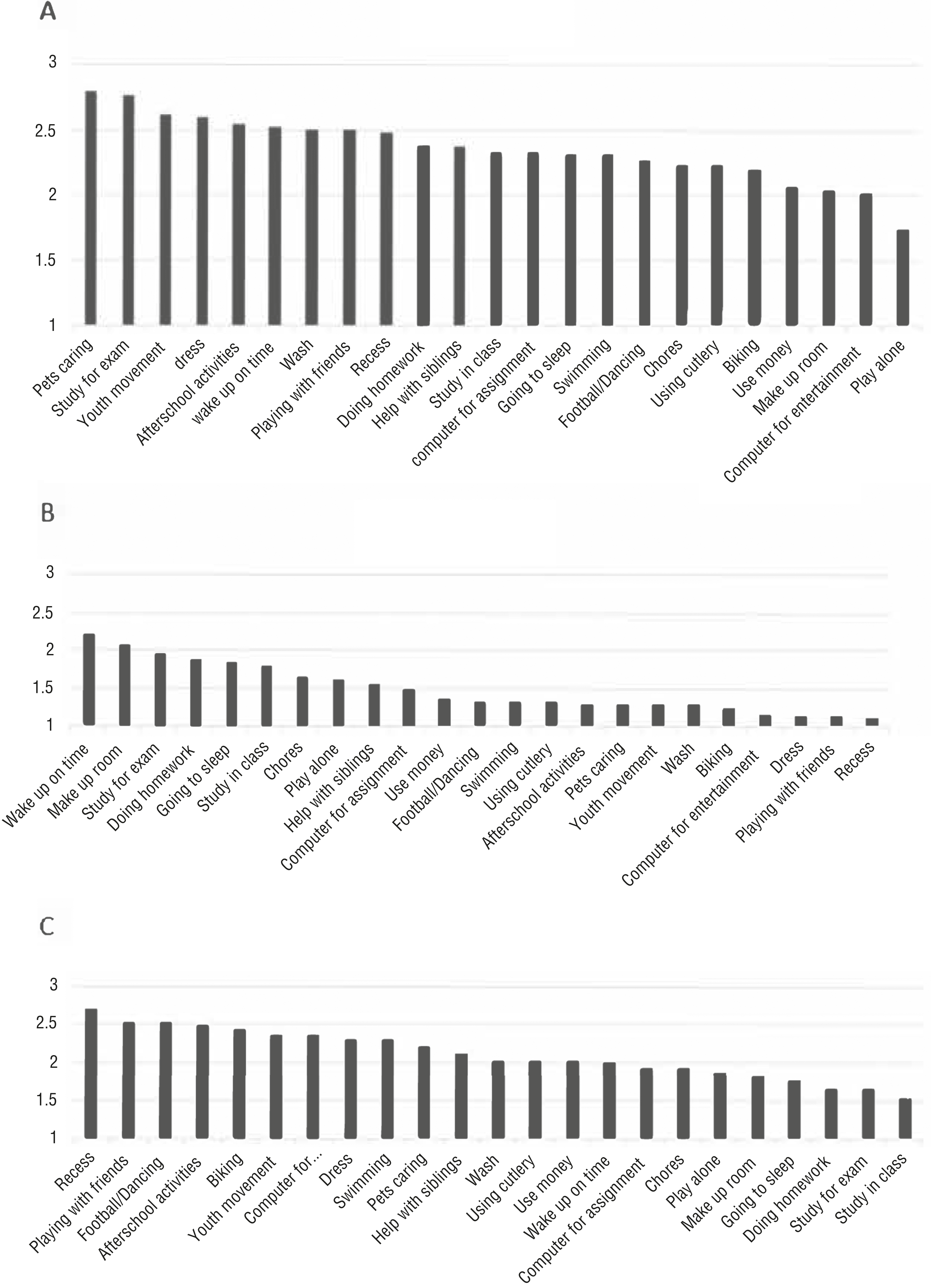
Mean scores for (A) valuable, (B) challenge, and (C) felt time for each activity (N = 60).
Correlations Between Perceived Meaning of Occupations and Dimensions of Participation
Fair correlations were found between the perceived meaning of everyday activities (reported by the child) and the child’s participation (reported by the parents). Challenge was negatively correlated with the child’s independence and parental satisfaction scores (rs = −.27 and −.26, respectively, p < .05). As the perceived challenge of the task increased, the child’s independence and parental satisfaction decreased. Valuable was positively correlated with the child’s independence, enjoyment, and parental satisfaction scores (rs = .32, .38, and .34, respectively, p < .05). Felt time was positively correlated with the child’s enjoyment and parental satisfaction (rs = .26 and .27, respectively, p < .05). However, autonomy was correlated only with the child’s independence score (r = .35, p < .05).
Discussion
In general, children appeared to have a positive perception of the meaning of their everyday activities. The perceived value of activities was high, the perceived challenge was low, the perceived time was almost equally distributed between time passing quickly and slowly, and the number of “choose to do” activities exceeded the number of “must do” activities. The results also indicate that the subjective perceived meanings were moderately correlated with the children’s dimensions of participation, as reported by their parents.
The positive perceived meaning of everyday activities among typically developing healthy children can be understood in light of the Classical Developmental Stage Theory (Erikson, 1993). Elementary-school-age children acquire skills and learn to take part in activities that are expected in their society. Efficient performance of valued activities leads to a sense of competence and satisfaction with participation. Moreover, because of external social norms and internal self-motives, children this age perceive their attributes, dispositions, and competencies more positively than negatively (Thomaes et al., 2017). They usually present a high level of self-concepts, such as self-perceived competence (Harter, 1982) or mastery motivation (van Wietmarschen, 2014). In this context, perceiving occupations as meaningful among children with typical development is no exception.
The most valuable activities are in the categories of ADLs and IADLs (e.g., taking care of a pet, getting dressed, waking up on time), leisure (e.g., afterschool activities), and education (studying for exams). The children in this study implicitly recognized the importance of self-care and self-maintenance activities as enablers of or prerequisites for social activities and learning. These findings are compatible with the contextual approach to occupational development. According to Lawlor (2003), engaging in occupations is a means of interacting socially and bonding with significant others. At the same time, waking up on time and studying for exams were perceived as challenging activities, whereas getting dressed was not considered challenging. This finding indicates that children attached importance to an activity regardless of its difficulty.
Humphry and Wakeford (2008) discussed the contextual nature of activities through vicarious learning; children recognize and adopt what is important in their society. Parental views and values were found to influence occupational development (Wiseman et al., 2005) and may also have influenced the perceived importance and value of occupations. The educational activities (e.g., doing homework) were perceived as valuable and challenging. According to the Positive Psychology Theory (White & Dolan, 2009), we may assume that perceived value helps people cope with difficulties.
Of note, the least challenging activities (self-care and social participation; e.g., recess, getting dressed, and using screens for entertainment) were mostly informal activities that involved little or no prior planning and were often, but not always, initiated by the child (King et al., 2003). Obviously, the children perceived informal activities as activities they chose to do, whereas educational activities were seen as mandatory. Correspondingly, time went by quickly when the children were engaged in social activities and went by slowly when they were in class.
In line with previous findings (Rosenberg, 2015; Rosenberg & Bart, 2016), the present results revealed that the participation of typically developing healthy children was diverse and intensive. The children were quite independent and enjoyed their participation in everyday activities, and their parents were satisfied with their children’s participation. Moreover, the results revealed that the children’s subjective perceived meanings of everyday activities moderately contributed to their actual participation.
To better understand the association among occupations, development, and well-being, Jonsson and Persson (2006) suggested classifying occupations on the basis of how people experienced them. They proposed two categories based on the balance or imbalance between perceived challenge and skills and a third category of low challenge. In the current study, perceived challenge and value limited and promoted, respectively, the subjective dimensions of participation (child’s independence, child’s enjoyment, and parental satisfaction).
Perceived autonomy correlated with the child’s actual independence in participation. According to the Classical Self-Determination Theory, the need for autonomy is a basic need for choice in initiating, maintaining, and regulating an activity (Ryan & Deci, 2000). A comprehensive literature review highlights the association between autonomy and various positive outcomes among children. In line with these results, our findings revealed that children who perceived a higher sense of autonomy (more activities carried out by choice than obligatory activities) needed less assistance while participating in their everyday activities.
However, contrary to our expectations, perceived autonomy was not associated with the child’s enjoyment. Participating in mandatory activities may also be enjoyable. Further study is required to assess whether perceived value mediates the association between perceived autonomy and enjoyment. As expected, the child’s enjoyment was correlated with the sense of time.
The parents reported higher enjoyment scores for children who had more perceptions of time “flying” than of time “crawling.” This result is compatible with previous insights that time passes quickly when people are engaging in “the right challenge” and having fun (Csikszentmihalyi, 1997; Larson, 2004).
Overall, our initial findings provide empirical support for how the perceived meaning of occupations actually contributes to different aspects of participation in everyday activities among typically developing healthy children. Further study is warranted to assess the perceived meaning of occupations among other groups of children, for example, middle-school-age children or children with disabilities.
Limitations
Beyond the internal consistency, as reported in this study, the psychometric properties of the PMOQ need to be further developed for children with and without developmental disabilities. Nevertheless, the generalization of the current findings is limited because of the sample characteristics. Most of the children had relatively educated parents with average or above-average income.
Implications for Occupational Therapy Practice
The findings of this study have the following implications for occupational therapy practice:
The PMOQ may assist researchers in understanding the perceived meaning of occupations among children.
The PMOQ may contribute to the occupational science literature in the context of child development.
The PMOQ may assist pediatric occupational therapy practitioners in eliciting their young clients’ perspectives of their everyday occupations.
The PMOQ may broaden the potential pathways to accomplishing the goal of facilitating meaningful participation in everyday occupations for children.
Conclusion
The results show that elementary-school-age children are capable of reflecting on their everyday activities and reporting their perceived experience. The findings shed light on how the subjective perceived meaning of everyday activities and actual participation are interconnected. Previous studies assessed the contribution of children’s sensory–motor, cognitive, and emotional personal factors to their participation. The current findings add to this body of literature by revealing the contribution made by the perceived meaning of occupations—perceived value, challenge, autonomy, and sense of time—to the participation of healthy children.
Footnotes
Acknowledgments
We thank the families who made this work possible.