





Abstract
In these first 100 years of occupational therapy, education requirements have changed and grown exponentially, expanding from 6- to 12-wk courses, to 1-yr certificates, to multiyear undergraduate and now graduate degrees. Similarly, how curricula convey the profession’s core concept of occupation in relation to other content has varied over time (Presseller, 1984). Currently, though, teaching occupation as the profession’s core knowledge is required by the World Federation of Occupational Therapists (2016), the Accreditation Council for Occupational Therapy Education (2011) in the United States, and other accrediting bodies internationally.
Mandating occupation as the central concept for education supports occupation-based practices and distinctive professional identities. It is a long-held principle in education that professional identities develop through learning the distinctive knowledge and logic of a discipline or profession (Paul & Elder, 2002). Professional identity refers to the internalization of the beliefs, values, skills, and knowledge of one’s professional group (Adams et al., 2006). In occupational therapy, who occupational therapy practitioners are and their distinctive contributions to health care connect essentially to their knowledge of occupation. Thus, practitioners’ professional identities develop, in part, through what they learn: about the profession’s ethos, an occupational perspective of health, views of humans as occupational beings, and occupation-focused models (Ashby et al., 2016).
In addition to developing through what students learn, professional identities form through how students learn, through a field’s signature pedagogies (Shulman, 2005). Signature pedagogies refer to teaching processes that are characteristic of how a profession educates its practitioners. For example, Socratic questioning around a case study is a signature pedagogy in law education. Signature pedagogies entail concrete teaching processes plus accompanying assumptions about what knowledge is most important; how best to convey knowledge to students; and what values, beliefs, and dispositions are characteristic of the profession.
Promoting professional identities is an important aim of education, and scholars urge educators to be intentional and explicit about this aim (Cruess et al., 2014; Hooper, 2008; Trede et al., 2012). A solid professional identity helps occupational therapy practitioners manage job stress, supports career longevity, prevents role blurring, and bolsters advocacy for occupation-based practice (Ashby et al., 2016). Thus, programs that explicitly and powerfully emphasize knowledge of occupation likely graduate students with distinctive, resilient professional identities.
Given how much is at stake, it is imperative that researchers continue to explore and develop the methods and structures by which students learn the concept of occupation and its application in occupation-based practices. However, the strategies used to convey occupation to students and the perspectives embedded in those strategies have been minimally studied. A study of 25 U.S. occupational therapy programs by Hooper et al. (2018) found that occupation was addressed from varying angles: as a concept unto itself apart from practice; as a way of seeing the profession; as a tool for practice; and as synonymous with models of practice, theories, or the Occupational Therapy Practice Framework: Domain and Process (3rd ed.; OTPF–3; American Occupational Therapy Association [AOTA], 2014b; Krishnagiri et al., 2017; Price et al., 2017). Sometimes, when teaching focused on other topics, occupation was not included in the instruction. Regardless of the angles taken on occupation in teaching, findings from Hooper et al. generated a list of learning activities and instructional strategies that were characterized primarily as active and experiential, and participants provided rich descriptions of what was required of students during learning activities.
The aim of the study presented in this article was to corroborate whether the learning activities, instructional strategies, and student requirements identified from the initial 25 programs extended to a larger population of educators in the United States. The authors conducted a survey of faculty and program directors in all U.S. occupational therapy and occupational therapy assistant programs.
Method
Design
The overall project involved a process that mirrored exploratory sequential design research (Creswell & Clark, 2011). Exploratory design involves a qualitative phase followed by a quantitative phase. The design purpose is to “generalize qualitative findings based on a few individuals from the first phase to a larger sample gathered during the second phase” (Creswell & Clark, 2011, p. 86). Methods specific to the qualitative phase of this project have been described elsewhere (Krishnagiri et al., 2017). The quantitative phase used a descriptive survey. Accepted procedures of survey development were used, including the design of survey items from qualitative findings, expert review of questions, pilot testing of the questions, and development of a sampling plan (Blair et al., 2011).
Instrument
The survey included 13 questions (see Appendix). Researchers designed the questions on the basis of results from the earlier qualitative phase. For example, instructional strategies that programs in the qualitative phase reported using to teach the concept of occupation were included as choices in the survey. Survey respondents were asked to choose all the instructional strategies that they used in their teaching and to add others. Several questions allowed participants to choose more than one response. For example, respondents were asked to “check all that apply” or “that are explicit” when selecting from a list of instructional strategies and from a list of what students were required to do during learning activities.
The majority of survey questions were multiple choice, and four survey questions were open ended, including the participant’s definition of occupation, the name of the learning activity the participant selected to illustrate how students learn about occupation, the name of the course in which this activity was taught, and an opportunity to include additional items not covered in the survey. The survey took approximately 15 min to complete.
Sampling and Data Collection
The purpose of the study was to triangulate findings from the qualitative sample to a larger population of occupational therapy and occupational therapy assistant program faculty across the United States. The two groups of educators were included in the same survey because both share the same accreditation standards for teaching occupation and because no differences were found in the qualitative phase between occupational therapy and occupational therapy assistant programs in how they addressed the concept of occupation in curricula.
Contact information for all faculty published on program websites was procured. Calls were made to programs that did not publish email addresses. A total of 1,590 email addresses were gathered, although the annual education data for that year showed a total of 1,701 faculty (AOTA, 2014a). After institutional review board approval, all 1,590 occupational therapy and occupational therapy assistant educators were sent a link to the online survey via email invitations 4 wk into the spring semester. Two reminder emails were sent before the deadline.
Data Analysis
Survey data were analyzed by a statistician using descriptive statistics such as frequencies of responses and a few cross tabulations. Responses to two of three open-ended questions—naming a learning activity that best conveys occupation and defining occupation—were analyzed using a summative content analysis (Hsieh & Shannon, 2005), with the first and second author independently analyzing the responses. The researchers independently grouped the answers and discussed their groupings, leading to consensus on the categories.
Results
A total of 634 respondents began the survey. Of those, 586 (92.4%) stated that they taught the concept of occupation in one or more courses and 48 (7.6%) said they did not teach courses that included occupation. A total of 315 respondents answered all the questions in the survey for an overall response rate of 19.8%. Faculty members constituted 80% of respondents and program directors 20%. A total of 45.5% of respondents held master’s degrees, 16.6% clinical doctorates, and 37.9% academic doctorates. A majority, 54.5%, held graduate degrees in occupational therapy or occupational science, and 45.5% held graduate degrees in related fields.
Definition of Occupation Used
Because the purpose of the survey was to explore how educators addressed occupation with their students, it included an open-ended question asking respondents to share their definition of occupation. Some respondents provided short descriptions, whereas others offered extensive definitions. The summative content analysis of the responses identified eight groupings of definitions with an array of emphases including meaningful and purposeful, means and ends, identity, engagement, vehicle of change, temporal nature, educational activity, and relationship to profession.
The definitions included a mixture of what people do, what people experience, and how people are shaped by occupation. Definitions that emphasized what people do commonly included statements such as “meaningful activities, or groups of activities, structured by habits and routines, shaped by societal expectations, the environment, and person factors.” Those that emphasized peoples’ experience commonly included statements such as “occupation brings enjoyment and purpose.” Those that emphasized how people are shaped by occupation commonly included statements about occupation influencing health, identity, well-being, and meaning, among others. Most definitions involved elements of all three.
Within definitions of occupation, respondents often included comments about the profession and educational programs. For example, occupation was identified by some as “the key organizing concept of our profession,” whereas others commented that occupation was “not an organizing feature of our curriculum” and, more broadly, that “understanding occupation from the categories of the OTPF–3 is an essential educational experience [for students].” Most of the respondents’ definitions of occupation were consistent with definitions in the literature, including those of the OTPF–3 and several others (Christiansen et al., 2005; Law et al., 1996; Pierce, 2001). A word cloud of key words revealed that activities, meaningful, life, everyday, occupation, person, engage, and purpose were most prominently emphasized.
Learning Activities Used to Teach Occupation
A learning activity is a broad instructional task, project, or assignment that incorporates several tools, resources, and instructional strategies oriented toward specific learning outcomes (Beetham, 2007). In the second open-ended question of the survey, respondents (n = 315) identified one learning activity that they believed best conveyed the concept of occupation to students. Grouping these learning activities by content resulted in 13 categories. The activities were like those reported in the qualitative phase of the larger project. The most frequently cited activities included
Using the OTPF–3 (AOTA, 2014b),
Observing someone’s occupation,
Conducting interviews about occupation,
Analyzing activity and performance,
Reflecting on one’s own and others’ occupations,
Learning about environment and culture as facets of occupation,
Using role-playing, and
Developing clinical reasoning.
The survey data did not indicate what was taught about occupation through these learning activities. The qualitative data, however, indicated that these same activities conveyed occupation on a continuum from explicitly to implicitly to absent (Krishnagiri et al., 2017). In other words, occupation was taught either as a concept unto itself apart from practice or as a tool for practice and was sometimes not referenced during similar learning activities.
Visual analysis and a frequency count of the titles and descriptions of courses in which respondents’ learning activities occurred suggested that occupation was taught in courses that typically occur early in the curriculum approximately 55% of the time. About 50% of the sample also reported teaching occupation in intervention, research methods, and basic science courses.
Instructional Strategies Used to Teach Occupation
Instructional strategies refer to specific methods, techniques, procedures, and processes used during instruction and within learning activities (Beetham, 2007). Because learning activities can incorporate multiple instructional strategies, respondents were asked to identify from a list all the strategies that they incorporated within the learning activity they reported as best conveying occupation (Figure 1). Indeed, most learning activities included multiple instructional strategies, usually active strategies such as discussion, reading, experiencing, and writing about occupation.
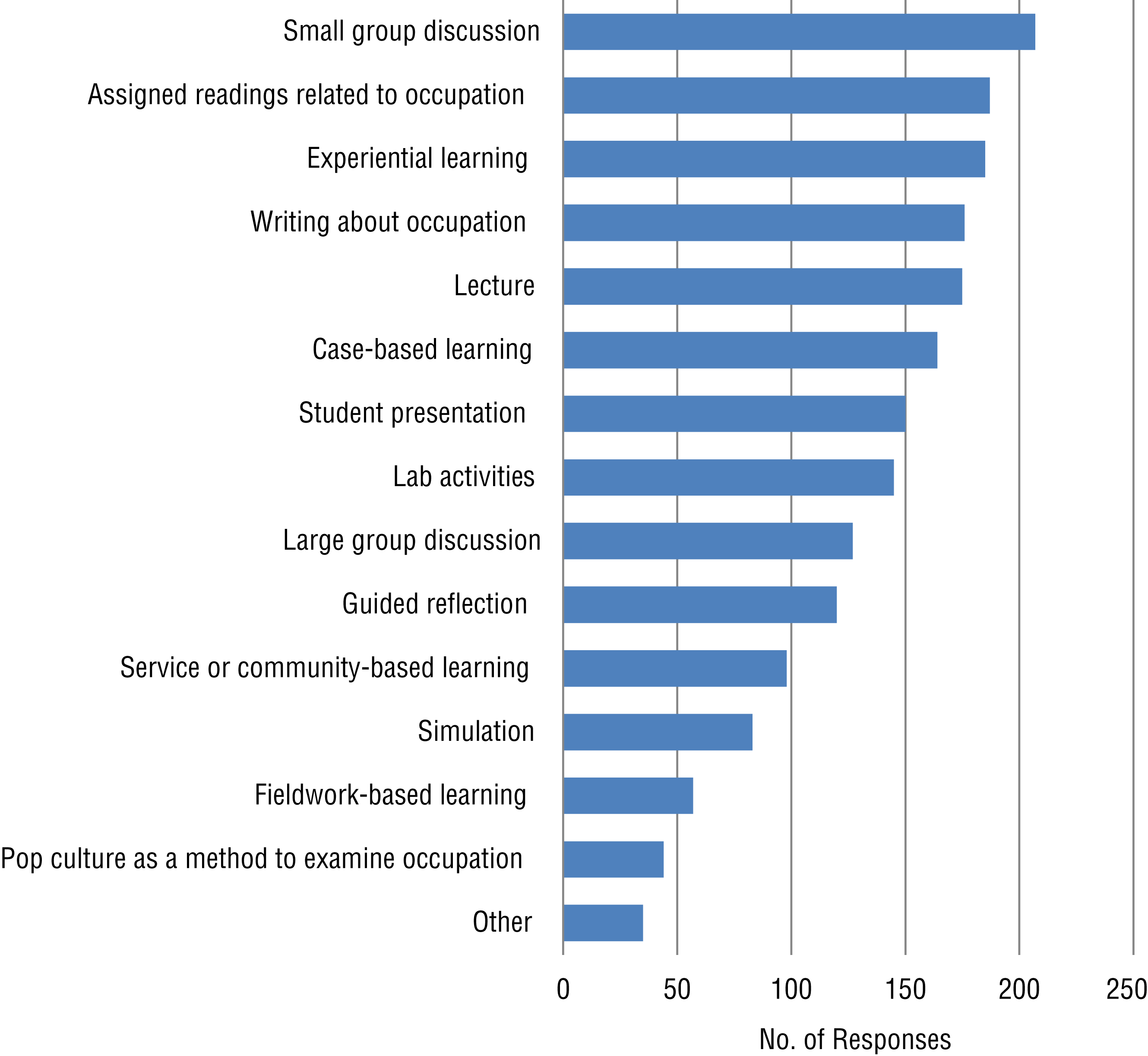
Participants’ (N = 315) responses to what instructional strategies were incorporated into the broad learning activities that teach occupation. The question indicated “select all that apply.”
Learning Activities Required of Students
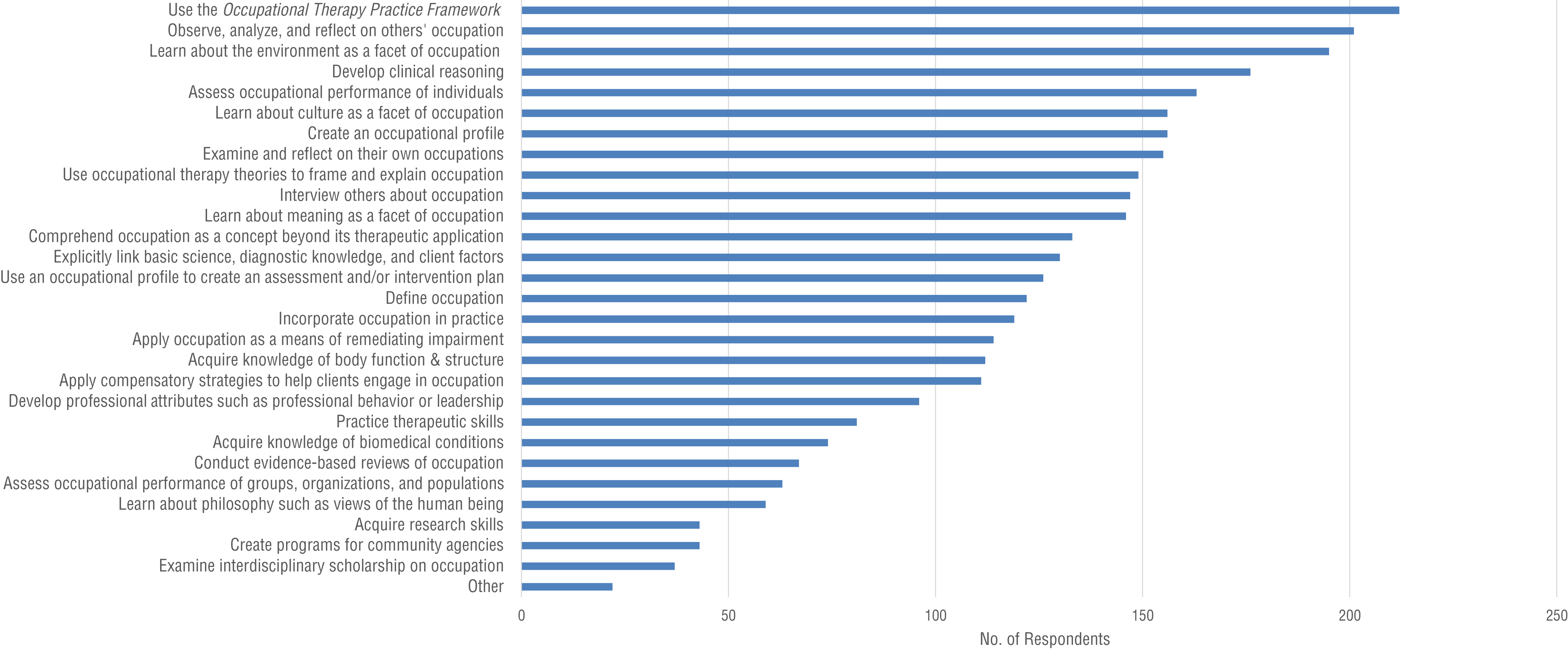
A learning activity may engage students in multiple skills and content areas simultaneously. Therefore, to discern what students were doing while learning about occupation, respondents were asked to choose items from a list of student tasks (Figure 2). The list of tasks was, as noted previously, identified from the qualitative phase of the larger project. Respondents predominantly identified requiring students to use the OTPF–3, observe and analyze others’ occupations, and learn about the environment–occupation transaction. Most learning activities required students to engage on multiple levels, such as observe and analyze or read and discuss.
Summary
The survey results on how occupation was addressed corroborated that some findings from the qualitative phase of the larger project extended to a broader sample of educators. Working from a variety of definitions of occupation, respondents emphasized different facets of occupation. They reported teaching occupation in courses early in the curriculum. Like participants in the qualitative phase, respondents identified multiple learning activities used to teach occupation, presumably with a similar range of how explicitly occupation comes through in an activity’s implementation. In addition, as in the qualitative phase, respondents identified multiple instructional strategies used within each learning activity. Across the varied learning activities and instructional strategies, students were required to demonstrate multiple skills and content areas and engage with the concept of occupation at multiple levels of understanding and application.
Discussion
The purpose of this study was to triangulate findings generated through the qualitative phase of the research project, which explored how 25 occupational therapy and occupational therapy assistant programs addressed occupation. We sought to determine whether a broader sample of faculty across the United States might answer questions about teaching occupation similarly to the smaller group in the qualitative phase. The survey results were highly consistent with the qualitative findings and therefore appear to generalize to a larger population of educators.
The results of the survey, in tandem with the qualitative findings they corroborated, offer initial empirical support for what Schaber (2014) conceptualized as occupational therapy’s signature pedagogies. Signature pedagogies are the characteristic forms of teaching and learning within a profession that arise from and reflect a field’s unique culture, ways of knowing, and knowledge base (Shulman, 2005). Signature pedagogies, as much or more so than content, shape how and what students learn and how they understand their profession—in other words, their professional identities. Schaber, working from Shulman’s (2005) ideas, proposed that occupational therapy has at least three signature pedagogies: relational learning, affective learning, and highly contextualized active learning.
Relational learning occurs within and through human connections, emphasizing modeling within the student–teacher relationship (Schaber, 2014). Through their classroom facilitation and mentoring, educators model professional identity grounded in connection, empathy, and collaboration. In this study, several identified instructional strategies lent themselves to learning through human connection and instructor modeling—if, of course, the strategies were designed with that aim in mind. Examples include group discussion, guided reflection on observations of occupation, and simulation of occupation-based interventions. In addition, the learning activities identified in this study presumably involved learning in and through relationships, including community-based and service learning projects in which students interacted with others. Moreover, a top requirement in the learning activities asked students to observe or interview others and then analyze and reflect on the occupations observed and discussed. This activity is another potential example of learning through connection with others.
Affective learning transforms identity by changing values and beliefs (Schaber, 2014). Identity transformation occurs when students encounter a dilemma or situation that does not fit their perceptions. As they respond emotionally to the experience, they examine, and perhaps change, their beliefs and assumptions (Matheson, 2013). Education scholars have claimed that some instructional strategies prompt transformation more readily than others, particularly strategies such as service learning and problem-based learning that are designed to question students’ habitual ways of seeing the world and thus reshape their identities (Matheson, 2013).
In this study, several learning activities lent themselves to transformative or affective learning, such as case-based learning and service learning using occupation as the frame, again, assuming the activities were designed with a transformative aim in mind. Other activities identified by respondents also have potential to achieve affective learning (e.g., interviews about and observations of others’ occupations, exploration of one’s own occupations, learning new occupations and reflecting on that learning). Findings from the qualitative phase of the research project showed that educators used these types of learning activities with the intent to transform students’ ways of seeing self, other, and the profession through the lens of occupation (Price et al., 2017).
Schaber (2014) claimed that the third signature pedagogy in occupational therapy is highly contextualized active learning, or “learning through doing” (p. S43). Learning through doing involves setting up tasks and the environment to effect specific learning outcomes. Although it is difficult to ascertain from this survey how highly contextualized the identified learning activities were, most were active. Examples of active learning included observe, analyze, and reflect on others’ occupations and incorporate occupation in practice. It is reasonable to assume that learning activities in community environments were in naturalized contexts.
The survey results provided some empirical evidence for Schaber’s (2014) proposed signature pedagogies in occupational therapy education. However, categorizing types of learning activities and instructional strategies per Schaber’s proposed signature pedagogies does not provide an understanding of how each pedagogy helps students learn about occupation or develop a distinctive professional identity. Each pedagogy comprises three levels, what Shulman (2005) referred to as surface, deep, and implicit structures. These levels must align to convey disciplinary knowledge and foster professional identity. Examining each level in future research will, we propose, help us understand how the profession’s signature pedagogies stimulate student identity formation in relation to knowledge of occupation.
The surface structure refers to the observable actions of teaching such as case studies, simulation, question and answer, stories from practice, or skill demonstration. The survey data identified the surface structure of multiple pedagogies. More descriptive detail of the surface structure of various pedagogies was developed from the qualitative phase of this project (Krishnagiri et al., 2017; Price et al., 2017).
The deep structure of a pedagogy refers to the set of assumptions it carries about “how best to impart a certain body of knowledge and know-how” (Shulman, 2005, p. 55). Teaching requires not only selecting active, relational, and contextualized pedagogies but also having an awareness of their deep structure. Understanding assumptions within signature pedagogies requires a separate line of inquiry, much like the work done in education on teacher beliefs (Farrell & Ives, 2015). However, when taken together, the results of this study on the learning activities, instructional strategies, and what students do during the learning activities may provide a first glance at deep structures in occupational therapy pedagogy.
One example from this study includes instructors asking students to observe and interview a person in the community and develop an occupational profile to present in class for discussion. It can be surmised that the deep structure of this approach involves assumptions that (1) students learn occupational therapy best by engaging in practice-related tasks; (2) the profession imparts its perspective by having students do things; and (3) students have to not only learn skills but also learn how to frame and understand observations, interviews, and profiles through an occupational lens. There seems to be a presumption that when students engage in basic practice-related tasks, they learn how to think like an occupational therapy practitioner—a significant aspect of professional identity. These educational intentions were corroborated in the qualitative results; however, assumptions and intentions within teaching sometimes remained implicit (Price et al., 2017).
The implicit structure of signature pedagogies consists of the values, beliefs, and attitudes that form the moral standards for the profession, another important aspect of professional identity (Shulman, 2005). Instructors commonly help students learn how to discover clients’ meaningful occupations, develop interventions based on those occupations, consider what ethically can and cannot be done, and consider broader societal issues that contribute to the situation. This guided facilitation conveys, even if implicitly, the skills and reasoning of an occupational therapy practitioner and the beliefs, values, and occupational perspective that guide the profession. The survey data indicated learning activities and strategies through which educators could convey the profession’s underlying beliefs. Further research is needed, however, to describe the actual aims underlying common educational practices and how educators reveal to students the implicit structure within a pedagogy.
This survey of U.S. occupational therapy and occupational therapy assistant faculty corroborated the qualitative findings from the 25 randomly chosen programs on how occupation is addressed in curricula. The results provide initial empirical evidence on occupational therapy’s instructional strategies and learning activities that align with Schaber’s (2014) proposed signature pedagogies. In addition, the two phases of the research project, in combination, provide a glimpse of some of the deeper and implicit structures within the profession’s pedagogy through which professional identities and occupational perspectives may form.
Limitations
The 19.8% response rate for this survey is low, especially given that the average survey response rate for health care professionals is 58%, according to Cook et al. (2009). It is in the same range, however, as another study conducted with a group of occupational therapy educators, at 20% (Gupta & Bilics, 2014), suggesting that survey fatigue may be an issue with this population. The timing of the survey, sent about 4 wk into the spring semester, and the two reminder emails sent per standard protocol (Blair et al., 2011) should not be a cause for the low response rate. The length of the survey, with 10 closed-ended questions and 4 short-answer questions on familiar topics, requiring about 15 min to complete, was not expected to be too burdensome, although colleagues reported it as challenging. Only half of the respondents who began the survey and stated that they taught occupation completed the survey. Nevertheless, there were 315 completed surveys and 319 partially completed surveys that corroborated qualitative findings, thus providing a strong initial look at instructional strategies in occupational therapy.
Implications for Occupational Therapy Education
This study has the following implications for occupational therapy education:
Data from the study provide learning activities and instructional strategies to use in teaching.
Educators should select active, relational, and contextualized pedagogies and examine the deep and implicit structures of their pedagogies to make those explicit to students.
The quantitative and qualitative strands of the project encourage educators to evaluate how clearly, explicitly, and deeply occupation is present in learning.
Conclusion
The results of this survey, along with the results of the preceding qualitative phase, describe how the conceptual core of the occupational therapy profession is addressed in occupational therapy and occupational therapy assistant programs. Because the survey data corroborated the findings from the qualitative data, the results presented, notwithstanding methodological limitations, have laid a foundation for understanding the surface structures of how occupation is taught, providing initial evidence for proposed signature pedagogies.
Many respondents reported teaching occupation through highly engaged activities and strategies. What is not known, however, are the depth and breadth with which occupation is taught and what students are learning about occupation. Further research is needed, therefore, on what is explicitly conveyed through these identified learning activities and instructional strategies; how these learning activities, instructional strategies, and their deep and implicit structures foster students’ professional identity; what educators believe is important to teach about occupation; and what professional development needs exist related to knowledge of occupation and occupational science.
Footnotes
Acknowledgments
We thank James S. Zoller, MHA, PhD, Dean Emeritus, College of Health Professions, Medical University of South Carolina, for his assistance with survey design, data management, and analysis. This study was supported through a collaboration between the Society for the Study of Occupation: USA and the American Occupational Therapy Foundation. Portions of the study were presented at the Society for the Study of Occupation: USA conference (2014).
Survey of U.S. Occupational Therapy and Occupational Therapy Assistant Faculty on Teaching Occupation
Note.
