





Abstract
Engagement in meaningful paid employment has far-reaching benefits for health and well-being (Raphael, 2006). Employment provides income, which is essential for daily needs such as transportation, food security, and housing (Berkman, 2014). Work can provide opportunities for social engagement and the development of personal social networks (Donelly et al., 2010). Employment is an important avenue for self-expression, often providing adults with a role that is central to their identity and sense of self-worth (Berkman, 2014; Donelly et al., 2010; Lysaght et al., 2012).
Intellectual disabilities (ID) are chronic impairments that present before age 18 yr and are characterized by significant limitations in intellectual functioning and adaptive behavior (American Association on Intellectual and Developmental Disabilities, n.d.). Despite limitations, people with ID benefit from meaningful employment similarly to their typically developing peers, gaining skills, financial independence (Donelly et al., 2010), and a higher overall quality of life (Kober & Eggleton, 2005). Access to a work environment supports social interaction and relationship building (Donelly et al., 2010). A work schedule provides a framework for organizing time use and productive routines (Donelly et al., 2010). The financial and social benefits of paid employment also support the ability to make choices in other areas of occupation such as social participation and recreation (Berkman, 2014; Donelly et al., 2010).
After decades of work by advocates, the Americans With Disabilities Act (ADA; Pub. L. 101-336) was passed in 1990, codifying the legal right to work for people with disabilities for the first time in the United States. Since then, legislative, judicial, and public advocacy efforts have continued to increase access to community workspaces for people with disabilities. In 2000, the U.S. Department of Education funded the second national longitudinal study to improve understanding of school-to-work transition services and service recipients (Cameto et al., 2004). The Individuals With Disabilities Education Improvement Act (IDEA; Pub. L. 108-446) became law in 2004, updating school-based transition service mandates to more effectively support students in moving from school to employment. The ADA Amendments Act of 2008 (Pub. L. 110-325) clarified that plaintiffs in ADA court cases should not have to offer evidence validating their disability to prove that workplace discrimination has occurred. More recently, the Workforce Innovation and Opportunity Act of 2014 (Pub. L. 113-128) called on states to offer more comprehensive, coordinated employment supports for people with disabilities, and a landmark statewide ruling required Rhode Island to provide students with ID opportunities for community-based employment services (U.S. Department of Justice, 2014).
Despite the increased focus on access and support, people with disabilities continue to experience lower rates of paid employment and lower pay than their peers without disabilities (Erickson et al., 2018). People with ID have employment rates among the lowest (Erickson et al., 2018) and are less likely than peers with physical disabilities to find work that matches their interests (Donelly et al., 2010). Stigma (Scior, 2011), difficulty negotiating accommodations (Schreuer et al., 2009), transportation barriers (Stock et al., 2011), and inadequate support services (Donelly et al., 2010; Lysaght et al., 2012) limit access to employment for people with ID.
Services designed to support transition from school to paid employment aim to help youth with ID achieve higher rates of meaningful employment, which may lessen broader employment-related social and financial inequities (Landmark et al., 2010; Lövgren et al., 2017). However, these services are complex and undergo rapid changes (Landmark et al., 2010; Lövgren et al., 2017; Moreno et al., 2014). Moreover, there is wide variation in resources, programming, and access to services across the United States (Honeycutt et al., 2015; Moreno et al., 2014; Winsor, 2016). Perhaps most important, a paucity of research has focused specifically on transition within the ID population. These factors make it difficult to identify and implement best practice in school-to-work transition for youth with ID.
Occupational therapy practitioners can provide unique, valuable transition support for students moving from school to work (American Occupational Therapy Association [AOTA], 2008, 2018; Rockwell, 2006) by providing client-centered services in natural contexts (AOTA, 2014, 2015; Persch et al., 2016; Schreuer et al., 2009). Unfortunately, occupational therapy practitioners are identified as optional—not required—transition team members (IDEA, 2004), and occupational therapists have reported limited involvement in supporting school-to-work transition (Abbott & Provident, 2017).
Given that paid employment is a highly relevant occupation of adulthood and is associated with high levels of quality of life and well-being, the lack of clear best practice in transition services is distinctly problematic. Likewise, the consistently poor employment outcomes for youth with ID despite decades of legislative mandates point to an urgent need to deepen the understanding of occupational therapy practitioners’ potential and current role in providing transition services. To that end, we undertook a scoping review of the literature to identify and describe interventions within the scope of occupational therapy for youth with ID who are transitioning from school to paid employment and to describe the professionals currently involved in providing these interventions.
Method
As illustrated in Figure 1, we used Arksey and O’Malley’s (2005) scoping review framework, with modifications based on recommendations articulated by Daudt et al. (2013), Hidalgo Landa et al. (2011), Levac et al. (2010), and Peters et al. (2015).
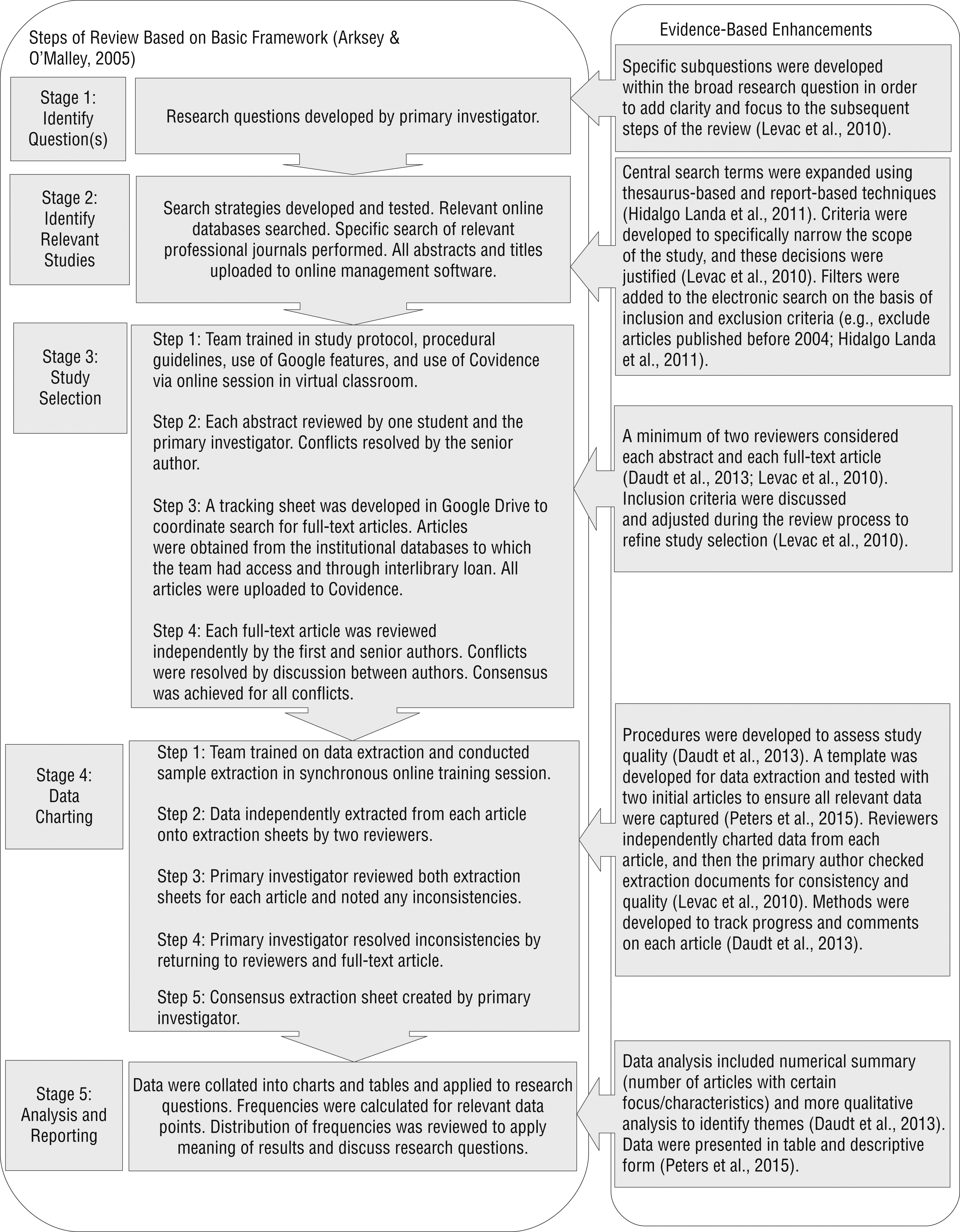
Flowchart of scoping review methods.
Research Questions
This scoping review aimed to identify and describe current interventions for facilitating school-to-work transition for youth with ID, categorize the interventions within the occupational therapy domain of practice, and identify and describe the ways in which outcomes were measured. The review was guided by the following specific research questions:
What interventions are being used with youth with ID in school-to-work transition, and how do those interventions align with the Occupational Therapy Practice Framework: Domain and Process (3rd ed.; OTPF–3; AOTA, 2014)?
Who (i.e., which discipline, training, skills) is implementing these interventions?
Are occupational therapy practitioners or other professionals providing interventions within the occupational therapy domain of practice?
What outcomes are targeted by each intervention, and how are these outcomes measured?
To what extent are established, psychometrically sound outcome instruments being used to evaluate interventions?
What gaps and opportunities exist for occupational therapy in school-to-work transition for youth with ID?
Search Strategy and Inclusion and Exclusion Criteria
As recommended by Hidalgo Landa et al. (2011) and in consultation with an academic librarian, we identified primary search terms and then expanded them using thesaurus- and report-based strategies. Search strategies were developed and tested for four electronic databases. Hand searching was performed in journals that publish studies on transition.
Articles were included if they were peer reviewed, were published in English, described an intervention explicitly focused on transition from school to paid employment, and if at least 10% of participants had a diagnosis of ID and no significant co-occurring physical diagnoses such as cancer, cerebral palsy, or traumatic brain injury. Articles that did not report specific diagnoses and percentages of participants with each diagnosis were excluded. Amendments to IDEA in 2004 updated regulations for transition services, so only articles published from 2004 to 2017 were included. Gray literature such as dissertations, theses, and book chapters were excluded.
During abstract review, we noted international variation in the cultural and legislative contexts of transition services, so we refined the criteria to include only U.S.–based articles. During full-text review, we refined the criteria to exclude participants with autism spectrum disorder unless the article explicitly stated that at least 10% of the sample had co-occurring ID. Articles describing clinical or community interventions were included, even if they lacked a clear experimental design. Secondary analysis and review articles were excluded because of the possibility that other articles included in this review provided the primary analysis. Consistent with scoping review methodology, after each revision to the inclusion criteria, we re-reviewed previously excluded articles to ensure they still did not meet the inclusion criteria.
Review Process
The scoping review team consisted of the two primary investigators (Taryn Rosner and MJ Mulcahey), two additional licensed occupational therapists, four graduate occupational therapy students, and one undergraduate student. The review was managed using Google Drive and Covidence (Version v114769aa9ee; Veritas Health Innovation, 2017). Covidence is a web-based software platform that supports systematic and scoping reviews by enabling multiple collaborators to upload, access, manage, and review titles, abstracts, and full-text articles. All members of the team received instruction in the study protocol and procedures and in use of the Google Drive and Covidence features through a synchronous online training session. The training was recorded, and a link was provided to all team members. A Google Drive share folder was developed with nested folders for abstract review, full-text review, and data extraction. Guiding documents (e.g., exclusion and inclusion criteria, directions for each step of the review, glossary of operational definitions) were available in the folders throughout the review.
Abstract and full-text screening was performed in Covidence. Each abstract was independently screened by Rosner and one of the trained reviewers; any conflicts regarding inclusion were resolved by Mulcahey. For abstracts that passed screening, full-text articles were obtained, uploaded to Covidence, and reviewed by primary investigators for inclusion. Full-text review disagreements were resolved in discussion between the primary investigators. Reasons for exclusion were recorded for all full-text articles.
Data Extraction and Management
Data extraction was managed using Google Drive and was completed by the two additional licensed occupational therapists and two graduate students from the review team. These team members participated in a training session focused on the procedures for data extraction and in an interactive demonstration by Rosner of the extraction process for one included article. A recording of the training was made available to the team. A central shared folder was created containing the extraction template (excerpted in Appendix A), written instructions, operational definitions, the OTPF–3, a sheet for tracking which reviewer completed extraction for each article, and a nested folder containing each included article in PDF format. Each reviewer also had an individual folder for their completed extraction sheets, which could be accessed only by that reviewer and Rosner.
Data were extracted from each full-text article independently by two of the trained reviewers. Rosner reviewed the first three extraction sheets completed by each reviewer and provided feedback to ensure accuracy, consistency, and quality. After initial extraction, Rosner compared the two completed extraction sheets for each article, highlighted and resolved any conflicts, and created one consensus extraction sheet for each article.
Data were organized on the extraction sheet (see Appendix A) in two main sections: study elements and OTPF–3 alignment. In the study elements section, the publication information, purpose, sample size and characteristics, methodology, details on the interventions, outcomes measured and method of measurement, and relevant results were listed. Reviewers categorized the study design using a list of preestablished operational definitions. They also recorded whether any author was an occupational therapist or occupational therapy assistant. In addition, reviewers assessed the quality of each study they reviewed by responding “yes,” “no,” or “can’t tell” to questions adapted from the Critical Appraisal Skills Programme (CASP; 2014) checklist (see Appendix A). The CASP questions address issues of bias and study design.
The section, focused on OTPF–3 alignment, consisted of tables listing the occupational therapy domains, intervention types, and approaches used. Reviewers marked yes if the intervention described in the article represented that concept in the OTPF–3 or no if the intervention did not represent that concept; for those marked yes, reviewers briefly described the intervention. For example, if an intervention used a classroom training model to teach students about components of transition, the reviewer marked yes for the education and training intervention type and noted that the students were receiving education on transition topics. The reviewers then indicated how outcomes described in the article fit with the outcome categories defined in the OTPF–3. The reviewers marked yes for each occupational therapy outcome measured or discussed in the study and noted any measurement methods used.
Data Analysis
Data from each consensus extraction sheet were collated and are displayed in Appendix B. Study design, purpose, setting, outcomes, and outcome measures were categorized to allow summary and comparison. Frequencies were calculated to determine how often each category appeared in the included articles. Similarly, the frequency with which OTPF–3 intervention types, approaches, and outcomes appeared in the articles was calculated. Distribution of frequencies was reviewed to apply meaning to the results and to provide insight into the original research questions. The quality of each study was rated on the basis of response frequency of CASP items. As shown in the Quality column of Appendix B, studies that received affirmative answers on all CASP items were given a rating of strong, studies with two no or “can’t tell” responses were considered moderate, and studies with three or more no or can’t tell responses were considered weak. Moreover, studies with small sample sizes (<20) could not be rated as strong. Articles that did not explicitly discuss outcomes were labeled as descriptive.
Results
As illustrated in Figure 2, the database searches yielded 13,591 titles and abstracts. A total of 1,782 items were removed as duplicates during title and abstract or full-text review. Hand searching produced an additional 8 nonduplicative articles that were added directly to the full-text screening stage of the review. The team reviewed 151 nonduplicate full-text articles. Of these, 116 (76.8%) were eliminated because they did not meet the inclusion criteria, and 35 (23.2%) were included in the scoping review.
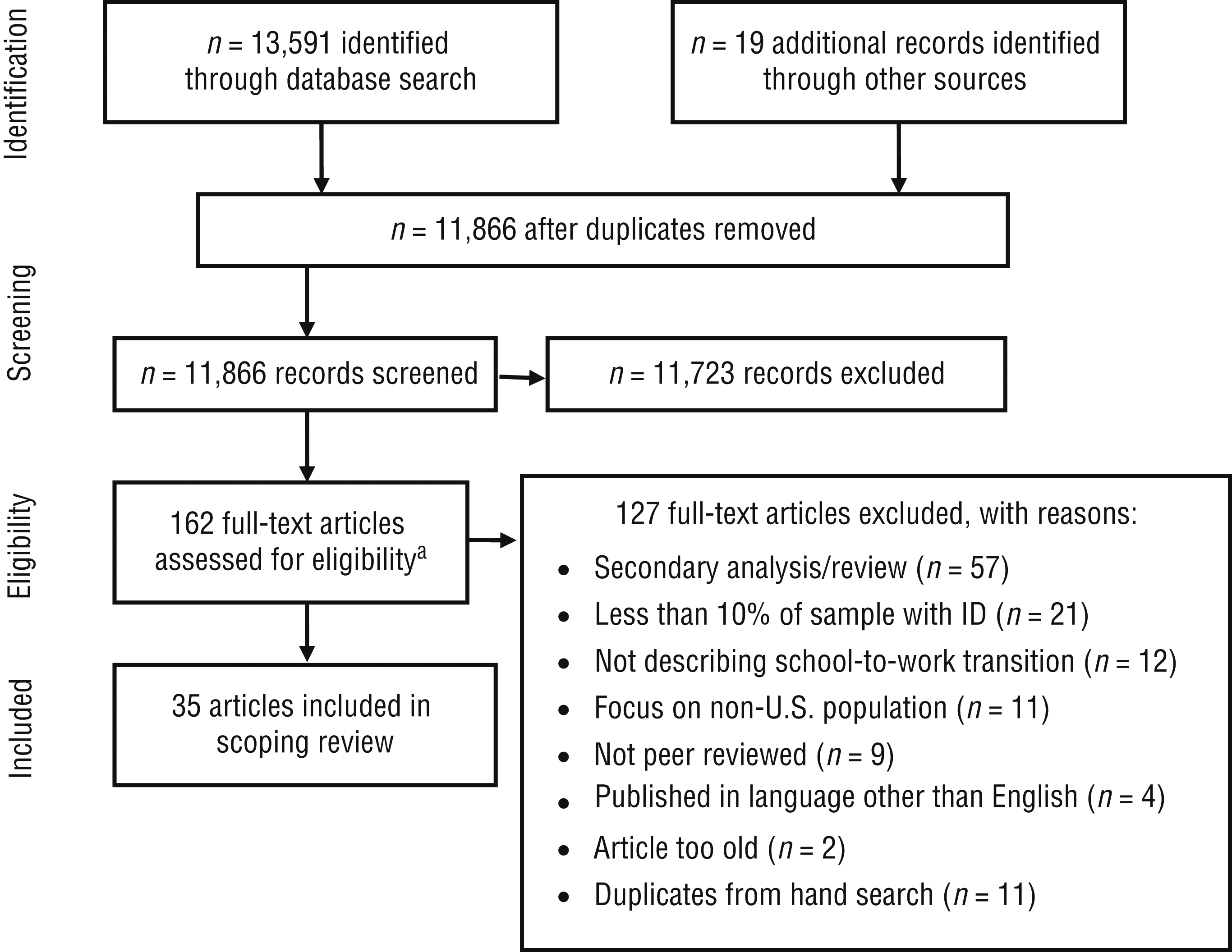
Flow of information through the phases of the scoping review.
Study Designs
As displayed in Appendix B, the majority of articles described studies with designs that were categorized as low level, including
Case study (n = 4, 11.4%; Certo & Luecking, 2006; Izzo & Kochar-Bryant, 2006; Pouliot et al., 2017; Wittig et al., 2014),
Single subject (n = 5, 14.3%; Allen et al., 2012; Bartholomew et al., 2015; Johnson & Rose, 2017; Morgan & Horrocks, 2011; Robinson & Smith, 2010),
Case series (n = 10, 28.6%; Cihak et al., 2004, 2008; Mechling & Ortega-Hurndon, 2007; Müller & VanGilder, 2014; Palmer et al., 2012; Riffel et al., 2005; Rogers et al., 2008; Rouse et al., 2014; Smith et al., 2015; Wehmeyer et al., 2006),
Retrospective cohort (n = 2, 5.7%; Estrada-Hernández et al., 2008; White & Weiner, 2004), and
Mixed methods (n = 2, 5.7%; Carter et al., 2016; Dunn et al., 2016).
A small portion used higher level designs, including cluster randomized controlled trials (RCTs; n = 4, 11.4%; Lee et al., 2011; Wehmeyer, Palmer, et al., 2011; Wehmeyer et al., 2013; Wehmeyer, Williams-Diehm, et al., 2011) and traditional two-arm RCTs (n = 3, 8.6%; Powers et al., 2012; Seagraves et al., 2004; Smail & Horvat, 2006). Five (14.3%) articles were descriptive, without any explicit research design (Carter et al., 2012; Dubberly, 2011; Hartman, 2009; McEachern & Kenny, 2007; Wilson et al., 2017).
Of the studies with an experimental design, only 8 received a strong quality rating, indicating sound design and minimal bias (Estrada-Hernández et al., 2008; Lee et al., 2011; Powers et al., 2012; Rogers et al., 2008; Wehmeyer, Palmer, et al., 2011; Wehmeyer et al., 2013; Wehmeyer, Williams-Diehm, et al., 2011; White & Weiner, 2004). Three studies received a weak rating, indicating significant issues with design or bias (Certo & Luecking, 2006; Izzo & Kochar-Bryant, 2006; Pouliot et al., 2017). The remaining studies (n = 19) received a moderate rating. In summary, the majority of studies had at least some quality issues that made findings difficult to interpret and generalize.
Interventions
Almost half of the articles (n = 16, 45.7%) evaluated specific interventions aimed at improving knowledge, skills, or access related to school-to-work transition (Allen et al., 2012; Bartholomew et al., 2015; Carter et al., 2016; Cihak et al., 2004, 2008; Dunn et al., 2016; Izzo & Kochar-Bryant, 2006; Johnson & Rose, 2017; Lee et al., 2011; Mechling & Ortega-Hurndon, 2007; Pouliot et al., 2017; Riffel et al., 2005; Rouse et al., 2014; Seagraves et al., 2004; Smail & Horvat, 2006; Smith et al., 2015). Twelve articles (34.3%) evaluated full transition programs or models (Estrada-Hernández et al., 2008; Müller & VanGilder, 2014; Palmer et al., 2012; Powers et al., 2012; Robinson & Smith, 2010; Rogers et al., 2008; Wehmeyer et al., 2006, 2013; Wehmeyer, Palmer, et al., 2011; Wehmeyer, Williams-Diehm, et al., 2011; White & Weiner, 2004; Wittig et al., 2014). Seven articles (20.0%) described programs or models but did not specifically evaluate effectiveness (Carter et al., 2012; Certo & Leucking, 2006; Dubberly, 2011; Hartman, 2009; McEachern & Kenny, 2007; Morgan & Horrocks, 2011; Wilson et al., 2017), although three of these did include a subjective report of outcomes (Certo & Luecking, 2006; Hartman, 2009; Morgan & Horrocks, 2011).
Table 1 summarizes the interventions used in each study for school-to-work transition and their alignment with the OTPF–3 intervention categories. Each article described at least one intervention aligned with multiple domains of occupational therapy practice. Every intervention type identified in the OTPF–3 was represented in at least 1 article. Despite the alignment of interventions with the OTPF–3, none of the studies had an occupational therapy practitioner as an author or intervention team member. Intervention providers were specifically described in 24 articles, including special educators (n = 20), school counselors (n = 3), speech-language pathologists (n = 1), behavioral therapists (n = 1), physical therapists (n = 1), and job coaches or work site support staff (n = 5). The remaining 11 articles did not specify the type of provider.
Study Alignment With the Occupational Therapy Practice Framework: Domain and Process, Third Edition
Outcomes and Measurement Methods
Several outcome categories were described:
Performance of specific skills (n = 16, 45.7%; Cihak et al., 2004; Dunn et al., 2016; Johnson & Rose, 2017; Lee et al., 2011; Müller & VanGilder, 2014; Palmer et al., 2012; Powers et al., 2012; Rouse et al., 2014; Seagraves et al., 2004; Smail & Horvat, 2006; Smith et al., 2015; Wehmeyer et al., 2006, 2013; Wehmeyer, Palmer, et al., 2011; Wehmeyer, Williams-Diehm, et al., 2011; Wittig et al., 2014)
Employment outcomes (n = 10, 28.6%; Allen et al., 2012; Certo & Leucking, 2006; Estrada-Hernández et al., 2008; Hartman, 2009; Morgan & Horrocks, 2011; Müller & VanGilder, 2014; Powers et al., 2012; Rogers et al., 2008; White & Weiner, 2004; Wittig et al., 2014)
On-the-job performance (n = 9, 25.8%; Allen et al., 2012; Cihak et al., 2008; Dunn et al., 2016; Johnson & Rose, 2017; Mechling & Ortega-Hurndon, 2007; Morgan & Horrocks, 2011; Pouliot et al., 2017; Riffel et al., 2005; Robinson & Smith, 2010)
Participation in the transition process (n = 6, 17.1%; Bartholomew et al., 2015; Izzo & Kochar-Bryant, 2006; Lee et al., 2011; Powers et al., 2012; Wehmeyer et al., 2006; Wehmeyer, Williams-Diehm, et al., 2011)
Knowledge of the transition process (n = 5, 14.3%; Bartholomew et al., 2015; Carter et al., 2016; Izzo & Kochar-Bryant, 2006; Lee et al., 2011; Wehmeyer, Palmer, et al., 2011)
Satisfaction with transition services (n = 4, 11.4%; Izzo & Kochar-Bryant, 2006; Müller & VanGilder, 2014; Riffel et al., 2005; Smith et al., 2015).
The employment outcomes category included elements such as employment status, job quality, job satisfaction, salary, and job maintenance or longevity. Self-determination outcomes were categorized under performance of specific skills and were measured in 15 of the 16 articles in that category. No outcomes were reported in 4 articles (11.4%; Carter et al., 2012; Dubberly, 2011; McEachern & Kenny, 2007; Wilson et al., 2017). All articles that reported outcomes had at least one outcome that aligned with the OTPF–3 outcome categories, as summarized in Table 1.
Outcomes were measured using a variety of methods, including
Structured observations (n = 14, 40.0%; Allen et al., 2012; Bartholomew et al., 2015; Cihak et al., 2004, 2008; Dunn et al., 2016; Johnson & Rose, 2017; Mechling & Ortega-Hurndon, 2007; Morgan & Horrocks, 2011; Riffel et al., 2005; Robinson & Smith, 2010; Rouse et al., 2014; Seagraves et al., 2004; Smail & Horvat, 2006; Smith et al., 2015),
Qualitative interviews (n = 10, 28.6%; Certo & Leucking, 2006; Dunn et al., 2016; Hartman, 2009; Izzo & Kochar-Bryant, 2006; Morgan & Horrocks, 2011; Müller & VanGilder, 2014; Pouliot et al., 2017; Rogers et al., 2008; White & Weiner, 2004; Wittig et al., 2014),
Surveys (n = 10, 28.6%; Allen et al., 2012; Carter et al., 2016; Estrada-Hernández et al., 2008; Hartman, 2009; Lee et al., 2011; Müller & VanGilder, 2014; Riffel et al., 2005; Rogers et al., 2008; Smith et al., 2015; Wittig et al., 2014), and
School or employment record review (n = 3, 8.6%; Müller & VanGilder, 2014; Rogers et al., 2008; White & Weiner, 2004).
In addition, goniometry and dynamometry were used in three studies focused on physical fitness interventions to enhance vocational performance in youth with ID (Johnson & Rose, 2017; Seagraves et al., 2004; Smail & Horvat, 2006). Preexisting assessment tools, summarized in Table 2, were used in eight studies (22.9%; Johnson & Rose, 2017; Lee et al., 2011; Palmer et al., 2012; Powers et al., 2012; Wehmeyer et al., 2006, 2013; Wehmeyer, Palmer, et al., 2011; Wehmeyer, Williams-Diehm, et al., 2011), predominantly to measure self-determination outcomes.
Assessment Tools Used in Included Articles (N = 35)
Note. AIR = American Institutes of Research.
Discussion
Overall, transition services for youth with ID appear to lack standardization, consistency, and a strong evidence base. The articles included in this review described a broad, heterogeneous mix of school- and community-based programs and interventions. Approaches often lacked a focused intervention that could be explicitly described and objectively evaluated. Outcomes were infrequently evaluated with established, psychometrically sound measures, making it difficult to use outcomes data to inform decisions about treatment. These findings raise concerns about the ability to deliver best practice transition services to youth with ID, who are particularly at risk for poor work outcomes (Erickson et al., 2018; Heyman et al., 2016; Lövgren et al., 2017; Winsor, 2016).
The results of this scoping review reveal concerning gaps in the literature relevant to occupational therapy participation in transition services for youth with ID. Interventions aligned with the scope of occupational therapy practice are being implemented to support transition to paid employment by professionals and paraprofessionals outside the occupational therapy profession. It has been well established that occupational therapy is underrepresented in transition literature and services (Abbott & Provident, 2017), but the complete absence of occupational therapy from the articles included in this review is particularly concerning. Research is urgently needed to identify the interventions occupational therapy practitioners are currently providing to youth with ID as they transition from school to work and then to measure the effectiveness and impact of those interventions to guide best practice.
As researchers build evidence supporting occupational therapy leadership in transition practice, school systems and occupational therapy practitioners will need to consider how to make adjustments to caseloads and workloads to allow time to effectively plan and implement transition services. Education and advocacy by individual practitioners and occupational therapy professional organizations may be needed to assist practitioners in securing their roles in transition teams.
Implications for Occupational Therapy Practice
The overarching motivation for this review was to explore occupational therapy’s current and potential role in school-to-work transition for youth with ID on the basis of interventions described in the literature. Significant gaps in the literature reveal the following challenges and opportunities in this area of practice:
More evidence is needed to answer basic questions about the role occupational therapy currently plays in transition service teams. Research is needed that specifically asks the following questions: Are occupational therapy practitioners currently working on transition teams? If so, what specific services are they providing? If not, what are the barriers to practitioners’ involvement in providing school-to-work transition services for youth with ID? Do occupational therapy practitioners themselves value participation in transition teams? Do other special education professionals understand and value what occupational therapy practitioners bring to the table?
Interventions within the scope of occupational therapy practice are being provided, but the evidence to support their efficacy is poor, and they are being offered by non–occupational therapy professionals. Occupational therapy practitioners have an opportunity and responsibility to contribute to the knowledge base in this practice area by developing and establishing the efficacy of interventions that support transition to paid employment for youth with ID. Because paid employment is a highly relevant and culturally expected occupation, occupational therapy must aggressively establish itself as central to services and programs supporting school-to-work transition. Moreover, in light of the low-level evidence in this area, occupational therapy has the opportunity to emerge as the leader in efficacy research. Researchers should design and implement studies that measure the efficacy of interventions that are distinctly aligned with the occupational therapy scope of practice.
Occupational therapy professional organizations need to make advocacy and education a priority to help practitioners navigate logistical hurdles as they step into leadership roles in this area of practice.
Conclusion
This scoping review identified 35 articles that addressed the transition from school to work for youth with ID. The interventions described were varied and the literature was heterogeneous, making it difficult to generalize findings and to recognize trends or patterns. Although the articles described interventions aligned with occupational therapy practice, occupational therapy was not represented in the articles. Further research is needed to determine what occupational therapy practitioners are currently contributing to this area of practice and to evaluate the effectiveness of transition interventions. Limitations of this review include a specific focus on the United States, which was necessary for clarity but limited potentially available evidence on transition interventions. In addition, further evidence might have been obtained from gray literature sources such as dissertations and theses.
Footnotes
*
Indicates studies that were systematically reviewed for this article.
Acknowledgments
We acknowledge the role and contribution of Gary Kaplan, Associate Director, Library Information Services, Thomas Jefferson University, who assisted in the creation and beta testing of the database search strategy. Caitlin Cadematori, Rebecca Goldstein, and Madelyn Adams are acknowledged for their contributions to screening articles and obtaining full-text articles for review. This study was conducted in partial fulfillment of a doctorate in occupational therapy at Thomas Jefferson University. There was no extramural funding for this study.