





Abstract
The occupational therapy profession has been experiencing substantial growing pains, and the environment presents uncertainty and opportunities. The profession has experienced the swing from the celebratory high of the American Occupational Therapy Association’s (AOTA’s) 2017 Centennial Celebration to the reality of internal and external challenges related to entry-level professional preparation, payment and practice shifts, and new service delivery directives—all during a contentious political, economic, and societal climate. Three Rs—relationships, resilience, and relevance—can guide the profession in a focus on restoring and creating meaningful yet strategic relationships, embracing a collective strength and capacity for personal and professional resilience, and committing to innovative action to ensure occupational therapy’s relevance as a health and human services profession. This Inaugural Presidential Address offers a message of simplicity and hope for the occupational therapy profession as well as a declaration of the AOTA president’s own grounding values and focus.
Wendy C. Hildenbrand, PhD
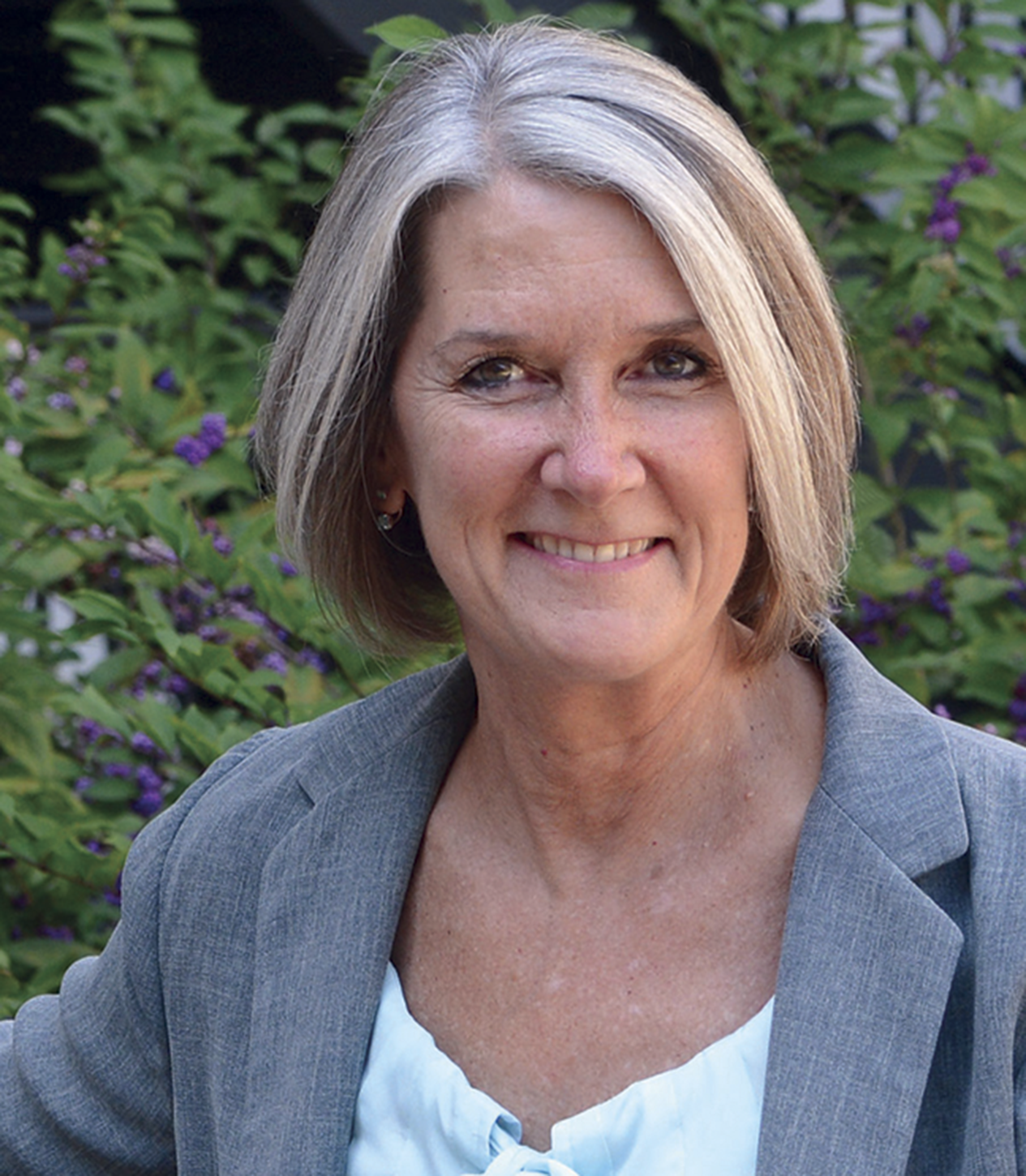
Welcome to my Inaugural Presidential Address! As you might imagine, I’ve spent the past few months trying to visualize what this moment would be like. I can’t lie—that first step out on this stage from behind the curtain was somewhat overwhelming. And then I look around this room and see I am surrounded by occupational therapy friends, professional colleagues, energized students, and a fair number of skeptics to keep me on my toes. I also feel the love from my University of Kansas Rock Chalk Jayhawk nation, and from my personal tribe of close supporters—my family, my fella, and my friends. One special shout out to my dad in the audience today, which also serves as a disclaimer, for I come from a long family tradition of pastors. So, I’ll try to not be too preachy today, but if it happens, know that I do come by it honestly. As I start, I ask for your grace in the places where I stumble. I am truly thankful that you are here with me today.
Who knew that the nontraditional student sitting in the back row of class in the mid-1980s would one day say yes to the nudge to consider serving our profession in this way? Not me! Yet, I do stand before you as the 31st president of the American Occupational Therapy Association (AOTA). I receive this baton from President Amy Lamb, who has served with integrity, decisiveness, and passion for our profession. I am grateful for her mentorship and leadership. Today, I am here to begin my own leadership journey as AOTA president. I am honored by your confidence, humbled by your support, and strengthened in knowing I do not serve alone in this role. Look around—we are all in this together!
When I was asked about a title for my inaugural presidential address, it took a minute to land on it, because I didn’t know how I wanted to set the stage for my term. I don’t have a presidential theme for the next 3 years; instead, I want to embrace the journey to meet the needs of our profession, and you as the occupational therapy workforce, as it unfolds.
Let’s face it, our profession has been experiencing substantial growing pains. Presently, the road we travel is paved with uncertainty and opportunities. We’ve experienced the swing from the celebratory high of our 2017 Centennial Celebration to the reality of internal and external challenges related to entry-level professional preparation, payment and practice shifts, and new service delivery directives—all during a contentious political, economic, and societal climate.
Additionally, I’ve observed and heard difficult exchanges between Association bodies and professional colleagues that have been productive and constructive to our collective growth efforts, as well as some worst-case scenarios that have been polarizing and destructive to the very fabric of our occupational therapy profession. Although debating our future is important, we’ve created our own pain in some spaces.
Through all of this, I want you all to know that your AOTA national office welcomes an open window of opportunity to examine Association structures, operational practices, and governance policies to ensure better transparency, improved responsiveness, and greater efficiency. In case you missed it, I purposefully identified this as a period of growing pains, acknowledging that what we are dealing with is hard. That does not have to be a bad thing—growing pains can equate to growing gains. However, it is human nature to have a “me” focus, especially when facing challenges. That said, it is also human nature to come together and support one another. I urge us all to be human and consider a “we” focus.
We must collectively respond to changes that are happening within and around our profession . . . and grow. We can’t sit watching on the sidelines, nursing hurt feelings, instead of being in the occupational therapy game. Although I’ve always been a great back row girl, I’ve never viewed the occupational therapy profession as a spectator sport. Neither should you. We need everyone to be an engaged and active participant in our profession . . . starting now!
Back to Basics: The Three Rs
In the promotional blurb for this Inaugural Address, I referred to getting “back to basics” with the “three Rs.” What do I mean when I say “back to basics”? I mean stressing simplicity when things seem complicated and making a commitment to fundamental principles to ensure that we advance boldly into the 21st century. We must “matter more” to and for others, which means occupational therapy must be essential and relevant moving forward (Styrlund & Hayes, 2014).
Of course, “three Rs” means different things depending on the person and context. Most of us are familiar with the education-focused three Rs of “reading, ’riting, and ’rithmetic” as the basis for sound learning—in effect, a base for life success. For many of us, the three Rs bring to mind a more environmentally conscious reference to “reduce, reuse, and recycle” to cut down on waste and support sustainable living. For some of us—either because we lived it or because we value lessons from history—the three Rs capture key elements of President Franklin D. Roosevelt’s New Deal in the wake of the Great Depression—“relief, recovery, and reform.” Primarily, the New Deal aimed to alleviate hardship experienced by regular everyday people, safeguard against another wave of economic and infrastructure collapse through policy and programs, and interject stability and hope at a very downtrodden time in our country. Although not free from controversy and differences of opinion, the legacy of the innovative New Deal endures. Have you been to a national park lately? If so, thank FDR!
Today, I share my three Rs—“relationships, resilience, and relevance”—as they relate to our profession at this point in time, a time embroiled in some uncertainty but also ready for stability and ripe for innovation and transformation. It is time to reset our focus on restoring and creating meaningful yet strategic relationships, embracing our collective strength and capacity for personal and professional resilience, and committing to innovative “doing” to ensure our relevance as a health and human services profession and a member-focused association. It is my goal that you receive this address as a message of simplicity and hope for the occupational therapy profession as well as a declaration of my own grounding values and focus as your next president.
Relationships
The first R I’d like to address is relationships (Figure 1). I chose to address this R first because relationships are central to who I am—in my personal life, in my professional life, in my views about society, and in how I aspire to serve as your president. Also, I appreciate great music, including a particular love for New Orleans jazz and the upbeat zydeco sound. Both genres capture my love for rich but complex interactions between people and groups with the end goal of making harmony out of both aligned and disparate chords in a way that makes sense . . . and that sounds amazing. Think about the individual effort made to produce sound that contributes to the final composition, in concert with others. It’s not always easy . . . not always cohesive . . . not always on beat, if you will . . . but the commitment to come together and respect the individual sounds as part of the whole—now, that is music to my ears!

Relationships.
Let’s think about relationships and what that word means. An article in Forbes magazine articulated a difference between relationship and partnership. The definition of relationship is “an ongoing connection that may or may not outlive our current circumstances” (Appel, 2017, para. 13). This definition suggests variance in time, connection, and desired outcomes, with an almost transient or situational quality to the connections. At first, I didn’t like this definition. I value my relationships with others. People matter to me. I hold relationships close. However, when I stepped back, I recognized some truth in these parameters. Like many of you, I have relationships across the continuum from people I connect with annually for my Big 12 basketball tournament marathon with my sister, to my monthly book club friends who share my love for stories and wine, to my professional relationships, both new and long-standing, with some of you. I value my relationships and do my best to care for people and experiences.
So, although relationships are about connection,
A partnership is a commitment to an ongoing relationship. We recognize that breakdowns will occur. When these happen, we’ll do what it takes to move through them. We take responsibility for our reactions and don’t blame the other for what it evokes in us. We stay in connection and explore together. (Appel, 2017, para. 14)
Healthy relationships are foundational for strong internal and external partnerships. We are able to carry them both out only through civil words and actions anchored in trust and respect.
We have got to embrace civility in our exchanges with others. Let’s start with inclusion and providing the welcome, civil space that ensures opportunities for all interested people to see themselves actively participating in a meaningful way. Let’s consider the power of acceptance and tolerance in our relationships, recognizing all perspectives as future possibilities with merit rather than as threats to the status quo or our egos. How about mutual respect, kindness, and compassion as critical for strength in our relationships and partnerships? Friends, we have work to do!
In early March, I had the privilege of spending time talking with occupational therapy colleagues in Connecticut. While there, I was asked, “As you come into your role as AOTA president, what do you see as the greatest internal challenge to our profession?” My honest answer was that I was concerned about civility, or rather the lack of civility as observed in interactions within our profession’s workforce.
Generally, I am encouraged by our collective civility. We are kind, respectful, and supportive even in disagreement or when working through wicked problems. But I’ve been disheartened over the past several months by the increasing tone of incivility and the ease with which such exchanges take place in verbal and written communication, especially on social media, at the expense of other people and our profession. Admittedly, we’ve struggled with how to navigate uncertainty, ambiguity, change, and differences of opinion. I’ve witnessed an increase in incivility. Am I the only one seeing . . . hearing . . . feeling it? I don’t think so! Is this rise in incivility isolated or unique? No—it is on the rise all around us. But that does not give us a pass to ignore this issue. In my office, I have a sticky note on my desk that reads, “Don’t raise your voice; improve your argument.” Some of you have been raising your voice, so to speak—you’ve been vocal. We appreciate your engagement. However, it is important for all of us to understand that most people do not hear the message when we are uncivil. More than that, however, incivility undercuts relationships and partnerships. We do not have time or energy for that. We can do better! We can—we must—embrace civility.
One last point I want to make about relationships is the importance of connecting and being civil more broadly, as a society and in service to the greater good of humanity. David Brooks (2019), a columnist for the New York Times, called on us to be a “nation of weavers” by increasing our connections with others and our capacity to embrace and celebrate differences. Brooks started Weave: The Social Fabric Project through the Aspen Institute to support an inclusive rather than isolationist approach to social interactions and support systems. He challenged us to weave a social fabric that recognizes our interdependence and supports relationships that unify us rather than rip us apart. Applied to our profession, I like this challenge! Are you a fabric weaver or a ripper? Each one of us needs to do our part to weave, not rip—to strengthen the integrity of our occupational therapy fabric.
Resilience
The second R is resilience. To me, resilience is when people experience life and acknowledge difficulties or downturns, yet they persist, they adapt, they move forward. Personally, I’ve come to appreciate resilience through my family upbringing, my Midwest roots, and my professional journey over time.
My family has shared a lot of love and closeness, but we have also shared many hard lessons learned, tough times that were out of our control, and difficult decisions we made that were very much within our control but came with great risk (Figure 2). Individually and collectively, we’ve hit a few bumps in our road, but we are survivors . . . we are resilient.
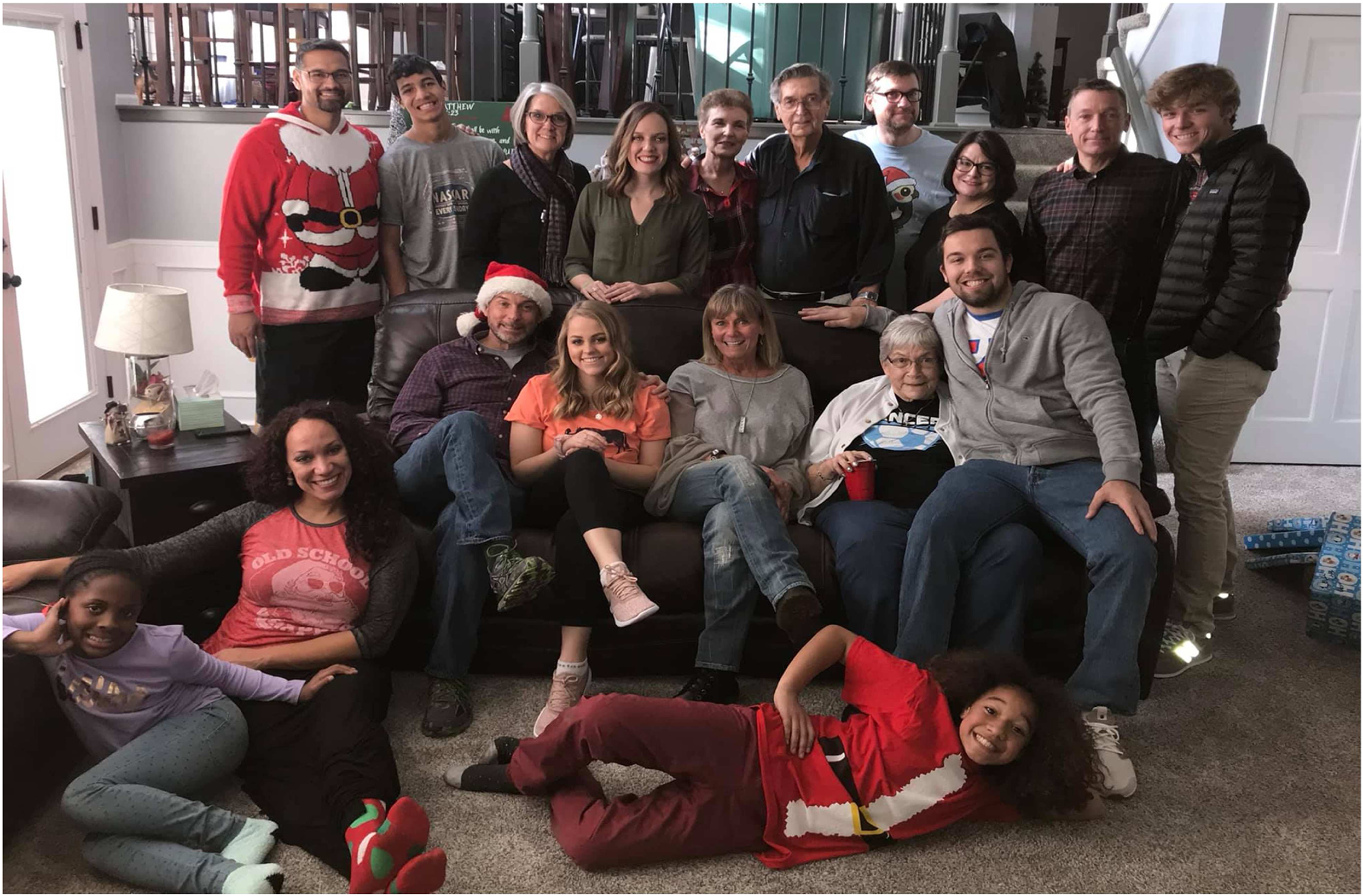
The author and her family.
As a Kansas City girl, I live in an area where spring can bring destructive tornadoes and flooding, but that also provides fertile ground for developing “Midwest values” such as hard work and stick-to-itiveness, friendliness, individual integrity and humility, and willingness to help others by doing good deeds. In the book The Small-Town Midwest: Resilience and Hope in the Twenty-First Century, author Julianne Couch (2016) channels her Midwest upbringing into an investigative examination of place, of motivation for staying in place (or not) despite challenges, and of the importance of porous boundaries in support of permanence, mobility, and sustainability. Her work captures the meaning of resilience and hope and speaks to me as a lifelong resident of Middle America and as an occupational therapist of 30 years. Like me, Couch references familiar Midwest values and characteristics such as friendliness, a strong work ethic, and daily living practices based on trust. She also outlines the annoyances of being viewed as a political monoculture and, my personally least favorite identification of the Midwest, as “flyover country.” This view is shortsighted, to say the least. Warning: Please do not overlook or underestimate the spunk of a strong Midwesterner!
Occupational therapy practitioners often engage with and are regarded by others in a Midwest kind of manner, right? We’re friendly. We’re the team players! We trust others to be kind and honest, and to stay in their lane! We respectfully engage in active listening to hear different viewpoints while internally rehearsing our occupational therapy elevator speech or committee stand on an issue. We often bemoan the need to routinely educate others about occupational therapy and feel dismissed or overlooked in some bigger systems discussions. Unfortunately, some see us as “nice” to have around, but not essential to desired outcomes as part of a team or program. That is not OK. We must take proactive steps to set the record straight by our words and actions—that yes, we are essential! So, I extend the warning I just offered to say, Do not overlook or underestimate the spunk of a strong occupational therapist, occupational therapy assistant, or occupational therapy student! But spunk is not enough. We have an individual and collective responsibility to strategically prepare, position, and elevate our profession and our workforce so occupational therapy survives and thrives through the 21st century.
In The Small-Town Midwest, Couch (2016) states,
Resilience of place doesn’t exist if people see themselves simply as inhabitants there. It exists if people see themselves as stewards, understanding they are responsible for knowing the place’s story, its challenge, and striving to keep the collective porch swept. . . . A town [or, in our case, a profession] that doesn’t come together to plan how to keep the doors open, and then see those plans through, is likely to falter, and lose population to the point that it cannot be sustained. (pp. 2–3)
“Cannot be sustained” . . . let me ask, does this statement scare you? I won’t suggest that it should or not, but I will assert that the relevance and sustainability of our profession depend on all of us working together to “sweep the porch,” proactively plan, and take steps to remain viable and valued in health, education, and human services environments. When you get down to basics, resilience ensures sustainability and survival.
Sustaining our profession will not be possible if you are simply doing your job or waiting for AOTA to be the ultimate problem solver during tough times. AOTA is not a building in Bethesda, Maryland; rather, we are AOTA. Everyone inside and outside this room—member or nonmember of AOTA—must be an active steward for our profession. This means being informed by and sharing accurate information (not biased spin or one-sided debates), being alert and responsive to opportunities that expand our occupational therapy footprint, and being ambassadors for occupational therapy. We are not—and cannot be—a flyover profession.
Quoting the late Elizabeth Edwards, Couch (2016) observes that resilience begins with accepting new realities (p. 2). Admittedly, this might be hard to hear; part of our new realities may not align with our expectations as we look to the future of occupational therapy. We all have choices to make regarding the attitude we hold about our work, the approach we take in professional conversations with others, and the ways we serve our profession. AOTA is embracing this period of uncertainty and challenge as an opportune time for transformation. I hope you can evolve with us . . . we need you.
On a collective level, it is possible that our profession’s new reality might include changing where or how we work, rethinking payment models, and broadening our service delivery lens to serve populations and communities as well as individuals and families. Our shared reality requires that we demonstrate authentic occupational therapy as an essential element of cost-effective solutions in hospitals and skilled nursing facilities, in school systems and transition programs, and in community mental health settings and health promotion–focused initiatives.
On an individual level, each of us must strengthen our resolve to provide quality occupational therapy services. In Amy Lamb’s 2017 Presidential Address, she urged us to stand firm in our professional ethics and assert ownership of our practice decisions. Her charge was timely and timeless; we are each responsible for decisions we make about not only how we practice but also how we educate, how we research, how we advocate, how we publish, and how we represent occupational therapy. Also, we make personal decisions about how we “walk the talk” related to caring for ourselves and others. At AOTA, we’ve heard your concerns about burnout and compassion fatigue. We continue to listen and are working to identify ways to best support you.
Several national initiatives have raised the visibility of clinician stress and burnout and identified resilience strategies for those of us working in the health, education, and human services workforce. Most recently, the Institute for Healthcare Improvement released the IHI Framework for Improving Joy in Work to help health care organizations improve professionals’ experience of providing care, asserting that finding joy and meaning in work is central to workforce engagement, productivity, and effective systems (Perlo et al., 2017). Finding joy in our work can build our professional resilience. Resilient occupational therapy professionals and students are empowered occupational therapy professionals and students.
During my presidency, professional resilience and clinician well-being will be a priority in the Association’s efforts to serve you well. Professional resilience is “a health and human service professional’s commitment to achieve balance amid occupational stressors and life challenges, while fostering professional values and career sustainability” (Fink-Samnick, 2009; 2017, p. 251). Although I’m concerned about the health of our occupational therapy workforce during this time of uncertainty, I have great faith in your capacity to respond to change—the resilient you! Professional resilience requires that each of us invest in physical and psychological self-care, a foundation of inner strength, a definition of personal and professional value, identification and achievement of personal and professional goals and aspirations, and self-advocacy (Fink-Samnick, 2009, 2017). Together, these investments can increase the meaning and joy you find in your work, ultimately enhancing your career satisfaction and longevity (Fink-Samnick, 2009). I ask you to make your own professional resilience, well-being, and overall health a high personal priority.
As a profession, while we hold tightly to foundational principles that ground us, we must also embrace growth practices and proactive visioning that will allow us to reach beyond internal boundaries and external barriers. We need to stabilize our roots and branch more securely into environments and populations that can benefit from occupational therapy. We must reach, we must stretch, and we must be willing to endure purposeful growing pains that will highlight our profession’s strength and capacity to maximize health, well-being, and quality of life for all people, populations, and communities.
Relevance
As a Kansas girl, I ask you to follow this yellow brick road with me. Eighty years after The Wizard of Oz was released, most of us are familiar with Dorothy and friends and their harrowing journey to visit the Wizard of Oz, all walking (sometimes running and even falling) down the path to retrieve lost personal elements and find a way home. Dorothy and her mischievous but loyal dog Toto were searching for how to return to Kansas after an unpredictable tornado upended their lives and they found themselves in uncharted territory surrounded by unfamiliar people. Of course, Scarecrow was searching for his brain, Tin Man for his heart, and Cowardly Lion for his courage. Dorothy and her friends (Figure 3) sought relevance through the identification and expression of their gifts and strengths in a manner that would serve them well. Their relevance ensured their survival and opened the door for contributions that were authentic to them and meaningful to and valued by others.

Relevance.
The path to finding relevance and discovering how we can “matter more” as a profession is not an easy one. We must watch for twists and turns in the road, attack by “flying monkeys,” and the threat of “poison poppies” that put us to sleep. We want it to be a path of our choosing, not a path dictated by other people, systems, or our own apathy. We must define our own relevance.
We all want to be relevant. I would say that most of us have experienced or anticipated feeling irrelevant at certain points in our lives, and that does not always feel good.
On a personal note, I have two amazing daughters who continue to grow into independent, smart, beautiful, kind women, and as they’ve grown, they have called on me differently than in the past. We still love and value one another, but our relationships have changed over time, in a good way. I see this change as growth, in spite of a few “mommy” growing pains, yet I embrace the ways I remain relevant and matter to them as they live their adult lives.
On a professional note, I recently had the opportunity to spend time with Kitty Reed at AOTA’s national office working in the Wilma L. West Library. As an occupational therapy historian and disciplined librarian, Kitty’s expertise is valuable and needed as AOTA cares for our profession’s historical records and documents. When thanking Kitty for generously sharing her time and talents to support this effort, she stated with a smile, “At this point, this is how I can contribute.” Kitty continues to make meaningful contributions and remains relevant!
Looking back to this year’s opening ceremony, as Grace Damman and Fu Schroeder shared their story, something Grace said really struck me—that she had had to think about and decide, “How do I make the most of this precious life?” Another way to capture that question could be, “How do I stay relevant?” As a profession, we must ask questions about our relevance as well, and we must have answers. Do others still want what we have to offer? How and where can we make the most meaningful contribution? Do we still matter? Are we still relevant?
As a helping profession, we are here to serve others, but we will have an impact on others—be relevant—only to the extent that we “matter more” to them. Our relevance is determined by others—by how the world sees who we are and how others value our contributions as a profession.
As a profession, we often worry about the unpredictability of change—payment, policy, personnel, society, our own competence—but more specifically, we worry that the changes that surround us will best us before we figure out how to adapt. Many times, we are reacting and responding to change rather than seeing the full landscape, recognizing the realities we face, and proactively setting our course forward. Change is a lot less threatening and scary when we realize that relevance is the answer.
Yes, as a profession, we are experiencing change, and yes, some of the changes ahead might be hard, but we’ve done hard before, and we will come to the other side of change again as a strong, relevant profession. We must recognize that maintaining or establishing relevance takes work. Relevance is not doled out like a participation trophy, and it is not up to others (not even AOTA) to make us relevant. Being relevant is up to each one of us. I encourage all of you to be the best you can be in your present work, but we also need to be very interested in discovering unmet needs that can be addressed by intersecting with authentic occupational therapy. Addressing unmet needs is going to help us “matter more” to others.
I’ve spent time thinking about relevance, specifically about how we as occupational therapy professionals and students can ensure that we “matter more” in our hypercharged and hyperchanging world (Hinojosa, 2007). In their book Relevance: Matter More, Styrlund and Hayes (2014) identified four key dynamics of relevance that can be applied to our profession. Their formula combines authenticity, mastery, and empathy with action to capture the critical nature of relevance. I touch on each of these next.
Authenticity
Authenticity is being true to self and real to others. To be authentic, we must step outside of ourselves, look behind the curtain, and seek what is real and true about us. This means being honest in our assessment of our strengths and limitations, of our constraints and capacity, so we have an accurate picture. That said, we must be tethered to reality, or we are not authentic.
Sometimes reality or authenticity comes to us through a “great humbling” experience in our life. As a profession, we’ve been humbled by policy changes, reimbursement shifts, and societal needs. A great humbling is a crisis that shakes and wakes us, which I believe is happening at this time in our profession. We can learn from past humblings, yet replicating our response to then might not be our best response to now. Regardless, we are shaking in some places right now and need to secure our road to stability. A great humbling requires another three Rs: respiration, reckoning, and reconstruction.
First, respiration—take a deep breath! Breathing allows us to pause and regroup to see another day. It’s hard sometimes, but critical to survival.
Next, reckoning is the process of acknowledging change and loss and looking in the mirror to reflect on what is or is not happening. When facing change or crisis, we do have choices. At any fork, one path represents change, and perhaps greater authenticity, and another represents preservation of a status quo that might be less relevant in the changing world around us. Unfortunately, not everyone does well in this space; some people get bitter, some blame others without looking at themselves as well, some become insular and surround themselves with people who align with their “reality.” If this issue makes you uncomfortable, I urge you to consider why. Are you struggling with authenticity or change? Clarity isn’t always comforting, but it is honest and authentic (Styrland & Hayes, 2014, p. 60).
Finally, reconstruction is the opportunity to shore up necessary structures and supports and to rebuild as part of change and growth. We can create space for innovative thinking and unlock energy for transformative doing. We can identify and clarify our strengths and limitations and take actionable steps to own the DNA of our occupational therapy profession and our Association.
Mastery
Happiness is foundational to mastery. When we are unhappy, we have nothing to give, no energy to expend, and no motivation to improve. Additionally, happiness and our commitment to mastery can be undercut by entitlement, learned helplessness, and comparisons (Styrland & Hayes, 2014, p. 88). We must be better than good—we must be masterful . . . be great . . . be awesome! Mastery does not require perfect conditions or perfect timing, but it does require you to do something. “Better to be yourself than to imitate the best self of someone else” (Styrland & Hayes, 2014, p. 77).
Empathy
Empathy serves as the docking station of relevance—the space where all else is grounded and charged. In To Kill a Mockingbird, Harper Lee (1960/2002) reminded us that “you never really understand a person until you consider things from his point of view . . . until you climb into his skin and walk around in it” (p. 33). I’d say that captures empathy related to our relationships and interactions with others. We must have a desire to be of service to others and know how to listen so we can understand and actively serve best.
Action
Finally, action, as the driving force behind relevance, is critical. “No matter how authentic we are, no matter how much mastery we achieve or how much empathy we cultivate, relevance is impossible to attain without action” (Styrland & Hayes, 2014, p. 138).
In my neighboring state of Missouri, I’ve spent many Saturdays floating on rivers, and I assure you that action is key to a successful float trip (Figure 4). The first rule of paddling a canoe down a river is that to truly steer the canoe, you must be going faster than the river, which is possible only if you have an oar in the water and are paddling hard. Likewise, if we as a profession are merely going with the flow, we will never be able to choose where we go. We must have oars in the water and paddle faster than the current that surrounds us and wants to direct us.

Action.
We must do more than just tell people that they need us. We must demonstrate our distinct value, and we must demonstrate this now. What does action look like in your practice or professional arena? Do you share the evidence you use as a basis for practice? Do you encourage practice using manualized therapy approaches and share examples of their application in your work? Do you elevate your practice by gathering data to support your efficacy in your work? Do you engage colleagues to work on enhancing skills and crafting innovative solutions to meet client needs? These are spaces where we need to act, remembering that there is no relevance without action.
Dorothy (with her sidekick Toto), Scarecrow, Tin Man, and Cowardly Lion—they enact a story of relevance. Now, let’s not forget that they came together after a tornado upended homes and left unwelcome debris behind. Yet they linked arms and supported one another to meet their individual goals, but as part of a shared mission toward relevance. They conquered uncertainty and anxiety by acting—by taking that first tentative step on an unfamiliar road. Through their journey to see the wizard, they came to realize that they themselves had the power to move forward, to be innovative, to transform their own future path as well as the legacy they would leave behind. In the spirit of Glenda, the Good Witch—yes, they had the power all along! So do we!
Conclusion
To bring this message home, I’d like to sum up the three Rs of relationships, resilience, and relevance. First, our relationships with others ground the personal lives we lead, the professional work we do, the interprofessional and intraprofessional partnerships we forge, and our shared hope for the future of occupational therapy. Internally, our relationships with each other either sustain or drain us; they can create space for innovation or fortify barriers to change. We must own our decisions about how we relate to others; your approach to relating is up to you. I urge you to opt for civility and authenticity in your professional and personal relationships with others.
Second, being rooted in resilience ensures that we have the capacity to stand firm in hard situations when necessary and the willingness to strengthen and lengthen our reach to support growth as a profession, even when we experience the stretch or redirection as growing pains. Professional resilience also means knowing when to walk away from people and places that do not align with your personal or professional values and that threaten to compromise your authenticity as an occupational therapy professional. I urge you to set the daily intention to walk the talk of self-care and self-compassion as an occupational therapy professional and as a human being.
Third, we must be relevant! We must be authentic in our demonstration of occupational therapy. We must identify and master the knowledge we need to elevate our profession. We must exemplify empathy in our personal and professional relationships and in our responsiveness to the unmet needs of others and society. We must deliberately choose to act . . . to act now . . . and to act boldly! We must “matter more.” We must get back to basics!
Finally, I want to assure you that I am eager to serve you and our profession in this role, and yes, I know that we are entering a time of transition and transformation. Now, it is fair to say that a few key details and a couple of surprises have come to my awareness. To all of that, I say, Let’s do this! I am committed to serving you and occupational therapy in the next 3 years from a foundation of hope, optimism, and joy. As my then 4-year-old grandson Gaffin told me while gathering yard tools for a busy outdoor afternoon, “I’m glad I have my special gloves, Mammo! We have important work to do here!” I agreed with him then, and I believe his statement holds true now. We all have important work to do here!
Charge to Our Profession
As I close, I share a challenge, a dare, and my hope for you. First, I challenge you to look forward with a hopeful lens about the future of our profession. In the book Making Hope Happen, psychologist Shane Lopez (2013) talked about “nexting,” or looking forward to what’s next with positive anticipation. Yes, there will be easy days and tough times, yet I ask you to be grounded in positive anticipation. No hope is ever too small!
Now for the dare! Time magazine’s February 2019 special issue focused on “The Art of Optimism.” I identify with filmmaker Guillermo del Toro’s (2019) view that “believing is an act of rebellion.” I’ve always been a bit of a rebel, so this speaks to me . . . and I want it to resonate with you. Del Toro asserts that optimism is the hard, brave choice: “Optimism is our instinct to inhale while we are suffocating. Our need to declare what needs to be in the face of what is. Optimism is not uncool; it is rebellious and daring and vital.” Do you hear that? I dare you to be optimistic!
Finally, my hope for all of us is that we engage in our personal and professional lives such that we experience happiness and joy. We have much to be excited about and many reasons to move forward with positive anticipation. What if the best is yet to come?