





Abstract
Fieldwork is an integral component of occupational therapy education. Many occupational therapy clinicians volunteer to serve as fieldwork educators, but occupational therapy education requires only minimal formal training on how to be an educator (Koski et al., 2013; Provident et al., 2009). Barton et al. (2013) found that 52% of fieldwork educators reported receiving no training for their role as fieldwork educators, although those who did receive training experienced significantly lower role strain. Experience as a clinician does not automatically prepare a therapist to be a fieldwork educator (Hanson, 2011). Many occupational therapists rely on their experience as students to inform their own teaching style (Provident et al., 2009), but using experience is only one part of evidence-based practice, which also includes accessing published evidence (Taylor, 2007).
The Accreditation Council for Occupational Therapy Education (ACOTE®; 2017) requires academic programs to provide evidence that their fieldwork education represents collaboration between the academic program and its fieldwork educators. Academic programs are also required to provide support and training to fieldwork educators.
Fieldwork educators value ongoing relationships with academic programs (Hanson, 2011; Hook & Lawson-Porter, 2003) and want additional teaching or support for the role of fieldwork educator (Kirke et al., 2007). Fieldwork educators also value opportunities to create support networks for this role (Hanson, 2011; Mackenzie et al., 2001; Scarvell & Stone, 2010) and to communicate and learn collaboratively with other fieldwork educators (Hook & Lawson-Porter, 2003). Specifically, fieldwork and clinical educators desire training in such practical skills as giving effective feedback (Hills et al., 2012; Mackenzie et al., 2001) and managing interpersonal issues or conflict (Hanson, 2011; Higgs & McAllister, 2005).
Evidence suggests that role training is effective in changing and improving clinical educator skills. After training, fieldwork and clinical educators have reported high levels of satisfaction with learning and increased confidence in their role (Hook & Lawson-Porter, 2003; Mackenzie et al., 2001; Scarvell & Stone, 2010; Sellars & Clouder, 2011). In addition, an audit in England found that 77% of participants who completed fieldwork training subsequently supervised a student (Craik et al., 2004). Moreover, studies of the physical therapy profession have found that students give credentialed clinical instructors (i.e., those who completed a standardized preparation and credentialing course) significantly higher teaching effectiveness scores than they do noncredentialed clinical instructors (Housel et al., 2010; Morren et al., 2008). Credentialed clinical instructors have reported frequent use of the teaching and supervisory behaviors presented in the credentialing course (Bridges et al., 2013; Greenfield et al., 2012).
Even though role training for fieldwork educators is important, challenges associated with traditional courses and workshops include travel, time, and cost. Fieldwork educators have reported desiring online and flexible options for role development (Hanson, 2011) that focus specifically on issues related to fieldwork education. Therefore, novel approaches need to be further studied to support fieldwork educators.
Online Journal Clubs to Facilitate Role Training
Traditional journal clubs are a simple, collaborative way to stay current with evidence and consider the application of current literature to practice (Honey & Baker, 2011). A systematic review of 16 studies provided strong evidence that journal clubs are effective in improving both clinical and literature reading skills. In this review, 94% of the included studies reported improvement in skills, knowledge, or behavior; critically, though, the review suggested that accommodations must be made to allow for staff participation during normal working hours (Honey & Baker, 2011). Whereas traditional journal clubs are synchronous and occur face to face, online journal clubs facilitate asynchronous collaboration among working professionals at different times and in different locations.
Evidence to date suggests that online journal clubs are both feasible and effective in the health professions. Wutoh et al. (2004) found that internet-based learning is as effective as traditional learning techniques. One study found that online journal clubs in nursing resulted in increased confidence, understanding of the evidence, and connectedness with colleagues (Sortedahl, 2012). The same study found that immediately after the journal clubs, participants intended to apply the new information by advocating, reflecting, educating, reading more evidence, and changing practice priorities. At a 1-mo follow-up, all participants had acted on their intentions and engaged in at least one such application activity (Sortedahl, 2012). Eighty percent of respondents in a more recent nurse-driven online journal club reported that participation had improved the quality of their practice (Garlinghouse & Frank-Scott, 2015).
Academic programs have also effectively incorporated online forums into training for clinical educators. In a study by Schreiber and Dole (2012), physical therapy clinical instructors participated in a 16-wk online forum after a course. Schreiber and Dole found strong participation (91%) in online discussion, with the discussion content focusing mainly on strategies to implement practice changes. In addition, they reported statistically significant, positive results regarding knowledge gained after participating in both the course and online discussions (Schreiber & Dole, 2012). A similar study reported positive changes in both knowledge and behavior as a result of a course combined with an online discussion board (Schreiber et al., 2013).
Occupational therapy fieldwork educators report limited time for role-specific development (Hanson, 2011; Hook & Lawson-Porter, 2003). Online journal clubs are successful precisely because of the 24/7 availability of the asynchronous written discussion platform and the selection of role-relevant articles (Lin et al., 2017; Peacock et al., 2016). Guided by the existing literature, one of the authors of this article (Ellington) conducted a pilot online journal club with occupational therapy fieldwork educators affiliated with her college (Mary Baldwin University). Participants overwhelmingly reported that the journal club was worthwhile. They found the article to be role relevant and reported that the online journal club gave them the opportunity to collaborate with and learn from colleagues in diverse settings and locations (Ellington, 2018).
The purpose of this study was to replicate and extend that pilot work in a larger, more diverse multisite online journal club for occupational therapy fieldwork educators in different practice settings and parts of the country. The specific research question was whether a multisite online journal club would be acceptable and effective in role-specific training of occupational therapy fieldwork educators.
Method
Design
This mixed-methods study used a prospective cohort design. The institutional review boards of both Mary Baldwin University and the University of Missouri approved and oversaw the study. All participants provided informed consent. Quantitative findings were supported by qualitative results that provided context for and further insight into behavioral strategy development and implementation. In addition, qualitative themes were triangulated against quantitative findings.
Participants
We were academic fieldwork coordinators at our respective institutions throughout the study and used purposive snowball sampling with a target of 24 total participants (12 participants at each of two sites). We queried the fieldwork database at our respective institutions to identify fieldwork educators and coordinators at Level II fieldwork sites affiliated with that institution. We then sent an invitation email to all matching database entries with a valid email address. The email included inclusion criteria and instructions to share the email with any other potentially eligible occupational therapists at the facility. Inclusion criteria limited the sample to currently licensed occupational therapists who were employed at facilities currently contracted for fieldwork education with either host institution and who had access to a computer and internet service. Potential participants contacted the investigator from whom their invitation originated. That investigator replied with an email including a link to the electronic informed consent document.
Journal Club and Survey Instruments
Participants who completed the informed consent document were directed to a presurvey. The presurvey included 13 background and demographic questions related to education, experience, practice setting, fieldwork education experience, and fieldwork-specific training (Figure 1).
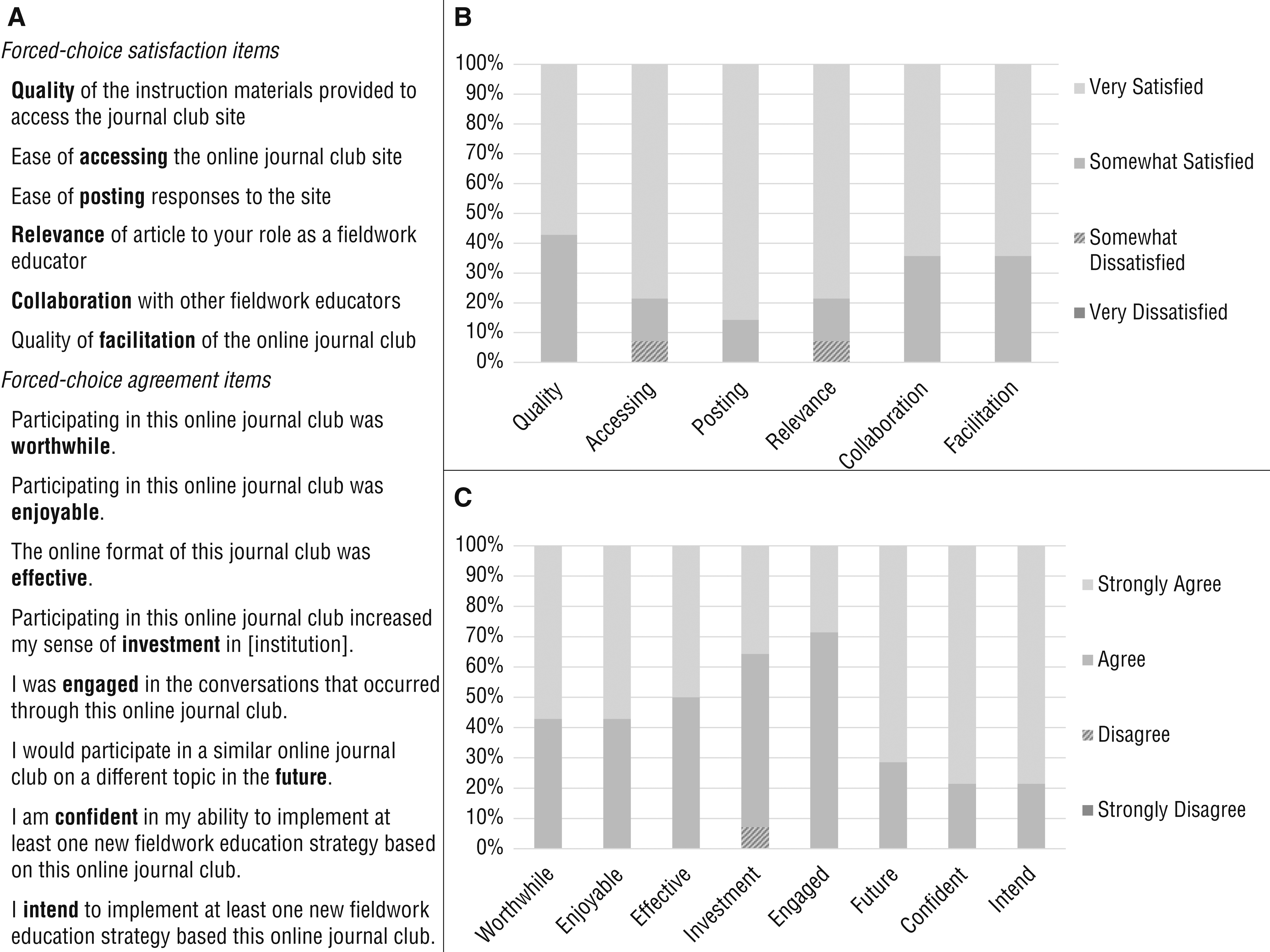
Postsurvey satisfaction and agreement responses: (A) item prompts, (B) forced-choice satisfaction responses, and (C) forced-choice agreement items.
Those who completed the presurvey were then provided instructions to access the online journal club and the article to be discussed, “The Impact of ‘Generation Y’ Occupational Therapy Students on Practice Education” (Hills et al., 2012). Reproduction rights were purchased from the publisher. The online journal club was conducted on a private WordPress site (Automattic Inc., San Francisco), restricted to registered participants. On each Monday for 4 wk, we emailed participants instructions to read a section of the article, discussion prompts, and a reminder to post a comment to that week’s conversation page and respond to at least 1 other participant’s comment. The four consecutive article sections to be discussed were (1) Introduction and Methods, (2) Results (Part 1), (3) Results (Part 2), and (4) Discussion and Conclusion. In Wk 5, participants were asked to make and share a personal plan to implement the strategies discussed in the online journal club. Participants shared and commented on plans in the same discussion format.
At the end of Wk 5, we emailed a link to the postsurvey, which included 20 questions. Fourteen forced-choice quantitative items addressed participant satisfaction and perceptions of the online journal club. Six free-response items checked for comprehension and asked participants to reflect on their learning and to report behavioral strategies that they planned to implement as a result of the online journal club.
Six months after Wk 5, a follow-up survey was sent to all participants. The follow-up survey reminded participants of the behavioral strategies they had identified on the postsurvey and asked whether they had followed through with those strategies (forced choice, yes or no). Those who answered yes were then presented with a forced-choice, yes-or-no item asking whether they found the strategy beneficial. Those who answered that they had not implemented at least one strategy were presented with a free-response item asking why they had not implemented their identified strategies.
The surveys were modified from previous work by the first author (Ellington, 2018). Although the original survey items demonstrated obvious face validity, revisions were made to increase both content and construct validity. As yet, none of the instruments has been subjected to formal reliability or validity testing.
Analysis
Participants who did not complete all phases of the study were excluded from analysis. We summarized presurvey sample characteristics using descriptive statistics. We used independent-samples t tests, Mann–Whitney U tests, and χ2 tests to examine between-groups (institutional) differences in ratio, ordinal, and nominal data, respectively.
We found no significant differences between the two samples; thus, we collapsed all postsurvey and follow-up survey data into a single sample (n = 14). We compiled descriptive data for all forced-choice items and the free-response item on which participants reported time engaged in the online journal club.
Following an established process described by Dillaway et al. (2006), the first author (Ellington) thematically coded and analyzed the free-response narrative data to discover themes related to the most and least beneficial aspects of the journal club, suggestions, and new knowledge gained as a result of participating in the online journal club. The second author (Janes) reviewed the thematic analysis for confirmability and compared the results with quantitative findings to triangulate the qualitative findings.
Results
Twenty-seven participants provided informed consent and completed the presurvey. Eleven participants dropped out after completing the presurvey, and 2 dropped out after completing the postsurvey. Seven participants from each site participated in the online journal club and completed all phases of the study, for a total of 14 participants. The number of participants at each stage is provided in Table 1.
Number of Participants at Each Study Stage, by Site
Presurvey
Demographic characteristics of the sample are provided in Table 2. We found no significant differences between institutions in years in practice, number of students supervised, prior participation in face-to-face or online journal clubs, gender, age, or level of education. Because we did not detect any significant differences between groups, we collapsed all responses into a single sample for all subsequent analyses.
Demographic Characteristics of the Sample
Note. M = mean; SD = standard deviation.
Postsurvey
Participants reported spending approximately 4 hr (range = 3–5 hr) on journal club activities over the course of the 5-wk online journal club.
With three exceptions, participants unanimously reported that they were somewhat or very satisfied and that they strongly agreed with all forced-choice questions and statements about the journal club, including factors such as ease of use, relevance of learning, and satisfaction with the experience (see Figure 1). One participant reported being somewhat dissatisfied with the ease of access to the online journal club site. Another participant reported being somewhat dissatisfied with the relevance of the article to that participant’s role as a fieldwork educator. One participant reported somewhat disagreeing with the statement “Participating in this online journal club increased my sense of investment in [institution].”
All participants provided accurate free-response summaries of the key findings of the article discussed in the online journal club, demonstrating comprehension of the content. All but 1 journal club participant listed at least one fieldwork education strategy they intended to implement as a result of the online journal club. A thematic review of these responses revealed some commonalities among strategies, including plans to more clearly communicate expectations about professionalism and how feedback would be given, maintaining regular meetings with students, encouraging students to seek feedback, supporting student self-reflection, and explicitly discussing communication styles.
Participants also provided feedback about the online journal club experience. When we considered aspects of the online journal club, two prominent themes emerged. First, participants valued learning from other fieldwork educators and increasing their network of colleagues. Second, participants appreciated the opportunity to explore the research and felt that the article’s content was relevant to their role. In addition, multiple participants also valued the flexibility of the online, asynchronous format. When asked for suggestions for the journal club, the most common response (n = 5) was that no improvements were needed. However, several participants (n = 3) did offer the suggestion that facilitators provide reminder emails throughout the week to encourage return visits to the site discussion. A variety of other suggestions from individual participants included posting questions on Sunday rather than Monday, reducing the time spent on one article, slowing down the pace to increase the time spent on one article, including more articles, increasing facilitator participation in discussions, and adding a live chat option.
Follow-Up Survey
Of the 13 participants who had reported a self-generated fieldwork education strategy on the postsurvey, 10 reported that they had implemented their strategy by the 6-mo follow-up. In addition, the 1 participant who had not reported a planned fieldwork education strategy on the postsurvey reported that she had subsequently created and implemented a strategy after the postsurvey, bringing the total number of participants who implemented a self-generated fieldwork education strategy to 11. When presented with their self-reported, self-generated strategy and a forced-choice (yes-or-no) response, all 11 reported that the implemented strategy had been beneficial.
Of the 3 participants who reported not having implemented their self-generated fieldwork education strategies, 2 reported that they had not supervised a fieldwork student in the interim period and thus had not had the opportunity to do so. The third reported that time constraints had limited her opportunity to implement a strategy but that the follow-up survey had prompted her to follow up with her facility’s fieldwork coordinator to discuss the strategy.
Discussion
This study is a meaningful addition to the growing body of evidence demonstrating the feasibility and effectiveness of online journal clubs in the realm of health care education. Although recent studies and publications have explored online journal clubs in the realm of nursing practice or medical education (Chetlen et al., 2017; Lin et al., 2017; Peacock et al., 2016; Rodriguez et al., 2016), there are few examples of the use of online journal clubs within the occupational therapy profession. Given the positive participant responses in this study, the online journal club has merit for further use among occupational therapy practitioners.
Participation in the online journal club was strong, with most participants engaging regularly throughout the 5 wk. This result seems to highlight interest among fieldwork educators in this type of role development and education, interaction, and flexible participation. Although those who completed the online journal club were clearly engaged throughout, 11 participants dropped out after completing the presurvey but before starting the journal club. Previous studies have noted similar challenges with participation and retention (McLeod et al., 2010; Sortedahl, 2012). Other studies have noted that time to participate might be a barrier (Grol & Wensing, 2004; Ottenbacher et al., 2002; Rodriguez et al., 2016), but participants in this study did not report that to be the case; rather, they wanted reminders to participate more often. Although some past studies have reported challenges with technology as a barrier to participating in online journal clubs (Sortedahl, 2012), this was not a significant finding in this study.
Given the importance of translating knowledge into practice, this study included opportunities to create personal action plans and a 6-mo follow-up. The very high action plan implementation rate at the 6-mo follow-up suggests that the online journal club was effective in helping fieldwork educators make positive changes to practice. This finding aligns with the reflections of Lin et al. (2017), who encouraged health care professionals to “actively participate in online discussions to help accelerate knowledge translation” (p. 473).
Participants’ strong positive feedback about the benefits of creating a community of fieldwork educators and learning collaboratively mirrored the results of the pilot study (Ellington, 2018) as well as those of several other studies (Higgs & McAllister, 2005; Hook & Lawson-Porter, 2003; Mackenzie et al., 2001; Scarvell & Stone, 2010). Future iterations of the online journal club should continue to offer the convenience and flexibility of an asynchronous design but may benefit from incorporating other technology to allow live interactions to support networking among participants and connection to the host institution.
Limitations
Although our findings are promising, several limitations must be considered. Most important, our purposive snowball sampling method all but ensured a motivated, engaged sample of participants. Our findings of acceptance and effectiveness would likely not hold up under mandatory participation. Also, our survey instruments have not yet been tested for reliability and validity. Although they have obvious face validity, further development (ongoing) is warranted.
Finally, two technical limitations of the WordPress platform need to be addressed going forward. The WordPress commenting platform is not particularly robust as a discussion tool because it lacks options for threaded discussions or quotations. A better platform may facilitate more in-depth journal club discussions. As with most asynchronous platforms, WordPress does not provide any reliable way to track active time spent in discussion. Continuing education requirements (e.g., National Board for Certification in Occupational Therapy [NBCOT] Professional Development Units [PDUs]) for participation in an online study group assume synchronous communication and require documentation of time spent in the group. Without the ability to track active time, journal club participants can only claim credit for reading peer-reviewed research at a lower PDU conversion rate than for participation in an online study group. A more advanced platform with time-tracking abilities—or revision of the NBCOT requirement to account for asynchronous communication—would increase the continuing education value of the online journal club format for busy practitioners.
Implications for Occupational Therapy Education
This study confirms previous work suggesting that online journal clubs are an effective, engaging way to promote active learning among occupational therapy fieldwork educators. An online journal club facilitated by an academic fieldwork coordinator can lead to self-generated strategies that positively influence the effectiveness of fieldwork education. This approach provides crucial role support to fieldwork educators without adding to already-crowded entry-level curricula.
The results of this work have the following implications for occupational therapy education:
Academic fieldwork coordinators should consider online journal clubs as an effective way to engage fieldwork educators in role-relevant continuing education.
Journal club participants should be encouraged to implement self-generated application plans to follow through on the lessons learned from the journal club.
Additional consideration should be given to the accessibility of the online journal club, including the potential for synchronous online discussion.
Conclusion
We currently have three lines of inquiry and development underway. As noted, formal validation of the survey methods is ongoing. In addition, extensive review of existing online collaboration platforms is needed to identify options that facilitate more engaging interactions and provide more value to participants. Once the instruments are validated and the platform is improved, we plan to intentionally test variations of the online journal club format to improve the effectiveness of practitioners in the field. This research will include comparisons of synchronous and asynchronous online journal clubs to explore both preferences and outcomes among fieldwork educators.
In our study, the implementation of an online journal club for fieldwork educators by two academic programs was successful. This mode of learning and support was largely accepted by fieldwork educators and incorporated mechanisms to promote application of the evidence and new knowledge. This multisite study provides information about a novel approach to supporting the role of occupational therapy fieldwork educators.