





Abstract
Participation in sport has wide-reaching benefits. Evidence from systematic reviews has shown that sport participation is associated with greater cardiorespiratory fitness (Brinkley et al., 2017; Oja et al., 2015) and cardiovascular function (Oja et al., 2015), improved self-esteem and social interaction, a positive subjective perception of health (Brinkley et al., 2017), and fewer depressive symptoms (Eime et al., 2013). Sport is therefore important for the promotion of physical, mental, and social health and well-being and may be used by occupational therapy practitioners to promote these benefits for clients.
The primary mandate of occupational therapy is to facilitate health, participation, and well-being by engaging clients in occupation (American Occupational Therapy Association [AOTA], 2014a). Occupation refers to engagement in any meaningful and purposeful activity that people use to occupy their time (AOTA, 2014a). Engaging in occupation provides people with an opportunity to construct a unique, complex, and ever-changing identity (Taylor & Kay, 2013).
Eight categories of occupation have been identified as affecting people’s health and well-being. The focus of this scoping review is leisure. As an occupation, leisure is defined as “a nonobligatory activity that is intrinsically motivated and engaged in during discretionary time, that is, time not committed to obligatory occupations such as work, self-care, or sleep” (Parham & Fazio, 1997, p. 250). In other words, leisure is an activity people engage in purely for enjoyment during their free time.
Sport is one important leisure opportunity that includes the three elements essential to an occupation as outlined by the Occupational Therapy Practice Framework: Domain and Process (3rd ed.; AOTA, 2014a). In particular, sport includes (1) client factors, including proprioceptive and muscle functions (e.g., hand–eye coordination); (2) performance skills and patterns (e.g., gripping a golf club, running); and (3) a complex environment that integrates physical, social, institutional, and cultural aspects in which roles and routines may be present (e.g., playing a sport every Sunday). Sport is also classified as a serious leisure occupation because it requires a significant investment of time, energy, and resources (Taylor & Kay, 2013).
For specific populations, the outcomes of participation in sport demonstrate a therapeutic element of sport relevant to occupational therapy practice. For instance, a recent systematic review identified that older adults engage in sport to navigate negative stereotypes of aging, to reap overall health benefits, and to foster social connections (Jenkin et al., 2017). A second study showed that participation in sport significantly increases the quality of life of people with spinal cord injuries (Kljajić et al., 2016). In addition, a systematic review has found that engagement in sport has a beneficial effect on the cardiopulmonary system, psychological well-being, physical functioning, and social reintegration for people who have had an amputation (Bragaru et al., 2011). Further benefits of sport were shown in a fourth study (Darcy & Dowse, 2013), in which people with intellectual disability participated in sport to develop new skills, increase well-being, and obtain social benefits such as spending time with others. In addition, occupational therapy’s contribution to clients with mental illness is well recognized, and sport as a therapy can contribute to greater well-being and lower levels of depression and anxiety symptoms (McMahon et al., 2017). As such, sport participation is an avenue that occupational therapy practitioners can use to promote health and well-being.
As we have shown, many systematic reviews and other forms of literature have examined the benefits of sport for health and well-being. However, the number of research studies that have explored the benefits of sport specifically in relation to occupational therapy practice is unknown. Given that occupational therapy practitioners have a rich focus on encouraging health, participation, and well-being and that the evidence is clear that sport is beneficial to physical, mental, and social health and well-being, the body of knowledge on sport in occupational therapy practice needs to be expanded. Thus, the purpose of this scoping review was to explore the extent, range, and nature of sport in the peer-reviewed occupational therapy literature.
Method
Our research question was, “What is the extent, range, and nature of peer-reviewed occupational therapy literature investigating sport as a leisure occupation?” Given the broad nature of this research question, we determined that a scoping review was the most appropriate form of review, because it allowed us to capture a diverse range of literature (Armstrong et al., 2011). This scoping review was informed by the five-stage process designed by Arksey and O’Malley (2005).
In January 2018, we conducted a systematic search (Arksey & O’Malley, 2005) of the literature in the following databases: Embase, MEDLINE, OTseeker, PsycINFO, PubMed, and SPORTDiscus. The search terms used were occupational therap* and a list of 109 sports, such as golf OR basketball (Appendix A). Sports were defined as any “activity involving physical exertion and skill in which an individual or team competes against another or others for entertainment” (Lexico Dictionaries, 2020), such as golf, swimming, or football. The list of sports was extracted from AusPlay (2017) to eliminate nonsporting occupations such as jogging or walking. The search terms were paired with an “adult” filter and an “English language” filter.
Inclusion criteria for the studies were (1) the activity in context met the definition of sport as previously defined, (2) the study was written in the English language, (3) the study included only the human population, and (4) participants were adults ≥18 yr old. Studies that did not have an occupational therapy focus or that included only noncompetitive general physical activity were excluded. There was no restriction by year of publication. Before the first screening phase, we examined and discussed the initial search results to calibrate the inclusion and exclusion criteria to ensure consistency in title and abstract screening, which was performed by one reviewer (Costalonga). Next, a second reviewer (Stenner) independently verified the title and abstract screening for accuracy. No discrepancies were found. Two reviewers (Costalonga and Crozier or Baldock) independently undertook full-text screening, and conflicts were resolved by consensus. Reference lists of included studies and review articles identified in the initial search were screened to locate any further relevant studies.
The data were then descriptively charted. Two authors (Costalonga and Crozier) independently extracted data using an Excel spreadsheet, according to the following predetermined fields: study design, type of sport, conceptual framework (e.g., Person–Environment–Occupation [PEO; Law et al., 1996]; Model of Human Occupation [MOHO; Kielhofner, 2002]), journal of publication, study population, outcome measures used, and study findings (Table 1). Extracted data were cross-checked for discrepancies. We then summarized and discussed the study results to identify major themes, gaps, and areas of interest for the scoping review.
Characteristics of Articles Examining the Role of Sport as a Leisure Occupation in Occupational Therapy
Note. CHART = Craig Handicap Assessment and Reporting Technique; LAM = Leisure Attitude Measurement; LMS = Leisure Motivation Scale;
MDI = Major Depression Inventory; PCL–M = PTSD Checklist–Military Version; PTSD = posttraumatic stress disorder.
Results
The initial database search identified 1,062 studies (Figure 1). After removal of duplicates (n = 44), 1,018 potential studies were retained for title and abstract screening. Of these, 953 studies did not meet the eligibility criteria and were removed, leaving 65 studies for full-text screening. Of these 65 studies, 6 met all inclusion criteria for the scoping review. No additional relevant studies were identified by scanning the reference lists of included articles.
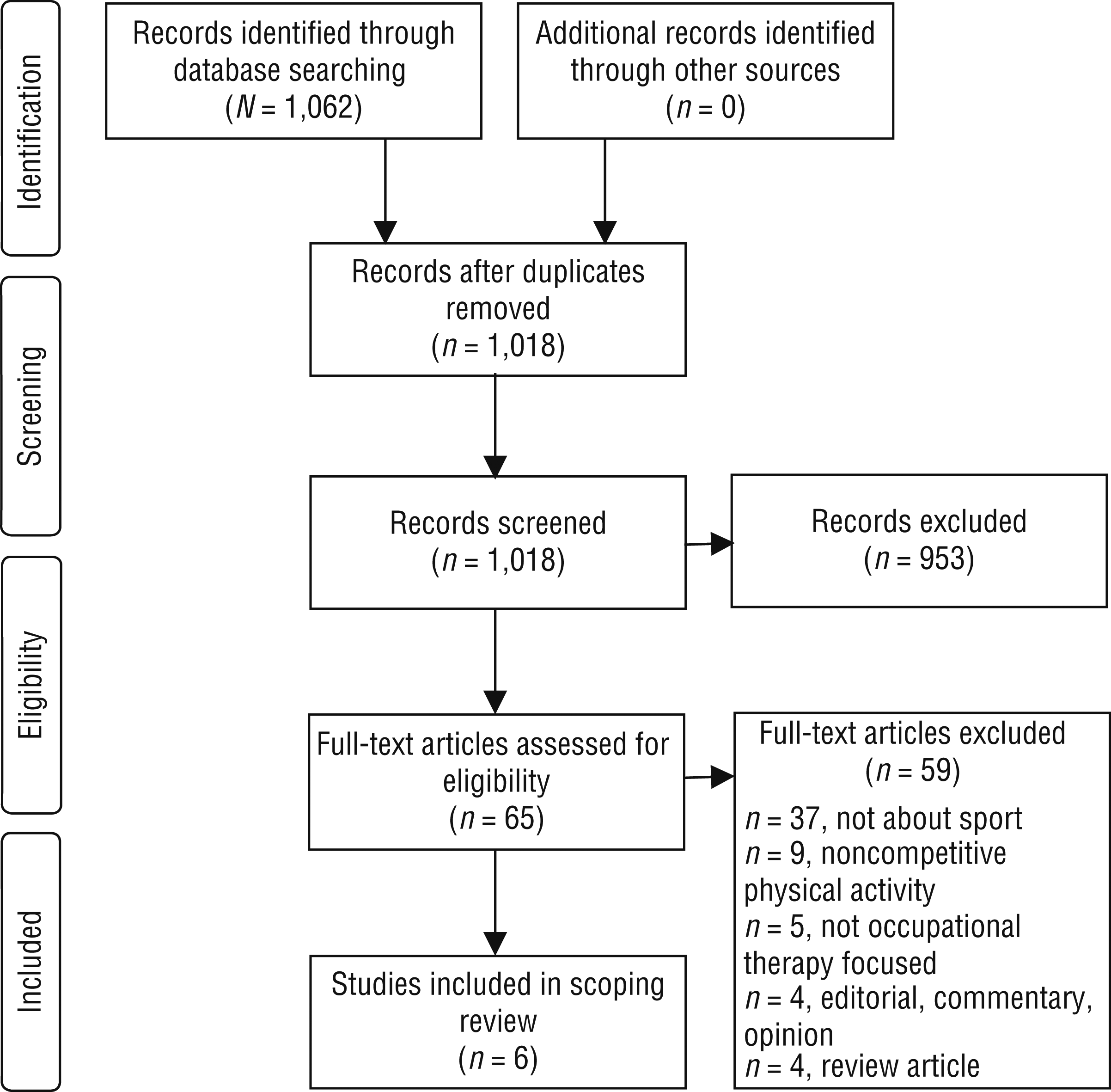
Flow diagram of study selection process.
The full results are presented in Table 1. Of the 6 identified studies, 4 used quantitative methods (Hanson et al., 2001; Rogers et al., 2014; Unruh & Elvin, 2004; Wickham et al., 2000), and 2 used a qualitative approach (Mynard et al., 2009; Ratcliff et al., 2002). All included studies had small sample sizes (n < 50), and half of the studies included fewer than 6 participants (Mynard et al., 2009; Ratcliff et al., 2002; Unruh & Elvin, 2004). The included studies investigated a diverse range of sports, including wheelchair sports (Hanson et al., 2001; Wickham et al., 2000); Australian rules football (Mynard et al., 2009); dragon boat racing (Unruh & Elvin, 2004); surfing (Rogers et al., 2014); and martial arts, judo, and Tai Chi (Ratcliff et al., 2002). They also included a diverse range of participant populations, such as people with spinal cord injury (Hanson et al., 2001; Wickham et al., 2000); people with amputations (Mynard et al., 2009); female survivors of childhood abuse (Ratcliff et al., 2002); breast cancer survivors (Unruh & Elvin, 2004); and veterans with posttraumatic stress disorder, depression, or both (Rogers et al., 2014). Three studies were conducted in the United States (Hanson et al., 2001; Rogers et al., 2014; Wickham et al., 2000), 2 in Australia (Mynard et al., 2009; Ratcliff et al., 2002), and 1 in Canada (Unruh & Elvin, 2004).
All the studies aimed to determine whether sport had a positive impact on the individual. Four studies reported positive results with regard to physical, social, and general well-being (Hanson et al., 2001; Ratcliff et al., 2002; Rogers et al., 2014; Unruh & Elvin, 2004), and 1 qualitative study reported positive outcomes, with themes of a spirit of inclusion, team building, and meaning of team involvement (Mynard et al., 2009). In contrast, another study found no statistically significant changes with regard to attitudes and motivation toward leisure after engaging in sport (Wickham et al., 2000).
All 6 studies were published in occupational therapy–specific journals: the American Journal of Occupational Therapy (Hanson et al., 2001; Rogers et al., 2014), the Australian Journal of Occupational Therapy (Mynard et al., 2009), Occupational Therapy in Health Care (Wickham et al., 2000), the Canadian Journal of Occupational Therapy (Unruh & Elvin, 2004), and the Journal of Occupational Science (Ratcliff et al., 2002). Four studies were published between 2000 and 2004 (Hanson et al., 2001; Ratcliff et al., 2002; Unruh & Elvin, 2004; Wickham et al., 2000), 1 was published in 2009 (Mynard et al., 2009), and another was published in 2014 (Rogers et al., 2014).
Discussion
This scoping review explored the extent, range, and nature of peer-reviewed articles reporting on sport as a leisure occupation in the occupational therapy literature. The 6 studies included were published between 2000 and 2014, and they represent a diverse range of literature, including quantitative and qualitative research, and a range of sports and participant profiles. Of the 6 studies, 5 reported benefits of sport for health and well-being.
The results of this scoping review first highlight the minimal amount of peer-reviewed literature investigating the use of sport as a leisure occupation in the field of occupational therapy. Across all relevant databases and journals, only 6 studies of the initial pool of 1,018 met the inclusion criteria. Considering the vast health and social benefits of sport (Brinkley et al., 2017; Darcy & Dowse, 2013; Jenkin et al., 2017; McMahon et al., 2017; Oja et al., 2015; Stone & Baker, 2018), along with the extent to which occupational therapy practitioners claim leisure is a major category of their practice (AOTA, 2014b), this number is small and the topic is therefore an important area for future research efforts.
Second, this review highlights that the 6 studies had little consistency among them regarding the sport examined, the outcomes examined, and the research methods used. For example, five unique sports were examined across the 6 studies. As such, it is difficult to compare findings, because different sports may have unique physical, social, and cultural benefits. Examining similar sports would provide a greater opportunity to compare the findings and infer greater or lesser benefits of a particular sport as therapeutically valuable. Given the limited and diverse extant literature identified concerning sport in occupational therapy, undertaking a systematic review or meta-analysis would be unsuitable at this time because of the significant heterogeneity among studies (Charrois, 2015).
Despite this heterogeneity, 5 of the 6 studies indicated that participation in sport resulted in positive outcomes. This finding strengthens the position that sport as a leisure occupation in occupational therapy has benefits for clients and should be explored further. Moreover, 1 study investigated sport through a conceptual lens (Ratcliff et al., 2002), in contrast to the other studies, which explored the effect of sport on the individual. Given the importance of conceptual theory (e.g., the PEO Model, MOHO) in occupational therapy practice and research, it is interesting that only 1 study explicitly stated that the purpose of the research was to explore this topic with a theoretical underpinning. Future research in this area might consider more explicit connection to theory relevant to occupational therapy practice and research.
A third finding worth comment is that the outcome measures used in the studies shared no commonalities, which makes completion of a systematic review or meta-analysis to identify benefits of sport in occupational therapy practice difficult. Also, just 1 study included objective outcome measures. Although subjective outcomes are important to consider, more consistent outcome measures are required to conduct a systematic review or meta-analysis for the benefits of occupational therapy interventions using sport (Petrisor & Bhandari, 2007).
In addition to using different research methods, the 6 studies used varying designs. Of the 4 quantitative studies, 3 were observational, indicating they were at Level 3-2 or lower on the Australian National Health and Medical Research Council hierarchy of evidence (National Health and Medical Research Council, 2019). Although observational studies are useful for evaluating associations between sport and therapeutic benefits, further research in occupational therapy should use research designs that are able to establish cause-and-effect relationships. This knowledge further adds to the concern regarding the lack of homogeneity among study features and limits the ability to conduct a quality systematic review or meta-analysis. By indicating the extent, range, and nature of peer-reviewed occupational therapy literature investigating sport as a leisure occupation, however, the included studies did allow us to answer the research question, and thereby provide researchers and occupational therapy practitioners with ideas for how sport can be used in occupational therapy practice.
Fourth, because the majority of participants were 18–60 yr old, the results provide some initial support for the use of sport as therapy with adult populations. However, these findings also highlight the limited number of studies investigating the impact of sport in occupational therapy for older adults. For perspective, consider that a large proportion of occupational therapy is conducted in eldercare and other settings, such as mental health, that involve treating older adults (Lin et al., 2015). These results highlight a significant gap in the literature given that sport has various health and social benefits for older adults (Lahti et al., 2016; Tak et al., 2013).
In addition, the included studies were conducted in only three countries (i.e., Australia, Canada, United States). One could argue that all three of these countries consider sport to be a significant part of their culture (Brown, 2004; Hinch, 2006; Sotiriadou et al., 2013). The concern is that we found no publications from other countries that also consider sport a prominent part of their culture, such as Germany and France (Eisenberg, 2011). The reason for this is unknown but may be due to government views and priorities for occupational therapy practitioners. Given that more than one-fourth of all occupational therapy practitioners work in a hospital setting (AOTA, 2014b), it may be that there is increased funding and demand for occupational therapy practitioners to work in areas to manage ill health, rather than in areas that focus on health promotion or assisting clients to return to other meaningful occupations. This scoping review therefore provides a rationale for practitioners from other countries with high occupational therapy prevalence and high sport participation to investigate sport as a leisure occupation.
In contrast to the other results, we did find commonalities across participants’ diagnoses. Half of the included studies involved participants with mental health conditions, and the other half involved participants with a physical condition. Recent systematic reviews have been published on the benefits of sport for adults’ mental health (Eime et al., 2013; Gayman et al., 2016), and the publication of studies investigating the benefits of sport as therapy from an occupational therapy perspective is an advancement in the field. Moreover, numerous studies have investigated the benefits of sport for people with spinal cord injury, such as increased functional capacity and general health (Medola et al., 2011; Stephens et al., 2012). Transferring this knowledge to occupational therapy practice may lead to positive outcomes in terms of increased health and well-being for groups with both a mental and a physical diagnosis.
Surprisingly, just 1 of the 6 studies was published after 2009, indicating a lack of recent published research on sport in occupational therapy. The reason for this dearth of research is unknown, but it may be due to a perception that occupational therapy and sport are not well suited. The perception may be that sport as a therapy and intervention should be left to physiotherapists, exercise physiologists, or recreational therapists, despite occupational therapy’s interest in leisure and sport in existing frameworks (AOTA, 2014a). Moreover, occupational therapy practices or agencies may have funding models that prevent or limit sport as an appropriate intervention tool for occupational therapy practitioners. This study’s findings show that occupational therapy practitioners could refocus their scope of practice to the origins of occupational therapy: engagement in all meaningful occupations, not just activities of daily living.
Limitations
A potential limitation of this review (Arksey & O’Malley, 2005) was the exclusion of gray literature from the systematic search. The gray literature may have included relevant unpublished reports or government publications on sport and occupational therapy, as well as any unpublished master’s theses or doctoral dissertations. We purposely did not include gray literature because we wanted to examine the number of peer-reviewed published articles to highlight the extent to which sport has been investigated and reported on in the occupational therapy literature.
The search strategy used in this study may have led to two further limitations. First, the search terms may have omitted some recognized sports in more culturally diverse countries and locations. Given the extensive list of sports used as search terms and an English-only filter, this is unlikely but still a possibility. Second, we may have missed some studies by not searching all potentially relevant databases. However, given that we searched five databases relevant to occupational therapy, we believe that the risk that relevant studies were not identified by the search strategy is minimal.
The criterion that excluded studies written in any language other than English was also a limitation. Literature on sport in occupational therapy may have been published in other languages from European countries such as Switzerland and Austria that have a high prevalence of occupational therapy practitioners (Council of Occupational Therapists for the European Countries, 2016).
With reference to the aim of this scoping review, the literature on sport in occupational therapy is outdated; thus, the findings of this scoping review may not be externally valid for the current population. Conversely, given that changes to occupational therapy practice frameworks and models in the past 10 years have been limited, findings from the studies included in the review may still be applicable to current populations. There is a clear need for future research to explore sport as a leisure occupation.
Implications for Occupational Therapy Practice
The findings of this scoping review have the following implications for occupational therapy practice:
Occupational therapy practitioners should consider the importance of sport as a leisure occupation and include it in future clinical practice to help clients achieve physical, social, and mental health and well-being.
Different options for sports could be trialed with different populations, such as people with mental illness, people with spinal cord injury, and people who use wheelchairs.
Occupational therapists and researchers should explore the gap in literature identified by this review and continue to add to the knowledge and use of sport in occupational therapy.
Conclusion
This scoping review identified minimal extant research concerning sport in the peer-reviewed, published occupational therapy literature. Considering that sport is categorized as a leisure occupation and that leisure is one of the main categories of occupation considered by occupational therapy practitioners, additional research in this area is clearly needed. Given the strong relationship between the benefits of engaging in sport and its impact on health and well-being, it is surprising that occupational therapy practitioners have not further explored sport as an avenue for therapy. As such, the results highlight a gap that requires additional research into the role of sport as a leisure occupation and the place of sport in occupational therapy. Specifically, high-quality research with valid outcome measures and rigorous methods and processes would help strengthen the existing literature base and has the potential to inform future occupational therapy practice and have a positive impact on people’s health and well-being.
Footnotes
*
Indicates studies that were included in the scoping review.
Appendix
“occupational therap*” AND
Athletics or “track and field” or Swimming or Cycling or Football or soccer or Golf or Tennis or Basketball or Netball or Cricket or Surfing or “Australian football” or “Touch football” or Canoeing or Kayaking or “Rock climbing” or Abseiling or Caving or “Mountain biking” or Crossfit or Bowls or “Martial arts” or Boxing or Ski or snowboard or “Motor cycling” or “Wood chopping” or Volleyball or Equestrian or Hockey or Badminton or “Rugby” or Gymnastics or Squash or Sailing or “Modern pentathlon” or Calisthenics or Skate or “Table tennis” or Waterskiing Wakeboarding or Powerlifting or Rowing or Oztag or Karate or Triathlon or Softball or “Tenpin bowling” or Shooting or Baseball or Jujitsu or Archery or “Shooting sports” or “Muay Thai” or “Mixed martial arts” or “Water polo” or Taekwondo or Ice skating or “Motor sport” or Croquet or Gridiron or “Ice hockey” or Diving or Handball or BMX or “Paddle sports” or “Roller Derby” or “Air sports” or “Dragon boat racing” or Kitesurfing kiteboarding or Lacrosse or Judo or “Carpet bowls” or Fencing or “Kung fu wushu” or Paintball or Petanque or “Gaelic football” or Wrestling or Campdrafting or “Tee ball” or Kendo or “Horse racing” or Rogaining or “Fishing Sport” or Bocce or Boules or Rodeo or Floorball or “Adventure racing” or Curling or “Outrigger canoe” or Boccia or Polocrosse or “Synchronised swimming” or “Eight ball” or “Baton twirling” or Biathlon or Bobsledding or Goalball or “Harness racing” or “Ice racing” “speed skating” or Korfball or Luging or Polo or “Sepak takraw” or Skeleton or “Wheelchair rugby”
Filters: “adult” and “English Language”