





Abstract
Occupational therapy education in the United States relies on Level I fieldwork experiences as a critical opportunity for students to apply classroom learning in practice settings (Accreditation Council for Occupational Therapy Education [ACOTE®], 2011; American Occupational Therapy Association [AOTA], 2009). Level I fieldwork experiences are designed to introduce students to practice and help them apply learning gained from a didactic curriculum in preparation for 12-wk Level II fieldwork experiences (ACOTE, 2011). Various types of Level I fieldwork education exist, and they are often labeled as traditional or nontraditional. Traditional placements are described as clinical experiences in which students receive 1:1 supervision from an occupational therapy practitioner in accordance with an apprenticeship model (Mulholland & Derdall, 2005). Nontraditional placements often occur in agencies in which no occupational therapy exists and are often described as experiential or service learning (AOTA, 2016; Chabot, 2016; Mulholland & Derdall, 2005). Level I fieldwork experiences differ by institution and are designed to reflect didactic instruction resulting in varied outcomes at different points in an academic curriculum (ACOTE, 2011; AOTA, 2016); however, one desired outcome of Level I fieldwork is improved critical thinking and professional reasoning. Vogel et al. (2009) defined critical thinking as an underlying component of professional reasoning in occupational therapy. For the purposes of this study, critical thinking was defined as “the process of purposeful, reflective judgement focused on deciding what to believe or what to do” (Insight Assessment, 2014, p. 14).
Although studies of critical thinking and professional reasoning in occupational therapy education exist, most have investigated changes across the curriculum—before and after Level II fieldwork—or specific pedagogical approaches in the classroom (Unsworth & Baker, 2015). To date, only one study, conducted by Coker (2010), has specifically measured changes in critical thinking as a result of a traditional Level I fieldwork, and it found that students improved both self-perceived reasoning and critical thinking skills. A need exists to better understand which pedagogical approaches in Level I fieldwork are most effective in developing critical thinking and reasoning skills. Studies that use a quantitative design are particularly needed (Unsworth & Baker, 2015).
Most studies of Level I traditional and nontraditional fieldwork have focused on describing the development of such experiences and students’ perceptions of these experiences (Roberts et al., 2015). Specific benefits of nontraditional Level I fieldwork from a student perspective include personal and professional development, understanding the value of occupation, development of professional reasoning, and applying theory to practice (Bazyk et al., 2010; Knecht-Sabres, 2010; Nielsen et al., 2017). Although no recent studies have compared Level I traditional and nontraditional fieldwork models beyond an examination of the student perspective, Gat and Ratzon (2014) did compare nontraditional and traditional placements. They reported that students who completed nontraditional placements had higher perceived personal responsibility, cultural competence, and personal skills.
Although research on innovative fieldwork approaches, such as nontraditional placements and simulation, is increasing, research on the pedagogical approaches used in Level I fieldwork is limited. Moreover, occupational therapy educators have been challenged to strengthen research designs (Roberts et al., 2015) to understand not only the pedagogical approaches that are most effective in developing critical thinking and reasoning skills but also the differences between traditional and nontraditional experiences. Therefore, the purpose of this pilot study was to compare traditional and nontraditional Level I fieldwork experiences with a specific emphasis on understanding the development of critical thinking skills. Specific research questions were as follows: (1) Do critical thinking scores on the Health Sciences Reasoning Test (HRST; Insight Assessment, 2014) increase after traditional and nontraditional Level I fieldwork? and (2) Is there a difference in the development of critical thinking skills between traditional and nontraditional fieldwork experiences?
Method
This study’s nonrandomized pretest–posttest design included a pretest completed in the first week of class before students started the fieldwork experience and a posttest completed at the end of the semester for students enrolled in either a traditional or nontraditional Level I fieldwork course. Institutional review board approval was obtained before the study began.
Participants
The participants were recruited from a population of fourth-semester master of occupational therapy students enrolled in either a psychosocial or a physical disabilities Level I fieldwork course at the University of North Dakota (N = 73). The average age of the 73 students completing the instruments was 23.04 yr (standard deviation [SD] = 3.57, range = 20–47). Approximately one-third of the participants (32.9%) were age 20 or 21 yr, 29 (39.7%) were age 22 or 23 yr, and 20 (29.3) were age 24–47 yr. Most (86.3%) were female.
Potential covariates regarding previous education and academic achievement that might affect critical thinking were measured. Students were asked whether they had previously earned a bachelor’s degree and what critical thinking–type classes they had completed (math, science, or other, including their total). Grade point average (GPA) before study enrollment was also included.
Intervention
Fifty-five students were assigned to nontraditional Level I fieldwork. The intervention included a 16-wk nontraditional fieldwork experience in which students met 3 hr/wk with a refugee who had recently come to the United States through a refugee resettlement program and engaged in didactic classroom experiences 2–4 hr/wk during which students discussed their experiences with evaluation, intervention, and outcomes with that refugee. Students completed individual reflective writing assignments throughout the semester (Nielsen et al., 2017). They also completed one 5-day traditional psychiatric placement during the semester. The sample included students at the main campus as well as a satellite campus, which accounts for the larger sample size.
Eighteen students were assigned to traditional Level I fieldwork during a 16-wk semester. The intervention included two 5-day fieldwork experiences (40 hr each) in a physical disability setting followed by an in-class opportunity to discuss students’ experiences in the clinic. Students were required to complete a case study after each 5-day placement. The sample included only students from the main campus because students at the satellite campus were not enrolled in traditional Level I placement at that time.
Instruments
The HSRT is used to detect and measure reasoning and critical thinking skills. It contains items from the California Critical Thinking Skills Test (CCTST; Insight Assessment, 2019), which was developed on the basis of the Delphi Expert Consensus Definition of Critical Thinking (Facione, 1998). Construct validity analysis revealed high correlations between the CCTST score and the Graduate Record Examination Total score (r = .719, p < .001). The HSRT has strong internal consistency in regard to reliability, with a minimum α level of .80 (Insight Assessment, 2014). The HSRT consists of five subscales (Induction, Deduction, Analysis, Inference, and Evaluation), with scores potentially ranging from 1 to 10. A total HSRT score is created by summing the subscale scores.
Procedure
After receiving approval from the university’s ethics committee, we explained the purpose of the study to the participants. Participants were given an identification number and consent forms. They completed the instruments online during the first (pretest) and last (posttest) week of the class during regularly scheduled class time. We were the course instructors; however, no grades were attached to study participation.
Analysis
We used paired t tests to compare average HSRT and five subscale scores before (pre) and after (post) participants’ fieldwork experience (α = .05). A repeated-measures design (RMD) was used to test for pre–post differences between students who participated in traditional and nontraditional fieldwork (α = .10). Students were then classified as having improved (pre–post change > 0) or not improved on the HSRT and its subscales, and forward stepwise logistic regressions were used to find which previous achievement variables were likely to be associated with improvement (α = .10 was the criterion for entrance into the model).
Results
Seventy-three occupational therapy students participated in the study, 55 (75.3%) who completed nontraditional fieldwork and 18 (24.7%) who completed traditional fieldwork. Two-thirds (68.5%) did not have a previous bachelor’s degree. The average total number of critical thinking classes was 4.03 (SD = 2.09, range = 1–10). Eleven (15.1%) reported having taken no math classes, and 22 (30.1%) reported having taken two or three. More than one-third (39.7%) had taken no, or only one, science class. Nearly half (47.9%) reported no other critical thinking–type class. The average reported GPA was 3.47 (SD = 0.26, range = 3.00–4.00); 25 (34.2%) had a GPA ≤ 3.3, and 21 (28.8%) had a GPA > 3.6.
Average pre- and post-fieldwork HSRT scores were obtained for the students. Table 1 shows the results from paired t tests for all 73 occupational therapy students for the HSRT and its subscales. All scores increased on average (mean differences = 0.041–0.507) with the exception of the Inference subscale (mean difference = −0.411). The Analysis subscale had the only significant increase (p = .004): 0.425 points on average.
Mean HSRT Scores Before and After Fieldwork (N = 73)
Note. HSRT = Health Science Reasoning Test; SE = standard error.
Significant increase from before to after fieldwork at α = .05.
Table 2 shows the change in average pre- to post-fieldwork HSRT scores for the 18 students who participated in traditional fieldwork and the 55 who completed nontraditional fieldwork. The paired t tests showed significant increases in the average HSRT (p = .025) and Analysis subscale (p = .001) score only for those with the nontraditional fieldwork experience. Both the Inference and Evaluation subscales showed a decrease (–0.382 and –0.073, respectively). For the 18 students who participated in traditional fieldwork, all p values were very high (>.101), indicating no significant difference in HSRT scores. The RMD showed strong interaction for the HSRT (p = .085) and the Deduction subscale (p = .091), suggesting an effect on pre to post scores due to type of fieldwork.
Mean HSRT Scores Compared Before and After Fieldwork for 18 Students With Traditional and 55 With Nontraditional Level I Fieldwork Experience
Note. RMD = repeated-measures design; SE = standard error.
Significant increase from before to after fieldwork at α = .05.
A logistic regression was used to find academic variables (number of math classes, number of science classes, GPA, and whether the student had earned a bachelor’s degree first) that were associated with improvement in HSRT score for the traditional and nontraditional Level 1 fieldwork experience (Figure 1). Thirty-seven (50.7%) students had improved HSRT total scores. Students had improved scores on the Induction (n = 31; 42.5%), Deduction (n = 29; 39.7%), Analysis (n = 34; 46.6%), and Inference (n = 15; 20.5%) subscales. Students who completed traditional fieldwork and had taken two to six science classes showed statistically significant improvement on the HSRT (p = .035). For students who took part in nontraditional fieldwork, those who had taken two to six science classes (p = .014), had a GPA of 3.4–3.6 (p = .079), or had a GPA above 3.6 (p = .003) were more likely to improve on the HSRT. Students who completed the nontraditional fieldwork experience and who had earned a bachelor’s degree were more likely to improve on the Inference subscale (p = .040).
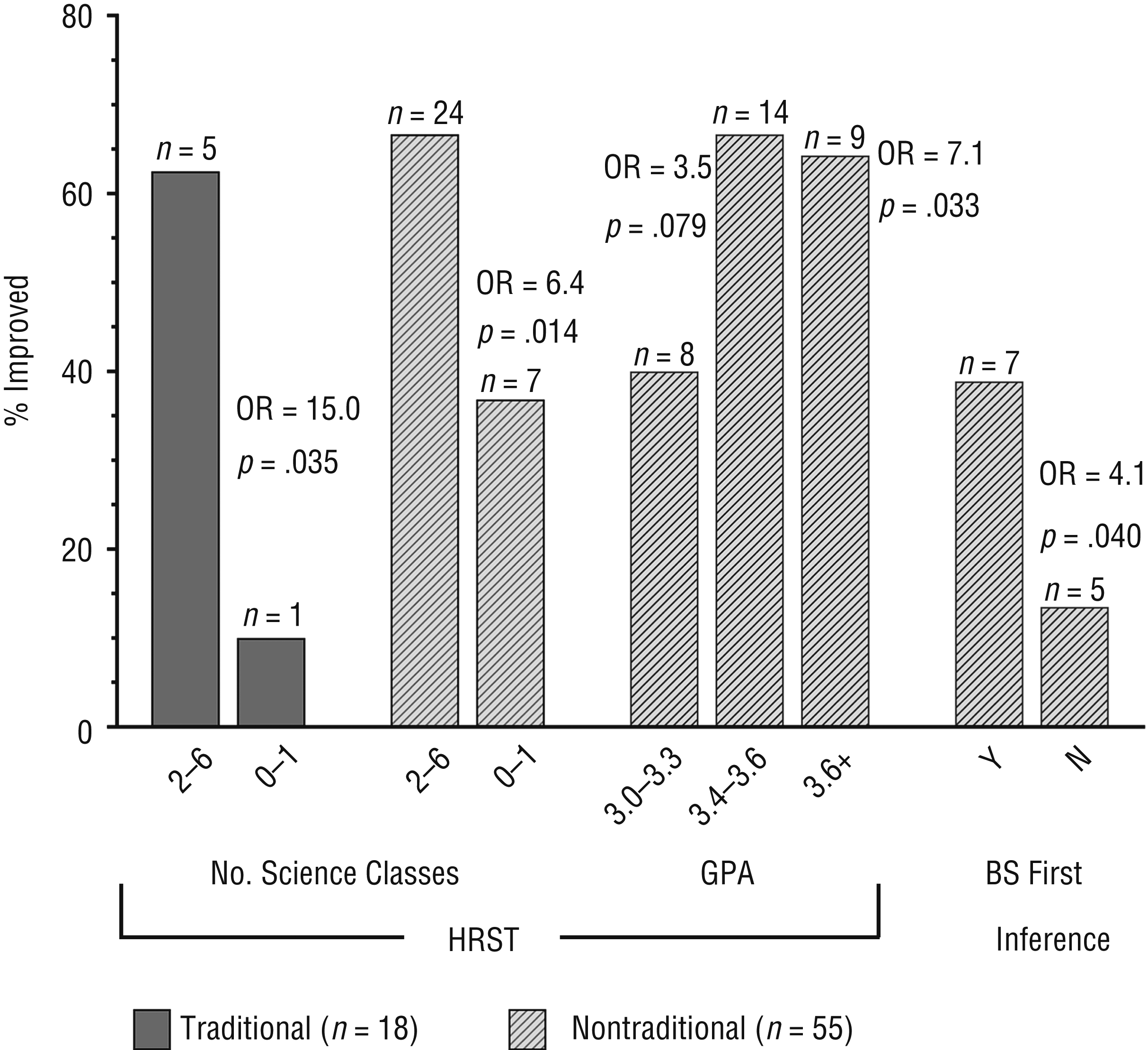
Academic variables associated with improved HRST critical thinking scores for traditional and nontraditional Level I fieldwork experience.
In summary, scores on the Analysis subscale improved with fieldwork, especially the nontraditional fieldwork experience, and overall HSRT scores improved with the 16-wk nontraditional fieldwork. Science classes were tied to improvements on the HSRT (all students) and on the Inference subscale (nontraditional fieldwork group). A high GPA in the nontraditional fieldwork group was associated with improvement on the HSRT.
Discussion
This study of Level I fieldwork experiences and their impact on critical thinking validated our hypothesis that Level I fieldwork experiences facilitate the aim of improving students’ ability to critically think and professionally reason. In addition, the HSRT scores supported what students have perceived to be a benefit of Level I fieldwork experience: their own self-report of improved reasoning (Bazyk et al., 2010; Coker, 2010; Falk-Kessler et al., 2007; Knecht-Sabres, 2010; Vroman et al., 2010).
In terms of specific gains made between traditional and nontraditional fieldwork placements, Coker (2010) found that students who completed a 1-wk experiential learning experience with children with cerebral palsy made significant gains in their overall reasoning scores and in scores on the CCTST Evaluation, Inductive Reasoning, and Deductive Reasoning subscales. In comparison, in this study only students in the nontraditional Level I fieldwork experience showed significant gains in their overall HSRT score. In addition, only students in the nontraditional fieldwork experience had statistically significant improvement in the area of analysis, which Coker did not find to be a significant area of improvement.
These findings raise further questions about why students made gains on certain subscales and not on others. It is possible that specific pedagogical approaches facilitate gains in certain areas. For example, the students who took part in nontraditional Level I fieldwork completed several critical thinking writing assignments focused on skills of analysis. These assignments were meant to facilitate additional areas of critical thinking, not just analysis, but this was not the case. Educators will need to reevaluate pedagogical methods to better target evaluation, inductive, deductive, and inference skills.
Limitations
Limitations to this study include the fact that we used only the HSRT to measure change. Better measures of academic achievement, or comparisons of classes in addition to science and math, would be useful. A more equal comparison of the number of students in nontraditional versus traditional fieldwork placement and random assignment to conditions should be used in further studies.
Implications for Occupational Therapy Education
The results of this study have the following implications for occupational therapy education:
Level I fieldwork results in improved critical thinking, and nontraditional fieldwork experiences had an impact on overall critical thinking in this study. Although further investigation is needed, these findings support the use of both nontraditional and traditional fieldwork.
Nontraditional fieldwork was accompanied by weekly discussion and assignments that targeted specific components of reasoning, yet only students’ analytical skills improved. Refinement of learning activities and assignments and further study to determine which are most effective are needed.
Conclusion
This study demonstrated that students gain critical thinking skills in both traditional and nontraditional Level I fieldwork. However, the findings provide further support that, when paired with intentional pedagogical approaches, nontraditional fieldwork improves overall critical thinking, with the strongest gains in analysis. Further research is needed to better understand pedagogical approaches that assist in the development of all critical thinking skills during Level I fieldwork.