





Abstract
Many veterans of Operation Iraqi Freedom, Operation Enduring Freedom, and Operation New Dawn incurred psychological and physical trauma during combat that continues to disrupt their daily lives (Tanielian et al., 2008). As veterans detach from the military, many pursue a college education (Radford, 2011). It is critical to understand factors that promote student veterans’ achievement of positive outcomes despite lingering effects of combat exposure.
Occupational therapy practitioners can adopt a resilience perspective to understand how student veterans achieve positive outcomes after combat exposure (Eakman et al., 2016). Resilience is the process by which people adapt to adversity and achieve well-being (Masten, 2014; Ryff et al., 1998). Occupational therapy practitioners foster student veterans’ psychological well-being after combat-related trauma (American Occupational Therapy Association, 2018), but targets for occupational therapy intervention to promote resilience must be further developed (Eakman et al., 2016). The purpose of this study was to uncover modifiable factors that influence student veterans’ adaptation to past combat exposure. Establishing support for targets within the domain of occupational therapy can inform practitioners’ role in addressing resilience among combat-exposed student veterans.
Resilience Among Student Veterans
Overcoming adversity extends beyond avoiding negative outcomes (e.g., psychopathology); it includes achieving positive outcomes, such as meaning and purpose in life (Zautra et al., 2010). Meaning and purpose in life is the interpretation of one’s existence as predictable, valuable, and organized around coveted pursuits (Steger et al., 2006). Life meaning is a critical component of psychological well-being (Ryff, 1989). Psychological well-being is a key indicator of successful adaptation to adversity (Ryff et al., 1998) and is central to occupational therapy (Eakman, 2013). Veterans’ successful adaptation to risk factors such as combat exposure can be considered in terms of achieving life meaning.
Risk factors are forces that threaten positive outcomes such as life meaning (Masten, 2014). Combat exposure is a risk factor for student veterans; potentially traumatic qualities of combat include exposure to warfare events (e.g., firing a weapon to kill an enemy combatant) and fear for one’s safety (King et al., 2006). Risk factors such as combat exposure may operate in an indirect model of risk by depleting assets necessary to achieve positive outcomes (Masten, 2014); for example, combat exposure may pose an indirect risk to life meaning by producing health-related symptoms. Combat exposure has been linked to posttraumatic stress disorder (PTSD; Ozer et al., 2003), depression (Hoge et al., 2004), and somatic symptoms (e.g., pain; Hoge et al., 2007). In turn, health conditions have been linked to lesser life meaning among student veterans (Dutra et al., 2016).
A person-focused approach to investigating resilience can be used to understand how successful adaptation to risk factors such as combat exposure is achieved (Masten, 2014). This approach involves classifying people on the basis of level of risk exposure and life outcomes achieved in response to risk. Identifying characteristics associated with these classifications can uncover processes influencing adaptation to risk.
Protective Factors
Protective factors are forces that promote adaptive responses to risk exposure, and their operation can be understood within differing models of resilience (Rutter, 1987). A protective factor operates in a compensatory model of resilience when it promotes positive outcomes independently of the risk and in a moderator model when it alters the influence of the risk itself (Masten, 2014). We identified protective factors for this study using the Model of Meaning of Life Experiences (King, 2004), which posits that life meaning and resilience are fostered by three sources of meaning: (1) belonging (healthy relationships), (2) self-understanding (knowledge of oneself and one’s relationship with the world), and (3) doing (meaningful activity). For this study, we identified six protective factors, two reflecting each source of meaning: (1) social support, (2) instructor autonomy support, (3) academic self-efficacy, (4) coping ability, (5) social and community participation, and (6) meaningful activity.
Belonging
A sense of belonging emerges from feeling understood, valued, and supported; social bonds are understood to foster life meaning and resilience (King, 2004). Postdeployment social support and instructor autonomy support reflect belonging among student veterans. Social support is perceived emotional needs fulfillment and instrumental assistance from others (King et al., 2006). Instructor autonomy support is the perception that instructors support self-determined action in the classroom (Black & Deci, 2000). Both indicators reflect healthy social bonds, and instructor autonomy support reflects a social context fostering an internal locus of control. Veterans who secure social support and experience autonomy have been found to successfully adapt to combat exposure (Pietrzak & Cook, 2013).
Self-Understanding
Self-understanding includes positive appraisals of one’s ability to successfully navigate the world; such appraisals bolster inner resources that promote life meaning and resilience (King, 2004; Masten, 2014). Student veterans’ sense of self-understanding can be understood in terms of academic self-efficacy and coping ability. Academic self-efficacy reflects students’ appraisal of their academic ability (Schunk, 1991) and represents perceived mastery that contributes to their sense that they can persist despite challenges (Rutter, 1987). Coping ability has been defined as the ability to “effectively use cognitive appraisal skills in a flexible, committed approach to active problem solving despite stressful circumstances” (Sinclair & Wallston, 2004, p. 95). Coping ability directly alters the impact of risk (Rutter, 1987) and, as such, likely operates solely within a moderator model of resilience. Self-efficacy (Blackburn & Owens, 2015) and coping ability (e.g., Pietrzak et al., 2011) have been found to promote successful responses to combat exposure among veterans.
Doing
Student veterans’ sense of doing can be captured by activity engagement that fulfills social roles and aligns with their values and interests; such engagement fosters meaning in life and resilience (Eakman, 2013; King, 2004). Social and community participation reflects activity engagement that is social and fulfills nondomestic roles (Chang et al., 2013; Levasseur et al., 2010). Meaningful activity is activity that aligns with one’s values and interests, thereby generating positive subjective experiences (e.g., competence and connection with others; Eakman et al., 2018). Both indicators reflect a sense of doing; meaningful activity is considered a critical protective factor among student veterans (Eakman et al., 2016), and veterans who report engagement in community-based activity have been found to achieve adaptive responses to combat exposure (Pietrzak & Cook, 2013).
Purpose of the Study
In this study, we used a person-focused approach to understanding resilience, classifying student veterans according to their levels of combat exposure and life meaning. We formulated three hypotheses:
1. Consistent with a compensatory model of resilience, we hypothesized that student veterans with high life meaning will have higher levels of protective factors (excluding coping ability) than student veterans with low life meaning, irrespective of their level of combat exposure.
2. Alternatively, consistent with a moderator model of resilience, we hypothesized that among student veterans with high combat exposure, those with high life meaning will have higher levels of protective factors than those with low life meaning and that among student veterans with low combat exposure, the beneficial effect of the protective factors will be smaller.
3. With respect to combat-related health conditions, we hypothesized that student veterans with low life meaning will have higher levels of health conditions than those with high life meaning.
Method
Participants and Procedure
This was a prospective longitudinal panel study with data collected on two occasions from the same set of participants (Menard, 2002). This design allowed us to determine whether baseline levels of protective factors and health conditions were associated with adaptation to combat exposure at follow-up (i.e., meaning in life). We report protective factors and health conditions at baseline and adaptation to combat exposure at follow-up (i.e., level of life meaning). We used a convenience sample of veterans enrolled in college; 49 (21.7% of the baseline sample) received New Start for Student Veterans (NSSV) services, a supported education program for student veterans.
After the study’s approval by the university’s institutional review board, we obtained informed consent from participants and emailed them an invitation to an online survey containing measures of the study variables. Service providers contacted NSSV participants; other veterans were reached through the university’s veterans’ benefits office. Invitations were sent every November and April from 2013 to 2018; participants were eligible to complete multiple surveys. In addition, NSSV participants were sent an invitation when they entered the program; baseline responses for 20 NSSV participants (8.9% of the follow-up sample) occurred between planned measurements. Participants received a $10 Amazon gift card for completing each survey.
A total of 6,614 invitations were sent, and 1,297 veterans (19.6% response rate) completed at least one survey. For the current study, respondents were included if they were veterans who had previously deployed to a combat zone; application of this inclusion criterion reduced our sample size to 226 at baseline and 153 at follow-up. Time between measurements ranged from 0.72 to 29.16 mo (mean [M] = 6.92 mo, standard deviation [SD] = 4.24). The wide range of time between measurements can be attributed to the inclusion of follow-up data from participants who missed planned measurements but responded to subsequent invitations.
Instruments
Sample Classification
The Indicator of Combat Exposure (ICE) is a five-item assessment of combat exposure. We used Rasch analysis to evaluate the rating scale design of the ICE according to procedures outlined by Bond and Fox (2007) and modified the scale to optimize category functioning. We calculated a separation ratio to detect the number of statistically significant strata by which the sample is portioned, thereby facilitating meaningful classification of our sample (Wright & Masters, 2002). Person separation was 1.7, thus dividing the sample into 2.6 strata and indicating that the ICE detects two statistically distinct classifications. Accordingly, we split the sample into high (scores >8) and low (scores ≤8) combat exposure by evenly dividing the possible range of ICE scores (3–14).
The Meaning in Life Questionnaire Presence subscale (MLQ–P) is a well-validated five-item assessment of meaning and purpose in life (Steger et al., 2006). Using the average MLQ–P value (M = 22.43, SD = 7.31) from a study of student veterans (Dutra et al., 2016), we established two groups reflecting high (scores ≥22.43) and low (scores <22.43) life meaning at follow-up. We derived the cutoff using Dutra et al.’s values because their sample had a demographic profile similar to that of a representative sample of student veterans (Cate, 2014).
Protective Factors
The Postdeployment Support Questionnaire is a valid and reliable 10-item scale assessing perceived social support (King et al., 2006). We used the six-item version (Shen et al., 2009) of the Learning Climate Questionnaire (Black & Deci, 2000) to assess perceived instructor autonomy support. The Brief Resilient Coping Scale (BRCS) is a psychometrically sound four-item indicator of coping ability (Sinclair & Wallston, 2004). We assessed academic self-efficacy using the Academic Self-Efficacy Scale, a well-validated eight-item instrument (Chemers et al., 2001). We assessed social and community participation using the Veterans’ Social and Community Participation Assessment, a structurally valid five-item measure of the frequency of veterans’ engagement in social and community-based activity (Kinney et al., in press). The Engagement in Meaningful Activities Survey is a psychometrically sound 12-item assessment of positive subjective experiences associated with activity (Eakman, 2012).
Health Conditions
The PTSD Checklist–Civilian Version is a well-validated 17-item assessment of PTSD symptoms (Blanchard et al., 1996). The Patient Health Questionnaire Depression Scale is a valid and reliable nine-item assessment of depressive symptoms (Kroenke et al., 2001). The Patient Health Questionnaire Somatic Symptoms Scale is a well-validated 15-item assessment of somatic symptoms (Kroenke et al., 2002).
Data Analysis
We conducted independent samples t tests and χ2 tests for the continuous and dichotomous variables, respectively, to compare participants who completed measurements at both time points (“stayers”) with those who did not (“leavers”). We operationalized risk as the level of combat exposure (low vs. high) and adaptation as the level of life meaning (low vs. high). Considering the intersection of these two variables generates four possible classifications: (1) adaptive (low combat exposure, high life meaning), (2) maladaptive (low combat exposure, low life meaning), (3) resilient (high combat exposure, high life meaning), and (4) depleted (high combat exposure, low life meaning). We assumed that veterans who had achieved high life meaning had successfully adapted to combat exposure. We constructed a classification status variable indicating presence in one of the four groups. We generated descriptive statistics for variables across groups.
Linear mixed models (specified in IBM SPSS Statistics Version 25.0; IBM Corp., Armonk, NY) were fit to obtain the adjusted means of all protective factors and health conditions for each of the four classification groups. We specified linear mixed models because it allowed us to test hypotheses while accommodating unequal variances in protective factors and health conditions across the four groups (Weaver & Black, 2015). The means were adjusted for the following control variables: age (held constant at 31.32 yr), gender (held constant at 0 = female), marital status (held constant at 0 = unmarried), and time between measurements (held constant at 6.92 mo). We tested the interaction between classification status and all control variables to evaluate the assumption of homogeneity of slopes. We used independent samples t tests to compare the adjusted means in correspondence with our hypotheses and evaluated significance using a Bonferroni adjusted α of .025. We calculated Cohen’s d using adjusted means and observed standard deviations to approximate effect size (Field et al., 2012).
Results
Of the 153 participants who completed measurements at both time points, 86.3% were male and 45.1% were married, and the average age was 31.32 (SD = 7.34). BRCS scores at baseline indicated that stayers (M = 14.73, SD = 2.85) had lesser coping ability than leavers (M = 15.85, SD = 2.83), t(224) = 2.77, p = .006; no other variables differed between stayers and leavers. Classification procedures yielded a relatively even distribution of participants across the four groups (see Figure 1). Table 1 provides descriptive statistics for study variables. Except for social and community participation, classification status was significantly associated with all protective factors and health conditions (Table 2).
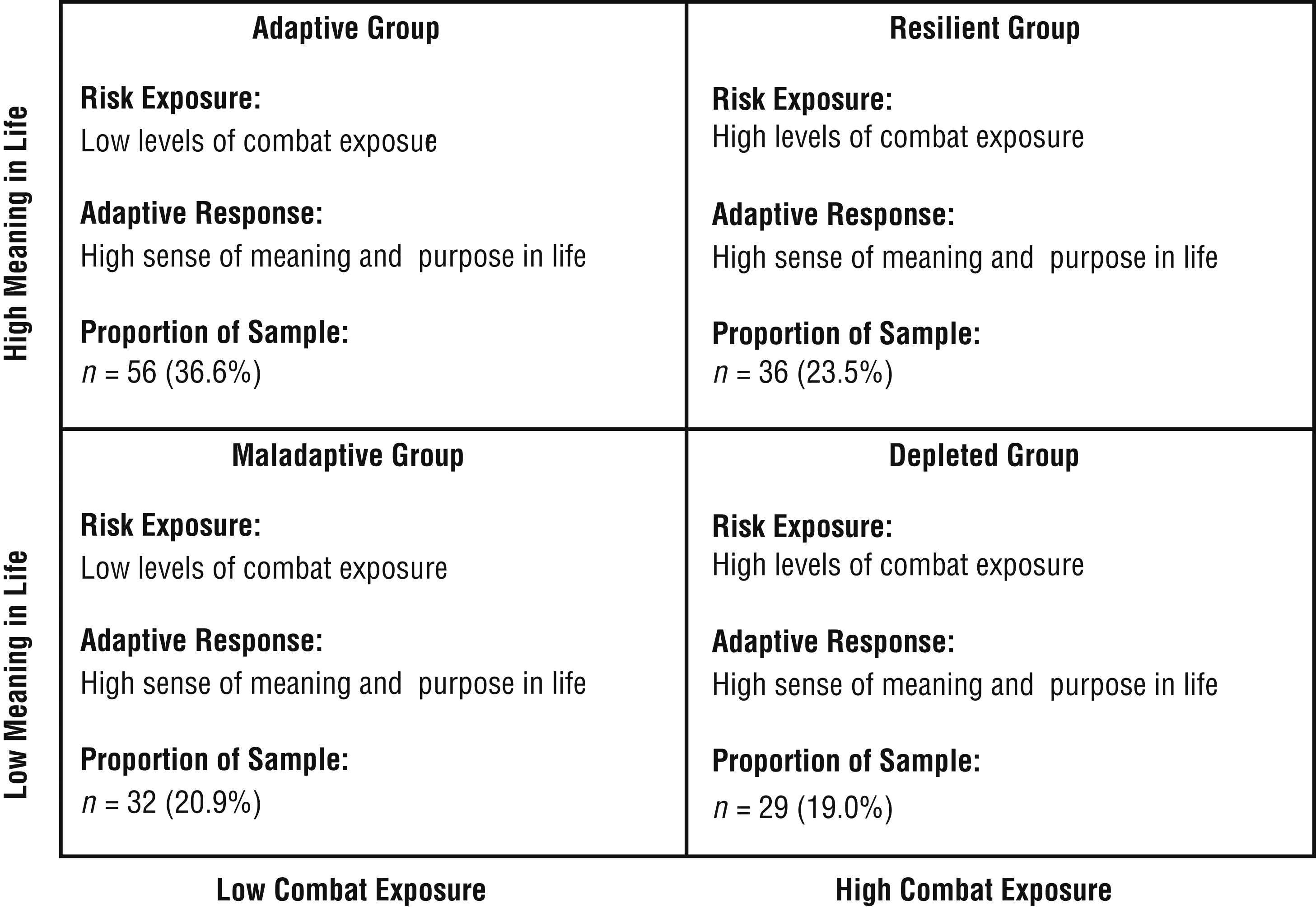
Diagram of combat exposure by life meaning classification at follow-up (N = 153).
Descriptive Statistics for Study Variables Across Classifications (N = 153)
Note. ASE = academic self-efficacy; IAS = instructor autonomy support; M = mean; PTSD = posttraumatic stress disorder; SCP = social and community participation; SD = standard deviation; T1 = baseline; T2 = follow-up.
Comparison of Protective Factors and Health Conditions Across Combat Exposure by Life Meaning Classifications (N = 153)
Note. ASE = academic self-efficacy; df = degrees of freedom; IAS = instructor autonomy support; M = mean; PTSD = posttraumatic stress disorder; SCP = social and community participation; SE = standard error.
Adjusted mean reflects value with time between measurements held constant at median (5.39 mo).
Significant difference between adjusted means (p ≤ .025).
*p < .05. **p < .01. ***p < .001.
Hypothesis 1: Compensatory Model of Resilience
The results support the role of meaningful activity and coping ability in a compensatory model of resilience. Participants who reported high meaning in life at follow-up, at both levels of combat exposure (high and low), reported greater baseline meaningful activity and coping ability compared with those with low life meaning at follow-up (Table 2).
Hypothesis 2: Moderator Model of Resilience
The findings indicate that social support afforded a protective advantage only among participants with low combat exposure and not among those with high combat exposure, as hypothesized. Moreover, the interaction between classification status and time between measurements was significant, F(3, 73.00) = 4.21, p = .008. We probed this interaction by observing the association between classification status and social support for participants with different lengths of time between measurements. When we held time between measurements constant at the median (5.39 mo), we noted that those with high life meaning at follow-up and low combat exposure had greater levels of social support than those with low life meaning. When time between measurements was held constant at the 75th percentile (6.67 mo), social support did not differ between groups with low, t(58.58) = 1.93, p = .058, d = 0.44, and high, t(62.08) = 1.50, p = .139, d = 0.36, combat exposure.
Hypothesis 3: Level of Combat-Related Health Conditions
Participants who endorsed low life meaning at follow-up reported more severe health-related symptoms at baseline; specifically, those who reported low life meaning at follow-up, with both low and high levels of combat exposure, reported greater baseline depression compared with those with high life meaning. Those with low life meaning at follow-up and low levels of combat exposure had greater baseline somatic symptoms compared with those with high life meaning. Those with low life meaning at follow-up and high levels of combat exposure had greater baseline PTSD.
Discussion
This longitudinal study classified a sample of student veterans with respect to levels of combat exposure and life meaning to identify processes that influence adaptation to past combat exposure. The results indicate that meaningful activity and coping ability operate in a compensatory model of resilience, contributing to life meaning regardless of the level of combat exposure. Greater social support explained high life meaning among those with low but not high combat exposure. Health conditions appeared to limit life meaning after combat exposure.
A greater sense of meaningful activity, regardless of level of combat exposure, was associated with life meaning. Literature concerning protective factors among combat veterans has mostly overlooked the benefits of activity, with a few exceptions (e.g., Pietrzak & Cook, 2013). Our findings indicate that activity may be an important means by which student veterans achieve a meaningful life despite combat-related risk. Whereas meaningful activity conferred a protective advantage, frequency of social and community participation did not. This finding suggests that the subjective experience of activity, rather than the observable aspects, may be especially important for fostering successful adaptation to combat exposure. Meaningful activity may afford experiences that engage adaptive mechanisms that promote the transcendence of adversity, such as a sense of mastery, autonomy, and connection with others (Eakman, 2013; Masten, 2014). Researchers should develop and test interventions that facilitate student veterans’ engagement in meaningful activities that elicit a sense of mastery, autonomy, and connection with others.
Our findings also suggest that coping ability affords a protective advantage to student veterans regardless of level of combat exposure. This finding was contrary to our hypothesis that coping ability would operate solely in a moderator model of resilience. Successful adaptation to combat exposure may be achieved by reappraising combat-related experiences, regardless of their severity, in a manner that provides a source of meaning. For example, some veterans have reported benefits after combat-related trauma, including personal growth and increased valuation of relationships (Pietrzak et al., 2010). Occupational therapy practitioners targeting psychological well-being among combat-exposed veterans should work with multidisciplinary teams to bolster coping skills through cognitive–behavioral techniques that facilitate positive reappraisal of adversity (Pietrzak et al., 2011).
It is interesting that social support contributed to high life meaning among participants with low, but not high, levels of combat exposure. This finding is consistent with what Luthar (1993) labeled a “protective–reactive effect,” in which a protective factor is generally an advantage but less so when risk is high. The protective–reactive effect of social support may be explained by our finding that PTSD was elevated and fostered low life meaning in response to high levels of combat exposure. PTSD may impede student veterans’ ability to secure social support, thereby dampening its protective advantage (e.g., Resnik & Allen, 2007). Researchers should develop and test interventions that facilitate combat-exposed student veterans’ engagement in activity enabling social interactions to promote social support. Indeed, veterans’ engagement in shared activities has been associated with greater social support (Eakman et al., 2019).
Combat-exposed student veterans with low life meaning reported more severe health-related symptoms than those with high life meaning. Some studies of combat-related risk have considered the absence of health conditions to be a successful response to combat exposure (e.g., Pietrzak & Cook, 2013); our findings suggest that health conditions should instead be considered a potential mechanism by which combat exposure threatens student veterans’ life meaning. Depression symptoms appear to pose a particular threat; they were associated with low life meaning in response to varying levels of combat exposure. This finding is congruent with evidence supporting the deleterious impact of depression on student veterans’ psychological well-being, despite the emphasis placed on PTSD in the literature (Bergmann et al., 2019). Occupational therapy practitioners promoting student veterans’ resilience should work with multidisciplinary teams to manage the symptoms of health conditions and compensate for their impact on occupational performance.
Limitations and Directions for Future Research
Participants included in the analyses (i.e., stayers) had lesser coping ability than leavers, indicating that our findings may not generalize to the overall population of student veterans. Also, the relationship between classification status and social support depended on time between measurement occasions, which may indicate that the finding was an artifact of our specific measurement schedule and thus may not generalize to the student veteran population.
We encourage replication of the current study to validate all findings. Although our longitudinal design offers advantages over a cross-sectional design, it still precludes assertions of causality. Nonetheless, our findings offer theoretical support for future studies capable of uncovering causal relationships and may inform treatment theories underlying interventions targeting student veterans’ resilience. Future research should strengthen treatment theories by uncovering mechanisms by which protective factors confer an adaptive advantage. For example, evidence suggests that meaningful activity fosters life meaning indirectly through psychological needs fulfillment (Eakman, 2013). Testing such relationships while accounting for combat-related risk would further develop theory underlying resilience-promoting interventions.
Implications for Occupational Therapy Practice
The results of this study have the following implications for occupational therapy practice:
Interventions should be developed and tested to foster student veterans’ resilience by targeting engagement in meaningful and shared activities.
Occupational therapy practitioners working with student veterans should work with multidisciplinary teams to bolster coping ability, manage symptoms of combat-related health conditions, and compensate for the influence of health conditions on occupational performance.
Conclusion
In this longitudinal study, we classified a sample of student veterans on the basis of concurrent levels of combat exposure and life meaning, thereby ascertaining influences on their adaptation to combat exposure. The findings suggest that engagement in meaningful activity, adaptive coping ability, and social support may promote successful adaptation to combat exposure. Further, combat-related health conditions may contribute to a maladaptive response to combat exposure. Occupational therapy practitioners are uniquely situated to foster student veterans’ resilience.
Footnotes
Acknowledgments
This study was completed while the first author was a PhD candidate in the Department of Occupational Therapy at Colorado State University. Funding for the study was provided through philanthropic support of the New Start for Student Veterans program by a private donor and through the Center for Meaning and Purpose at Colorado State University. We thank the student service members and veterans for expending valuable time and effort to participate in this research. In addition, we thank Julia Sharp for her input on analyses. The views expressed in this article are those of the authors and do not necessarily reflect the official policy or position of the Department of Defense, Department of Veterans Affairs, or U.S. government.