





Abstract
Low vision affects approximately 15% of Americans older than age 65 (Federal Interagency Forum on Aging-Related Statistics, 2012), and this percentage is expected to double by 2050 (National Institutes of Health, 2016). Low vision has a significant impact on all aspects of daily life, including reading required for participation in occupations. The aim of this systematic review was to determine the effectiveness of interventions within the scope of occupational therapy to improve reading required for the performance of occupations by older adults with low vision.
Background
Low vision is a permanent loss of visual acuity or visual field that cannot be corrected through surgical, pharmaceutical, or optical intervention (U.S. Department of Health and Human Services, 2004). Although this loss of visual function can affect all aspects of daily life, the most frequently reported reason for seeking services is difficulty with reading tasks (Owsley et al., 2009). Occupational therapy can help clients learn to adapt to their vision loss and to use effective compensatory strategies to participate in meaningful occupations. Interventions include technology, visual skills training, and multicomponent interventions.
Technology used in interventions for older adults with visual impairment includes hand and stand magnifiers, telescopes, and electronic magnification devices. These devices are commonly prescribed to assist clients in maintaining participation in reading tasks required for activities of daily living, instrumental activities of daily living, and leisure tasks. With advances in technology, use of mainstream devices, such as tablets and e-readers, to enhance reading performance has become increasingly common (Gill et al., 2013; Kaldenberg & Smallfield, 2017; Mednick et al., 2017).
For some clients with central or peripheral field impairments, systematic training in the use of residual vision can be effective in improving reading performance. This article discusses vision skills training related to central visual field impairment and hemianopsia. For clients with central visual field impairment, eccentric viewing training includes rapid serial presentation training and controlled eye movement training. For clients with hemianopsia, visual skills training includes compensatory systematic scanning training, computer-based visual search training, and audiovisual stimulation training.
Often, low vision rehabilitation services include multicomponent interventions that provide multiple strategies to improve participation in meaningful occupations, including reading. These interventions may include group therapy, education about the client’s eye condition and available resources, training in problem-solving strategies, environmental modification (e.g., lighting), training in the use of low vision devices, instruction in adaptive strategies and work simplification, training in techniques for reading, education regarding adjustment to vision loss, and training in performance of daily occupations.
A previous systematic review of the literature regarding the effectiveness of interventions to enhance reading required for the performance of occupations found 32 articles that supported interventions within the scope of occupational therapy for the outcome of reading performance (Smallfield et al., 2013). The authors found strong evidence supporting low vision programs that included occupational therapy and moderate evidence supporting electronic magnification. Moderate evidence supported the use of lighting to improve reading performance. Limited evidence was found to support eccentric viewing training and optical magnification. The effectiveness of optical magnifiers, text eccentric viewing, characteristic preferences, and line guides within optical magnification was unclear (Smallfield et al., 2013). Building on this evidence, the purpose of the current systematic review was to identify and analyze new evidence for the effectiveness of interventions within the scope of occupational therapy practice to promote reading required for the performance of occupations by older adults with low vision.
Method
This systematic review is one of three reviews of the literature on older adults with low vision supported by the American Occupational Therapy Association (AOTA) as part of the Evidence-Based Practice (EBP) Project (see also Liu & Chang, 2020, and Nastasi, 2020, in this issue). The method for the review was specified in advance and documented in a protocol for the review authors.
Search Strategy
Search terms for the review were identified by the methodology consultant to the EBP Project and AOTA staff in consultation with the review authors and an advisory group. The search terms were identified to capture pertinent studies and to ensure that the terms relevant to the specific thesaurus of each database were included. Table 1 lists the search terms used in this review specifically related to the population (older adults with low vision) and types of interventions. A medical research librarian with experience in completing systematic review searches conducted the search in the Cochrane Database of Systematic Reviews, MEDLINE, PsycINFO, CINAHL, and OTseeker databases. The methodology consultant for the EBP Project did the initial review of the search results, eliminating all records not relevant to the scope of the review. The review authors examined reference lists in the included articles for potential studies to ensure that all appropriate studies were included.
Search Terms for Reading Performance for Older Adults With Low Vision
Suggested citation: Smallfield, S., & Kaldenberg, J. (2020). Occupational therapy interventions to improve reading performance of older adults with low vision: A systematic review (Table 1). American Journal of Occupational Therapy, 74, 7401185030. https://doi.org/10.5014/ajot.2019.038380
Eligibility Criteria
Several inclusion and exclusion criteria outlined the structure for the quality, type, and years of publication of the literature incorporated into the review. This review included peer-reviewed scientific literature published in English between 2010 and 2016. The intervention approaches examined were within the scope of practice of occupational therapy. Participants were older adults living with low vision with an average age of ≥55 yr. The review excluded data from presentations, conference proceedings, non–peer-reviewed research literature, dissertations, and theses. Studies with no outcomes related to reading were excluded.
AOTA uses standards of evidence modeled on those developed in evidence-based medicine (Sackett, 1989):
Level I: Meta-analyses, systematic reviews, randomized controlled trials (RCTs)
Level II: Two-group, nonrandomized studies (e.g., cohort, case-control)
Level III: One-group, nonrandomized studies (e.g., before and after, pretest and posttest)
Level IV: Descriptive studies (single-subject design, case series)
Level V: Case reports and expert opinions that include narrative literature reviews and consensus statements.
Data Extraction
The authors conducted an initial review of the literature individually and then worked collaboratively to reach a consensus on all studies. Key information from each study included in the review was extracted in an evidence table (Table 2, at the end of this article), and the study topics were synthesized into themes. The EBP Project methodology consultant reviewed the evidence table to ensure quality control.
Evidence Table for Reading Performance for Older Adults With Low Vision
Note. ADLs = activities of daily living; AMD = age-related macular degeneration; AVT = audiovisual stimulation training; CCTV = closed-circuit television; COPM = Canadian Occupational Performance Measure; CT = compensatory therapy; fPRL = preferred retinal locus for fixation; HVFDs = homonymous visual field defects; LV VFQ–48 = Veterans Affairs Low Vision Functioning Questionnaire; M = mean; MMSE = Mini-Mental State Examination; NEI VFQ–25 = National Eye Institute Vision Function Questionnaire–25 plus supplement; NVT = Neuro Vision Technology; OT = occupational therapy; RCT = randomized controlled trial; RRC = Radner Reading Charts; RSVP = Rapid Serial Visual Presentation; RT = restitution therapy; TVF = targeted vision function; VET = visual exploration training; VT = visual stimulation training; wpm = words per minute.
This table is a product of AOTA’s Evidence-Based Practice Project and the American Journal of Occupational Therapy. Copyright © 2020 by the American Occupational Therapy Association. It may be freely reproduced for personal use in clinical or educational settings as long as the source is cited. All other uses require written permission from the American Occupational Therapy Association. To apply, visit www.copyright.com.
Suggested citation: Smallfield, S., & Kaldenberg, J. (2020). Occupational therapy interventions to improve reading performance of older adults with low vision: A systematic review (Table 2). American Journal of Occupational Therapy, 74, 7401185030. https://doi.org/10.5014/ajot.2019.038380
Analysis
Each theme was analyzed for strength of evidence to assist in determining final recommendations for occupational therapy education, practice, and research. Analysis of study design, findings, and risk of bias determined the strength of evidence designation. The strength of evidence provided by the studies as a whole was determined in accordance with AOTA guidelines based on the U.S. Preventive Services Task Force (2014) recommendations:
Strong evidence indicates consistent results from well-conducted studies, usually at least two RCTs.
Moderate evidence indicates one well-conducted RCT or multiple moderate quality studies (Level II or III). The available evidence is sufficient to determine health outcomes, but confidence in the evidence is constrained by factors such as the number, size, or quality of individual studies or by inconsistency of findings across individual studies.
Low evidence indicates a small number of low-level studies, flaws in the available studies, and some inconsistency in findings across individual studies. The available evidence is insufficient to assess effects on health and other outcomes of relevance to occupational therapy with confidence.
Results
Figure 1 is a flow diagram of article selection. The review team identified 16 articles describing 8 Level I RCTs, 2 Level II studies, and 6 Level III studies for inclusion in the final qualitative synthesis of interventions addressing reading.
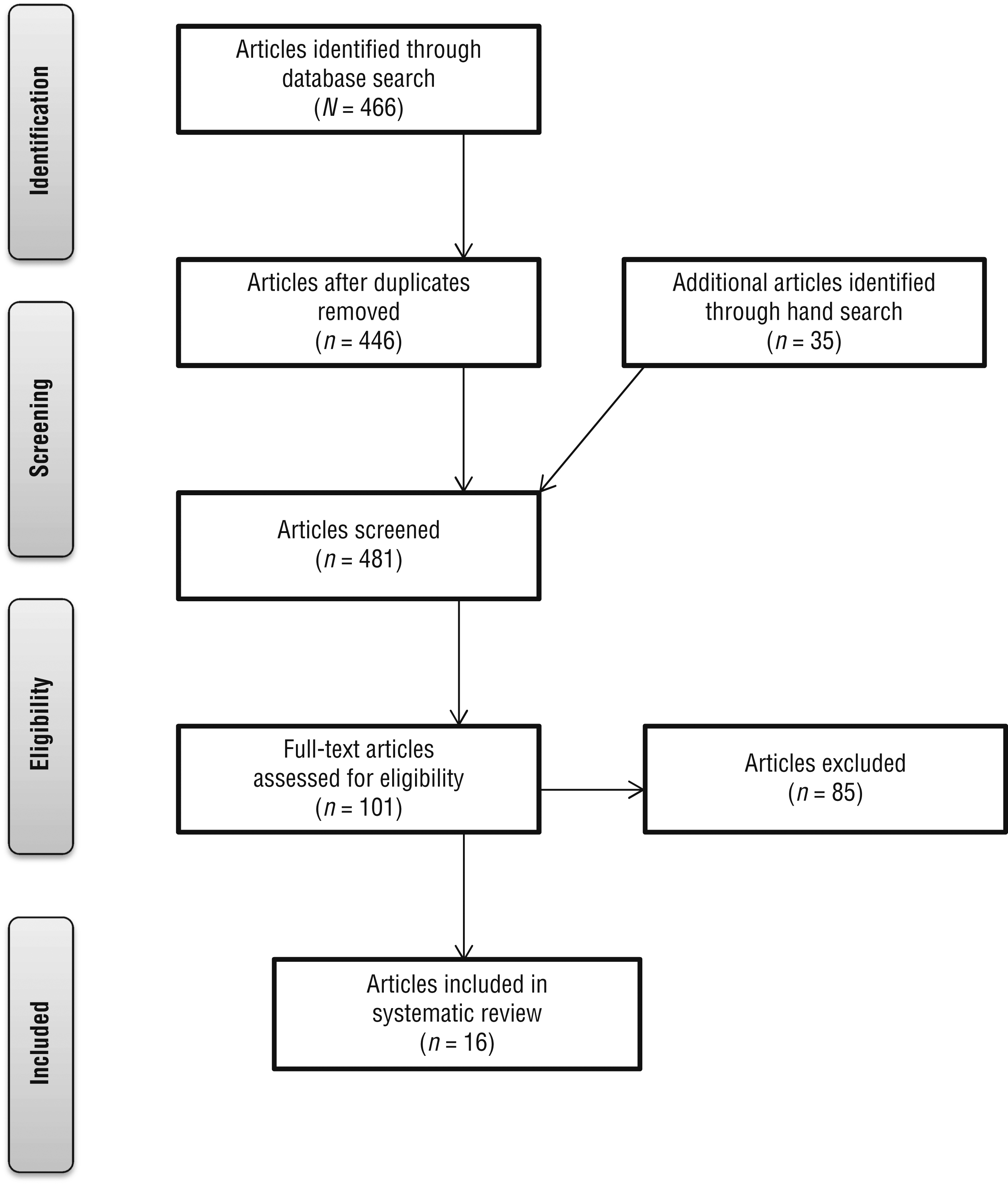
Flow diagram of article inclusion and exclusion process.
Risk of Bias
Each article was assessed for risk of bias as described in the Cochrane risk-of-bias guidelines (Higgins et al., 2011). The authors collaborated to reach consensus on each category of bias assessed. Many of the studies included in this review had high risk of selection bias because of lack of randomization of participants to study groups. In addition, many studies had high risk for detection and performance bias because they were not blinded. Table 3 (at the end of this article) summarizes the risk of bias for all articles included in this review.
Risk-of-Bias Table
Note. Categories for risk of bias are as follows: + = low risk of bias; ? = unclear risk of bias; – = high risk of bias. NA = not applicable because of study design. Risk-of-bias table format adapted from “Assessing Risk of Bias in Included Studies,” by J. P. T. Higgins, D. G. Altman, and J. A. C. Sterne, in Cochrane Handbook for Systematic Reviews of Interventions (Version 5.1.0), by J. P. T. Higgins and S. Green (Eds.), 2011, London: Cochrane Collaboration. Retrieved from http://handbook-5-1.cochrane.org. Copyright © 2011 by The Cochrane Collaboration.
Suggested citation: Smallfield, S., & Kaldenberg, J. (2020). Occupational therapy interventions to improve reading performance of older adults with low vision: A systematic review (Table 3). American Journal of Occupational Therapy, 74, 7401185030. https://doi.org/10.5014/ajot.2019.038380
Outcome Measures
Outcome measures used in the majority of studies included reading speed (words per minute) and reading duration. Additionally, self-report measures such as the National Eye Institute (2000) Visual Function Questionnaire (VFQ–25) were used in five studies. Few studies included in this review used functional outcome measures of reading.
Interventions to Enhance Reading
The 16 articles were categorized into three themes according to type of intervention: (1) technology, (2) visual skills training, and (3) multicomponent interventions. These findings are an update to the 2013 systematic review on the same focused question and theme (Smallfield et al., 2013) and provide either new or additional support to the existing body of evidence within each theme.
Technology.
The previous review (Smallfield et al., 2013) found limited strength of evidence to support the use of low vision devices (high-add spectacles, nonilluminated and illuminated handheld magnifiers, nonilluminated and illuminated stand magnifiers, high-plus lenses, telescopes, and electronic magnification) to improve reading performance because of the low methodological quality of the studies included. However, moderate evidence was found to support the use of stand-based electronic magnification (e.g., closed circuit television [CCTV]) to enhance reading required for the performance of occupations compared with other types of low vision devices.
The current review identified 4 additional studies (1 Level I, 1 Level II, 2 Level III) addressing the effectiveness of technology interventions addressing reading required for occupational performance. Two studies examined the effectiveness of vision-specific assistive technology. In an RCT examining the use of CCTVs, Burggraaff and colleagues (2012) found no significant differences on measures of reading performance between participants who received standardized training from a low vision therapist to use the CCTV and control participants who received only the standard delivery instructions. CCTV use by all participants increased their reading acuity and maximum reading speed and decreased the number of errors compared with reading with no CCTV. In a Level III pilot study with 12 participants, Moisseiev and Manis (2016) found that a portable artificial vision device (OrCam; Jerusalem, Israel) significantly increased reading performance of older adults with low vision compared with baseline and with other low vision devices the participants were already using.
Two studies examined use of mainstream technology for reading by older adults with low vision. In a Level II study, Gill et al. (2013) compared reading text on a computer tablet and an e-reader to reading text on paper. Older adults with low vision who used an iPad with larger text sizes read significantly faster than when reading text on paper. The participants also read significantly faster with paper than with the e-reader. Kaldenberg and Smallfield (2017; Level III) studied the feasibility of a computer tablet group training program to improve occupational performance of four participants. Performance and Satisfaction ratings on the Canadian Occupational Performance Measure (Law et al., 2005) showed mean increases of 3.45 and 3.65, respectively; improvement greater than 2 points is considered meaningful clinical change.
In summary, low evidence was found for the use of vision-specific assistive technology and mainstream technology to improve reading required for the performance of daily occupations. Moderate evidence continues to support stand-based electronic magnification and training.
Visual Skills Training.
Visual skills training typically refers to a structured or systematic form of visual exercise to improve awareness of the visual field (Kaldenberg & Smallfield, 2017). Definitions of vision skills training vary in the literature depending on the underlying visual deficit. In this review, we refer to vision skills training as it relates to central visual field impairment and hemianopsia. For clients with central visual field impairment, visual skills training includes eccentric viewing training, both rapid serial presentation training and controlled eye movement training (Chung, 2011; Palmer et al., 2010; Seiple et al., 2011). For clients with hemianopsia, visual skills training includes compensatory systematic scanning training, computer-based visual search training, and audiovisual stimulation training (Aimola et al., 2014; de Haan et al., 2015; Hayes et al., 2012; Jacquin-Courtois et al., 2013; Keller & Lefin-Rank, 2010; Mödden et al., 2012; Schuett et al., 2012).
The previous review (Smallfield et al., 2013) found limited evidence from 2 Level I studies, 1 Level II study, and 1 Level III study with limited sample sizes supporting eccentric viewing training for central visual field impairment (Frennesson et al., 1995; Kabanarou & Rubin, 2006; Vukicevic & Fitzmaurice, 2005, 2009). We found 10 additional studies in the theme of visual skills training. Three studies addressed the effectiveness of visual skills training for central visual field impairment. Moderate evidence from 1 Level I RCT (Seiple et al., 2011) and 2 Level III studies (Chung, 2011; Palmer et al., 2010) supports the use of eccentric viewing training, with controlled eye (steady eye) movements, to improve reading speed and duration. One of the Level III studies (Palmer et al., 2010) also found significant improvements in reading comprehension, and the other found no improvements in visual acuity, critical print size measurements, location of the functional preferred retinal locus, or fixation stability (Chung, 2011).
The previous systematic review did not address visual skills training for people with hemianopsia (Smallfield et al., 2013); we include 7 articles addressing this intervention in this review. Four Level I studies (Aimola et al., 2014; de Haan et al., 2015; Keller & Lefin-Rank, 2010; Mödden et al., 2012), 1 Level II study (Jacquin-Courtois et al., 2013), and 2 Level III studies (Hayes et al., 2012; Schuett et al., 2012) provide low evidence for the effectiveness of visual skills training for older adults with hemianopsia to improve reading required for occupational performance. The results of these studies were inconsistent, and many had small samples, increasing the risk of bias. Two Level I studies showed no improvements in reading using compensatory scanning training or computer-based compensatory training (de Haan et al., 2015; Mödden et al., 2012). Two Level I studies found significant improvement in visual search and reading for participants who were provided 20 or more sessions of reading and visual exploration or audiovisual stimulation training (Aimola et al., 2014; Keller & Lefin-Rank, 2010).
In summary, moderate evidence supports the use of eccentric viewing training, specifically training in the steady eye technique, to improve reading speed and duration for older adults with central visual field impairment. Low evidence supports the use of visual skills training, such as compensatory systematic scanning training, computer-based visual search training, and audiovisual stimulation training, to improve reading performance for older adults with hemianopsia.
Multicomponent Interventions.
The previous systematic review (Smallfield et al., 2013) found strong evidence from 5 studies (4 Level I, 1 Level III) supporting low vision programs that included occupational therapy as part of interprofessional services for older adults with low vision (Eklund & Dahlin-Ivanoff, 2007; Eklund et al., 2008; Markowitz et al., 2008; McCabe et al., 2000; Pankow et al., 2004). Occupational therapy interventions included group therapy, education about the eye condition and available resources, training in problem-solving strategies, environmental modification, training in the use of low vision devices, instruction in adaptive strategies and work simplification, training in techniques for reading, education regarding adjustment to vision loss, and training in performance of daily occupations.
The previous review (Smallfield et al., 2013) also included 5 studies of low vision rehabilitation programs that did not include occupational therapy but included a combination of interventions including a low vision examination, prognosis and education about the eye condition, low vision therapy, prescription of low vision devices, eccentric viewing training, and home visits (Goodrich et al., 2006; La Grow, 2004; Reeves et al., 2004; Scanlan & Cuddeford, 2004; Stelmack et al., 2008). Combined, these studies provide conflicting evidence regarding the interventions’ effectiveness in improving reading required for the performance of occupations compared with either an alternative intervention or no intervention.
The current review found 2 Level I studies that add to the body of evidence for multicomponent interventions addressing reading required for the performance of occupations. Stelmack et al. (2012) completed a Level I RCT in which the intervention group received five weekly 2-hr vision therapy sessions, a home visit, 5 hr of homework each week, and low vision device prescription. Compared with a control group receiving no services, the intervention group improved significantly in reading and other visual function skills at 4-mo follow-up.
Rovner et al. (2013) conducted a Level I RCT in which the intervention group received problem-solving training along with goal setting and solution identification and a control group received supportive therapy with no focus on vision rehabilitation. The researchers found no significant differences between groups in reading performance measured with the VFQ–25. On the basis of this single study, it is unclear whether a problem-solving approach is an effective strategy to promote reading performance, and further investigation is warranted using a performance-based outcome measure.
In summary, there continues to be strong evidence to support multicomponent interventions that include vision therapy, low vision device prescription and training, environmental modification, and homework for older adults with low vision to support reading required for occupational performance.
Discussion and Implications
The purpose of this systematic review was to examine updated evidence for the effectiveness of interventions within the scope of occupational therapy to improve reading required for the performance of occupations by older adults with low vision. Results provide low evidence for the use of vision-specific assistive technology and mainstream technology, and therefore occupational therapy practitioners should use these interventions cautiously on a case-by-case basis as appropriate. Moderate evidence supports stand-based electronic magnification and training, which should be offered routinely.
Moderate evidence also supports the use of eccentric viewing training, specifically training in the steady eye technique, to improve reading speed and duration for older adults with central visual field impairment, and this intervention should be offered routinely. Low evidence supports the use of visual skills training, such as compensatory systematic scanning training, computer-based visual search training, and audiovisual stimulation training, to improve reading performance for older adults with hemianopsia, and therefore these interventions should be used cautiously on a case-by-case basis.
Strong evidence supports multicomponent interventions that include vision therapy, low vision device prescription and training, environmental modification, and homework, and such interventions should be provided routinely. Finally, low evidence exists on the use of a problem-solving approach for the outcome of reading performance, and therefore this intervention should be used cautiously on a case-by-case basis.
Implications for Occupational Therapy Education
Reading is an important skill necessary for the performance of many daily occupations. This review adds valuable evidence to support the role of occupational therapy in addressing the reading needs of older adults with low vision. As the population ages, the need for occupational therapy practitioners trained to address the occupational needs of older adults with low vision will increase. On the basis of the results of this review, occupational therapy curricula should include the following knowledge and skill training in low vision to facilitate reading performance:
Knowledge of common low vision conditions and progression
Functional implications of low vision for occupational performance
Assessment of functional vision, including reading
Stand-based electronic magnification and training
Eccentric viewing training (steady eye training) for clients with central field impairment
Visual search training for clients with neurological visual impairment
Comprehensive multicomponent interventions that include low vision devices and training, home assessment and intervention, homework, psychosocial intervention, and eccentric viewing training
Training in the use of standardized outcome measures for the outcome of reading to demonstrate intervention effectiveness
Knowledge of the potential need for referral to an advanced practice clinician in the area of low vision for intervention beyond the generalist skill level.
Implications for Occupational Therapy Research
Occupational therapy has the potential to play a significant role in enhancing reading skills for older adults with low vision. This review contributes to the existing body of research in the area of occupational therapy interventions to improve reading required for occupational performance. However, the studies included in the review are limited by small sample sizes, research designs that do not include a control group, and lack of functional outcome measures. Future research on interventions to address reading for the performance of daily occupations should include
The role and effectiveness of mainstream technology,
Larger sample sizes and use of functional outcome measures,
Ongoing study of the efficacy of problem-solving training for the outcome of reading,
Analysis of single-component interventions within multicomponent low vision rehabilitation, and
Occupational therapy practitioners in study design and as interventionists.
Implications for Occupational Therapy Practice
The results of this review indicate that occupational therapy practitioners working with older adults with low vision on reading performance should use the following interventions as part of routine service provision:
Comprehensive low vision rehabilitation
Eccentric viewing training (steady eye training).
Practitioners should use the following interventions on a case-by-case basis:
Vision-specific assistive technology
Mainstream technology to improve reading
Visual search training for hemianopsia.
Limitations
Although the body of evidence to support interventions within the scope of occupational therapy to improve reading required for the performance of daily occupations is growing, the articles included in this review have several limitations. Seven of the 16 studies included small sample sizes, specifically fewer than 30 total participants. Additionally, many studies included outcome measures that were either self-report or not tied to functional activity. Seven articles included neurological visual diagnoses, which were not included in the previous review. Original research using qualitative methodology was not included in the review. New evidence supporting traditional low vision intervention strategies, such as hand and stand-based magnification, was not found in this updated systematic review. Only occupational therapists served as reviewers in this study, which may contribute to potential bias.
Conclusion
Low vision is a chronic condition common in older adults that leads to significant challenges in engagement in desired occupations that require reading. The aim of this updated systematic review was to determine the effectiveness of interventions within the scope of occupational therapy to improve reading required for performance of occupations for older adults with low vision. Moderate evidence supports the use of comprehensive low vision rehabilitation, stand-based electronic magnification, and eccentric viewing training (steady eye technique). Occupational therapy practitioners working with older adults with low vision are strongly encouraged to integrate these interventions into routine care for this population with the goal of improved reading for the performance of daily occupations.1
Footnotes
Acknowledgments
We thank Deborah Lieberman, MSHA, OTR/L, FAOTA, and Elizabeth G. Hunter, PhD, OTR/L, for their guidance and support on this project, as well as Lea Fang, BA, who assisted with minor editing. An earlier version of this work was presented at the 2018 AOTA Annual Conference & Expo in Salt Lake City, Utah.
*
Indicates articles included in the systematic review.