





Abstract
Over the years, the number of students with learning disabilities attending higher education institutions has increased (Harrison et al., 2013). These students continue to experience difficulties in basic academic areas (Lovett et al., 2017), including handwriting. Although students perform many of their academic activities using digital devices, tests are usually still handwritten. Consequently, students with handwriting difficulties, or dysgraphia (Berninger et al., 2015), are often limited in their ability to demonstrate their knowledge, which thus affects their achievements and participation in academic activities.
Students with dysgraphia often receive test accommodations. However, the current decision-making process for providing accommodations is not always based on sound evidence to ensure that the proposed accommodations decrease the barriers caused by the disability (Weis et al., 2016). Therefore, a need exists for an evidence-based and individualized protocol for selecting accommodations for students with dysgraphia.
Test Accommodations for Higher Education Students With Dysgraphia
Students with dysgraphia are a heterogeneous group. Their handwriting difficulties may be manifested in slow writing, poor legibility, pain, and fatigue (Graham et al., 2016), which often affect their academic performance and participation in various activities. In such situations, intervention is warranted and may take different forms. It may focus on working directly with the person on improving body functions or ability to perform a certain activity. Intervention may also focus on facilitating opportunities to engage in occupations, such as providing environmental or activity-based accommodations (American Occupational Therapy Association, 2014), which are the focus of this study. In higher education settings, pedagogical methods such as direct interventions to improve handwriting are not common; students are mostly given test accommodations to demonstrate their knowledge.
The purpose of test accommodations for students with dysgraphia is to diminish the limitations to test performance created by their handwriting difficulties, which are not relevant to the content or the ability being evaluated. Thus, they are provided an equal opportunity to fulfill their academic potential (Sireci et al., 2005; Thurlow et al., 2006). However, an accommodation that helps one particular student with dysgraphia may not be beneficial for other students with this disability (Fuchs et al., 2005). Thus, accommodations, like any intervention, need to be tailored to the specific needs of each student. Test accommodations for students with dysgraphia vary and may include providing extended time, using word processing, dictating a response, transcribing the text, and using speech-to-text software (Li & Hamel, 2003).
The type of accommodations provided is usually decided by the higher education institution, according to the technical means available and the institution’s academic standards, and in congruence with the prevailing law ( Guckenberger v. Boston University, 1998). Although the accommodations allowed by institutions may differ, extended time and word processing (using keyboarding) are the most common (Lovett, 2010; Weis et al., 2016), probably because they are relatively easy to apply and allow students to work independently (rather than require assistance or special technology). These accommodations are therefore the focus of this study.
The rationale for providing extended time for students with dysgraphia is that it may enable slow writers to more fully express their knowledge during the test (Stretch & Osborne, 2005). It may also allow students with poor legibility to write more slowly and legibly and enable students who experience pain to take short pauses. However, extended time may prolong and exacerbate students’ pain. Similarly, word processing (i.e., keyboarding) may assist in circumventing illegible handwriting (Klein & Taub, 2005), thus preventing the phenomenon of legibility bias (i.e., lower scores on essays as a result of illegible handwriting; Greifeneder et al., 2010). Keyboarding may also reduce fatigue or pain (Whithaus et al., 2008).
Although these postulations about keyboarding may be correct, it may not be sufficient to remove the barrier of slow handwriting speed. For example, studies have reported a medium correlation between handwriting and keyboarding speeds (Weigelt-Marom & Weintraub, 2018), indicating that a subgroup of students with dysgraphia may also have difficulties in keyboarding (Rosenberg-Adler & Weintraub, 2020). Moreover, if students with dysgraphia are not proficient keyboarders, this accommodation may limit writing speed. In addition, from an ecological perspective, keyboarding is not always a sufficient solution for illegible handwriting. If legibility is considered to be readability rather than neatness (Greifeneder et al., 2010), even machine-printed output may be less readable if it contains typing or spelling errors.
The pros and cons of offering extended time or keyboarding demonstrate the need to establish the most appropriate accommodation for each student, in a systematic and evidence-based decision-making process. Although a few decision-making protocols exist (e.g., Lindstrom, 2007; Ofiesh et al., 2004; Weis et al., 2016), they were not developed for students with dysgraphia. Moreover, they do not include a simulation stage, in which clinicians examine writing with possible accommodations, using standardized measures. This extra step is crucial because it provides the necessary evidence that the selected accommodation circumvents the handwriting difficulties (Weis et al., 2016). This study’s objectives were threefold: (1) to describe the development of an evidence-based and individualized decision-making protocol (henceforth, the Protocol) for selecting test accommodations for students with dysgraphia, (2) to establish the Protocol’s face and content validity, and (3) to examine the Protocol’s interrater reliability (IRR) and preliminary outcomes.
Development of the Protocol
The development of the Protocol for selecting accommodations for students with dysgraphia was based on a literature review, outlined in the previous section, and our clinical experience. First, we established the Protocol’s three underlying principles:
The selection of accommodations should be tailored to each student on the basis of standardized assessments of writing performance (i.e., legibility, speed) that are administered using accommodations.
An accommodation is effective if it improves writing performance but does not create a limitation in a different aspect of writing (e.g., keyboarding may improve legibility but limit speed).
In situations in which there is no optimal accommodation (e.g., speed or legibility does not sufficiently improve), the best possible choice should be selected, taking into account students’ relative improvement and accompanying pain (Lindstrom, 2007; Ofiesh et al., 2004; Weis et al., 2016).
We used these principles to devise a multistep process (Steps A–D) for selecting the best-fit accommodations for students who were already diagnosed with dysgraphia (Figure 1).
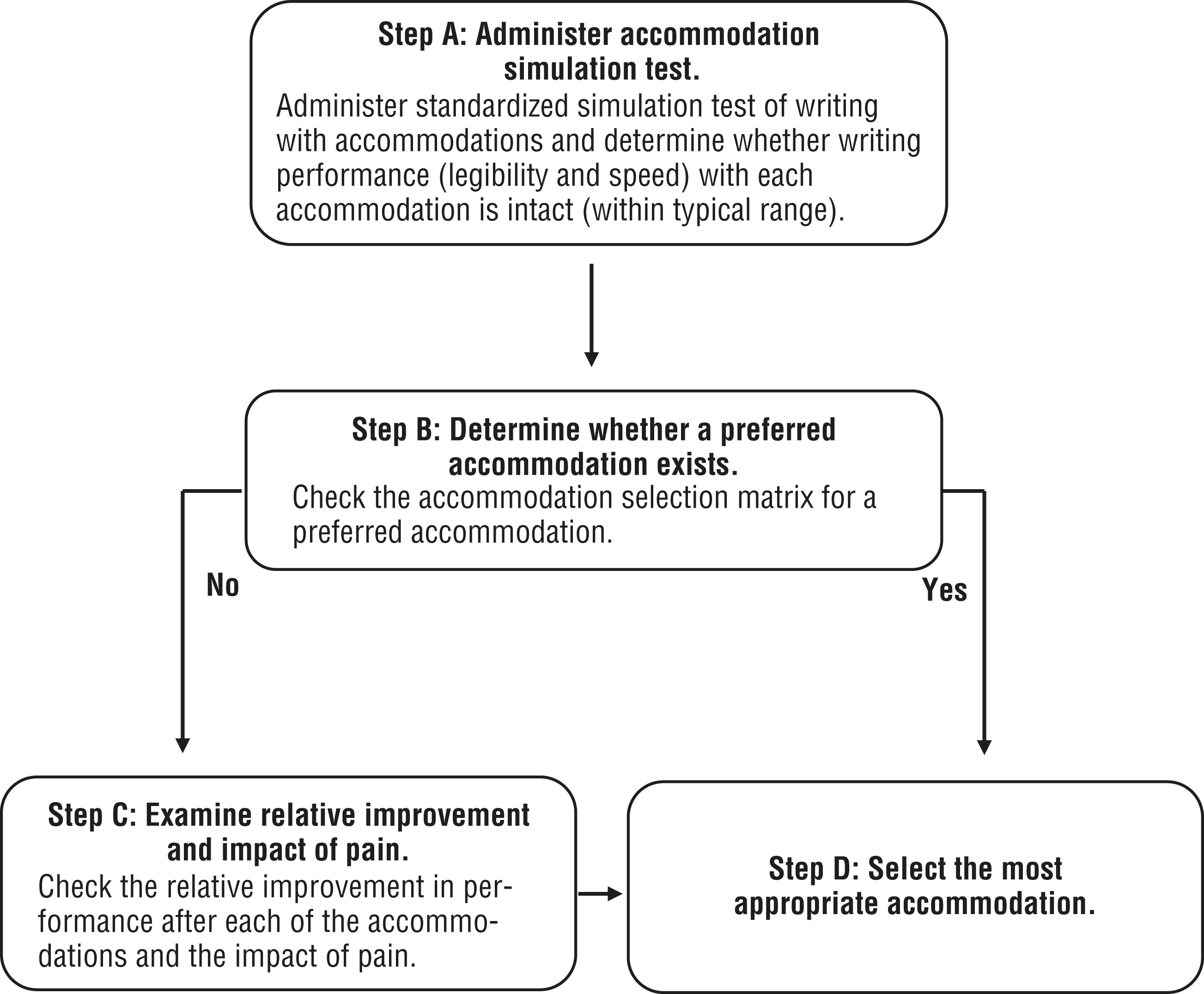
Decision-making process for selecting accommodations.
Each step is described and its application demonstrated through two higher education students with dysgraphia (according to standardized tests), John and Diane. They were eligible for test accommodations because they were diagnosed in childhood as having a learning disorder and because of their current academic and handwriting performance. John’s handwriting was slow, and Diane had difficulties with both legibility and speed.
Step A: Administer Accommodation Simulation Test
A standardized test is administered, simulating writing with accommodations. On the basis of this simulation, it is determined whether students’ performance in the writing measures (legibility and speed) under the accommodation conditions (extended time and keyboarding) is within the typical range. For each accommodation and writing measure, the clinician marks a plus sign (+) when the performance is intact (i.e., within the typical range) and a minus sign (−) when it is not. These signs are then used in Step B.
For example, when John (slow handwriting) wrote under the extended-time condition (i.e., 25% extra time), his handwriting legibility was intact (+), but his handwriting speed was still lower than expected (–; see ovals in Figure 2). In contrast, his writing speed using keyboarding improved and was intact (+). For Diane (difficulty in both legibility and speed), her written texts were still illegible (–) under both accommodations—because of many typing errors in keyboarding, among other reasons—but her writing speed improved and was intact (+; see bold rectangles in Figure 2).
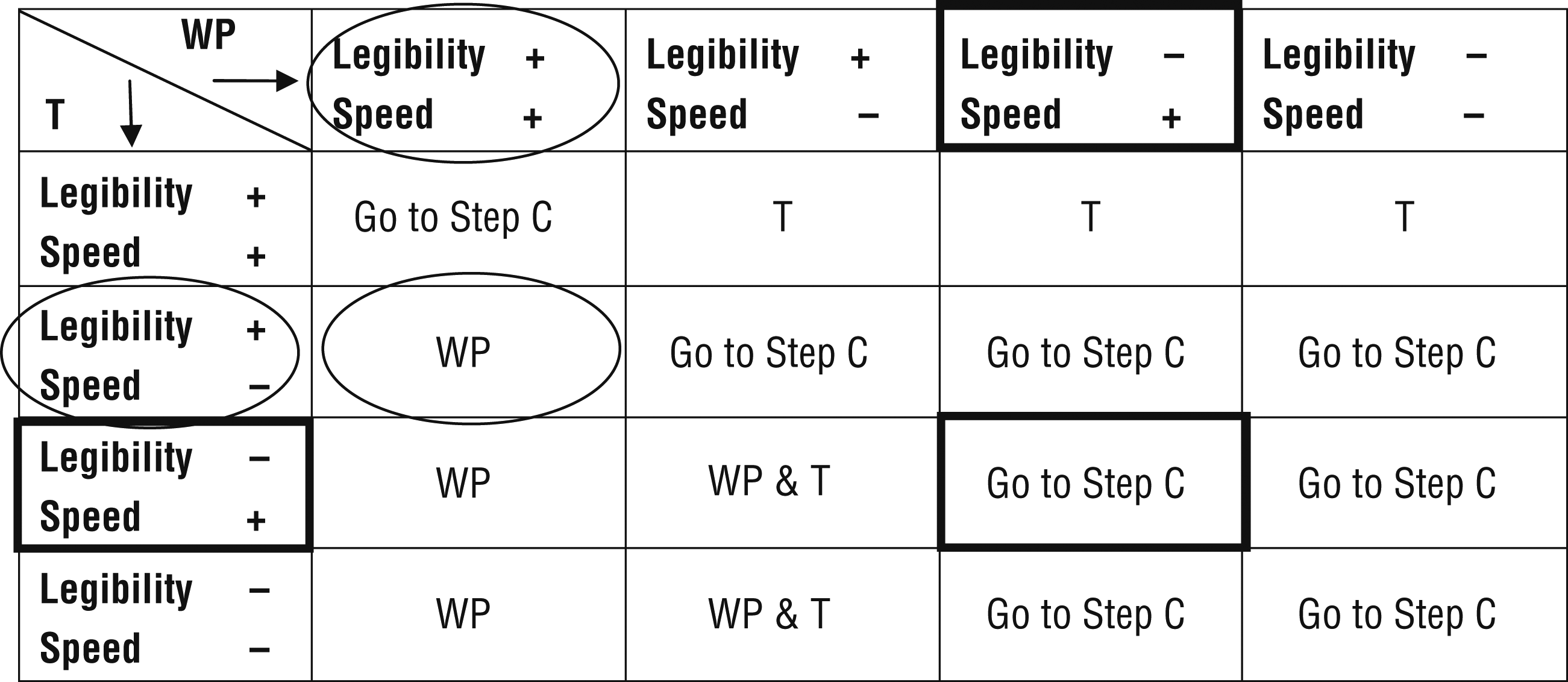
Accommodation selection matrix for John and Diane.
Step B: Determine Whether a Preferred Accommodation Exists
The accommodation selection matrix (Figure 2) is used to compare students’ performance under the two accommodation conditions, based on the findings in Step A. If a preferred accommodation exists, the clinician moves to Step D. If not, then Step C is warranted.
For example, when combining John’s results from the two accommodation simulations, the matrix showed that the preferred accommodation for John was keyboarding. Therefore, the clinician moved to Step D and selected keyboarding. However, in Diane’s case, both accommodations did not remove the barrier, making it difficult to determine the preferred accommodation, so additional factors needed to be considered in Step C.
Step C: Examine Relative Improvement and Impact of Pain
On the basis of the information collected in Steps A and B, the relative improvement in performance after each of the accommodations and the impact of pain are examined. For example, Diane’s legibility improved more with keyboarding (although it was insufficient) than with the extended-time condition. In addition, handwriting, but not keyboarding, caused her high levels of pain.
Step D: Select the Most Appropriate Accommodation
The most appropriate accommodation is selected, if one exists, after Step B or after Step C. For example, on the basis of Step C, after relative improvement and pain were examined, the most appropriate accommodation for Diane appeared to be keyboarding.
Method
Face and Content Validity
To establish the Protocol’s face and content validity, we asked three clinicians, experts in the area of dysgraphia, to review the Protocol’s rationale, process, and accommodation selection matrix and evaluate whether each of these components was appropriate and sufficiently comprehensive. Each expert separately stated that the components were clear and were aligned with the literature relating to accommodations for students with learning disabilities, and specifically for those with dysgraphia. Therefore, we proceeded to examine the Protocol’s interrater reliability and initial outcomes.
Interrater Reliability and Initial Outcomes
Participants
The study used a convenience sample of 25 students from a large university in central Israel, of whom 22 (88.0%) were male and most (62.5%) were first-year students. Students’ ages ranged from 22 to 30 yr (mean = 24.9, standard deviation = 2.1). The students were recruited through the Unit for Diagnosis and Support for Students With Learning Disabilities at the university. They were included in the study if they had a previous diagnosis of a specific learning disability (i.e., reading or writing difficulties) and were eligible (in the past or currently) for test accommodations and if they were identified as having dysgraphia on the basis of a standardized test. Students were excluded if in the past 6 mo they had a physical condition involving their upper limb, neck, or back (e.g., inflammation, fracture) or were taking medications that may have affected their handwriting or typing abilities (except for medication for attention deficit hyperactivity disorder). Of the 25 students, 13 (52.0%) had reading difficulties and all had handwriting difficulties.
Measures
Two measures were used: the Student Background Questionnaire and the Handwriting Performance of Post-Secondary Students Evaluation (HaPPS; Weintraub et al., 2012, 2014). We developed the Student Background Questionnaire to obtain demographic (e.g., name, gender, age) and developmental, medical, educational, and vocational information, such as a previous learning disability diagnosis.
The HaPPS is a standardized test that evaluates handwriting performance of higher education students and includes two parts. Part A (Weintraub et al., 2012) consists of three tasks: a 10-min copying task, 3 min of writing from dictation, and a 5-min expository composition. After each task, students are asked to rate the degree of pain or discomfort that they experienced, on a scale ranging from 0 (no pain or discomfort) to 10 (unbearable pain). Each task is scored for writing speed (number of characters, including letters and punctuation marks, per minute) and legibility (percentage of unreadable words). The cutoff point for handwriting difficulty in speed or legibility is a standard score less than –1.5. Part B (Weintraub et al., 2014) simulates writing with accommodations (extended time and keyboarding) using copying tasks with texts similar to those in Part A. The measures are identical to Part A.
Part A of the HaPPS was found to have medium-high and statistically significant IRR for legibility, .61 < r < .87, p < .01, and for speed, .76 < r < .90, p < .01. It was also found to discriminate between students with and without dysgraphia in speed, F(4, 112) = 16.58, p = .001, and legibility, F(4, 110) = 11.80, p = .001.
Procedure and Data Analysis
After receiving approval from the university’s ethics committee, we placed notices at the university’s Unit for Diagnosis and Support for Students With Learning Disabilities. Interested students received a detailed explanation of the study and were asked to sign an informed consent form. We used results from the Student Background Questionnaire and Part A of the HaPPS, which was administered individually, to establish students’ eligibility for the study. Next, we used the Protocol as previously described to determine the most suitable accommodation for the eligible students. As part of this process (Step A of the Protocol), we administered Part B of the HaPPS. Students were individually tested by a certified clinician who specialized in learning disabilities and had more than 10 yr of experience.
To examine interrater reliability of the decision-making Protocol, we trained three handwriting experts to use the Protocol. Each expert then received a summary of the writing performance (with and without accommodations) of each of the 25 students and was asked to select the most appropriate accommodation for each student by following the Protocol. Data analyses were performed using IBM SPSS Statistics (Version 20; IBM Corp., Armonk, NY). Descriptive statistics were used to describe the sample and students’ performance on the different tests. To estimate IRR, Cohen’s κ was computed for each pair of experts and then averaged to provide a single index of IRR (Cohen, 1960; Hallgren, 2012; Light, 1971).
Results
Students’ handwriting performance without accommodations is shown in Table 1. Mean standard deviations were less than the cutoff points for determining impaired handwriting legibility and speed. In examining the IRR, Cohen’s κ indicated high agreement (κ = .80; Landis & Koch, 1977), suggesting that the Protocol yielded good IRR. Next, we examined the distribution of the recommended accommodations (i.e., the Protocol’s outcomes) in relation to handwriting difficulties (legibility and speed; Table 2). Most students (n = 20) had poor legibility, and 10 also had slow handwriting. For these students, keyboarding was found to be the most effective accommodation. However, in the subgroup that also had handwriting speed difficulties, most students (70%) also required extended time.
Results on the Handwriting Performance of Post-Secondary Students Evaluation, Part A (N = 25)
Note. M = mean; SD = standard deviation.
Percentage of illegible words.
Mean number of characters written per minute.
The composition task is not measured for speed.
Handwriting Difficulties and Distribution of Accommodations Provided
Note. T = handwriting with 25% extended time; WP = word processing; — = not applicable.
Keyboarding was found to be most effective for 3 (60%) of the 5 students who had only slow handwriting. Interestingly, in these cases, the students’ keyboarding speed was intact, and they did not need additional time. Finally, extended time was found to be most effective for only 2 students who had slow but legible handwriting. For elaboration on students’ writing performance (with and without accommodations) and accompanying pain, see Appendix A.
Discussion
Students with dysgraphia in institutions of higher education are often assisted by test accommodations to help diminish the barriers to their performance created by their disability. Therefore, the provided accommodations should be carefully selected to best fit their needs. To this end, we developed a systematic, evidence-based decision-making Protocol to guide clinicians in selecting the most appropriate test accommodations for specific students. The Protocol includes a crucial step in which clinicians examine, in a standardized and systematic manner, whether the accommodation actually alleviates the student’s handwriting difficulty. This step is absent in existing guidelines suggested for students with learning disabilities (Lindstrom, 2007; Ofiesh et al., 2004; Weis et al., 2016). The aim of this study was to examine the initial psychometric properties and outcomes of the Protocol for selecting accommodations for students with dysgraphia.
The suggested Protocol was found to have face and content validity. This validity may be attributed to the Protocol’s following several principles based on a literature review relating to test accommodations for students with dysgraphia and based on extensive clinical experience. In addition, the study results showed that the Protocol had high interrater reliability. One factor that may explain this finding is that the Protocol includes several specified steps, which are performed in a consistent and uniform manner, and is based on objective information (i.e., a standardized assessment). These steps provide a clear roadmap for clinicians to follow, and in our study, they consequently led to a relatively uniform decision-making process in determining the most appropriate test accommodations for the students.
The study’s results also support previous findings showing that students with dysgraphia are a heterogeneous group (Berninger et al., 2015) with respect to the expression of handwriting legibility, speed, and accompanying pain (Feder & Majnemer, 2007; Rosenblum & Dror, 2017). This heterogeneity reinforces the assertion that test accommodations must be tailored to each student according to his or her specific capacity (Gregg & Nelson, 2012; Lindstrom, 2007; Weis et al., 2016). Moreover, an important finding of this study is that the best-fit accommodation for students with dysgraphia is not always intuitive. For example, extended time was not necessarily the preferred accommodation for slow handwriters; more than half the students with slow handwriting alone benefited more from keyboarding. Similarly, although keyboarding was found to improve legibility for students with both slow and illegible handwriting, in 70% of these cases, keyboarding was still slower than expected. This finding supports previous studies (Rosenberg-Adler & Weintraub, 2019) showing the existence of a subgroup of slow handwriters who are also slow keyboarders. These results also suggest that these students may require alternative accommodations that circumvent writing, such as speech to text or dictating a response.
These results indicate that the examination of writing performance with accommodations in the simulation step appears to be crucial in the decision-making process, enabling selection of the most appropriate accommodation for each student while maintaining the principles of specificity and fairness in accommodation provision and test validity (Burns, 1998; Fuchs et al., 2005). However, because this is one of the first studies on this topic, the results need to be treated with caution, especially given the small sample size and recruitment from one university. Future studies should examine the effectiveness of the Protocol with larger samples and a diverse age group. In addition, it is important to examine whether, after applying the Protocol and providing students with the best-fit accommodation for their handwriting difficulties, their written expression (i.e., in the tests themselves) improves. Finally, it is important to extend the Protocol and examine its feasibility and efficacy with additional possible accommodations such as dictating a response or using speech-to-text software.
Implications for Occupational Therapy Practice
This study has several implications for occupational therapy practice:
Evaluation of students’ handwriting performance and selection of the most appropriate accommodation should be systematic and based on standardized tests (Ofiesh, 2007; Ofiesh et al., 2004; Weis et al., 2016).
This process should include a step simulating possible accommodations for a specific student and a step deciding whether the accommodation alleviates the student’s handwriting difficulties in the manner suggested in the Protocol.
The suggested Protocol appears to be easy to follow and has the potential to provide a reliable and systematic method for selecting the accommodation that best fits a student with dysgraphia while considering his or her unique circumstances.
Conclusion
The selection of an appropriate accommodation for students with dysgraphia should be based on standardized tests, be tailored to each student’s writing abilities, and follow a systematic process. This process should include a step simulating possible accommodations for the specific student and a step determining whether the accommodation alleviates the student’s handwriting difficulties. To this end, the Protocol described in this study appears to be a promising, evidence-based tool that may assist occupational therapists in selecting the most appropriate accommodations for students with dysgraphia.
Footnotes
Acknowledgments
We thank Chait Bar Yosef, Ruth Traub Bar-Ilan, Hagit Shoval, and Sharon Abecassis for their assistance in validating the Protocol and their helpful remarks. We also thank Ruth Traub Bar-Ilan and Adi Ovadia-Israeli for their helpful ideas, clinical experience, and knowledge while we developed the Protocol.
Appendix
Writing Performance With and Without Accommodations, Accompanying Pain, and Suggested Accommodation
| Participant and Measure a | Handwriting Performance Without Accommodations b | Copying With Extended Time | Copying With Word Processing | Suggested Accommodation | ||||
| Z | Performance | Pain | Z | Performance | Pain | |||
| 1 | ||||||||
| Legibility | – | −3.0 | – | 7 | 0.1 | + | 4.5 | WP |
| Speed | – | −0.3 | + | −0.5 | + | |||
| 2 | ||||||||
| Legibility | + | −0.2 | + | 2 | 0.6 | + | 1 | HW-T |
| Speed | – | −1.1 | + | −1.8 | – | |||
| 3 | ||||||||
| Legibility | – | −4.4 | – | 8.5 | −0.1 | + | 0 | WP |
| Speed | + | 0.4 | + | −0.2 | + | |||
| 4 | ||||||||
| Legibility | – | −4.2 | – | 4.5 | −1.4 | + | 2.5 | WP |
| Speed | + | −0.1 | + | 0.2 | + | |||
| 5 | ||||||||
| Legibility | – | −0.2 | + | 8 | −0.1 | + | 0 | WP |
| Speed | + | 0.3 | + | 6.1 | + | |||
| 6 | ||||||||
| Legibility | – | −6.7 | – | 4 | 0.0 | + | 0 | WP |
| Speed | + | 0.0 | + | 0.5 | + | |||
| 7 | ||||||||
| Legibility | – | −2.4 | – | 3 | −0.3 | + | 3 | WP-T |
| Speed | – | −0.4 | + | −1.6 | – | |||
| 8 | ||||||||
| Legibility | – | −1.3 | + | 8.5 | 0.6 | + | 0 | WP |
| Speed | + | 0.3 | + | 2.1 | + | |||
| 9 | ||||||||
| Legibility | – | −9.2 | – | 9 | 0.6 | + | 3 | WP |
| Speed | + | −2.3 | – | 1.1 | + | |||
| 10 | ||||||||
| Legibility | – | −3.6 | – | 7.5 | 0.6 | + | 4.5 | WP-T |
| Speed | – | −3.2 | – | −3.7 | – | |||
| 11 | ||||||||
| Legibility | – | −0.2 | + | 8 | 0.6 | + | 2 | WP |
| Speed | – | −1.1 | + | −0.8 | + | |||
| 12 | ||||||||
| Legibility | – | −2.3 | – | 8.5 | 0.6 | + | 6.5 | WP-T |
| Speed | – | −3.4 | – | −4.4 | – | |||
| 13 | ||||||||
| Legibility | – | −3.6 | – | 8 | −0.7 | + | 0 | WP |
| Speed | + | 2.8 | + | 0.29 | + | |||
| 14 | ||||||||
| Legibility | – | −10.9 | – | 7.5 | 0.6 | + | 4.5 | WP-T |
| Speed | – | −0.3 | + | −3.0 | – | |||
| 15 | ||||||||
| Legibility | – | −3.2 | – | 1 | −1.9 | + | 1 | WP-T |
| Speed | – | 0.4 | + | −2.9 | – | |||
| 16 | ||||||||
| Legibility | – | −1.3 | + | 8 | −1.4 | + | 4 | WP |
| Speed | + | 0.3 | + | 5.0 | + | |||
| 17 | ||||||||
| Legibility | – | −3.7 | – | 5 | −0.1 | + | 1 | WP |
| Speed | + | 0.6 | + | 6.2 | + | |||
| 18 | ||||||||
| Legibility | – | −5.6 | – | 6.5 | 0.6 | + | 7 | WP |
| Speed | + | 0.7 | + | 0.1 | + | |||
| 19 | ||||||||
| Legibility | – | −3.0 | – | 3 | −0.3 | + | 0 | WP |
| Speed | – | −0.2 | + | −1.3 | + | |||
| 20 | ||||||||
| Legibility | + | 1.1 | + | 2 | 0.3 | + | 0 | HW-T |
| Speed | – | −1.2 | + | −1.7 | – | |||
| 21 | ||||||||
| Legibility | + | 0.6 | + | 4 | 0.6 | + | 1 | WP |
| Speed | – | −0.3 | + | 2.3 | + | |||
| 22 | ||||||||
| Legibility | + | −0.2 | + | 1.2 | −0.6 | + | 0 | WP |
| Speed | – | −0.9 | + | 1.1 | + | |||
| 23 | ||||||||
| Legibility | + | −0.8 | + | 7 | 0.6 | + | 2 | WP |
| Speed | – | −0.3 | + | −1.1 | + | |||
| 24 | ||||||||
| Legibility | – | −6.7 | – | 1 | −0.3 | + | 0 | WP-T |
| Speed | – | −0.3 | + | −1.5 | – | |||
| 25 | ||||||||
| Legibility | – | −11.7 | – | 2 | 0.6 | + | 0 | WP-T |
| Speed | – | −1.4 | + | −2.0 | – | |||
Note. HW-T = handwriting with extended time; WP = word processing; WP-T = word processing with extended time. − = difficulty; + = intact.
Legibility measure is percentage of illegible words. Speed measure is mean number of characters written per minute.
Based on results on the Handwriting Performance of Post-Secondary Students Evaluation, Part A.