





Abstract
Occupational therapy is a client-centered health profession that therapeutically uses everyday activities to enable clients to participate in roles, habits, routines, and rituals in settings that are relevant to their lives (American Occupational Therapy Association [AOTA], 2014). To design occupation-based interventions that facilitate the tailored changes needed for successful participation, occupational therapists who work collaboratively with clients must have high levels of professionalism, defined as the competencies, values, behaviors, and ethics that enable occupational therapists to fulfill their responsibilities to clients, other health care professionals, and broader society (Aguilar et al., 2013; Hordichuk et al., 2015). Professionalism is cited as a core attribute of competent occupational therapists in many professional association documents, including Standards of Practice for Occupational Therapy (AOTA, 2015) and Essential Competencies of Practice for Occupational Therapists in Canada (Association of Canadian Occupational Therapy Regulatory Organizations, 2011).
Although professionalism is important for occupational therapists, teaching professionalism to students is challenging (Robinson et al., 2012; Sullivan & Thiessen, 2015). Students may find it difficult to learn about and understand professionalism because they have few lived experiences relating to occupational therapy. Because professionalism is a complex, multifaceted concept, educators also find it challenging to convey the components of professionalism and teach them to students (Aguilar et al., 2013; Hordichuk et al., 2015); they therefore need information from multiple sources (Sullivan & Thiessen, 2015). Several pedagogical approaches to teaching professionalism have emerged from literature on the medical and health professions (Birden et al., 2013; Bossers et al., 1999). One approach uses a formal curriculum of lectures to teach students specific information about the professional behaviors they will need to treat clients in a clinical setting. However, literature reviews have found that some aspects of professionalism (e.g., professional relationships) are not easily taught through didactic coursework (Birden et al., 2013).
The informal professionalism curriculum, defined as unscripted, unplanned, and highly interpersonal forms of teaching and learning professionalism (Cruess et al., 2008), is often used as a complement to lecture-based education (Baernstein et al., 2009). This informal professionalism curriculum emerges through student contact with university educators, clinicians at medical placements, and peers in nonacademic contexts. Clinicians, in particular, have been cited as key role models for students, providing the primary influence on their professional development (Baldwin et al., 2014; Birden et al., 2013).
Role modeling occurs when students observe the behaviors and attitudes of someone they admire and subsequently adopt those behaviors and attitudes themselves (Cruess et al., 2008). By interacting with practitioners, students have opportunities to observe and practice the professional behaviors and attitudes required of an occupational therapist. However, one criticism of role modeling is that it is imitative and observational and could thus be considered a less active form of learning. Concerns have also been raised about the uneven quality of practitioners available to help students model professionalism. Accordingly, a need exists for other informal professionalism curricula that could provide students with an active learning experience with good role models.
We have designed a new international role-modeling pedagogy as an informal curriculum to offer students opportunities to observe the professionalism of good occupational therapy role models. This pedagogy is defined as the use of international experts who have developed an occupational therapy–related theory (incorporating a conceptual model, framework, and frame of reference) or practice model to facilitate students’ learning about professionalism. These experts are reflective therapists who can identify knowledge gaps and develop theories or practice models to enhance occupational therapy practice; they are thus assumed to be good role models for professionalism (Parham, 1987).
The theoretical framework for this pedagogical approach was Bandura’s (1977) Social Learning Theory, which involves four steps of observational learning. The first step is attention to modeled behaviors; that is, students observe professionalism by actively interviewing occupational therapy experts. The second step is retention of observed inputs, whereby students summarize the experts’ observed professionalism in an individual self-reflection report, following the process of role modeling (Cruess et al., 2008). The third step is production of a motor response, which involves students’ self-reflection on converting their observations into action plans for development of a professional self. The last step is an incentive and motivation process, which requires positive sanctions for students’ modeled behaviors (i.e., instructors provide feedback on each student’s observation and action plan in the self-reflection report).
In addition, the concept of internationalization of curriculum (Horton, 2009) is operationalized in the international role-modeling pedagogy. Because many of the experts who have developed theories or practice models are based outside of Hong Kong, interacting with them could provide students with more access to an international learning experience. For instance, students’ perspectives on occupational therapy could be broadened by engaging with global theories, practices, and types of professionalism developed under different cultural expectations. Moreover, in this pedagogy students are required to work in groups and interview one expert per group. The group-based design is aimed at fostering students’ teamwork attitude and skills, which are considered one core attribute of professionalism (Silva et al., 2019).
The development of genuine professionalism is a learning continuum in which professionalism develops sequentially through stages that should begin when students join an occupational therapy education program (Kasar & Muscari, 2000). Therefore, in the current study we explored how the international role-modeling pedagogy helped first-year occupational therapy students learn professionalism from international experts who had developed theories or practice models; specifically, we had two research questions:
To what extent did the international role-modeling pedagogy foster students’ understanding and awareness of professionalism in occupational therapy?
What were students’ perceptions of learning experiences regarding professionalism in the international role-modeling pedagogy?
Method
Participants
Our study population consisted of 102 first-year undergraduate occupational therapy students enrolled in “Occupational Therapy Theory and Process I,” a mandatory course at The Hong Kong Polytechnic University during the 2017–2018 academic year. An invitation to participate and research details were distributed to all students who attended the course orientation. Interested students were asked to provide written consent. Ethical approval for this study was obtained from the Human Subjects Ethics Subcommittee of The Hong Kong Polytechnic University.
International Role-Modeling Pedagogy
The international role-modeling pedagogy was conducted in the aforementioned course, using the format of student projects that involve interviews with international experts who have developed occupational therapy–related theories or practice models. To identify potential experts, the teaching team conducted a systematic search of three databases (MEDLINE, CINAHL, and PsycINFO) using search terms related to occupational therapy and model, theory, frame of reference, or framework before the study began. A total of 117 occupational therapy–specific theories or practice models reported between 1997 and 2017 were identified. A database (https://ottheory.com) was then developed to archive these theories and practice models. Because of the tremendous volume of search results, we selected for inclusion in the database only the 68 theories and practice models that were most common or recently developed, based on our teaching experiences and needs at the time this study was conducted.
We then wrote a brief summary of each theory or practice model, allowing students to search for and choose international experts in whom they were particularly interested. We also generated a student interview preparation guide (including invitation email templates and step-by-step interview questions) to help students contact and interview the experts. In addition, we videotaped an interview with one developer of the Person–Environment–Occupation model (Law et al., 1996) as a demonstration for the students. The interview video was shared with students during the third week of class, when this model was taught.
When the interview projects began, students were divided into 16 groups of 6 or 7 students each. Each group was asked to browse the database and to choose a preferred theory or practice model from among the 68 included in the database. However, before this point, the teaching team had approached 34 experts for whom email addresses were available, and 8 consented to be interviewed. Thus, we decided to allocate one expert each to two groups. If the students selected an expert who did not consent to an interview, they were informed by the teaching team that they needed to select another expert. Using the first-come, first-served principle, the first group whose selection was matched with the experts’ availability was assigned the role of inviting the expert, arranging the interview date, and preparing Zoom video communications (Zoom, San Jose, CA) for the interview, and the second matched group was assigned to interview the expert.
During the Zoom interviews, students used the prepared guide to explore the expert’s inspiration, perspective, and professionalism in a semistructured manner (see Figure 1 for interview questions). When possible, the interviews were video recorded or audio recorded so that they could be shared with the group of students who had contacted the expert but were not able to participate in the interview. The completed interviews ranged in length from 11 to 52 min (median [Mdn] = 21 min). After the interviews, students each wrote a 500-word individual self-reflection report on their observations of the expert’s professionalism and their own personal strengths and weaknesses, together with an action plan for developing a professional self. Each group of students also created a 10-min video presentation to introduce the theory or practice model about which they had interviewed the expert. The self-reflection report and video presentation were assessed at 10% and 25% of the final grade, respectively.
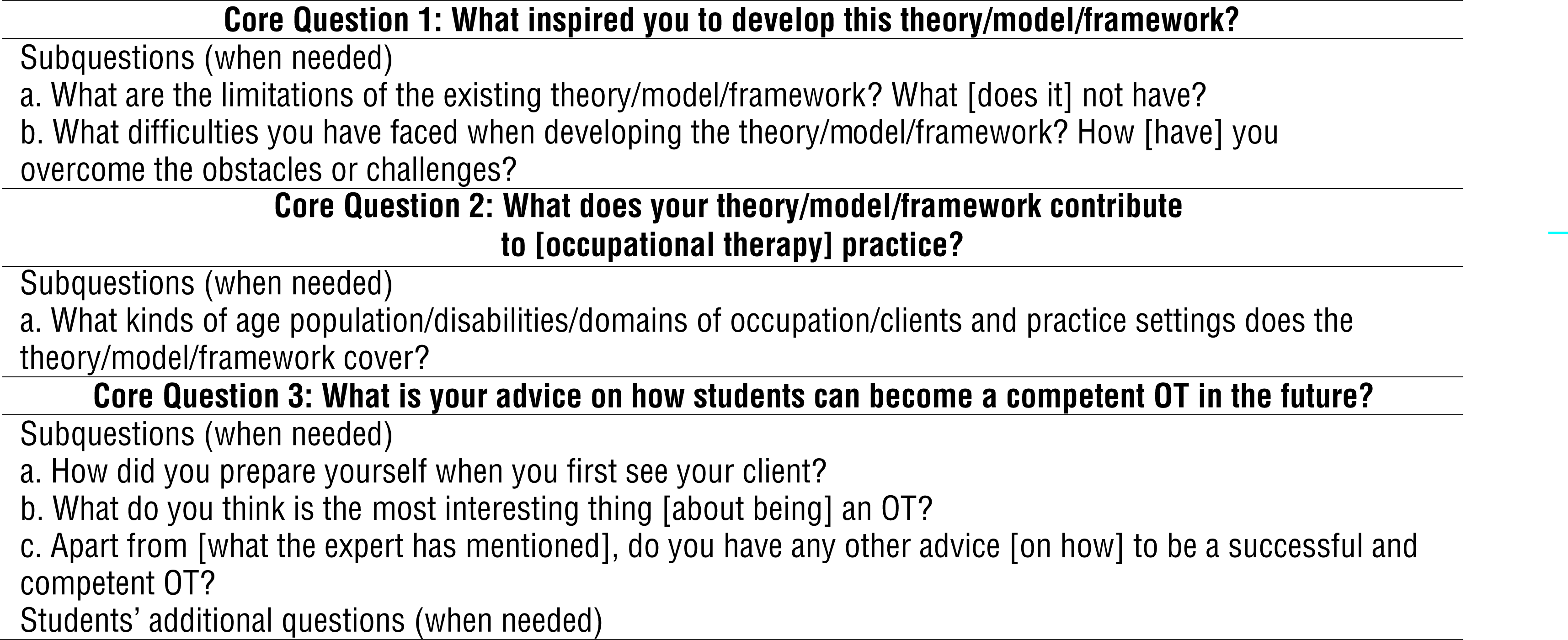
Guided questions used to interview the international experts.
Students’ Demographic Characteristics, Pre- and Postclass Understanding of Professionalism, and Satisfaction With the International Role-Modeling Project (N = 83)
Note. IQR = interquartile range; Mdn = median; — = not applicable.
With one exception, students carried out interviews with experts. Unfortunately, as a result of daylight savings time, one group got the time wrong, and the expert had no alternative time free for an interview. These students completed their video presentation on the allocated model and then watched the researchers’ interview with one developer of the Person–Environment–Occupation model to complete their self-reflection reports.
Procedures and Instrumentation
A paper-based preclass survey was distributed during a break in the first lecture to students who consented to participate. This survey included a section on professionalism that consisted of two open- and two closed-ended questions. The open-ended questions asked students to write about the professional values and attitudes (one question) and professional behaviors (the other question) they thought a competent occupational therapist should have. The two closed-ended questions asked students to rate their current understanding of professional values and attitudes and professional behaviors, respectively, on an 11-point rating scale ranging from 0 (completely low) to 10 (completely high). Students also provided their age and gender.
Between the 2nd and 11th weeks of the semester, the students attended regular course activities (including weekly lectures, fortnightly tutorials, and one hospital visit) that were not part of the international role-modeling pedagogy. Meanwhile, they conducted the interview with their selected international expert, following the interview preparation guide. At the end of the 11th week, the students submitted their video presentations and individual self-reflection reports via the Blackboard Learning Management System (Blackboard Inc., Washington, DC). A lecture on professionalism and the occupational therapy code of ethics (Occupational Therapists Board of Hong Kong, 2017) was taught in the 12th week of this course to avoid any influence on the students’ self-reflections on the international experts’ professionalism.
In the final lecture of the 13th week, the students completed a paper-based, postclass survey during the break. Like the preclass survey, this survey contained two closed-ended questions designed to assess their understanding of professional values and attitudes and professional behaviors, respectively. The postclass survey also included four closed-ended questions to assess students’ satisfaction with the project (Table 1). Students rated their satisfaction on an 11-point scale ranging from 0 (completely dissatisfied) to 10 (completely satisfied). It also included two additional open-ended questions; the first asked what the students found useful in the international role-modeling project, and the other asked how the international role-modeling project could be improved.
Summary of Students’ Perceptions of Categories of Professionalism Before and After Interviewing the International Experts (N = 83)
Note.
After the course final exam, a focus group of 5 students was convened to obtain a more in-depth understanding of their experience during the project. The 5 students were selected to reflect different groupings and levels of understanding of professionalism, as reported in the postclass survey. The first author led the focus group in a semistructured manner. Topics included the students’ experience of interviewing the experts and learning about occupational therapy theories and professionalism, as well as the usefulness of the interview preparation guide. The focus group was audio recorded and lasted for approximately 40 min.
Data Analysis
A descriptive analysis was used to summarize the quantitative data obtained from the pre- and postclass surveys. Because the data were not normally distributed, median and interquartile range are reported. Wilcoxon signed-rank tests were used to analyze the difference between pre- and postclass data. Significance was set at p < .05.
The students’ preclass survey responses to open-ended questions about aspects of professionalism were analyzed qualitatively through inductive content analysis (Elo & Kyngäs, 2008). The first author and a project assistant coded the data independently, created categories, compared their results, and discussed potential disparities. The second author took part in the discussion and peer debriefing. The same process was used to create categories signifying professionalism in the international experts, as recorded in the student self-reflection reports. Those categories were grouped into three main categories—professional values and ethics; professional attitudes and behaviors; and professional image, communication, and collaboration—on the basis of Hordichuk et al.’s (2015) structure, which was established through a comprehensive literature review on professionalism in occupational therapy. The occurrence frequency was quantified for each subcategory under the main categories.
The students’ learning experiences, reported in the postclass surveys and the focus group audio file, were typed or transcribed into digital text files. Inductive content analysis (Elo & Kyngäs, 2008) was also used to analyze the textual content line by line to identify emerging themes and representative quotations. The first author and project assistant carried out the initial coding independently and discussed it iteratively; the other coauthors engaged in peer debriefing.
Results
Of the original group of 102 students, 83 (81.4% response rate) returned the preclass surveys and 63 (75.9% retention rate) completed the postclass surveys. Most of the students were female (77.8%) and had a median age of 18 yr (see Table 1). We found no significant differences between students who did and did not complete both surveys in relation to gender (χ2[N = 83] = 2.459, p = .117), age (Mann–Whitney U = 524.000, p = .162), or preclass understanding of professional values and attitudes (U = 488.000, p = .124) or behaviors (U = 559.500, p = .447).
As Table 1 shows, students had a significantly higher level of self-rated understanding of professional values and attitudes (Wilcoxon signed-rank Z = 6.766, p < .001) and behaviors (Z = 5.671, p < .001) on the postclass surveys than on the preclass surveys. In addition, their satisfaction with the interview preparation guide was high (Mdn = 8). Students were moderately to highly satisfied with this project’s interactive environment, planning and design, and internationalized learning experience (Mdn = 7).
The categories of professionalism coded from the students’ preclass surveys and self-reflection reports are presented in Table 2. Although most subcategories were similar across the three main categories before and after the interview, frequencies changed. In the professional values and ethics category, the top three subcategories before the interview were professional integrity, inquisitiveness, and client-centeredness; after the interview, they were client-centeredness, critical thinking, and commitment to lifelong learning. In the category of professional attitudes and behaviors, confidentiality, caring, and being organized were the three most frequently cited subcategories before the interview. After the interview, the top three subcategories were passion, being knowledgeable, and being observant. In the professional image, communication, and collaboration category, the top subcategory before the interview was communication; after the interview, both collaboration and communication were the top subcategories. In addition, eight subcategories not identified in the preclass surveys emerged in students’ self-reflection reports (see Table 2).
Four primary themes related to students’ experience of learning about professionalism emerged from the focus group and postclass surveys. The first theme was obtaining learning opportunities. Students were grateful for the opportunity to interview an insightful, professional occupational therapist who had developed a theory or practice model. In one of the surveys, Student 77 noted that “the project allowed us to contact very outstanding role models; we could learn so many things from them.” In the focus group, Student 19 made a similar comment: “This whole experience was just eye-opening to me with somebody who is an [occupational therapist] and who is so professional and engaging as a person. . . . It was a really cool experience.”
The second theme was understanding occupational therapy professionalism. In both the surveys and the focus group, quite a few students said that the experts’ passion for developing a new theory or practice model had enhanced their understanding of professionalism. In the focus group, Student 3 noted,
What she [the expert] has done is to tell us to be lifelong learners because, in the model of occupational empowerment, there is a concept [of learning] how to listen, and that concept comes from a book that she [the expert] read about 20 years ago. I think she reminded us to be lifelong learners.
Students also learned the positive attributes of professionalism from the experts’ advice on being a competent therapist. In her survey responses, Student 91 said, “She [the expert] reminds us to be observant, lifelong learners; to understand the ever-changing world; and to address environmental changes.”
The third theme was aspiration in the pursuit of professionalism. After interviewing the experts, some students reflected on potential changes in their own professional attitudes and behaviors. As Student 23 wrote, “All of this [professional attitudes and behaviors] knowledge will be useful for my further study and future career.” In the focus group, Student 19 was impressed by the expert who experienced clients’ difficulties and tried to help them. This student reflected on this professionalism by saying,
What I should be, as an [occupational therapist, is] to be really passionate about helping people. . . . Really, it gave me a really good perspective on who I am as a student and who I should aspire to be in my future career.
The last theme, which emerged from the students’ views on ways to improve the international role-modeling pedagogy, was learning from practical troubleshooting. The students found it difficult to find suitable interview times because of time zone differences or the need to collaborate with another group or to use video communication software for the interview. They suggested inviting more experts, giving students autonomy in choosing which experts they were interested in interviewing, providing flexible interview questions, and having more consultations.
Discussion
The results of this study’s qualitative analysis indicate that students had a positive perception of the informal learning experience provided by the international role-modeling pedagogy. The experience enhanced students’ perceived understanding of professionalism and their awareness of specific professionalism attributes modeled by the experts. However, the students also faced challenges in implementing the interview project, suggesting the need for further improvement.
In medicine and health care education, experienced practitioners are commonly chosen as role models on account of their clinical skills and good relationship with clients (Silva et al., 2019); however, we chose international experts who had developed a theory or practice model. Most of these experts had PhDs, some had the role of clinical educator or fieldwork coordinator, and all worked at academic institutions; they could thus be considered good professional role models. Before the study, we wondered whether first-year students would be too inexperienced to value the opportunity to interview successful professional role models and to observe their professionalism. A perhaps surprising finding was that the students reported improved understanding of professionalism after the interview. They were satisfied with the interactive environment and internationalized learning experience. The themes from the focus group discussion and open survey questions reinforced the positive findings and removed our original concern.
According to Sullivan and Thiessen’s (2015) study of occupational therapy students’ perspectives on professionalism, first-year students tend to understand professionalism by searching for examples, such as image and presentation, that convey competence. It is possible that the distinguished professional role models, with their clear professionalism and competence in developing occupational therapy–specific theories or practice models, met the expectations of students at the beginning of their professional behavior development (Kasar & Muscari, 2000). This may be one explanation for the students’ positive experience of learning professionalism from those international experts.
Note that the subcategories of professionalism most frequently cited by the students in preclass surveys were clinically oriented, contrasting with the subcategories mentioned in their self-reflection reports, as shown in Table 2. This change may be attributable to the developmental process of understanding professionalism, which requires experience derived from various sources and contexts of practice (Bossers et al., 1999; Robinson et al., 2012; Sullivan & Thiessen, 2015). Before the semester began, students had spent a week on clinical placement. They had therefore been exposed to practical aspects of professionalism by clinical educators and reported a number of clinically oriented attributes of professionalism in their preclass surveys. These clinical experiences might have contributed to the students’ initial view of professional attributes and affected their observations on the international experts’ professionalism in this study. In particular, the international role models had a focus that differed from that of the clinical educators: They were passionate about expanding the theoretical and practical knowledge base of occupational therapy. Because they had a preliminary understanding of professionalism in clinical placements, the students might have been more aware and reflective of the international experts’ professionalism, viewed from the perspective of professional responsibility.
The context-specific nature of professionalism, which differed between clinical educators and professional role models, is partially supported by Robinson et al. (2012), who found that occupational therapy students focused on general elements of professionalism and did not fully embrace all of the elements demonstrated by faculty members. Similarly, Sullivan and Thiessen (2015) noticed a difference between their first- and second-year occupational therapy students when it came to comprehending professionalism. That study found that first-year students relied on explicit examples when attempting to understand professional behaviors; by contrast, second-year students emphasized ethical and intrinsic aspects of professionalism, possibly drawn from their extensive fieldwork experience. The findings of the present and previous studies highlight the influence of experience on the development of students’ understanding of professionalism. The international role-modeling pedagogy facilitated students’ awareness of different elements of professionalism, and it may be used to complement clinical education in teaching professionalism.
There were some challenges in implementing the interviews with the experts. Two groups of students who were trying to arrange interviews did not understand that daylight savings time begins on different days in other countries; as a result, they were 1 hr late for their interview. One expert realized what the problem was and delayed the interview, but the other refused to reschedule. To address this challenge, we have modified the interview preparation guide, which now mentions daylight savings time. Also, the same group now has to both contact and interview the expert. As more theories and practice models are added to our database, students will have a wider choice of international experts and will gain autonomy in choosing experts of interest. These improvements in the international role-modeling pedagogy will be tested with future cohorts of first-year undergraduate students at our university. Ongoing work is also being done to explore our entry-level students’ perceptions of professionalism through interviewing international role models.
Limitations
This study has several limitations. First, it is a pilot application of the international role-modeling pedagogy, involving first-year occupational therapy students at one university in Hong Kong; these factors limit the generalizability of the study findings to senior students or those studying at other institutions and in other countries. Second, some students did not respond to the invitation to participate in the study; as a result, students who are more cooperative may be overrepresented in our sample. Third, we did not use standardized assessments of professionalism as an outcome measure because we could not find one instrument that assessed students’ professionalism specifically in occupational therapy. Although we used 11-point numeric rating scales to assess students’ perceived understanding of professionalism, the psychometric properties of these scales were not tested. In addition, the students received one formal course lecture on professionalism during the semester. Because these factors may have influenced the overall results, the study findings should be interpreted with caution.
Implications for Occupational Therapy Education
This study suggests that the international role-modeling pedagogy is a viable approach; it enhances students’ experience of learning professionalism by connecting them with international experts who have developed theories or practice models. The process of interviewing experts, observing their professionalism, and reflecting on personal changes in professionalism facilitated the learning of students who participated in the project. These strategies could become essential components of similar role-modeling projects designed to target successful occupational therapists whose inventions contribute to the profession.
Because the study of professionalism can be a stand-alone course or part of a broader course, educators need to carefully analyze their course content and objectives if they want to adopt this international role-modeling pedagogy in their programs as an informal curriculum. To avoid repeated interview invitations to international experts, video recordings of the interviews completed in this study can be requested (with the experts’ consent) by directly contacting the researchers. Future studies could consider modifying the interview mode to a TED-like presentation by international role models, to extend its application to students all over the world for learning about professionalism in occupational therapy.
Conclusion
We developed an international role-modeling pedagogy to provide first-year occupational therapy students with the opportunity to learn professionalism from international experts who had developed a theory or practice model. Students generally appreciated the informal learning experience and gained an enhanced understanding and awareness of diverse professionalism attributes. This pedagogy has the potential to be integrated into occupational therapy curricula and provide role models to enhance the teaching of professionalism to students.
Footnotes
Acknowledgments
We thank Grace Fisher, Michael Iwama, Lori Letts, Cecilia Li-Tsang, Sandra Moll, Nancy Pollock, Roseann Schaaf, and Elizabeth Townsend for their contributions as international role models in this study. We are also grateful for the assistance of Ka-Yan Leung and Ka Kei Tsang. This study was funded by a Teaching Development Grant 2016–2019 for Smaller Scale Projects (1.51.XX.49E9) at The Hong Kong Polytechnic University. Parts of this study were presented at the Occupational Therapy Australia 28th National Conference & Exhibition, July 10–12, 2019, Sydney, New South Wales, Australia.