





Abstract
Since the turn of the millennium, the occupational therapy profession has increasingly turned its attention toward questions of equity, diversity, inclusion, rights, and justice. Position statements and their periodic revisions can be found in multiple countries and at the level of the World Federation of Occupational Therapists (WFOT) relating to concepts and domains such as cultural safety, Indigenous health, diversity, inclusive health and educational practices, and environmental sustainability (AOTA, 2016; Canadian Association of Occupational Therapists, 2016; WFOT, 2018). In 2016, the WFOT Minimum Standards for the Education of Occupational Therapists added the focus on human rights as one of the four primary principles in occupational therapy educational programs.
In 2009, WFOT defined diversity as the “pluriformity in which humankind presents itself, such as ethnicity, culture, socio-economic position, caste, gender, class, sexual identity, age and religious beliefs” (p. 14), adding that diversity may also include geographic location, physical and mental health, and ability, while acknowledging that these dimensions of identity intersect. Despite this definition and the increased attention to questions of diversity, the “absence of attention to other aspects of social diversity, beyond ethnicity, is alarming” (Beagan, 2015, p. 278) in occupational therapy literature related to culture and diversity. Multiple authors have advocated for an increasingly critical approach that attends to occupational rights (Hammell, 2008, 2020), a reflexive understanding of the sociopolitical and historical dimensions of power relations (Gerlach, 2012), and systemic forces affecting communities and groups (Gerlach et al., 2018). As occupational therapy professionals, we need to shift our units of analysis from individuals to the social and political systems that create injustice, question the underlying assumptions of our occupational therapy theories and concepts, rebuild our models to reflect multiple ways of knowing, and engage in political reasoning.
Competency-based education has been identified as problematically framing diversity in an individualistic frame of skill acquisition that ignores power relations and that “suggests an end point of competence can be achieved or suggests that incompetence in working with diversity is the fault of the unskilled or unaware therapist” (Beagan, 2015, p. 278). More profoundly, although the competency-based paradigm has been expanded as an attempt to respond to the problem of racism in health care, a critical historical analysis argues that competency-based educational practices are a logical product of institutionalized racism and function as tools in the reproduction of white supremacy and racism in health care systems (Grenier, 2020). Dismantling current competency paradigms was prioritized where we (the authors) live and work, in line with key recommendations made by Canadian national organizations in a 2014 joint position statement on diversity in occupational therapy for educators and professional programs, which included the following:
1. Educators, preceptors and mentors in occupational therapy should critically examine the approaches to diversity being conveyed to learners, to ensure they attend to biases embedded in the profession and in professional education, power relations between clients and therapists and within the profession, and connections between individual experiences and broader social power relations.
2. Educators and researchers should critically examine whether the effects of social, political and economic power relations are being reduced to “cultural differences.”
3. Educators and researchers [should] expand attention to diversity beyond ethnicity to examine the occupational impacts of differences in social class, race, gender identity, sexual orientation, religion, disability, etc., and the impacts of intersecting social identities. (Association of Canadian Occupational Therapy Regulatory Organizations [ACOTRO] et al., 2014, p. 1)
These recommendations are consistent with AOTA’s (2013) Societal Statement on Health Disparities, which situates educational institutions as perpetuating problematic discourses related to diversity and their role in dismantling and rebuilding those discourses to reflect the realities of power relations that create systemic and occupational injustice.
Previous work has explored and reflected on best practices in teaching diversity in occupational therapy education (e.g., Kinébanian & Stomph, 1992); however, no comprehensive analysis of current pedagogical practices and paradigms used by occupational therapy educators has been published, to our knowledge. As occupational therapy educators and researchers in a Canadian academic institution, we set out to map the landscape of current pedagogies used to teach diversity in occupational therapy curricula to inform our (and others’) teaching practices. The specific research question was “What pedagogical practices and theories do occupational therapy faculty and educators use to teach concepts of diversity within professional occupational therapy education programs?”
Method
Design
The protocol used to conduct this scoping review was developed according to the methods outlined by the Joanna Briggs Institute (2015).
Data Sources and Selection
Search terms and term combinations were compiled by the three authors on the basis of our practice expertise and a review of relevant core documents, such as position statements. The search was restricted to locate articles published in and after 2007 in any language, to survey pedagogical practices in current entry-to-practice programs, and to focus on studies published after the release of the first formal and explicit occupational therapy position statement on diversity in Canada in 2007 (ACOTRO et al., 2008).
Data collection took place in September 2017 with searches of CINAHL, PsycINFO, MEDLINE, Google Scholar, ERIC, Web of Science, and ProQuest Dissertations and Theses, yielding a sample set of 912 articles, including preprints for 2018. We each conducted an independent title and abstract review of the first 100 articles to clarify the initial inclusion and exclusion criteria. We then conducted another independent title and abstract review of the next 100 articles using these clarified criteria. We discussed nonoverlapping articles, that is, those that were either included or excluded by one but not all authors, to further refine the inclusion and exclusion criteria. Marie-Lyne and Hiba (the first and second authors) then conducted an independent title and abstract review of the remaining articles using the third version of the inclusion and exclusion criteria. Interrater agreement during this step was 70%. The two of us then reappraised 75 nonoverlapping remaining articles to finalize the inclusion and exclusion criteria and reached a final agreement rate of 87%.
The final inclusion criteria were as follows:
Any publication type (i.e., scientific, conceptual, gray)
Reference to entry-to-practice occupational therapy admissions, curricula, or preparedness for diversity-focused practice, teaching, or learning
Explicit links to diversity of students, faculty, or clients.
Exclusion criteria were as follows:
Relation to clinical practice and clinical outcomes rather than pedagogy
Focus on continuing professional development or continuing education for practicing and licensed occupational therapists
Full text of peer-reviewed conference abstracts not shared by the primary authors.
The systematic process for the title and abstract reviews was completed between September 2017 and May 2018, yielding 155 articles for full-text review using the finalized criteria (Figure 1). Together with Laurence (the third author), we completed a full-text review of 51 or 52 articles each, retaining a final sample set of 87 articles.
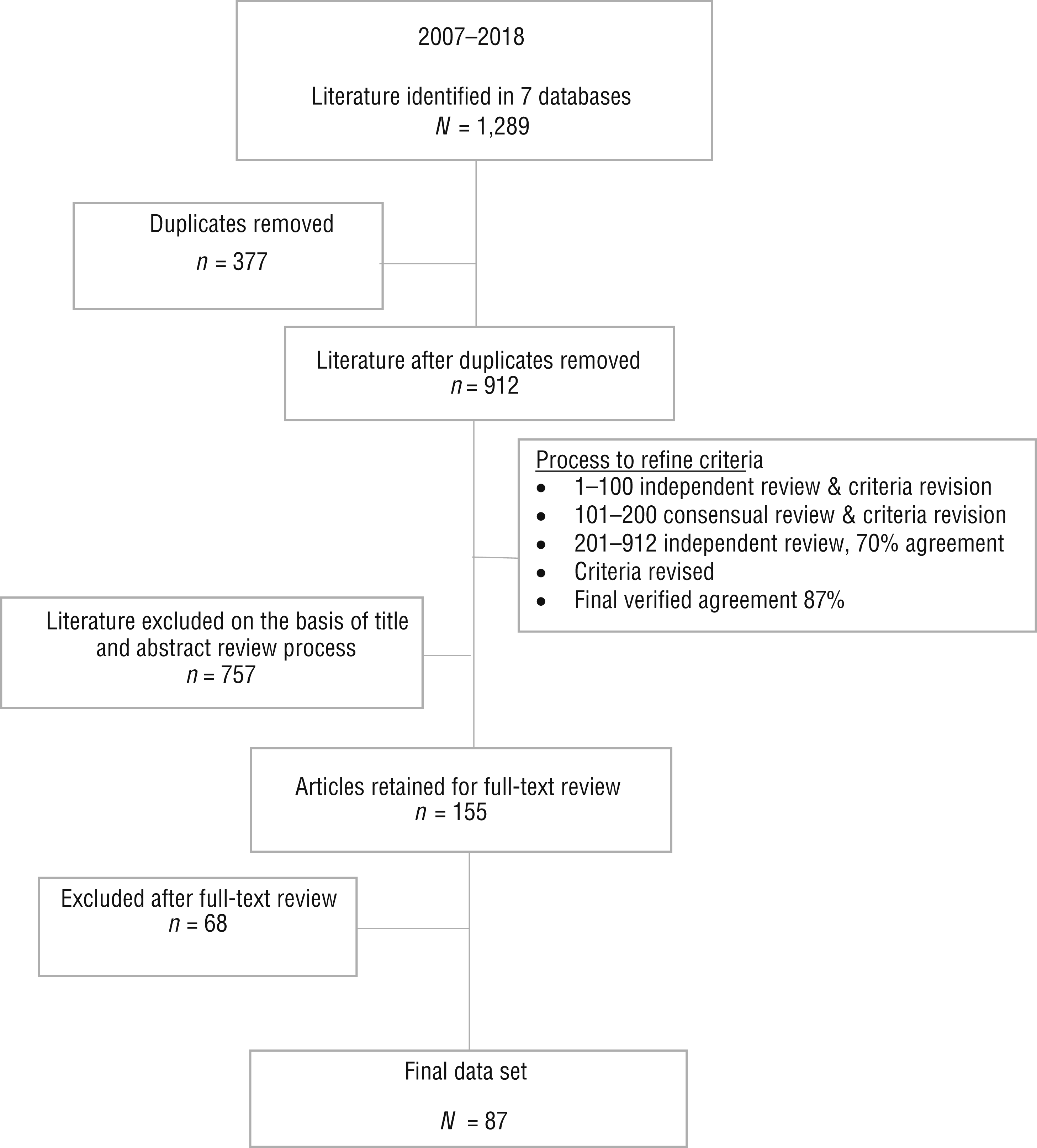
Flow of search results through the scoping review process.
Data Extraction and Analysis
The full-text reviews of, and data extraction from, the 87 articles took place between May 2018 and February 2019. An Excel spreadsheet was used to compile the following information: year of publication, study aims and settings, methodology and methods, tools and measures, participant sample sizes and characteristics, pedagogical concepts and practices, and outcomes or key findings. A final column was used for critical notes on the quality of the study, underlying educational assumptions and paradigm, and fit with the identified methodology. Studies were also examined to see whether the researchers actively interrogated students’, faculty members’, and their own positionality, power dynamics, and ways of knowing in the design of the pedagogies, the research, and the interpretation of results (Kinsella & Whiteford, 2009).
After data extraction, we first categorized studies thematically to answer the research question regarding types of pedagogical practices and core pedagogical concepts and theories that were studied in relation to diversity. Marie-Lyne and Hiba then iteratively analyzed the data through the lens of critical theories with attention to intersectionality (e.g., Ahmed, 2006; Crenshaw et al., 1995; Giroux, 2011; Hill Collins & Bilge, 2016; Swain et al., 2003)—that is, by focusing on the underlying ideologies and epistemologies, power dynamics and loci of “legitimacy,” ethical intentions and implications, and links to espoused diversity pedagogies and learning outcomes within the research questions, study designs, teaching practices, and targeted deliverables. We identified clusters of common characteristics by which themes could be grouped into broader overarching concepts. The analysis was fostered through dialogue among the three of us and theories of equity, diversity, and inclusion in education.
We pause here to reflexively state our positionalities and epistemologies and how they molded this scoping review (Thomas et al., 2020). We are occupational therapy educators who identify with various and overlapping marginalized groups and who intentionally draw on anti-oppressive practices to engage in equity-focused teaching and research in occupational therapy in Canada. These positionalities and epistemologies were the motivation for the research question, and they influenced the breadth of the sampling criteria, which specific data we extracted and how we appraised the data, and our use of critical theories in the analysis, leading to the specific identified gaps and recommendations in this article.
Results
Most of the articles (N = 87; Table 1) were published between 2013 and 2018 (60%), used a qualitative or qualitative-dominant mixed methodology (57%), and were conducted in or by educational programs in the United States (48%). All studies in the final data set were published in English, with the exception of one Portuguese language article that we read using Google Translate.
Characteristics of the Final Data Set (N = 87)
Pedagogical Practices
Our thematic grouping of practices revealed multiple pedagogical practices that occupational therapy faculty use to teach or address concepts of diversity in professional occupational therapy education programs (Table 2). The three dominant approaches—community service learning, international service learning, and didactic or course-based practices—are described in the sections that follow.
Frequency of Pedagogical Practices in the Data Set
Percentages for selected types of pedagogical practices are calculated on the basis of the number of studies for that category. Percentages are not included for some practices because we focused on the dominant approaches within each category or an interesting approach that was part of the subset.
The total number of practices is larger than the number of studies (N = 87) because some studies used multiple pedagogical practices.
Community Service Learning
Thirty-two studies (37% of the sample set) examined the educational use of community service learning practices to teach concepts of diversity in various ways. These placements took place in local community organizations with service needs, such as nonprofit organizations, homeless shelters, early-years centers, supported living communities, refugee groups, and other role-emerging settings. The majority were clinical placements, with only 5 of the 32 studies (16%) having explicitly included semester-long fieldwork initiatives integrated with academic content aiming to foster critical reflection on concepts such as student positionality and cultural humility. The majority of these studies focused only on student learning outcomes, which were related to teamwork, cultural understandings, and the role of the occupational therapist in diverse settings. Only the fieldwork classified separately in Table 2 under community–university partnerships (n = 7) explicitly explored community-defined expectations and outcomes.
International Service Learning
The second most frequently used pedagogical practice, described in 22 studies (25%), was the use of international fieldwork that focused on outcomes such as cultural competence and cross-cultural collaboration. The majority of these fieldwork experiences (20, or 91%) were short term, in which students engaged in 2- or 3-wk placements, typically in lower resource countries. All these studies focused on individual students’ perspectives, such as self-reported knowledge about the host country and culture.
Didactic or Course-Based Practices
Twenty studies (23%) focused on didactic or course-based practices to teach concepts of diversity. These practices included student participation in lectures and classes in which teachers used a knowledge-based information translation model (e.g., readings, slides, videos, online content) to teach concepts of diversity. Of these studies, 8 focused on threading didactic content using an identified model or theory of cultural competence across a course or a curriculum. Learning outcomes were focused on students’ cognitive skills and self-perceived readiness to work with diversity and were evaluated primarily via questionnaires.
Other Pedagogical Practices
Other pedagogical practices were described and evaluated to a lesser extent (see Table 2). These practices included an ongoing focus on what individual students were expected to learn and change (e.g., case studies, reflective journaling, international online classrooms), practices focused on individual educators (e.g., faculty development, service user–led teaching), and practices focused at the institutional level (e.g., outreach and admissions, bridge programs).
Educational Paradigms
Across the identified pedagogical practices, five underlying pedagogical paradigms or theories emerged from the analysis of the data set: competency-based pedagogy, social justice focus, critical paradigm, social accountability, and constructivist pedagogy. These approaches have differing educational aims and underlying ethics. Within the whole data set and across all five paradigms, 33 articles (38%) were deemed to be critically reflexive in nature. These paradigms and attendant learning foci and pedagogical practices are presented in the sections that follow in decreasing order of prevalence within the data set.
Competency-Based Pedagogy
Competency-based pedagogy is an approach that focuses on teaching and learning of content knowledge and concrete skills used for efficient task performance that are intended to be quantifiable or measurable in some form (Serdenciuc, 2013). Our scoping review located 38 articles (44%) focused on a competency-based approach to diversity education in occupational therapy programs. Of these articles, 5 (13%) were deemed to be critically reflexive using the criteria described in the “Data Analysis and Extraction” section. These studies used interview responses or journal entries, or both, as data.
The majority of these 38 studies were conducted in and by North American educational programs (29, or 76%) and focused on cross-cultural work. The emphasis was on the concept of cultural competence and its derivatives such as cultural awareness, cultural understanding, and cultural intelligence. Outcomes were measured in terms of self-reported perceived self-efficacy and readiness, willingness to engage in cross-cultural work, or questionnaires modeled on a predetermined cognitive continuum of cultural awareness (e.g., Inventory for Assessing the Process of Cultural Competence Among Health Care Professionals–Revised; Campinha-Bacote, 2002). The most prevalent pedagogical practices within this paradigm were short-term international fieldwork (55%; all but 1 were 2–3 wk in length), followed by online connections and virtual classrooms with international occupational therapy or interprofessional health care students (18%; a limited number of contact events were required within a course) and theoretical content on cultural competence delivered in interprofessional classes (16%). The majority of these studies (34, or 89%) conceptualized diversity education as international experiences outside the educational programs’ country.
Social Justice Focus
The social justice focus is an approach that seeks to expose and combat different forms of oppression such as racism, sexism, ableism, and heterosexism and their consequences (Adams et al., 1997). Of the 87 articles, 25 (29%) adopted a social justice approach to diversity education in occupational therapy programs. Of these articles, 16 (64%) were deemed to be critically reflexive; half were based in the United States (n = 8) and one-third were based in Europe (predominantly the United Kingdom; n = 6).
Pedagogical practices within this category included local role-emerging fieldwork initiatives addressing health and social inequities and focused on civic engagement and social accountability (14 of 25, or 56%, with students invested for 10–12 wk), an academic and curricular focus on systemic issues and occupational justice with and for specific marginalized and discriminated groups (e.g., sexual diversity, older adults, people with mental illness; 26%), and humanities-informed pedagogies (e.g., viewing documentaries) to foster sensitization to hegemonic discourses and implicit bias in racism and understanding health disparities from broader sociocultural perspectives (13%). Only 1 of the studies in this category examined international fieldwork and was designed with the lens of equity and reciprocity ethics in global health.
In terms of outcomes, 10 studies qualitatively explored student learning in relation to social justice via focus groups, interviews, or journaling. Two of these qualitative-dominant studies, along with 3 others, used validated questionnaires examining stigmatizing attitudes such as racism. Seven studies described outcomes at the structural level in the creation of or changes in the quality of university–community partnerships. Finally, 5 theoretical papers addressed occupational therapy concepts related to social justice and their implications for education.
Critical Paradigm
The critical paradigm is an approach to education in which the teacher works to lead students to question ideologies and practices considered oppressive and encourages emancipatory responses to the conditions of their own lives (Freire, 1974). It overlaps with, yet differs from, social justice or social accountability in that the focus is on the learners’ and educators’ critical awareness of their own positionality and contexts, rather than those of intended clients and communities. Of the 87 articles, 10 (11%) adopted a critical approach to diversity education in occupational therapy programs and were based in multiple countries. Not surprisingly, 90% of these were explicitly critically reflexive in relation to the authors’ positionality.
The pedagogical practices in this paradigm fostered students’ critical consciousness of their own social identities and actions through humanities-informed approaches such as cultivating the narrative imaginary via thick descriptions to foster storied understanding and empathy; fostering vulnerability in dialogue, primarily led by racialized faculty engaging in consciousness raising beyond their course objectives; and promoting political literacy. Reflexive journaling and story sharing were the primary approaches to capture change.
Hidden Curriculum and Social Accountability
The hidden curriculum refers to institutional policies, evaluation processes, resource allocation, and the specific use of language in official texts (Hafferty, 1998). These are core elements of a socially accountable health care education that is equitable (Boelen & Heck, 1995). Nine studies (10%) addressed inclusivity and social accountability within the hidden curricula of occupational therapy programs, of which 6 studies (67%) were deemed to be critically reflexive.
These studies described initiatives such as outreach and admissions practices, the explicit involvement of people with disabilities in designing and delivering content, universal course designs and student accommodations, and bridge programs to support occupational therapy students from rural or working-class backgrounds to acquire the implicit social and academic norms that are usually taken for granted in postsecondary institutions. Change was captured via case studies, including ethnographic field notes, interviews, and journaling. Surveys of indicators were used when relevant to admissions-related outcomes.
Constructivist Pedagogy
Constructivist pedagogy is an approach to education in which the teacher guides students in constructing knowledge together by building on already-established knowledge through experiential exploration and dialogue (Duffy & Cunningham, 2001). Of the 87 included articles, 5 (6%) explicitly adopted a constructivist approach to foster transformative learning, that is, a questioning and shifting of one’s worldviews (Mezirow, 2003). Of these 5 articles, 2 included a critically reflexive statement by the authors, and 1 was conceptual. The studies were all located in the global North (United States, Canada, and northern Europe).
The pedagogical practices in these articles were heterogeneous, with two commonalities being that each study focused on only one specific dimension of diversity as social identity and that all included dialogue as a learning strategy. Practices included a role-emerging placement in a homeless shelter, online testimonials for learning about grief and bereavement, a lecture and lab on sexuality and people with physical disabilities, a photovoice assignment around ageism and older adults, and arts-based approaches to promote reflection on movies about specific disabilities. The primary outcomes evaluated in 4 of the studies were shifts in attitudes in relation to the specific diversity domain (e.g., sexuality and physical disability) using an in-house questionnaire or structured journaling.
Discussion
This scoping review outlines the educational paradigms and pedagogical practices reported in the literature on teaching diversity in occupational therapy entry-to-practice programs. Five overarching educational paradigms guided the choice of learning outcomes and implementation of multiple pedagogical practices. Almost half of the sample set was situated within a competency-based paradigm, followed by one-third within a social justice focus. In terms of practices, community service learning and international service learning were the favored teaching practices for diversity. Research methods were predominantly qualitative, qualitative-dominant mixed methods, descriptive, or conceptual. Fewer than half of the studies were presented within a critically reflexive stance by the authors. This scoping review provides an understanding of the current landscape of research on diversity education in professional occupational therapy education.
In line with scholarly (Kinsella & Whiteford, 2009) and policy calls (Kinébanian & Stomph, 2010) to include critical reflexivity within occupational therapy education for diversity, we attempted to examine how the included studies, pedagogical practices, and paradigms allowed for and fostered such a critical stance. We found that some educational paradigms were more likely to be associated with at least some critical positioning, ranging from 13% of studies situated within a competency-based paradigm to 90% of those situated within a critical paradigm, with constructivism (40%), social justice (64%), and attention to the hidden curricula (67%) located in between.
The dominance in this data set of a cultural competency paradigm combined with short-term international fieldwork initiated in and by North American programs is of concern. Only 4 of the 38 studies included within the competency-based paradigm conceptualized diversity as inherent to one’s own context with the use of local role-emerging fieldwork, and only 1 of these 4 studies went beyond students’ self-awareness and perceived self-efficacy in cultural understanding to explicitly focus on human rights and marginalized communities. The outcomes in this set of studies were located at the level of students’ self-reporting on concepts such as knowledge about the “Other,” with the notable absence of reflexivity, naming of power dynamics, or deep consideration of the host community’s experiences or needs.
These cultural competency approaches presume an unquestioned neutral ethics of the international or foreign Other as an object for learning. Short-term international fieldwork relies on student “exposure” to non-White Others, usually from underserved countries or communities, to increase student cultural competence. Such projects capitalize on the marginalized state of racialized Others—socially constructed as inferior from the arbitrary hierarchy of White as the norm—within health care contexts to produce an educational object for the experience of health care students (who are presumed to be White), thus reproducing processes of racism and supremacy (Grenier, 2020). Few of these curricular initiatives were established with the ethics of reciprocity or capacity building (see Aldrich, 2015; Bessette & Camden, 2016; Cabatan & Grajo, 2017; and Gat & Ratzon, 2014, for the four exceptions within the cultural competency-based paradigm). Competency paradigms have been shown to be ineffective for learning about diversity in nuanced ways (Beagan, 2015). This is particularly true in medical and health professions education in which complex, critical reflection is vital to delivering quality and equitable care in a globalized world (Talbot, 2004).
The ethics of social justice align well with diversity and occupational therapy. Yet, in spite of the centrality of critical thinking for social justice, not all of these studies were critical in nature when attempting to match student learning as a resource to meet identified needs within the students’ and universities’ own local communities. Evaluation of outcomes was often focused only on the students themselves (e.g., their attitudes), with the exception of 3 studies that explicitly looked at community–university partnerships and reciprocity and that evaluated partnerships not just from the perspectives of university faculty or students (see Beck & Barnes, 2007; Kearsley, 2012; McGrath et al., 2014). These social justice initiatives do best when they are married to a critical paradigm that also raises awareness of students’ own privilege, positionalities, and ideologies and their impacts on practice (Wilding, 2011) and when they ensure that community service learning initiatives are not implemented in a tokenistic (checklist approach) or objectifying manner. Integrating community partnerships with academic content throughout the academic year in various ways (hybrid or sequential) seems most promising to provide safer spaces for guided student dialogue and reflection and to plan critical action at a pace that promotes the development of relationships and knowledge of the community context (e.g., McMenamin et al., 2010).
This scoping review identified the beginning of a trend in occupational therapy education that reflexively examines not just the formal (what is taught and how) but also the informal and hidden curriculum. The identified studies examined what types of diversity or equity processes actual educational programs enacted in terms of applying principles of justice within occupational therapy education in addition to teaching about it (Restall et al., 2018; Zafran et al., 2019). This trend is part of the growing concern in health care education with social accountability (Boelen & Heck, 1995) and a critically inclusive approach to education that addresses equity and diversity within health care education itself (Razack & Philibert, 2019). It is perhaps no surprise that these critical initiatives are led by minority occupational therapy faculty (e.g., Daniel, 2009) or originate in places where the questions of human rights, colonization, and dispossession have been explicit in health care and social services for a long time (e.g., Brazil, South Africa, Israel, Australia).
Finally, a note on transformative learning: This is a concept that has been addressed from a multiplicity of paradigms (Taylor, 2008), yet in the small number of studies identified in this scoping review, occupational therapy education has remained focused on cognitive constructivism. Although this paradigm is essential to multiple learning objectives for health care professionals, teaching that aims to focus on inequities and oppressive worldviews should incorporate other paradigms that are ethically aligned with and effective for transformative learning for justice (Zafran, 2020). This argument applies more generally: That is, it is not necessarily the pedagogical practices or concepts themselves that are more or less effective or ethical; rather, it is the underlying educational paradigm that will determine how the practice is implemented and whether it is in line with which ethics and intended outcomes. For example, international fieldwork can be approached from a critical or social justice paradigm, or both, that focuses on being invited in, acknowledgment of broader structural processes that produce inequities, reciprocity and identification of interests, capacity building, sustainability, power sharing, and true long-term partnership (see Storr et al., 2018).
The limitations of this study include the difficulty in distinguishing between educational paradigms for some of the articles and the possibility that publication word count limits may have led us to deem some studies as less critically reflexive than they actually were. In addition, some articles began within a critical paradigm but then enacted a social justice focus, highlighting the overlap between these philosophies and intentions. Several studies were interdisciplinary in nature, including (but not limited to) occupational therapy. This means that only the shared interprofessional curricula were included in these studies, which may not have captured other approaches to teaching diversity in the occupational therapy programs. The English language publication bias led to a majority of articles on studies conducted in the global North within the data set. Finally, the lack of studies in this data set addressing Indigenous partnerships and topics in occupational therapy education is notable. Key words for these initiatives and studies clearly do not fall under the broader notions of equity and diversity and require terms specific to reconciliation and decolonization in academia.
Implications for Occupational Therapy Education
The findings described in this article have the following implications for occupational therapy education:
It is important for occupational therapy educators to name and critically examine the paradigms they are using in teaching diversity.
Occupational therapy educators should attend to the coherence among their choice of educational paradigms, the intended learning objectives, ethics of teaching and learning, choices of pedagogical practices, and identification and evaluation of outcomes.
Occupational therapy programs can expand their roles as socially accountable institutions by critically examining the formal (including fieldwork) as well as the hidden aspects of their curriculum with regard to diversity education.
Conclusion
This scoping review included qualitative studies, quantitative studies, mixed methods studies, descriptive and conceptual papers, reviews, and policy literature to explore the pedagogical paradigms and practices used to teach diversity in occupational therapy programs between 2007 and 2018. The thematic and critical overview of the current overarching pedagogical paradigms and practices provides a better understanding of the current landscape of published research on diversity education in professional occupational therapy programs globally. Significant concerns regarding the ongoing use of a competency-based paradigm arose during the analysis phase of this review, calling for a critical resistance to cultural competency as the dominant framework for teaching equity.
Although shifts in pedagogical paradigms and practices take time to implement, it is important that occupational therapy programs seriously evaluate their choices of educational epistemologies and critically reflect on the underlying ethics and (in)justices that these epistemologies imply. Concerted efforts by accreditation bodies and curriculum committees will be required to redress current uncritical approaches and attendant oppressive pedagogical practices that seem to currently form a large part of diversity education, and replace them with philosophies and transformative practices that seek to expose and combat the realities of power relations that reproduce systemic injustice. Moreover, the intended outcomes or indicators of success of pedagogical initiatives must go beyond the cognitive skills of individual students and explore the hoped-for transformational links between chosen teaching philosophies and strategies and actual improvements in culturally safe and equitable health care at the level of therapeutic relationships and all the way to systemic processes and structural impacts and partnerships.
Footnotes
*
Indicates studies that were included in the scoping review.
Acknowledgment
This study was partially funded by a doctoral grant awarded to Marie-Lyne Grenier by the Canadian Social Sciences and Humanities Research Council (No. 752-2018-0151). The dataset is available upon request from the corresponding author, Hiba Zafran.