





Abstract
The COPQ shows promise as a reliable occupational performance measure for children for both clinical and research purposes
Occupational therapy practitioners who work with children and their families aim to promote child health and well-being by helping them participate successfully in their roles and everyday occupations, thereby improving occupational performance. According to Law (2003), occupational performance is the competency in and satisfaction with which a person performs their meaningful occupations, and it is dependent on the interrelations among person factors or abilities, physical and sociocultural environmental factors, and characteristics of the occupations being performed. According to Fisher and Griswold (2014), occupational performance refers to an act of doing and accomplishing a selected action or skill, activity, or occupation resulting from the dynamic transaction among the person, context, and activity.
The Occupational Therapy Practice Framework: Domain and Process (3rd ed., or OTPF–3; American Occupational Therapy Association, 2014) incorporates these ideas in its definition of occupational performance and identifies activities of daily living, sleep and rest, instrumental activities of daily living, education, work, play, leisure, and social participation as areas of occupation within its domain. Comprehensive measures of children’s occupational performance should therefore address these occupational areas and are essential to occupational therapy practitioners who seek to identify appropriate areas to target in treatment (Mulligan, 2017). Moreover, because enhancing client occupational performance is the primary goal of occupational therapy, measures of occupational performance are important as client outcomes and should be used in research that examines the effectiveness of occupational therapy interventions.
The availability of sound, comprehensive assessment tools for measuring children’s occupational performance is unfortunately very limited, and this led to the development of the Children’s Occupational Performance Questionnaire (COPQ; Mulligan, 2019). This article presents the results of initial studies that focused on the COPQ’s content validity, including item analyses for determining the difficulty level and ordering of items, age trends, and internal consistency.
The development of the COPQ was based on a review of literature that conceptualized, defined, and studied occupational performance as a construct, along with a review of current measures of occupational performance and adaptive behavior geared toward children (Mulligan, 2019). Concepts from the World Health Organization’s (2007) International Classification of Functioning, Disability and Health–Children and Youth Version (ICF–CY) related to the domains of activity and participation and concepts from the OTPF–3 (AOTA, 2014) were used to guide and organize content. The ICF–CY addresses the complex relationship between impairments in basic processes, such as body functions, and a child’s ability to participate in daily life. In the ICF–CY framework, body functions include psychological and intellectual capabilities, such as adaptability, attention, and orientation, and motor functions, such as muscle strength and balance. Impairments in body function often lead to activity restrictions or difficulties that ultimately result in participation limitations.
The majority of COPQ items fall into the ICF–CY activity dimension and represent the performance of discrete tasks and activities, whereas other items address the level of performance skills. In contrast, most standardized assessments currently available for use with children examine body functions such as balance and coordination, along with gross motor, visual–motor, fine motor skills, or all of these (Cordier et al., 2016; Mulligan, 2014). Item development for the COPQ involved a review of more than 20 assessment tools, including measures of child functioning, occupational performance, and adaptive behavior. Measures were reviewed for content, type of rating scale and measurement parameters, and psychometric properties.
The assessment tools most similar to the content, type of items, and methods of administration considered for the COPQ included the Canadian Occupational Performance Measure (Law et al., 2005); the Pediatric Evaluation of Disability Inventory (Haley et al., 1992) and its latest version, the Pediatric Evaluation of Disability Inventory–Computer Adaptive Test (Haley & Coster, 2020); the Assessment of Motor and Process Skills (Fisher & Bray Jones, 2012); the Child Occupational Self-Assessment (Version 2.1; Keller et al., 2005); and two measures of adaptive behavior, the Vineland Adaptive Behavior Scales, Second Edition (Vineland–II; Sparrow et al., 2005) and the Adaptive Behavior Assessment System, Third Edition (Harrison & Oakland, 2015). Adaptive behavior and occupational performance have many similarities, as depicted in seminal work by Heber (1961), who defined adaptive behavior as one’s ability to successfully perform the everyday practical skills required to meet the demands of daily life within one’s environments.
Various iterations of the COPQ were drafted, pilot tested, and revised on the basis of feedback compiled from focus groups and interviews with child development experts, occupational therapy graduate students, occupational therapy clinicians, and parents (Mulligan, 2019). COPQ items address activities, tasks, and performance skills that support a child’s ability to perform occupations within each of the occupational domains included in the OTPF–3.
A study of discriminant validity demonstrated that COPQ scores are capable of differentiating typically developing children from children with disabilities (Mulligan, 2019). Moreover, moderate to strong positive correlations were found between COPQ domain area and total scores and Vineland–II domain and total scores, indicating that the COPQ measures the many skills and abilities children require to meet the demands of daily life (Mulligan, 2019). The results from preliminary studies of earlier versions of the COPQ also provided valuable data-driven information for clarifying content, improving item wording, and making decisions regarding the addition and deletion of items (Mulligan, 2019). In this article, I present the results of a study in which I used scores from a sample of 181 children to examine internal consistency reliability and age trends and to explore item difficulty and the accuracy of item order in each COPQ domain.
Method
Participants
A convenience sample was recruited from personal and professional contacts of the author and graduate student research assistants and consisted of the caregivers of 156 children and 25 older children who completed the measure as a self-report (N = 181). The children ranged in age from 2 mo to 19 yr (M = 8 yr, 10 mo; SD = 5 yr, 7 mo). Age groups were represented as follows: Thirty-two children (18%) were age 3 yr or younger, 34 (19%) were ages 3–6 yr, 31 (17%) were ages 6–9 yr, 48 (26%) were ages 9–16 yr, and 36 (20%) were ages 16–19 yr. Most participants (91%) indicated their race as White, and 75% were identified as typically developing. The 46 children identified as having a medical condition or a disability affecting their development (25% of participants) included 8 with autism spectrum disorder, 12 with a developmental or intellectual disability, 8 with a learning or attention disorder, and 4 with cerebral palsy; 14 indicated “other.”
Children’s Occupational Performance Questionnaire
The COPQ is a behavioral rating scale developed to measure occupational performance in children ranging in age from birth to 19 yr. Items rate child competency or ability to complete tasks and activities that are associated directly with the performance of occupations typically desired, culturally relevant, or required of children. Occupational areas are addressed in five domains: (1) Personal Activities of Daily Living (PADL), including rest and sleep (106 items); (2) Instrumental Activities of Daily Living (IADL; 67 items); (3) Education/Work (EW; 83 items); (4) Play/Leisure (PL; 85 items); and (5) Social Participation (SP; 101 items). The IADL and EW items are administered only to children age 3 yr or older, because children younger than this rarely engage in occupations associated with those domains.
The COPQ is completed by a caregiver who knows the child well, such as a parent, occupational therapist, or teacher, and it takes approximately 20 to 30 min to complete. Children age 16 yr or older have the option to complete the COPQ as a self-report questionnaire, and the current version has a total of 442 items. Sample items for each domain are provided in Table 1.
COPQ Sample Items by Domain
Note. COPQ = Children’s Occupational Performance Questionnaire.
Procedure and Data Analyses
The COPQ was completed online using Qualtrics survey software (Version 2019; Qualtrics, Provo, UT) by means of a link sent to participants by email. Some participants (about 10%) completed a paper form. Completion of the questionnaire served as informed consent, and procedures approved by the University of New Hampshire’s Institutional Review Board for the Protection of Human Subjects were followed. Directions for completing the COPQ were provided on the questionnaire along with detailed instructions for applying the rating scale. Data from completed questionnaires were transferred to an SPSS data file, and analyses including descriptive statistics, Spearman ρ coefficients, and Cronbach’s αs were conducted using IBM SPSS Statistics (Version 26; IBM Corp., Armonk, NY). Analyses of age trends were conducted with scores from only the sample of typically developing children; all other analyses were completed with the entire, combined sample.
Results
Analyses of age trends showed that, as expected, performance in each the five occupational domains improved with age. Spearman ρ coefficients between chronological age and each of the domain total scores were positive and moderate to strong, and all were statistically significant at p < .01 as follows: PADL, r = .77; PL, r = .80; SP, r = .84; IADL, r = .94; and EW, r = .93. Trend lines (Figures 1 and 2) showed that for all occupational areas, growth in performance was greatest in the younger age groups, with weaker developmental trend noted in children ages 6 through 19. Somewhat stronger trends reflecting greater changes with age were noted within the IADL and EW domains.
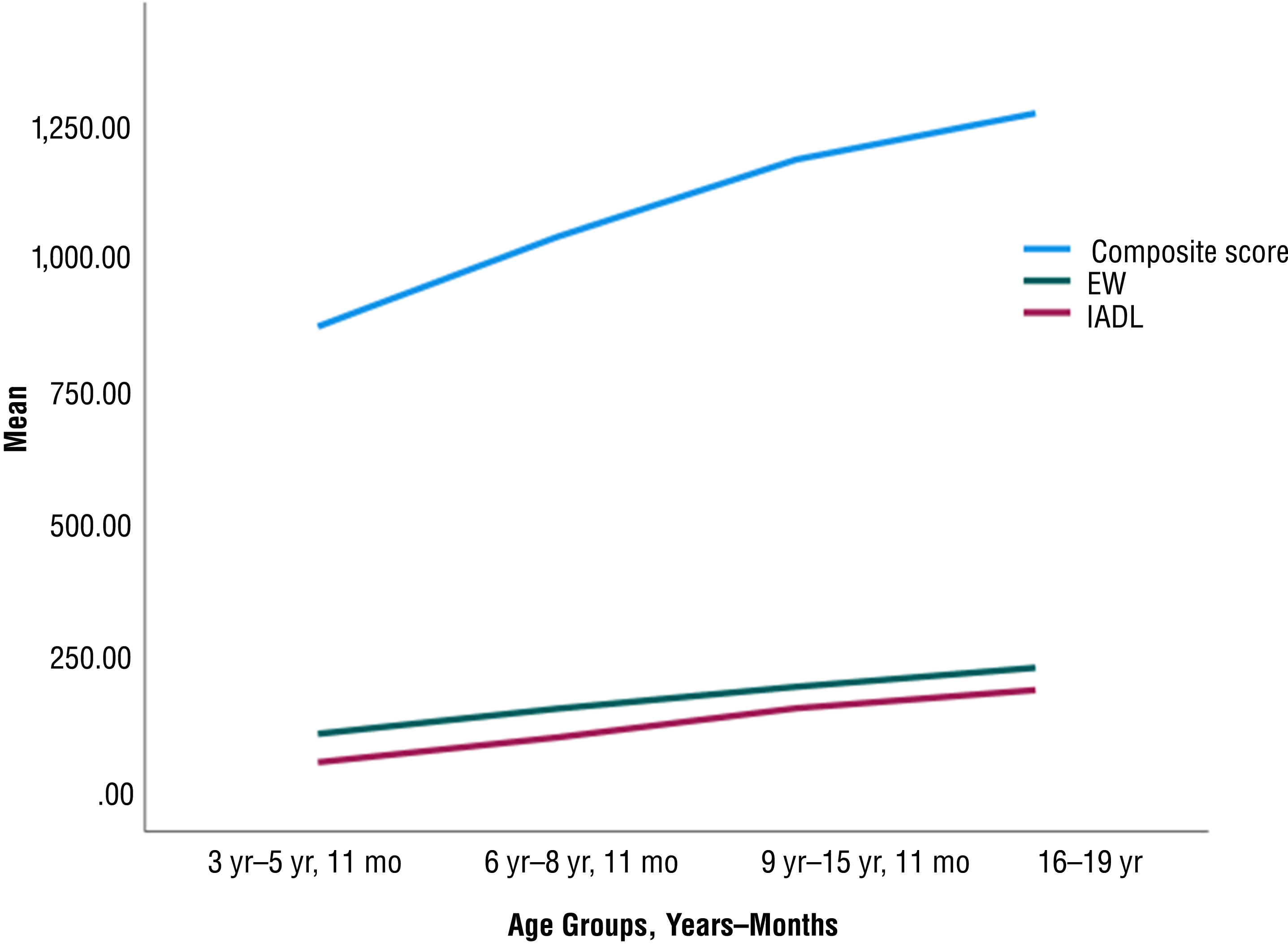
Age trends for EW and IADL domains and COPQ composite score.
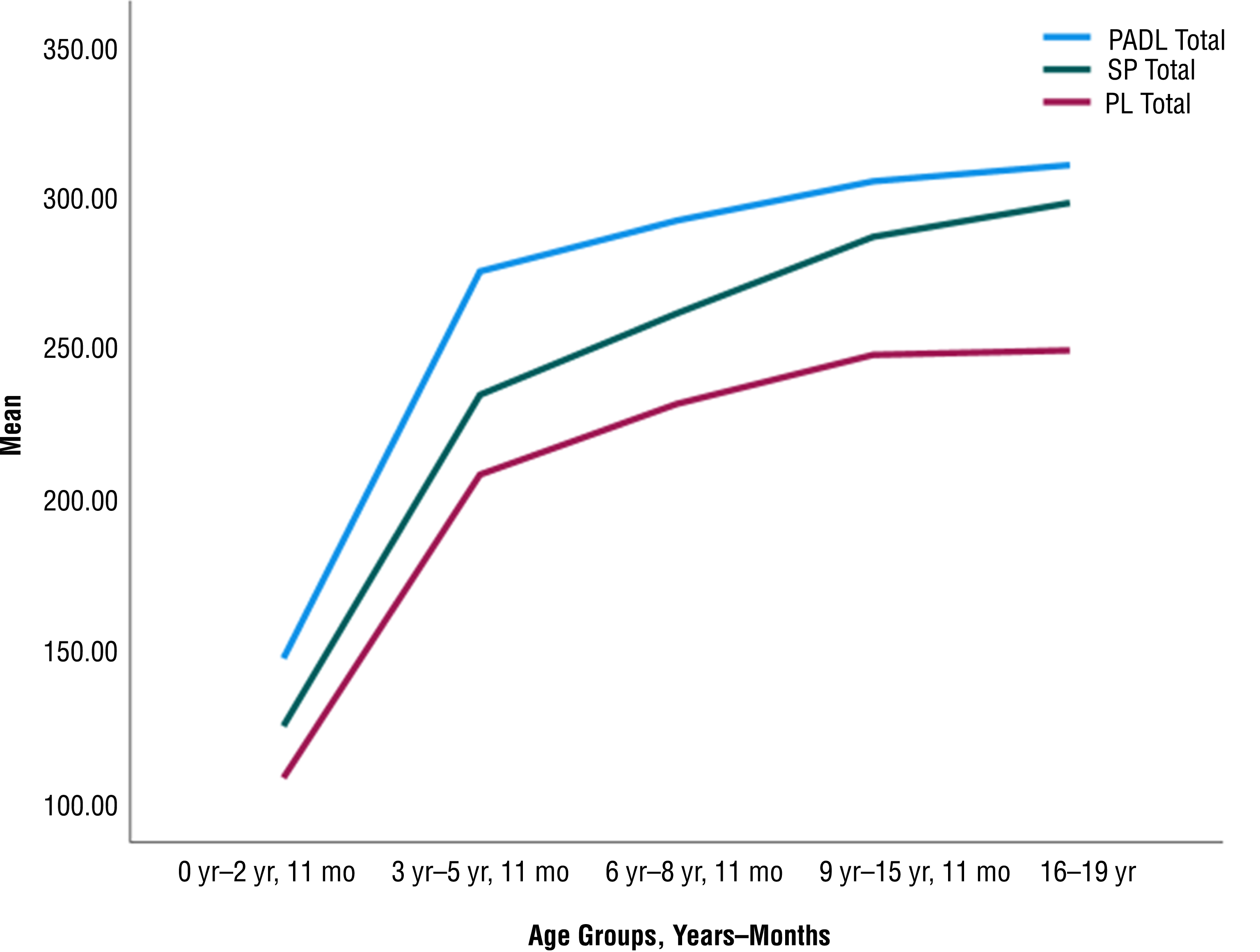
Age trends for the PADL, PL, and SP domains.
Internal consistency reliability ratings, reported in Table 2, indicated very high consistency within each of the domains (Cronbach’s α = .96–.99), suggesting that the items in each domain are measuring, or are related to, the same construct. According to Clark and Watson (1995), interitem correlations of a scale with adequate homogeneity of items generally should fall between .15 and .50. The range and average r values for the interitem correlations are reported in Table 2, with the average r values falling within the upper range of what typically would be expected, also demonstrating that each of the scales comprises items that relate to a single construct. Further inspection revealed that some intercorrelation values in each of the scales were very high (>.80), and some were unusually low (0 or negative). This information helped identify potential problem items that either were redundant (high values), or were ill fitting (low values), and these were subsequently examined more closely for possible elimination.
Internal Consistency Reliability and Interitem Correlation Summary
Note. COPQ = Children’s Occupational Performance Questionnaire.
Item analyses also involved computing mean ratings at the item level, and the percentage of cases assigned each of the ratings (0–3), to explore item difficulty, with the accuracy of ordering items within each domain from easiest to most difficult. On the basis of mean ratings, 6% to 14% of the items were misplaced depending on the domain, with the highest number of misplaced items occurring in the SP domain. Item clusters in which children of various ages began to show inconsistences in item scores (some able, some unable) also emerged, indicating where ceiling levels of performance begin to occur for children of certain ages.
Discussion
Internal consistency results for the five COPQ domains demonstrated that the items in each occupational area make up a well-defined, discrete construct. Cronbach’s α values were very high, and it is plausible that the values were somewhat inflated because of the large number of items in each domain. The results are encouraging and show strong relations among items that represent abilities in performing the many different occupations that fall into the same domain. For example, in the PADL domain, items reflecting performance in toileting and dressing occupations were associated with one another. The high α values, along with highly correlated item pairings, revealed some item redundancy and therefore room for paring down the number of items without compromising the stability of the measure.
Three plausible explanations for item pairings with very low item intercorrelations within the same domain were as follows: (1) the items addressed very different kinds occupations (physical play/sports vs. sedentary leisure, feeding vs. sleep), (2) the level of difficulty of the correlated items was extreme given that the domains are designed for children of all ages, and (3) one or both of the items are ill fitting and not strongly associated with the underlying construct (specific occupational domain) being measured. Further study in which item response theory is applied using the Rasch model would facilitate exploration of these possibilities and help refine the tool by reducing the number of items in each domain, thereby strengthening construct validity while increasing efficiency.
Age trend results and correlational analyses based on the COPQ Composite Occupational Performance scores and chronological age provided support for the idea that occupational performance is a developmental construct. Competency in social participation and levels of performance in personal and instrumental activities of daily living, play/leisure occupations, and work- and education-related occupations increase with age. COPQ item ratings also were able to capture periods of rapid growth for certain occupations; for example, great changes in ability to dress and toilet oneself between ages 2 and 5 yr were noted, and advances in job readiness skills occurred in the late adolescent years.
As children age, and their motor, cognitive, communication, and social–emotional functioning mature, they become more capable of executing increasingly complex and demanding performance skills and tasks (Rathus, 2017). Such advancements ultimately allow children to achieve higher levels of occupational performance, as demonstrated by increasing levels of engagement, independence, and success in performing culturally relevant, meaningful, everyday tasks and activities. The developmental trends noted in COPQ scores demonstrate that the tool is able to measure and capture this growth in children’s abilities to successfully perform the increasingly complex tasks and occupations desired by and expected of them over time. Moreover, developmental trends demonstrated that there is some capacity to predict when (i.e., at what age) children typically master occupation-based tasks and activities and the order in which they are mastered.
Despite the developmental patterns that emerged, item analyses showed some natural variation among children of the same age with respect to when and in what order they achieved competency in certain occupation-based tasks. Places where a reordering of items would more accurately reflect item difficulty were identified. The variability in rating of items across typically developing children of a similar age suggests that COPQ baseline and ceiling performance levels for children will be broad and occur over a fairly large set of items.
Limitations
A study limitation to consider in interpretation of the results is that the sample was relatively small, and it lacked heterogeneity with respect to socioeconomic status, racial/ethnic diversity, and type of disability. Normative data collection of the COPQ will need to include a much larger and diverse sample of children. Although the COPQ has many strengths as a caregiver or self-report questionnaire, there is some inherent subjective bias on the part of the person completing the ratings that has the potential to influence the results. Performance-based observations are therefore recommended to augment data from the COPQ and to assist in uncovering contextual factors or specific characteristics of the occupation being observed that may be affecting child performance.
Implications for Occupational Therapy Practice
Clinical implications of this study for occupational therapy practice are as follows:
The COPQ shows promise as a reliable and valid measure of occupational performance of children of all ages.
The COPQ addresses performance within all occupational domains, and it has applications for guiding occupational therapy interventions as well as for measuring the progress and outcomes of those interventions.
Conclusion
This study provides preliminary evidence that supports aspects of the COPQ’s content-related validity and internal consistency reliability. The COPQ shows promise as a reliable, efficient, and easy-to-use tool to use for assessing all domains of occupational performance to help guide the delivery of client-centered occupational therapy interventions for children. Moreover, the results demonstrate the developmental nature of achieving competency in performing the relevant occupations demanded of and desired by children over time. The results presented in this article will be used to guide further revisions and refinement of COPQ items in preparation for normative data collection and to guide further study of its psychometric properties.
Footnotes
Acknowledgments
I thank the caregivers who participated for their valuable assistance with this study and the occupational therapy graduate students from OT 886 at the University of New Hampshire who assisted with the data collection.