





Abstract
A modified zippering teaching vest with added visual and language cues was successfully used to teach zippering skills to typically developing 3- and 4-yr-olds.
Childhood is a time of increasing independence as children gain skills needed to complete activities of daily living (ADLs) and participate fully in developmentally appropriate daily occupations. Occupations are central to a client’s identity and sense of competence (American Occupational Therapy Association, 2020). One ADL achieved successfully by most young children between ages 2 and 6 yr is the skill of dressing (Children’s Hospital of Orange County, 2014), which contributes to their growing sense of autonomy and confidence.
The acquisition of dressing proficiency requires several integrated abilities, including visual–motor, fine motor, and cognitive–language skills. One way to view the progression of competence in dressing during childhood is from an ecological developmental perspective, which considers specific sequences and milestones while emphasizing the environment’s influence on developmental trajectories (Bronfenbrenner, 1989). Kreider et al. (2014), who were occupational therapy practitioners, inspected manipulations in a child’s physical and social environment as a way of categorizing pediatric intervention studies; they built on Bronfenbrenner’s (1989) work by terming these manipulations “environmental targeting” (p. e63). In the same systematic review, they examined occupational therapy interventions in which practice of occupational tasks such as dressing was incorporated into treatment sessions. They found that 32% of effective occupational therapy studies in pediatrics incorporated environmental targeting or occupational practice.
Research also indicates that the process of teaching new skills such as dressing can be learned and retained more effectively when it is within a storytelling context (Bruner, 2004; Justice et al., 2005; Wasik & Bond, 2001), a strategy often used in the practice of pediatric speech-language pathology. Elley (1989), a speech-language pathologist, conducted a study that indicated that people absorb instruction more rapidly when storybooks are accompanied by pictures, such as a children’s book.
Most children gain proficiency with dressing skills through trial and error rather than direct instruction (Sewell et al., 1998); moreover, research specifically on the acquisition of dressing skills or the teaching of dressing skills to typically developing children has been limited. Many children with disabilities or at risk for disability, however, struggle with dressing skills and other related daily occupations (Van der Linde et al., 2015), and some research exists on this topic. In one study, Jasmin et al. (2009) looked at the process of teaching daily living skills to 35 preschoolers with autism spectrum disorder. Results indicated that their diagnostic features, such as sensory avoidance and delayed language or fine motor skills, correlated with difficulty in acquiring age-appropriate functional skills such as dressing. Studies looking directly at dressing instruction with children with disabilities have demonstrated value in various types of physical and verbal prompting, including a most-to-least prompting protocol (Iscan et al., 2016) and a simultaneous prompting procedure (Sewell et al., 1998).
Presenting instructional information in multiple ways also aligns with Universal Design for Learning (UDL) principles. UDL is an educational model that provides learners with multiple means of representation, expression, and engagement (Center for Applied Special Technology, n.d.). Overall, the limited available research on dressing skills among children with disabilities indicates that verbal and physical prompts seem to help those who cannot dress independently with this skill acquisition. Dressing skills are frequently a focus of early intervention and school-based services that often include both occupational therapy practitioner and speech-language pathologist involvement, ideally using an interprofessional approach. However, a gap in the literature continues to exist concerning best practices for teaching dressing skills, such as zippering, to children.
Using Bronfenbrenner’s (1989) ecological developmental framework and the concept of environmental targeting (Kreider et al., 2014) as a starting point, in this interprofessional research study we sought to add to the understanding of how children learn new dressing skills. Drawing on the use of storytelling (Bruner, 2004), targeted prompts (Iscan et al., 2016), and UDL in instruction, we aimed to test the value of a modified zippering vest presented with targeted vocabulary and storytelling relating to the additional visual cues that the vest provides. We asked the following research question in this study: “Does the use of a specially designed zippering teaching vest accompanied by a story that includes targeted vocabulary improve the zippering skills of typically developing 3- and 4-yr-olds who cannot zipper?” The results of this study have potential implications for teaching zippering skills to children who lack this skill.
Method
This quantitative study had an experimental, two-group, pre–post design. After the study received institutional review board approval, participants were recruited at a local preschool; we sought typically developing 3- and 4-yr-old children who could not zipper independently per parent report. Using a convenience sampling technique, we recruited preschool children through letters that were distributed by classroom teachers to families who attended preschool. Informed written consent was obtained from all parents. Each child who met the eligibility criteria was randomly assigned to a control group or an intervention group. Data collection and analysis were conducted by occupational therapy and speech-language pathology graduate students, who had completed research confidentiality training modules and detailed data collection and analysis instruction by the three faculty researchers. These researchers supervised all phases of the study.
Screening for Eligibility
Participant eligibility was confirmed through a three-part screening process: parent report, three zippering trials, and the Developmental Assessment of Young Children–Second Edition (DAYC–2; Judith & Maddox, 2013). First, the participant eligibility process was initiated by parent report stating that their child was unable to zipper independently. Next, the preschoolers were seen in a separate room during preschool time by graduate student researchers, who were supervised by licensed practitioners and researchers. Inability to zipper independently was confirmed by direct observation during the eligibility screening; children were given three attempts to zip a practice vest. Vests were first adjusted for size with shoulder clips, and assistance was given for donning the vest if needed; however, no other physical or verbal cuing was given during the screening process. Finally, if the preschooler could not zipper, relevant sections of the DAYC–2 were administered to determine whether the child’s language and motor skills were within normal limits.
The DAYC–2 measures children’s developmental level in the Communication, Cognition, Physical, Social–Emotional, and Adaptive Behavior domains, identifying children from birth through age 5 yr, 11 mo, with possible delays. The test format allows examiners to obtain information through observation, interview of caregivers, and direct assessment. The DAYC–2 may be used in arena assessment so each discipline can use the evaluation tool independently by testing specific domains or by testing all five domains to measure general development.
Repeated reliability and validity studies conducted for the DAYC–2 have attested to its trustworthiness as a screening tool. Test–retest reliability coefficients ranged from .70 to .91, and moderate to large correlations were found between the DAYC–2 and similar assessments (Swartzmiller, 2014). Standard scores, percentile ranks, and age equivalents are provided for each domain and overall general development. Across all domains and subdomains, raw scores increased with age, demonstrating construct validity (Swartzmiller, 2014).
To qualify for the study, preschoolers had to pass both the Communication and Physical domains and all related subdomains on the DAYC–2, in addition to parent report of the child’s inability to zipper and demonstration to researchers of an inability to zipper during three observed attempts. The Communication domain measures skills of receptive language and expressive language, whereas the Physical domain measures motor development (gross motor and fine motor); these domains were deemed most relevant to this study.
Procedure
Each child who met the eligibility criteria was randomly assigned to a control group or an intervention (comparison)group. Group assignment was masked: Teachers, parents, and children did not know which zippering protocol they or their child would follow. For both control group and experimental group participants, all intervention sessions were conducted by occupational therapy and speech-language pathology graduate students under direct face-to-face supervision from occupational therapy and speech-language pathology faculty members. Each participant in the study received three individualized sessions and was allowed three attempts to zip in each session (nine trials total per participant). The treatment protocol for the participants in both groups was administered once per week (6 days in between sessions) over a 3-wk time period to minimize the impact of normal development.
During the intervention sessions for the control group, supervised zippering practice was given with an unadorned standard zippering teaching vest. In this group, no story was read. Rather, the participants were told to put on the vest, and if they needed help, it was provided. After the vest was put on and adjusted for size, the participants were encouraged to zip it up and were provided with generic prompts by the graduate student researchers. Twelve predetermined generic verbal prompts were used to encourage the child to complete the task, in keeping with verbiage that might be used by a parent or preschool teacher during guided zippering practice. The following generic verbal prompts were used:
Use both hands. Hold the two sides together. Try again. That’s it! Put the zipper in the hole. Hold the vest with your other hand. Use your other hand. Pull up the zipper. Good job! Pull it up. Pull hard. Wow, you did it!
The intervention sessions for the comparison group, developed through collaboration of occupational therapy practitioners and speech-language pathologists, consisted of instruction that used a modified zippering teaching vest with visual cues, targeted vocabulary, and a story relating to the visual cues. The modified teaching vest had an image of a plant shoot on it along the zipper itself, with leaves at the top, plant roots at the bottom, and a leaf-shaped zipper pull (Figure 1), all visible to the child on the front of the vest. The image of plant roots growing down was used to encourage a downward pulling motion with one hand, whereas the leaf-shaped zipper pull and image of a growing plant shoot were used to prompt an oppositional pull up with the other hand.
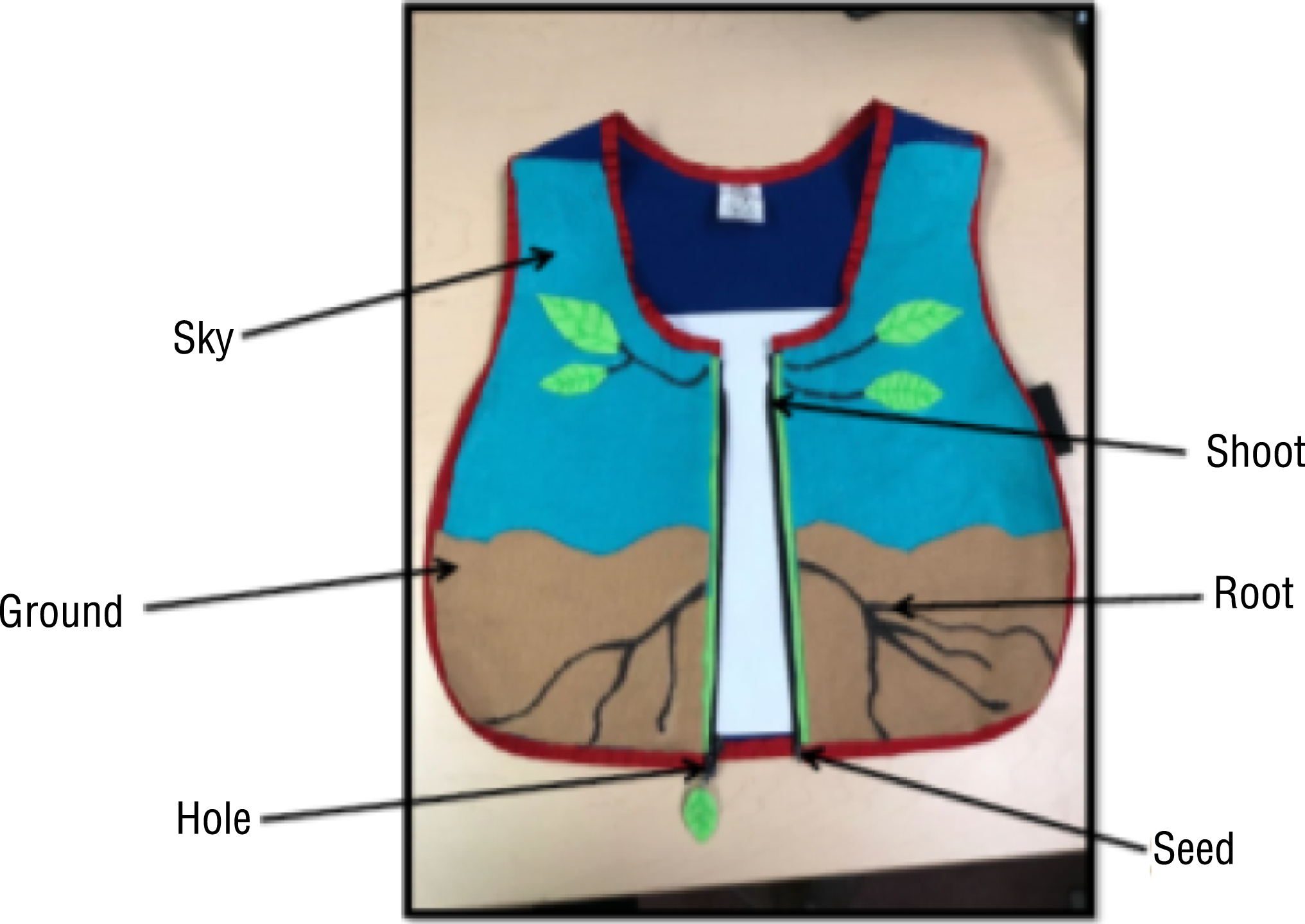
The modified teaching vest.
This oppositional pulling motion was taught to participants with the language prompt “pull down the root, pull up the shoot,” which was incorporated in the related storybook. The simultaneous oppositional pulling motions allowed the vest fabric and zipper to become more taut and rigid, thus facilitating better zipper prong engagement and successful completion of the zippering task. The design and visual cues were based on careful activity analysis, theories of ecological development (Bronfenbrenner, 1989) and environmental targeting (Kreider et al., 2014), and the UDL framework (Center for Applied Special Technology, n.d.).
Next, during each session, each child was pretaught targeted vocabulary from the story (e.g., root, shoot, sky, seed, hole, ground) and then read the story. The investigators generated a storybook targeting specific language related to the visual cues on the modified vest because information can be learned and retained more effectively when it is within a storytelling context (Bruner, 2004; Justice et al., 2005; Wasik & Bond, 2001) and accompanied by pictures, such as a children’s book (Elley, 1989). The story referred to planting a seed into the hole (pin into the tab), with the roots going down (pulling downward with one hand) and the shoot growing up (pulling upward with the other hand). The following text was used for the story:
This is a story about shoots. Shoots have roots. Roots grow down, down, under the ground. Shoots grow up, up, up. This story starts with a seed. The seed is planted in a little hole deep, deep in the ground. Roots grow down, down in the ground from the seed. The roots grow down, and the shoot goes up! The shoot grows up, up to the blue sky. It’s your turn! Plant the seed deep, deep in the little hole. Pull down the root. Pull up the shoot.
After the story was read, each child attempted to zip up the vest three times per session. Targeted verbal prompts provided during these zippering attempts were taken directly from the related storybook and the story vocabulary. Examples include “Plant the seed deep in the hole,” “Pull down the root,” and “Pull up the shoot.”
Analysis
Each individual session was video recorded. Video sessions were reviewed by two student researchers who independently analyzed the data in terms of the child’s success at each step of the seven-step zippering sequence (Appendix) and compared and aligned their findings. Student researchers analyzing the data sets were different from those who collected data, and all were trained by the lead researchers on how to analyze the zippering sequence; the lead researchers reviewed and confirmed analysis processes and results. We coded data using a score of 2, 1, or 0. A score of 2 indicated success with all seven zippering steps, a score of 1 indicated partial success (completed Steps 1–4, 1–5, or 1–6), and a score of 0 indicated completion of no more than Steps 1–3.
To determine interrater and intrarater reliability, 25% of the videos from each trial were randomly chosen and analyzed by a different rater and the same rater, respectively. Percentage agreement and Cohen’s κ coefficients (Landis & Koch, 1977) were calculated for the predetermined skills. After the analysis was completed, the raters reviewed their results for agreement on each video. The interrater percentage agreement was >98%, and the differences were resolved through discussion and review of the tape. Intrarater reliability was determined by having 25% of the samples reanalyzed by the same student researcher. The percentage agreement was >99%. The following guidance was used to interpret the κ values: .41 to .60 is fair, .61 to .80 is good, and >.80 is very good reliability among raters (Warner, 2008). Cohen’s κ coefficients for both the interrater and intrarater reliability analyses were .96 and .99, respectively, indicating very good reliability.
All data were entered into a spreadsheet and then into IBM SPSS Statistics (Version 26; IBM Corp., Armonk, NY) for analysis. A repeated-measures analysis of variance was used to compare the differences between each session for each group of participants, and post hoc analyses were used to compare the measures between the two groups of participants. Data analysis processes were reviewed and confirmed by a biostatistician.
Results
Fifty preschoolers were recruited for the study. Parents of 32 children consented, with 14 preschoolers (age range 3 yr, 6 mo to 4 yr, 11 mo) ultimately participating in each study cohort (N = 28). Fourteen participants were male, and 14 were female. Four children who completed the screening were later excluded because of concerns on the DAYC–2 or absences. Participants all scored within the normal range in the Physical and Communication test domains. Participant scores on the DAYC–2 indicated no significant difference between groups. The mean (standard deviation) of standard scores ranged between 100.78 (10.94) and 104.50 (8.04).
Nine discrete zippering trials were analyzed for each child over three sessions, totaling 126 trials for both the control and comparison groups, with an overall sum of 252 observed, video-recorded, and analyzed zippering trials in the study. Baseline data of the pretrial zippering ability showed no initial difference between the two participant groups, t(26) = −0.27, p = .330, mean difference = −0.50, standard error = 0.40.
Results indicate that all children made progress along the seven-step continuum established for engaging and pulling up a zipper during the study, but the data reveal differences in this progress between control and comparison group participants (the descriptive statistics and the confidence interval for each zippering trial group can be found in Table 1). The confidence interval describes a range of values within which the true value lies. For this study, the 95% confidence interval was used for each zippering trial.
Descriptive Statistics of Zippering Trials
Note. CI = confidence interval.
A repeated-measures design was used, which involves multiple measures of the same variable taken on the same or matched group of participants either under different conditions or over two or more times (Howell, 2013). In our study, we used two groups of participants (control group and modified vest with storybook group) and repeated the same treatment (variable) over three separate sessions. A repeated-measures, between-subjects test revealed a statistically significant difference between the two groups, F(2, 26) = 5.23, p = .031 (Table 2). To determine where the difference occurred, we completed a post hoc analysis. A post hoc analysis occurs after the data are collected and the researcher looks at the means and then notes which of the means are far apart and which are close together (Howell, 2013). An independent-samples t test was used to compare scores on the same variable (treatment) but for two different groups (control group and modified vest with storybook group). See Table 2 for the results of the independent-samples t-test analysis.
Repeated-Measures Test Between the Control and Comparison Groups
p < .05.
These results suggest that a modified practice zippering vest with added visual and language cues aided preschoolers ages 3 and 4 in developing their zippering skills. Both groups developed their skills further with added practice; however, the children in the comparison group performed significantly better than those in the control group, beginning with the second set of interventions. Although little difference was seen after the first practice session (control or comparison), the two cohorts diverged with the second exposure and continued to differentiate in skill acquisition. The preschoolers in the comparison group were able to complete more steps of the zippering sequence than preschoolers in the control group after Sessions 2 and 3, and the difference was found to be statistically significant.
The fragility index, a measure of the robustness (or fragility) of clinical results, was calculated at 5 for this study. The fragility index numerically represents how many participants would be required to convert a study from being statistically significant to not significant (p ≥ .05) within the same study.
Cohen’s d was calculated at 0.86, with an effect size r of .40. An effect size was used to indicate the size of the difference between the performance of the two groups. After examining the study’s results, the effect size was considered to be moderate to medium because the group with the modified vest and storybook performed better than the group without these tools.
Discussion
Research indicates that instructional methods with simultaneous visual and verbal prompts can enhance children’s learning (Chabani & Hommel, 2014). In the current study, we integrated this knowledge by providing an instructional method for a discrete multistep functional task that attempted to offer a more effective way to teach children to engage and pull up the zipper. Through carefully designed vests that are based on the UDL framework and related crafted stories with targeted vocabulary, zippering skills can be taught. This study builds on research that speaks to the importance of combining environmental targeting with occupational practice (Kreider et al., 2014) and Bronfenbrenner’s (1989) ecological model framework. Both of these models point to the benefit of using both task modification and practice to achieve the most progress toward many functional goals.
The protocol also drew on research-based knowledge about language and instruction from the field of speech-language pathology, specifically work by Justice et al. (2005), who found that children learned novel words through storybooks. Although the two protocols were not equal (the modified vest and storybook were used with the comparison group only), the control group did parallel the comparison group, with both protocols consisting of a zippering vest, specific verbal prompting, and the identical number of trial attempts. Studies such as this one advance clinical practice by testing the value of a specific product modification used for a specified number of practice sessions, thus providing preliminary research-based parameters for an intervention protocol that can help clients advance their skills. Additionally, this study lends support to the benefits of an interprofessional lens for creating and evaluating new treatment ideas that more fully address the multifaceted aspects of many daily activities and take advantage of the expertise of different health professionals such as occupational therapy practitioners and speech-language pathologists.
Limitations
Although the results of this study indicate that children practicing with the modified zippering vest and related story and vocabulary made more progress than those using a typical zippering practice vest with generic prompts, it is not apparent which element or elements (the story, the modified vest, or the story-related language prompts) made the difference. This limitation could be investigated in future studies. Other study limitations include a small number of participants, an unknown degree of parental influence in teaching zippering skills at home, and the lack of measurement of the long-term effects of these sessions. Additional research might also look at zippering skills among children within specific disability categories to determine whether the comparison zippering protocol used in this study could also be beneficial in helping them advance their zippering skills.
Implications for Occupational Therapy Practice
The results of this study have the following implications for occupational therapy practice:
Zippering and other dressing or fastening skills constitute a frequent individualized education program or clinical goal for children who are receiving occupational therapy in both school-based and private therapy settings.
Success in these everyday tasks can increase a child’s independence and confidence, allowing the child to more fully participate in school and home environments.
Occupational therapy practitioners offer specialized skills and knowledge and can work with speech-language pathologists to create innovative treatments to better address the occupational needs of clients and assess their efficacy.
The intervention tested also incorporated UDL principles that can make the results useful across multiple settings with children.
This research demonstrates the impact that occupational therapy practitioners, in partnership with speech-language pathologists, can have in facilitating occupationally based skill acquisition.
Conclusion
In this study, we found that a modified practice zippering vest with added visual and language cues helped typically developing preschoolers progress with zippering skills. All children in the study developed their skills further with added practice. Children in the comparison group, however, made more progress in advancing their skills through the seven identified steps of zippering than those in the control group, starting with the second intervention session. Results therefore indicate that the novel instructional method and materials used, developed with input by occupational therapy practitioners and speech-language pathologists, made a statistically significant difference in the skill acquisition of zippering among the children participating in the study.
Footnotes
Acknowledgments
Research was conducted at Salus University, with additional statistical support obtained through Louisiana Tech University. We thank the occupational therapy and speech-language pathology students who helped us with the study from inception to completion.
Appendix
Seven-Step Zippering Sequence Used to Measure a Child’s Success
| Session Number: ________ | Try 1 | Try 2 | Try 3 | Researcher Comments |
| Zippering skill | ||||
| 1. Getting ready: Line up the bottom of each side of the vest, using two hands. | Try 1: | |||
| Try 2: | ||||
| Try 3: | ||||
| 2. Getting ready: Side 1: Hold the zipper prong and zipper tab together with R [right] thumb and index finger. | Try 1: | |||
| Try 2: | ||||
| Try 3: | ||||
| 3. Getting ready: Side 2: Hold zipper tooth with L [left] thumb and index finger. | Try 1: | |||
| Try 2: | ||||
| Try 3: | ||||
| 4. Get set: Insert L zipper tooth securely into R zipper tab (hole) (two-handed activity). | Try 1: | |||
| Try 2: | ||||
| Try 3: | ||||
| 5. Get set: Hold the zipper tab with zipper tooth inserted firmly together with your R hand; zipper prong should remain free. | Try 1: | |||
| Try 2: | ||||
| Try 3: | ||||
| 6. Go: Pull the zipper prong up while simultaneously pulling the middle bottom edge of the jacket down with your other hand. | Try 1: | |||
| Try 2: | ||||
| Try 3: | ||||
| 7. Finish: Zip the jacket all the way to the top. | Try 1: | |||
| Try 2: | ||||
| Try 3: |