





Abstract
A wide range of literature, much of it in non–occupational therapy or international journals, is available to support occupational therapy intervention with adults with ID.
Occupational therapy practitioners support people with intellectual disability (ID) across their lifespan and in various practice settings, but the profession must do more to meet the specialized needs of this underserved population (Johnson et al., 2019). ID is a chronic condition diagnosed before age 18 yr that significantly affects a person’s intellectual and cognitive functioning as well as adaptive behavior skills, or the “conceptual, social, and practical skills [that people use to function] in their everyday lives” (American Association on Intellectual and Developmental Disabilities, n.d., Adaptive Behavior section, para. 1). ID is one type of developmental disability that often co-occurs with other developmental disabilities, such as cerebral palsy or autism spectrum disorder (ASD).
The demand for occupational therapy services has grown as the population of adults with ID has increased, postsecondary education and employment programs have expanded, and more people have transitioned from institutional to community settings (Berg et al., 2017; Dean et al., 2015). The inclusion of occupational therapy as a habilitative service under the essential health benefits of the Patient Protection and Affordable Care Act of 2010 (Public Law 111-148) has also increased demand for occupational therapy services, but greater advocacy, informed by evidence, may be needed for adults with ID to access these services (Brown, 2014).
Occupational therapy practitioners can play an integral role in supporting adults with ID in adaptive behavior skills through teaching, remediating, or adapting the activities of daily living (ADLs), instrumental activities of daily living (IADLs), and vocational and social activities essential to live meaningful lives (Johnson et al., 2019). Occupational therapy practitioners use habilitative (i.e., establish) and compensatory approaches to teach new skills or modify tasks and environments to maintain, enhance, or improve occupational performance among adults with ID (American Occupational Therapy Association [AOTA], 2014; Brown, 2014). To ensure the most effective and efficient care to improve occupational outcomes, occupational therapy practitioners need to use literature to inform ethical, evidence-based intervention with adults with ID.
Systematic and scoping reviews on occupational therapy practice with adults with intellectual and developmental disabilities (IDDs) exist in the literature; however, they have largely focused on occupational therapy intervention literature related to people with ASD or specific occupational performance issues (e.g., Harmuth et al., 2018; Williamson et al., 2017). Williamson et al. (2017) concentrated on describing literature on health care access and health management occupations of adults with ID. Reviews by Waldman-Levi et al. (2019) and Bathje et al. (2018) scoped the literature for interventions that aimed to enhance the occupational performance of adults with IDDs. However, Waldman-Levi et al. focused solely on ADL and IADL interventions with adolescents and adults with ID. Bathje et al.’s systematic review identified occupation-based intervention studies for adults with mild to moderate neurodevelopmental disorders, which limited their review to only 10 articles. This scoping review differs from previous reviews in its inclusion of literature on any occupational therapy–related intervention with adults with any level of ID.
It is imperative that occupational therapy practitioners identify the extent of literature available to guide intervention planning with this population. The purpose of this scoping review was to summarize literature that can inform occupational therapy intervention with adults with ID and categorize this evidence by occupational performance outcomes informed by the Occupational Therapy Practice Framework: Domain and Process (3rd ed.; OTPF–3; AOTA, 2014).
Scoping Review: A Methodological Framework
We used scoping review procedures as outlined by Arksey and O’Malley (2005). We completed the steps in a reflexive and iterative manner to ensure that the review was structured and thorough (Arksey & O’Malley, 2005).
Develop a Guiding Research Question
After completing an exploratory search with broad search terms and discussing the preliminary results with the consulting university librarian with expertise in systematic and scoping reviews, we formulated the following research question: What is the scope of the evidence related to occupational therapy practice with adults with ID? We defined the relevance to occupational therapy practice through consensus discussions on the basis of the OTPF–3 and our clinical experience with adults with ID. Because the scope of the literature was much broader than initially anticipated, this scoping review focuses on the following subquestion: What is the scope of the evidence related to occupational therapy intervention with adults with ID?
Identify Relevant Literature
We determined appropriate key words, and the consulting librarian constructed a custom search in PubMed, CINAHL, PsycINFO, and Scopus because these databases cover IDDs in scholarly journals across all disciplines. The custom search was not limited to occupational therapy journals to capture articles for which occupational therapy scholars were authors or coauthors that dealt with occupational therapy–related topics but were not necessarily published in occupational therapy–specific journals. A list of controlled vocabulary terms used in each database is provided in Table A.1 in the Appendix. Citations and abstracts from these searches were exported to EndNote (Clarivate Analytics, Philadelphia, PA) and uploaded into Covidence (https://www.covidence.org/), a web-based review management system.
Select Studies
Articles were included for review if they (1) were published in English between January 2002 and January 2018, (2) were published in a peer-reviewed journal, (3) included content about people ages 18 yr or older with primary or coexisting ID at any level, and (4) included information relevant to occupational therapy practice (e.g., related to occupational performance strengths and needs of people with ID). Articles were excluded if they (1) were literary criticism (e.g., book reviews, editorials) or conference proceedings; (2) were gray literature (e.g., dissertations, government reports); or (3) included only participants with physical, developmental, or cognitive disabilities without ID (e.g., adult-onset muscular dystrophy, high-functioning ASD, dementia). To establish reliability, three authors independently screened 20 titles and abstracts for inclusion, compared their decisions, discussed their reasoning, and came to consensus, documenting any clarification regarding inclusion and exclusion criteria. These authors conducted this reliability consensus of 20 articles three times until they reached 90% consistency.
Map the Data
We identified 3,402 articles for screening (1,203 PsycINFO; 1,102 CINAHL; 732 Scopus; and 365 PubMed). A total of 826 duplicates were removed, resulting in 2,576 articles to be screened. After reviewing titles and abstracts, we deemed 2,007 articles irrelevant to the research question, leaving 569 articles to be assessed for inclusion. Two authors conducted full-text screenings of each article, and three authors discussed and came to consensus regarding any disagreements about inclusion to ensure reliability. Of the 569 articles assessed, 410 were excluded, leaving 159 that met the inclusion criteria (Figure 1).
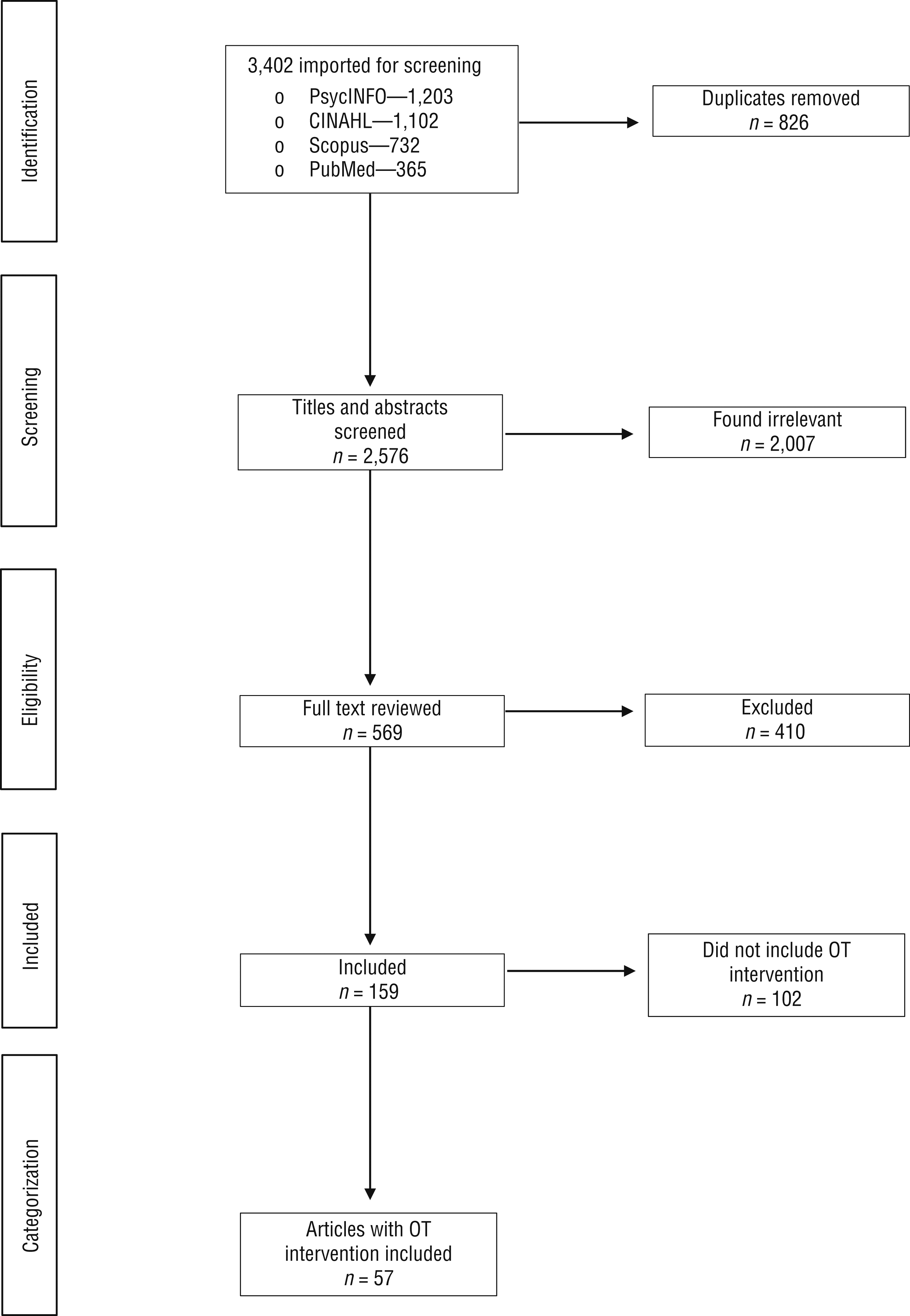
Flow diagram for inclusion and exclusion of peer-reviewed studies in the scoping review.
To analyze the full text of included articles, we extracted key information (e.g., purpose of the study, sample characteristics, types of evidence provided, areas of occupation addressed, measures used, implications for intervention) from each article into a shared Excel (Microsoft Corp., Redmond, WA) spreadsheet. For each article, one author completed the initial data extraction, and a second author reviewed and added to this information. The articles were divided into three major categories on the basis of the type of evidence that the article provided: descriptive, assessment, or intervention.
Evaluate and Summarize Findings
To develop codes for the 57 intervention articles, three authors independently reviewed extracted data, proposed inductive codes and descriptions, and deliberated initial codes. These authors reviewed the extracted data and referred to the full articles until they reached consensus about the coding structure, which developed into intervention outcome categories and intervention strategy categories. Subsequently, these authors assigned each article outcome and strategy codes, as appropriate, and used a shared audit trail to track individual coding. These authors also discussed differences in coding and referred back to full-text articles until reaching consensus.
Results
Of the 159 articles that met the inclusion criteria for the larger scoping review, data were extracted from 57 articles that provided intervention evidence. Articles were published in journals that were not occupational therapy specific (66%), for example, Research in Developmental Disabilities, more frequently than in occupational therapy journals (34%). Intervention evidence for adults with ID was international, with authors and research from 14 countries. The most frequently represented countries were the United Kingdom (26%) and the United States (24%). Half of the articles used small sample designs, including case studies (16 articles) or single-subject designs (13 articles).
Findings from the analyses of intervention articles depicted the intended outcomes of the intervention and intervention strategies (citations and summaries for all articles included in this scoping review can be found in Table A.2). The occupational therapy–related intervention outcomes highlighted in the literature included ADLs, employment, leisure and social interaction, and community participation. Intervention strategies used to reach each of these outcomes are discussed in the sections that follow, as is the intervention strategy of inclusive therapeutic process, which crossed multiple outcomes.
Activities of Daily Living
The most common intervention outcome with adults with ID was improving or enhancing their ability to care for themselves and perform life activities (22 articles). Most articles were specifically about occupational therapy intervention to address ADLs. Three articles detailed interventions within the scope of occupational therapy practice but not provided by occupational therapy practitioners. Single-subject design (N = 1–6 participants) and pretest–posttest experimental design (N = 44–77 participants) were the most frequent types of studies used to measure ADL outcomes. ADL interventions targeted broad occupations such as morning routines and time management, client-selected daily life activities, or specific tasks such as functional mobility or exercise for health management (e.g., Arvidsson & Jonsson, 2006; Hällgren & Kottorp, 2005; Lotan et al., 2010; Nilsson et al., 2011).
Staff training and technology training were the most common strategies used to create change in ADL performance. Formal staff training combining classroom and on-site interaction improved how staff interacted with, prompted, and graded activities for adults with ID, resulting in increased ADL engagement (e.g., Stancliffe et al., 2008). Training to use technology also increased independence in ADL performance (e.g., Lotan et al., 2010; Nilsson et al., 2011). For example, one article suggested that adults with profound ID and multiple disabilities can learn to use power mobility with technology and caregiver supports, considerable practice (up to years), appropriate equipment referrals, and follow-up from practitioners (Nilsson et al., 2011). Habilitative approaches such as client education and practice were also effective in enhancing skills for ADLs (e.g., Hällgren & Kottorp, 2005).
Employment
Eighteen articles focused on intervention with adults with ID to address occupational performance in employment or productive occupations. Ten of these articles identified occupational therapy as part of the intervention team, and an additional 2 articles had occupational therapy faculty among its authors. Researchers most frequently used single-subject design or descriptive case studies to study employment interventions, and all but 1 of the articles included 5 or fewer adults with ID as participants.
These articles focused on improving specific job skills and job-related social skills for employment for adults with ID primarily through the use of prompting strategies, group skills training and practice, environmental modifications, and technology training (e.g., Cannella-Malone et al., 2017; Liu et al., 2013). Video modeling applications and creation of customized work spaces to support the physical, cognitive, and behavioral needs of adults with ID were deemed effective strategies for vocational training (Cannella-Malone et al., 2017; Gentry et al., 2012). Examples of workplace modifications included using visual supports, advocating for appropriate accommodations, or having a support person present (e.g., Ineson, 2015; Kramer et al., 2018). Environmental strategies to adapt both physical and social environments were effective to support self-determined decision making and to improve work performance (e.g., Mirza & Hammel, 2009). Employment-related interventions for productive occupations with adults with profound ID focused on the use of technology-based prompting systems, practice, and reinforcers (e.g., food or drink) to increase their engagement in simple sorting tasks and activity transitions (e.g., Lancioni et al., 2015).
Leisure and Social Interaction
Ten articles provided evidence for interventions to enhance leisure and social interaction. All but 2 of these articles specified the role of occupational therapy in the intervention. Authors primarily used qualitative descriptions or single-subject designs, although 3 studies involved designs with more than 20 participants. Specific leisure and social interaction outcomes included improving relationships between adults with ID and their caregivers and increasing participation in leisure activities, such as gardening or computer games (e.g., Sempik et al., 2014).
Sensory strategies, technology training, and other specific intervention activities were the most common means to improve leisure and social interaction. Sensory strategies to manage sensory sensitivities, anxiety, and challenging behaviors demonstrated mixed results (e.g., Green et al., 2003; Kaplan et al., 2006). Specific therapeutic activities, such as horticulture programs and training to use virtual reality leisure programs, positively enhanced the social interaction skills and leisure participation of adults with ID (e.g., Sempik et al., 2014; Yalon-Chamovitz & Weiss, 2008).
Community Participation
Six articles were found on interventions to improve community engagement for this population. Half of the articles included explicit discussion of occupational therapy involvement in the intervention, and occupational therapy practitioners wrote 1 additional article. Program evaluation was the most common method to study community participation, and most studies included more than 20 participants. Community participation outcomes included improvement in traveling in the community, navigating adult service systems, or engaging in other activities outside of the home (Berg et al., 2017; Stock et al., 2011; Zakrajsek et al., 2014). The most common interventions involved program classes, staff training, and technology applications to support adults’ community participation (e.g., Stock et al., 2011; Zakrajsek et al., 2014).
Inclusive Therapeutic Process
Crossing multiple outcomes, 4 articles emphasized the benefit of explicit inclusion of adults with ID in the therapeutic process as an important means to create change (e.g., Ball & Shanks, 2012; Dean et al., 2015). These articles noted that practitioners preferred informal discussion to gather and use feedback for service planning and that person-centered, multidisciplinary planning processes were integral to improving occupational engagement (Ball & Shanks, 2012; Prakash et al., 2007). Focusing on client strengths and preferences coupled with coaching and collaboration with community partners was recommended to improve self-determination and occupational performance among adults with ID (Dean et al., 2015). Additionally, consumer-directed assistive technology with environmental modification improved client satisfaction (Mirza & Hammel, 2009).
Discussion
The search for evidence supporting occupational therapy practice with adults with ID generated more articles than anticipated. Most intervention studies were published in non–occupational therapy journals, which may be contributing to an impression that limited evidence exists to support occupational therapy intervention with adults with ID. Many articles contained information relevant to occupational therapy intervention without explicitly stating whether occupational therapy practitioners were involved. This finding is consistent with prior research that showed that 82.8% of occupational therapy practitioners drew evidence-based practice information from non–occupational therapy sources (Döpp et al., 2012). However, occupational therapy–specific intervention evidence was also published in these journals.
Articles included in this scoping review described a range of habilitative and compensatory approaches involving technology training, prompting strategies (often through the use of technology), and caregiver training to improve occupational performance outcomes for adults with ID. In this scoping review, we also found a small body of literature on intervention strategies that occupational therapy practitioners can use to better engage people with profound intellectual and multiple disabilities. Moreover, literature emphasizing inclusive therapeutic processes highlighted the importance of prioritizing perspectives of adults with ID to improve occupational therapy outcomes. Learning the perspectives of adults with ID may require adaptations to traditional interview methods within the occupational therapy process because of cognitive impairments and potentially limited receptive and expressive communication skills (Ball & Shanks, 2012).
Issues with ADLs or employment may represent typical reasons for referral to occupational therapy for adults with ID because they were the most common occupational outcomes in this scoping review. However, employment may be overrepresented because including occupation as a search term helped capture work and employment articles beyond occupational therapy–specific literature, thus increasing the total number of articles included in this scoping review. Several articles emphasized emerging and distinct roles for occupational therapy practitioners working with adults with ID in the areas of behavior management, inclusive education and employment, care coordination, and advocacy (e.g., Dean et al., 2015; Parkinson et al., 2009; Prakash et al., 2007). Although these articles present a myriad of growth opportunities for occupational therapy practice with adults with ID, practitioners may need support to provide care coordination services that fall outside of traditional occupational therapy roles (Parkinson et al., 2009).
Reemergent occupational therapy roles in mental health promotion may help adults with ID manage challenging behaviors and anxiety that affect their occupational performance. Leisure and community participation articles provided examples of mental health promotion interventions (e.g., Graham et al., 2016; Green et al., 2003). Psychosocial-focused occupational therapy intervention is important as more adults with ID with comorbid mental health diagnoses gain access to inclusive community spaces (Blaskowitz et al., 2019; Urwin & Ballinger, 2005).
Small sample designs, including case studies and single-subject designs, were most frequently used in the studies included in this scoping review. This finding may speak to challenges in recruiting adults with ID, who are considered a vulnerable population with extra research protections. Although small sample designs can limit the generalizability of research findings, they are often the more appropriate design choice for research with adults with ID because of the wide variability of skills within this population and the need to individualize intervention strategies to meet their specialized needs. Occupational therapy practitioners working with adults with ID in clinical or community-based settings can easily translate findings from small sample design research into practice and track the effects of their intervention with this population.
This review builds on findings from recent reviews with similar populations (Bathje et al., 2018; Waldman-Levi et al., 2019). The specific populations for each review differed in that Waldman-Levi et al. (2019) included adolescents, Bathje et al. (2018) included people without ID, and both previous reviews excluded people with profound ID. Therefore, although some overlap occurred in the articles included in each review, this review included multiple new articles. By including the full range of levels of ID and a broader scope of interventions relevant to occupational therapy, we extended intervention outcomes found beyond those of employment and ADLs and IADLs. Intervention strategies encompassed those not represented in recent reviews, such as caregiver training and environmental modifications. Moreover, by including nonresearch articles published in peer-reviewed journals, this review also provides information about the broad role of occupational therapy with this population and the importance of inclusive practices to seek and use perspectives of adults with ID in the occupational therapy process.
It is challenging to capture all relevant literature on intervention with adults with ID, whether for research or evidence-based practice. Many interventions relevant to occupational therapy are published in developmental disability literature that occupational therapy practitioners may not regularly access. When reviewing literature, the distinctions between ID and the broader categories of neurodevelopmental or developmental disability may be unclear; in addition, it may not be explicit whether ID coexists with other developmental conditions, such as cerebral palsy or ASD. Moreover, studies with people with cognitive disabilities may not specifically state whether ID is included. The prevalence of relevant literature from the United Kingdom sparks another source of potential confusion because ID is labeled as learning disability in the United Kingdom. Specific learning disability (termed learning difficulty in the United Kingdom) is substantially different from ID, but the population included in an article may be ambiguous.
Although the findings of this study are broad, the primary limitation is that relevant articles were likely missed. The variation in terminology for adults with ID and difficulty capturing interventions that do not explicitly mention occupational therapy are major aspects of this challenge. Although we used multiple strategies to develop search terms and consulted with a librarian, this area should be further explored. Moreover, because the initial search yielded so many articles, we did not complete hand searching or reference list reviews that may have yielded additional results.
Opportunities exist for future research to support occupational therapy intervention with adults with ID. The bulk of the existing evidence includes ADLs or employment outcomes; further research may address community participation, leisure, social interaction, and mental health promotion. Few articles included people with severe or profound ID; additional research is needed with this population. Technology-related interventions were among the most common; these interventions could be expanded to explore different technological advances and to consider the broad range of intervention strategies appropriate with this population. Findings also imply that sufficient evidence may be present for a systematic review that evaluates the strength and rigor as well as quality of intervention evidence to support occupational therapy practice with adults with ID.
Implications for Occupational Therapy Practice
The results of this scoping review have the following implications for occupational therapy practice:
Occupational therapy practitioners need to explicitly seek and use the perspectives of adults with ID with whom they work to ensure inclusive and person-centered practice.
Occupational therapy practitioners have distinct skills to support adults with ID with participation in a broad range of occupations and may need to advocate for their role in promoting community participation, social interaction, and mental health.
Evidence supports a wide variety of compensatory and habilitative approaches with adults with ID; moreover, a combination of approaches may be appropriate, especially when using technology or caregiver prompting to support participation.
When searching for occupational therapy–related evidence for adults with ID, occupational therapy practitioners need to search broadly to include journals outside of occupational therapy and consider search terms carefully.
Conclusion
Research and policy-related evidence that can inform occupational therapy practice with adults with ID exists; however, occupational therapy practitioners may not be knowledgeable of or have access to the full range of literature available. This scoping review demonstrates that evidence published in occupational therapy and non–occupational therapy journals supports occupational therapy intervention with adults with ID. Using broad search strategies that generate evidence beyond occupational therapy publications may bridge perceived gaps in evidence-based practice with adults with ID. Occupational therapy practitioners can play a vital role in supporting adults with ID to live meaningful lives according to their preferences and use existing evidence to support expanding their role with this population.
Supplemental Materials
Supplementary material for Evidence to Inform Occupational Therapy Intervention With Adults With Intellectual Disability: A Scoping Review
Supplementary material, sj-docx-1-aot-10.5014_ajot.2021.043562.docx for Evidence to Inform Occupational Therapy Intervention With Adults With Intellectual Disability: A Scoping Review by Meghan G. Blaskowitz, Khalilah R. Johnson, Theodore Bergfelt and Wanda J. Mahoney in The American Journal of Occupational Therapy
Supplementary material for Evidence to Inform Occupational Therapy Intervention With Adults With Intellectual Disability: A Scoping Review
Supplementary material, sj-docx-2-aot-10.5014_ajot.2021.043562.docx for Evidence to Inform Occupational Therapy Intervention With Adults With Intellectual Disability: A Scoping Review by Meghan G. Blaskowitz, Khalilah R. Johnson, Theodore Bergfelt and Wanda J. Mahoney in The American Journal of Occupational Therapy
Footnotes
Acknowledgments
We thank David Nolfi (Head Librarian for Research Engagement, Health Sciences/STEM [Science, Technology, Engineering, and Mathematics] Initiatives, and Assessment at Duquesne University) for his methodological consultation and support in establishing search strategies for this scoping review. We also thank Emily Casile (occupational therapy student at Duquesne University) and Lindsey Wethington (occupational therapy student at Washington University) for assistance with editing this scoping review, the supplemental tables, and the figure.
*
Indicates studies included in the scoping review.
Appendix. Supplemental Tables
Summary of Evidence Informing Occupational Therapy Intervention With Adults With Intellectual Disability for the Articles Included in the Scoping Review
| Author/Year/Country | Purpose | Article Type | Participants | OT Intervention | Intervention Results | Outcome Code | Intervention Strategy Code |
| Applegate et al. (2008) United States | Determine effect of a specific teaching strategy on time-telling accuracy in adults with ID | Research: single-subject design | N = 1 19-yr-old with mild ID | Computer-based intervention to tell time on analog clock with visual and auditory feedback for KR No direct OT in intervention; likely part of setup, but not specified |
Participant increased performance and accuracy with identifying time on an analog clock. | ADLs | Other therapeutic activity |
|
Arikawa et al. (2013)
Japan |
Describe role of OT in supporting adults with IDDs to acquire and maintain employment | Case study description (not research) | N = 2 adults, age in the 40s, with moderate ID | Role of OT in helping adults with IDDs acquire employment | Visual instructions were used for simple, repetitive job tasks. Identifying a key support person in the workplace was helpful for ongoing support. | Employment | Environmental modifications |
|
Arvidsson & Jonsson (2006)
Sweden |
Describe how adults with DDa experience using time aids 1 yr after being introduced to them by an OT; analyze how using time aids affects independence and autonomy | Research: phenomenology | N = 10 adults ages 25–45 with DDa who could answer simple, short questions | OT intervention that used time aids (long-term impact of technology) | Time aids increased independence during morning ADL routines, improved productivity, and helped adults with ID manage break times during work. Authors recommend considering how long it may take a client to accept the aid versus a support person and possible stigma associated with its use. | ADLs | Technology training |
|
Aspinall & Nichols (2008)
United Kingdom |
Describe software used in project that aimed to explore how electronic AT affects employability in adults with cognitive disabilities | Case study description (not research) |
N = 28 adults with ID (age not specified) Brief case examples provided for 2 adults |
TATE intervention using electronic AT to increase employability in adults with cognitive disabilities No explicit mention of OT |
Adapting and trialing AT and software applications that addressed real-world situations supported participants’ ADL and IADL performance. | Employment | Technology training and environmental modifications |
|
Ball & Shanks (2012)
United Kingdom |
Determine how OTs gather and use feedback on service planning and individualized care from adults with ID | Research: mixed methods | N = 70 OTs in LDb special interest section | General intervention process; how clients were involved in OT process | Several OTs reported that they did not use systematic approaches, aside from informal discussion, to gain feedback from service users. Enabling service users to understand the role of the OT was central to this process, however. | No outcome code | Inclusive therapeutic process |
|
Benford (2017)
United Kingdom |
Provide a practice analysis of an adaptation of Drive to Learn intervention strategy with an adult with cerebral palsy and profound LDb and additional disabilities | Case study description (not research) | N = 1 adult age 23 yr with cerebral palsy, profound LD,b and additional disabilities | OT intervention provided 3 times per week for 28 sessions to learn to operate power wheelchair with switches | Participant demonstrated significant improvement in the use of a power wheelchair with multiple switches and individualized motivating factors. | ADLs: functional mobility | Technology training |
|
Berg et al. (2017)
United States |
Understand the experiences of adults with ID attending a transition and postsecondary education program for students with IDDs | Research: case study of a program | N = 32 adults ages 19–28 yr with ID | Transition and postsecondary education program OT involved in program |
Students with ID needed education on differences between entitlements and eligibility, how to seek supports and services, how to negotiate community transportation and financial management, other executive functions, and socialization. Students also needed support in self-advocacy as it pertained to disability disclosure. | Community participation | No intervention strategy |
|
Borioni et al. (2012)
Italy |
Assess the effects of equestrian rehabilitation and onotherapy on physical and psychosocial skills of adults with ID and develop a measurement tool | Research: measurement pilot study | N = 23 adults with mild to severe ID and additional disabilities Equestrian rehabilitation, n = 8 (M age = 38.6 yr) Onotherapy, n = 15 (M age = 42.9 yr) | Therapeutic activities with horses, donkeys, or both No explicit mention of OT |
The intervention that included both horses and donkeys demonstrated positive effects in improving autonomy and social integration among adults with ID. | Leisure | Other therapeutic activity |
|
Bunning et al. (2012)
United Kingdom |
Explore how adults with ID engage with a symbol recognition system to access media on a computer and role of support professionals during the activity | Research: action research | N = 5 youth and adults ages 15–28 yr with profound ID and additional disabilities | Training at least 1 time per week to use symbol recognition system on computer to play multimedia OTs among support professionals involved in the intervention |
All participants demonstrated attention to the computer and basic actions with symbols. Supporter facilitation was deemed important for successful outcomes. |
Employment | Technology training |
|
Campbell et al. (2015)
United States |
Determine whether video modeling on a portable device can facilitate the development of self-help skills in adolescents with autism spectrum disorder | Research: single-subject design |
N = 3 participants with severe ID and additional disabilities n = 1 youth age 17 yr n = 2 adults age 19 yr |
OT intervention of video modeling of handwashing | Results suggest that video modeling improved handwashing skills. | ADLs | Prompting strategies |
|
Cannella-Malone et al. (2017)
United States |
Compare the effects of least-to-most prompting with self-directed video prompting with error correction on vocational skills | Research: single-subject design | N = 2 adults ages 26 and 28 yr with moderate ID and additional disabilities | Individual training sessions with iPod Touch video app or live instruction to fill envelopes or to fold towel OT consulted in the postsecondary program and helped design task analysis used in the study. |
Both self-directed video prompting and least-to-most prompting were effective in teaching participants vocational skills. | Employment | Prompting strategies |
|
Castelhano et al. (2013)
Portugal |
Investigate professionals’ use of multisensory stimulation environments and computer-mediated playfulness in multisensory environments | Research: qualitative descriptive | N = 12 professionals (n = 8 OTs) who worked with children and adults with ID and other disabilities | Multisensory stimulation environment |
Multisensory rooms were used for relaxation, anxiety and hyperactivity reduction, and sensory exploration and integration and as a space to perform other non–sensory-focused interventions (e.g., motor, communication, cause/effect) with clients. | Leisure | Sensory strategies |
|
Chan et al. (2011)
Singapore |
Describe program to help students develop proficiency climbing ladders | Research: case study | N = 4 adults age 19 yr with mild ID | 10-wk OT and psychologist intervention using cognitive–behavioral therapy strategies to decrease anxiety and climb ladders for work | Model of Human Occupation and cognitive–behavioral therapy guided the intervention. Two participants successfully climbed a short 4- to 5-step ladder by the end of the intervention. | Employment | Occupational trainingc |
|
Dean et al. (2015)
United States |
Highlight the role of OT in community settings and consumer-directed supports for adults with DDa | Policy (not research) | Adults with ID and other DDa; number and ages not specified | OT role in consumer-directed supports that focused on individualized support planning with adults with ID having more control of services | Recommendations to address self-determination included coaching to increase problem solving, self-awareness, and self-efficacy in the home, community, and workplace and collaboration with parents, job coaches, vocational rehabilitation, or important others. | OT roled | Inclusive therapeutic process |
|
de Paula Nunes Sobrinho & de Lucena (2012)
Brazil |
Customize a workstation for a woman with ID | Research: case study | N = 1 adult age 25 yr with ID and additional disabilities | Ergonomic work analysis with a workstation customization No explicit mention of OT |
Work analysis and customization for adults with ID need to consider social skills, cognitive skills, and behavioral needs in addition to biomechanical factors. | Employment | Environmental modifications |
|
Gentry et al. (2012)
United States |
Describe iPod Touch as a cognitive–behavioral intervention for vocational success for adults with autism | Research: multiple case study design |
N = 3 participants n = 1 20-yr-old with ID and additional disabilities n = 1 21-yr-old with autism n = 1 60-yr-old with autism, cerebral palsy, and epilepsy |
OT intervention to set up iPod Touch with individualized supports for work, to train adult and job coach in its use, and to provide follow-along support for up to 6 mo | Participant with ID demonstrated improved work performance, decreased need for direct supervision from job coach, and decrease in behavioral challenges with iPod Touch installed, picture prompts, and audio cue apps. Device also kept participant engaged during long bus ride to work. | Employment | Environmental modifications, prompting strategies, and technology training |
|
Graham et al. (2016)
United Kingdom |
Examine a model of effective forensic practice with positive interventions for men with ID who have committed sex offenses | Case study description (not research) | Adults with LDb; number and ages not specified | Forensic program with OT involvement based on attachment theory and the Model of Human Occupation | Program fostered good relationships between staff and adults with LD.b It was anticipated that these good relationships could decrease staff turnover and improve participant outcomes. | Leisure | Other therapeutic activity |
|
Green et al. (2003)
United Kingdom |
Investigate the clinical effectiveness of sensory integration intervention for adults with ID | Research: single-subject design | N = 2 adults ages 28 and 34 yr with LDb and other disabilities | Individualized OT sensory integration intervention provided 2–3 times per week for 30–50 min each session | The first client experienced a 75% reduction in the negative behavior of screaming, whereas no observable or measurable change was found in the second client’s behavior during the treatment phase or after withdrawal of treatment. | Leisure | Sensory strategies |
|
Grolla et al. (2011)
Italy |
Evaluate the efficiency of a weight loss rehabilitation program for patients with Prader–Willi syndrome | Research: program evaluation | N = 49 youth and adults ages 18–42 yr with Prader–Willi syndrome | 4-wk/26-day weight-loss program for people with Prader–Willi syndrome that included daily physical exercise and other music/recreational activities (physical exercise performed daily; OT provided 1 day per week) | People with Prader–Willi syndrome who completed a 26-day cycle of the program had an average decrease in BMI of 2.1 units. | ADLs | Occupational trainingc |
|
Hällgren & Kottorp (2005)
Sweden |
Evaluate effect of an OT intervention on ADL performance and awareness of disability | Research: single case design |
N = 7 adults ages 20–53 yr with ID n = 6 adults with mild to moderate ID n = 1 participant with cerebral palsy and mild ID |
OT home-based intervention to adapt and practice selected ADL tasks in 5 sessions over 2–3 mo Included video to determine key aspects of task difficulty and to provide feedback instruction |
5 intervention sessions improved motor and process skills during ADLs in adults with mild and moderate ID, and changes were maintained during follow-up period. Large variability in awareness of disability during baseline prevented determining whether changes were attributed to the intervention or random variation. | ADLs | Occupational trainingc |
|
Harr et al. (2011)
United States |
Study whether increased opportunities for household task participation affect self-determination, participation within family unit, and responsibilities | Research: mixed-methods case study | N = 1 20-yr-old with spina bifida, moderate ID, and visual–perceptual issues | OT intervention using a rehabilitation approach (positioning and use of a mirror), behavioral strategies (checklist, reward system), and family education | Participant demonstrated increased independence, participation in home and community tasks, and self-determination after the intervention. | ADLs | Staff and caregiver training |
|
Hutchinson et al. (2008)
Canada |
Apply SCCT to the case of a student in work-based education | Research: case study | N = 1 18-yr-old with moderate DDa | Application of SCCT, including occupational interests, choices, and performance, to interpret work-based education case Author was an OT, but no explicit mention of OT was made. |
Use of SCCT has the potential to inform work-based interventions for adults with developmental disabilities. | Employment | Environmental modifications |
|
Ineson (2015)
United Kingdom |
Describe OT approach for a client with severe ID trying to obtain work | Research: case study | N = 1 28-yr-old with severe ID | OT intervention provided weekly to improve prevocational skills and to broker connections with potential employers Visual communication supports provided to ensure partnership in OT sessions and research |
Supported employment agencies did not support adults with more severe disabilities. | Employment | Environmental modifications |
|
Kaplan et al. (2006)
United States |
Study the effects of Snoezelen sensory intervention on engagement | Research: single-subject design | N = 3 adults ages 31, 47, and 52 yr with ID and additional disabilities | OT intervention that provided Snoezelen 2 times per week for 30 min per session | Snoezelen may have short-term effects on task engagement and challenging behavior among adults with profound ID. | Leisure | Sensory strategies |
|
Kjellberg et al. (2012)
Sweden |
Explore OT perspective on client involvement in decision making during intervention process | Research: survey research (quantitative and qualitative data) | N = 285 OTs working with adults with mental illness and/or ID | Survey of OT perceptions on the extent to which their clients are involved in decision making during the OT process (e.g., defining problems, setting goals, making plans for therapy) | Client participation in decision making was low. OTs must implement strategies to ensure that adults with ID are actively involved in the decision-making process during therapy. | No outcome code | Inclusive therapeutic process |
|
Koritsas et al. (2008)
Australia |
Study effects of active support training on client engagement, choice making, perception of staff supports, and challenging behavior | Research: pretest–posttest design |
N = 23 n = 12 adults ages 27–57 yr with varying levels of ID n = 11 staff who supported adults with ID |
Active support training provided to staff over a 3-mo period No explicit mention of OT |
Active support training for staff can positively affect how adults with ID participate in activities and can decrease their challenging behavior in group homes. | ADLs | Staff and caregiver training |
|
Kottorp et al. (2003)
Sweden |
Determine effect of an OT intervention, guided by OT Intervention Process Model, on ADL performance and disability awareness in adults with ID | Research: single-subject design | N = 3 adults ages 24, 26, and 30 yr with moderate ID | OT intervention focused on providing client-centered, adaptive, and restorative ADL interventions for adults with ID | 1–5 OT intervention sessions were enough to detect change. If no change occurs after 5 sessions, professionals likely need to revise or discontinue IPM program. |
ADLs | Occupational trainingc |
|
Kramer et al. (2018)
United States |
Study feasibility of electronic peer mentoring of a problem-solving intervention for transition-age youth with IDDs | Research: feasibility study |
N = 51 n = 9 mentors ages 17–35 yr n = 42 mentees ages 14–22 yr All had DD,a but 55% of mentors and 64% of mentees had ID. |
Mentoring intervention that paired adults with IDDs with youth with IDDs to assist them in goal development and problem solving Authors were OTs. OT students and licensed social workers supervised peer mentors. |
Mentoring program was found to be feasible. Adult mentors had a phone script, job supports, and other individualized supports to enhance their mentoring work and to increase success of the program. |
Employment | Environmental modifications |
|
Lancioni et al. (2006)
Italy |
Compare rehabilitation professionals’ opinions of individual versus cooperative activities (social validation assessment) | Research: descriptive study |
N = 66 n = 5 adults ages 26–45 yr with profound ID and visual–hearing impairment n = 61 rehabilitation personnel as raters |
Rehabilitation personnel observed provision of individual and cooperative tasks for adults with ID. OTs served as raters. |
Rehabilitation professionals rated cooperative task completion more favorably than individual task completion. | Employment | No intervention strategy |
|
Lancioni et al. (2013)
Italy |
Determine how adults with profound ID can learn new work activities with technology assistance | Research: single-subject design | N = 2 adults ages 31 and 33 yr with profound ID and blindness | Technology-based prompting system that provided adults with ID praise as they learned work tasks No explicit mention of OT |
Technology-based prompting helped adults with ID stay on task and complete tasks with few errors. | Employment | Prompting strategies |
|
Lancioni et al. (2015)
Italy |
Study the effectiveness of technology to assist adults with ID to transition to next work activity | Research: single-subject design | N = 3 adults ages 39–43 yr with severe to profound ID and blindness | AT with optic sensor and audio to prompt adults to move to next workstation, with reinforcer after tasks were completed No explicit mention of OT |
AT system increased adults’ independent transition to next work task. | Employment | Prompting strategies |
|
Lancioni et al. (2014)
Italy |
Study the impact of AT and environmental setup on independent activity engagement among adults with ID | Research: single-subject design |
N = 5 participants n = 4 adults ages 30–44 yr with severe to profound ID and visual–hearing impairment n = 1 adolescent age 13 with severe to profound ID and visual impairment |
AT with automatic reinforcers and environmental modifications, including physical arrangement of work tables No explicit mention of OT |
Technology-mediated light cues and reinforcers increased independent engagement among adults with severe/profound ID and multiple disabilities. | Employment | Prompting strategies |
|
Lancioni et al. (2008)
Italy |
Study effectiveness of AT for prompting adults with ID during independent, simple task completion | Research: single-subject design | N = 4 adults ages 20–43 yr with profound ID and visual–hearing impairment | AT that provided prompts to adults with ID during work tasks No explicit mention of OT |
Adults with ID reached and maintained almost 100% completion after 5–10 practice sessions with AT prompting. | Employment | Prompting strategies |
|
Liu et al. (2013)
Hong Kong |
Determine effectiveness of an OT work training program in teaching work behaviors, communication, and emotional regulation to adults with ID | Research: one group pretest–posttest design | N = 14 adults ages 18–40 yr with mild to moderate ID and autism | OT intervention provided 2 times per week for 1 hr Interventions included group training, role-play, and practice of specific work tasks as well as social, communication, and emotional skills. Environmental cues were provided to remind adults of appropriate work behaviors. | Improvement was noted in social and communication skills in the workplace. Minimal improvement was noted in impulse control. | Employment | Occupational trainingc |
|
Lotan et al. (2009)
Israel |
Determine effectiveness of an off-the-shelf VR exercise program in improving physical fitness of adults with ID | Research: pretest–posttest design with control group |
N = 59 adults ages 34–60 yr with moderate ID and physical disabilities Intervention group, n = 28 Control group, n = 31 |
OT intervention: 5- to 6-wk exercise program provided 3 times per week for 30-min sessions using an off-the-shelf VR program (Sony PlayStation II EyeToy) | Use of an off-the-shelf VR program created change in physical fitness levels for adult participants with ID. | ADLs | Technology training |
|
Lotan et al. (2010)
Israel |
Study effect of VR system on physical fitness of adults with severe ID | Research: pretest–posttest design with control group |
N = 44 adults ages 25–58 yr with severe ID and physical disabilities Intervention group, n = 20 Control group, n = 24 |
8-wk VR video exercise system provided 3 times per week for 30-min sessions The OT provided technical support. |
VR video exercise system was effective in improving physical fitness (as measured by resting heart rate). | ADLs | Technology training as well as staff and caregiver training |
|
Lotan et al. (2011)
Israel |
Determine feasibility and effectiveness of VR exercise program to improve physical fitness of adults with ID | Research: pretest–posttest design with control group |
N = 44 adults ages 25–58 yr with severe ID and physical disabilities Intervention group, n = 20 Control group, n = 24 |
8-wk VR exercise program run by caregivers and provided 2–3 times per week for 30-min sessions The OT provided technical support. |
VR exercise program created change in physical fitness levels. Caregivers need encouragement and support to implement exercise program. | ADLs | Staff and caregiver training as well as technology training |
|
Mead et al. (2010)
United Kingdom |
Describe an OT student project of educational interactive whiteboard games designed to support students with LDb | Program development (not research) | Youth with LDb; number and ages of participants not specified | OT intervention that provided student-developed ADL/IADL interactive whiteboard games to college students with LDb | Students with LDb enjoyed the whiteboard games and receiving positive feedback when they completed ADL/IADL games successfully. | ADLs | Occupational trainingc |
|
Mihailidis et al. (2016)
United States |
Provide an overview of how cognitive–assistive technologies (N-CAPS) can been applied to work tasks | Research: descriptive pilot study | N = 4 adults ages 18–65 yr with ID | N-CAPS used to support adults with ID during 5 trials of a work assembly task First author was from an OT department, but no explicit mention of OT was made. |
N-CAPS assisted adults with ID to complete work tasks with 83% accuracy, 86% sensitivity, and 82% specificity. However, adults ignored 51% of N-CAPS prompts. 3 out of 4 participants enjoyed using N-CAPS. All participants found the system easy to use. | Employment | Prompting strategies |
|
Mirza & Hammel (2009)
United States |
Examine the effectiveness of consumer-directed AT and environmental modifications for aging adults with ID | Research: pretest–posttest design with control group |
N = 75 adults ages 29–80 yr with mild to profound ID Intervention group, n = 30 (consumer-directed AT and environmental modification) Control group, n = 45 (standard AT) |
OT home- and community-based intervention provided in 5 sessions (2 hr each) over 3 mo Provision of AT devices, environmental modifications, task organization, and time management to address basic self-care goals Systems-level advocacy also provided |
Statistically significant difference was found in satisfaction with and perception of performance between the intervention group and the control group. Significant positive correlation was also noted between perceived occupational performance rating and satisfaction rating on identified goals. |
ADLs | Inclusive therapeutic process and environmental modifications |
|
Nilsson et al. (2011)
Sweden |
Explore opportunities to use a joystick-operated power wheelchair with people with cognitive disabilities through an 8-phase learning process | Research: grounded theory | N = 45 children and adults ages 1–52 yr with profound cognitive disabilities including ID | Power wheelchairs fitted with specially programmed joysticks and transparent trays Practice with joystick 1–2 times per week between 5 and 60 sessions per person Lead author was an OT; OT was discussed in the article. |
8 out of 45 participants reached Phase 6 of the 8-phase learning process. Facilitators grew conscious of how they could better facilitate incremental gains among participants as they practiced joystick use (e.g., using a reassuring, calming tone; providing manual facilitation and verbal cuing; directing a participant’s attention to cause and effect during collisions). |
ADLs: functional mobility | Technology training |
|
Olivier et al. (2007) South Africa |
Describe a prevocational skills program fieldwork experience aimed at empowering people with ID | Research: program development and evaluation | OT students working with adults with lower intellectual functioning; number and ages of participants not specified | OT student intervention provided in 12 sessions over 7 wk to learners with disabilities Intervention focused on prevocational skills (e.g., interviewing, professional dress, table manners) and community participation (e.g., grocery shopping, opening a bank account, networking) |
Adults participated in all sessions and provided positive feedback. A manual for sheltered workshop teachers was created to cover training topics, but carryover by staff was limited. | Community participation and employment | Occupational trainingc |
|
Pal et al. (2013)
New Zealand |
Explore the perceptions and experiences of OTs and PTs in reducing fall risk among people with ID | Research: semistructured interviews | N = 8 OTs and PTs who worked for a service organization for people with ID | OT and PT fall prevention intervention focused on individual-level strategies (e.g., functional mobility, physical activity, trial use of adaptive devices) and environmental strategies (e.g., home modifications, educating support staff) | Environmental modifications, physical activity participation, mobility devices, and safe mobility education were most useful. | ADLs: functional mobility | Staff and caregiver training |
|
Parkinson et al. (2009)
United Kingdom |
Quantify the range of occupation-focused interventions and assessments versus generic tasks and assessments used by an OT within ID services | Research: program evaluation | OTs working with adults with LDb
n = 42–61 adults with LD per audit; age not specified |
OTs provided care coordination as well as individual and group interventions. Interventions were focused on enabling participation in self-care, productive work, and leisure. | As care coordinators, OTs were able to engage clients in occupation-focused tasks 82% of the time with caseloads of ≤10 adults. However, this capacity dropped to 31% of the time with caseloads of ≥11 adults. OTs were well prepared to assume the role of care coordinator, but high caseloads affected an occupation-focused approach to assessment and intervention. |
OT roled | No intervention strategy |
|
Perez et al. (2012)
Australia |
Identify PBS activities used by an OT and how PBS can be enhanced | Research: descriptive, semistructured interviews | OTs who provided PBS to N = 10 adults with ID; age not specified | OT’s role in PBS | OTs expressed a lack of confidence at times in providing PBS but felt that OT should be involved in evaluation and treatment of a variety of contributors to challenging behavior. | Leisure and OT roled | Other therapeutic activity |
|
Prakash et al. (2007)
United Kingdom |
Describe the development and operation of an ID assertive outreach team and the results of an audit comparing a period of assertive outreach care with standard community care | Research: program evaluation | N = 19 adults (M age = 42.4 yr) with mild LDb and additional disabilities | Assertive community treatment, which includes OT, is a care program approach that includes risk assessment within a person-centered, multidisciplinary care planning process. Even when an adult is admitted to the hospital, care planning continues to decrease the length of stay. |
Adults who participated in assertive community outreach reported positive experiences and increased engagement. Reductions in short-term hospitalization were not determined. |
Community participation | Other therapeutic activity |
|
Rice & Hernandez (2006)
United States |
Investigate the effect of high versus low frequency of KR feedback on motor learning performance | Research: participant-matched, two-phase experimental design with control group |
N = 33 participants ages 26–65 yr n = 17 adults with mild to moderate DDa n = 16 adults without disabilities who were age and gender matched to those with DD |
OT intervention to use a computer with motor learning KR feedback | For people with DDa in the motor learning acquisition phase, the group who received 100% KR and feedback on performance during motor learning performed better and improved throughout acquisition, whereas the 50% KR group decreased acquisition over time. However, the 50% KR group performed better than the 100% KR group in the retention phase. | ADLs: functional mobility | Other therapeutic activity |
|
Sempik et al. (2014)
United Kingdom |
Examine the effectiveness of social and therapeutic horticulture for participants with ID | Research: one group pretest–posttest design |
N = 143 participants (M ages = 16 yr for youth, 35 yr for adult men, and 38 yr for adult women) n = 56 adults with LDb n = 61 adults with mental health diagnoses n = 10 adults with autism n = 16 adults with cognitive impairments and physical disabilities |
OT intervention using horticulture activities 5-hr group intervention approximately 1 time per week for 1 yr |
Participation in therapeutic horticulture at least 1 day per week was found to positively affect the social interaction skills of adults with ID after 90 and 180 days of participation. Motivation also increased after 90 days of participation in the activities. Marginal significance was seen in their communication at 90 days (p = .057), and no significant improvement was seen for task engagement. |
Leisure | Other therapeutic activity |
|
Stancliffe et al. (2008)
Australia |
Examine changes in the overall amount of praise used by residential staff and the rate at which it was given to residents before and after active support training | Research: observational pretest–posttest design |
N = 58 adults ages 27–62 yr, including residents, direct support staff, and managers of group homes n = 22 residents (18 with ID, 1 with acquired brain injury, 1 with multiple disabilities; 2 lost to follow-up) n = 31 direct support staff n = 5 managers |
Staff participated in a 2-day, classroom-based active support workshop and a 100-min onsite interactive training session. No explicit mention of OT was made. |
Staff help precipitated a medium-level change in resident engagement, and the effectiveness of staff help increased after active support training. The amount of staff praise also increased from pretest to posttest, not because staff gave praise at a quicker rate but because staff spent more time supporting residents during activities. |
ADLs and community participation | Staff and caregiver training |
|
Stock et al. (2011)
United States |
Describe practices related to physical access to community and technology to support community access for adults with cognitive disabilities (i.e., ID, autism spectrum disorder, traumatic brain injury) | Literature review; case study (not research) | People with ID discussed throughout literature review; case study included 1 19-yr-old with DS | Case study included Discovery Desktop to help an adult with DS run apps with large icons on his smartphone. A visual assistant app combined photos or video segments with verbal instructions for step-by-step modeling. The apps were then used to help the participant learn 4 new travel routes. No explicit mention of OT was made. |
Participant reported high satisfaction with these assistive technologies, with the highest score given for ease of use. No change was found on the self-determination measure. | Community participation | Technology training |
|
Toogood (2008)
United Kingdom |
Conduct an evaluation of interactive training when implemented independently of an active support workshop | Research: single-subject design |
N = 7 n = 5 staff who provided support in a small community home for adults with ID n = 2 adults age 25 yr with ID |
2-hr individual interactive training session (component of active support) that included pretraining observation and review, interactive coaching, and follow-up posttraining observation and review No explicit mention of OT was made. |
An increase in client on-task behavior was noted after coaching, suggesting that staff members were somewhat more effective at supporting client engagement immediately after interactive training coaching than they had been before coaching (clinically significant). 1 client’s challenging behavior decreased slightly after training, whereas 1 client’s challenging behavior slightly increased. |
Leisure and ADLs | Staff and caregiver training |
|
Totsika et al. (2008)
United Kingdom |
Describe staff experiences of receiving interactive training and implementing skills learned from the training in their daily work with people with ID | Research: semistructured interviews | N = 58 staff who provided support to 20 adults with ID at 10 community group homes | Staff completed an interactive training for active support and implemented it for 2 yr before data collection. No explicit mention of OT was made. |
Staff reported changes in the way they supported adults with ID after active support training that included interactive training. | ADLs | Staff and caregiver training |
|
Urwin & Ballinger (2005)
United Kingdom |
Evaluate an OT sensory integration intervention to increase engagement and functional behavior among people with LDb and sensory processing dysfunction | Research: single-subject design | N = 5 adults ages 19–65 yr with moderate to severe LDb and additional disabilities | OT sensory integration intervention for 10–40 min, 2 times per week, for 4 wk | 4 of 5 participants experienced improved goal attainment scaling scores. 2 of 5 participants (who were tactilely defensive) appeared to need a longer period of time to habituate to sensory integration therapy. All participants returned to baseline with removal of sensory integration techniques. | ADLs | Sensory strategies |
|
Waight & Oldreive (2012)
United Kingdom |
Outline the approaches used by an OT and an SLP to address a client’s functional challenges in signing a tenancy agreement | Research: case study | N = 1 adult with LDb and blindness; age not specified | OT and SLP intervention to support a man with ID to obtain housing and sign a tenancy agreement over 3 sessions Client trained to use Clicker 5 computer software and easy-read version of the traditional tenancy agreement |
Client successfully signed tenancy agreement after demonstrating understanding of what a tenancy agreement was, the tenant versus landlord responsibilities, and the steps to sign it. OT supported client’s understanding and successful use of AT supports and worked with case manager to ensure continuation of support. |
ADLs | Technology training |
|
Weiss et al. (2003)
Israel |
Explore ways that a VR system can provide positive leisure experiences and physical activity for people with ID | Research: quantitative | N = 5 adults (M age = 25.6 yr) with severe ID and severe spastic cerebral palsy | Participants completed 3 game like scenarios using Gesture Xtreme VR system. OT was a core member of the research team who reviewed and analyzed the videotaped sessions. |
Participants reported a high level of “presence” (the user’s view of their active participation within a virtual environment as represented by their avatar) and enjoyment during all VR leisure activities, especially soccer. They also reported physical fatigue because they were using many muscle groups during VR activities. Results indicate the potential to use VR to build social connections. |
Leisure | Technology training |
|
Yalon-Chamovitz & Weiss (2008)
Israel |
Examine the feasibility and potential of using VR games as leisure activities for young adults with considerable ID and physical disabilities | Research: repeated-measures experimental design | N = 33 adults ages 20–39 yr with moderate ID and additional disabilities | GestureTek GX VR system for 12 wk VR system used by OT who worked in adult neurorehabilitation was adapted for this study. |
Participants reported a high level of enjoyment while playing games using GestureTek GX. Level of success playing games did not change significantly from 1st session to 20th session. Introducing adults to VR games and training staff/caregivers in setup may be sufficient to promote this leisure activity. |
Leisure | Technology training |
|
Zakrajsek et al. (2014)
United States |
Describe the development, implementation, and evaluation of a pilot program for staff training | Research: mixed-methods program evaluation | N = 36 staff who supported adults with ID in community agencies | Staff training pilot intervention to share experiences and offer strategies to increase community participation All authors were OTs; however, no explicit mention of OT was made. |
Significant improvements were found in staff confidence in understanding their agency’s community participation programming, implementing it with clients, documenting it, and assessing barriers/supports to participation. | Community participation | Staff and caregiver training |
Note. ADLs = activities of daily living; AT = assistive technology; BMI = body mass index; DD = developmental disability; DS = Down syndrome; IADLs = instrumental activities of daily living; ID = intellectual disability; IDDs = intellectual and developmental disabilities; IPM = Intervention Process Model; KR = knowledge of results; LD = learning disability; N-CAPS = nonlinear contextually aware prompting system; OT = occupational therapist/occupational therapy; PBS = positive behavior support; PT = physical therapist; SCCT = social cognitive career theory; SLP = speech-language pathologist; TATE = Through Assistive Technology to Employment; VR = virtual reality.
aDD is the classification often used for people with intellectual disability in Canada, although this classification was used for some samples in other countries.
bLD is the classification used for people with intellectual disability in the United Kingdom.
cAuthors used “occupational training” to describe habilitation skill development interventions involving teaching and practicing task performance, which differs from “prompting strategies” that focused on the effectiveness of a type of prompting or that compared different types of prompting and technology training in which the focus was teaching the person to use technology that was an essential aspect of the occupation (e.g., using Global Positioning System apps for community mobility, using computer games, using a power wheelchair).
dArticles coded “OT role” focused on emerging OT roles and responsibilities with adults with ID or the OT’s role within an interdisciplinary team rather than the outcomes of intervention.
References
Supplementary Material
Please find the following supplemental material available below.
For Open Access articles published under a Creative Commons License, all supplemental material carries the same license as the article it is associated with.
For non-Open Access articles published, all supplemental material carries a non-exclusive license, and permission requests for re-use of supplemental material or any part of supplemental material shall be sent directly to the copyright owner as specified in the copyright notice associated with the article.
