





Abstract
This scoping review provides occupational therapy practitioners with a summary of occupational therapy–related assessment tools for adults with ID and an assessment reference guide.
In occupational therapy, structured assessment tools assist with collecting occupational profile information and are essential to analyze occupational performance and measure outcomes (American Occupational Therapy Association [AOTA], 2020); however, few assessment tools in occupational therapy are specifically intended for use with adults with intellectual disability (ID). ID is diagnosed in childhood and is a lifelong developmental disability involving significant cognitive impairment and issues with adaptive behavior or occupational performance (American Association on Intellectual and Developmental Disabilities [AAIDD], n.d.).
Although ID-specific assessment tools are uncommon, the assessment of adults with ID requires distinct considerations. When working with adults with ID, occupational therapy practitioners should be familiar with two major areas that have implications for assessment: adaptive behavior and self-determination.
Adaptive behavior consists of conceptual, social, and practical skills related to performance of many occupations (AAIDD, n.d.). Many tools are available to assess the adaptive behavior of people with ID because it is part of the diagnostic criteria for the condition. Adaptive-behavior measures are likely to be appropriate tools for occupational therapy practitioners because this behavior includes occupational performance and other areas of the occupational therapy domain, such as activities of daily living (ADLs), vocational skills, social skills, and problem solving.
Self-determination consists of skills, preferences, opportunities, and supports that enable people to make things happen in their lives. It is an essential aspect of quality of life (QOL) and a major occupational therapy outcome (AOTA, 2020; Simões & Santos, 2016; Wehmeyer & Abery, 2013). Adults with ID often experience lower levels of QOL and self-determination than people without disabilities (Blaskowitz et al., 2020; Simões & Santos, 2016). The risk for decreased self-determination makes this an important assessment area for occupational therapy practitioners to consider when working with adults with ID (Angell et al., 2019; Dean et al., 2015).
Occupational therapy practitioners work with people with ID across the life course in various settings and need appropriate assessment strategies for this population. Because eligibility for special education services may continue until age 22, occupational therapy practitioners may work with adults with ID in school settings and require structured assessments to assist with transition services. In addition, occupational therapy services may be provided to adults with ID in settings in which they are the primary clients, such as state institutions for people with developmental disabilities, community group homes, vocational programs, or postsecondary programs (Berg et al., 2017; Johnson et al., 2019). Occupational therapy practitioners who work with programs for adults with ID may need assessment tools appropriate for overall program evaluation in addition to individual assessment. Adults with ID also receive occupational therapy services for coexisting health conditions in medical settings, such as hospitals and nursing homes, where identifying appropriate assessment tools for this population is a common challenge for occupational therapists (Mahoney et al., 2019).
Regardless of the setting, occupational therapy intervention with adults with ID may involve small changes in performance, and assessment tools need to be sufficiently sensitive to measure this change. For example, many occupational performance assessment tools rate a person’s level of independence (i.e., minimal, moderate, or maximal assistance). Level of independence may not reflect the participation and QOL changes that can result for the adult with ID and their caregivers with occupational therapy intervention, because many adults with ID often continue to require some assistance.
Recent scoping reviews have concentrated on intervention with people with ID (e.g., Blaskowitz et al., 2021; Waldman-Levi et al., 2019). In contrast to these previous reviews, the aim of this study was to identify assessment tools within the domain of occupational therapy practice used in the literature with adults with ID.
Method
We followed the five-step scoping review procedure as outlined by Arksey and O’Malley (2005). A scoping review is an appropriate framework to synthesize existing knowledge that addresses an exploratory research question aimed at mapping key concepts and the range of available evidence (Arksey & O’Malley, 2005). This study’s focus on assessment tools arose from the initial findings of a broader scoping review performed to examine the literature on occupational therapy practice with adults with ID.
Step 1: Develop a Research Question
After reviewing the preliminary results of an exploratory search in consultation with a university librarian with expertise in conducting scoping reviews, we determined the broad research question “What is the scope of the evidence related to occupational therapy practice with adults with ID?” As a result of the unanticipated volume of literature captured, we created subquestions on assessment, intervention, and descriptive background evidence (also see Blaskowitz et al., 2021). This article focuses on the subquestion “What is the scope of the evidence on occupational therapy–related assessment with adults with ID?”
Step 2: Identify Relevant Literature
Together with the consulting librarian, we finalized key words to perform custom searches in CINAHL, PsycINFO, PubMed, and Scopus. Controlled vocabulary terms included intellectual disability, mental retardation, learning disability (used in the United Kingdom), cognitive impairment, adult, and occupational therapy (Blaskowitz et al., 2021). All citations and abstracts from the searches were first exported to EndNote and then to Covidence (Veritas Health Innovation, 2019), an online review management system used to categorize and track articles.
Step 3: Select Studies
Articles for the larger scoping review met the following inclusion criteria: (1) published in English between January 2002 and January 2018, (2) published in a peer-reviewed journal, (3) included content about people ages 18 yr or older with primary or coexisting ID at any level, and (4) included information relevant to occupational therapy practice. The exclusion criteria were (1) literary criticism or conference proceedings; (2) gray literature (e.g., dissertations); or (3) focused on participants with physical, developmental, or cognitive disabilities without ID (e.g., adult-onset muscular dystrophy, Asperger syndrome, mild cognitive impairment; Blaskowitz et al., 2021).
Two different authors reviewed each article for inclusion, and we all discussed and came to consensus in the event of any disagreements. For example, discussion was required to determine whether Kjellberg et al. (2003) included adults with primary or coexisting ID because the article described an assessment tool completed with adults with learning disability. Although the study took place in Sweden, two of the authors were from the United Kingdom, where learning disability is the term used for ID. It was not clear from the article whether the participants’ learning disability was actually ID, so we excluded this article from the review.
Step 4: Map the Data
To establish reliability, we screened 60 titles and abstracts, reaching 90% consistency. We identified 3,402 articles for screening, and 159 met the inclusion criteria (Figure 1). Two different authors conducted full-text screening of each article, and we all discussed and came to a consensus regarding any disagreements about inclusion. We extracted key information (e.g., purpose of the study, assessment tools and data collection measures, participants, occupations addressed, implications for occupational therapy evaluation) into an Excel spreadsheet (Version 2016; Microsoft, Redmond, WA). For each article, one author completed the initial data extraction, and a second author reviewed and added to this information.
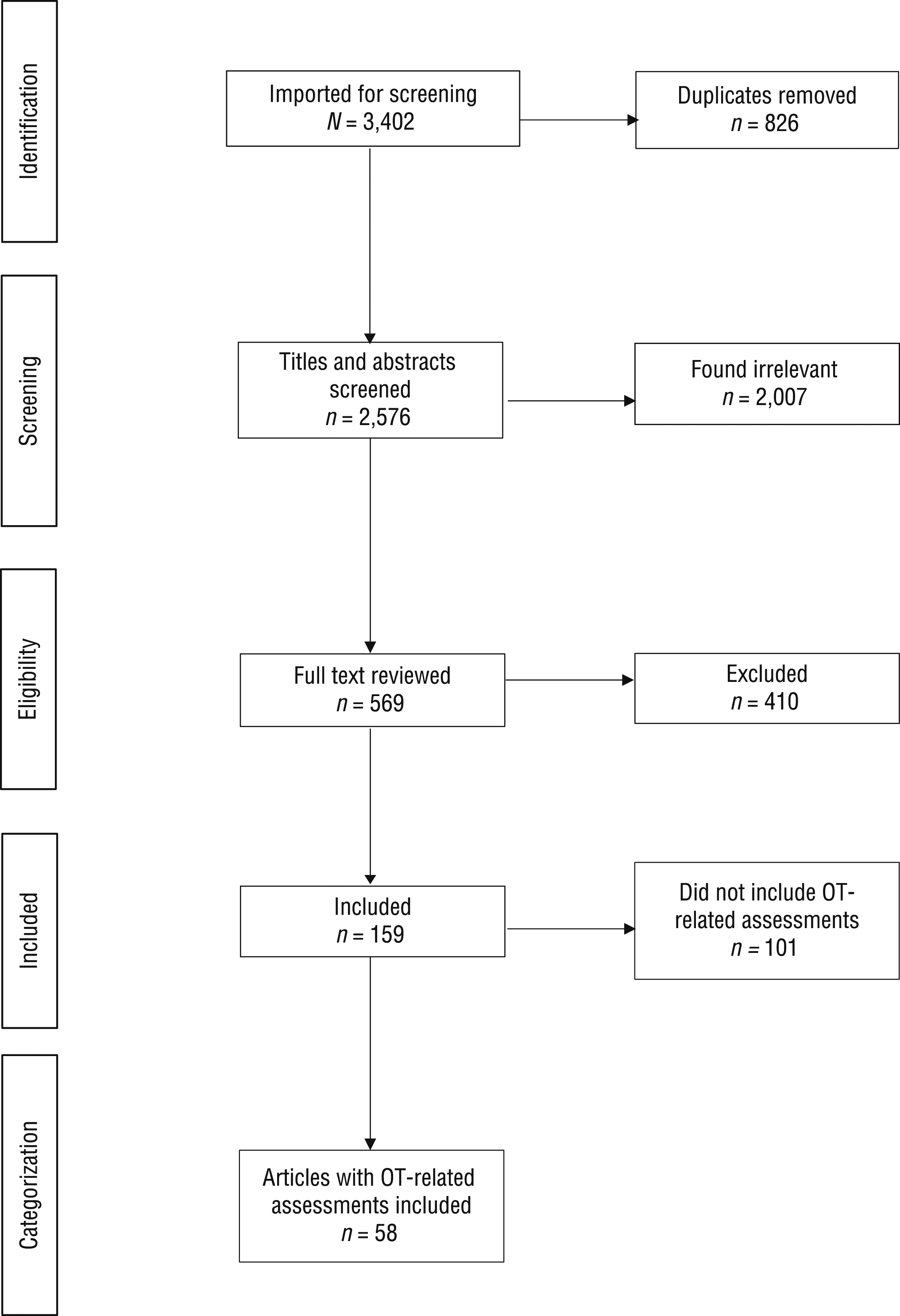
Flow diagram for inclusion and exclusion of studies in the scoping review.
Because this review focused on assessment, we reviewed all articles that used assessment or data collection strategies with adults with ID within the domain of occupational therapy, as defined by the Occupational Therapy Practice Framework: Domain and Process—Fourth Edition (AOTA, 2020). For example, IQ tests are often used with adults with ID, but they are not included in this review because, with the exception of adaptive behavior assessments, they are not in the occupational therapy domain. We reviewed each assessment strategy to determine its clinical relevance on the basis of our experience as occupational therapists who work with people with ID and came to a consensus about the inclusion of each tool. In addition to published assessment tools, we included research tools or strategies if they were sufficiently described in the article to allow for their application in clinical practice.
Step 5: Evaluate and Summarize Findings
We reviewed the extracted data and original articles to code assessment strategies in the articles according to the occupational therapy domain topic of each assessment. We used an iterative, inductive process and consensus discussions to develop the codes and determine the frequency of each code. We included codes for psychometrics and strategies to assess programs or groups in addition to domain topic codes. We sought additional information about assessment tools from online sources, articles, and manuals; this information is included in an assessment reference guide (Table A.1 in the Appendix).
Assessment Resource Guide for Occupational Therapy With Adults With Intellectual Disability
Note. ADLs = activities of daily living; AMPS = Assessment of Motor and Process Skills; DD = developmental disabilities; ESI = Evaluation of Social Interaction; FACT = Functional Assessment Compilation Tool; IADLs = instrumental activities of daily living; ID = intellectual disability; IDD = intellectual and developmental disabilities; OT = occupational therapy; QOL = quality of life.
Some pediatric assessments are designed for young adults up to age 22; OT practitioners should use clinical judgment to determine the appropriateness of these tools with adults older than this.
OT practitioners should use caution when selecting pediatric assessment tools for use with adults with ID if the intended age for the assessment does not extend into adulthood.
This assessment has an updated version that was not used in the article cited.
Results
The search yielded 58 articles with information on 73 distinct assessment tools for adults with ID within the domain of occupational therapy. Assessment tools appeared in the included articles primarily as research data collection tools or in examples illustrating their use with adults with ID. The assessment tools focused on occupational performance and participation, person factors, environmental factors, or all of these. Occupational performance and participation assessments evaluated ADLs, work, leisure, or multiple areas of occupation. Person factor assessments measured cognition and perception (i.e., mental functions), social skills, sensory processing, pain, and physical abilities. Environmental assessments focused on social support for adults with ID. In addition to individual assessment, some researchers used tools with group programs as an initial needs assessment or to evaluate program outcomes. Table A.1 includes a complete list of the assessments. Articles that focused on psychometrics of assessment tools are included in Table A.2.
Summary of Research Articles on Assessment Psychometrics
Note. ADLs = activities of daily living; AMPS = Assessment of Motor and Process Skills; BPI-01 = Behavior Problems Inventory (Korean version); CRA= Choking Risk Assessment; DD = developmental disability; ETUQ = Everyday Technology Use Questionnaire; FSTT = Functional Simulated Technology Tasks; IADLs = instrumental activities of daily living; ID = intellectual disability; IDA = Irena Daily Activity; IDD = intellectual and developmental disabilities; LOTCA = Loewenstein Occupational Therapy Cognitive Assessment; NCAPC = Noncommunicating adult pain checklist; NTUH PCE = National Taiwan University Hospital Physical Capacity Evaluation; OT = occupational therapist; PEDI-–PRO = Pediatric Evaluation of Disability Inventory–Patient Reported Outcome; PRA = Pneumonia Risk Assessment; PT = physical therapist; QOL = quality of life; RICSA = Revised Irrabeena Core Skills Assessment; VABS = Vineland Adaptive Behavior Scales.
Participation and Quality of Life
Seventeen assessment tools focused on participation of adults with ID across multiple occupations, including ADLs, community participation, and employment. These tools also assessed broad areas of self-determination and QOL (see Table A.1). Participation and QOL assessments, such as the Volitional Questionnaire (VQ) or Canadian Occupational Performance Measure, can inform occupational profiles and intervention planning or measure outcomes (de las Heras et al., 2007; Law et al., 2005; Mahoney et al., 2016; Mirza & Hammel, 2009). Although some of these assessments use self-report ratings by adults with ID or observation to understand their participation and QOL, the majority rely on caregiver report.
Some participation and QOL assessment tools were developed by professionals outside occupational therapy, but occupational therapy practitioners can use them to understand the strengths and needs of adults with ID. For example, the Supports Intensity Scale (Thompson et al., 2004) helps practitioners identify the current supports adults with ID have and their unmet support needs, information that is valuable to maximize participation in occupations (e.g., Dean et al., 2015). Similarly, adaptive behavior assessments, although designed to be diagnostic tools for ID, can also be used by occupational therapy practitioners to support intervention planning in ADLs, social participation, leisure, work, or other assessed areas (Table A.1; e.g., Berg et al., 2017).
QOL and self-determination assessments encompass many occupations and often involve a combination of self-report and family- or staff-report versions. Self-determination, an aspect of QOL, is an important consideration for adults with ID (Dean et al., 2015), and the Arc’s Self-Determination Scale was the tool most commonly identified in this scoping review to assess the level of control and choice-making that adults with ID have in their lives (Wehmeyer, 1995; e.g., Stock et al., 2011).
Activities of Daily Living
The most frequent assessment domain referenced in this scoping review was performance of ADLs and instrumental activities of daily living (IADLs). We found 24 distinct assessment tools for the domain of ADLs (Table 1). The most frequently cited tool was the Assessment of Motor and Process Skills (AMPS; Fisher & Bray Jones, 2012), an observation tool designed by occupational therapists to assess the quality of ADL and IADL performance in addition to motor and process skills (e.g., Fisher et al., 2017). Adaptive behavior assessments also provide insight into ADL performance of adults with ID, in addition to other domains (e.g., Berg et al., 2017). Although many ADL assessments cover multiple daily living occupations, some assessments target a specific ADL, such as power mobility use for people with severe or profound ID or safety issues with eating (e.g., Benford, 2017; Sheppard et al., 2017; see Table A.1).
Articles That Included Occupational Therapy–Related Assessments for Adults With ID
Note. See Appendix for complete reference list of assessment tools and included articles. ID = intellectual disability.
Total number of articles exceeds 58 total articles in review because some articles included multiple assessments.
Total number of assessments exceeds 73 because 3 assessments were coded in two categories.
Modifications to interviews about ADLs or other areas may be necessary to include adults with ID in the assessment process. Jurkowski and Paul-Ward (2007) used a photovoice process to enable adults with ID to share their views about health promotion. This adapted interview process, which can be used in clinical practice, involves providing a camera to adults with ID. Their photographs can be used to help them answer questions and as visual supports to aid the interview.
Another ADL assessment strategy used in the literature with adults with ID is Goal Attainment Scaling, a means of tracking progress during intervention and measuring outcomes (Kiresuk et al., 2014). Goal Attainment Scaling can be used to assess any occupation or other factor; in the literature on adults with ID, it was used to assess ADL performance (Benford, 2017; Urwin & Ballinger, 2005).
Work or Leisure
Seven assessments identified in this scoping review focused on vocational skills or work performance of adults with ID, and one tool was developed to measure leisure with young adults with ID (Table 1; Table A.1). Career planning tools that focus on individual preferences and skills may be common in secondary educational settings and are within the domain of occupational therapy. A review of career planning tools found five self-report or observation-based vocational tools appropriate for adults with ID (Murray et al., 2016). In a work setting, self-report tools can identify perceived supports and barriers at work. Observational tools, such as the Work Personality Profile, are also appropriate for identifying competence in specific vocational skills (Bolton & Neath, 2008; e.g., Liu et al., 2013).
Person Factors
Nineteen assessments identified in this scoping review concentrated on person factors of adults with ID (see Table A.1). Major areas for person factor assessments included cognition and perception, social skills, sensory processing, and other factors, such as physical abilities.
Cognitive Assessments
Seven cognitive assessments found in the literature can be used to understand the mental functions of an adult with ID. Jang, Chern, and Lin (2009) suggested that occupational therapy practitioners assess cognition of adults with ID in vocational and educational settings because it is a major influence on work and educational performance. Cognitive decline is a potential concern for older adults with ID, and the Dementia Screening Questionnaire for Individuals With Intellectual Disabilities can identify such decline (Deb et al., 2007; Naick, 2017).
Social Skills Assessments
Seven assessments detailed in the literature provide information on a person’s ability to interact socially, build social networks, and regulate emotions or behavior (see Table A.1). Challenging behavior was frequently part of social skills assessments for adults with ID, for whom self-injurious or aggressive behavior can significantly interfere with participation (e.g., Koritsas et al., 2008). The most common occupational therapy tools to assess social skills were observational tools of social interaction skills (e.g., Fisher et al., 2017).
Sensory and Other Person Factor Assessments
Two sensory assessments and three additional assessments addressed pain or motor abilities for adults with ID in the literature (see Table A.1). Occupational therapy–designed sensory tools included a self-report questionnaire that may need to be adapted or used as an interview with adults with ID and a caregiver or professional report intended for people with developmental disabilities (e.g., Urwin & Ballinger, 2005; see Table A.1). A pain assessment was developed for caregivers or health care providers to rate indicators of pain for adults with ID who have limited communication abilities (Lotan et al., 2009).
Social Support
Social support was the only environmental factor assessed in the articles in this review. Eight assessment tools describe social support provided by family members or others to adults with ID. The Supports Intensity Scale (Thompson et al., 2004), classified in this review as both a Participation and QOL tool and a Social Support tool, provides information about social support networks of people with ID and how this support affects their self-determination and occupational performance (e.g., Koritsas et al., 2008). Some social support assessment tools focus on caregiver stress, which affects the participation of adults with ID (e.g., Magill-Evans et al., 2011).
Program Assessment
A subset of authors used assessment tools to determine the need for a new program or to evaluate existing programs that support adults with ID. For example, Boland et al. (2008) included the interview tool they created on the basis of several published assessments to learn the perspectives of adults with ID and their caregivers. These interviews served as a needs assessment for health promotion programming. Liu et al. (2013) used two social skills assessments and a vocational assessment to evaluate the effectiveness of a work training program for adults with autism and ID that was designed by occupational therapists and implemented by rehabilitation assistants.
Psychometrics
Thirteen articles included in this review were research studies of the psychometric properties of 14 assessment tools for adults with ID (see Table A.2). These assessment tools were existing tools being tested to determine their appropriateness for adults with ID, adaptations or translations of existing tools, and new assessment tools. Authors found that existing tools, such as the AMPS, yielded valid scores with adults with ID (Fisher & Bray Jones, 2012; Kottorp et al., 2003b). In contrast, researchers found significant concerns with the interrater reliability of scores from the Revised Irrabeena Core Skills Assessment, an Australian tool designed for staff members to rate the daily living skills of adults with ID (McGregor, 2007; Milasinovic & Buchanan, 2013). New assessment tools included several designed for people with severe to profound ID, such as the Choking Risk Assessment and the Assessment of Learning Powered Mobility (Nilsson & Durkin, 2014; Nilsson et al., 2011; Sheppard et al., 2017).
Discussion
Occupational therapy practitioners may have varying levels of familiarity with the 73 assessment tools identified in this review, especially those created by other professionals. The assessment reference guide (Table A.1) can serve as a useful resource for occupational therapy practitioners working with adults with ID. This evidence-informed resource can assist occupational therapists in selecting appropriate assessments to use with adults with ID for initial assessment, progress monitoring, outcomes measurement, or program evaluation. Assessment processes that take a 360° view of the adult with ID, from the perspective of the individual, caregivers, and practitioners or support staff who know them well, may provide a more accurate picture of the person’s strengths, needs, and priorities, especially for those with limited communication.
Learning the perspective of clients is necessary for person-centered practice, and engaging adults with ID in inclusive assessment and planning processes can improve their self-determination, also an important factor for occupational therapy practice (Angell et al., 2019; AOTA, 2020; Wehmeyer & Abery, 2013). Occupational therapy practitioners may need to adapt structured self-report assessment tools or use other methods to enable adults with ID to share their perspectives and engage the person’s voice in the assessment and intervention planning process. Assessment modifications to elicit information from adults with ID include simplifying questions and using photographs (Boland et al., 2008; Jurkowski & Paul-Ward, 2007). Observation is another way to ascertain the perspectives of adults with ID, using a tool such as the VQ (de las Heras et al., 2007).
Structured observation is a valuable assessment method, especially for adults with severe or profound ID. For example, researchers used the VQ to rate observed levels of involvement in day program activities (Mahoney et al., 2016). Nilsson, Eklund, Nyberg, and Thulesius (2011) provided a structured observation chart that occupational therapy practitioners can adapt to assess adults with profound ID and their level of involvement in multiple occupations beyond the power wheelchair mobility for which it was designed.
Occupational therapists should also consider selecting outcome measures for adults with ID that are sensitive to small changes that may result from occupational therapy intervention. Researchers demonstrated how Goal Attainment Scaling for individualized goals, created with the client and potentially with caregivers, can be used to measure outcomes with the population (Benford, 2017; Urwin & Ballinger, 2005). The focus of outcome measures may need to be on participation and support needs rather than on person factors. Many adaptive behavior assessments emphasize participation in a variety of occupations and are appropriate for initial occupational therapy assessment; however, these diagnostic tools may not be sufficiently sensitive to change to be used as outcome measures for occupational therapy intervention (Bryze, 2020).
The AMPS, the most frequently cited assessment in this review, is an occupational therapy–designed tool appropriate for use with adults with ID that provides a structured way to observe and rate ADL performance (Fisher & Bray Jones, 2012). The formal certification process required before using the AMPS as a standardized assessment may be a barrier for some occupational therapy practitioners. Fisher and Marterella (2019), however, provided information about how to use the AMPS as a nonstandardized observation assessment.
Occupational therapy practitioners may also find themselves supporting adults with ID outside of direct service provision as consultants or program evaluators (Johnson et al., 2019). Some articles explicitly discussed assessment of groups of adults with ID, which can inform program evaluation. As more state health systems for adults with ID move toward value-based payment structures under the Patient Protection and Affordable Care Act (2010; Pub. L. 111-148), it is increasingly important that occupational therapy practitioners use assessment tools to measure program- and population-level outcomes (Blaskowitz et al., 2020). These articles also serve as examples of how research methods can inform clinical program evaluation (e.g., Mirza & Hammel, 2009).
This scoping review expands on existing occupational therapy research on assessment tools by focusing on adults with ID (e.g., Romli et al., 2019). Moreover, by including any tool within the occupational therapy domain, this study builds on a previous systematic review and literature reviews on assessment tools appropriate for people with ID that focused on specific occupations, such as career planning or community mobility (Murray et al., 2016; Stock et al., 2011). Although psychometrics research is important for evidence-based practice, this review demonstrates that research on the measurement properties of assessment tools is not the only research evidence that can inform assessment selection. Future research may explore the assessments used in occupational therapy practice with adults with ID, including how occupational therapy practitioners assess areas for which this review found no evidence, such as the physical environment.
Limitations
The primary limitation of this scoping review is that it may not have captured all articles with relevant assessment tools, especially because we did not conduct a hand search when the scope of literature found was more extensive than anticipated. For example, activity card sort assessments are appropriate for use with adults with ID, but none of the articles we located demonstrated their use with this population (Bryze, 2020). We also did not locate additional self-determination assessment tools for adults with ID (e.g., Abery et al., 2000; Wolman et al., 1994). The chief limitation of the scoping review methodology is that it does not include an assessment of the quality of evidence.
Implications for Occupational Therapy Practice
This scoping review has the following implications for occupational therapy practice:
Many assessment tools are appropriate for occupational therapy practitioners working with adults with ID, especially those created by other professionals that include areas important to occupational therapy, such as self-determination and social support. The assessment resource guide in Table A.1 provides information on tools for use with adults with ID that are within the scope of occupational therapy.
Person-centered occupational therapy evaluation and intervention planning with adults with ID must engage adults with ID, and this review provides examples of self-report tools, observation tools, and interview modifications to gather their perspectives and support self-determination.
Occupational therapy practitioners can use resources identified in this scoping review to inform assessment selection and monitor and evaluate outcomes for programs for adults with ID in addition to individual evaluation.
Conclusion
This scoping review identified a broad range of assessment tools within the occupational therapy domain that are appropriate for use with adults with ID. Occupational therapy practitioners may need to look beyond assessments created in occupational therapy to incorporate areas essential for people with ID, such as self-determination and social support. In addition, occupational therapy practitioners need to modify assessment processes or select tools to ensure that the perspectives of adults with ID are reflected in the occupational therapy process.
Supplemental Materials
Supplementary material for Occupational Therapy–Related Assessments for Adults With Intellectual Disability: A Scoping Review
Supplementary material, sj-docx-1-aot-10.5014_ajot.2021.046342.docx for Occupational Therapy–Related Assessments for Adults With Intellectual Disability: A Scoping Review by Wanda J. Mahoney, Meghan G. Blaskowitz and Khalilah R. Johnson in The American Journal of Occupational Therapy
Supplementary material for Occupational Therapy–Related Assessments for Adults With Intellectual Disability: A Scoping Review
Supplementary material, sj-docx-2-aot-10.5014_ajot.2021.046342.docx for Occupational Therapy–Related Assessments for Adults With Intellectual Disability: A Scoping Review by Wanda J. Mahoney, Meghan G. Blaskowitz and Khalilah R. Johnson in The American Journal of Occupational Therapy
Footnotes
Acknowledgments
We thank David Nolfi, Head Librarian for Research Engagement, Health Sciences/STEM Initiatives, and Assessment, and Ted Bergfelt, Librarian at Duquesne University, for their methodological consultation and support in establishing and implementing search strategies for this scoping review. We also acknowledge the research assistance of occupational therapy students Rebecca Batchelor from the University of North Carolina at Chapel Hill, Lindsey Wethington from Washington University in St. Louis, and Emily Casile and Amy Castagnino from Duquesne University.
*
Indicates articles included in this scoping review.
References
Supplementary Material
Please find the following supplemental material available below.
For Open Access articles published under a Creative Commons License, all supplemental material carries the same license as the article it is associated with.
For non-Open Access articles published, all supplemental material carries a non-exclusive license, and permission requests for re-use of supplemental material or any part of supplemental material shall be sent directly to the copyright owner as specified in the copyright notice associated with the article.
