





Abstract
Understanding associations between fathers’ own playfulness and supportiveness during joint play and their child’s playfulness with fathers’ perceptions of this experience can further enhance service delivery to children and families through interprofessional work to benefit parent–child relationships as well as child development.
Play is a central and fundamental area of occupation in children’s lives, and it significantly contributes to their overall development (e.g., Skard & Bundy, 2008; Waldman-Levi & Bundy, 2016). Joint play is an enjoyable experience in which both partners share physical space and objects, ideas, intentions, and emotions while interacting (Pickens & Pizur-Barnekow, 2009; Waldman-Levi & Bundy, 2016; Waldman-Levi, Finzi-Dottan, & Cope, 2019). The parent’s role during play is to support their child’s engagement, exploration, and enjoyment in a playful manner. Joint play is shaped by the ways in which the parent responds to their child. Parents’ responses are guided by their capacity to identify and interpret their child’s behavior and needs (Borelli et al., 2017; Slade, 2007). Occupational therapy practitioners working with families recognize the centrality and importance of all forms of play for children’s growth and development (Waldman-Levi & Bundy, 2016). To provide family- and child-centered care, it is essential that occupational therapy practitioners understand children’s experiences of joint play with their parents. Although most of the literature on parent–child relations has focused on mothers, current research has suggested that fathers’ engagement in caregiving and play has a significant impact on child development (Cabrera et al., 2017; Jones & Mosher, 2013). However, inconsistencies and gaps in knowledge exist with respect to the type of play fathers engage in and their perception of the role they play as partners in promoting child playfulness (MajdandžIć, 2017; Menashe-Grinberg & Atzaba-Poria, 2017). In addition, the majority of studies have used solely quantitative methods in their analysis of questionnaires or observations and have not included qualitative methods, which would support an understanding of fathers’ perceptions of what guides the way they play with their children (e.g., Gregory et al., 2019; StGeorge et al., 2015).
Child and parent playfulness and the manifestation of play behavior or its quality have become the focus of much research (Menashe-Grinberg & Atzaba-Poria, 2017; Waldman-Levi & Bundy, 2016; Waldman-Levi, Finzi-Dottan, & Cope, 2019; Waldman-Levi, Grinion, & Olson, 2019). Playful interactions are cheerful and purpose driven and can calm a distressed child or ease transitions between activities (Cabrera et al., 2017; Lindsey et al., 2010). Maternal and paternal playfulness make unique contributions to children’s emotional regulation and reduced negativity above and beyond parental sensitivity and structuring (Menashe-Grinberg & Atzaba-Poria, 2017). Parents’ gender, culture, and personality influence how they play and interact with their children (Lindsey et al., 2013; Menashe-Grinberg & Atzaba-Poria, 2017; Popp & Thomsen, 2017). Menashe-Grinberg and Atzaba-Poria (2017) and John et al. (2013) found that although mothers and fathers do not differ in the extent of playfulness exhibited during play interactions, they differ in the type of play they engage in.
Fathers tend to engage their children in rough- and-tumble play, a physical playful activity in which partners wrestle, jump, tumble, run, and hit one another (Fletcher et al., 2013). Popp and Thomsen (2017) suggested that the excitement and arousal of the interaction in rough-and-tumble play may be a mechanism that influences the father–child relationship and supports the development of self-regulation skills. John et al. (2013) reported that during joint play, fathers provided their children with opportunities to lead, displayed peerlike behaviors, and challenged their children. Father–child play has been associated with children’s ability to regulate their own level of stimulation, manage emotions, and reduce unwanted behaviors (Gregory et al., 2019; Lindsey et al., 2010, 2013). Fathers who engaged in more rough-and- tumble play had children with fewer behavioral problems (Fletcher et al., 2013; Paquette & Dumont, 2013). Fathers’ continuous engagement throughout their child’s development predicts a range of positive developmental outcomes (Caughy et al., 2020; Sethna et al., 2017).
Although a few studies have focused on fathers’ playfulness (e.g., Paquette & Dumont, 2013; Sethna et al., 2017; StGeorge et al., 2015), there is a dearth of research examining how fathers’ own playfulness and behavior during joint play are shaped by their perceptions of the experience. Therefore, in this mixed-methods study we focused on the associations between fathers’ own playfulness and their support of their child’s playfulness. We further examined whether fathers’ support of their children’s playfulness predicted the children’s level of playfulness in the context of joint play in the home environment. In addition, we explored fathers’ perceptions of play experiences. Acknowledging that neither quantitative nor qualitative methods are exclusively sufficient to capture the father–child joint play experience, we designed a mixed-methods convergent approach. The assumption underlying the use of a mixed-methods approach in research is that quantitative and qualitative methods complement each other and may lead to a more comprehensive understanding of the research problem (Creswell & Plano-Clark, 2018). The following research questions were set forth with respect to the quantitative and qualitative methods: Will fathers’ own playfulness be associated with how they support their child’s playfulness, and will their supportive behavior predict their child’s playfulness? What are fathers’ perceptions concerning play? How can fathers’ perceptions inform observations of the joint play experience with respect to their supportiveness of their child’s playfulness?
Method
This mixed-methods study was granted approval by Long Island University’s institutional review board.
Design
A convergent mixed-methods design was implemented, following four distinct steps, as shown in Figure 1. The quantitative and qualitative methods were used at the same time and with equal emphasis (see Figure 1, Steps 1 and 2). The separate methods of analysis allowed us to answer the quantitative and qualitative research questions (see Step 2). In Step 3, we compared the data to better understand the phenomenon while answering the third research question. Last, in Step 4, we interpreted the merged findings while validating one set of findings with the other (Creswell & Plano Clark, 2018).
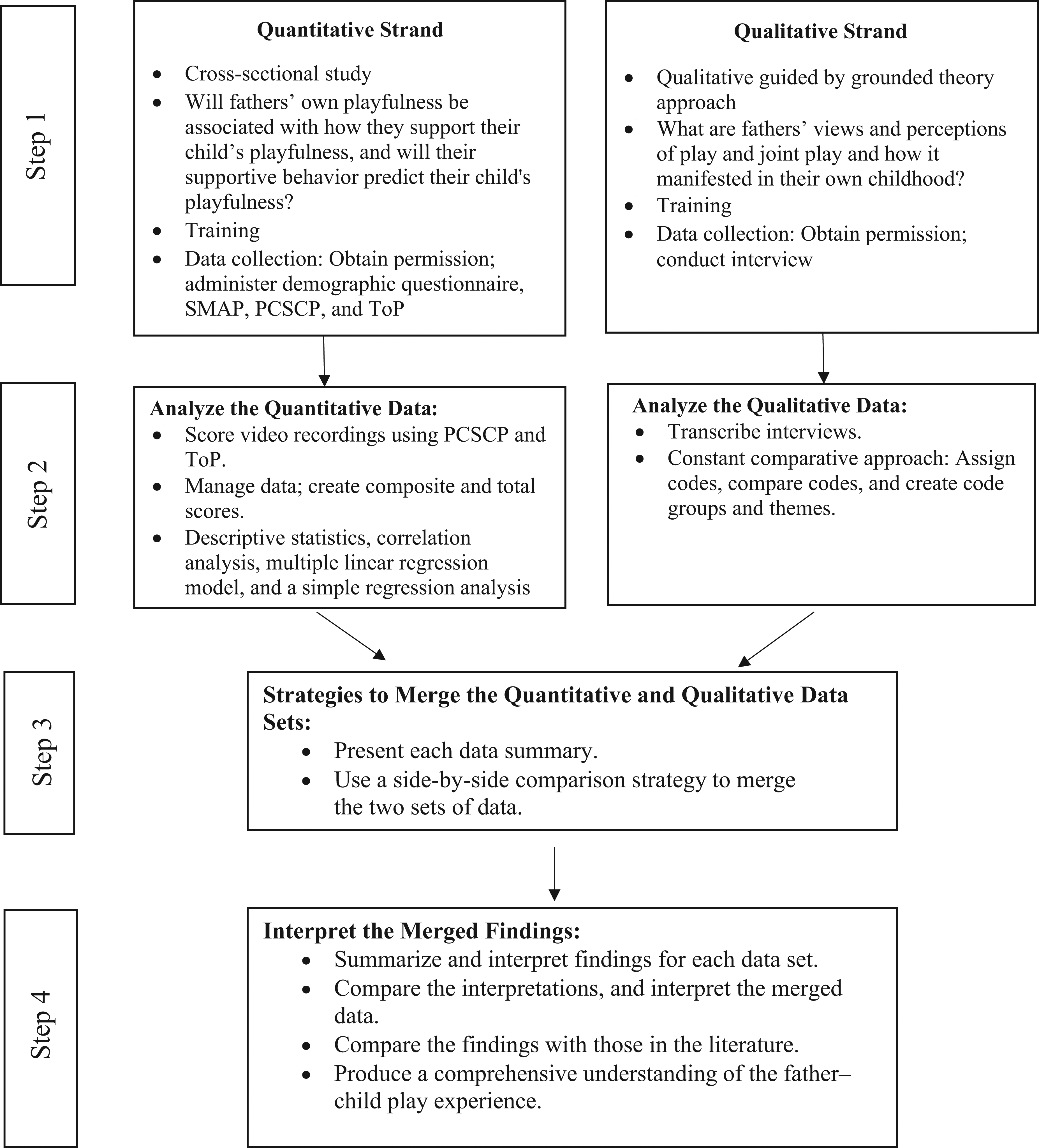
Flowchart of the implementation of the convergent mixed-methods design.
Participant Selection
A convenience sampling method was used to recruit father–child dyads living in a metropolitan area, based on acquaintance with families who met the following inclusion criteria: (1) children had no known diagnosis; (2) children and fathers had no major sensory deficits; (3) children were between ages 12 mo and 5 yr; (4) fathers understood written and spoken English; and (5) in cases in which a parent had more than one child in the specified age range, the oldest of them was recruited for this study.
Data Collection
Quantitative
We contacted families who we knew met the study’s inclusion criteria and scheduled a time for a home visit. First, each father’s informed consent and each child’s assent was obtained, and then the father was asked to complete the demographic questionnaire. Each father–child dyad was then invited to play as they typically would, for 15 min, while data were collected by video recording the session with a portable video camera. This allowed for further analysis of playfulness using the Parent/Caregiver’s Support of Child’s Playfulness (PCSCP; Waldman-Levi & Bundy, 2016) and the Test of Playfulness (ToP; Skard & Bundy, 2008). The fathers then completed the Short Measure of Adult Playfulness (SMAP; Proyer, 2012).
Qualitative
Immediately after the joint play period, the coinvestigator (an occupational therapy graduate student) engaged the father in a semistructured audio-recorded interview that lasted 10 to 20 min.
Measures
Test of Playfulness
The ToP is a standardized observation tool for use with infants, children, and adolescents ages 6 mo to 18 yr. Scores are based on 15-min observations in familiar play settings. It views a child’s playfulness as indicated by the tendency to be involved in play activity. The ToP consists of 29 items that represent four core concepts: intrinsic motivation, internal control, freedom from unnecessary constraints of reality, and framing. The items are scored on a 4-point scale ranging from 0 (low frequency of the behavior, low intensity, or unskilled) to 3 (high frequency of the behavior, high intensity, or skillful) with respect to extent (proportion of time), intensity, or skillfulness; thus, a high score on the ToP indicates greater child playfulness. The ToP has sound psychometric properties based on an array of studies with typically developing children and children with disabilities and is available in the public domain (Skard & Bundy, 2008). The ToP was used to score the child’s playfulness while viewing the 15-min video recording.
Parent/Caregiver Support of Child’s Playfulness
The PCSCP is an assessment tool that is used to measure parents’ support of the playful behavior of their child ages 6 mo to 11 yr. It is scored on the basis of observation in a 15-min familiar play setting. The PCSCP contains 27 items, which are scored on two different scales, Quality and Frequency, which range from 1 (low) to 3 (high). The Quality scale consists of 17 items reflecting the quality of the behaviors that were observed, and the Frequency scale consists of 10 items reflecting the frequency of the observed behaviors. The PCSCP has two factors: (1) Flow, consisting of 9 items assessing support of the child’s continued engagement, and (2) Creative, consisting of 6 items assessing support of child’s creativity during play. The PCSCP has excellent preliminary internal consistency and acceptable interrater reliability, and it is correlated with other measures assessing parental behaviors, thus supporting its criterion validity (Waldman-Levi, Finzi-Dottan, & Cope, 2019; Waldman-Levi, Grinion, & Olson, 2019). The PCSCP was used to score fathers’ supportiveness while viewing the 15-min video recording.
Short Measure of Adult Playfulness
The SMAP is a self-report measure that assesses an adult’s playfulness tendency. It contains five items or questions that are rated on a 7-point scale ranging from 1 (strongly disagree) to 7 (strongly agree). The SMAP has high test–retest reliability and high convergent validity (Proyer, 2012). Fathers completed the SMAP after the joint play experience.
Semistructured Interviews
A semistructured interview with a set of open-ended questions was used to explore each father’s perceptions of play. The questions explored the play experience during the home visit, how it compared with typical father–child play experiences, and how it compared with the child’s play with their mother. It also offered the opportunity for fathers to share their own childhood experience of play.
Analytic Strategy
We used separate analytic strategies for the quantitative and qualitative data (see Figure 1, Step 2).
Quantitative
The average score on each measure (PCSCP Total, Quality, and Frequency scales and Flow and Creative factors; ToP Total, Extent, Intensity, and Skillfulness scales) was used. Father’s age and level of education and child’s age and gender were examined as possible confounding variables using Pearson correlation analysis and an independent-samples t test. The SMAP analysis followed Proyer’s (2012) guidelines using the average score for the five items. To answer the first quantitative research question, we used IBM SPSS Statistics (Version 26) to perform descriptive Pearson correlation analysis, independent t tests, and multiple linear and simple linear regressions (p < .05).
Qualitative
The audio-recorded interviews were transcribed verbatim, then uploaded to ATLAS.ti (Version 8) to manage interview transcripts, codes, code groups, and themes. The constant comparative method was used. First, we assigned meaning (codes) to the father’s responses, then moved iteratively between codes and text in order to group codes into larger units of meaning, referred to as code groups. Next, the code groups were compared on the basis of similarities and differences and organized into a larger and more abstract level of meaning (themes; Creswell & Poth, 2018).
Methodological Integrity
At the beginning of the study, each investigator received training for the tasks for which they were responsible (i.e., data collection and interview, scoring the PCSCP or ToP, transcribing interviews).
Quantitative
Three research assistants received training from Amiya Waldman-Levi in observing and scoring the video- recorded observations with the PCSCP and ToP. Interrater reliability was calculated as the level of agreement in scoring between two experienced and trained raters for the PCSCP and the ToP separately. Twenty percent of the video-recorded observations were used to calculate interrater reliability. The PCSCP and ToP were found to have satisfactory interrater reliability, with the level of agreement between the two raters ranging from 82% to 100% and 77% to 97%, respectively.
Qualitative
The training was conducted by Waldman-Levi and Amber Cope and included guidance and role-playing the data collection tasks and transcribing interviews. Two separate teams of occupational therapy graduate students were involved; one team collected the data during the home visits, and the second team transcribed the interviews.
While analyzing the data, we used different methods to guard against bias. For example, we created an audit trail through the use of management software (ATLAS.ti) to analyze and organize data and then checked the inductive process against the transcripts (see Figure 1, Step 2).
Results
Quantitative Findings
Demographic Characteristics
The sample consisted of 57 typically developing children and their fathers. Fathers were predominantly Caucasian (84%) and married (90%), with a mean of 17 yr (SD = 2.5) of education (college education) and a mean age of 33.3 yr (SD = 6.8). Children’s mean age was 36 mo (SD = 11.9; range = 22–60 mo); 25 were boys (44%) and 32 were girls (56%; Table 1). Father’s level of education was not statistically associated with the support he provided his child during joint play or with the child’s playfulness (rs = .10 and .00, ps = .57 and .10, respectively). Father’s age had a negative and low association with the support he provided his child during joint play (r = −.30, p = .04), but not with the child’s playfulness (r = .01, p = .93). This means that the older the father was, the less he supported his child’s playfulness, but an older father’s child was not necessarily more or less playful than other children. Child’s age was positively and moderately associated with how playful he or she was (r = .49, p = .00), but not with father’s supportiveness (r = .20, p = .15). This means the older the child was, the more playful they were.
Demographic Characteristics of the Sample
Note. N = 57 children and fathers.
Data are missing for 9 cases.
Data are missing for 2 cases.
Data are missing for 5 cases.
Fathers’ Own Playfulness and Support of Their Child’s Playfulness
Although fathers perceived themselves as playful (SMAP scores; Table 2) and moderately supported their child’s playfulness (PCSCP scores), their support for creativity during play was relatively low (M score on the PCSCP Creative factor = 1.52, on a scale ranging from 0 to 3). Their children were rated as mildly playful (see Table 2). Examination of joint play through PCSCP and ToP scores revealed significant and positive low to moderate associations between a father’s PCSCP Total, Quality, Frequency, and Flow factor scores and ToP Total, Extent, and Skillfulness scores. The frequency of father support had significant, positive, and moderate associations with ToP Total and Skillfulness scores (see Table 3). Fathers’ own playfulness did not correlate with their child’s playfulness (r = −.00, p = .10). An analysis was conducted to determine whether father’s support and child’s playfulness differed between father–daughter and father–son dyads. The results of the independent t tests showed that there were no significant gender-related differences in father’s supportiveness, t(53) = 0.45, p = .65, or in child’s playfulness, t(54) = −0.98, p = .33.
Father Support of Child Playfulness and Playfulness Tendency, Child’s Playfulness
Note. N = 57. PCSCP = Parent/Caregiver’s Support of Child’s Playfulness; SMAP = Short Measure of Adult Playfulness; ToP = Test of Playfulness.
Associations Between Father Support of Child Playfulness and Child’s Playfulness
Note. N = 57. PCSCP = Parent/Caregiver’s Support of Child’s Playfulness; ToP = Test of Playfulness.
p < .05.
p < .01.
Predicting Child’s Playfulness
A multiple linear regression was carried out to investigate whether father’s supportiveness and age significantly predicted child’s playfulness (outcome). The results of the regression indicated that the model explained 11.4% of the variance and showed a trend toward significance in predicting child’s playfulness, F(2, 47) = 3.03, p = .058. Although father’s support contributed significantly to the model (Β = 0.367, p = .02), father’s age did not (Β = 0.006, p = .47). Next, a simple linear regression was carried out with father’s support as the predictor of child’s playfulness (outcome). The results of the regression indicated that the model explained 11% of the variance, indicating that the model was a significant predictor of child’s playfulness, F(1, 53) = 6.50, p = .02. Father’s supportiveness contributed significantly to child’s playfulness (B = 0.330, p = .01).
Qualitative Findings
Demographic Characteristics
As a result of several technical challenges, we had a smaller sample of 11 interviews available for analysis. Overall, the characteristics of this subsample of fathers was comparable to the quantitative sample characteristics, with an average level of education of 18 yr (SD = 3.46) and an average age of 33.4 yr (SD = 5.9). All were Caucasian; 9 were married (82%), 1 was single (9%), and 1 had missing data. Their children’s age average was 33.4 mo (SD = 5.93); 4 were boys (36.4%), and 7 were girls (63.6%).
Fathers’ Perception of Play
Four themes were found to capture the father’s perception of joint play: (1) relationship and interpersonal skills, (2) father’s play history, (3) observations about joint play, and (4) spousal differences in play style (see Supplemental Figure A.1, available online with this article at https://research.aota.org/ajot).
In the first theme, fathers described play as an opportunity to build and sustain their relationship with their child: “It helps the child feel loved, and you’re interested in what they are doing. To be honest, sometimes you could go crazy doing the same things over and over again, but to them, it’s occupying their whole world.” Another father shared, “It’s important because it builds a relationship. I want her to understand that I’m here for her; I’ll always be here for her.” Fathers saw the play as beneficial for interpersonal skill development. “Well, while you’re playing with them, you’re teaching them as you’re going, what’s right, what’s wrong, how to play with other people.”
The second theme reflected fathers’ joint play with their siblings or extended family rather than with their father. One father reported that his father did not engage in play interaction with him: “He was very standoffish, like, ‘Here’s a box of Legos, go figure it out.’” He continued, explaining how he used to play with extended family members but not with his own father: “If I got together with family, then I would have somebody to play with.” Another father reported, “For the most part, it was me with a toy that I could build or break by myself. . . . I was definitely on my own.” Although fathers consistently reported a lack of play with their fathers in childhood, some attempted to make sense of this upon reflection: “My father wasn’t such a person to get down on the floor and play with his kid. Every father is different; everyone has their own view on it.” Fathers remembered other ways they interacted with their own fathers, for example, “He would school me and teach me things, but my father wasn’t the type to throw a football with me, or ride a bike with me.”
The third theme encompasses fathers’ observations of joint play experiences. One father described his observation of his daughter playing and what he expected of her; continuing to describe how she actually played: “We have puzzle games where she is supposed to be putting animals together. She would rather pile it up and build buildings with them.” Fathers picked up on the complexities of their child’s play preferences: “It definitely depends on her mood. It’s hard to really say that she has a favorite.” Fathers shared how play changes when their child is alone versus with them or any other play partner: “When I’m not playing with her, she’s even more into her imagination.” When fathers were involved in the play, they found they had an enjoyable effect on their child. One noticed, “I was laughing, he was excited, and the energy level just rose from there. When I start to laugh, he starts to laugh and anything goes, for that matter.”
The last theme captures how fathers compared their joint play style with their child’s mother’s style. One distinction was the increased role of education and teaching in their child’s mother’s play style compared with their own. Another common difference was that their joint play was more physical than the mother’s play. One father described how playing with a ball changes between spouses, implying he is more physical in his approach to playing: “My wife also plays active games with her, just not like the way I would do it. Maybe, she would play with a ball inside the house but she’ll roll it instead of throwing it.” Fathers also reflected on dispositional differences: “I’m the joker, she’s [his wife] the serious one.” One father went further to highlight how their child behaves in response: “She [the mother] has her demeanor so he knows not to get out of line with her. I like to laugh at what he does so he’ll see this as an opportunity to continue doing what he’s doing.”
Fathers’ Supportive Remarks About Joint Play
In the third step of the mixed-methods convergent design, the two sets of results were compared to draw a connection between how fathers’ supportiveness of their child’s playfulness resonated with their perceptions of joint play. Fathers who described themselves as playful stated a desire to incorporate their own early positive experiences into their child’s life: “It’s nice to be able to carry it over like that and play with my children, like the same way they’re able to figure stuff out by themselves and learn how to build things.” A father’s supportiveness and perception of the joint play experience was associated with child playfulness. “When I start to laugh, he starts to laugh, and then anything goes, for that matter.” Fathers also described how they need to adjust to the child’s abilities or interests: “Sometimes he holds his attention for a long time. Other times, he’s very quick, and you have to change and adapt on the fly.”
Discussion
In this study, we explored fathers’ perception of their play experiences and how these experiences may have shaped joint play experiences with their child. Previous studies have shown that a father’s behavior and involvement during play contribute to children’s social–emotional, cognitive, and linguistic development (e.g., Cabrera et al., 2017; Lindsey et al., 2010).
A comparison of our results on fathers’ supportiveness with the results of a previous study (Waldman-Levi, 2021) revealed that fathers tend to show lower levels of support than mothers. Although children’s playfulness with fathers was lower than their playfulness with mothers (Waldman-Levi, Grinion, & Olson, 2019), these differences were not significant (Waldman-Levi, 2021). In the current study, ToP Total, Extent, and Skillfulness showed correlations of greater magnitude with the PCSCP Flow factor. ToP core concepts and the Flow factor consisted of more items, which could lead to correlations of greater magnitude. As measured by the PCSCP, a father’s support of his child’s playfulness predicted how playful the child was regardless of the child’s gender and the father’s level of education. Although fathers reported that they were playful people on the SMAP as well as in the interview, this was not associated with their behavior or their children’s behavior during the observed joint play experience.
This lack of association could have several explanations. When fathers reflected on the lack of joint play during their own childhood, they also shared their appreciation for being able to play with their child and how they invested themselves in joint play. Perhaps the ability to self-reflect on their own childhood play experiences affected their interactions with their child; although they demonstrated less playfulness or mischievousness, they nonetheless remained engaged and supportive (Borelli et al., 2017; Slade, 2007). It could also be that the presence of an observer had an impact on fathers’ demonstration of playful behavior. By conducting this study in the family home environment, guiding dyads to play the way they usually do, this study’s findings illustrate that parental support has a positive influence on children’s behavior (Lindsey et al., 2010; Menashe-Grinberg & Atzaba-Poria, 2017; Popp & Thomsen, 2017).
Parents’ ability to reflect on their own thoughts, experiences, and actions guides their actual behavior and contributes to their relationship with their child (Borelli et al., 2017; Slade et al., 2005). Parental reflective capacity is a significant predictor of a child’s social– emotional development, especially in the context of joint play (Waldman-Levi, Grinion, & Olson, 2019). By reflecting on their own childhood experiences, they are better aware of their influence on their child’s experiences and development. Occupational therapy practitioners can use this study’s findings to enhance their service delivery while working with families, engage in conversation to better understand parents’ perceptions and experiences, and observe joint play in different contexts. An explicit effort to understand parents’ and children’s behaviors and perceptions can pave the way for interprofessional work with family therapists, psychologists, and social workers.
Limitations and Future Research
A convergent mixed-methods design provides a rich and comprehensive understanding of the phenomena under investigation; however, there are a few challenges in using this design (Creswell & Plano-Clark, 2018), for instance, different sample sizes. One of the limitations of this study relates to the convenience sampling method used and the sample characteristics of the fathers, who were predominantly Caucasian and married and had a college-level of education, and that the children were firstborn. Future research should include families of different sociodemographic backgrounds as well as children with disabilities. Last, the presence of an observer may have affected how fathers interacted with their child. In future studies, the interviewer could begin the interview before the play experience to establish rapport, then view the video footage with the father to probe their memory and reflective capacity.
Implications for Occupational Therapy Practice
The findings of this study have the following implications for occupational therapy practice: Occupational therapy practitioners may use these findings to guide their practice while promoting play and appreciating paternal views as unique and essential for children’s engagement in play. Understanding parents’ perceptions and experiences can enhance service delivery to children and families through interprofessional work.
Conclusion
This study used a convergent mixed-methods design to better understand how fathers’ own playfulness, supportive behavior, and child’s playfulness connect with their perceptions of play and joint play experience. Fathers’ appreciation of play and joint play may enable them to support their child’s playfulness. The convergence of the two analyzed sets of data, quantitative and qualitative, yielded a multidimensional understanding of the joint play experience. The current study offers insight into how a father’s support predicts a child’s playfulness behavior. Fathers’ reflections on their past and current joint play experiences illustrate how thoughts, perceptions, and values guide their behaviors.
Supplemental Material
Supplementary material for Understanding Father–Child Joint Play Experience Using a Convergent Mixed-Methods Design
Supplementary material, sj-pdf-1-aot-10.5014_ajot.2022.046573.pdf for Understanding Father–Child Joint Play Experience Using a Convergent Mixed-Methods Design by Amiya Waldman-Levi, Amber Cope and Laurette Olson in The American Journal of Occupational Therapy
Footnotes
Acknowledgments
The data supporting this study’s findings are available on request from Amiya Waldman-Levi. The data are not publicly available because they contain information that could compromise the privacy of research participants. We report no potential conflicts of interests. We express our sincere appreciation to the fathers and their children who willingly volunteered to participate in this study. We are thankful to our students from the Department of Occupational Therapy, Long Island University– Brooklyn who assisted us in data collection.
References
Supplementary Material
Please find the following supplemental material available below.
For Open Access articles published under a Creative Commons License, all supplemental material carries the same license as the article it is associated with.
For non-Open Access articles published, all supplemental material carries a non-exclusive license, and permission requests for re-use of supplemental material or any part of supplemental material shall be sent directly to the copyright owner as specified in the copyright notice associated with the article.
