





Abstract
The Sensory Experiences Questionnaire Version 2.1., Short Form, can be used to assess the three broad patterns of sensory responsiveness among the general population of young children.
Although atypical sensory features that occur among clinical populations, such as children with autism spectrum disorder (ASD; Baranek et al., 2019; Gourley et al., 2013; Lane et al., 2010; Tomchek & Dunn, 2007) or other developmental disorders (DD; Reynolds & Lane, 2009), have received much attention in research, less is known about sensory features or patterns that occur among typically developing (TD) children. Understanding sensory functioning in a community sample of young children can shed light on the etiology of sensory behaviors and their development and serve as a critical benchmark for determining atypical sensory features. The aim of the current study was to examine the sensory features of children age 3 yr from a large community sample using the Sensory Experiences Questionnaire (Version 2.1, Short Form; SEQv2.1), which is a caregiver-report tool designed to assess children’s sensory experience in everyday situations.
Although terms in the literature vary to some degree, sensory symptoms across modalities (e.g., visual, auditory, tactile) are frequently categorized into three major patterns of sensory response: hyperresponsiveness (HYPER); hyporesponsiveness (HYPO); and sensory interests, repetitions, and seeking behaviors (SIRS; Ausderau et al., 2014 ; Kirby et al., 2019; Miller et al., 2007). HYPER refers to an overreactive or exaggerated response to sensory stimuli, which can be observed in children’s avoidant, aversive, and negative affective behaviors in response to stimuli. HYPO is characterized by children’s underreactivity and extremely low level of response to sensory stimuli, such as a delayed reaction to or lack of awareness of touch, pain, sound, and other modalities. Finally, SIRS refers to a pattern in which children enjoy and show interest in or craving for intense sensations that are repeated (Ausderau et al., 2014). These sensory patterns are not mutually exclusive and may co-occur within individuals (Baranek et al., 2006; Ben-Sasson et al., 2007).
Beyond clinical groups, sensory features have been reported in the general population in the context of everyday activities, although many of these studies are based on smaller samples of young children and mainly have compared sensory features of TD children as a reference group with those of other groups (e.g., Dunn & Bennett, 2002). According to one study with a larger community sample (N = 703), approximately 13.7% (n = 96) of kindergarteners met the criteria for a sensory processing disorder (Ahn et al., 2004). High rates of sensory issues in the community have led some researchers to suggest that sensory processing may involve a dynamic interaction between the continuum of children’s neurological thresholds and behavioral responses that result in individual differences (Dunn, 1997; Dunn & Daniels, 2002). In line with this view, studies have consistently demonstrated that levels of atypical or extreme sensory features are generally lower among TD or low-risk samples than among groups with ASD or DD (Baranek et al., 2006; Ben-Sasson et al., 2007; Dunn & Daniels, 2002). In an epidemiological study of 8-yr-old children, for example, the prevalence of sensory atypicalities (as reported by parents on a background information form) was 53.6% among children with ASD (15 of 28 children) versus 8.0% overall (352 of 4,397 children; Jussila et al., 2020).
Despite evidence of differences in sensory features between TD and ASD groups, however, it is not clear whether such differences reflect distinct sensory structures or dimensions for each group or differences in degrees or levels of intensity and frequency along a continuum of sensory functioning and experience. To date, although the sensory constructs HYPER, HYPO, and SIRS have been validated among children with ASD or DD and among those without disabilities (Ausderau et al., 2014; Baranek et al., 2006), these sensory constructs have not yet been examined as a central research focus with a large amount of cross-sectional data from a community sample of preschoolers.
In the current study, we tested a proposed structure of sensory features in a large community sample of preschoolers using the SEQv2.1 (Baranek, 1999). We hypothesized that the three patterns of sensory response (i.e., HYPO, HYPER, SIRS) previously validated in clinical groups would also be validated in a large community sample.
Method
As a part of a larger prospective study of children’s development, a community sample of caregivers was initially recruited from North Carolina's state birth registry when their infants were ages 6 to 16 mo and asked whether they wanted to be contacted for future follow-up studies. Latinx families were excluded from recruitment mailings because at the time of the study the survey instruments were not available in Spanish. Caregivers who gave permission were recontacted to solicit their participation in the current study. Recruitment was done via email, and caregivers were asked to complete a follow-up Qualtrics survey, which included SEQ 2.1 items, when their child reached age 3 yr. The surveys were also available in paper format for those parents who requested it. Approximately 34% of the parents who were recontacted participated in the study. The study protocols were approved by the University of North Carolina at Chapel Hill’s institutional review board.
Participants
The participants were 2,205 caregivers of children ages 3 yr to 3 yr, 11 mo (M = 41.89 mo, SD = 3.85; see Table 1). Ten participants who were missing responses to more than two SEQv2.1 items were excluded from the analysis, making the final sample size 2,195.
Children’s Demographic Characteristics
Note. N = 2,205. Percentages may not total 100 because of rounding. HYPER = hyperresponsiveness; HYPO = hyporesponsiveness; SEQv2.1 = Sensory Experiences Questionnaire (Version 2.1, Short Form); SIRS = sensory interests, repetitions, and seeking behaviors.
Measures
The SEQv2.1 (Baranek, 1999; Baranek et al., 2006) is a 43-item caregiver-report questionnaire designed to assess the sensory responsiveness of children ages 5 mo to 12 yr. Items encompass five modalities, as well as social and nonsocial contexts. The items are organized into three sensory response patterns—HYPER, HYPO, and SIRS—and are rated on a 5-point scale: 1 (almost never), 2 (once in a while), 3 (sometimes), 4 (frequently), and 5 (almost always). The SEQv2.1 has good internal consistency (α = .80) and test–retest reliability (intraclass correlation coefficient = .92; Little et al., 2011; Patten et al., 2013). It has been used in studies of both high-risk infants (Grzadzinski et al., 2020; Wolff et al., 2018) and children ages 2 to 12 yr with ASD and DD to capture heterogeneity in sensory features (Baranek et al., 2006).
Data Analysis
Confirmatory factor analyses (CFAs) were conducted under robust weighted least squares estimation using Mplus (Muthén & Muthén, 2017) to examine whether the proposed structure of the SEQv2.1 held for this community sample. The three factors characterizing the sensory response patterns (HYPO, HYPER, SIRS) were tested using 32 of the 37 quantitative items (excluding the 5 control items) that are used in scoring.
In CFA, item variability is viewed as stemming from the factors and from measurement error. The model here, excluding the enhanced perception factor, is in line with the model proposed by Ausderau et al. (2014) for Version 3.0 of the SEQ, in which it was tested with a large sample of participants with ASD. In addition to the three content factors (HYPO, HYPER, SIRS), it incorporates a set of six measurement factors. The measurement factors—five modalities (i.e., tactile, auditory, visual, gustatory–olfactory, vestibular–proprioceptive) and one social context factor (as opposed to a nonsocial context)—were included to account for correlated item errors (Kenny & Kashy, 1992). All correlations of these measurement factors with each other and with the content factors were fixed to 0. Each item was allowed to load on one content factor and up to two measurement factors (sensory modality, social context, or both; Figure 1). Model fit was evaluated using multiple indices: χ2, the comparative fit index (CFI), the Tucker–Lewis Index (TLI), and the root mean square error of approximation (RMSEA). In general, a CFI or TLI value >.92 and a RMSEA of <.06 indicates a good fit (Hu & Bentler, 1999; Marsh et al., 2004).
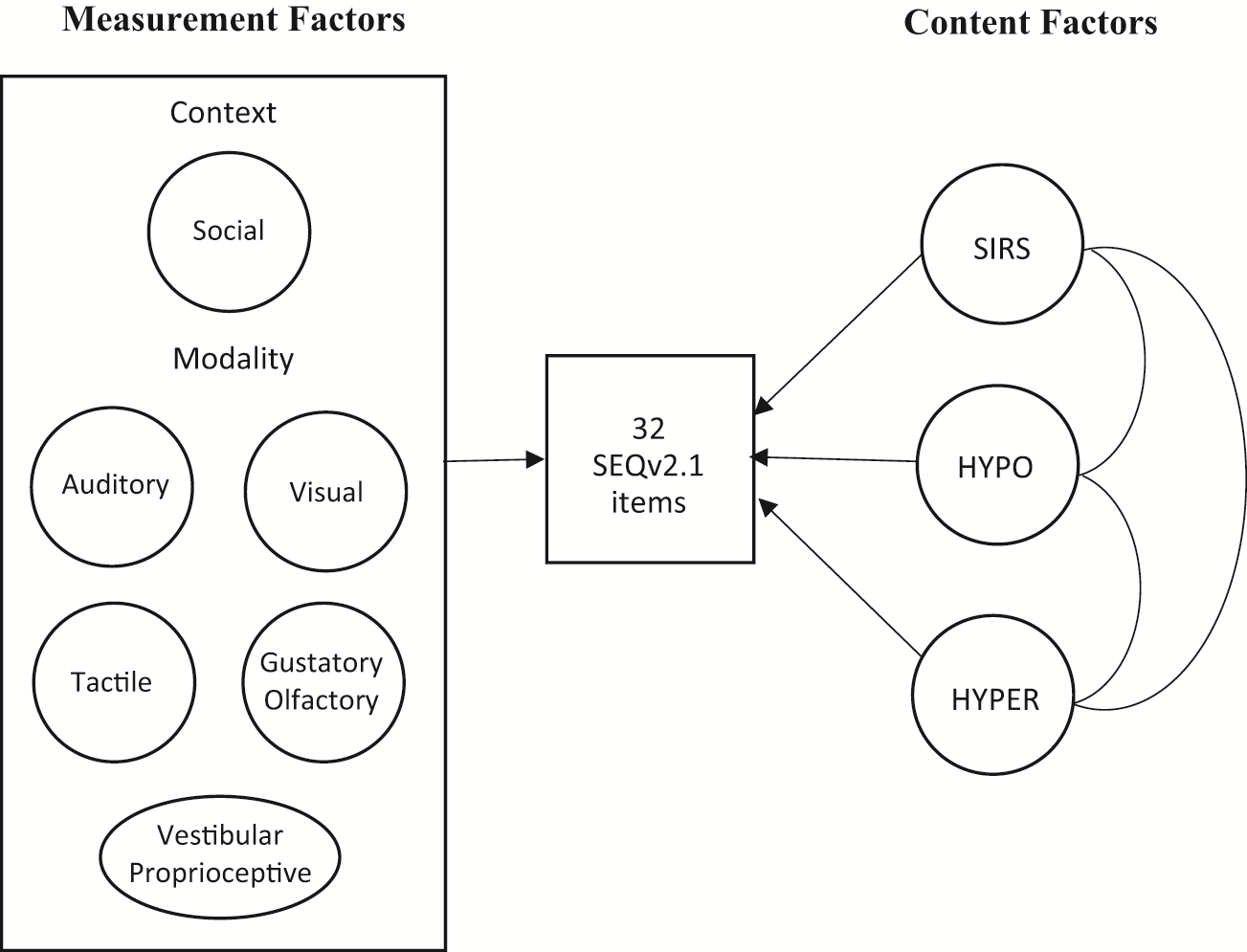
Confirmatory factor analysis model.
Also, sex invariance was checked between boys and girls to confirm findings from a previous study with samples with ASD (Ausderau et al., 2014). The measurement invariance across child sex was tested with multigroup CFA, using Wu and Estabrook’s (2016) analytic approach, which is more appropriate for ordered categorical data than more traditional approaches. The invariance analyses were conducted using R (R Core Team, 2018).
Results
The model fit indices revealed a good fit for the proposed model, χ2(419) = 2,763.34, RMSEA = .05, CFI = .95, TLI = .94, although, as expected with large samples, the χ2 statistic was significant (p < .01; Cheung & Rensvold, 2002). The SEQv2.1’s items had moderate to high loadings on the HYPO, HYPER, and SIRS factors, where a higher factor loading value indicates stronger support for the purported latent factor. For HYPO, 6 items loaded between .37 and .73; Item 3, “tune-out loud noises,” had the lowest loading, and Item 10, “slow to notice new objects in the room,” had the highest. For HYPER, 13 items loaded between .32 and .67; the lowest was Item 20, “dislike being tickled,” and the highest was Item 17, “react negatively when touched.” For SIRS, 13 items loaded between .37 and .86; the lowest was Item 28, “seek out physical rough-housing play,” and the highest was Item 36F, “extremely fascinated with touch” (tactile experience). Factor loadings for all items were significant (p < .001) and >.30, with the highest loadings (>.80) noted for the fascination items, Items 36A–F (e.g., “extremely fascinated with sounds”). The correlations among the three factors (HYPO, HYPER, SIRS) were moderate to large (r = .43–.70), with the strongest correlation found between the HYPO and HYPER factors (Table 2).
Between-Factor Correlations for Sensory Response Patterns
Note. HYPER = hyporesponsiveness; HYPO = hyperresponsiveness; SIRS = sensory interests, repetitions, and seeking behaviors.
Next, item endorsements, standardized factor loadings, and R 2 values for each item were examined; they are summarized in Table 3. Item endorsements indicate that parents observed the specific sensory feature in their child “frequently” or “almost always.” In our sample, parents’ item endorsement ranged from 0.6% to 40.2%, and the HYPO and HYPER items showed generally lower levels of endorsement than the SIRS items.
Item Endorsement and Standardized Factor Loadings
Note. HYPER = hyporesponsiveness; HYPO = hyperresponsiveness; SIRS = sensory interests, repetitions, and seeking behaviors.
Endorsement rate for response categories 4 (frequently) and 5 (almost always), which denote atypicality.
Finally, invariance testing generally indicated invariance across sex and confirmed findings from the previous study. There was no significant reduction in model fit from configural to threshold invariance (likelihood ratio test [LRT]: Δχ2[63] = 37.4, p = .99; CFI = .953, TLI = .949, RMSEA = .047) and from threshold to loading invariance (LRT: Δχ2[63] = 51.0, p = .86; CFI = .956, TLI = .955, RMSEA = .044).
Discussion
The primary aim of this study was to test the validity of the latent factor structure of the SEQv2.1 in a large community sample of children age 3 yr and, as hypothesized, the results supported a three-factor structure. Thus, we found that the three broad sensory response patterns previously found in clinical samples (HYPO, HYPER, SIRS; e.g., Ausderau et al., 2014; Baranek et al., 2006) also existed in this general population of preschoolers. However, the associations among the factors and frequency of behaviors differed from those in studies of clinical samples. Likewise, the SEQv2.1 factor loadings for the present sample were more widely spread out and lower, especially for items in the hyperresponsiveness category. Smaller factor loadings and lower levels of item endorsement in a community sample as compared with the literature for clinical groups are understandable, given that these constructs are generally used to capture atypical sensory features (deviations from normative development), which are less likely to be endorsed in a general population in which the vast majority of children are TD. For example, in one study, young children with ASD exhibited especially extreme hyporesponsiveness, which discriminated these children from both TD children and those with DD. Hyperresponsiveness, however, was more similar among clinical groups (e.g., those with ASD and DD) but still different from among TD children (Baranek et al., 2006).
The evidence of the three-factor structure—HYPO, HYPER, and SIRS—in this community sample of 3-yr-olds suggests that these sensory response patterns are present in normative development to some degree and may reflect similar mechanisms supporting sensory modulation. Given that sensory modulation refers to a person’s ability to regulate and respond to sensory input from internal (e.g., proprioceptive) or external (e.g., auditory) sources adaptively (Mulligan, 2002), it may be considered under a broader framework of self-regulation in child development (Fox & Polak, 2004).
Self-regulation abilities mature rapidly around the preschool years, with increasing attentional, social, and cognitive capacities to process and respond to environmental inputs in effortful and voluntary ways (Eisenberg et al., 2011; Montroy et al., 2016). It is possible that sensory response patterns change with age, reflecting, to some degree, the maturation of a variety of neurodevelopmental systems, such as attentional control (flexible attention disengagement and shifting), social cognitive functioning, and emotion regulation, as well as sensory reactivity. Disruptions or atypical development in such underlying systems may contribute to sensory features commonly observed in clinical samples of children with ASD and DD. In a community sample in which children’s level of sensory features is overall low, challenges with sensory reactivity may be present but may not be at levels of severity or frequency critical enough to interfere with adaptive behavior or participation. Although the general population and clinical groups display similar observable behaviors but to a different degree quantitatively, it is also possible that qualitative differences in sensory experiences (Dickie et al., 2009) or underlying neural mechanisms may be present. It could be that more intense sensory features observed in TD children at young ages are transitory in development and later disappear from the behavioral repertoire except under more stressful environmental conditions (Cermak & Daunhauer, 1997; Harricharan et al., 2019) but persist with delayed or disrupted development in clinical populations.
Although the occurrence of children’s sensory features was overall low in our community sample of preschoolers, SIRS behaviors were relatively more strongly endorsed than HYPO or HYPER behaviors. Ben-Sasson et al. (2007) similarly showed that relatively fewer TD toddlers engaged in extreme underreactivity and overreactivity, but they engaged in more seeking than those with ASD. It is possible that some SIRS behaviors may reflect beneficial explorations of the environment (especially in young TD children), whereas the presence of these behaviors later in development may suggest delays in development and potential interference with adaptive behavior. Thus, it is likely important to evaluate sensory features in the context of the child’s age or developmental stage, as well as across situations.
An interesting finding was that the intercorrelations among the three sensory response patterns in our sample were somewhat different than those reported in large clinical samples. Ausderau et al. (2014) found a stronger association between HYPO and SIRS (r = .64) than between HYPO and HYPER (r = .49) in a large sample of children with ASD ages 2 to 12 yr, whereas in the present community sample of children age 3 yr, the associations were stronger for HYPO and HYPER (r = .70) than for HYPO and SIRS (r = .43). This different pattern of correlations may reflect broader self-regulatory trends typical of children in this period. As young children transition to increasingly voluntary self-regulatory behaviors that require environment-specific adjustments (Calkins & Williford, 2009), they may be prone to more fluctuation and shifting between under- and overreactivity, which affects optimal engagement (e.g., Baranek et al., 2001), until the behavioral repertoire becomes more stable. Also, given that the SEQv2.1 is a parent survey, it may be possible that different caregiving experiences, perceptions, and expectations may have influenced the endorsement of various sensory features.
Finally, measurement invariance analyses across sex revealed that item responses from parents of boys versus girls were not only similar in the number of factors and their pattern of factor–item associations, but were also equivalent in the scales of response categories and factor loadings. Thus, SEQv2.1 factor mean scores appear comparable and can be used for both boys and girls at this age.
Limitations
Our community sample size was very large but focused solely on caregiver reports on 3-year-old children. Future research could benefit from expanding the age range of children in community samples and from prospectively studying children in both TD and various clinical populations over time using both caregiver and observed measures of sensory response patterns. More studies are also needed on the predictive value of sensory processing measures to adaptive behavior and participation outcomes. Finally, because the current study aimed to replicate earlier studies that included mainly English-speaking families and lacked versions of the instrument translated into other languages, the majority of participants in this study were White European-Americans. However, considering that occupational therapists serve clients from diverse ethnic and racial backgrounds, future research is needed that includes more diverse participants and examines the generalizability of the findings across different populations.
Implications for Occupational Therapy Practice
This study has the following implications for occupational therapy practice: The SEQv2.1 can be used in a general population of preschoolers to identify three sensory response patterns: HYPO, HYPER, and SIRS. The short length and parent-report format of the SEQv2.1 make it efficient for clinical practitioners to use in assessing sensory challenges that may be associated with a child’s daily functioning. Evaluation of a child’s sensory processing patterns with a validated measure such as the SEQv2.1 would allow for more targeted interventions that can lead to better outcomes.
Conclusion
This study demonstrates that three widely described sensory response patterns previously described in clinical samples—HYPO, HYPER, and SIRS—are also valid to measure in a large community sample of preschool-age children. Practitioners can use the SEQv2.1 with both TD and clinical samples of children to better understand how sensory features manifest in daily life activities.
Footnotes
Acknowledgments
The North Carolina Child Development Survey project was partially supported by a grant from the Autism Speaks Foundation (Grant 5946) and a gift from the Ireland Family Foundation. We thank the families who participated and the students and staff who contributed to data collection and coding as part of the Program for Early Autism Research, Leadership, and Service team.