





Abstract
The results of this study shed light on the effects of Zentangle® to determine whether the tool can be used in occupational therapy intervention to improve affective well-being.
Mental illness is a global issue. About 30% of the global population has had a mental disorder at some point in time (Steel et al., 2014). The global economic cost of mental disorders is expected to reach $6 trillion by 2030 (Marquez & Saxena, 2016). Because positive mental health can help to reduce the prevalence of mental illness (Keyes et al., 2010), discovering alternative interventions to promote mental health that are efficacious and cost-effective is important. According to the World Health Organization (2001), mental health is not just the absence of mental illness but a state of well-being. Affective well-being is one of the core components of the broader construct of subjective well-being (Fredrickson & Losada, 2005). It refers to the emotions and moods people experience in daily life (Hudson et al., 2017), which differentiates it from psychological well-being, which emphasizes a sense of meaning and fulfillment in life.
In recent decades, growing evidence has suggested the therapeutic value of art intervention and its positive effects on well-being, such as mood enhancement and reduction of stress, anxiety, and depressive symptoms (Heenan, 2006; Jensen & Bonde, 2018; Secker et al., 2007). Researchers have found that drawing can be a better medium for short-term emotional regulation than writing (Drake et al., 2011), which has been more effective in reducing negative affect when used for distraction rather than self-expression (Drake & Winner, 2012). Compared with free drawing, structured drawing has been demonstrated to be more effective in anxiety reduction because participants may enter a meditative state during the process (Curry & Kasser, 2005). Yet, one possible drawback of art interventions is that a person’s desire to make the drawing perfect may undermine the mood regulation effect of drawing (Halprin, 2002; Zimmermann & Mangelsdorf, 2020).
Zentangle®, a self-help art intervention, can minimize this drawback because it emphasizes the acceptance of one’s imperfections. Therefore, it could potentially become an alternative tool to improve affective well-being. Zentangle is a meditative drawing practice where a pen and small pieces of paper are used to draw repetitive and structured patterns called tangles, which are combinations of five elemental strokes: dots, lines, orbs, simple curves, and S curves. The art form, created by Rick Roberts and Maria Thomas in 2003, was originally used as a tool for relaxation and focus improvement (Roberts & Thomas, 2012). Roberts and Thomas (2012) found that advantages of this doodling practice were that it was not time consuming (it can be finished in 15 min) and that it is easy for almost everyone to learn.
According to its founders, Zentangle is a form of mindfulness practice (Roberts & Thomas, 2012). The two core elements of mindfulness are (1) being aware of one’s moment-to-moment experience and (2) acting nonjudgmentally and with acceptance of one’s creation of art (Kabat-Zinn, 2003; Keng et al., 2011). Zentangle urges participants to focus on every stroke of the doodling process and stresses that there is no right or wrong, which prevents participants from judging their work and retains their attention on the process (Roberts & Thomas, 2012). Zentangle’s motto is “one stroke at a time, everything is possible,” which to some extent echoes the core values (e.g., nonjudgmental and present-moment awareness) of mindfulness. As a mindfulness practice, Zentangle has been shown to have positive effects on health (Brown & Ryan, 2003; Robins et al., 2014). Kopeschny (2016) shared a phenomenological study that used focus groups and interviews and concluded that Zentangle was a mindfulness process that was fully integrated with meditation.
In addition to the emphasis that fosters mindfulness, Zentangle has been used as a tool to enhance self-compassion (Super, 2015), nonjudgmental awareness, and self-kindness and to minimize self-criticism (Neff, 2003). Likewise, self-compassion stresses self-kindness and mindfulness, which are in line with the core values of Zentangle (Neff, 2003). Moreover, according to Zessin et al. (2015), self-compassion is correlated with affective well-being, and self-compassion interventions are effective in reducing depression, anxiety, and stress (Neff & Germer, 2013). Proving that Zentangle is an effective tool for the enhancement of self-compassion would be beneficial.
Although Zentangle has become more popular, research on it is still nascent. Using self-report questionnaires, Chen et al. (2016) examined the effect of an 8-wk Zentangle intervention for patients with schizophrenia who had social interaction anxiety and low self-esteem. Their study had 44 participants who were randomly assigned to either the experimental group or the control group. In addition to regular therapy activities, the experimental group attended a 1-hr Zentangle program for 8 wk. Although this study had a control group, Chen et al. (2016) conducted only within-group comparisons. The experimental group showed a significant reduction in social interaction anxiety and an improvement in self-esteem after the intervention compared with the baseline. No significant within-group differences were found for the control group. Another research study (Sufrin, 2016) also found that Zentangle can be beneficial in the form of a brief intervention. In a study with 24 caretakers of patients with Parkinson’s disease, results from self-report questionnaires showed that both stress and anxiety decreased significantly after drawing a Zentangle for 20 min.
Nevertheless, whether Zentangle is effective in stress reduction is debatable; the only other study of Zentangle in relation to stress reported a contradictory result (Yu, 2017). In that study, 8 undergraduates joined a 3-hr Zentangle destress group for 4 wk. After the 4-wk intervention, the self-report questionnaires indicated that participants had no significant reduction in stress. These two studies are thus far the only Zentangle research related to stress reduction, and both used a single-group design. Clearly, this topic is insufficiently researched.
Apart from stress reduction, Zentangle’s effect on positive affect has also been studied. Hui and Ma’rof (2019) conducted a study with 44 Malaysian undergraduates. The Zentangle class and the data collection process lasted for around 3 hr. The self-report data showed that a single-session Zentangle intervention could lead to a significant increase in positive affect compared with preintervention. Currently, most research studies suggest that Zentangle can have positive psychological effects. To our knowledge, the only randomized controlled trial (RCT) of Zentangle (Chen et al., 2016) did not include between-group comparisons and targeted only patients with schizophrenia. To fill the research gap, we conducted the first pilot RCT to examine the effects of Zentangle on affective well-being among Hong Kong adults, compared with a waitlist control (WL) group. We hypothesized that practicing Zentangle would lead to better affective well-being. To capture potential changes in affective well-being, we assessed positive affect (PA) and negative affect (NA) and levels of depressive, anxiety, and stress symptoms because they are closely related to affective well-being and are frequently used in art interventions as outcome measures (Drake & Winner, 2012; Jensen & Bonde, 2018). We also evaluated self-compassion, in consideration of its close relationship to affective well-being (Zessin et al., 2015).
Method
Study Design
This study was a two-armed, parallel-group RCT. Participants were randomly assigned to the Zentangle (ZEN) group or the WL group in a 1:1 ratio. Research ethics approval was obtained from the Survey and Behavioral Research Ethics Committee of The Chinese University of Hong Kong (SBRE-19–152).
Participants
Participants were recruited via a university mass mailing system and social media. The inclusion criteria were (1) Hong Kong resident, (2) ages 18 to 65 yr, (3) able to communicate in Cantonese, (4) having the essential equipment to join a webinar, and (5) willing to provide informed consent and comply with the research protocol. No monetary incentives were offered to participants, but they were offered one Zentangle class free of charge.
The exclusion criteria were as follows: (1) having suicidal ideation; (2) currently using medication or psychotherapy for any psychiatric disorder; (3) having depression or anxiety, which was identified by a score of at least 14 points on the Depression subscale and at least 10 points on the Anxiety subscale of the 21-item Depression Anxiety Stress Scale (DASS–21); (4) not able to join the study as a result of major medical, psychiatric, or neurocognitive disorders; and (5) currently participating in any mindfulness practice.
Procedure
During the preparation stage, the coronavirus disease 2019 (COVID-19) outbreak made it impossible to hold a face-to-face Zentangle class. Thus, the entire study was conducted online from April 2020 to May 2020. All interested participants first completed a screening questionnaire. Eligible participants were invited to fill out the baseline questionnaire and provide informed consent. Participants were informed that they would be randomized to either the ZEN group or the WL group. The simple randomization procedure was performed by an independent assessor using a computer-generated list of random numbers. Although there was no blinding to the participants’ group assignment after the randomization, all outcome measures were collected online and calculated with computer programs and formulas.
After randomization, both groups received a standardized email with details on the Zentangle class. The treatment evaluation form and the engagement questionnaire were provided to only the ZEN group immediately postintervention and at the 2-wk postintervention assessment. Aside from these two questionnaires, both groups completed three identical sets of questionnaires at baseline, immediate postintervention, and 2-wk postintervention. The Zentangle class was provided to the WL group after the collection of all postintervention data.
Sample Size
Julious (2005) calculated that at least 12 participants per group were needed for a pilot study; therefore, we planned to recruit 15 participants per group. However, due to interest, we had 19 participants in each group, exceeding the minimum.
Intervention
The intervention consisted of one 2-hr Zentangle, delivered by a certified Zentangle teacher. The instructor first introduced the history of Zentangle and the essential elements of a Zentangle drawing (i.e., the elemental strokes). He also explained the principles of Zentangle, such as “no right or wrong,” “no eraser,” and “one stroke at a time.”
The pattern of the first drawing is called Keeko, which is a simple Zentangle pattern made up solely of straight lines (Supplemental Figure A.1, available online with this article at https://research.aota.org/ajot). It is used for warm-up and lets participants know that Zentangle can be easily accomplished even using just a single stroke. Participants spent 15 min on this drawing. The second Zentangle drawing consists of four different patterns, namely “Hollibaugh,” “Crescent Moon,” “Diva Dance (Rock and Roll),” and “Hemp,” in which all five elemental strokes are used (Supplemental Figure A.2). Fundamental Zentangle techniques such as “drawing behind” and “aura-ing” were used in this drawing. It took 80 min for the participants to finish this Zentangle. During the Zentangle process, the instructor kept reminding participants to focus on each stroke and wait to appreciate the drawings they created after the creation process.
Before the end of the meeting, participants were encouraged to practice Zentangle daily for 2 wk. A weekly email reminding participants to practice Zentangle daily was also sent to them at the beginning of each week.
Measures
All questionnaires were administered in Chinese.
Primary Outcome
The Positive and Negative Affect Schedule (PANAS) is a 20-item self-report scale that is made up of two 10-item subscales that evaluate PA and NA. This scale is widely used in both clinical and community settings to measure affective well-being and change in mood over a specific period. A 5-point Likert scale is used, ranging from 1 (very slightly or not at all) to 5 (extremely). Example items are “interested” (PA) and “distressed” (NA). The total score for each subscale (i.e., PA and NA) ranges from 10 to 50, with a higher score indicating a higher level of either PA or NA. The momentary mean scores for PA and NA are 29.7 (SD = 7.9) and 14.8 (SD = 5.4), respectively. The PANAS’s internal reliability has been demonstrated to be high for both PA (Cronbach’s α = .84–.87) and NA (Cronbach’s α = .86–.90; Watson et al., 1988).
The Chinese version of the PANAS was adopted from a Taiwanese thesis (Lu, 2012), and our team agreed that the translation was appropriate. The primary outcome was assessed at three time points (baseline, immediate postintervention, and 2-wk postintervention).
Secondary Outcomes
The DASS–21 is a 21-item self-report measure consisting of three subscales that measure depression, anxiety, and stress (Lovibond & Lovibond, 1995). Items are rated on a 4-point Likert scale ranging from 0 (did not apply to me at all) to 3 (applied to me very much, or most of the time). Example items are “I felt that life was meaningless” (Depression), “I felt I was close to panic” (Anxiety), and “I felt that I was rather touchy” (Stress). The total score for each subscale ranges from 0 to 21, with a higher score indicating a higher level of depression, anxiety, or stress. The internal reliability of the Depression (Cronbach’s α = .94), Anxiety (Cronbach’s α = .87), and Stress (Cronbach’s α = .91) subscales is high (Antony et al., 1998).
The Self-Compassion Scale–Short Form (SCS–SF) is a self-report scale that consists of 12 items evaluating degree of compassion. It assesses how the person treats themself in difficult times. This scale is made up of six components: self-kindness, self-judgement, common humanity, isolation, mindfulness, and overidentification. Items are rated on a 5-point Likert scale ranging from 1 (almost never) to 5 (almost always). An example item is “I’m disapproving and judgmental about my own flaws and inadequacies.” The total score ranges from 12 to 60, with higher scores indicating higher self-compassion. The SCS–SF has demonstrated high internal reliability (Cronbach’s α = .86; Raes et al., 2011).
We used the validated Chinese versions of the DASS–21 (Chan et al., 2012; Moussa et al., 2001) and SCS–SF (Chen & Chen, 2019). Secondary outcomes were assessed at two time points (baseline and 2-wk postintervention).
Intervention Satisfaction and Engagement
Intervention satisfaction was assessed immediately after the Zentangle class. Participants were asked, “How satisfied were you with the Zentangle class?” and indicated their overall satisfaction on a 5-point Likert scale ranging from 1 (very dissatisfied) to 5 (very satisfied). Intervention engagement was assessed at 2-wk postintervention. Participants were asked to indicate their average practice days per week and average daily practice time during the past 2 wk and whether they intended to practice in the future.
Statistical Analysis
For quantitative data, intention-to-treat analyses were conducted using maximum likelihood estimation, with the missing-at-random assumption. Regardless of whether they completed the postintervention questionnaires, participants in both groups were included in the analyses. Comparability of groups at baseline was assessed by means of independent t tests for continuous variables or χ2 tests for categorical variables. Between-group differences from baseline to immediate and 2-wk postintervention were analyzed by means of linear mixed-effects models. Separate analyses were conducted for the ZEN group, who had practiced Zentangle for at least 80 min a week, and the WL group.
All data were analyzed using IBM SPSS Statistics (Version 25.0) and computed at p ≤ .05 (two-tailed). Effect sizes were calculated with Cohen’s d, which is the mean difference divided by a pooled standard deviation.
Results
Participant Characteristics
All 225 potential participants completed the online screening for eligibility, and 187 were excluded from the study for various reasons (Figure 1). Thirty-eight participants who completed the baseline questionnaire were randomized into the ZEN group (n = 19) or the WL group (n = 19). Participants’ mean age was 36.0 yr (SD =11.5), and they were primarily female (92.1%). The majority of the participants were university educated (86.8%) and single (73.7%). Roughly two-thirds of participants worked full time (Table 1). No significant difference was found between the ZEN group and the WL group on any of the baseline measures or participant characteristics.
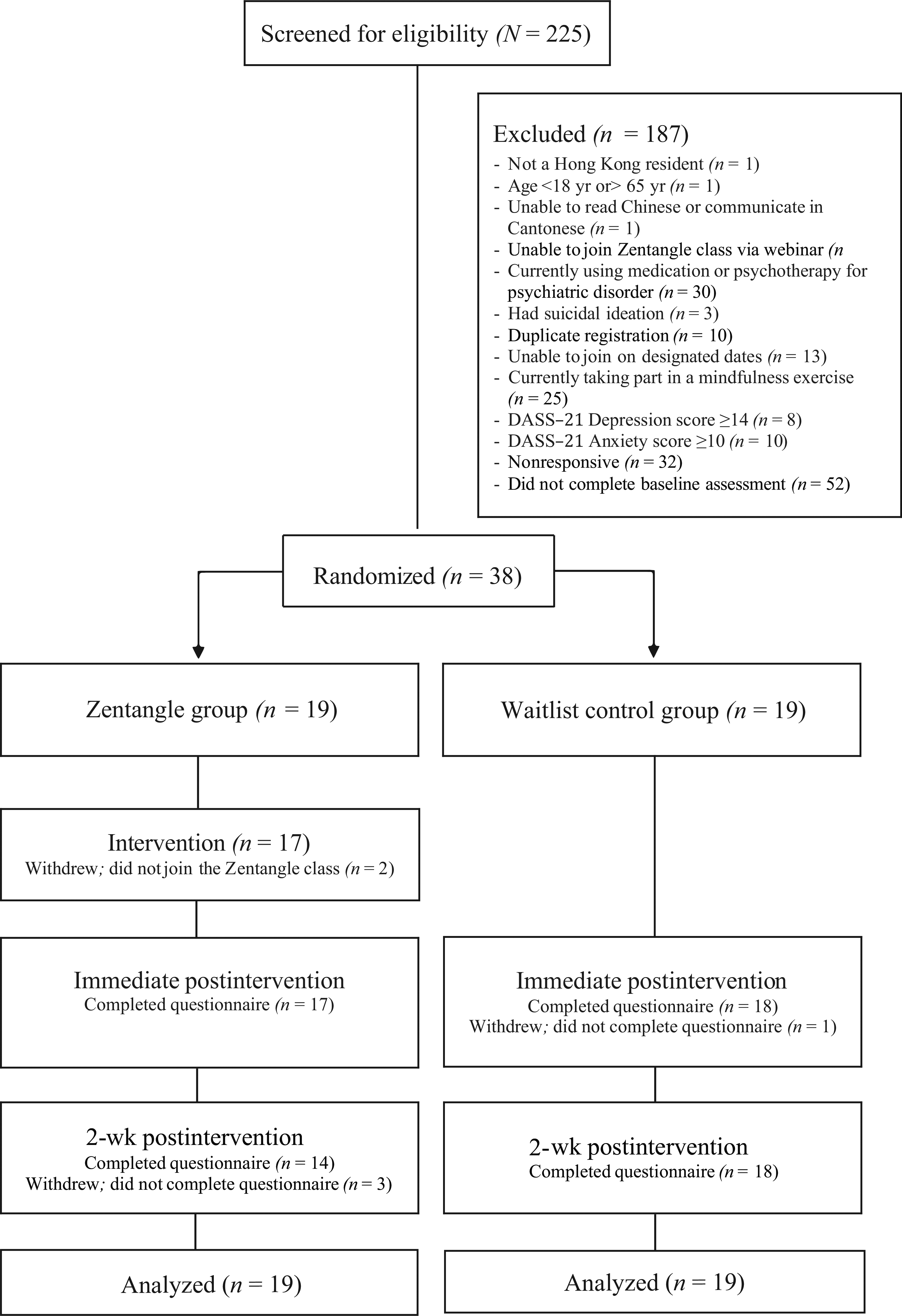
Participant flow diagram.
Demographic Characteristics of the Participants
Note. Percentages may not total 100 because of rounding. WL = waitlist control; ZEN = Zentangle®.
Attrition Rate
Of the 38 eligible participants who completed the baseline measures, 35 (92.1%) filled in the immediate postintervention questionnaires. Thirty-two (84.2%) also completed the 2-wk postintervention questionnaires. There were no significant differences on any of the baseline characteristics or measured variables between participants who dropped out and those who completed all the questionnaires.
In the ZEN group, 17 (89.5%) participated in the class and filled in the questionnaires at the immediate postintervention assessment, and 14 (73.7%) completed the 2-wk postintervention questionnaires. In the WL group, 1 participant dropped out at the immediate postintervention assessment, and the rest completed all questionnaires.
Intervention Effectiveness
Between-Group Comparison
Table 2 shows that there were significant Group × Time interactions in NA at immediate postintervention and 2-wk postintervention. The ZEN group (M = 28.89, SD = 5.59) had significantly greater reductions in NA than the WL group (M = 19.00, SD = 6.91) at the immediate postintervention. For 2-wk postintervention, the ZEN group still showed greater reductions (M = 21.14, SD = 6.62) in NA than the WL group (M = 26.61, SD = 7.22). The between-group effect sizes were large at both immediate (d = 1.04, p < .01, 95% confidence interval [CI] [0.31, 1.72]) and 2-wk postintervention (d = 0.79, p < .01, 95% CI [0.05, 1.49]) assessments. For PA and other secondary measures, no significant differences were found across all time points (p > .05).
Estimated Means, Standard Deviations, p Values, and Effect Sizes at Baseline, Immediate Postintervention, and 2-wk Postintervention
Note. CI = confidence interval; DASS–21 = 21-item Depression Anxiety Stress Scale; PANAS = Positive and Negative Affect Schedule; SCS–SF = Self-Compassion Scale–Short Form; WL = waitlist control; ZEN = Zentangle®.
Estimated means and standard deviations were calculated with linear mixed-effects models.
Between-group effect sizes were reported as positive if the ZEN group had greater psychological improvement than the WL group.
Between-groups p values: Group × Time interactions were calculated with linear mixed-effects models. At baseline, p values were calculated by means of independent t tests.
High-Practice Group Analysis
Six participants who had practiced for at least 80 min per week (M = 140.83 min, SD = 67.26) were classified as the high-practice (HP) group. Table 3 presents the statistical comparison of the HP group and the WL group. The linear mixed-effects model analysis showed a significant Group × Time interaction in NA at the 2-wk postintervention assessment. The findings showed a more significant reductions in NA in the HP group (M = 19.00, SD = 8.03) compared with the WL group (M = 26.61, SD = 7.22) at the immediate postintervention, with a large between-group effect size (d = 1.00, p < .01, 95% CI [0.00, 1.93]). Secondary outcome measures showed significant improvements in anxiety symptoms (M = 1.83, SD = 2.23) and self-compassion (M = 37.83, SD = 11.07) in the HP group, compared with the level of anxiety symptoms (M = 4.22, SD = 3.34) and self-compassion (M = 35.50, SD = 7.99) in the WL group at the immediate postintervention. The between-group effect size was large for anxiety symptoms (d = 0.84, p < .05, 95% CI [−0.14, 1.76]) and low for self-compassion (d = 0.24, p < .01, 95% CI [−0.69, 1.16]). No significant difference was found for PA, depression, and stress symptoms (p > .05). For the ZEN group, no significant differences were found between the HP and low-practice (LP) groups on any of the baseline characteristics or measures.
Estimated Means, Standard Deviations, p Values, and Effect Sizes for the HP Group and the WL Group at Baseline and 2-wk Postintervention
Note. CI = confidence interval; DASS–21 = 21-item Depression Anxiety Stress Scale; HP = high-practice; PANAS = Positive and Negative Affect Schedule; SCS–SF = Self-Compassion Scale–Short Form; WL = waitlist control.
Estimated means and standard deviations were calculated by linear mixed-effects models.
Between-group effects sizes were reported as positive if the HP group had greater psychological improvements than the WL group.
Between-group p values: Group × Time interactions were calculated by linear mixed-effects models. At baseline, p values were calculated by independent t tests.
Intervention Satisfaction and Engagement
All ZEN group participants (n = 17) reported that they were very satisfied (n = 11; 64.7%) or satisfied (n = 6; 35.3%) with the Zentangle class. Their mean score was 4.65 out of 5 (SD = 0.48), indicating a high level of satisfaction.
Participants were encouraged to practice Zentangle daily for 2 wk. Of the 14 participants who returned the 2-wk postintervention questionnaires, 11 (78.6%) had practiced Zentangle at least once a week, with an average daily practice time of 30.00 min (SD =13.60), and their average practice time per week was 96.82 min (SD = 70.93). In addition, 3 participants (21.4%) reported that they had not practiced Zentangle at all.
Discussion
This study is the first RCT to examine the effectiveness of Zentangle on the general public’s affective well-being, compared with a WL group. Participants in the ZEN group showed significant reductions in NA at immediate postintervention and 2-wk postintervention assessments irrespective of their average practice time, compared with the WL group. With a longer self-practice time (at least 80 min/wk), Zentangle was found to be effective in lowering anxiety (DASS–21 Anxiety subscale) and improving self-compassion (SCS–SF). No significant results were found for PA, depressive symptoms (DASS–21 Depression subscale), and stress symptoms (DASS–21 Stress subscale). We showed that Zentangle is feasible as a cost-effective alternative to conventional interventions in reducing NA and, with longer practice time, alleviating anxiety and enhancing self-compassion. This study can also be used as a basis to study the potential effects of Zentangle in clinical populations.
Significant Reductions in Negative Affect and Insignificant Changes in Positive Affect
Compared with the WL group, the ZEN group showed significant effects on reducing NA at immediate postintervention (d = 1.04) and 2-wk postintervention (d = 0.79). It is worth noting that the baseline NA for both groups (ZEN group, 29.89; WL group, 27.32) was much higher than the average momentary score of 14.8 found in a previous study (Watson et al., 1988). This discrepancy was likely the result of the impact of COVID-19, as evidenced in a recent survey showing that the level of NA among Hong Kong people was high (Gloster et al., 2020). At all assessment time points, no significant improvements in PA were found compared with the WL group. The insignificant change in PA seems to be contradictory to the findings of the Zentangle study conducted by Hui and Ma’rof (2019). However, we speculate that their single-group design using within-group comparisons might have contributed to the discrepancies with our findings using between-groups comparisons.
In fact, the asymmetry effects on PA and NA are congruent with those of previous studies on art interventions. Previous studies have suggested that drawing can significantly reduce NA, but it has no significant impact on PA (Drake & Winner, 2012; Northcott & Frein, 2017). One possible reason is that the Zentangle drawing process itself serves as a distraction. Because Zentangle requires people to focus on every stroke they are drawing, this might serve as a distracting tool for emotional regulation, shifting the person’s attention to the present moment. Although distraction has been found to be effective in reducing NA, it does not lead to an improvement in PA unless positive stimuli are included in the intervention to arouse positive emotions (Valim et al., 2019). This notion was also supported by a study by Dalebroux et al., (2008), which showed that adding positive elements to drawings can lead to a significant increase in PA. Nonetheless, according to its founder, Zentangle drawing is itself nonrepresentational (Roberts & Thomas, 2012), meaning that the patterns and the elemental strokes are neutral rather than positive. In other words, it focuses on the present moment and “no right or wrong” in the drawings in lieu of stimulating positive thoughts or memories in the drawing process. This distracting and nonjudging nature of Zentangle can be the reason why Zentangle intervention is more effective in reducing negative emotions than in enhancing positive ones.
Reduction in Anxiety Among Participants in the High-Practice Group
Higher levels of self-practice with Zentangle are essential when using Zentangle to reduce anxiety symptoms (DASS–21 Anxiety subscale). No significant changes in anxiety were observed in the Zentangle group at 2-wk postintervention assessment, compared with the WL group, but a significant reduction in anxiety was found among participants engaged in at least 80 min of Zentangle practice per week, with a large effect size (d = 0.84). These results are consistent with those of the study by Curry and Kasser (2005), which found that structured drawing helps participants to experience a meditative state and reduce anxiety. Our findings suggest that, with a longer practice time, Zentangle can be used as an effective preventive tool to minimize anxiety in the general population. Because this study focused only on the nonclinical population, future studies should evaluate the effectiveness of Zentangle with people with anxiety and explore the possibility of integrating Zentangle into treatment for anxiety disorders.
Improvement in Self-Compassion Among Participants With Longer Practice Time
Another significant effect of the Zentangle intervention was found in the enhancement of self-compassion in the ZEN HP group, who practiced Zentangle for at least 80 min, compared with the WL group. This improvement in self-compassion is in line with our expectations because the core values of Zentangle and self-compassion have many similarities; both emphasize being mindful and nonjudgmental. The insignificant results in the ZEN group (both HP and LP groups) could be explained by the insufficient time spent on Zentangle practice. According to a systematic review by Kotera and Van Gordon (2021), self-compassion interventions with a longer duration (>11 hr) provide the most robust results for improvement in self-compassion. Another study on mindful practice also pointed out that longer daily practice time can lead to a greater rise in self-compassion (Berghoff et al., 2017). Our findings suggest that Zentangle practice can improve self-compassion if practice time is long enough.
Insignificant Effects on Symptoms of Depression and Stress
No significant reductions were found in symptoms of depression (DASS–21 Depression subscale) and stress (DASS–21 Stress subscale), irrespective of participants’ average practice time. This result was surprising, given that Zentangle is commonly regarded as a stress-relieving activity. However, comparing the HP group with the WL group, the between-group changes on both measures were in the predicted direction, with a moderate effect size for depressive symptoms (d = 0.68) and a small effect size for stress symptoms (d = 0.37). Moreover, the between-group effect of Zentangle to reduce depressive symptoms was close to being statistically significant (p = .08). Thus, the insignificant findings could be attributed to the small sample size, which may lead to the inability to detect statistically significant differences. In addition, a previous meta-analysis on positive psychological interventions indicated that positive psychological interventions might have been more effective with depression if the duration of the Zentangle intervention was longer (Bolier et al., 2013).
Strengths and Limitations
This is the first RCT to demonstrate that Zentangle can be effective in improving the general public’s mental health by reducing NA. With longer practice time, it also helps to reduce anxiety symptoms and enhance self-compassion. The intervention was implemented with a nonclinical population of adults of different ages, which sheds light on the potential of using Zentangle to promote positive mental health in the general population. The demographics of the two groups were very similar, which reduced the chance of results being affected by confounding factors. Moreover, the Zentangle patterns used are clearly listed, which allows for future replication of the study and further testing the psychological effects generated from different patterns.
The sample size for this pilot study was small, which might have contributed to the insignificant findings. A fully powered RCT is thus recommended in the future. In addition, the nonrepresentative sample in this study might affect its generalizability. Because the Zentangle sessions were delivered online, only participants with basic computer knowledge and stable internet access were able to join the intervention. The study sample was recruited using the internet and was a nonclinical population, also limiting the generalizability of the findings. In addition, the long-term effect of Zentangle was not assessed. Finally, the study had no active control group, and because participants were not blinded to group allocation, the results could potentially be affected by their grouping.
Implications for Occupational Therapy Practice
Our study’s results demonstrate that Zentangle may have the potential to be a cost-effective intervention in occupational therapy practice in terms of improving affective well-being across different areas of practice, such as psychiatric rehabilitation and pediatric, geriatric, and palliative care. It could be used to foster a sense of positivity and social interaction. In addition, Zentangle may be useful in enhancing occupational engagement, which is defined as participation in everyday activity as well as the emotional and psychological aspects associated with the activity (Black et al., 2019). According to Jackman (2014), mindfulness practice can be incorporated into existing occupational therapy interventions because it helps to increase one’s awareness of the present moment and leads to more enjoyment during occupational engagement. Zentangle, a form of mindful practice, can probably bring similar benefits. Besides, an advantage of Zentangle is that art knowledge is not required to create beautiful drawings, which is beneficial to those whose occupational performance is interrupted. Research on replicability with a larger sample size is warranted to investigate additional advantages of Zentangle and its applicability in different areas of practice. The nature of Zentangle has the potential to improve fine motor and sequencing skills, concentration and sustained attention, and emotional and sensory regulation.
Conclusion
Our study demonstrates that Zentangle is effective in lowering NA in the general population. In addition, Zentangle with longer practice time appears to be more beneficial for alleviating anxiety symptoms and improving self-compassion. Future studies with a larger sample size, longer follow-up, and an active comparison group are warranted to evaluate the effects of Zentangle in both clinical and nonclinical populations.
Supplemental Material
Supplementary material for The Effects of Zentangle® on Affective Well-Being Among Adults: A Pilot Randomized Controlled Trial
Supplementary material, sj-pdf-1-aot-10.5014_ajot.2022.049113.pdf for The Effects of Zentangle® on Affective Well-Being Among Adults: A Pilot Randomized Controlled Trial by Siu-Ki Chung, Fiona Yan-Yee Ho and Henri Chun-Yiu Chan in The American Journal of Occupational Therapy
Footnotes
Acknowledgments
This trial was registered at ClinicalTrials.gov (NCT04309279). The authors wish to thank all the participants in the study and the members of Public Mental Health Laboratory, The Chinese University of Hong Kong, for their assistance in data collection and manuscript preparation.
References
Supplementary Material
Please find the following supplemental material available below.
For Open Access articles published under a Creative Commons License, all supplemental material carries the same license as the article it is associated with.
For non-Open Access articles published, all supplemental material carries a non-exclusive license, and permission requests for re-use of supplemental material or any part of supplemental material shall be sent directly to the copyright owner as specified in the copyright notice associated with the article.
