





Abstract
This review supports and guides occupational therapy practitioners in the use of theory-based self-management interventions in stroke rehabilitation to enhance outcomes.
Stroke is one of the most significant health problems facing the United States (Virani et al., 2020). People with stroke present with a wide variety of symptoms, such as mood disorders (Chun et al., 2018; Towfighi et al., 2017), physical disability (Hatem et al., 2016), cognitive impairment (Sun et al., 2014), and somatic symptoms (Hinkle et al., 2017). It has long been recognized that coping ineffectively with these symptoms interferes with daily functioning and prevents stroke survivors from returning to their premorbid level of participation (Chau et al., 2009).
Unfortunately, research shows that half of community-dwelling stroke survivors still have persistent difficulties participating in activities that support their roles in different areas of life (Wolf et al., 2016). It has been found that the greatest impact of stroke on patient well-being comes from the chronic consequences faced by stroke survivors after they leave the hospital (Fisher et al., 2013). This outcome is in part attributed to stroke rehabilitation focusing more on improving physical recovery and less on enabling stroke survivors to cope with their long-term psychosocial sequelae and problems embedded in everyday life (Jones, 2006; Jones et al., 2013). With diminished support from health care providers after discharge, stroke survivors experience unprecedented problems and uncertainties in symptom management, psychosocial adaptation, and community reintegration (Chau et al., 2009; Lo et al., 2013). Therefore, it is critical to empower community-dwelling stroke survivors with the knowledge and strategies necessary to manage their conditions and live an independent life (Lo et al., 2013).
Self-management is supported by chronic disease management literature as an effective approach to managing chronic conditions and improving health outcomes (Aggarwal et al., 2019; Chodosh et al., 2005). In recent decades, stroke rehabilitation has been extended from physical rehabilitation to addressing skills necessary for stroke survivors to manage their symptoms and meet their psychosocial needs in everyday life; in addition, self-management is seen as a critical component of care (Satink et al., 2015). Moreover, interventions to support stroke self-management are being featured more prominently because of their promising results in clinical trials (Damush et al., 2011; Lo et al., 2018), systematic reviews (Fryer et al., 2016; Lo et al., 2013; Warner et al., 2015; Wray et al., 2018), and meta-reviews (Parke et al., 2015; Pearce et al., 2015).
Although current reviews of self-management interventions for stroke survivors are positive, systematic investigations of theory use in intervention development and its effect on intervention effectiveness are lacking. According to Medical Research Council guidance, the use of a theoretical framework enhances the effects of behavioral change interventions (Craig et al., 2008). Previous reviews have found that greater use of theory in the development of self-management interventions is associated with greater effectiveness in diverse populations (Lau et al., 2020; Lycett et al., 2018). More important, evaluating the use of theory in interventions facilitates an understanding of the behavioral changes underlying interventions and provides a basis for replicating effective interventions, refining ineffective interventions, and developing better interventions (Michie & Prestwich, 2010). Lo et al. (2013) conducted a systematic review of theory-based self-management interventions for stroke survivors, but it indicated only what theory was used in each study; therefore, little is known about how and to what extent theory was applied in the development of the intervention. A systematic and in-depth examination of theory use is needed to evaluate the essential theoretical components related to specific outcomes and to inform the development of effective theory-based self-management interventions for stroke survivors.
National Institute for Health and Care Excellence (2014) guidelines have suggested that, along with application of a theoretical framework, selection of behavior change techniques (BCTs) are integral to the design of an effective behavior change intervention (Duff et al., 2017). Identifying BCTs in interventions provides insights into the mechanisms of action and effective components of successful interventions, leading to accurate replication and faithful implementation of effective interventions (Michie et al., 2013). However, this ability is challenging for complex interventions such as self-management that often involve many different BCTs (e.g., goal setting, action planning, and problem solving), the combinations and descriptions of which vary from intervention to intervention (Lorig & Holman, 2003). The absence of standardized definitions for BCTs and the large heterogeneity among self-management interventions hamper review studies from making direct comparisons across interventions and identifying replicable BCTs associated with effectiveness (Chodosh et al., 2005; Michie et al., 2009; van Vugt et al., 2013). To facilitate and standardize the identification of BCTs, Michie et al. (2013) developed the BCT taxonomy v1 that includes 93 hierarchically organized BCT codes. The BCT taxonomy v1 has commonly been applied in reviews to evaluate behavioral change interventions (Alkhaldi et al., 2016; Hansen et al., 2018; Kebede et al., 2017).
To complement previous reviews and expand the evidence base for theory-based self-management interventions for stroke, we established the following objectives for this systematic review: (1) examine what theories have been applied in the development of the theory-based self-management interventions for community-dwelling stroke survivors; (2) identify what BCTs were included in these interventions; (3) investigate the extent to which these interventions encourage participants to implement behavior changes; and (4) appraise the effectiveness of these interventions to improve self-efficacy, quality of life, and functional independence.
Method
The protocol for this study is registered at the Prospective Register of Systematic Reviews (PROSPERO; CRD42020168721).
Definitions
Self-management is defined as the strategies used by people for their own health and well-being, consisting of the actions they take to (1) lead a healthy lifestyle; (2) meet their social, emotional, and psychological needs and implementation behaviors; (3) care for their long-term condition; and (4) prevent further illness (McLean et al., 2016). A theory is defined as a set of concepts, mechanisms, and propositions that explain or predict the human behavior of performing occupations (Christiansen et al., 2015; Glanz & Rimer, 2005). According to the Theory Coding Scheme (TCS; Michie & Prestwich, 2010), a theoretical construct is a key concept in the theory that is hypothesized to have a causal relation with behavior, and a predictor refers to a construct that is not explicitly linked to a theory but is evidenced to be predictive of behavior. A BCT is defined as “an observable, replicable, and irreducible component of an intervention designed to alter or redirect causal processes that regulate behavior, that is, a technique is proposed to be an ‘active ingredient’” (Michie et al., 2013, p. 23).
Search Strategy
We searched the literature using strategies developed by a medical librarian (Angela Hardi) for concepts of stroke and self-management. A detailed search strategy is available in Supplemental Appendix A, available online with this article at https://research.aota.org/ajot. These strategies were executed in Ovid MEDLINE, Embase, Scopus, CINAHL, Cochrane Library, and ClinicalTrials.gov. We limited results to randomized controlled trials (RCTs) by using RCT filters recommended by the Cochrane Group for Ovid MEDLINE, Embase, and CINAHL as well as a librarian-created filter for Scopus. We focused on RCTs because they are the gold standard for evidence of the effectiveness of health interventions (Barton, 2000). All searches were completed on May 26, 2020.
Study Selection
The selection process is illustrated in Figure 1. Six investigators (Stephen C. L. Lau [SL], Stephanie Judycki [SJ], Mikayla Mix [MM], Olivia DePaul [OD], Rachel Tomazin [RT], and Dana Zavesky) independently screened titles, abstracts, and keywords yielded by the database search. Any disagreements were resolved by discussion with two investigators (Alex W. K. Wong [AW] and Carolyn Baum [CB]). Full texts of remaining studies and their reference lists were subjected to further scrutiny following the same procedure. We included articles that (1) were original articles published in peer-reviewed journals, (2) included community-dwelling stroke survivors, (3) included participants age 18 or older, (4) were RCTs, (5) assessed the effectiveness of self-management interventions, (6) explicitly mentioned the use of theory in the development of the intervention, and (7) were written in English. We excluded (1) abstracts, conference proceedings, pilot data sets, reviews, protocols, and articles not written in English; (2) articles on participants without stroke; (3) articles on children and adolescents; (4) non-RCT studies; (5) articles that did not involve self-management interventions; (6) articles that did not explicitly mention the use of theory; and (7) articles that did not assess the effectiveness of a self-management intervention.
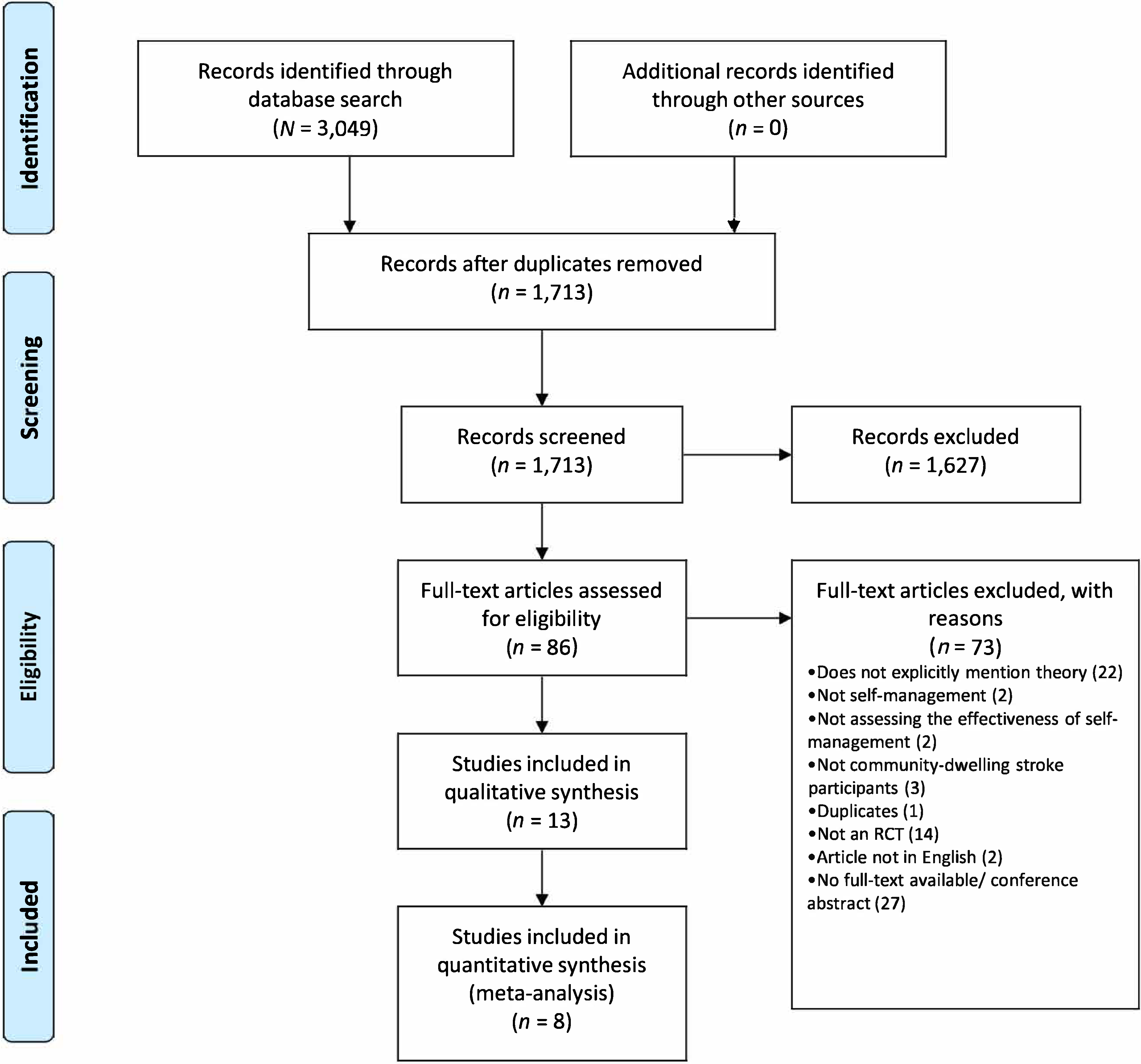
Flow diagram for inclusion and exclusion of peer-reviewed studies in the systematic review.
Data Extraction and Quality Appraisal
Using a structured form, we extracted data on (1) study characteristics (authors, publication year, country, inclusion and exclusion criteria, sample size of each group); (2) patient characteristics (gender distribution, mean age); (3) intervention characteristics (mode of delivery, theory, treatment intensity, descriptions of intervention and control conditions); and (4) statistics (means and standard deviations for each outcome measure). Stephen C. L. Lau and Carolyn Baum were contacted via email to retrieve missing information from the included articles.
To assess the extent to which theory had been applied, we used the TCS (Michie & Prestwich, 2010). The TCS consists of 19 items evaluating six categories: reference to underpinning theory (Items 1–3), targeting of related theoretical constructs (Items 2, 5, 7–11), selecting participants or tailoring interventions using theory (Items 4 and 6), assessing relevant constructs (Items 12 and 13), theory testing (Items 14–18), and theory refinement (Item 19). We computed a percentage score using the formula applied by Lycett et al. (2018): (number of TCS items applied divided by 19 TCS items) × 100%; a higher score indicates a more extensive use of theory.
To identify the BCTs, we used BCT taxonomy v1 (Michie et al., 2013) to code each intervention. BCT taxonomy v1 was developed and validated by Michie et al. (2013) using the Delphi method, which involved 54 international experts from psychology, behavioral medicine, and health promotion. BCT taxonomy v1 is an extensive hierarchically organized taxonomy of 93 discrete BCTs categorized into 16 groups. For instance, “1.1. goal setting (behavior)” and “1.2. problem solving/coping planning” are examples of BCTs grouped under “1. goals and planning.” To reflect rehabilitation-oriented self-management approaches intended to engage the participants in the behaviors addressed in the intervention in their daily lives (Boger et al., 2015; Hammel et al., 2013; Jones et al., 2013; Wolf et al., 2016), our study team (CB, AW, SL, MM, SJ, OD, RT) augmented the BCT taxonomy v1. Two new categories of BCT codes (“17. the delivery” and “18. participant demonstrates action”) were added to record the delivery of the intervention and to reflect the actions that the participants implemented as a result of the intervention.
The taxonomy of the new BCT codes, including their definitions and examples, is available online in Supplemental Appendix B. The delivery codes include the use of a lay coleader as well as the use of an individualized learning approach that includes active learning, reflects the participant’s social and cultural priorities, engages family and friends, fosters decision making, and encourages the use of community and personal resources. The codes reflecting that the participant has implemented new behaviors include whether the participant is actively managing symptoms; expressing hope, aspirations, or resiliency; and managing mood and stress. It is also possible to record whether the participant reports on the status of their personal goals and use of social support. The new codes also reflect changes made to lifestyle, activities, and schedules as well as how their changed behaviors might relate to their caregivers’ stress and burden.
We appraised the methodological quality of each study using the Physiotherapy Evidence Database (PEDro) scale (Maher et al., 2003). The PEDro scale is an 11-item scale that assesses the risk of bias and statistical reporting of RCTs. With the exception of Item 1, which assesses external validity, 1 point is given to each satisfied item. The total score ranges from 0 to 10 points; higher scores reflect higher quality. A study is defined as sufficient quality when its total PEDro score is greater than 4 points (Van Peppen et al., 2004).
Study Outcome Measures
Study outcomes selected a priori were self-efficacy, quality of life, and functional independence. Self-efficacy is a conceptual element underpinning self-management (Dishman et al., 2005). Quality of life is a key outcome for evaluating the long-term impact of stroke (Pedersen et al., 2021) and the effectiveness of stroke interventions (Salter et al., 2008). Functional independence is an important indicator of stroke recovery (Oczkowski & Barreca, 1993).
Statistical Analyses
For each study, we estimated a standardized mean difference (SMD) using Cohen’s d test. The SMD is the difference in the change score (difference between post- and preintervention scores) between the intervention and control groups divided by the pooled baseline standard deviation of the distribution of the score used in the study. The effect sizes of 0.2, 0.5, and 0.8 are classified as small, medium, and large, respectively (Cohen, 1988). A positive SMD indicates a larger improvement on the outcome measures in the treatment group, and vice versa. We performed all meta-analyses with the metan command in STATA 16 by pooling the SMD between trials using random effects models, which account for the inherent heterogeneity of studies. The I 2 statistics were calculated a posteriori as an estimate of between-trials SMD heterogeneity. The I 2 statistics should be interpreted with caution because their power to detect heterogeneity is compromised by the small number of trials (Hedges & Pigott, 2001). Tests of funnel plot asymmetry were not performed because of the low power of the test with the limited number of studies (Higgins et al., 2020).
Results
Study Selection
In the initial search, we identified 3,049 citations. Duplicates were removed, and the titles, abstracts, and keywords of the remaining 1,713 unique citations were screened. Eighty-six studies were selected for full-text review. Figure 1 summarizes the review process and reasons for exclusion, following the Preferred Reporting Items for Systematic Reviews and Meta-Analyses (PRISMA) statement. Finally, we retained 13 studies for systematic review, 8 of which were included for meta-analysis.
Study Characteristics
Table C.1 in Supplemental Appendix C describes the characteristics of the 13 included RCTs (Level 1), involving 2,168 participants. The smallest study included 28 participants, and the largest included 404. Between 0% and 52.6% of the study participants were female. The average age of participants ranged from 52.1 to 72.0 yr. The duration of interventions ranged from a single session to 40 wk. Face-to-face format (n = 6; Fu et al., 2020; Glass et al., 2004; Green et al., 2007; Kendall et al., 2007; Wolf et al., 2016, 2017) and individual sessions (n = 6; Cheng et al., 2018; Claiborne, 2006; Damush et al., 2011, 2016; Fu et al., 2020; Glass et al., 2004) were the common features of interventions. Treatment as usual was the predominant control condition (n = 10; Cheng et al., 2018; Claiborne, 2006; Damush et al., 2011, 2016; Glass et al., 2004; Green et al., 2007; Kendall et al., 2007; Lo et al., 2018; Sajatovic et al., 2018; Sit et al., 2016).
Methodological Quality
All included studies scored >4 points on the PEDro scale, indicating that the quality of all included studies was sufficient. Table C.2 provides details of the quality assessment of the included studies. The mean PEDro score of all included studies was 6.2, with a range from 5 to 8 points. None of the studies blinded participants and therapists.
Use of Theory
Table C.1 summarizes the use of theory in each study. Theories used in intervention development included Social Cognitive Theory (SCT; n = 7; Damush et al., 2011, 2016; Kendall et al., 2007; Lo et al., 2018; Sajatovic et al., 2018; Wolf et al., 2016, 2017), family systems theory (n = 1; Glass et al., 2004), health empowerment theory (n = 1; Sit et al., 2016), self-determination theory (n = 1; Fu et al., 2020), transtheoretical model (n = 1; Green et al., 2007), chronic care model (n = 1; Cheng et al., 2018), and care coordination model (n = 1; Claiborne, 2006). The use of theory as assessed by the TCS ranged from 31.6% to 63.2%; 8 studies were coded >50%. The TCS application of each study is detailed online in Supplemental Appendix D.
Behavioral Change Techniques
Figure 2 summarizes the use of BCTs among the included studies. Of the 93 BCTs of BCT taxonomy v1, 37 (39.8%) unique BCTs were used by the included studies. Of our 23 BCTs extended from the original taxonomy, 18 (78.3%) unique BCTs were used by 11 studies. The average number of BCTs applied in each intervention was 9.14 (range = 1–28). The most applied BCT categories were goals and planning (12 of 13 studies), the delivery (10 of 13 studies), social support (8 of 13 studies), and antecedents (8 of 13 studies). No BCTs from the covert learning category were identified. The most applied BCTs were social support (practical; 8 of 13 studies), problem solving (8 of 13 studies), goal setting (behavior; 6 of 13 studies), and adding objects to the environment (6 of 13 studies).

Summary of behavior change techniques application.
Impact of Interventions on Self-Efficacy, Quality of Life, and Functional Independence
Figure 3 shows the results of the meta-analyses. Six studies showed a significant difference for self-efficacy in favor of the intervention group (SMD = 0.27, 95% confidence interval [CI] [0.06, 0.48], I 2 = 47.0%). More specifically, SCT-based interventions yielded a significant effect size in favor of the intervention group (SMD = 0.31, 95% CI [0.05, 0.57]), whereas health empowerment theory–based interventions did not reach statistical significance (SMD = 0.14, 95% CI [−0.14, 0.43]). Four studies showed a marginally significant difference for quality of life in favor of the intervention group (SMD = 0.23, 95% CI [−0.02, 0.48], I 2 = 22.1%). Two studies showed a significant difference for functional independence in favor of the intervention group (SMD = 0.19, 95% CI [0.01, 0.37], I 2 = 0.0%).
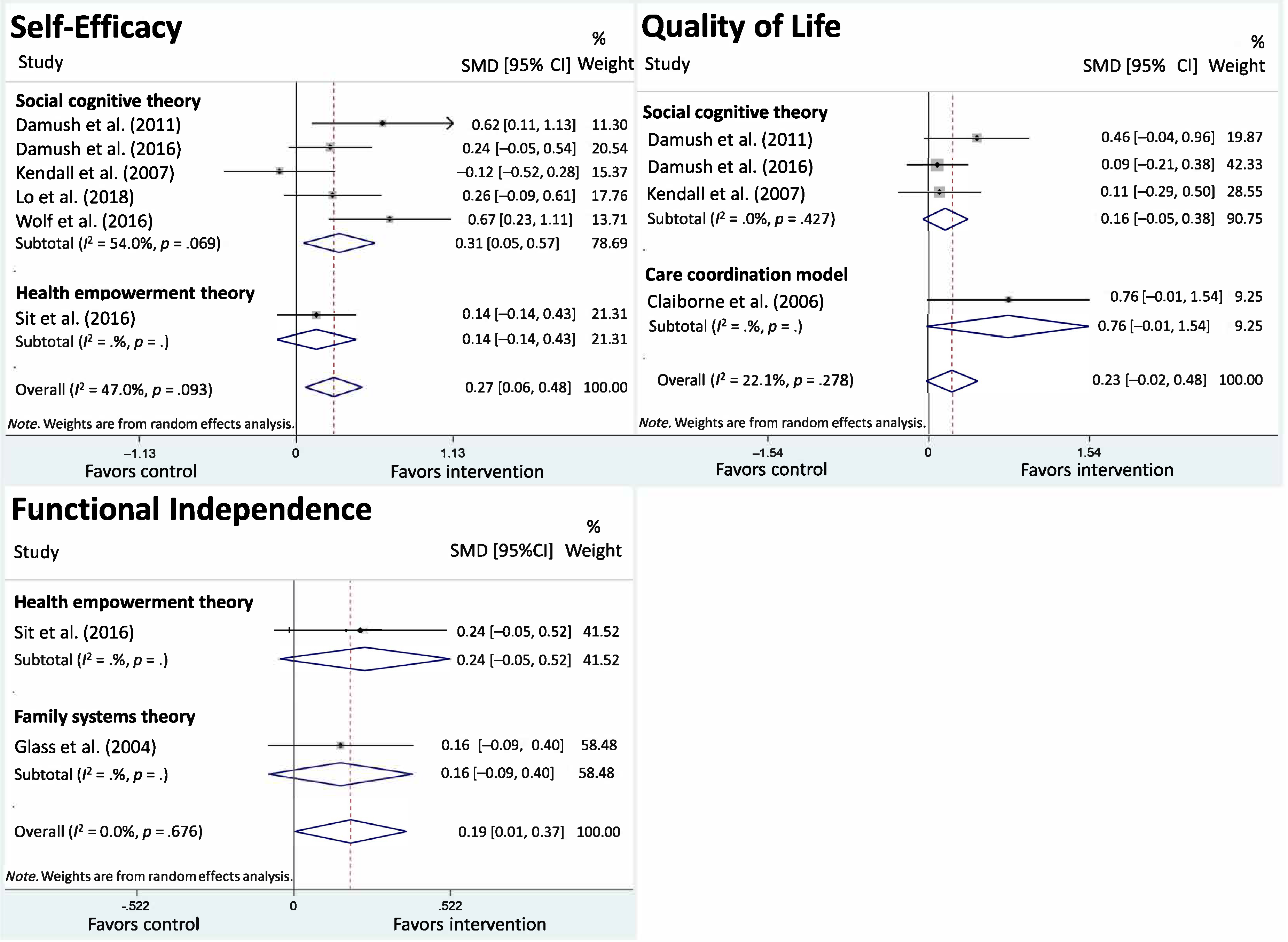
Forest plots of SMD between theory-based self-management interventions and control conditions.
Discussion
An important goal of occupational therapy is to empower patients to take control of their own health and well-being within their context, thereby managing the impact of their chronic condition, sustaining the responsibilities and roles that are meaningful to them, and fully participating in their everyday life (American Occupational Therapy Association [AOTA], 2015). This client-centered approach has made occupational therapy practitioners especially suited to supporting self-management (AOTA, 2015), which has rapidly been gaining prominence in stroke research over the past decade. The purpose of this systematic review was to offer timely evidence for the use of theory and behavioral coding to inform the development of effective self-management interventions for stroke survivors. To our knowledge, this review is the first meta-analysis on self-management interventions for stroke survivors. We also investigated, for the first time, the extent to which theory has been applied to the development of stroke self-management interventions, and we identified the BCTs in each intervention. Results obtained in this review suggest that theory-based self-management interventions could become a routine part of care to help stroke survivors cope with the effects of stroke on their lives.
In the initial search, we identified 3,049 citations, of which only 13 RCTs were included in this systematic review. The relatively scarce number of included articles highlights the paucity of attention and research on the role of theory in the development of stroke self-management interventions. Interventions used in the included studies differed in their use of theory, but SCT (n = 7) was used much more frequently than others. The SCT proposed by Bandura (1986) provides a holistic perspective to enhance self-management by emphasizing the role of social context in learning; in addition, it outlines how behavioral change results from the reciprocal interaction of the cognitive, behavioral, personal, and environmental factors. The SCT is among the most widely used theories in chronic disease management research and is recognized as a cornerstone of effective self-management interventions (Allegrante et al., 2019; Painter et al., 2008). Moreover, the predominance of the SCT is in part attributed to the common adoption of Stanford University’s Chronic Disease Self-Management Program (CDSMP; Lorig et al., 1999) by several of the included studies (Damush et al., 2011, 2016; Kendall et al., 2007; Wolf et al., 2016, 2017). Grounded in SCT, the CDSMP is a globally recognized, theoretical-based self-management program centered around developing patients’ self-efficacy to manage their chronic health conditions (Lorig et al., 1999).
Among the included studies, the majority (n = 8) demonstrated a reasonable use of theories (>50% as assessed by the TCS) in the development of their interventions. However, most studies did not provide sufficient details on the linkages between theory-relevant constructs and intervention techniques, and no study attempted to refine the chosen theory on the basis of the findings. These missing pieces of information are essential for (1) advancing research in theory-based self-management interventions for stroke through a better understanding of what and how theoretical elements were mapped onto the interventions and (2) refining theories to become more relevant to stroke survivors. According to the TCS findings, none of the included studies used theory to tailor the intervention techniques to patients’ characteristics. Self-management interventions often consist of an array of different components, some of which might have little or no relevance to a person. Research with other populations has found an association between patient characteristics and varying self-management capacity (Cameron et al., 2009; Connelly, 1993; Rockwell & Riegel, 2001). Such tailored self-management interventions have been shown to increase patient engagement and produce greater behavioral changes (Park et al., 2013; Plow et al., 2016), warranting further research in the stroke population.
Accurate selection of BCTs is essential for the tenets of theory to be fully realized and to link the causal pathway between theory and intervention effectiveness (Dalgetty et al., 2019). Our results indicate substantial heterogeneity in the application of BCTs across studies. On average, the interventions used 9.14 BCTs, with a range of 1 to 28. The wide range in the number of BCTs used does not seem to be solely explained by choice of theory, given that the interventions that used the lowest (Kendall et al., 2007) and the highest (Sajatovic et al., 2018) number of BCTs were both based on the SCT. Other possible reasons could be limited reporting on participant experiences with the interventions, little awareness of the BCTs, and varying levels of completeness and fidelity in integrating theory into the design of interventions. Among all BCTs identified, the most commonly used BCTs were problem solving and social support. Problem solving is essential for self-sustaining independence by enabling people to identify and overcome barriers to effectively self- manage their unique conditions (Fitzpatrick et al., 2013), whereas social support advocates the involvement of patients’ social networks to support self-management among people with or without compromised self- management capabilities (Koetsenruijter et al., 2016).
To augment the original BCT taxonomy v1 to better capture behavioral changes, we developed additional codes to extend its coverage to intervention delivery and behavior implementation. The widespread use of the extended BCTs in 85% of the studies and the high coding rate of 78.3% of total extended BCT codes suggest high relevance and practical values of our extended BCT codes. Findings on the use of new BCTs indicate that strategies encouraging participants to share or report their implementation behaviors that occurred outside the therapeutic sessions were not commonly applied. This information is important because it reflects whether participants are actually performing and benefiting from the new behaviors addressed in the intervention so that timely modifications could be made by the practitioners to meet the participants’ needs. Moreover, encouraging participants to share their experiences in group sessions also promotes mutual learning, validations, and support from their peers, which have been found to benefit people living with chronic conditions (Foster et al., 2007).
Findings from the meta-analyses suggest that theory-based self-management interventions are effective in enhancing self-efficacy and functional independence, but not quality of life, among community-dwelling stroke survivors. However, caution should be taken when interpreting the results because of the small number of studies available for each analysis and the risk of expectation bias from the unblinded research participants and therapists in all studies. The positive findings on self-efficacy concur with previous literature suggesting that self-efficacy is the core element underpinning self-management that links knowledge and action (Dishman et al., 2005). Self-management interventions enhance stroke survivors’ self-efficacy in different ways, such as mastery experiences, goal attainment, and problem solving (Jones & Riazi, 2011). Compared with self-efficacy, the effect size for functional independence is smaller, and none of the individual studies reached statistical significance.
This result could be because of the fact that the participants were community-dwelling stroke survivors who were in the chronic phase of stroke recovery; hence, additional changes in functional independence may not be anticipated. Moreover, functional independence was measured in the included studies with the Barthel Index, the sensitivity of which is compromised by its ceiling effect among community-dwelling stroke survivors (Young, 2010). Future studies might use participation measures to indicate their participation in community life. The lack of significant findings on quality of life could be related to the length of follow-up because improvements in quality of life might take longer for patients to experience after they started incorporating and implementing self-management strategies in their daily lives. Because of insufficient follow-up data, the long-term effects of interventions were not examined and reflected in the results.
Limitations and Strengths
There are limitations inherent in our systematic review. First, the overall sample of 13 studies was small, and the number of studies for each of the outcome domains was even smaller. The small number of studies precluded a more thorough investigation and the examination of publication bias. Second, the studies commonly excluded stroke survivors with cognitive impairment, and cognitive impairment was ambiguously defined in the inclusion and exclusion criteria (e.g., “no severe cognitive impairment” and “cognitively impaired before stroke”). This ambiguity limited the generalizability of our findings because cognitive impairment is highly prevalent among people with stroke (Sun et al., 2014). Third, the effectiveness of the interventions on long-term outcomes might have been underestimated because follow-up data were not examined. Fourth, we were only able to code what was reported by the included studies so we might have underestimated the use of theory and BCTs in studies that were restrained from providing more details because of journals’ word limits. Despite these considerations, this review has several strengths, including being the first meta-analysis to examine theory-based self-management interventions for community-dwelling stroke survivors and the first to systematically investigate the extent of theory use and the application of BCTs using an established coding scheme and taxonomy; we also used a rigorous search strategy in multiple databases. In addition, we extended the BCT taxonomy v1 to facilitate future reviews and intervention designs in the rapidly developing field of self-management.
Implications for Future Research
The use of TCS and BCT taxonomy v1 is recommended to guide the development and implementation of theory-based stroke self-management interventions. Moreover, TCS and BCT taxonomy v1 are recommended to ensure that the theoretical basis and applications are adequately delineated to achieve the overall objective of preparing people to manage their daily functional needs and to enhance their health and well-being. The use of sequential multiple assignment trials and multiphase optimization strategy designs are also recommended to identify the best combinations of intervention components and to develop adaptive interventions. Future research should also consider a longer duration of follow-up to track long-term outcomes.
Implications for Occupational Therapy Practice
On the basis of our findings, we make the following recommendations for occupational therapy practice: Self-management is a useful tool for occupational therapy practitioners, and it has the potential to be a routine part of occupational therapy to improve stroke survivors’ experience. Providing stroke survivors with the opportunity to learn to manage their “new selves” helps them overcome challenges with stroke symptoms, such as cognitive and physical impairment. Occupational therapy practitioners have been involved in patient education approaches, such as stroke clubs and stroke groups. It is possible to frame these interactions as interventions using self-management approaches. Occupational therapy practitioners who are new to self-management could look for self-management workshops and seminars. Occupational therapy practitioners could benefit from the use of theory to identify relevant content, choose appropriate measures, and select effective approaches in designing and implementing interventions that empower their patients with stroke to manage their new health and life conditions. Occupational therapy practitioners could consider adopting SCT-based approaches to facilitate stroke survivors’ self-management, because people are encouraged to share the successful and unsuccessful strategies they implemented to improve their health in their daily living. Group sessions based on SCT’s social learning approach can encourage participants to share their experiences, promoting mutual learning, validations, and support from their peers. It is important for occupational therapy practitioners to include measures that capture changes in health and participation. Examples include the Participation Strategies Self-Efficacy Scale (Lee et al., 2018), the Activity Card Sort (Baum & Edwards, 2001), the Community Participation Indicators (Heinemann et al., 2011), and the Patient-Reported Outcomes Measurement Information System–Ability to Participate in and Satisfaction With Social Roles and Activities (Bode et al., 2010).
Conclusion
This systematic review provides an overview of the use of theory and BCTs in existing theory-based stroke self-management interventions to inform the design and replication of more effective interventions. Our meta-analyses offer initial evidence for the effectiveness of theory-based self-management interventions to enhance self-efficacy, functional independence, and quality of life among community-dwelling stroke survivors. Our findings suggest that theory-based self-management interventions have the potential to be used as a routine part of care to help community-dwelling stroke survivors cope with the effects of stroke on their lives and to enhance their recovery. Systematic recording and reporting on the use of theory and BCTs are recommended to ensure clarity and facilitate the evaluation of future interventions.
Supplemental Material
Supplementary material for Theory-Based Self-Management Interventions for Community-Dwelling Stroke Survivors: A Systematic Review and Meta-Analysis
Supplementary material, sj-pdf-1-aot-10.5014_ajot.2022.049117.pdf for Theory-Based Self-Management Interventions for Community-Dwelling Stroke Survivors: A Systematic Review and Meta-Analysis by Stephen C. L. Lau, Stephanie Judycki, Mikayla Mix, Olivia DePaul, Rachel Tomazin, Angela Hardi, Alex W. K. Wong and Carolyn Baum in The American Journal of Occupational Therapy
Footnotes
*
Indicates studies included in the scoping review.
Acknowledgments
Carolyn Baum and Alex W. K. Wong are co–senior authors of this systematic review. This review was supported by the Program in Occupational Therapy Dissertation Fund, Washington University in St. Louis, St. Louis, Missouri. The National Institutes of Health (Grant K01-HD-095388) and the American Occupational Therapy Foundation (Grant AOTFIRG20Wong) supported a portion of Alex W. K. Wong’s effort in developing this review.
References
Supplementary Material
Please find the following supplemental material available below.
For Open Access articles published under a Creative Commons License, all supplemental material carries the same license as the article it is associated with.
For non-Open Access articles published, all supplemental material carries a non-exclusive license, and permission requests for re-use of supplemental material or any part of supplemental material shall be sent directly to the copyright owner as specified in the copyright notice associated with the article.
