





Abstract
The findings of this study confirm that understanding the development of playfulness and exploring its relationship with cognitive functioning in typically developing children fills important gaps in occupational therapy knowledge and contributes to delivery of early intervention, especially when cognition or playfulness are at risk.
Occupational therapy practitioners use play in interventions both as a goal and as a means to improve development and social participation (Cahill & Beisbier, 2020; Fabrizi et al., 2016; Miller Kuhaneck et al., 2013; Waldman-Levi & Weintraub, 2015; Wilkes-Gillan et al., 2016). Although children’s play progresses as they interact with their physical, sensory, and social worlds (Pachner, 2014; Vygotsky, 1966/2016), the role of playfulness in development has not yet been explored. Playfulness is an internal disposition with emotional and cognitive components. It is linked to coping skills, adaptation, and a sense of well-being (Gordon, 2014; Magnuson & Barnett, 2013; Proyer, 2012). There is ample evidence of deficits in playfulness among children with disabilities (e.g., Bundy et al., 2007; Cordier et al., 2010; Fabrizi et al., 2016) as well as in adults’ playfulness (e.g., Barnett, 1990, 2007, 2019; Proyer, 2012). The discussion of children’s playfulness remains focused on the effects of culture, gender, and the environment (Barnett, 2018; Barnett & Kleiber, 1982, 1984). Neither the manifestation of playfulness in typically developing children nor how it changes over time has been explored. Understanding whether playfulness exhibits a developmental trajectory and exploring its relationship with cognitive functioning could fill two important gaps in knowledge and promote the delivery of early intervention, especially when children’s cognition or playfulness is at risk.
Knowing the extent to which cognition contributes to playfulness or vice versa will inform occupational therapy practitioners as they plan interventions. If cognition contributes to playfulness, the emphasis of intervention would be on fostering cognitive development while assessing its effect on playfulness and related factors (e.g., coping). However, if cognitive development is fostered through playfulness, then the emphasis would be on creating opportunities for children to play and be playful. In this study, we explored the relationship between infant playfulness behavior and cognitive functioning during a time of rapid growth in all areas of development and the development of playfulness from infancy through toddlerhood in the context of parent–child play.
To comprehend the relationships between playfulness and cognitive development, we used a simple mediation model to assess both during laboratory and home visits. With the mediation model, we examined whether playfulness behavior at age 6 mo affects playfulness behavior at age 24 mo through its effect on cognitive functioning at age 18 mo. We speculated that playfulness at age 6 mo would affect cognitive functioning at age 18 mo, which may in turn influence children’s playfulness at age 24 mo.
Changes in play are associated with cognitive development (Pachner, 2014; Vygotsky, 1966/2016). For example, one study found that 6-mo-old infants’ engagement in physical play activities and in oral and manual exploration longitudinally related to language and cognitive performance at age 24 mo (Zuccarini et al., 2017). Progression from object and solitary play to manipulation of the physical and social environments corresponds with children’s growing capacity to use symbols and abstraction and occurs at around ages 12 to 18 mo (Knox, 2008; Vygotsky, 1966/2016). Cabrera et al.’s (2017) findings confirmed that pretend play is indeed related to vocabulary and emotional regulation at age 4 yr. Previous studies have demonstrated relationships between children’s play and playfulness (Lee et al., 2016) as well as among imaginative capacity, creativity, and playfulness (Moller, 2015). However, the measurement of play and playfulness has varied across studies. Some measured play by its form (e.g., object play, symbolic play) and playfulness as manifested in symbolic play or joy or silliness behavior, which are in turn related to cognitive functioning (Barnett & Kleiber, 1982).
The Playfulness Model (Bundy & Du Toit, 2019; Neumann, 1971; Skard & Bundy, 2008) postulates that playfulness reflects a continuum ranging from nonplayful to playful and consists of four essential elements: intrinsic motivation—the ability to engage in self-chosen, meaningful play activities (e.g., level of engagement and enjoyment), for which the source could be anything; internal control—the ability to change play to create more fun or challenge or to persist despite encountering personal (e.g., developmental deficits or immature skills) or environmental challenges (e.g., physical or human barriers); freedom from unnecessary constraints of reality—the ability to determine how close to objective reality a play transaction will be (e.g., pretending an object is something other than what it is) or engaging in joking or mischievous behaviors; and framing—the ability to provide and read cues that indicate how a player wants to be treated during the play and that support the continuation of play (e.g., Bundy & Du Toit, 2019; Skard & Bundy, 2008).
The Playfulness Model was incorporated into the Test of Playfulness (ToP; Skard & Bundy, 2008), an observation-based assessment for children between ages 6 mo and 18 yr. Many studies have confirmed differences in playfulness between atypically and typically developing children (e.g., Bundy et al., 2007; Cordier et al., 2010; Leipold & Bundy, 2000; Reed et al., 2000). Most studies that have examined playfulness have relied on Barnett and Kleiber (1982, 1984) and Barnett’s (1990) assumption that playfulness is a predisposition. However, a predisposition is a tendency, not an invariant quality. Thus, it is necessary to examine the ways in which playfulness, like play, changes over time. Keleş and Yurt’s (2017) study stands out because it examined playfulness among typically developing children ages 41 to 80 mo using the Child Playfulness Scale (CPS; Barnett, 1990). The CPS assesses playfulness through five separate components: (1) physical spontaneity, (2) social spontaneity, (3) cognitive spontaneity, (4) manifest joy, and (5) sense of humor. Although the ToP consists of four core concepts, it measures a unitary construct. Neither studies that used the CPS nor those that used the ToP have assessed the developmental trajectory of playfulness. Some researchers (e.g., Wilkes-Gillan et al., 2016) showed that promoting play leads to improvements in playfulness for school-age children with disabilities. Little is known about the development of playfulness among typically developing children or about the relationship of playfulness to cognitive functioning; knowledge of both may be pivotal to clinicians’ work with families with young children.
Occupational therapists often assess toddlers’ cognitive functioning using the Bayley Scales of Infant Development or the Miller Assessment for Preschoolers (e.g., Golos et al., 2011; Kleberg et al., 2002); both tools measure cognition and other developmental skills. The most common and comprehensive measure of early childhood cognitive development is the Mullen Scales of Early Learning (MSEL; Mullen, 1995). The MSEL is useful in assessing verbal and nonverbal cognitive abilities among very young children (Yitzhak et al., 2016). In addition, the MSEL is used extensively to identify children at risk for developmental delays (e.g., Yitzhak et al., 2016). Because of the MSEL’s suitability for measuring general cognitive functioning through verbal and nonverbal abilities, the scales have been adapted and validated across cultures (e.g., Milosavljevic et al., 2019; Yitzhak et al., 2016). The link between play and cognition is well established (e.g., Cabrera et al., 2017; Zuccarini et al., 2017), as has a link between pretend play and playfulness (Lee et al., 2016). The quality of pretend play is associated with cognitive and emotional self-regulation as early as age 3 yr (Delvecchio et al., 2015; Slot et al., 2017). However, the possible association between cognitive functioning and playfulness has not yet been explored (Keleş and Yurt, 2017).
To explore the development of playfulness and its relationship to cognition, we conducted a longitudinal study of typically developing children from infancy to toddlerhood. We also sought to determine the extent to which cognition mediates playfulness. We hypothesized that (1) there would be significant differences in children’s playfulness as measured with the ToP at ages 6 and 24 mo and (2) cognitive functioning at age 18 mo would mediate (explain) the development of infant playfulness at ages 6 and 24 mo. To test these hypotheses, we established a simple mediation model. The model postulates that cognitive functioning at 18 mo (the mediator) would explain the relationships between playfulness at age 6 mo (the independent variable) and playfulness at age 24 mo (the outcome variable). The simple mediation model is illustrated in Figure 1.
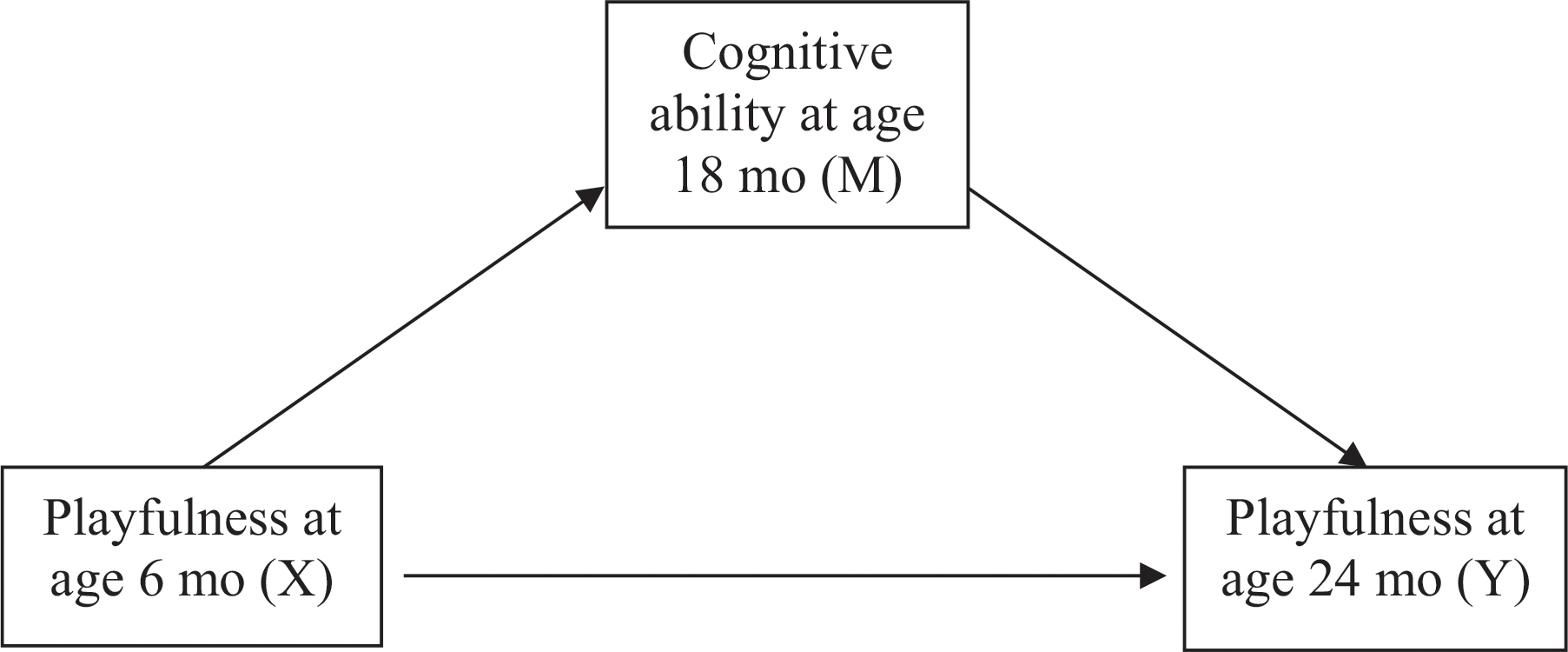
Hypothesized mediation model.
Method
The institutional review board of the Interdisciplinary Center Herzliya (Herzliya, Israel) granted approval for this study on May 3, 2015.
Participants
Eighty-six children participated in this study. There was a slight fluctuation in gender distribution at each time point as a result of dropouts or no shows; at age 6 mo, n = 96 (51 [53.1%] boys, 45 [46.9%] girls); at 18 mo, n = 103 (49 [47.6%] boys, 45 [43.7%] girls); and at 24 mo, n = 89 (45 [50.6%] boys, 44 [49.4%] girls). We collected data at three time points: Time 1 (T1), infancy (age 6 mo); Time 2 (T2), early toddlerhood (age 18 mo); and Time 3 (T3), toddlerhood (age 24 mo). The children were drawn from a sample of 109 Israeli families who participated in a longitudinal study. All children were firstborn and lived with heterosexual parents (Shai, 2019). The families lived in central Israel and were low risk, Jewish, and of middle to upper socioeconomic status (SES). Mothers’ mean age when the infants were 6 mo old was 32.5 yr (SD = 3.5, range = 25–44). Mothers’ mean years of education was 16 (SD = 2.9). All mothers were fluent in writing and speaking Hebrew and, based on a comprehensive baseline assessment reported by Shai (2019), did not report at-risk pregnancies or known neurological, psychiatric, or psychological disorders. We recruited the families through internet advertisements, flyers, and medical centers. A sample size of 86 was deemed sufficient (Conroy, 2016), based on a confidence level of 95% with a large population size (e.g., 50,000).
Instruments
Mullen Scales of Early Learning
The MSEL was administered at T2. It is a comprehensive measure of cognitive functioning for infants and preschool children from birth through age 68 mo and is administered by trained psychologists. It is used to assess four cognitive areas (visual reception, fine motor, receptive language, expressive language) and one gross motor area (not used in this study). Scores from the four cognitive areas are combined to produce an Early Learning Composite that represents general intelligence. The MSEL kit consists of standardized toys and objects (e.g., doll, blocks). Many items include a demonstration; administration time ranges from 15 to 60 min, depending on age. The more tasks a child completes, the higher the score, reflecting more advanced development. The MSEL has a theoretical basis in neurodevelopment and has good evidence of its construct and criterion validity as well as reliability in a normative population (Mullen, 1995). The MSEL provides both normative and standardized general scores (M = 100, SD = 15), based on the normative and standardized cognitive scales (M = 50, SD = 10).
Test of Playfulness
The ToP was administered at T1 and T3. It is a 29-item standardized observation tool for use with infants, children, and adolescents ages 6 mo to 18 yr. Trained raters score the items on a 4-point scale ranging from 0 (low frequency of the behavior, low intensity, or unskilled) to 3 (high frequency of the behavior, high intensity, or skillful); each item represents the extent of (proportion of time), intensity of, or skillfulness in one of four core concepts: intrinsic motivation, internal control, freedom from unnecessary constraints of reality, and framing. Scores are based on 15-min observation in familiar play settings. The ToP has established evidence of its internal reliability and construct validity (Bundy et al., 2001; Muys et al., 2006).
Procedure
At T1, each mother and her 6-mo-old infant visited the laboratory and engaged in 10 min of joint play that was recorded by four cameras at different angles. At T1, we recorded only 10 min of joint play, given the limited attention span of 6-mo-old infants (Knox, 2008). At both T2 and T3, we conducted home visits and observed mother–child dyads playing together for 15 min. The play interaction was video recorded. At each time point, we provided the dyad with age- appropriate toys (e.g., rattles, pop-up toys, dolls, tracks, blocks, puzzles, crayons) and invited them to play on a mat in the way in which they usually played together.
Graduate psychology students trained by a certified developmental psychologist (Dana Shai) administered the MSEL. Mothers were requested to avoid helping their children complete items but were encouraged to keep the children’s attention on the task (Shai, 2019). Graduate psychology students proficient in English scored the ToP as the children played with their mothers. A certified and licensed occupational therapist (Amiya Waldman-Levi) trained the ToP raters (Waldman-Levi et al., 2019). The month-long training included observing video-recorded play interactions, independently scoring them using the ToP manual, and group discussions to clarify differences in scoring. The calibration process resulted in raters’ Rasch- generated fit statistics within acceptable limits (MnSqs ∼1 and standardized z values ∼0). Upon completion of data collection, training, and calibration, graduate psychology students observed and scored the video recordings and entered all ToP and MSEL scores into the data set.
Data Analysis
Data were entered into IBM SPSS Statistics (Version 25). Initially, data were organized, and total scores were computed for the independent variable (ToP score at age 6 mo) and dependent variable (ToP score at age 24 mo), as well as for the mediator (MSEL score at age 18 mo). For all analyses, we used ToP raw scores (0 = low, 3 = high). Before other statistical analyses, we explored descriptive statistics for the demographic information and ToP and MSEL scores. To ensure there were no confounding variables, we calculated Pearson correlations between ToP scores at ages 6 and 24 mo and maternal education.
To test our first hypothesis—whether there would be significant differences in children’s playfulness as measured on the ToP at ages 6 and 24 mo—we used a paired t test (p < .05). To address our second hypothesis—whether cognitive functioning at age 18 mo would mediate the development of infant playfulness at ages 6 and 24 mo—we took several steps. First, we performed bivariate Pearson correlations between ToP scores at age 6 mo and ToP scores at age 24 mo, MSEL scores at age 18 mo and ToP scores at age 24 mo, and ToP scores at age 6 mo and MSEL scores at age 18 mo. Second, we calculated linear regression analyses to test whether ToP scores at age 6 mo predicted ToP scores at age 24 mo and whether MSEL scores at age 18 mo predicted ToP scores at age 24 mo. Last, we used the PROCESS macro (Version 3) added to IBM SPSS Statistics for the mediation analysis. We set p at <.05 for the bootstrapping approach with 1,000 samples to ensure that results from this sample could be generalized to the population (Hayes, 2017).
Results
The study’s findings are presented in relation to each hypothesis.
Hypothesis 1: Playfulness Development
Infants age 6 mo demonstrated a low level of playfulness behavior (M = 0.40, SD = 0.18); ToP raw scores ranged from 0 (low) to 3 (high). However, at age 24 mo, the same infants appeared to be more playful (M = 1.82, SD = 1.18). Paired t-test results confirmed the first hypothesis, according to which infants’ playfulness behavior showed a progression over time, t(88) = −60.30, p < .001, 95% confidence interval (CI) [−1.47, −1.38]. Toddlers’ mean cognitive score of 47.77 (SD = 19.68) matched the reported test mean of 50 (SD = 10; Mullen, 1995).
Hypothesis 2: Mediation Hypothesis
Correlations revealed that the more playful infants were at age 6 mo, the higher their cognitive functioning was at age 18 mo and the more playful they were at age 24 mo. Toddlers with higher cognitive performance at age 18 mo demonstrated more playful behavior at age 24 mo (see Table 1). Neither infant cognitive functioning at age 18 mo nor playfulness at age 6 or 24 mo correlated with level of maternal education. Infants’ playfulness at age 6 mo predicted cognitive functioning at age 18 mo. Toddlers’ cognitive functioning at age 18 mo predicted playfulness at age 24 mo (Table 2).
Correlations Between Playfulness at Age 6 Mo, Cognitive Functioning at Age 18 Mo, and Playfulness at Age 24 Mo
Note. N = 86. MSEL = Mullen Scales of Early Learning; ToP= Test of Playfulness.
p < .01.
p < .001.
Standardized Regression Coefficients Predicting Playfulness Behavior at 24 Mo From Playfulness Behavior at 6 Mo and Cognitive Functioning at 18 Mo
Note. N = 86. MSEL = Mullen Scales of Early Learning; ToP= Test of Playfulness
p < .001.
When we tested the mediation hypothesis in full, we noted that playfulness scores at age 6 mo significantly predicted cognitive functioning at age 18 mo (β = 26.680, SE = 7.721, p < .01), and cognitive functioning at age 18 mo was a significant predictor of playfulness scores at age 24 mo (β = 0.005, SE = 0.001). Consistent with full mediation, after controlling for cognitive functioning at age 18 mo, playfulness at age 6 mo was no longer a significant predictor of playfulness at age 24 mo (β = 1.167, SE = 0.100, ns). Approximately 20% of the variance in ToP scores at age 24 mo was accounted for by the predictors (R 2 = .20). Bootstrap estimation indicated that the indirect coefficient was significant (β = 0.120, SE = 0.05, 95% CI [0.0377, 0.2276]). Playfulness at age 6 mo was associated with playfulness at age 24 mo and was approximately 0.12 points higher as mediated by cognitive functioning at age 18 mo (Figure 2).
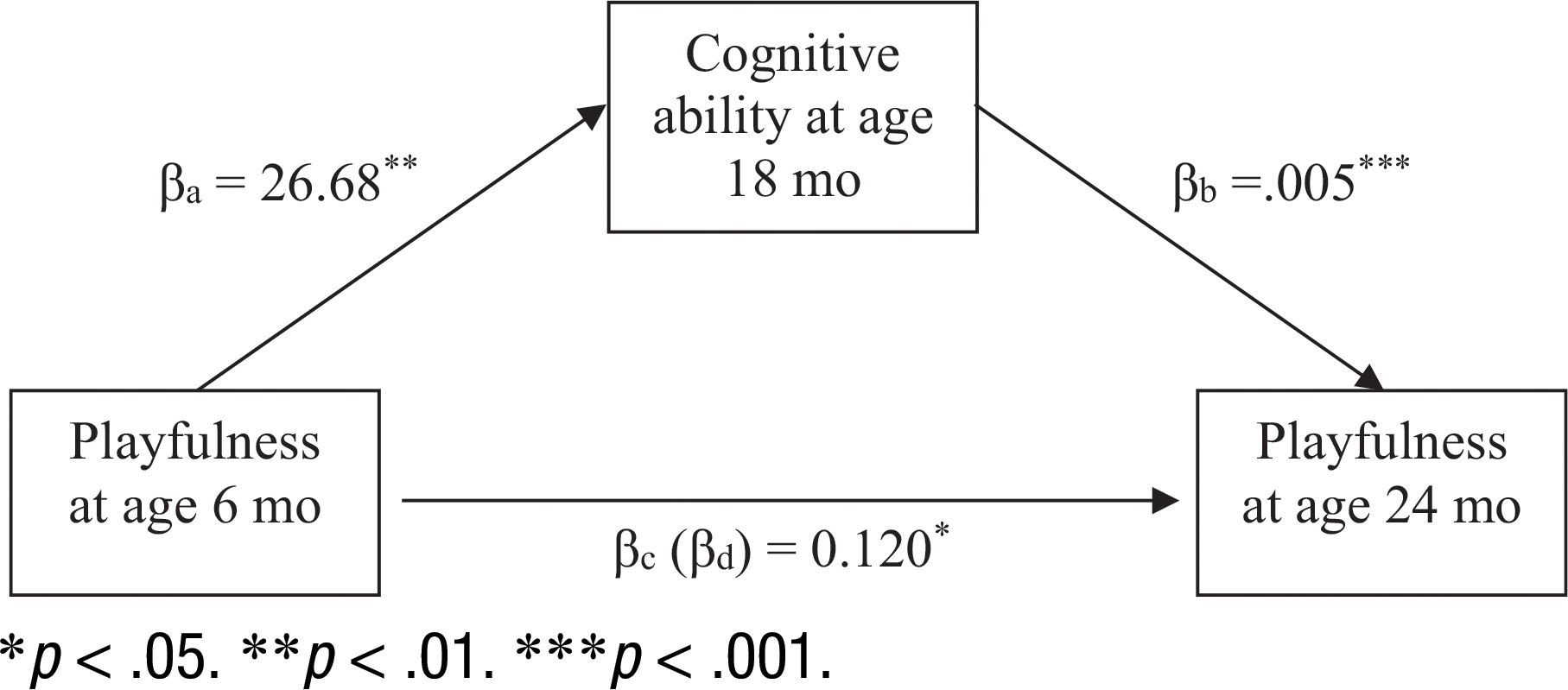
Full mediation model.
Discussion
Play is children’s central occupation; through it, they practice and develop cognitive, metacognitive, and social skills and regulate their emotions (Pachner, 2014; Slot et al., 2017; Spektor-Levy et al., 2017). Playfulness is observed, yet not exclusively, when children engage in self-chosen and intrinsically motivated play activities (Bundy & Du Toit, 2019 ; Skard & Bundy, 2008). Ample research has examined children’s cognitive development, some of which relates to play but not to playfulness. We found that playfulness progresses from ages 6 to 24 mo and is mediated by cognitive functioning, suggesting that cognitive functioning contributes to the development of playfulness. Pachner (2014) and Vygotsky (1966/2016) have claimed that play is the context in which cognitive processes are developed. Similarly, Spektor-Levy et al. (2017), in a cross-lagged study of children ages 5 to 10 yr, found that age had a significant effect on cognitive performance (accuracy, monitoring, control), metacognition, and self-regulation in problem-solving tasks. Similar behaviors are assessed with the Playfulness Model (e.g., creative use of objects and ideas, ability to overcome challenges; Skard & Bundy, 2008). Hence, Spektor-Levy et al.’s (2017) findings resonate with those of the present study regarding the effect of cognition on children’s development of playfulness.
Children’s play behavior is broken down into types of play—for example, explorative play, play with objects, pretend play, and social play (Parham, 2008). In this vein, Zuccarini et al. (2017) provided further support to our study regarding the association between playfulness and cognitive functioning. The former is observed when infants spend time exploring and manipulating objects and their environments while engaging in social play with adult caregivers. Zuccarini et al. (2017) reported that the duration of manual exploration at age 6 mo is longitudinally related to language and cognitive performance scores at age 24 mo. However, in this study we assessed playfulness behavior during mother–child joint free play, using Skard and Bundy’s (2008) measure. This measure of children’s playfulness behavior consists of four core components: source of motivation, locus of control, freedom from constraints of reality, and framing the play activity by providing and receiving social cues (Skard & Bundy, 2008). However, the ToP has been shown to measure a unidimensional construct, even though it contains four contributing elements. Regardless of whether the ToP measures a unidimensional construct, this study confirmed that typically developing children’s playfulness behavior develops over time.
We assessed playfulness in a laboratory environment (T1, age 6 mo) and a home environment (T2, age 18 mo, and T3, age 24 mo). In both environments, mothers and children were provided with age-appropriate toys. In similar studies, the convention has been to select the environment to allow the researcher to capture play in the most natural setting for the child on the basis of their age (e.g., O’Grady & Dusing, 2015; Roberts et al., 2018; Waldman-Levi et al., 2019). An additional aspect worth consideration is the duration of the play observation. When infants were 6 mo old, we observed them playing for 10 min; when they were 24 mo old, we observed them playing for 15 min. We based our decision on the expected attention span of infants and toddlers (Knox, 2008; Skard & Bundy, 2008). The ToP measures playfulness behavior with three different scales, one of which is Extent (proportion of time). The Extent scale captures the amount of time a child displays certain playfulness behaviors during the allotted time. By reducing the time we observed infants playing, we may have artificially inflated scores for Extent items. Perhaps an infant playing for 5 or 10 min received a higher score than a child playing for 5 or 15 min. This could potentially mean that the differences in ToP scores from T1 to T3 are even greater than the statistically significant difference we found. The difference between playfulness at ages 6 and 24 mo was statistically different, so a longer observation at 6 mo would not have changed the results.
Although adult playfulness is often described as a predisposition (Barnett, 2007; Proyer, 2012) children’s playfulness (as measured by the ToP) is developing. Promoting the development of playfulness from a young age is imperative because it contributes to toddlers’ cognitive functioning, which in turn promotes further development of playfulness. Frolek-Clark and Kingsley’s (2020) evidence-based clinical recommendations for early childhood occupational therapy point to the effectiveness of a therapist-led home-based intervention that implements play activities to promote children’s development (Frolek-Clark & Schlabach, 2013), as well as highlight the contribution of cognitive skills training programs to preschool children’s cognitive functioning. We concur with these recommendations for practice.
Limitations and Future Research
The study sample consisted of children from families of middle to upper SES. It is important to replicate this study with low-income families. We did not explore the effects of maternal responses and contributions during joint play on a child’s playfulness, and we did not examine paternal behavior. Future studies should assess maternal and paternal involvement during joint play; play among families identifying as lesbian, gay, bisexual, transgender, queer/questioning, or intersex and Black, Indigenous, and people of color; and possible contributions to a child’s playfulness and cognitive development.
Implications for Occupational Therapy Practice
This study has the following implications for occupational therapy practice: Cognitive functioning supports the development of playfulness and should be assessed and promoted with infants at risk for developmental delays. Occupational therapists should first assess an infant’s cognitive functioning and playfulness and then provide suitable interventions for infants at risk for developmental delays, promoting playfulness in the context of parent–child or caregiver– child everyday life in addition to promoting their cognitive functioning. Occupational therapists play a key role in advocating for the centrality of play in children’s lives to support the development of playfulness and cognitive functioning. An interdisciplinary team of educators, psychologists, and occupational therapists is well versed in designing opportunities and can work collaboratively to promote play among typically developing children. These findings can be incorporated into family and early child play-based preventive and health promotion programs.
Conclusion
We conclude that cognitive functioning supports the promotion of playfulness. Children learn to manipulate objects in various ways, form new ways to handle their environment, be mischievous and enjoy themselves, transition between activities, choose what to play with, and communicate their needs and preferences to others. Children make believe and create their own stories; they derive joy, relief, and fulfillment as they overcome challenges while figuring out solutions by themselves. These behaviors reflect playfulness and develop over time. Our findings call for parents, clinicians, and educators to value children’s playfulness and to reposition play in the center of their everyday life engagement. Moreover, occupational therapists working with young children and their families should consider adopting the Playfulness Model to guide interventions when children’s cognitive or playfulness development is at risk.
Footnotes
Acknowledgments
We thank all the families who participated in this study and trusted us to watch them play, parent, and love their children. We are thankful to the graduate students who assisted with data collection and data management. This research was supported by grants from the Israeli Science Foundation (No. 1888/14) and the FP7-PEOPLE-2012-IEF-Marie- Curie Action: Intra-European Fellowships for Career Development (Grant 300805).