





Abstract
This study verifies the relationship between a short-duration group program using an occupational diary and maintaining or improving satisfaction with occupation among community-dwelling older adults after program cessation.
Efforts to maintain and improve the health and well-being of older adults are gaining increasing importance given the aging global population (He et al., 2016). Against this social background, the field of occupational therapy has developed health promotion programs for community-dwelling older adults (Berger et al., 2018; Smallfield & Molitor, 2018). Health promotion efforts enable people to increase control over and improve their health (World Health Organization, 1986). The ultimate goal of health promotion is well-being (American Occupational Therapy Association, 2020), an evolving concept that includes the presence of positive emotions and moods, the absence of negative emotions, satisfaction with life, fulfillment, and positive functioning (Centers for Disease Control and Prevention, 2018).
Occupation-focused health promotion programs for healthy community-dwelling older adults, verified by means of randomized controlled trials (RCTs), include Lifestyle Redesign® (Clark et al., 1997, 2012) and a program that uses the Model of Human Occupation (Kawamata et al., 2012; Yamada et al., 2010) that consists of more than 15 sessions and takes more than 6 mo to implement. However, an RCT conducted in Sweden reported that a one-session program with occupation-focused discussions minimized declines in leisure engagement and ability to perform activities of daily living (Zingmark et al., 2014). Although the effect sizes were small, these results suggest that further research may enable the development of more effective programs that can be carried out in fewer sessions.
A shorter program may overcome potential barriers, such as a dearth of funding for health promotion, scarcity of clinicians working in community settings, and participants’ time constraints (Cassidy et al., 2017). Therefore, our team developed a group program consisting of one session per week for 4 wk and verified the effects of the program with an RCT (Takagi, Goami, & Bontje, 2020; Takagi, Goami, Orita, & Bontje, 2020). In total, the RCT included 125 community-dwelling older adults, 62 who were assigned to an intervention group and received the program and 63 who were assigned to a nonintervention control group. The RCT verified the effects of the program, confirming that scores on scales measuring satisfaction with occupation (Activity and Daily Life Satisfaction Scale for the Elderly [ADLSS]; Okamoto, 2009), sense that life is worth living (K–I Scale for the Feeling that Life is Worth Living among the Aged [K–I]; Kondo & Kamada, 2003), and life satisfaction (Life Satisfaction Index–Z [LSI–Z]; Wood et al., 1969) improved among community-dwelling older adults. Scores on these three scales showed a medium to large effect size (rs = .33–.36). Although the two studies (Takagi, Goami, & Bontje, 2020; Takagi, Goami, Orita, & Bontje, 2020) confirmed the effects immediately after the end of the program, it is unclear whether the program relates to participants’ satisfaction with occupation and life satisfaction beyond that.
Assessments of long-term impacts are critical to understanding the influences and efficiency of health promotion programs in terms of developing clients’ abilities to manage their health and well-being (Reitz & Graham, 2019). Previous studies have clarified that such programs have positive effects on life satisfaction and quality of life, even 3 to 12 mo after the final session of some programs (Clark et al., 2001; Kawamata et al., 2014; Zingmark et al., 2016). The expectation is that participants will use the knowledge and experience gained during the program developed by Takagi, Goami, and Bontje (2020) in their subsequent life and that it will have positive effects on their satisfaction with occupation, sense that life is worth living, and life satisfaction, even after the program.
This program used an occupational diary; thus, we hypothesized that continued use of the diary after the program’s end could improve satisfaction with occupation. The diary is a new tool to help people monitor daily occupational experiences that provide satisfaction or dissatisfaction (Takagi, Goami, & Bontje, 2020). It is based on the relationship between daily occupations and satisfaction, which shows that people feel satisfaction with occupations that include the following nine elements: connection, affirmation, contribution, effort, enjoyment, progress, success, acquisition, and recovery. Takagi et al. (2019) clarified this relationship by means of a qualitative analysis using narratives and records of occupational experiences that influenced the daily satisfaction of 20 community-dwelling older people. In this study, program participants were required to use the diary to identify occupations affecting their daily satisfaction each day and to analyze their occupational experience with regard to the aforementioned nine elements.
In this study, we aimed to (1) verify the relationship between a short group program using an occupational diary and changes in satisfaction with occupation, a sense that life is worth living, and life satisfaction among community-dwelling older adults 3 mo after the program and (2) identify the factors associated with changes in satisfaction with occupation—the primary outcome—after the program.
Method
Study Design
This study was conducted after the RCT conducted by our team (Takagi, Goami, Orita, & Bontje, 2020). Most control group participants received the program immediately after the RCT was conducted. A before-and-after comparison study verified the relationship between receipt of the program and changes in satisfaction with occupation, a sense that life is worth living, and life satisfaction. A case–control study was also conducted to clarify the factors associated with changes in satisfaction with occupation after the program.
Participants
The selection criteria for participants were (1) age ≥65 yr, (2) living independently, and (3) being able to answer the questionnaire on their own. Exclusion criteria were living in a care facility or being hospitalized.
Participants were recruited from a city in Japan with a population of just under 100,000 and an aging rate of 34.5% as of 2019; the population ages and declines annually. All older adults living in the city were approached through a public relations magazine and flyers distributed throughout the city. We gathered 152 people interested in the program in a university classroom to explain the study outline; 144 people agreed to participate.
Program
The Conceptual Model of Self-Monitoring (Wilde & Garvin, 2007) and Social Cognitive Theory (Bandura, 1986, 2004) were applied to the program to improve participants’ ability to manage daily occupations. We expected that occupational experiences that made participants feel satisfied with their daily lives would increase if participants improved their ability to manage daily occupations. Hence, we hypothesized that an increase in participants’ positive occupational experiences would be related to their improved satisfaction with occupation, enhanced sense that life is worth living, and increased life satisfaction (Takagi, Goami, & Bontje, 2020; Takagi, Goami, Orita, & Bontje, 2020).
This program consisted of using an occupational diary and attending group sessions. Participants were expected to use the diary at home daily during the program. Each day, participants selected the activity they did that day that most influenced their daily satisfaction. Next, they chose which elements (connection, affirmation, contribution, effort, enjoyment, progress, success, acquisition, and recovery; Takagi et al., 2019) fit their occupational experience. Figure 1 shows how the diary was completed and provides examples.
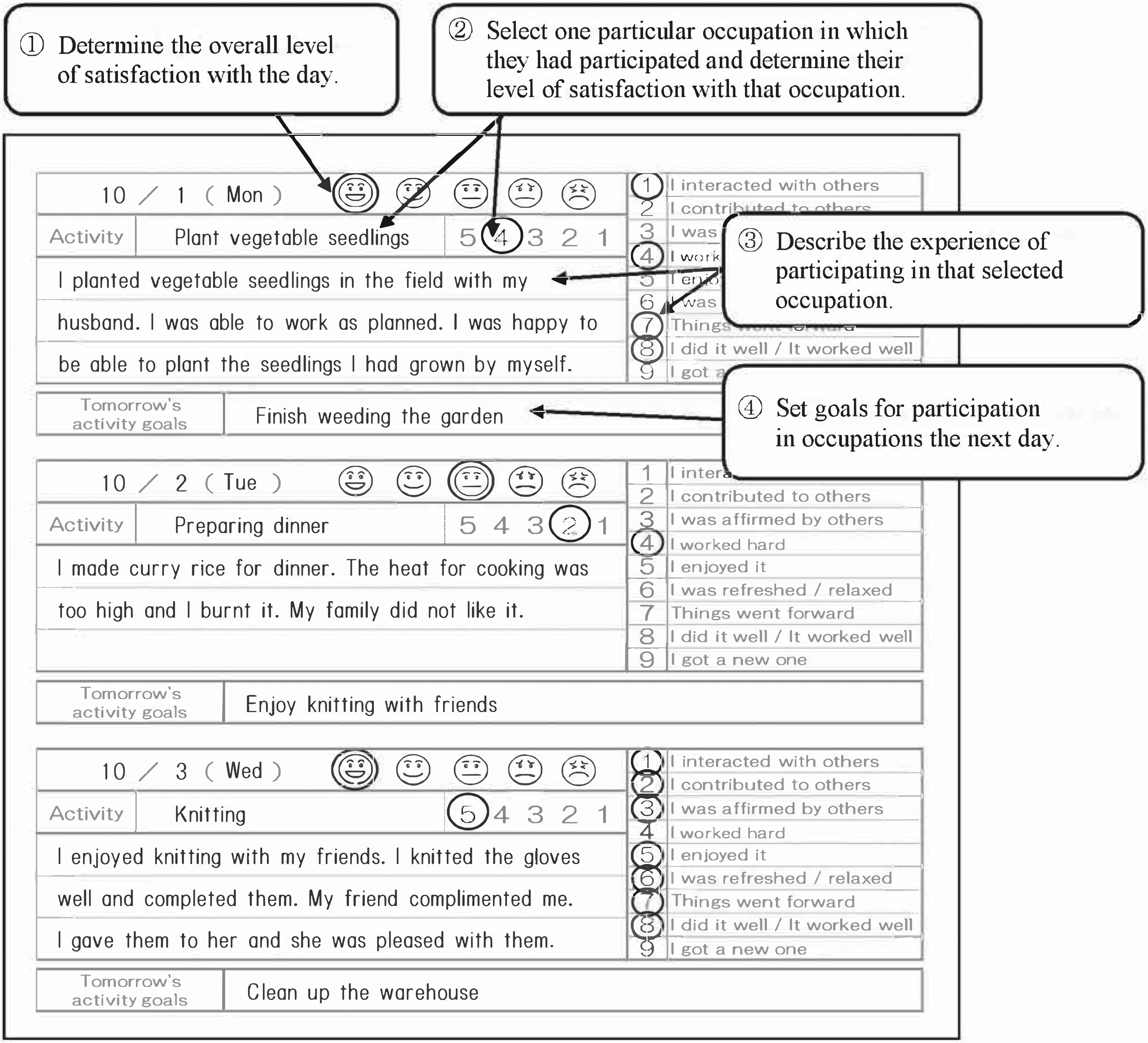
Instructions for writing an entry in the occupational diary and an example of a diary entry.
Group sessions were held once per week for 4 wk. Each session lasted 2 hr. The sessions included three elements: (1) lectures that provided the knowledge necessary to understand the relationship between daily occupational experiences and life satisfaction, (2) exercises in which participants analyzed their daily experiences on the basis of occupational diary and planned their daily occupations, and (3) sharing the plans that were made and the results of executing those plans. Specifically, in the first session, participants learned the relationship between occupation and satisfaction, as well as how to keep an occupational diary. They were then asked to make daily diary entries. In the second and subsequent sessions, they analyzed the past week’s diary entries and planned an occupation that could be performed the next week. Finally, the plan was shared with the group members. Carrying out the plan and keeping the diary were homework. At the beginning of each session, group members reflected on and shared the results of executing their plans. All group sessions were held in a classroom at the university. The first author, Masayuki Takagi, an occupational therapist, conducted all sessions, including lectures, exercises, and sharing, and the second author, Naruko Goami, also an occupational therapist, assisted.
The program was implemented over two terms: from January to February 2019 and from February to March 2019. Sixty-two participants attended the first term, and 82 participants attended the second. In both terms, participants were divided into four groups of 15 to 22 people according to their schedule. Each group’s participants attended the sessions at the same time. At the end of the program, an additional diary was distributed to all participants so that they could continue to write for 3 mo after the program. The decision to continue using the diary after the program was left to their discretion.
Outcome Variables and Measures
Evaluations were conducted at the start of the program (pretest), at the end of the program (posttest), and at the follow-up held 3 mo after the program. The first author who conducted the group sessions also distributed and collected the questionnaires in a university classroom during all evaluations. Participant characteristics were collected, including sex, age, educational background, family status, income, whether they drove a car, hobbies, diary habits, medication, hospital visits, going out, interacting with friends, and perceived health at the pretest.
Each evaluation measured satisfaction with occupation, a sense that life is worth living, and life satisfaction. Satisfaction with occupation was the primary outcome. The ADLSS (Okamoto, 2009) was used to measure satisfaction with occupation. The respondents rated four items on a 5-point scale ranging from 1 (not applicable at all) to 5 (very applicable). Cronbach’s coefficient α was .83, and coefficient ω was .86 (Okamoto, 2009).
The K–I (Kondo & Kamada, 2003) was used to measure the sense that life is worth living. The respondents rated 16 items on a 3-point scale (0 = no; 1 = not sure; 2 = right), with total scores ranging from 0 to 32; higher scores indicated a higher sense that life is worth living. The correlation coefficient was .87, and the test–retest correlation coefficient ρ was .83. Cronbach’s coefficient α was .82 (Kondo & Kamada, 2003).
The LSI–Z (Wood et al., 1969) was used to measure life satisfaction. The respondents rated 13 items on a scale ranging from 0 to 2. Total scores could range from 0 to 26; higher scores indicated higher satisfaction. The correlation coefficient was .57, and the Kuder– Richardson 20 coefficient α was .79 (Wood et al., 1969). Participants’ scores on the LSI–Z showed significant changes as a result of the effects of Lifestyle Redesign (Clark et al., 1997, 2012) and a program that applied the Model of Human Occupation (Yamada et al., 2010).
The continued use of the diary was evaluated only at follow-up. A self-administered questionnaire was used to investigate whether the participants continued to use the diary after the program ended. Participants were asked, “Have you written in the occupational diary since the program cessation?” Response options were “I have written in it every day,” “I have sometimes written in it,” “I don’t keep one,” or “other.” We rated “I have written in it every day” and “I have sometimes written in it” as “continued use”; “I don’t keep one” was rated as “no continued use,” and “other” responses were assigned to either category on the basis of the reasons given.
Statistical Analyses
To examine the relationship between the program and changes in scores 3 mo after the end of the program, we compared scores on each scale at pretest, posttest, and follow-up, using the Friedman test because normality could not be confirmed using the Lilliefors test. Next, multiple comparisons were performed using the Wilcoxon signed-rank test (with Bonferroni correction) for the variables that showed significant differences. The effect size r was calculated from the Z value of the Wilcoxon signed-rank test. We considered r = .10 a small effect, r = .30 a medium effect, and r = .50 a large effect (Cohen, 1988).
To examine the factors associated with changes in satisfaction with occupation after the program, those whose ADLSS score improved or did not change at follow-up in comparison with their score at posttest were designated the maintenance/improvement group; those whose score declined were designated the decline group. Next, we conducted between-groups comparisons of participant characteristics, score on each scale at posttest, and continued use of the diary using the t test, Mann–Whitney U test, and χ2 test. Univariate logistic regression analysis was performed with the two groups—maintenance/improvement and decline—as the dependent variables to determine the independent variables. For the result, the variables with p < .10 were collected as independent variables, and a multivariate logistic regression analysis was performed with the two groups as the dependent variables (Uchida, 2016). IBM SPSS Statistics (Version 23) was used for the statistical analyses, and the significance level was set to p < .05.
Ethical Considerations
This study was conducted with the approval of the research ethics committee of the Prefectural University of Hiroshima (18MH028).
Results
Participant Characteristics, Program Attendance, and Continued Use of the Occupational Diary
Of the 144 participants, 3 declined to participate in the program because of difficulty adjusting to the schedule or poor health and were not evaluated at posttest. In addition, 4 participants were absent from the follow-up because of poor health. Data from the 137 participants who completed all three evaluations were analyzed (follow-up rate = 95.1%). The participants’ mean age was 72.5 yr (SD = 5.69); 104 participants (75.9%) were women; 133 participants (97.1%) attended all four sessions; the remainder attended three sessions. At the follow-up, 69 (50.4%) participants’ use of the diary was rated as “continued use,” and 68 (49.6%) participants’ use was rated as “no continued use” (Table 1).
Comparison of Participant Characteristics and Posttest Scores for the Maintenance–Improvement and Decline Groups
Note. Age was compared using t tests. Posttest scores were compared using the Mann–Whitney U test. All other characteristics were compared using the χ2 test. ADLSS = Activity and Daily Life Satisfaction Scale for the Elderly; IQR = interquartile range; K–I = K–I Scale for the Feeling that Life is Worth Living among the Aged; LSI–Z = Life Satisfaction Index–Z.
Change in Scores at 3-Mo Follow-Up
The ADLSS score at follow-up (Mdn = 16, interquartile range [IQR] = 15–19) was significantly higher than at pretest (Mdn = 16, IQR = 14–18; p = .005, Z = −3.14), but the effect size was small (r = .19, 95% confidence interval [CI] [0.07, 0.30]; Table 2). The K–I score at follow-up (Mdn = 28, IQR = 23–30) was significantly higher than at pretest (Mdn = 25, IQR = 20–29; p < .001, Z = −4.26), but the effect size was small (r = .26, 95% CI [0.14, 0.36]). The LSI–Z score at follow-up (Mdn = 19, IQR = 16–22) was significantly higher than at pretest (Mdn = 17, IQR = 14–21; p < .001, Z = −5.26), and the effect size was medium (r = .32, 95% CI [0.21, 0.42]).
Comparison of Scores at Pretest, Posttest, and Follow-Up
Note. ADLSS = Activity and Daily Life Satisfaction Scale for the Elderly; IQR = interquartile range; K–I = K–I Scale for the Feeling that Life is Worth Living among the Aged; LSI–Z = Life Satisfaction Index–Z.
Differences were calculated using the Friedman test.
Differences were calculated using Wilcoxon signed-rank test (Bonferroni correction).
Factors Related to Changes in Satisfaction With Occupation After the Program
Comparison of the two groups—maintenance/improvement and decline—showed that the continued use of the occupational diary was significant at p = .05, χ2(1) = 0.03 (see Table 1). The univariate logistic regression analysis showed that continued use of the diary and posttest ADLSS score were significant at p < .10. Therefore, multivariate logistic regression analysis was performed with continued use of the diary and the posttest ADLSS score as independent variables; the dependent variables were the two groups. Only continued use of the diary was shown to be a factor related to changes in ADLSS score after the program. The results of the model’s χ2 test were significant, χ2(1) = 4.60, p = .03. The odds ratio for continued use of the diary was 2.10 (95% CI [1.06, 4.17], B = 0.742, SE = 0.35, p = .03).
Discussion
Considerations
In this study, ADLSS, K–I, and LSI–Z scores at the 3-mo follow-up were significantly higher than those at pretest, with small to medium effects. This suggests that the health promotion program was related to improved satisfaction with occupation and subjective well-being among community-dwelling older adults 3 mo after program cessation.
Occupational literacy encourages people to view their daily lives from an occupational perspective and to talk, write, and think about their daily occupations (Townsend, 2015). In this program, participants applied the acquired occupational knowledge to their daily lives and recorded and shared their experiences with others from an occupational perspective. Participants’ experience of these processes increased their occupational literacy and promoted their participation in daily occupations, even after the program was completed.
At follow-up, about half of the participants continued to use the diary. Continued use of the diary was selected as the analysis result for the factor related to changes in satisfaction with occupation after the health promotion program. Therefore, continued use of the occupational diary likely allowed for the level of satisfaction with daily occupations to be maintained and improved beyond the program period.
The diary was devised for participants to record the positive aspects of their daily occupations that brought them feelings of satisfaction. Subjective well-being is enhanced by observing and recording positive aspects of daily life (Seligman et al., 2005). The use of the occupational diary, which focused on the positive aspects of occupation, may have had positive effects on the sense that life is worth living and life satisfaction after the program.
Research Limitations
This study did not include a control group; thus, the influences of factors other than the program cannot be ruled out. The follow-up period was shorter than in previous studies (Clark et al., 2001; Kawamata et al., 2014; Zingmark et al., 2014). Therefore, a future study that includes a control group is needed to verify the longer term effects of the program.
Participants in this study were older adults living in an local city with a population of just less than 100,000. Many of the participants may have had a high intrinsic motivation to learn, and they tended to have obtained the study information from a public relations magazine or flyers. Thus, the relationship between the health promotion program and community-dwelling older adults’ satisfaction with occupation, sense that life is worth living, and life satisfaction after cessation may change depending on their area of residence or intrinsic motivation to learn.
Although those who answered “I have written in the diary every day” or “I have sometimes written in it” were rated as “continued use” to identify factors associated with changes in satisfaction with occupation after the program, we did not evaluate how frequently they wrote. Therefore, further research is needed to investigate the relationship between the frequency of diary use and changes in satisfaction with occupation.
Implications for Occupational Therapy Practice
This study has the following implications for occupational therapy practice: Occupational therapists may help to increase the satisfaction of community-dwelling older adults with occupation and subjective well-being through a group program that includes an occupational diary. Participants may be able to sustain the positive impact on their daily occupations by continuing to use the occupational diary after the program ends.
Conclusion
The results show that a health promotion group program using an occupational diary may be related to improved satisfaction with occupation, sense that life is worth living, and life satisfaction among community-dwelling older adults, even 3 mo after the program ends. The group program, which consists of a small number of sessions and can be implemented in a short period, can be useful in promoting well-being by focusing on the occupations of community-dwelling older adults.
Footnotes
Acknowledgments
We have no conflicts of interest to declare. This study received support from the Continuing Care Retirement Community Projects in Mihara, Hiroshima Prefecture, Japan. We express our deepest gratitude to the participants for their time and contribution. The study was registered in the University Medical Information Network (UMIN) Clinical Trials Registry (UMIN000034743).