





Abstract
This report provides the Arabic translation of the Modified Interest Checklist, which could be useful to rehabilitation professionals working with Arabic-speaking clients with psychiatric disorders and mental health conditions. The report concludes that further validation of the Arabic version is imperative.
People with psychiatric disorders and mental health conditions may have a pervasive and persistent low mood that is accompanied by low self-esteem and a loss of interest or pleasure in new or even previously enjoyed activities, known as avolition and anhedonia (American Psychiatric Association, 2013). Research indicates that across all ages, a strong association exists between interests and participation, with fewer interests usually resulting in decreased participation (Law, 2002). Each person has unique interests and occupations through which they find satisfaction. Interests are things that people find enjoyable or satisfying to do. The process of finding pleasure and satisfaction in doing activities is a central component of engaging in meaningful activities (American Occupational Therapy Association, 2020). Occupational therapy practitioners have traditionally asked clients about their interests to guide intervention plans focused on participation in meaningful activities. Facilitating participation in everyday occupations is a primary focus of occupational therapy (Sarsak, 2018).
Occupational therapy practitioners use a variety of tools to measure participation and engagement in occupations that are meaningful to their clients (Brown et al., 2019). The Interest Checklist has commonly been used to identify clients’ interests to choose meaningful activities for therapy (Klyczek et al., 1997; Matsutsuyu, 1969). On the basis of the Model of Human Occupation, the Modified Interest Checklist can be used as both a self-report and a proxy-report method of data collection (Kielhofner, 2008). It is used to gather information on a client’s amount of interest and engagement in 68 activities in the past, present, and future, and it can be used with adolescents, adults, and older adults (Kielhofner, 2008). Occupational therapy practitioners have been using the Modified Interest Checklist to assess people with cognitive impairments, and it is considered one of the most used occupation-based assessments (Manee et al., 2017).
In Arab countries, only a handful of assessment tools translated into Arabic are used in cognitive and psychiatric rehabilitation, resulting in a critical need for more translation and validation studies (Paul et al., 2019). The Modified Interest Checklist is an evidence-based outcome measure that has been used in clinical practice and research in Arab countries with different populations (Manee et al., 2017). Because no research studies were identified that translated the Modified Interest Checklist into the Arabic language, so a valid and reliable Arabic version needed to be developed that could be used in clinical practice and for research purposes. Therefore, the objectives of this study were to (1) translate and culturally adapt the Modified Interest Checklist into the Arabic language to make it available for use among people who do not understand English and (2) test whether the translation is valid and accurate and produces scores similar to the original English version.
Method
Research Design and Study Protocol
Debriefing and Brislin’s back-translation model were used in this study (Brislin & Freimanis, 1995; Cha et al., 2007). A committee consisting of six certified translators and registered occupational therapy practitioners performed the translation process, and suitability with the local culture was checked (Figure 1). Permission to use and translate the Modified Interest Checklist in this study was obtained from the Model of Human Occupation Clearinghouse, Department of Occupational Therapy, University of Illinois at Chicago. Participants were randomly assigned to answer either the English or Arabic version of the Modified Interest Checklist. After participants had completed the checklist by themselves, it was collected, and the checklist in the other language (either English or Arabic) was immediately given to the participant. Because the 68 activities in each checklist were written in two different languages, participants were prevented from looking at prior answers, with the intent to not influence the results.
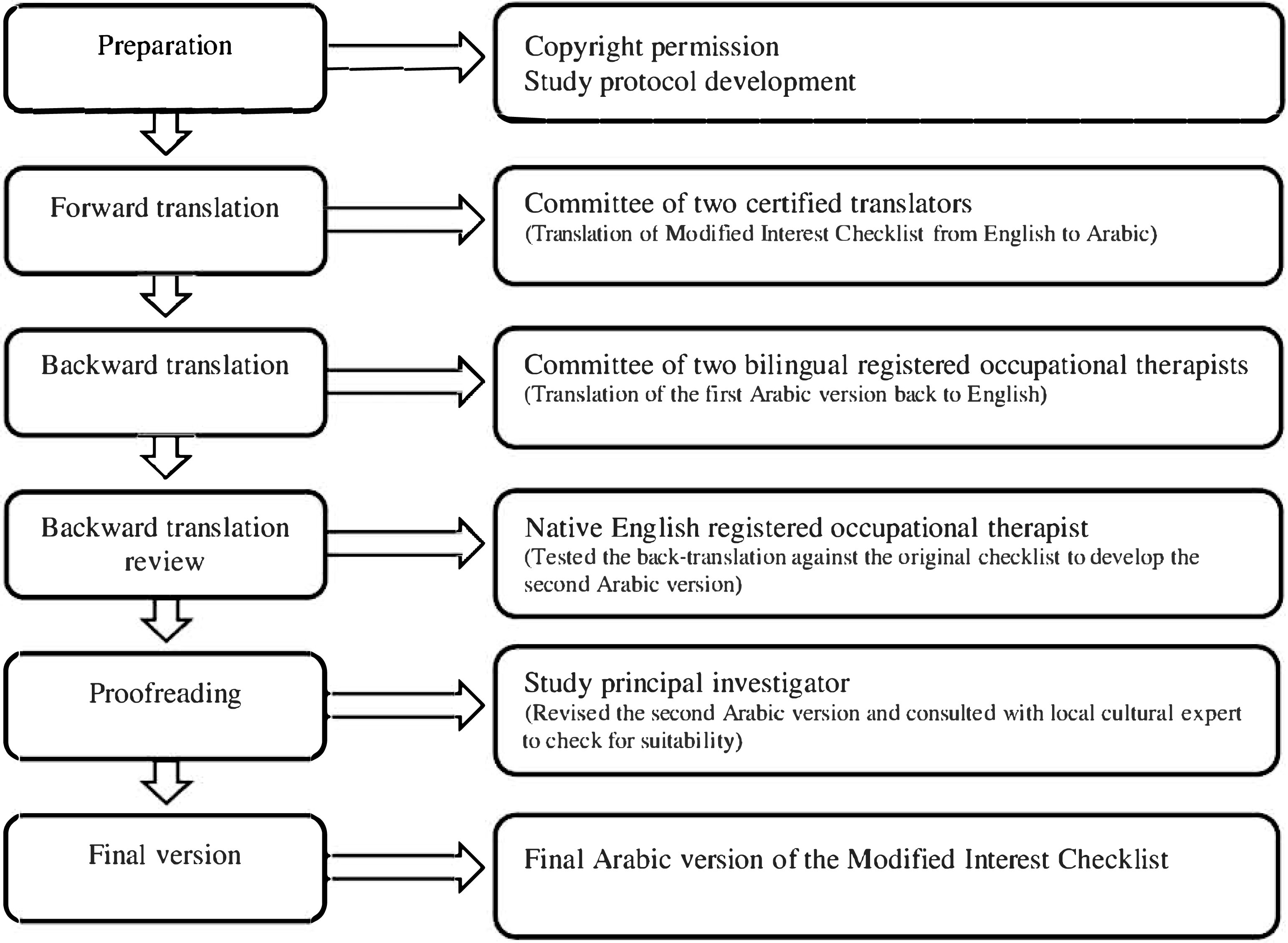
Steps for the translation of the Modified Interest Checklist into Arabic.
Ethics Approval and Consent to Participate
This study was approved by the institutional review board of Batterjee Medical College, a private medical college in Saudi Arabia. Informed consent was approved by the board and obtained from all participants before they completed the checklist.
Participants
Eighty-eight bilingual English- and Arabic-speaking adult clients with psychiatric disorders or mental health conditions were recruited from two inpatient mental health hospitals in Saudi Arabia.
Instrument
The Modified Interest Checklist was used in this study. The checklist is a written inventory used to identify clients’ interests (Dahlan & Ibrahim, 2014). It is a valid and reliable tool that is recommended to facilitate discussions between therapists and clients; in addition, it helps clients focus on leisure interests that influence choices of activities (Kielhofner, 2008; Kielhofner & Neville, 1983; Nakamura-Thomas et al., 2016). The Modified Interest Checklist includes 68 different activities and is used to gather information about whether the clients have participated in the activity in the past, whether they currently participate in the activity, and whether they would like to pursue this activity in the future; it also identifies level of interest in each activity. It requires approximately 15 to 30 min to administer and is appropriate for use with adolescents, adults, or older adults (Heasman & Salhotra, 2008).
Procedure
All participants were administered the Modified Interest Checklist in their inpatient units. The inclusion criteria for participants were (1) inpatient with a psychiatric disorder or mental health condition, (2) age 18 yr or older, and (3) ability to understand and respond to both English and Arabic versions of the Modified Interest Checklist. People with severe cognition and language impairments were excluded.
Data Analysis
The agreement between the two versions was assessed with the κ coefficient, and a 95% confidence interval (CI) was constructed for κ (Viera & Garrett, 2005).
Results
Participant Demographic Characteristics
The study sample consisted of 88 clients with a psychiatric disorder or mental health condition. Fifty participants (57%) were male, and 38 (43%) were female. The average participant age was 29.1 yr (SD = 18.12); in addition, most participants were Saudi (n = 46; 52%) and had been hospitalized for a mean of 9.76 yr (SD = 5.62). Participants with major depressive disorder (30%; 15 men, 11 women), paranoid schizophrenia (21%; 10 men, 8 women), and schizoaffective disorder (16%; 9 men, 5 women) composed more than 65% of the sample (Table 1).
Demographic Characteristics of the Study Participants (N = 88)
Modified Interest Checklist Translation and Cultural Adaptation
The 68 activities in the translated Modified Interest Checklist were reviewed carefully by the principal investigator. The cognitive debriefing and backward translation review revealed no major issues in the translation. Only 4 activities were modified to reflect more culturally acceptable activities that were consistent with Islamic Arabic culture and retained the intended meaning. In addition, 1 new activity was added so that participants could add even more activities that fit their personal preference and interest (Table 2).
Changes to Some Activities in the Modified Interest Checklist After the Adaptation of the Tool Into Arabic
Note. N/A = not applicable.
Kappa Measurement of Agreement
The results were statistically significant (p < .000), with moderate agreement between the scores obtained on the two versions of the Modified Interest Checklist (p < .000). The κ measurement of agreement was 0.59 (95% CI [0.42, 0.76]).
Discussion
The purpose of this study was to develop and culturally adapt an Arabic translation of the Modified Interest Checklist for Arabic-speaking clients with psychiatric disorders. The Matsutsuyu’s Interest Checklist is a well-known tool used by occupational therapy practitioners. Matsutsuyu’s (1969) Interest Checklist was revised by Kielhofner in 1985 (Kielhofner, 2008). The Modified Interest Checklist provides an overview of a client’s interests in a variety of leisure activities and helps the occupational therapy practitioner determine the client’s pattern of participation. It also assists with the development of an individualized treatment plan and helps develop effective interest-based interventions (Heasman & Salhotra, 2008).
The Modified Interest Checklist has been used and translated into different languages, including Japanese, Chinese, German, Spanish, Swedish, Italian, and Slovenian (MOHO-IRM Web, 2021). However, the checklist includes 68 activities that may vary from culture to culture and may not be applicable to all people because of different factors, such as high individual differences, personal preferences, age, gender, and religion (Heasman & Salhotra, 2008). Despite the fact that the Modified Interest Checklist has been already translated into different languages, few research studies have been conducted to adapt it to cultural context. In this study, the checklist was not only translated but was also adapted to Arabic culture to come up with a final translated Arabic version that is comprehensive, clear, and culturally acceptable. A previous study found that some Japanese people misunderstood some items on the checklist, and it was therefore revised to better match the Japanese culture (Nakamura-Thomas et al., 2016). Another study adapted the translated Interest Checklist to the Swedish context by conducting a national survey to investigate the extent to which adults carried out the interests on the checklist (Haglund & Sandulf, 2019). On the basis of that study, new interests were added, and others were updated, clarified, or removed.
This study was the first to translate the Modified Interest Checklist to the Arabic language and adapt it to Arabic culture. In addition, this study followed the recommended principles of good practice translating and culturally adapting outcome measures by using a rigorous translation and back translation process and having a cultural expert review it to ensure its suitability, clarity, and accuracy (Wild et al., 2005). In this study, a few cultural differences emerged from discussions with the local cultural expert before administering the checklist, mostly relating to religion, lifestyle, and relationships between men and women. While preserving primary content of the original checklist activities, a total of four activities were modified, and a new activity named “Other(s)” was created to add more emerging leisure activities if necessary (see Table 2). This minor change was deemed necessary to adhere to Arabic and Islamic values, beliefs, and culture and to appropriately adapt the checklist to the local context and population. An example of the modified interests is “Church activities,” which now is more inclusive and is called “Mosque/church activities” and is applicable to all Arabs (Muslim and Christian). Another example is “Football,” which now is called “Soccer” because most Arabs play soccer. Examples of new interests added under “Other(s)” include “networking” and “being active on social media” (e.g., Facebook, Instagram, Twitter).
Limitations
This study has some limitations. The sample size was small, and clients with psychiatric disorders were from only two local hospitals. Additionally, having participants complete the two self-reports back to back may have enabled them to remember previous answers just given or resulted in them becoming fatigued during the second self-report. Another limitation is that the study sample consisted mostly of adults with a psychiatric disorder or mental health condition. Because the sample did not include clients from different age groups with other health-related conditions, the results should be generalized with caution. In addition, the sample included clients from only four Arab countries. It is recommended that future studies have a larger heterogeneous sample from more clinical settings and sites, such as, but not limited to, inpatient and outpatient rehabilitation and mental health hospitals. The inclusion of clients with a variety of health-related conditions and from more Arabic countries is essential and may support and strengthen generalizability of this study.
Implications for Occupational Therapy Practice
In this study, statistically significant results with moderate agreement were obtained, suggesting that the translation of the Modified Interest Checklist could be useful to occupational therapy practitioners who would like to use it with Arabic-speaking clients with psychiatric disorders when conducting evaluations and interventional planning. The results of this study have the following implications for occupational therapy practice: The Arabic version of the Modified Interest Checklist is now available and can be used with Arabic-speaking clients with psychiatric disorders or mental health conditions in clinical practice and research. The Modified Interest Checklist can also be used to gather useful information on clients’ leisure interests that influence their daily activity choices and have a positive impact on finding pleasure and satisfaction in doing meaningful occupations.
Conclusion
The Arabic translation of the Modified Interest Checklist is culturally adapted and can be used with Arabic-speaking clients with psychiatric disorders or mental health conditions. This study provides evidence that the translated Modified Interest Checklist is valid and preserves the primary content of the original English Modified Interest Checklist. Further validation of the developed Arabic version in other Arab countries, clinical settings, and populations is crucial.
Footnotes
Acknowledgments
I give my thanks, deepest appreciation, and gratitude to the University of Illinois for permission to use and translate the Modified Interest Checklist into Arabic for this study. I believe that translation of such a useful and important tool will have a positive, significant impact on assessment of and intervention planning for Arabic-speaking patients and enhance their overall leisure interest and satisfaction by improving participation in meaningful and enjoyable activities. I also thank the team of translators and occupational therapists for their hard work, dedication, and help with both translation and data collection.