





Abstract
This scoping review provides an overview of academic publications in occupational therapy on the LGBTQIA+ population, identifying dominant topics and gaps and pointing to ways to advance occupational therapy’s contributions and actions that consider the needs and demands of people of dissident genders and sexualities.
Occupational therapy is “a field of knowledge and practices whose focus is humans in their everyday manifestations—the care of oneself and others, work, play, culture, social participation. [Occupational therapy involves] studying, dealing with, and intervening to reduce limits and barriers and to activate the potential of life, of everyday living” (Galheigo & Simó, 2012, p. 35). Historically, most occupational therapists have addressed individuals who have been excluded from elements that comprise citizenship, whether civil, political, and/or social, to promote personal autonomy and social participation, considering social justice (Lopes, 2021; Townsend, 1993).
Hegemonically (Gramsci, 1971), the history of the occupational therapy profession points out that, from the outset, professionals cared for people with physical impairments and a need for rehabilitation, people with intellectual disabilities, and people in mental distress. However, a feminist reading of this history recognizes that Hull House and its directors were extremely influential in establishing the foundations of the profession within the social realm, as, for example, within its social work with immigrant women and families in situations of vulnerability. Such work marked both immediate support actions attending to vulnerability and the construction of theoretical knowledge of these themes as within the scope of what would be called occupational therapy (Monzeli et al., 2019).
The profession is continually reshaped according to new emerging problems faced by society, expanding its possibilities and aiming to contribute to social demands and population groups that could benefit from its professional practices. On the basis of the proposition of social occupational therapy, a perspective that has been present since the 1970s, Barros et al. (2005) pointed out the need for the profession to focus on supporting individuals and groups who face disruptive processes of social support networks, including social vulnerability.
Within the contemporary context, occupational therapy has established a shift in professionals’ intervention from the automated world to the human world of organizations and conflicts—that is, a shift from the functional biological human to the world of historical and social human praxis (Galheigo, 2009; Sakellariou & Pollard, 2013). Therefore, macro- and microsocial profiles for practice are considered, recognizing that the profession focuses on ways of life and the everyday life of people who experience deprivation of rights, deficits in participation, and social insertion as a result of intersecting socioeconomic and cultural issues (Barros et al., 2005; Lopes & Malfitano, 2017).
On the basis of this shift, it is worth thinking about how gender and sexuality norms allow and legitimize the categorization of the “other” (i.e., people who break with such norms) in pejorative ways, creating subalternities (Spivak, 2015) that are recurrent among people who experience dissident genders and sexualities. The concept of dissident genders and sexualities expands the recognition of subordinated groups, going beyond the identity categories, such as homosexual, transgender, and nonbinary, among others (Colling, 2016). The word dissident refers to opposition to something—in this case, to the regulatory norms imposed by cisheteronormativity, heterosexism, and patriarchy. The concept does not negate or invalidate the identity categories; rather, it incorporates people who do not fit, nor want to fit, in such categories (Colling, 2016). Occupational therapists need to consider this concept to produce care strategies, support, and public policies for these groups.
Lesbian, gay, bisexual, transgender, queer, intersex, and asexual, among other dissident genders and sexualities (LGBTQIA+ population), rupture a framework of intelligibility, according to Butler (1999, p. 23): “‘intelligible’ genders are those which in some sense institute and maintain relations of coherence and continuity among sex, gender, sexual practice, and desire.” This rupture means that, in a heteronormative society, these populations are more prone to violence and deprivation in social (Braga et al., 2020; Miskolci, 2017) and occupational (Beagan, De Souza, et al., 2012; Jackson, 1995) participation. Therefore, occupational therapists can contribute to developing technical, political, and ethical actions that translate into complex social interventions whereby people can be included and participate, leading to care and social justice (Ghirardi et al., 2021; Lopes, 2021).
Method
We conducted a scoping review to identify and map the peer-reviewed literature focused on people who experience dissident genders and sexualities, apprehend the robustness of investigations on these subjects, and identify gaps that require further research (Arksey & O’Malley, 2005; Levac et al., 2010). Moreover, we sought to deepen understanding of how this topic has thus far been addressed in occupational therapy, given that Jackson (1995), Beagan et al. (2013), Beagan, Carswell, et al. (2012), Leite and Lopes (2017), and Marchant Castillo (2019) highlighted the lack of references regarding this population in this area. We also wanted to understand how occupational therapy has been involved in providing professional support to the LGBTQIA+ population. We ensured optimal reporting by using the five-stage process for analyzing journal articles developed by Arksey and O’Malley (2005), discussed in the sections that follow, and the Preferred Reporting Items for Systematic Reviews and Meta-Analyses extension for scoping reviews (PRISMA-ScR; Tricco et al., 2018).
Identifying the Research Question
The research question guiding this review was “What has been produced academically about lesbian, gay, bisexual, travesti, transsexual, transgender, queer, intersex, non-binary and other dissident genders and sexualities in occupational therapy?” Travesti is a political and historical native Brazilian classification, derived from popular culture and media, of people who use different technologies to build their bodies and identities linked to the feminine; however, they do not necessarily recognize themselves as women. This identity is distinct from the clinical terms transvestite and transvestism (Leite, 2012).
Identifying Relevant Studies
We conducted searches of the Virtual Health Library, CINAHL, SciELO Citation Index, SCOPUS, and Web of Science, all of which collect and index a substantial number of journals in the field of occupational therapy. The searches included articles published at any time through December 2021. The searches were made by title, keywords, and abstract using the following English keywords, selected in consultation with a university librarian: asexual*, bisex*, dissident gender, dissident sexuality, gay, homosex*, intersex*, lesbian*, nonbinar*, queer, sexual and gender minorities, transex*, transgender, transvesti*, and travesti* related to the key term occupational therap* (see Table A.1 in the Supplemental Appendix, available online with this scoping review at https://research.aota.org/ajot, for a sample search strategy). Records not in Spanish, English, or Portuguese were excluded. Both authors screened titles, abstracts, and keywords for possible inclusion; disagreements were resolved through discussion to achieve consensus. In addition, we manually screened the reference lists of eligible articles for articles to consider for inclusion (Arksey & O’Malley, 2005).
Selecting Studies
We included academic journal articles describing studies focused on any aspect of occupational therapy with the LGBTQIA+ population, including professional practice, undergraduate and graduate education, and theoretical analyses of the profession or research. Articles focused on interprofessional education and practice were included if occupational therapy was an explicit focus of the investigation.
Mapping the Data
Consistent with recommendations by Levac et al. (2010), we created an Excel spreadsheet to map the following data from included articles: names of authors, year of publication, country of authors’ institutional affiliations, research design, objective, population, key findings, and limitations.
Collating, Summarizing, and Reporting the Results
On the basis of a reading of the full text, we carried out a comprehensive analysis and established interrater reliability, reaching 95% consistency. We discussed each article’s content to identify its contribution to elucidating our research question. This process gave rise to some axes of analysis, which also enabled a thematic clustering of the articles, summarizing their objectives. Leite categorized the articles by theme, and Leite and Lopes discussed the categorization to achieve consensus.
Taking the assumptions of social and human sciences, as well as contributions from the philosophy of sciences, we depart from the notion of neutral research (Bourdieu, 2003; Kuhn, 1995). This does not limit the production of qualified analyses with academic and scientific rigor that help in understanding the investigated field. However, understanding how the construction of the individual directly impacts the knowledge produced, it is important to present the authors’ positionality. Leite is a gay, cisgender, Latino, middle-class man without disabilities, and Lopes is a heterosexual, cisgender, Latino, middle-class woman without disabilities. Over the years, both have developed academic knowledge that focuses on investigations of occupational therapy, social occupational therapy, genders, sexualities, and populations in social vulnerability.
Results
We identified 320 documents, 258 from the search results and 62 from the hand search of reference lists. After excluding duplicate files, we read the titles, keywords, and abstracts of 171 texts and excluded 128 that were not articles published in an academic journal. We read the remaining 43 articles (37 from the database searches and 6 from the reference list searches) in full and mapped the data; at this stage, no additional articles were excluded. Figure 1 presents the PRISMA flow diagram (Moher et al., 2009).
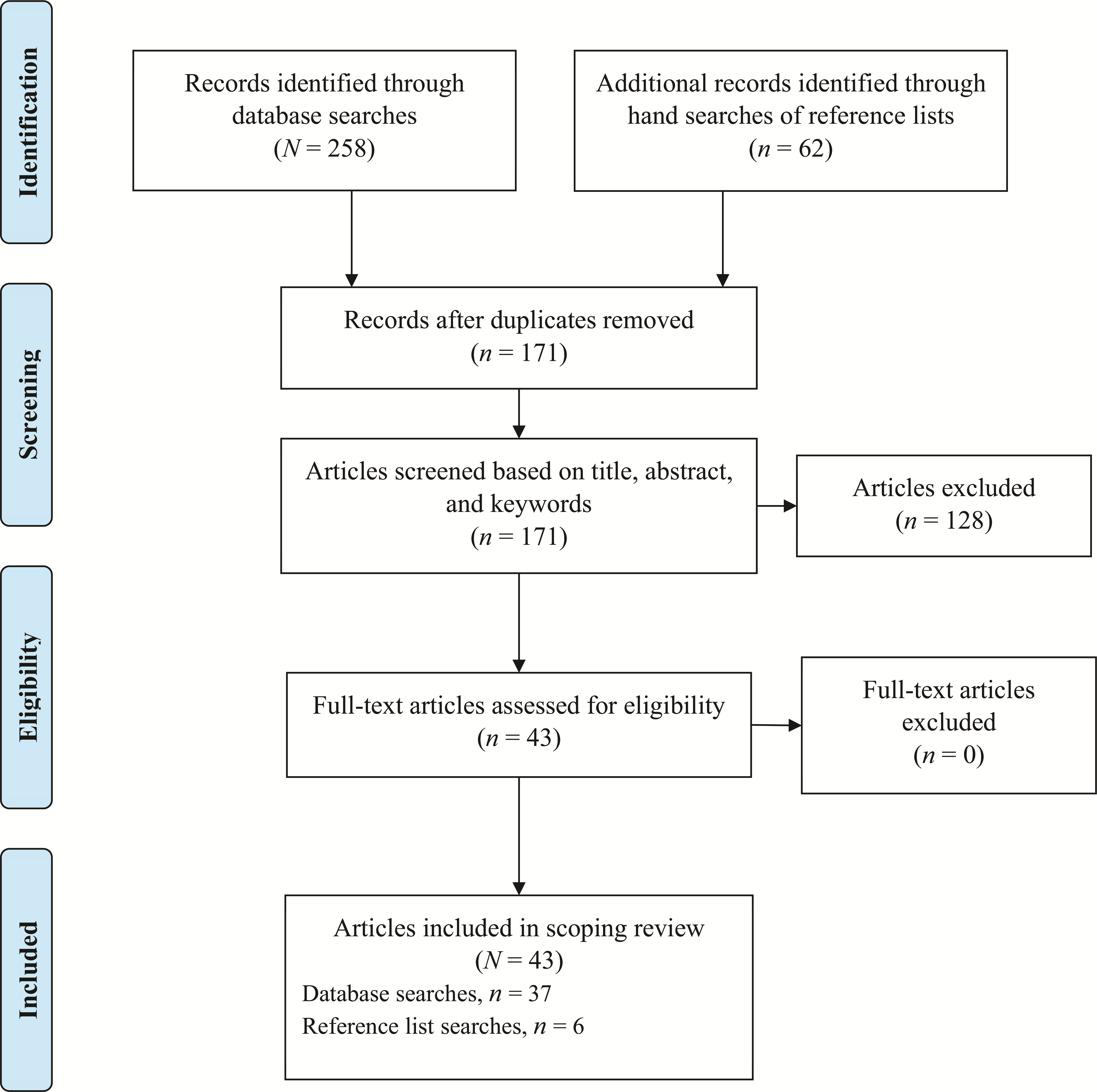
PRISMA flow diagram of article selection for the scoping review.
The 43 articles in this review (see Table A.2 in the Supplemental Appendix) include 28 research articles, 9 reflection articles, 3 experience reports, and 3 literature reviews. The oldest article was published in 1987 and the most recent in 2021, and there was a 6-yr gap between publication of the first article and the second in 1993. The year in which the most articles (6) were published was 2020 (Figure 2). Only from 2012 onward was at least 1 article related to our topic of interest published every year. Moreover, in this period some of the authors published more than 1 article related to the theme, but not more than 2, denoting the incipience of the theme in occupational therapy research and practice.
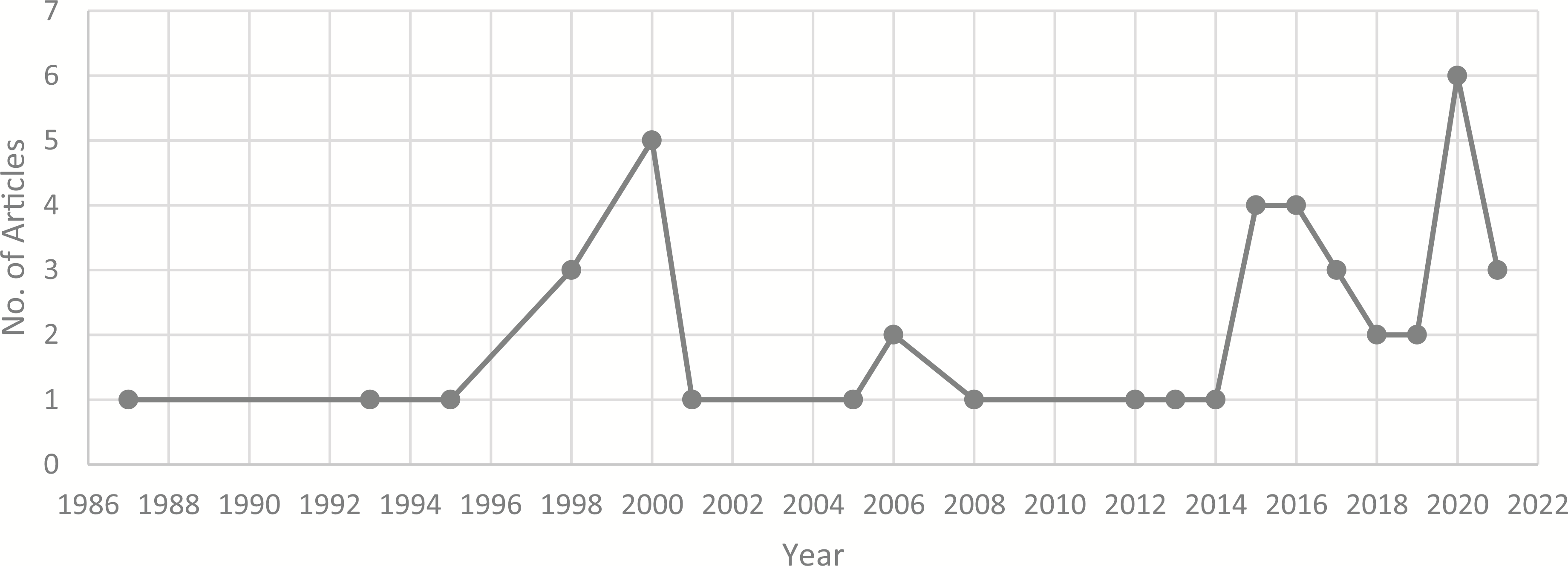
Distribution of articles included in the scoping review, by year.
The authors’ institutions were located in Australia, Brazil, Canada, Chile, India, Ireland, Israel, Portugal, South Africa, the United Kingdom, and the United States of America. Fifteen articles (35%) were written by only one author. Of the total of 110 authors, 99 (90%) published only once, demonstrating the incipience already mentioned, as specific experiences prevail without a tradition of researchers who have studied the same subject for years. The author with the largest number of articles was Jeanne Jackson (United States); authors who published 2 articles were Diego Almeida, Ricardo Correia, Jaime Leite Jr., Roseli Lopes, Kesia de Melo, and Gustavo Monzeli (Brazil); Brenda Beagan and Barry Trentham (Canada); Rebecca Twinley (United Kingdom); and Elizabeth Crepeau (United States). Except for Crepeau, Jackson, and Trentham, the other authors published from 2012 onward, which may indicate a more recent trend of researchers and professionals devoting their efforts to the subject.
The 43 articles were published in 18 journals (Table 1). Eight articles each were published in the Brazilian Journal of Occupational Therapy between 2015 and 2020, and in the British Journal of Occupational Therapy, mostly between 1993 and 2015. Six were published in the American Journal of Occupational Therapy between 1995 and 2000.
Distribution of Articles Included in the Scoping Review, by Journal (N = 43)
The Brazilian Journal of Occupational Therapy is a continuation of the Journal of Occupational Therapy From UFSCar; the title was changed in 2017 to better designate the journal’s scope. We have used Brazilian Journal of Occupational Therapy to refer to all articles published in this journal.
Revista Chilena de Terapia Ocupacional is its title in Spanish.
The articles discuss different groups of the LGBTQIA+ population, as noted in Table A.1 in the Supplemental Appendix. A dominant focus on the transgender population from 2015 onward can be observed, although the first 2 studies in our search results also addressed this population. Articles published from 1995 to 2015 were mostly about homosexuality and bisexuality.
We categorized the articles into three axes of analysis: (1) demands for occupational therapy, (2) professional education, and (3) interventions. Some articles are included in more than one axis. In the analysis that follows, we identify how each category dialogued and can inform the profession.
Demands for Occupational Therapy
The articles mostly point to life paths of the LGBTQIA+ population that do not necessarily start from experiences in occupational therapy but address the profession and professionals by aiming to facilitate and inform possibilities for actions with these people, considering their needs or challenges. To better describe the objectives of these articles, we divided this axis into four subthemes: work, gender affirmation, critical reflection, and instrumentalization for professional practice.
Work
The findings that dealt with the dimension of work had different approaches, such as the challenges involved in assuming a dissident identity in the work environment, such as stereotypes and gender performances expected for certain positions and discrimination experienced (Daly & Hynes, 2020; Phoenix & Ghul, 2016; Soeker et al., 2015); woman-to-woman rape and sexual assault and the impacts on victims’ occupations, including when they work in places that welcome other women who have been raped (Twinley, 2017); the experiences of lesbian, gay, bisexual, and queer occupational therapists (Beagan, Carswell, et al., 2012; Falzarano & Pizzi, 2015); and the ways an organization’s work climate can interfere with the inclusion of gay men, lesbians, and bisexuals (Jackson, 2000).
Gender Affirmation
Another group of articles focused on gender affirmation process, in which people shape their identity and body according to the gender with which they identify. We found articles about self-construction processes and the notion of emancipatory health in the trans population in Chile (Gómez-Antilef et al., 2020); the affirmation process of transgender people and its impact on the world of work (Bar et al., 2016; Daly & Hynes, 2020; Phoenix & Ghul, 2016); the reality of young travesties dealing with challenges, violence, and pleasures in educational, family, and sex work spaces (Monzeli et al., 2015); and a case study about a cross-dresser and the nuances of creating a new persona (Curtis & Morris, 2015).
Critical Reflection
Articles in the critical reflection subtheme set out critical arguments related to the professional field, with the aim to rethink theoretical and practical assumptions and take into account the relevance of professionals to the demands of the LGBTQIA+ population. The reflections elucidated how gender and sexuality are elementary variables in understanding the possibilities of experimentation in people’s everyday lives and occupations. These reflections dialogued with social occupational therapy based on queer theory (Braga et al., 2020; de Melo, 2016); practice with elderly people and in the context of aging (Correia et al., 2020; Harrison, 2001; Simon et al., 2021; Twinley, 2014); and the experiences of gay, lesbian, bisexual, and queer professionals (Beagan, Carswell, et al., 2012) in professional education (Crepeau, 1998) and professional practice (Jackson, 1995; Kingsley & Molineux, 2000). Other articles explore leisure (Almeida, 2020; Almeida & Lugli, 2018), homelessness (Gutman et al., 2021), and territorialization and deterritorialization as forms of gender expression (Swenson et al., 2022).
Instrumentalization for Professional Practice
This subtheme brought together articles that analyzed examples and possibilities of therapeutic occupational actions with the LGBTQIA+ population. These examples include the analysis of undergraduate education programs to apprehend issues involving the needs of travesties and transsexuals (Leite & Lopes, 2017); possible occupational therapists’ intervention with transgender people (Beagan et al., 2013); students’ comfort in dealing with sexuality in clinical practice (Jones et al., 2005); practitioners’ comfort in intervening with gay, lesbian, or bisexual people (Javaherian et al., 2008); and if interventions are responsive to the aging of this population (Simon et al., 2021; Twinley, 2014) and of people with HIV (Bedell, 2000; Yallop, 2000). Moreover, professional actions to resolve daily injustices experiences by dissident people of gender and sexualities were addressed (Bergan-Gander & von Kürthy, 2006; Gutman et al., 2021; Jackson, 1998; Kirsh et al., 2006; Murasaki & Galheigo, 2016; Walsh & Crepeau, 1998; Williamson, 2000).
Professional Education
Professional education was a concern raised by authors in a set of publications published between 2017 and 2020, demonstrating a thematic trend. Articles in the axis of professional education explore how occupational therapists were being prepared for education and professional practice with the transgender population (Acker, 2017; Leite & Lopes, 2017; McCave et al., 2019; Nowaskie et al., 2020; Pechak et al., 2018) and with gay men, lesbians, and bisexuals (Jackson, 1995; Javaherian et al., 2008; Kingsley & Molineux, 2000; Nowaskie et al., 2020). Jackson (1995) noted that sexual orientation was an invisible dimension in occupational therapy, reiterating the need for the profession to review its attitudes, considering color and social class in its propositions. Nowaskie et al. (2020) surveyed dentistry, medicine, occupational therapy, pharmacy, physician assistant, physiotherapy, and social work students in several U.S. universities and showed that occupational therapy students had the lowest workload including content regarding LGBT people, interacting with fewer than five LGBT patients per year. In a survey study comparing transphobia among undergraduate social work, nursing, psychology, and occupational therapy students at a U.S. public university, Acker (2017) found that occupational therapy students had high levels of transphobia. Leite and Lopes (2017) investigated the curricula of public universities in the state of São Paulo in Brazil and found a lack of education aimed at the travesti and transsexual population. Javaherian et al. (2008) and Kingsley and Molineux (2000) reported similar gaps in education on the care of lesbian, gay, and bisexual individuals.
With an interprofessional perspective, McCave et al. (2019) and Pechak et al. (2018) used the case of a transgender person in their education activities, considering that the dialogue between the different professional groups could expand care provision, which was positively evaluated in the studies. In each study, the case was constructed in dialogue with social activists focused on the rights of people who are gender and sexuality dissidents, seeking to enhance awareness and understanding of the challenges faced by the transgender population in health services.
Interventions
The scoping review showed evidence of the incipience of articles that analyzed the practices of occupational therapists with LGBTQIA+ people, which corroborates Marchant Castillo’s (2019) study that focused on occupational therapy research on the sexual education of children, adolescents, and young LGBT people. The articles addressing results of interventions are the two oldest articles, and both reported experiences with transgender people (Jessop, 1993; Khanna et al., 1987). A third article by Jackson (1998) also reflected on treatment of a patient.
Khanna et al. (1987) discussed the case of a transsexual woman and efforts of several professional practices, including therapeutic–occupational ones, to assess the possibility of conversion, pointing out transsexuality as a rare condition and highlighting the success of conversion interventions. Jessop’s (1993) article was the first and only work, within the scope of this review, published by an occupational therapist in an occupational therapy journal and reporting on therapeutic–occupational practice with a transsexual person. The author presented the case of a transsexual woman referred by psychiatry, who had doubts about her ability to “perform successfully as a woman” (Jessop, 1993, p. 322). Jackson (1998) cited the treatment of a lesbian who had a double stroke, addressing advances in the therapeutic relationship and treatment after the patient was able to identify her sexual orientation to her occupational therapist, who also came out to the patient.
Discussion
Academic publications that articulate occupational therapy in relation to the LGBTQIA+ population were mostly about general recommendations and possible contributions from professionals. Although some articles addressed descriptive results of therapeutic– occupational actions targeted to this population, the number of articles was small and restricted to the initial publication period of included articles and 1 article published in 1998. Thus, there is an urgency to move forward in this area so that we can apprehend the pertinence, effectiveness, limitations, and problems that may involve occupational therapists’ practices with the LGBTQIA+ population. The demands saliently pointed out in the articles are essential for guiding practice but should be supplemented by the work of researchers and activists who study and make up this population and have been making efforts to guide society in terms of what these needs would be. It is up to professionals and researchers in the field of occupational therapy to contribute to this agenda with our knowledge and actions.
Among the results of this scoping review, we found some notions that cross the three axes presented earlier (demands for occupational therapy, professional education, interventions). Different notions about transgender people have been raised; however, the research that addresses this collective is largely about transgender women, pointing to a gap in attending to the needs and challenges of transmasculinities. The articles contain a certain criticism of the binary logic of gender and the organization of professional practices, but building professional reasoning that goes beyond the biomedical–pathological nomenclature remains a challenge, given that some authors still use this language (Bar et al., 2016; Beagan et al., 2013; Curtis & Morris, 2015; Jessop, 1993; Khanna et al., 1987; Phoenix & Ghul, 2016).
This notion, currently understood as gender dysphoria, according to the Diagnostic and Statistical Manual of Mental Disorders (5th ed.; American Psychiatric Association, 2013), and as gender incongruence, according to the International Classification of Diseases, 11th Revision (World Health Organization, 2019), has been widely criticized over the years. Activists, researchers, and other people around the world have pointed out the dangers of maintaining a biomedical perspective on the bodies of trans people. Although the central justification for maintaining these categories is related to strategies for claiming and guaranteeing public policies, there is a logic of validation of the gender affirmation process (Bento, 2016; Mas Grau, 2017) and the bodies of trans people continue to be governed by a rule of power that reiterates its “docilization” (the production of docile bodies) and “disciplinarization” (the disciplinary process; Foucault, 2010). We highlight the study by Khanna et al. (1987), which, in addition to the pathologizing transsexuality, states that it is an errant condition and therefore amenable to treatment and conversion.
At the same time, especially in articles by Latin American authors, a perspective can be observed that dialogues with sociological studies, especially those referring to cultural studies and, among them, queer theorists (Almeida, 2020; Almeida & Lugli, 2018; Braga et al., 2020; Correia et al., 2020; Gómez-Antilef et al., 2020; Leite & Lopes, 2017; de Melo, 2016; Monzeli et al., 2015). According to these scholars, gender is understood as a social construction, fluid and unfinished, in which changes and crossings make up life and are not linked to any deviation. This perspective brings different meanings to possible body constructions and can contribute to occupational therapists’ understanding of these processes beyond biomedical logic.
Jessop (1993) provided a critical reading of her actions, noting that they may have reinforced gender stereotypes while also considering that this could be part of her clients’ expectations. Building practices that move in the direction of expanding the ways of being and living, including breaking with gender and sexuality stereotypes, is essential (Crepeau, 1998; Jackson, 2000; Leite & Lopes, 2017; Soeker et al., 2015). Moreover, this should align with individuals’ wishes. As pointed out by Leite and Lopes (2017), in their practice occupational therapists seek people’s social participation and autonomy, offering support to overcome impediments and limitations in the fullest realization of their everyday lives in ways that align with people’s aspirations. Occupational therapy’s actions should favor freedom and support security in the process of gender and sexuality affirmation; that is, It is not a matter of saying that travesties and transgender people cannot or should not be helped with dressing, makeup, walking in high heels, skin or hair care, if these are their demands, but certainly, this process cannot be naturalized or considered to be the most ambitious project of their lives. . . . When focusing on people’s work in the transition process, there is a need to reduce the social isolation that these people suffer from, as well as intervention in schools, jobs, health services, among other places, ensuring their rights. (Leite & Lopes, 2017, p. 487)
Thus, a reinterpretation of the interconnected ways of thinking about and doing occupational therapy requires recognizing how heterosexism, compulsory heterosexuality, and heteronormativity cross and underpin the profession. According to Miskolci (2017), heterosexism refers to the assumption that every person is, or should be, heterosexual; compulsory heterosexuality refers to imposition of the model of loving or sexual relationships between people of the opposite sex, and heteronormativity operates as one model for the regulation of life—of heterosexual and nonheterosexual people—based on the heterosexual, family, and reproductive model. Recognizing these structural issues and their place in creating and maintaining abject bodies (Butler, 1999) makes it possible to construct escape routes from the heterosexist disciplinary function. LGBTQIA+ people will feel these impacts in their everyday lives and occupations, enabling experiences of mutual respect (Sennett, 2004).
Education, practice, and research on LGBTQIA+ people in the field of occupational therapy needs to be made more complex, questioning the perspective by which such content is produced and whether the work, in fact, aligns with social justice. Moreover, if occupational therapy interventions themselves are to be important, services must be provided in ways that align with the demands of LGBTQIA+ people. In this scoping review, the understanding that the LGBTQIA+ population is experiencing great difficulty in accessing institutions is practically unanimous, whether it be at school or in sociolegal service or general health care services. Violence perpetrated by professionals and other users (patients, clients, students) and the cisheteronormative structure of the institutions (e.g., disrespecting their names, making jokes about their genders and sexualities, denying treatments) cause LGBTQIA+ people to be excluded from care, generating neglect in comprehensive care and contributing, for example, to school dropout rates (Andrade, 2015; Bento, 2008).
On the basis of this review, the importance of considering sexuality and gender in professional practice is clear. Moreover, according to Jackson (1995), other intersections of this subject in addition to sexuality need to be taken into account, such as color and social class. Recognizing these social markers of difference in interventions means carrying out actions that deal with the intersectionality that shapes individuals and their demands and makes it possible to break with a mistaken notion of equality of relations and to recognize the different nuances and intersecting inequalities that challenge these people (de Melo et al., 2020).
Ensuring respectful spaces is also essential for LGBTQIA+ professionals. The articles addressing work demands showcased the significant ways an oppressive work environment contributes to professional dissatisfaction, resulting in career losses and ruptures. As raised by Beagan, Carswell, et al. (2012), Falzarano and Pizzi (2015), and Javaherian et al. (2008), it is important that occupational therapists and the people with whom they intervene form sincere, trusting relationships in an environment that supports their intersecting identities and roles.
Coming out and “coming out of the closet” is a theme that many LGBTQIA+ people go through, and many of the articles addressed this an issue for participants. However, in the investigation by Murasaki and Galheigo (2016), it was central. Their findings highlight the need to understand that coming out of the closet, an expression commonly used when someone reveals their dissident identification, is an act that is repeated in the different spaces in which the person circulates and therefore must be understood not as a single episode but as one that happens repeatedly, in different institutions, places, and situations; with different people; and at different times (Sedgwick, 2007). These exit–re-entry movements out of and into the closet are marked by modulations, depending on the power relationships, the possibilities of living without prejudice and with differences, security, and job guarantees, among others.
Finally, seeking to contribute to overcoming a derogatory and stereotyped vision of LGBTQIA+ people, focused only on the suffering that they experience, means that occupational therapists need to intensify investigations that broaden the focus on this population. Such expansion would go beyond the scope of violence, restrictions, and impossibilities to unravelling the sociability networks, new everyday activities and other ways of life, and pleasures and knowledge that are established in the process of constructing identification as a dissident person (Leite & Lopes, 2017; Monzeli et al., 2015).
Study Limitations
Part of the study's limitations are a result of having databases that are relevant to the academic environment but potentially restricted with regard to professional interests. However, seeking to minimize this limitation, we selected databases that bring together the largest number of occupational therapy journals worldwide. Although gray literature can be included in a scoping review, we considered only articles from academic journals, aiming at a worldwide panorama with a specific focus. Gaps on the subject and recurring themes were identified, but priority topics were not listed. Moreover, consistent with scoping review guidelines, we did not evaluate the level of evidence of reviewed articles, denoting an initial and exploratory perspective. The inclusion of publications from different countries meant that covering the specificities of the geopolitical context of each of them or developing a comparative analysis was not possible. Nevertheless, we expect that future and ongoing studies will overcome these limitations.
Implications for Occupational Therapy Practice and Education
The findings of this scoping review have the following implications for occupational therapy practice and education: Dissident genders and sexualities are important expressions of people and must be considered for occupational therapy practice. LGBTQIA+ people face constant subordination processes and are exposed to different types of violence and harassment; therefore, education that allows occupational therapists to stop reproducing violence both in their direct professional practice and with LGBTQIA+ colleagues is essential, to broaden their understanding of possible ways of life in addition to heteronormativity. Education and occupational therapy interventions aimed at the LGBTQIA+ population, free from a biomedical or pathological and cisheteronormative perspective, need to be encouraged.
Conclusion
Historically, the everyday lives, occupations, and ways of life of LGBTQIA+ people have been bounded by cisheteronormative society. Occupational therapists should contribute to resolving the inequalities that result from this, such as in the scope of work and leisure and access to and strengthening of public policies linked to gender affirmation, among other sectors of life. Breaking with an analytical perspective that focuses only on suffering within oppressive conditions, we should learn more about how experiences of identification can also create new networks of sociability and strategies to face prejudice, overcoming, to some degree, oppression and producing recognition. Nevertheless, a need exists for more academic publications on professional practice aimed at people dissident from the sex–gender system, presenting their strengths and limits within contemporary sociopolitical conditions.
Finally, occupational therapy, based on its various theoretical and methodological assumptions, can offer resources so that professionals committed to the participation of everyone in social life can dedicate themselves to actions that attempt to resolve people’s suffering and advocate for a more just society, where differences can exist and citizenship can be enjoyed.
Supplemental Material
Supplementary material for Dissident Genders and Sexualities in the Occupational Therapy Peer-Reviewed Literature: A Scoping Review
Supplementary material, sj-pdf-1-aot-10.5014_ajot.2022.049322.pdf for Dissident Genders and Sexualities in the Occupational Therapy Peer-Reviewed Literature: A Scoping Review by Jaime Daniel Leite and Roseli Esquerdo Lopes in The American Journal of Occupational Therapy
Footnotes
*
Indicates articles included in the scoping review.
Acknowledgments
We are grateful to Dr. Ana Paula Serrata Malfitano, Dr. Khalilah R. Johnson, and Dr. Debbie Rudman for academic dialogues that contributed to this study. This study was funded by the São Paulo Research Foundation (FAPESP Grant 2019/13921-3) and the Coordenação de Aperfeiçoamento de Pessoal de Nível Superior–Brasil (CAPES Finance Code 001).
References
Supplementary Material
Please find the following supplemental material available below.
For Open Access articles published under a Creative Commons License, all supplemental material carries the same license as the article it is associated with.
For non-Open Access articles published, all supplemental material carries a non-exclusive license, and permission requests for re-use of supplemental material or any part of supplemental material shall be sent directly to the copyright owner as specified in the copyright notice associated with the article.
