





Abstract
This report adds knowledge translation and best practice strategies in parent education to the parent guidebook for using Ayres Sensory Integration® (ASI) and provides evidence that the guidebook is acceptable by experts, parents, and clinicians.
Sensory integration (SI) is a neurological process that organizes sensations and makes it possible to effectively interact and participate in activities and tasks (Ayres, 1972, 1979). Challenges with SI can affect every domain of a child’s development—including participation in daily occupations and routines (Watling et al., 2018), such as self-care, sleep, eating, and education (Ismael et al., 2018; Schaaf et al., 2011)—and can result in increased stress associated with caregiving (Watling et al., 2018). SI challenges affect up to 88% of children with disabilities and up to 96% of children with autism spectrum disorder (ASD; Ben-Sasson et al., 2019; McCormick et al., 2016).
The principles and practices of SI, first identified by A. Jean Ayres (1972) and now referred to as Ayres Sensory Integration® (ASI; Smith Roley et al., 2007), include assessment and intervention strategies that are routinely incorporated into pediatric occupational therapy practice. This approach is one of the most frequently requested and valued interventions by parents of children with ASD to promote their child’s occupational performance (Goin-Kochel et al., 2009).
ASI is recognized as an evidence-based occupational therapy intervention for children with ASD (Schoen et al., 2019; Steinbrenner et al., 2020), and it is manualized to promote the therapist’s fidelity to the intervention (Schaaf & Mailloux, 2015). In addition to intervention activities with the child, the evidence-based application of occupational therapy using ASI requires regular interaction with parents, caregivers, and teachers to educate them about the impact of SI functions on the child’s performance to facilitate carryover during daily routines (Parham et al., 2011; Schaaf et al., 2014); however, no published guide for this parent component is currently available.
Parent education and participation in the therapeutic intervention process can improve child outcomes and parent–child interactions and decrease parent stress related to caring for a child with special needs (Jackson et al., 2016; Kaminski et al., 2008; Schultz et al., 2011). Well-designed materials can increase parent knowledge and understanding of child behaviors (Barr et al., 2009). Moreover, child outcomes improve when education is integrated into interventions by providing opportunities for parent observation with therapist modeling, hands-on practice during interventions, and built-in opportunities for feedback and reflection (Kaminski et al., 2008).
Knowledge translation (KT) processes ensure that evidence from research is used by a spectrum of relevant stakeholders, including informal caregivers (World Health Organization [WHO], 2012). KT includes strategies such as educational outreach, educational materials, printed or electronic reminders, performance feedback, use of opinion leaders and champions, and substitution (or enhancement) of tasks to support the integration of new knowledge into daily activities (Castiglione & Ritchie, 2012; Table 1). Integration of KT strategies into the parent education guidebook for occupational therapy using ASI can thus promote parents’ understanding and use of ASI to improve their child’s outcomes.
KT Strategies (Castiglione & Ritchie, 2012)
Note. ASI = Ayres Sensory Integration®; KT = knowledge translation; PDSA = plan–do–study–act.
The purpose of this study was to adapt an existing unpublished parent guidebook for occupational therapy using ASI (Schaaf et al., n.d.). To clarify content and improve usability, we used relevant concepts from the parent education and KT literature as well as stakeholder feedback.
Method
Design
Cross-sectional survey methodology was used and launched via the Qualtrics online platform. This study was approved by the Thomas Jefferson University ethics board.
Participants
Participants included convenience samples of three groups of stakeholders: experts in ASI, practitioners who use ASI, and parents of children with ASD. The experts (n = 3) had advanced training in ASI and more than 10 yr of experience practicing and studying occupational therapy using ASI. The occupational therapy practitioners (n = 5) completed a certificate training program in ASI and had more than 2 yr of experience in occupational therapy using ASI; in addition, they were currently practicing occupational therapy using ASI in their clinical practice. Parent participants (n = 4) were parents of children with ASD who had received occupational therapy using ASI within the past 2 yr.
Instruments
Surveys were designed to obtain feedback about the content, acceptability, and usefulness of the parent guidebook. Three surveys (one for each stakeholder group) were developed by the research team and were reviewed by an expert in survey development to ensure that the items were clear, easy to rate, and relevant to the content area. Each survey used a 4-point Likert scale (1 = strongly disagree; 2 = disagree; 3 = agree; 4 = strongly agree) and included closed-choice and open-ended questions. Open-ended questions provided the option for detailed feedback on survey questions.
Procedures
The study involved four steps. First, we adapted the existing guidebook (Schaaf et al., n.d.) to ensure its alliance with ASI principles as well as best practices in parent education and KT methods. This process resulted in a revised parent guidebook. Next, three sequential reviews and ratings by stakeholders were conducted, and we made revisions, clarifications, and adjustments after each stakeholder review.
The previous guidebook was organized into four sections: (1) understanding the importance of play for child development (which included strategies for parents to introduce sensory–motor play at home), (2) understanding the child’s assessment findings, (3) linking the child’s assessment data to daily life participation challenges, and (4) creating and implementing strategies in the child’s natural environment and daily routines to promote participation in daily occupations. To adapt this existing guidebook, the first author (Cecilia Roan) reviewed the literature on ASI theory and best practice concepts in parent education to integrate these concepts into the revised guidebook. These strategies included ensuring a collaborative approach, providing opportunities for the therapist to model activities for parents, providing opportunities for the therapist to offer feedback to parents and for parents to do the same to the therapist, and providing opportunities for parent reflection on concepts and activities (Kaminski et al., 2008; Schultz et al., 2011). Similarly, KT strategies were integrated into the revised guidebook and included a parent education checklist to track use of the strategies, guidelines for the occupational therapy practitioners in their role as ASI champions 1 (including modeling and providing feedback within intervention sessions), and clinical decision supports to assist the practitioners with communication of content (Castiglione & Ritchie, 2012 ; Gagliardi et al., 2016; Sudsawad, 2007). In addition, materials were adapted and simplified to support parent understanding and usability and to ensure that strategies were easily incorporated into the family’s natural environment. A strategy to monitor implementation was added, specifically, a simplified application of the plan–do–study–act process (WHO, 2012). After the guidebook was adapted, it was reviewed and rated by the stakeholder groups sequentially.
Results
Ayres Sensory Integration Expert Results
As shown in Figure 1, all six expert survey questions achieved the benchmark mean score of 3 or higher. The experts agreed or strongly agreed that the guidebook was consistent with ASI principles, would complement occupational therapy using ASI, and would be useful in supporting a parent’s knowledge of ASI. All experts strongly agreed that the parent education guidebook was easy to follow and included strategies that would support a parent’s ability to integrate sensory–motor experiences needed by their child into daily routines. One respondent noted that the use of playtime strategies designed to help parents create a playful environment and to follow their child’s lead (Module 1) was not ASI specific. Feedback from the experts was integrated into the guidebook by adding a family routine worksheet with strategies to support parents’ ability to embed activities into family routines and greater explanation regarding the value of play in ASI. The name of this section was changed to better reflect its content and intent.
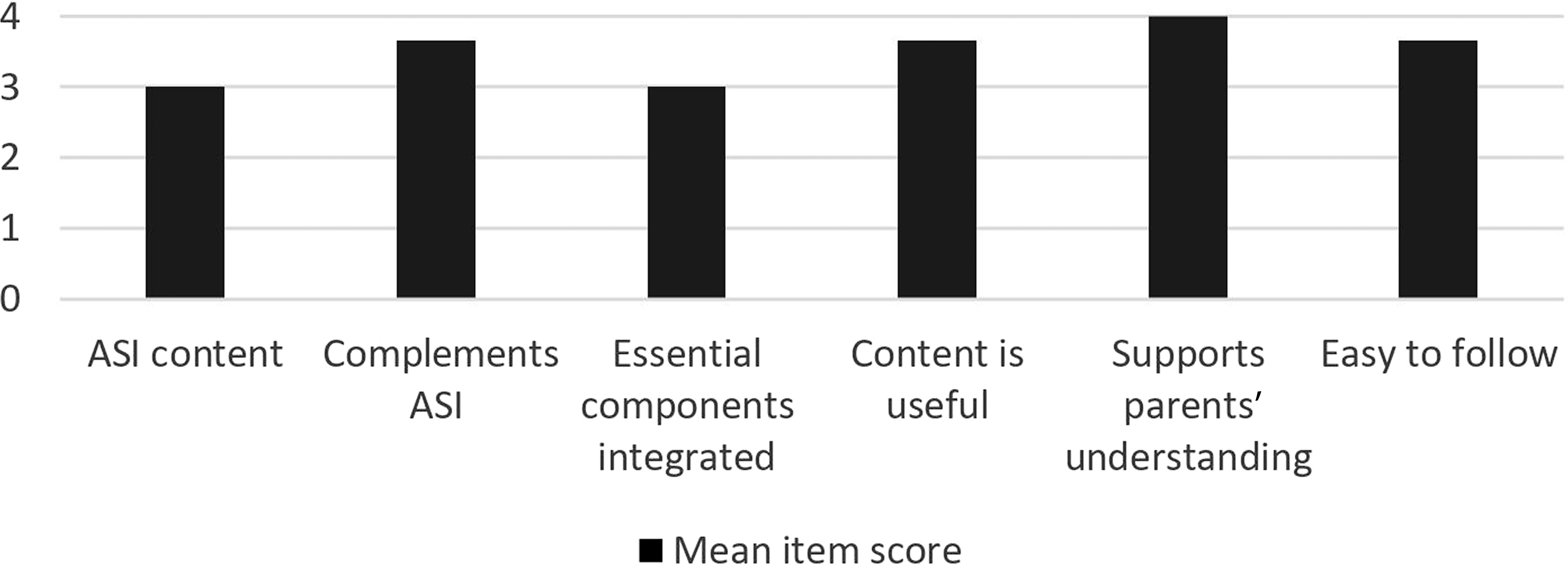
Results of Ayres Sensory Integration® (ASI) expert survey.
Occupational Therapy Practitioner Results
As shown in Figure 2, all eight closed-choice questions received a mean score of 3.0 or higher. Clinicians agreed or strongly agreed that the parent guidebook activities could be easily integrated into occupational therapy using ASI sessions and that the guidebook would be a useful tool to help parents understand the links between sensory factors and their child’s participation. Moreover, they all strongly agreed that the ASI parent guidebook materials provided useful information for parents of children receiving occupational therapy using ASI and could promote child and family outcomes. In addition, all clinicians agreed or strongly agreed that they would use the guidebook in conjunction with occupational therapy using ASI. Concerning the organization of the guidebook, one clinician responded, “I like the structured provision of information to parents to build their understanding of their child’s strengths and challenges—aligned to the progression of ASI.” Areas of concern identified were that the handout may be too long and time consuming and that adjustments to some activities would be useful to ensure the use of common, everyday items easily found in households. Adaptations based on this feedback were simplification of the parent handouts and modification of activity suggestions to use more common household items. One clinician suggested the use of video sources for parent education. We reviewed several and added a few to the guidebook.
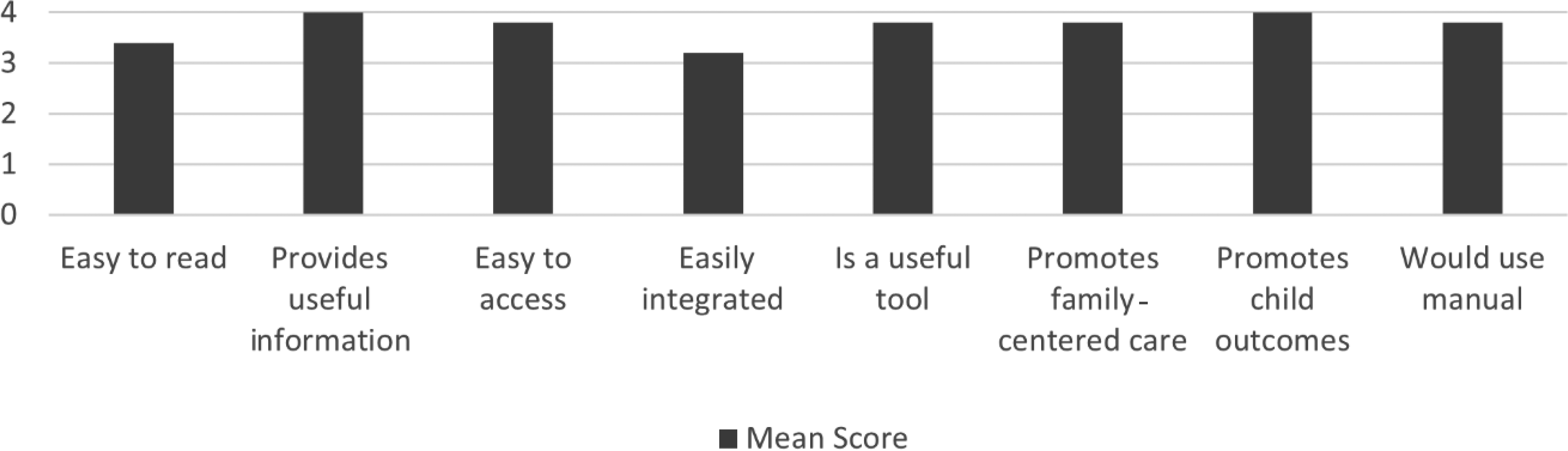
Results of Ayres Sensory Integration® (ASI) practitioner survey.
Parent Results
Last, the parents of children with SI difficulties reviewed the guidebook and provided feedback. Three out of 4 parents returned the survey. All questions received a score of 3.0 or greater, indicating high agreement (Figure 3). Parents agreed that the content of the guidebook was easy to read, was useful for assisting in understanding their child’s sensory–motor challenges, and could support understanding of how sensory–motor factors affect a child’s participation in daily activities and routines. Parents agreed or strongly agreed that the content of the guidebook was easy to understand. All parents strongly agreed that the educational activities could be completed within a reasonable amount of time, that specific strategies could be easily incorporated into family routines, and that the educational materials could help parents to support their child’s participation in daily activities. Parents did not provide additional recommendations in the open-ended question section.
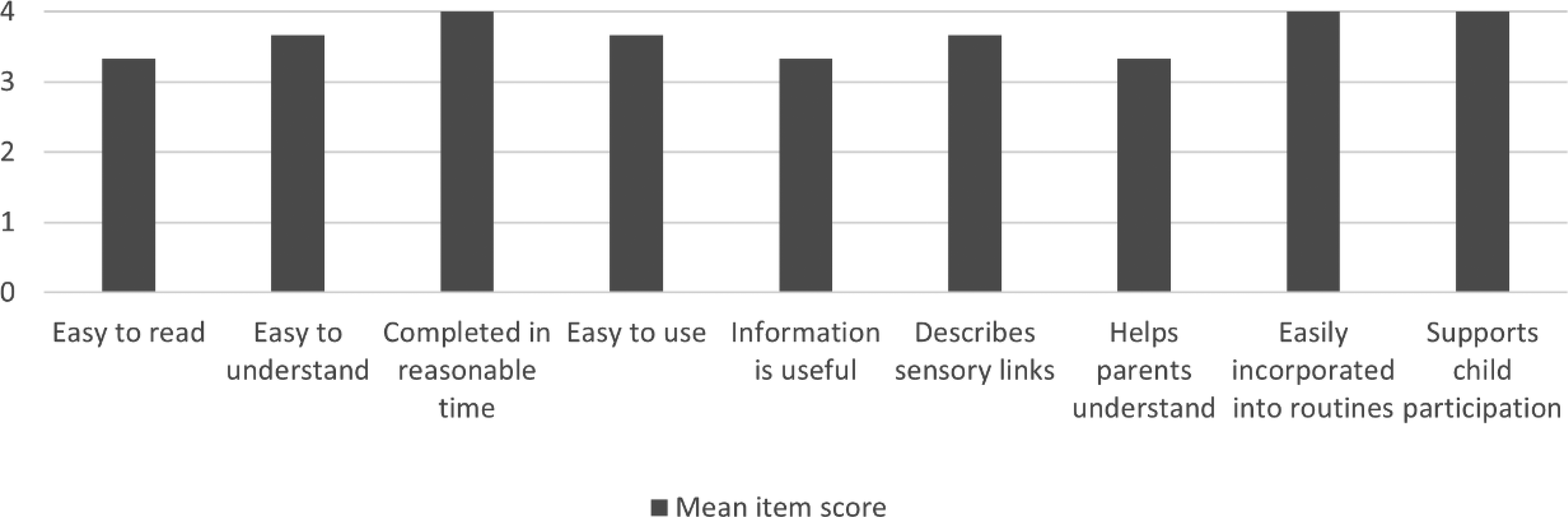
Results of parent survey.
Discussion
In this descriptive study, we focused on the further development of a parent guidebook for use in conjunction with occupational therapy using ASI. Principles from ASI were clarified, and KT strategies were integrated into the manual. Experts in ASI rated the guidebook as consistent with ASI principles, occupational therapy practitioners rated it as clinically useful, and parents rated it as user friendly and useful to support their learning.
Collaboration with parents is a key aspect of occupational therapy using ASI. As part of the American Occupational Therapy Association’s (2017) Vision 2025, occupational therapy practitioners are encouraged to use accessible, collaborative interventions designed to maximize the client’s participation in everyday living. In pediatric occupational therapy, this method involves incorporation of a family-centered care approach that includes collaboration with parents that provides education to help them promote their child’s development and participation. Collaboration can empower families and support parents’ ability to meet their child’s needs and improve family participation (An & Palisano, 2014; Cohn, 2001). Cohn (2001) found that parents’ understanding of their children’s specific patterns of SI challenges not only supported them in meeting their children’s needs but also allowed them to better advocate for their children and to feel more accepting and supportive of their children; this empowerment led to improved self-esteem and sense of worth in their child. In keeping with Cohn’s (2001) findings, we anticipate that the guidebook will support parents and caregivers in their roles as parents and advocates for their child.
KT is being used more frequently in occupational therapy to facilitate the translation of knowledge into daily practice (Donnelly et al., 2016). KT educational strategies—such as clinical decision supports, monitoring and feedback tools, and reminders—have been shown to promote behavior change in the health care setting (Johnson & May, 2015). KT strategies incorporated into the guidebook, as described earlier, encourage collaboration between providers and parents to promote successful outcomes. The integration of KT principles and strategies is a unique addition to the guidebook that will strengthen the clinician’s ability to facilitate the use of ASI knowledge by parents.
One value of the guidebook is that it can be individualized to meet the needs of the family. This customization is increasingly important as health care moves toward personalized treatments. Children and families each bring a unique set of characteristics and circumstances that are important considerations for designing and implementing intervention and parent education. The guidebook allows consideration of each child’s unique profile. Assessment findings are translated for parents in simple language, and then activities that address their child’s unique needs (on the basis of assessment data) are collaboratively chosen, described, and modeled for the caregiver. In this way, parents develop an understanding of their child’s unique strengths and needs, and they can use the individually tailored activities in a flexible way that aims to be responsive to their child’s needs and to the family’s daily routines.
ASI is a complex, evidence-based intervention that requires sophisticated clinical reasoning. Although numerous resources on sensory interventions are available to families via electronic sources, it may be difficult for parents to discern what aspects of this information is evidence based and appropriate for their child. The guidebook developed in this project can assist practitioners and parents by providing information, based on evidence-based occupational therapy using the ASI approach, that is vetted by experts, clinicians, and parents.
Limitations
Only 3 parents and 5 experts reviewed the guidebook. Future studies with a larger sample size may yield more diverse recommendations.
Implications for Occupational Therapy
This study recognizes the importance of collaboration with parents to improve child outcomes and has important implications for occupational therapy: The parent guidebook provides a useful supplement for therapists applying this approach to help guide their education and interaction with families. Families may benefit from the guidebook as a source of knowledge and resources, and the parent guidebook will assist therapists in implementation of ASI. The parent guidebook for occupational therapy using ASI provides a tool for clinical use and is ready for further testing to examine the effectiveness of ASI parent education.
Conclusion
The parent guidebook for occupational therapy using ASI described in this brief report provides a tool for clinical use and is ready for further testing. The guidebook can be accessed at https://www.jefferson.edu/academics/colleges-schools-institutes/rehabilitation- sciences/departments/autism-center-of-excellence.html.
Footnotes
1
Champions promote implementation and adoption of innovations through encouragement, coaching, and influencing others. They can be resource people and mentors (Kitson & Harvey, 2016).
Acknowledgments
We thank Rachel Dumont for contributing photos and activities to the guidebook and the parents, clinicians, and experts who reviewed the guidebook.