





Abstract
The findings of this study show that a canine-assisted intervention (CAI) is a valuable tool for students and young adults experiencing mental health challenges, including decreased quality of life (QOL), stress, and anxiety.
College presents challenges that can collectively compromise students’ mental well-being. Historically, these challenges have included overcoming poor sleeping and eating habits, adapting to increased academic demands, multitasking, financial difficulties, and social challenges (Fogle & Pettijohn, 2013). Additional challenges have arisen that require adjustment to the overwhelming stimuli of technology, reduced individualized support from student services, and complex financial stressors, such as student debt and employment concerns (Fogle & Pettijohn, 2013). The American College Health Association’s (2016, pp. 13–14) National College Health Assessment describes the impact of these stressors, including depression; anxiety; suicide; self-harm; anger; and feeling hopeless, exhausted, and lonely. This bleak profile of undergraduate student well-being may be carried into graduate school, where pressures intensify. Although there is an overall dearth of research on graduate student mental health, few researchers have studied this population and identified whether role conflict, time constraints, financial pressure, and lack of family or program support can compromise graduate student well-being (Hudd et al., 2000).
A subsector of graduate health care students (i.e., occupational therapy and physical therapy students) have experienced high levels of emotional distress (Hubbard & Blyler, 2016; Hughes & Byrom, 2019). Specific challenges facing graduate health care students include practical examinations that require learning clinical knowledge and skills through direct observation (Hubbard & Blyler, 2016). Additional challenges include meeting external awarding body requirements and professional standards of behavior and practice and the intense nature of the programs (Hughes & Byrom, 2019). External awarding bodies of graduate health care programs, such as the Accreditation Council for Occupational Therapy Education, have strict requirements, including standards students must meet throughout their curriculum and in their work both inside and outside the classroom. These demands represent significant additional requirements not always present in other graduate programs. The nature of health care programs inherently requires students to be resilient and psychologically responsive to difficult situations throughout coursework, simulations, and labs and when treating patients (Hughes & Byrom, 2019).
To support graduate students with these challenges, colleges typically offer one-on-one counseling. Although effective, such counseling remains costly, and providing resources to meet the demand has proven to be a challenge. Researchers have demonstrated that students struggle to access and utilize resources. Stecker (2004) found that only 29% of the health care student population sought mental health services. An additional 20% were interested in mental health services but did not seek or access them because of long waitlists and scheduling conflicts (Stecker, 2004). In addition, graduate students may be reluctant to access formal mental health services for fear of being stigmatized.
Providing resources supportive of graduate students’ mental well-being helps to create optimal learning conditions that influence the mastery of content and skill competency because students compromised by mental health and stress are less likely to master and retain the content needed to achieve professional competency. Students who can develop and embrace coping strategies during didactic work may carry those skills over to clinical rotations and into future practice as clinicians. It is further argued that students who take care of their well-being and manage stress enter their professions as better prepared and qualified practitioners, which has a multitude of positive outcomes, including the potential for better occupational balance throughout their education and decreased burnout as practitioners.
One informal and low-cost approach to supporting student well-being has been to provide access to therapy dogs (Barker et al., 2016; Binfet, 2017; Grajfoner et al., 2017; Ward-Griffin et al., 2018). Such canine visitation programs, or canine-assisted interventions (CAIs), provide opportunities for students to interact with therapy dogs and their handlers. Researchers have found that CAIs improve college student well- being by decreasing self-reports of stress (Barker et al., 2016; Crump & Derting, 2015), anxiety (Grajfoner et al., 2017; Stewart et al., 2014), peer isolation (Binfet & Passmore, 2016; Binfet et al., 2018; Stewart et al., 2014), and homesickness (Binfet & Passmore, 2016).
CAIs are typically offered during examination periods and as a one-time event, and there have been calls to investigate their effects more broadly (Grajfoner et al., 2017). Most notably, the majority of CAI programming has concentrated on undergraduate students, as evidenced by only three studies (i.e., Bell, 2013; Crossman et al., 2015 ; Wood et al., 2018) that included graduate students and only one study that concentrated specifically on graduate students alone (i.e., medical residents; Crossman et al., 2015). Given the challenges facing graduate students, additional research is needed to explore how CAIs may support students in advanced programs, where stress may impede students’ skills and professional competency.
This study builds on prior research and expands the understanding of CAIs’ efficacy by using graduate student participants and a multisession design. The aim of this study was to assess the pre- to postintervention changes in self-reports of quality of life (QOL) and occupational performance among graduate health care students who participated in a weekly CAI over 6 wk. We sought to answer two research questions: Are there significant differences between treatment and control groups in graduate students’ QOL? Are there significant differences between treatment and control groups in graduate students’ occupational performance (specifically, education) and ability to adapt to their graduate student role?
This study was approved by Wayne State University’s institutional review board (084119B3E), in addition to approval by the university’s Institutional Animal Care and Use Committee (Animal Welfare Assurance D16–00198[A3310–01]). Signs of canine distress were monitored by Christine Kivlen throughout each session, and no reports of compromised welfare occurred during sessions. To safeguard canine welfare, dogs worked under the supervision of their handler and were provided with water during sessions, and the number of student visitors to each dog handler station was restricted to 3 to 5.
Method
Research Design
We used a randomized controlled trial to test the effects of a recurring weekly 35-min CAI on graduate students’ well-being, including QOL, stress, anxiety, occupational performance, and adjustment to the graduate student role. Experimental participants engaged in the CAI for 6 wk in self-identified cohorts of 3 to 5 students. Students were given the option to engage with therapy dogs to their comfort level and were told that approved activities included petting, walking with, brushing, sitting with, playing with toys with, and talking to the therapy dog. The dose intervention followed best practices established by Binfet et al. (2018), in which 35 min was identified as students’ preferred duration for stress reduction. Outcome data were collected pre- and postintervention for experimental and control participants. Participants were enrolled over an 8-wk period, yielding a total of 29 groups of 3 to 5 participants who engaged in the intervention throughout the fall semester (Table 1).
Flow of Participants Through the Study
Note. As a result of scheduling challenges, Groups 20 and 22 never completed informed consent or started the study.
Sample Size and Power Analysis
On the basis of a one-tailed a priori power analysis with an anticipated Cohen’s d effect size of 0.5 and a power of 0.80, results from G*Power calculated a total N of 102 (n = 51 participants in each group). The principal investigator (PI; Christine Kivlen) continued enrolling participants in the study until a sample of 105 was achieved. One student dropped out, yielding a total of 104 participants.
Participants and Setting
Students
Participants were recruited from graduate health care programs (i.e., occupational therapy, audiology, biological sciences, cancer biology, engineering, molecular biology, pathology assistant, pharmaceutical sciences, pharmacy, physical therapy, physician’s assistant, and social work) at a large Midwestern university from September 2019 through February 2020. The inclusion criteria for this study required participants to be full-time students. Exclusion criteria included reported fear of or allergies to dogs. In addition, any students receiving mental health treatment were excluded to safeguard against any changes occurring after the intervention being the result of an outside form of treatment. Next, the informed consent was reviewed with each participant. Moreover, participants signed a document demonstrating their understanding of approved animal interaction activities and animal welfare standards that would be honored. The PI explained that any and all incidents would be documented using the university’s protocol, which ensured that the participant would receive immediate assistance and a report-of-injury form would be filed within 24 hr. No adverse events took place. Participants were randomly assigned in self-clustered groups of 3 to 5 to the experimental (n = 53) or waitlist control (n = 51) conditions. Students were blinded to their assignment, and those in the control condition were told that they were on the waitlist and given the option to engage in the intervention after data collection.
Therapy Dogs and Handlers
Five therapy dogs participated in the study: a shih tzu–poodle mix, a Labrador retriever–basset hound mix, a Leonberger, and two goldendoodles. All therapy dogs had 2 to 6 yr of therapy dog experiences in various settings, including hospitals, libraries, primary schools, colleges, and nursing homes. Handlers reported having an average of 3.25 yr (SD = 1.64) of experience in volunteer therapy dog work.
Measurement and Outcomes
Quality of Life
The World Health Organization Quality of Life–BREF (WHOQOL-BREF; Skevington et al., 2004; Cronbach’s α = 0.65–0.93) is a standardized assessment that measures QOL in the context of a person’s culture, value system, personal goals, standards, and concerns. It covers four domains—physical health, psychological well-being, social relationships, and environment—and satisfaction is a key thread throughout each domain. Using a 5-point Likert-type scale ranging from 1 to 5 (scale anchors vary depending on the question), participants were asked to respond to 26 items. Cronbach’s αs for this study were 0.90 and 0.89 for pretest and posttest, respectively.
Stress
Perceived Stress Scale.
The Perceived Stress Scale (PSS; Cohen et al., 1983; Cronbach’s α = 0.84–0.86) is the most widely used psychological instrument for measuring the perception of stress. It consists of a 10-item scale measuring the degree to which situations in one’s life are considered stressful over the course of the past 30 days using a 5-point Likert-type scale ranging from 0 (never) to 4 (very often). Cronbach’s αs for this study were 0.87 and 0.86 for pretest and posttest, respectively.
One-Item Stress Scale.
Momentary perceived stress was measured using a stress visual analogue scale (SVAS). The SVAS was used in each session as an entry and exit assessment to capture participants’ self-ratings of stress. Participants were asked to rate their stress using a 5-point response format ranging from 1 (not at all stressed) to 5 (very stressed). A one-item scale has been used to measure stress before and after on-campus CAIs in previous studies (Barker et al., 2016; Binfet, 2017).
Anxiety: Emotional Distress–Anxiety Short Form
The Patient-Reported Outcomes Measurement Information System (PROMIS) was developed beginning in 2004 through a collaborative process funded by the National Institutes of Health Roadmap for Medical Research Initiative (Cella et al., 2007). The PROMIS Emotional Distress–Anxiety Short Form (Cronbach’s α = 0.95–0.96; Wilford et al., 2018) is a 7-item scale on which respondents rate fear, anxious misery, hyperarousal, and somatic symptoms related to arousal over the past 7 days on a 5-point scale ranging from 1 (never) to 5 (always). Cronbach’s αs for this study were 0.91 and 0.89 for pretest and posttest, respectively.
Occupational Performance: Canadian Occupational Performance Measure
Internal consistency for the Canadian Occupational Performance Measure (COPM; Law et al., 2019) was reported by Cusick et al. (2007) to be acceptable for Performance (Cronbach’s α = .73) and Satisfaction (Cronbach’s α = .83). Although the COPM is typically used as a semistructured interview, it has also been used to measure satisfaction with and performance of predetermined occupations, specifically, caregiving skills (DiZazzo-Miller et al., 2017). The four-item scale includes questions pertaining to the predetermined performance area of productivity—specifically, education—which are rated on a 10-point response scale ranging from 1 (not able to do it) to 10 (able to do it extremely well) for Performance and from 1 (not satisfied at all) to 10 (extremely satisfied) for Satisfaction. Cronbach’s αs for this study were 0.78 and 0.83 for pretest and posttest, respectively.
Graduate Role: Student Adjustment to College Questionnaire
The Student Adjustment to College Questionnaire (SACQ; Baker & Siryk, 1989; Cronbach’s α = 0.76–0.91) is a self-report instrument designed to measure students’ adjustment to college in the areas of academic adjustment, social adjustment, personal–emotional adjustment, and attachment to the institution. Items are rated on a 9-point-Likert-type scale ranging from 1 (applies very closely to me) to 9 (doesn’t apply to me at all). Cronbach’s αs for this study were 0.78 and 0.83 for pretest and posttest, respectively.
Data Analysis
An analysis of covariance (ANCOVA) was conducted and determined the most appropriate analysis, given that the intent was to determine statistically significant differences between groups (experimental and control) in graduate student well-being while controlling for pretest scores. Data were verified to ensure they met all required assumptions for ANCOVA, including normality, homogeneity of variance, random independent samples, confirmation of the relationship between dependent variables, and a linear covariate (Table 2).
Tests of Normality
Note. QOL = quality of life.
Results
Demographic Information
Participants provided responses to a series of short, open-ended Likert-type questions, including gender, age, race–ethnicity, education level, and dog ownership. All graduate students were full time (N = 104; 79% female, M age = 23.72 yr, SD = 2.39, range = 20–36) and of various ethnicities (81% Caucasian, 14% Asian, and 4% Black or African American). The Integrated Postsecondary Education Data System (IPEDS) was used to collection information regarding race and ethnicity. In addition, approximately half of the participants in both groups owned a dog.
Quality of Life
Participants’ scores on the WHOLQOL–BREF provide support for Hypothesis 1. The ANCOVA indicated significant differences between groups in each of the four domains of QOL (Figure 1): physical health, F(1, 101) = 4.812, p = .031, ηp 2 = .046; psychological well-being, F(1, 101) = 11.743, p = .001, ηp 2 = .104; social relationships, F(1, 101) = 7.065, p = .009, ηp 2 = .065; and environment, F(1, 101) = 4.830, p = .030, ηp 2 = .046.
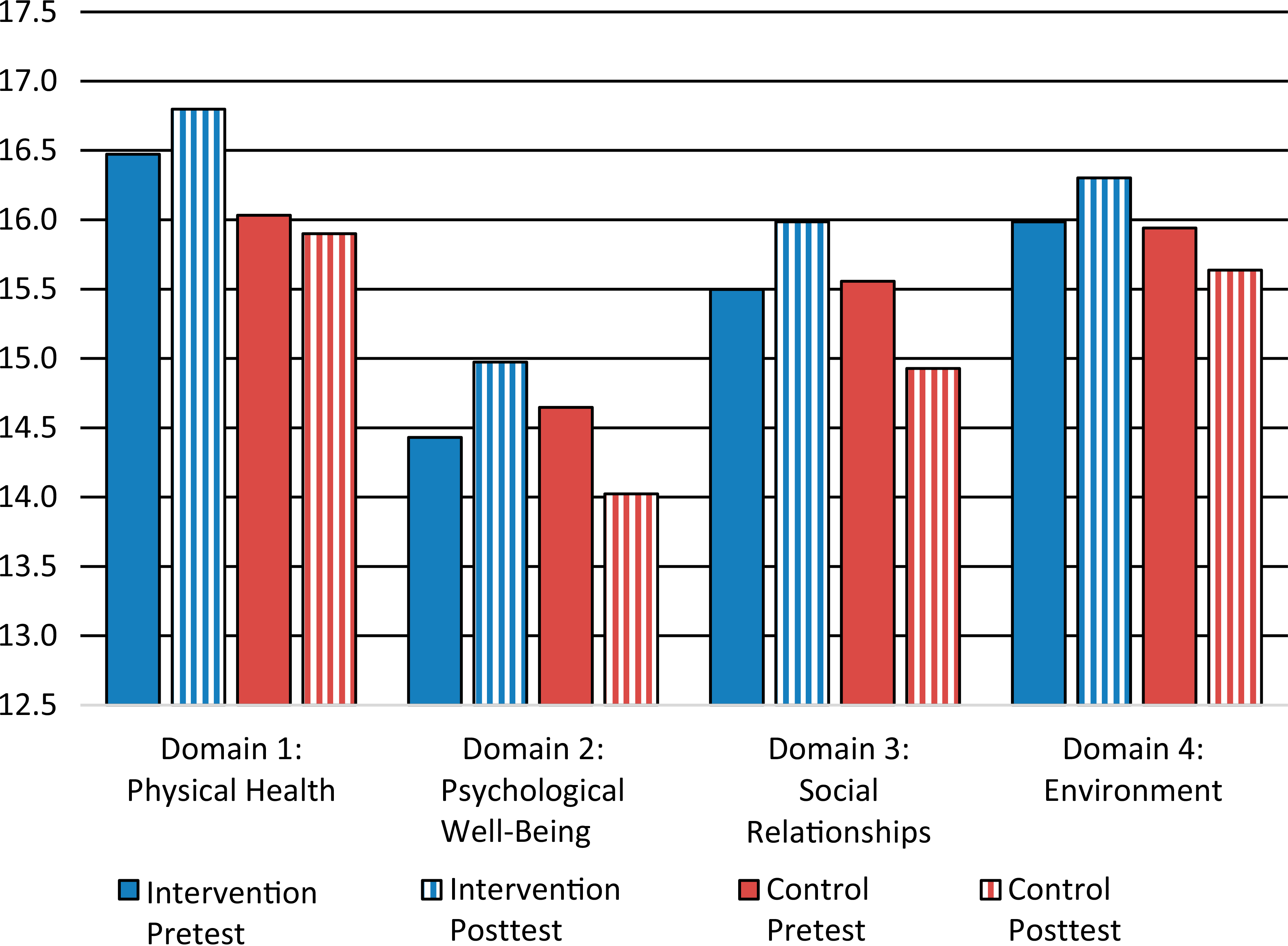
Pretest–posttest scores on the World Health Organization Quality of Life–BREF.
Stress
Stress over time was measured with the PSS and did not reach significance between groups, F(1, 101) = 3.76, p = .055, ηp 2 = .36; thus, although the results trended toward significance, they did not support the first hypothesis. However, momentary stress scores among the experimental participants provided support for the first hypothesis. We used t tests to measure the difference between perceived stress before and after each session, as measured with the SVAS, and the results demonstrated statistical significance (Table 3). Moreover, Cohen’s d shows the magnitude of difference between groups.
Comparisons of Experimental Participants’ Momentary Stress
Note. SVAS = stress visual analogue scale.
Anxiety
Participants’ scores on the PROMIS anxiety measure also supported the first hypothesis. The ANCOVA revealed a significant difference between groups, F(1, 101) = 4.134, p = .045, ηp 2 = .039 (Figure 2).
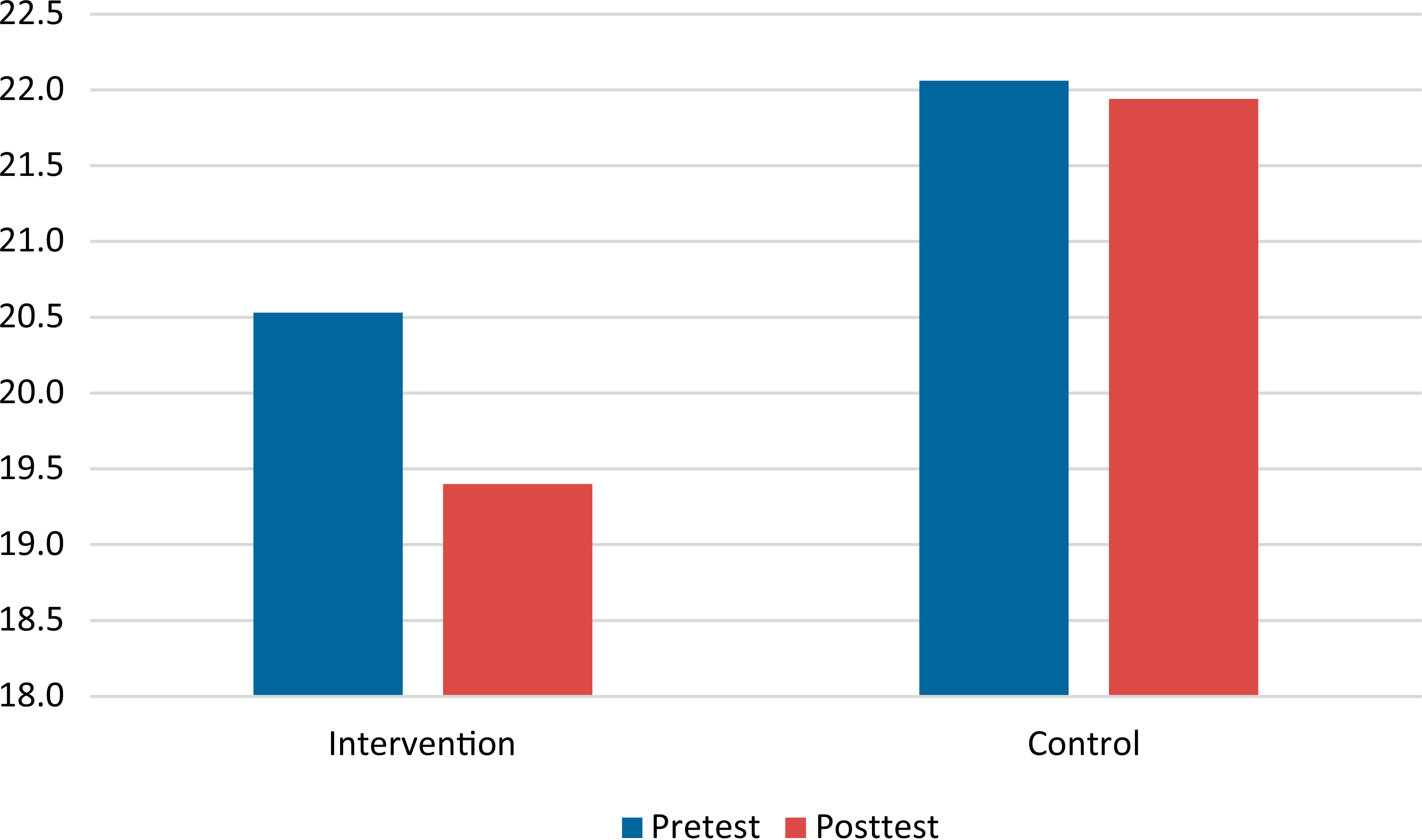
Pretest–posttest scores on the Patient-Reported Outcomes Measurement Information System Anxiety scale.
Occupational Performance and Graduate Student Role
Paired t tests revealed no significance differences in perceived satisfaction with education (pretest, M = 30.42, SD = 6.52; posttest, M = 31.04, SD = 5.20), t(52) = −0.803, p = .426, or perceived performance in education (pretest, M = 27.36, SD = 7.78; posttest, M = 28.15, SD = 7.07), t(52) = −1.030, p = .308. Scores on the SACQ indicated no significant difference between groups on adjustment to the graduate student role, further refuting Hypothesis 2, F(1, 101) = 3.294, p = .073, ηp 2 = 0.032.
Discussion
Graduate students who participated in a weekly CAI reported several favorable well-being outcomes. First, experimental participants reported significantly increased QOL, in alignment with Binfet and Passmore’s (2016) finding that participation in a CAI augmented students’ perceptions of satisfaction with life. Similarly, our findings are in accord with those of other researchers who found that participation in a CAI boosted mood and well-being (Grajfoner et al., 2017), happiness, and energy levels (Ward-Griffin et al., 2018).
When we examined well-being outcomes more closely, we saw that experimental participants reported reductions in both anxiety and stress. Graduate student participants’ self-reports of anxiety levels significantly decreased, aligning with the findings of studies of undergraduate students (Crossman et al., 2015; Grajfoner et al., 2017; Jarolmen & Patel, 2018; Stewart et al., 2014; Wood et al., 2018). Previous researchers have examined the effects on anxiety of brief, one-session CAIs, and our finding that multiple sessions reduce self-reports of anxiety is perhaps not surprising.
The stress reduction profile of participants in this study was perplexing because although experimental participants reported momentary within-session stress reduction, no significant differences were found from preintervention to postintervention across the six sessions. Researchers have studied the effect of CAIs on student stress using self-report measures (i.e., PSS and VAS) and physiological measures (i.e., blood pressure, heart rate, and saliva cortisol levels; Barker et al., 2016; Binfet, 2017; Blender & Ryan, 2009; Crump & Derting, 2015; Delgado et al., 2018; Jalongo & McDevitt, 2015; Ward-Griffin et al., 2018; Wood et al., 2018). Graduate students’ self-reports of stress reduction arising from within-session assessments are in alignment with other research that has used one-item scales to measure stress (Barker et al., 2016; Binfet et al., 2018; Delgado et al., 2018). Our findings suggest that, in the moment, spending time with therapy dogs could be an effective means of reducing stress among graduate students. One puzzling finding arising from our study was that stress, as measured over time with the PSS, did not show a significant preintervention-to-postintervention reduction; both experimental and control participants reported reductions in stress. It could be that graduate students developed coping skills as undergraduates that allow them to effectively manage their stress. In addition, it could be that when experiencing stress in the moment, the visceral feeling of stress more strongly informs ratings, whereas when asked about stress over time (i.e., over the past 30 days), the experience of stress is more difficult to recall and results in lower ratings. Regardless of the reason, we did not find a statistically significant reduction in perceived stress over time.
Occupational Performance and Adjustment to Graduate Student Role
Finally, we found no significant difference between the experimental group participants’ occupational performance in education or adjustment to the graduate student role and that of the control group participants. This is the first CAI study to measure the occupation of education. Many facets regarding this unexpected result require investigation. In both the experimental and the control groups, several participants rated their performance of and satisfaction with education activities as very high, creating a ceiling effect, which limited the ability for further improvement. The high performance and satisfaction levels are perhaps not surprising because students who have been successful in both high school and undergraduate work are likely to have developed advanced study skills.
Although no specific researchers have studied adjustment to the student role, Jalongo and McDevitt (2015) mentioned that students’ perceptions of the environment, library, and approachability of staff improved. In addition, Binfet and Passmore (2016) measured connectedness to campus and found that first-year college students felt more connected to their academic environment after engaging in an 8-week therapy dog program. Binfet (2017) found that participants who engaged in a therapy dog program experienced a significant increase in affinity to campus compared with students who did not engage in CAI. It can be argued that perceptions of environment, approachability of staff, connectedness to academic environment, and increased affinity to campus may be related to adjustment to the graduate student role; however, results for adjustment to the graduate student role were not statistically significant between groups.
Limitations and Future Research
This study had strong implementation fidelity (e.g., the tracking of participant attendance across sessions, the ratio of participants to dog handler teams, the use of a predetermined dosage); however, despite best intentions, this study was not without limitations. First, although the IPEDS is the most widely accepted and used classification system for race and ethnicity, the broad categories included in the classification system restricted the first author (Kivlen) from potentially capturing specific ethnicities participants identified as. For example, many participants identified as Middle Eastern or North African, but because that was not a choice, they were forced to choose what they felt was the next closest category, White or Caucasian. Second, participants in this study were drawn from a variety of health sciences graduate programs; future studies might compare and contrast students from different disciplines to explore the effects of CAI on specific graduate student populations.
This study’s findings inform the direction of several future empirical investigations. First, future research might explore what aspects of the CAI participants find especially useful in reducing their anxiety—the social context, the handler’s approach, or aspects of interacting with the therapy dog (e.g., touch)? Second, in light of our findings that participants reported within-session stress reduction but not overall across-session stress reduction, future research is needed to examine the relation between within- and across- session stress reduction benefits arising from participation in CAIs. Last, to complement the intervention research presented here, future research should capture participants’ views regarding their experience in the CAI sessions to inform researchers’ and practitioners’ understanding of how best to organize and deliver sessions.
Implications for Occupational Therapy Practice
The findings of this study have the following implications for occupational therapy practice: ▪ This study’s results may suggest a niche area of need for occupational therapists to practice and develop programming in the context of higher education. CAI is an example of one program that has the potential to be structured to fit the specific needs of an individual or groups of college students. ▪ Graduate health care students experienced significant decreases in negative mental health symptoms during their education and training. Reducing stress during education may be valuable in promoting optimal conditions for students to carry over to their work as practitioners. ▪ The CAI was delivered in low dosages over 6 wk of a semester, allowing for the potential of optimal learning (concerning decreased stress and anxiety) in respective programs to take place. ▪ The significant increase in all QOL domains suggests that CAI is a cost-effective informal program that can be promoted to encourage college students, including occupational therapy students, to engage in to prevent symptoms from manifesting into a more severe diagnosis.
Conclusion
This study illustrates how spending time with therapy dogs has a positive effect on graduate students’ QOL, anxiety, stress, occupational performance, and adjustment to the graduate student role. CAIs can be implemented as an attractive, low-cost intervention to improve the mental health and well-being of graduate health care students, who are an understudied population. This study provides evidence that a short (35-min) weekly CAI can significantly improve QOL and decrease anxiety and momentary stress among graduate health care students during education and training. This CAI has the potential to have a positive effect health care professionals’ mental health while learning, thus potentially fostering resiliency among future health care workers.