





Abstract
This position statement describes the role and importance of occupational therapy practitioners in integrating inclusive environments into their professional services and into their underlying science. Primary documents that define the occupational therapy profession clearly support its role in creating and ensuring inclusive environments.
AOTA’s updated position statement describes the role and importance of occupational therapy practitioners in integrating inclusive environments into their professional services and into their underlying science.
Creating environments that are inclusive for everyone is an important and complex objective. No one profession or discipline has this overt and central responsibility. Although many specialists have emerged from various professions and interest groups to help create inclusive environments, historically societal change for more inclusive designs has resulted from the efforts of people with disabilities and their advocates to influence legislation. Although it is not the sole responsibility of any profession to create inclusive environments, occupational therapy is distinct in that occupational therapy practitioners provide services to people with all types of impairments across the life span and across most settings and environments in which people live, work, and play. The environments include not only people with disabilities, but also families, caregivers, colleagues, and friends who interact with and support them. Occupational therapy practice has embedded context considerations in activity analysis and the design of therapeutic intervention as part of basic professional training. These considerations have been central to occupational therapy since its inception and have resulted in an increased awareness of environmental design considerations among occupational therapy professionals (Grady, 1995; Redick, et al. 2000).
This position statement describes the role and importance of occupational therapy practitioners in integrating inclusive environments into their professional services and into their underlying science. Primary documents that define the occupational therapy profession clearly support its role in creating and ensuring inclusive environments. For example, the Accreditation Council for Occupational Therapy Education (ACOTE®) Standards (ACOTE, 2018), the Occupational Therapy Practice Framework: Domain and Process (4th ed.; OTPF–4; American Occupational Therapy Association [AOTA], 2020b), and the Scope of Practice (AOTA 2021a) place the environmental factors within context as a key component of the occupational therapy scope of practice. The OTPF–4 uses the term environment more than 85 times; the ACOTE Standards more than 60 times. More important, these documents describe environments as a domain of interest embedded across the full life span and inclusive of people with all types of disabilities and impairments.
Importance of Addressing Inclusive Environments
Homes and public buildings present the most obvious need for inclusive environments. However, occupational therapy’s scope of practice includes all environments in which people perform occupations, including public buildings and spaces in the community (Layton & Steel, 2015), homes (Stark et al., 2017), information systems (Huang & Chiu, 2016), education (Chen & Patten, 2021), and work environments (Bonaccio et al., 2020), as well as the technology that supports them (Dratsiou et al., 2021). The environments of concern are numerous, but much of the foundational expertise is fundamental in occupational therapy professional training. A thorough understanding of client factors, primary influences of context, principles of universal design and accessibility, and basic environmental design strategies and the ability to assess human performance across environments are part of all accredited occupational therapy curricula (including practice-related ACOTE [2018] Standards B.2.1, B.3.2, B.3.6, B.4.15, B.4.18, and C.1.9).
Inclusive environmental design is specifically important to address in the home. As a result of the new emphasis in health provision due to the Improving Medicare Post-Acute Care Transformation (IMPACT) Act of 2014 (Pub. L. 113-185), the Patient Protection and Affordable Care Act (ACA; Pub. L. 111-148; 2010), and the requirements of coronavirus disease 2019 social distancing, health care services, education, and work are more likely to take place in the home. Occupational therapy practitioners can play a critical role in ensuring that the home environment is safe and therapeutic, including the technology required to deliver these services. In fact, occupational therapy evaluations and interventions conducted in person by the practitioner in the client’s home will always have the most successful outcomes, because being in the home allows the practitioner to understand and experience the client’s context and needs and to develop interventions that are most meaningful. Literature shows that a comprehensive home assessment in the client’s home and the development and implementation of an intervention and modification plan based on the assessments reduce falls for older adults (Chase et al., 2012; Dautzenberg et al., 2021; Stark et al., 2017). In addition, home modifications have been shown to reduce caregiver burden, which is a significant concern among individuals who care for older adults and people with disabilities (Gitlin et al., 2001; Stark et al., 2017). Internet access, computers, mobile devices, and health and therapeutic equipment, along with the physical design of the rooms and spaces in the home, must be considered for their inclusivity. Today, practitioners must also consider how the home must not only be safe for living but also effective in addressing the breadth of health, educational, work, and leisure occupations.
Key to defining the scope of creating inclusive environments is the intersection of personal and public environments. Accessible design may function as a custom solution for an individual’s needs and also function as universal design. Universal design is more public driven; however, individual needs must fit into accessible design as part of public environments and services (Rehabilitation Research Design and Disability Center, 2021; University at Buffalo, 2020; University of Maryland, 2021; U.S. Department of Transportation, 2021). Appendix A provides additional definitions relevant to inclusive environments.
As technology evolves, inclusive environments will continue to grow and shift into new designs. This has been demonstrated by the ways in which the mobile phone has recently changed daily living. Soon, smart homes, IoT (Internet of Things), smart cities, interactive robots, and autonomous vehicles will all place their historical stamps on how we interact with our environments. The technical communities are convening conferences and investing huge intellectual capital into these technologies (Brush et al., 2020; IEEE, 2021; Mora et al., 2020; Shafique et al., 2020; Siva & Zhang, 2020). As occupational therapy addresses all evolving technological forms of occupation, the interaction of technology with inclusive environments will be an ongoing focus for future practice (Smith, 2017).
Occupational Therapy’s Role in Inclusive Environments
Occupational therapy practitioners have a distinct role in ensuring inclusive environments, including predesign, design, evaluation and assessment, modifications, intervention (with clients to train and support them in learning to perform occupations with home modifications safely), and advocacy and social justice. An environment with barriers can have a negative effect on engagement, participation, and health, whereas supportive and inclusive environments can improve outcomes in these areas. Specifically, occupational therapy practitioners can be directly involved in each phase of inclusive design.
For instance, occupational therapy practitioners have expertise in evaluating client factors and performance skills. Bringing this knowledge forward and consulting on interprofessional teams, including families, contractors, and architects, during the predesign and design phases of new projects in lived environments (defined in Appendix A), including the home and community, may be particularly effective from a prevention perspective, because the environment can then be accessible to people with a range of impairments. Occupational therapists can evaluate the environment with a unique lens for understanding supports and barriers to engagement, participation, and safety. Moreover, practitioners can develop and implement environmental modifications to create more supportive environments.
In addition, occupational therapy practitioners are uniquely positioned to advocate for inclusive environments. People with disabilities face barriers to engagement and participation in the lived environment. Advocating for and achieving accessible, safe, and health-promoting environments is critical to improve clients’ lives. Practitioners can act as environmental justice advocates in rural and urban communities that may face heightened barriers due to the social determinants of health such as lower socio-economic status and decreased access to nutritious foods, heath care resources, and activities, as well as residing in high crime neighborhoods. Environmental assessment is complex and multifaceted. Each professional stakeholder provides a unique and important lens and skill set that can facilitate improved community living outcomes. For instance, occupational therapists engaged in home safety assessments and modifications can partner with contractors or “handy” professionals who have expertise in structural alterations of the home. Similarly, when engaging in accessibility assessments of public buildings, occupational therapists can partner with stakeholders such as architects and building owners to support inclusive environments for people with disabilities in the community. The flow of an environmental assessment and intervention is shown in Figure 1 (Burns & Pickens, 2017).
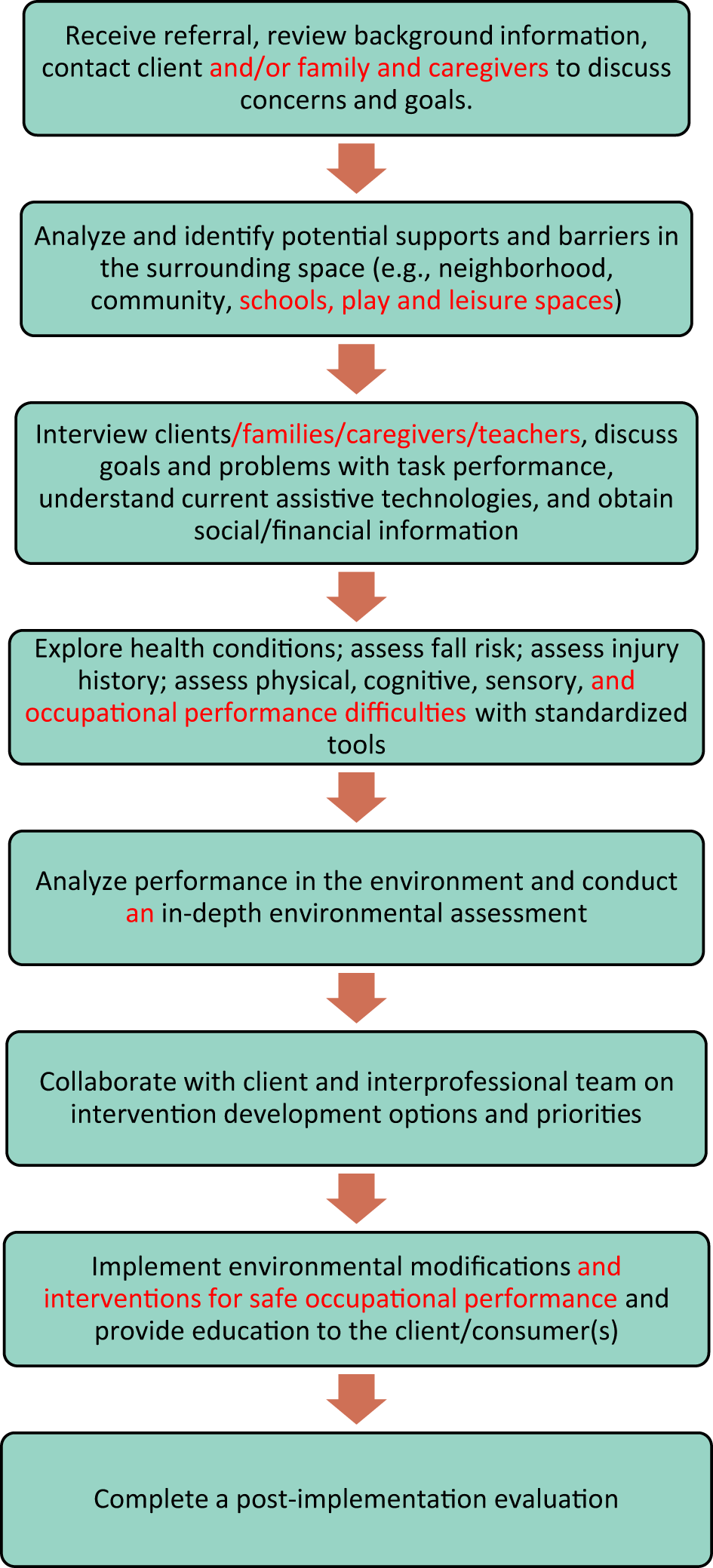
Flow of Environmental Assessment and Intervention
Theoretical Approach to Inclusive Environments
The environment is widely understood to affect disability, health, and occupational participation across interdisciplinary theoretical models (Hess & Schultz, 2008; Lawton & Nahemow, 1973; World Health Organization, 2001). In addition, the environment is distinctly highlighted in well recognized occupational therapy theoretical models, frameworks, and assessments, and it has been for decades (AOTA, 2020b; Bass et al., 2017; Kielhofner & Burke, 1980; Letts et al., 1994). The environment is almost without exception cited as a significant factor that influences performance, participation, health, and well- being and guides practitioners in the occupational therapy process.
Foremost in the OTPF–4, contexts are acknowledged to influence clients’ access to occupation as well as their quality of and satisfaction with performance. In addition, occupational therapy models give insight into the conceptual and theoretical basis for the role of environment in the occupational therapy process and outcome. ▪ The Person–Environment–Occupation model asserts that occupational performance, or the “person engaged in purposeful activities and tasks within an environment” (Law et al., 1996, p.16), can be enhanced by supports or hindered by barriers in the environment. The better the fit of the environment to the person, the better the performance that is attained. ▪ The Person–Environment–Occupational–Performance model similarly recognizes that performance is central to the interaction among the person, environment, and occupation (Bass et al., 2017). However, this model also recognizes the importance of participation, and subsequently the environment, to well-being and quality of life. ▪ The Model of Human Occupation is an open systems model that posits that behavior and occupation are the result of the interaction between personal characteristics (volition, habituation, and performance capacity) and the environment (Kielhofner, 1980a, 1980b; Kielhofner & Burke, 1980; Kielhofner et al., 1980; O’Brien, 2017). Specifically, it states that as a person engages in occupation, feedback is received from the environment, which can then be used to optimize performance. ▪ The Ecology of Human Performance framework emphasizes the role and importance of the environment (Dunn, 2017
; Dunn et al., 1994). In this framework, persons use their skills and abilities to perform tasks with the assistance of environmental cues and features. The better persons are able to interact with their environment, the better they can perform their desired occupations.
Across these commonly used occupational therapy models, the environment is considered a key factor affecting the performance of daily occupations. One could easily conclude that the environment is not just a variable that informs occupational therapy but also fundamental to occupational therapy practice. The occupational therapy process evaluates the environment, considers its influence on performance, creates relevant interventions that consider the environment, and directly addresses environment design to improve clients’ functional performance. Appendix B provides several case examples of the occupational therapy process to address the environment.
Lived Environment
The OTPF–4 describes context as a broad construct including environmental and personal factors that contribute to engagement in meaningful occupations. Environmental factors involve physical, social, and attitudinal surroundings. Accessible environments can support people living as independently as possible or as desired in their home and community in the contexts of social and built environments. This document uses the term lived environment to extend beyond the traditional view of built environment to include personal and public transportation systems, neighborhoods, human-made and natural environments in homes and communities, and others in the social network that provide instrumental and social support (AOTA, 2020b ; Davern et al., 2020). Occupational therapy practitioners should also consider unique and specialty environments that extend beyond the traditional view of homes and public buildings, such as nursing homes, assisted living facilities, long-term-care facilities, prisons, military locations (e.g., ships, airplanes), and places of worship, among others. Although the focus on physical aspects of the environment is necessary and often prioritized in environmental modification interventions, it is critical to consider the influence of social environment on engagement and participation as well (Burns et al., 2020). Understanding both the physical and the social–environmental determinants of engagement and participation contributes to the development of effective interventions in the lived environment.
Technology
Technology affects everyone and all environments. Technology can have a specific environmental access function, such as a grab bar, or it can have therapeutic, assistive, or occupational-related purposes (Smith, 2017). In all cases, the technology is intricately linked with use in an environment and cannot be ignored. Personal technologies such as mobile phones have become an integral part of the environment. Apps on cell phones and other mobile devices can be facilitators of successful engagement and participation for a large portion of the population across most environments. Technology has become a primary tool in a plethora of life occupations and environments and is key to policy (Claypool et al., 2021).
Policy
Policy initiatives in the United States have inspired the development of models and services that support least restrictive environmental decisions. Legislation around equitability and accessible environments support the shift from institutionalization to life in the community (Burns et al., 2017; de Jonge et al., 2011). Legislation such as the Rehabilitation Act of 1973 (Pub. L. 92-112), the Americans with Disabilities Act of 1990 (Pub. L. 101-336; Centers for Medicare & Medicaid Services [CMS], 2021), the Individuals with Disabilities Education Improvement Act of 2004 (IDEA; Pub. L. 108-446), the Olmstead decision ( Olmstead v L.C., 1999), the Fair Housing Act of 1968 (Pub. L. 90-284), and the IMPACT Act provide regulation for including and providing services for people with disabilities. In addition, several movements such as visitability, recognition of discrimination and prejudice in society, the civil rights movement, Black Lives Matter, and social determinants of health further increase the momentum toward creating spaces and environments that are accessible to all, including people with disabilities (Centers for Disease Control and Prevention [CDC], 2021; Internal Revenue Service, 2021; National Council on Independent Living, 2021 ; Pascoe & Smart Richman, 2009; Schmitt et al., 2014; Stepanikova et al., 2017).
The Rehabilitation Act of 1973 set the stage for disability support and equitable access for people with disabilities. Next, the Americans with Disabilities Act of 1990, a comprehensive piece of civil rights legislation that prohibits discrimination, guarantees certain rights for people with disabilities, including participation in everyday American life. Moreover, in Olmstead v. L.C., the U.S. Supreme Court held that public entities must provide community-based services to people with disabilities. Another important principle is that of the least restrictive environment (LRE), which is part of the Individuals with Disabilities Education Improvement Act of 2004, a federal special education law. Essentially, the LRE principle means that (1) children with disabilities in public institutions, private institutions, and other facilities should be educated with typical children, and (2) the use of special classes, separate schooling, or removal of children with disabilities should only be used if supplementary aids and services cannot meet the child’s needs. Last, the Fair Housing Act of 1968 expanded housing opportunities for marginalized populations, including people with disabilities, by prohibiting discrimination in selling, renting, or financing housing. The ADA, Olmstead decision, IDEA, and Fair Housing Act are hallmark shifts in society that have influenced the need for accessibility and opportunities for people with disabilities in the lived environment.
Another important legislative milestone influencing environmental modifications practice is the IMPACT Act of 2014. This act requires specified clinical assessment domains and categories using standardized data across the care continuum (CMS, 2021). This is particularly important to consider as clients progress through the care continuum toward discharge to their homes and community. Critical outcome metrics related to environmental modifications include potentially preventable 30-day post discharge readmission, functional status, medication reconciliation, and incidence of falls. The IMPACT Act highlights the need for environmental evaluations and modifications, with the eventual goal of improving function and participation for all individuals who have experienced a medical life event or disability.
However, in spite of these laws, regulations, and movements toward equality, discrimination and prejudice in society can have a major impact on people not feeling safe and empowered to access the environment. In fact, racial and ethnic minorities and those living with disabilities may encounter health and participation disparities secondary to perceived discrimination (Pascoe & Smart Richman, 2009; Schmitt et al., 2014; Stepanikova et al., 2017). For instance, it is well documented that perceived discrimination can lead to consequences such as poor psychological and cardiovascular health (Lockwood et al., 2018; Molero et al., 2019). Americans may have intersecting identities that include identifying as a racial or ethnic minority and as a person with a disability who may experience an even larger impact of systemic inequalities (National Disability Institute, 2020).
Social movements protesting and advocating for justice, including civil rights and Black Lives Matter, strive to change the political structure of society. Despite major strides in civil rights, people with disabilities still face disparities. People with disabilities may live in distressed communities as a result of resource barriers. Opportunity Zones are one approach designed to bring private capital to underserved communities. They are an economic development tool that affords people the opportunity to invest in distressed and low-income communities to increase economic growth and job creation while providing tax incentives for investors (Internal Revenue Service, 2021). Unfortunately, communities that are economically distressed require more than private capital alone to improve community well-being. An approach that occupational therapy practitioners can take to support these important initiatives is through environmental interventions that include advocacy for new and relevant policy pertaining to environmental access.
Visitability is another movement that aims to change home construction practices so that newly built homes are accessible for people with mobility impairments. They have three essential features: (1) one zero-step entrance, (2) doors with 32 inches of clear passage space, and (3) one bathroom that is wheelchair accessible on the main floor. Visitability extends the concept of public accessibility into the home so spaces are welcoming to everyone, such as an aging grandmother who uses a walker, a friend who uses a wheelchair, or a nephew who is learning to use bilateral lower limb prostheses. A visitable home is designed so that it can be visited by or lived in by people of various abilities (National Council on Independent Living, 2021).
Last, the neighborhoods that people live in have a direct impact on their health and well-being (CDC, 2018). Social determinants of health are “conditions in the places where people live, learn, work, and play that affect a wide range of health risks and outcomes” (CDC, 2021). Having access to quality, safe, and affordable housing and environments is a major social determinant of health along with other factors such as education, access to clean water and nutritious food, and opportunities for physical activity. It is of great significance to address accessibility in neighborhoods and communities to ensure equitable access to communal spaces for people with disabilities. Furthermore, it is important to consider development through adulthood and how environments and experiences shape learning, behavior, and health (Shonkoff & Richmond, 2009). In fact, this highlights the importance of considering and addressing environmental concerns across the life span.
Characteristics of the built environment within communities and neighborhoods are associated with disability, indicating the need for accessible spaces and infrastructure improvements (Danielewicz et al., 2018). This may be particularly problematic for people with disabilities if they are unable to live in desirable locations with newer and more accessible places, which may be due to affordability concerns (Burns et al., 2021). In addition to identifying and addressing existing infrastructure problems for people with disabilities, occupational therapy practitioners can engage in urban planning and the creation of accessible and inclusive neighborhoods. One exciting opportunity for occupational therapy practitioner involvement is in the planning and development of smart cities and smart communities. Smart cities and communities employ technology and data to improve infrastructure by increasing efficiency, supporting economic development, facilitating sustainability, and improving quality of life for citizens (Lai et al., 2020). Occupational therapists offer expertise in inclusive design and needs of persons with differing abilities, which is critical when promoting societal advancement through these increasingly wired communities.
Last, it is important to recognize that policy tends to favor programs that reinforce a least restrictive living environment and low-cost community models; institutionalization comes at a high cost (Burns et al., 2017). Although some funding and programs are available to support inclusive environments, locating resources is an ongoing challenge. Homeowners may have a limited budget or receive governmental social services, and they may be eligible for home improvement grants or waiver programs. However, if homeowners are unable to secure cost supports because of qualification guidelines or extensive waitlists, other options may include low-interest loans and reverse mortgages. Challenges are also encountered by building and business owners who have limited resources to make modifications for people with disabilities. Third-party payment is rarely available beyond evaluation services. Practitioners must fully understand the implications of providing home and environmental modification services to Medicare beneficiaries, including billing requirements, because occupational therapy practitioners cannot opt out of the Medicare program. In addition, federal and state fraud and abuse laws may require consideration when referrals for additional services such as home modifications are involved. Although resources may be in short supply, occupational therapy practitioners should prioritize the identification of potential resources in the community, even if the only option incrementally solves the problem (Burns et al., 2017). Recent funding opportunities through Medicaid state waivers and the Department of Housing and Urban Development show promise for additional funding sources as policymakers are focusing more directly on the social determinants of health, such as housing, transportation, and food sufficiency.
Trade-Offs and Prioritization
Environmental interventions for the home are typically individualized, whereas interventions in the community cater to a broader group of consumers. For individualized interventions, occupational therapy practitioners collaborate with their clients to develop an intervention plan after completing an in-depth evaluation. The collaboration typically involves identifying clients’ wants and needs and tailoring the interventions based on safety, along with pragmatic factors such as cost, aesthetics, and, arguably most important, client buy-in (Burns et al., 2017). Moreover, factors such as aesthetics and historic preservation may be particularly important in some communities, particularly those with organizations and foundations that advocate for preserving the distinctive character of the neighborhood.
Occupational therapy practitioners are equipped to make recommendations for inclusive environments and must consider the wants, needs, and requirements of the community. Balancing the needs of modern society, which might include mobility and transportation, livability, visitability, growth, and even tourism, while protecting and preserving historic architecture and material culture, is an important priority in many communities. Occupational therapy practitioners can work with city planners, developers, and organizations focused on revitalizing communities to meet the needs of people living with disabilities.
Funding is also an important factor to consider in environmental modifications, as described in the policy section. It is essential to assess funding available from clients, loans, mortgages, and third-party payment. Occupational therapy practitioners often need to prioritize modifications based on need and available funding; this can be done through collaborations with clients, community organizations, and city planners to meet the needs of the people living in their communities, especially people with disabilities.
Ethical Considerations
Occupational therapy practitioners have a responsibility to practice ethically within their scope of practice when providing services related to home and community environmental interventions, including assistive and information technologies. AOTA provides guidelines for practitioners in the AOTA 2020 Occupational Therapy Code of Ethics (AOTA, 2020a), Standards of Practice (AOTA, 2021b), and Scope of Practice (AOTA, 2021a) documents. The core principles of the Occupational Therapy Code of Ethics (AOTA, 2020a) beneficence, nonmaleficence, autonomy, justice, veracity, and fidelity should guide all practitioners when providing environmental evaluations and interventions in either the home or the community. Occupational therapy practitioners should adhere to all standards and guidelines provided by AOTA and be aware of and adhere to federal and state regulations in implementing home and community modifications. In addition to these regulations, practitioners must also ensure that they have the skills and knowledge required to implement environmental and assistive technology interventions. These skills and knowledge are first obtained in accredited occupational therapy curricula and should be built on through continuing education and professional development opportunities. Critical components of ethical practice in environmental interventions include comprehensive environmental evaluations and modifications, collaborative and interdisciplinary practice, consideration of social networks, attention to fiscal possibilities and constraints, practitioner responsibility to see projects to completion, continuing education, and technology competency (Hammel & Smith, 1993, Mendonca et al., 2015).
It is essential that occupational therapy practitioners who practice environmental modification obtain knowledge and certifications to support current and appropriate practice with their clients. Environmental interventions are typically covered as part of entry-level occupational therapy programs. However, practitioners who practice in this area should seek out opportunities for certifications, continuing education, and professional development to ensure they stay current.
Conclusion
Although this position statement focuses on professional practice, it is highly relevant to other key occupational therapy professional roles. Beyond the importance of environmental evaluation and intervention practice, advocates, researchers, inventors, and professional program instructors have critical roles in creating inclusive environments. Practice is dependent on preservice and in-service education that teaches sound and inclusive assessment and intervention processes. Practice excellence is based on research and the development of more inclusive environments. Practice only becomes real when it is funded and supported by the advocates working in the policy environment. Moreover, the continuum of practice is broad. As highlighted throughout this document, practitioners in all areas of practice are responsible for facilitating inclusive environments. The accompanying breadth of case studies highlights this scope (see Appendix B).
Footnotes
Authors
Rochelle Mendonca, PhD, OTR/L
Suzanne Burns, PhD, OTR
Jaclyn Schwartz, PhD, OTR/L
Roger O. Smith, OT, PhD, FAOTA, RESNA Fellow
Case Study Author Contributors
Raquel Van Der Biest, OTR/L, CLVT
Shelley Coleman Casto, MS, OTR/L, BCP, CPST
Lisa M Krefft, MSL, OTR/L
Linda R. Struckmeyer, PhD, OTR/L
Abigail Swidergal, MS, COTA/L, CKTP
Quinn P. Tyminski, OTD, OTR/L, BCMH
For The Commission on Practice
Caitlin Synovec, OTD, OTR/L, BCMH, Chairperson
Adopted by the Representative Assembly Coordinating Council (RACC) for the Representative Assembly, 2022.
Note. This revision replaces the 2015 Complex Environmental Modifications position statement previously published and copyrighted in 2015 by the American Occupational Therapy Association in the American Journal of Occupational Therapy, 69(Suppl. 3), 6913410010. 
Copyright © 2022 by the American Occupational Therapy Association, Inc.
Appendix A. Definitions
Because of the expansive scope of inclusive environments, the following key definitions help provide an understanding of environmental interventions in the home and community context: ▪ ▪ ▪ ▪ ▪ ▪ ▪ ▪ ▪ ▪ ▪