





Abstract
This review provides occupational therapy practitioners with a comprehensive understanding of the importance of school engagement to mental health and the range of behavioral, cognitive, and emotional engagement measures currently available for use with elementary school–age children, thereby enhancing the profession’s knowledge and scope of practice in school engagement.
Children spend a significant portion of their childhood in the school setting, where they learn to play, socialize with their peers, and engage with academic content (Case-Smith, 2015). School success is determined by how children engage in classroom tasks and learning activities (Ladd & Dinella, 2009). School engagement is defined as the extent to which the student commits to and participates in school activities, including internal thoughts and emotions and observable behaviors (Charkhabi et al., 2019; Glanville & Wildhagen, 2007). School engagement in the elementary years is critical for foundational academic learning and is positively correlated with later achievements in reading and mathematics and progression in class (Ladd & Dinella, 2009). School engagement is further linked to positive mental health outcomes for vulnerable young people, including those in out-of-home care (Bond et al., 2007; Threlfall et al., 2017; Wang & Peck, 2013), and it has been identified as a possible target for effective school-based interventions to promote child mental well-being (Threlfall et al., 2017). Occupational therapy practitioners frequently work with children who may experience difficulties with school engagement because of self-regulation concerns. Difficulties with self-regulation are a major contributor to child mental disorders in the elementary school years (Robson et al., 2020; Smithers et al., 2018), and they can affect the child’s ability to develop appropriately modulated behavioral responses to specific contexts, including schools (Watling, 2015). Currently, no best practice guidelines exist for the identification and measurement of school engagement difficulties in elementary-school-age children by occupational therapy practitioners. The lack of a consistent approach to school engagement measurement in occupational therapy limits the field’s ability to examine the efficacy of current school-based practices (Grajo et al., 2020).
School Engagement
Adequate school engagement is thought to promote learning and school performance; be positively associated with mental health and resilience; and reduce rates of school dropout, boredom, and persistent educational problems (O’Donnell & Reschly, 2020). Fredricks et al. (2005) suggested that school engagement is a multifaceted construct involving behavioral, emotional, and cognitive engagement. Behavioral engagement is reflected in positive behaviors in the classroom, for example, putting in effort; participating in academic, social, and extracurricular activities; and absence of disruptive behaviors (Fredricks & McColskey, 2012). Emotional engagement includes positive and negative emotional reactions in the classroom, for example, identification and sense of belonging to the school, personal value of school-related outcomes, taking pride in work, expressing positive affect with respect to learning, and expressing concern for classmates. Cognitive engagement is concerned with learning beyond school requirements, for example, challenge-seeking, being strategic in learning, and self-regulated learning. Although school engagement and motivation are sometimes used interchangeably, they are two distinct concepts. Motivation is the underlying reason for doing something, whereas engagement is the transactional outcome among the student, the context, and the tasks (Fredricks & McColskey, 2012; Fredricks et al., 2016).
The role of school engagement in academic achievement begins with the foundational school years. A 2-yr longitudinal study of Belgian kindergarten and Grade 1 students demonstrated a positive correlation between classroom participation during the year and academic results at the end of the year (Bossaert et al., 2011). Bossaert et al. (2011) further suggested that classroom participation is a key construct linking academic self-concept and peer acceptance to short-term and long-term achievement outcomes, including attendance and graduation. In a U.S. context, Ladd and Dinella (2009) suggested a bidirectional relationship between behavioral and emotional engagement, in which students who enjoyed school (emotional engagement) were more likely to develop more cooperative behaviors toward classroom activities and vice versa (Ladd & Dinella, 2009). Students who maintained a high level of behavioral or emotional engagement throughout their years at school would show greater academic progress (Ladd & Dinella, 2009), although some students became less engaged as they progressed through the elementary grades (Archambault & Dupéré, 2017; Ladd & Dinella, 2009). In a Canadian sample of 3rd graders and 6th graders, 3rd graders already reported a limited interest in literacy, and their engagement in 6th grade had dropped to a lower level (Archambault & Dupéré, 2017). These authors considered behavioral, cognitive, and emotional engagement and identified five student engagement trajectories, with boys overall presenting with a more worrisome decline from 3rd to 6th grade. Archambault and Dupéré (2017) also evidenced transient changes to engagement, with one model demonstrating a rapid decline in behavioral and cognitive engagement between 3rd and 4th grade but stabilizing by the end of elementary school. These results challenge readers to consider that disengagement, poor enthusiasm, and academic investment could be affected by the increase in academic challenge that occurs in the transition to later elementary school and into middle school (Archambault & Dupéré, 2017).
School Engagement and Self-Regulation
Self-regulation is a foundational skill necessary for successful engagement and participation in school activities (Watling, 2015), and it is strongly linked to child mental health (Robson et al., 2020; Smithers et al., 2018). Self-regulation refers to the ability to modulate alertness, emotional state, thought process, motivation, and behavior to subsequently adapt to the social, cognitive, and emotional demands of an activity (Florez, 2011; Mandich et al., 2015). The capacity to self-regulate improves with age and is related to the maturing of the prefrontal cortex, which controls executive functions, although contextual factors, such as poverty and adverse childhood experiences, may reduce students’ ability to self-regulate (Blair & Raver, 2015). Older students are more likely to pay attention and use metacognitive strategies for learning (Blair & Raver, 2015; Fredricks & McColskey, 2012). Research has suggested that very low or very high levels of stress associated with these contextual factors can dampen the use of executive function, planning, and self-regulation for school activities, which can then manifest as behavioral problems (Blair & Raver, 2015). Alternatively, self-regulation can be improved when students are in a caring and supportive environment (Blair & Raver, 2015; Watling, 2015).
School Engagement and Occupational Therapy
Occupational therapy practitioners are well positioned to facilitate school engagement in students because of their holistic consideration of the person, environment and context, occupations, and performance (Baum et al., 2015). This intersection of occupational performance and participation is school engagement. A recent systematic review summarized the effectiveness of interventions within the scope of occupational therapy that focused on educational participation (Grajo et al., 2020). Interventions ranged from using yoga as an activity-based intervention to using sensory-based intervention and environmental support. Although some interventions targeting educational participation were found to be effective, such as yoga, which had moderate evidence for its use, others, such as weighted vests and stability balls, had only low evidence to support their use (Grajo et al., 2020). The existing literature is limited by small sample sizes and a lack of control groups in study design. Moreover, most studies have been conducted by professionals in disciplines other than occupational therapy. Although evidence exists that supports the role of occupational therapy in addressing school engagement, a lack of consistency concerning how to measure school engagement remains problematic for the profession.
Measurement of School Engagement
Fredricks et al. (2016) suggested that school engagement is sensitive to changes in practice. By accurately identifying how much a student is engaging in school activities, the education team, including school-based occupational therapy practitioners, can adapt teaching styles and modify school policies to facilitate students’ engagement and improve learning outcomes. Additionally, accurate and reliable measurement of school engagement enables researchers and clinicians to evaluate the effectiveness of interventions targeted at improving school engagement (Fredricks & McColskey, 2012), which could improve overall student mental well-being (Threlfall et al., 2017).
Current methods for measuring school engagement among elementary-school-age students include student self-reports, experience sampling, teacher ratings, interviews, and observations (Fredricks & McColskey, 2012). Although measures of school engagement are being used in research and practice, Grajo et al. (2020) identified that there is no consensus on how to measure school engagement within the field of occupational therapy. To date, occupational therapy practitioners have used measures of on- and off-task behaviors, but these are considered unreliable because of the mismatch between behavioral engagement and cognitive engagement; that is, students can pretend to be on task but are not cognitively engaged (Fredricks & McColskey, 2012; Grajo et al., 2020). Student self-report measures can be more useful to measure subjective perception that is not directly observable, such as emotional and cognitive engagement, but self-report measures are subject to recall bias, dependent on honesty from the student, and do not reflect the change in context (Fredricks & McColskey, 2012). Because the constructs of these measures vary, therapists who measure only on- and off-task behaviors may risk misjudging the student’s overall engagement in school. Best practice measures of school engagement should be clear in defining engagement and what is being measured, psychometrically sound, sensitive to change, reflective of the fluctuations in engagement across contexts or time, and appropriate for the developmental age (Fredricks & McColskey, 2012).
In summary, school engagement is critical for a child’s likely academic success, mental health, and future life participation (Archambault & Dupéré, 2017; Ladd & Dinella, 2009; Threlfall et al., 2017). Occupational therapy practitioners frequently work with children who have school engagement difficulties that may be related to broader challenges in self-regulation, which is further associated with child mental health (Clark et al., 2019; Robson et al., 2020; Smithers et al., 2018). Currently, the information about best practice measurement approaches for school engagement in the occupational therapy profession is limited. Therefore, a scoping review of the literature can be valuable in determining the availability and suitability of school engagement measures for use by occupational therapy practitioners. The aim of this scoping review is, therefore, to examine the school engagement measures available for occupational therapy practitioners to use with elementary-school-age students.
Method
Design
The Preferred Reporting Items for Systematic Reviews and Meta-Analyses extension for Scoping Reviews (PRISMA–ScR; Arksey & O’Malley, 2005; Tricco et al., 2018) guided this scoping review. Ethics approval was not required for this study, and no protocol was registered. The original search was conducted in July 2020, and an updated search was performed in December 2021.
Search Strategy
The following comprehensive search strategy was finalized with a consulting research librarian on the basis of previous school engagement literature: [(“student engagement”) OR (“scho* engagement”) OR (“cognitive engagement”) OR (“learn* engagement”) OR (“academic engagement”)] AND [(“elementary school*”) OR (“primary school*”) OR (“school child*”) OR (schoolchild*) OR (“infant* school*”)] AND (assessment* OR measure* OR scale* OR tool* OR instrument*). This search strategy was executed in the PsycINFO, Eric, CINAHL, and A+ Education databases. Limitations were placed to include full text, English language, and records published between 2015 and 2021. Duplicate articles were removed from the search results.
Screening
Two researchers (Alison E. Lane and Kit Iong Tam) developed the inclusion criteria to maintain a comprehensive approach to identification of relevant sources. Data sources were included in the review if the (1) full text was available, (2) article was written in English, (3) measure was designed for elementary-school-age students, and (4) article was published between January 1, 2015, and December 1, 2021. Peer-reviewed studies that reported original data were included. Studies were excluded if they met one or more of the following criteria: (1) did not measure school engagement; (2) used only infant, adolescent, or adult scales; and (3) were not available for review or they did not meet the inclusion criteria.
Two reviewers (Tam, Tennille Johnson, or Kelsey Philpott-Robinson) screened titles and abstracts using Covidence (Veritas Health Innovation, 2020), a web-based software platform for systematic reviews, using the inclusion and exclusion criteria we have outlined. When consensus was not established, the reviewers met via video conference to discuss the search results. If consensus could not be reached, a third reviewer (Lane) resolved the conflict. Articles selected from the initial screening were subjected to full-text screening by the first author (Tam) and assessed for eligibility (Figure 1). Data sources included in the final review were organized using the bibliography management application EndNoteTM (Version X8.2).
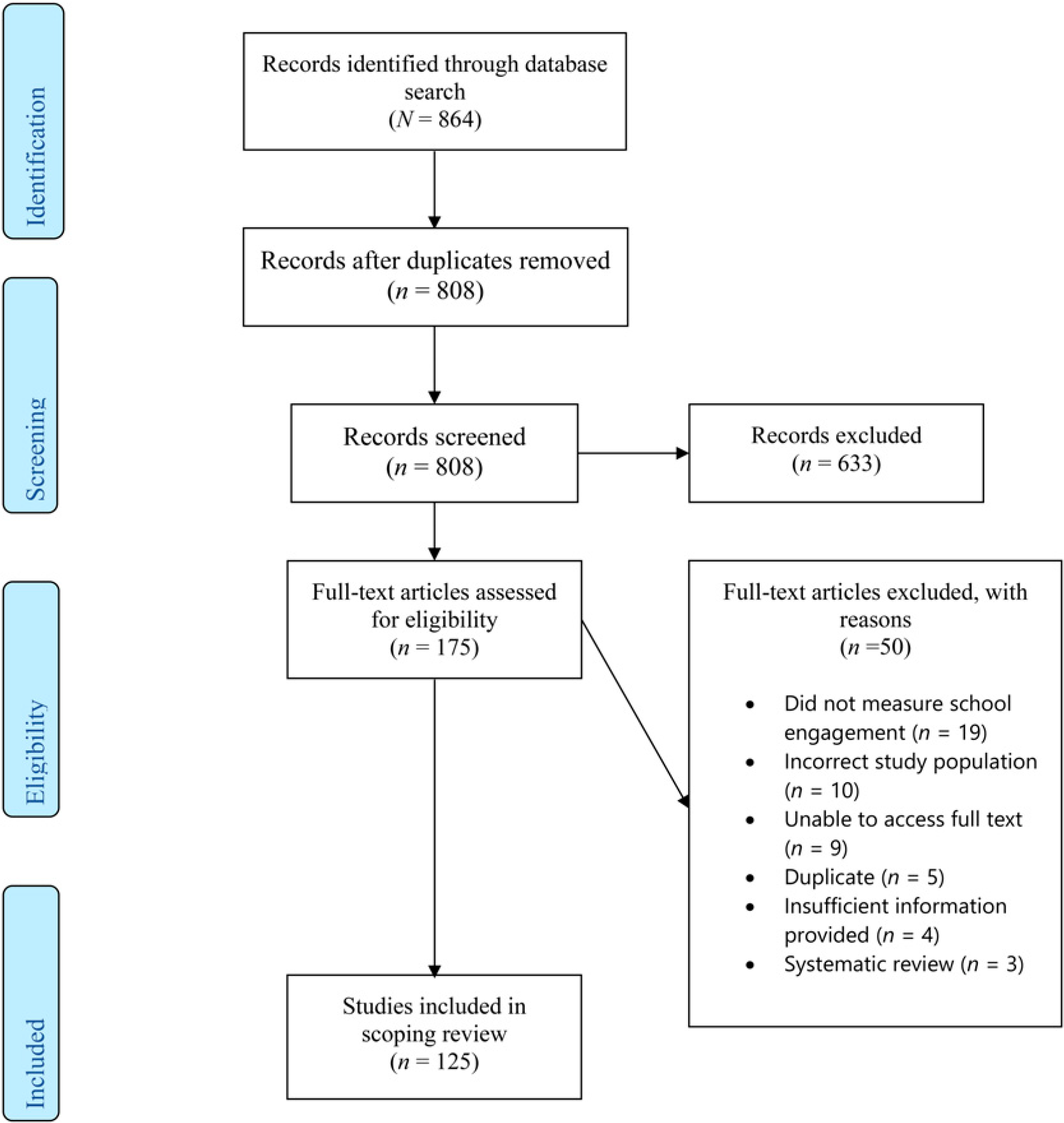
Flow diagram of the study selection process.
Data Extraction and Analysis
Two reviewers (Tam and Philpott-Robinson) independently extracted the following data from the included studies: author; publication year; title; study location, population, aim, purpose, and design; measure of engagement (see Table A.1 in the Supplemental Appendix, available online with this article at https://research.aota.org/ajot); type of measurement (e.g., student report, observation, teacher report); construct of engagement (e.g., behavioral, emotional, cognitive; see Table A.2); and any report of the measures’ psychometric properties. The findings were entered into an Excel spreadsheet. Data extraction was verified by a second reviewer (Johnson), who independently extracted data from 10% of the included sources. A third reviewer (Lane) compared the data from the two reviewers to ensure consistency and resolve any discrepancies.
Results
Figure 1 outlines the selection of studies using PRISMA–ScR. The initial 2020 search returned 477 records, and an additional 387 records were found in 2021. Overall, 864 records were identified, and 56 duplicates were removed. After title and abstract screening, 175 articles remained. After full-text review, 125 studies were included in this scoping review. Reasons for exclusion included no mention of measure of school engagement, incorrect study population, lack of full-text availability, or further duplication. Measures that focused on disengagement and disruptive behaviors were excluded from this review, given that engagement and disengagement are not considered symmetrically opposite (Morinaj et al., 2017; Schabracq & Cooper, 2003). Additionally, some systematic reviews were excluded because they did not mention school engagement measurements (see Figure 1).
Most studies were conducted in the United States (57.6%), followed by Australia (11.2%), China (8.8%), and Canada (4.0%). The remaining studies were conducted across Asia and Europe (18.4%). The majority of studies were conducted in education (74%), with the remainder covering health and science disciplines such as psychology, medicine, or nutrition. None of the studies were conducted by occupational therapy practitioners or published in occupational therapy journals.
Table A.1 details the range of study aims and corresponding school engagement measures used in the included studies. Overall, 85 measures of school engagement were used in the 125 studies; 45% were student self-report; 29%, observational; 17%, teacher report; and the remaining 9%, caregiver report or combined methods, including interviews or focus groups.
Behavioral engagement was the most common domain of engagement specified in the measures (32%) and was examined mostly through observational methods. Emotional and cognitive engagement were rarely measured in isolation, but they were often measured as a combination of behavioral, emotional, and cognitive engagement (34%). Student report and observation were the most common measurement types implemented to measure school engagement, followed by teacher report and caregiver report and combined approaches. Table A.2 outlines the school engagement measures found in this scoping review, including method of measurement (student report, observational, teacher report) and construct of school engagement measured (behavioral, emotional, cognitive). Frequency of use of each measure was calculated for the categories of observational, teacher report, student self-report, and caregiver or combined observational measures.
Momentary time sampling was the most common observational measure used, although the rationale for the length or duration of observation was rarely provided in included studies. Commonly, a combination of time-sampling methods based on the Behavioral Observation of Students in Schools (Shapiro, 2011) and the Cooperative Learning Observation Code for Kids (Volpe & DiPerna, 2010) were implemented. Further studies included observational models with theoretical support (Bruhn et al., 2018; DeJager & Filter, 2015; Fallon et al., 2020; Levy et al., 2016; Musti-Rao et al., 2015; Sabin, 2015; Torrington & Bower, 2021; Zimmerman et al., 2020).
Teacher-Report Measures
The Student Engagement vs Disaffection with Learning Scale (Skinner et al., 2009) was the most common teacher-report measure used to capture behavioral and emotional student engagement. The Direct Behavior Rating–Multi-Item Scales and Academic Competence Evaluation Scales–Teacher Form (DiPerna & Elliott, 2000) were also commonly used to measure behavioral academic engagement and behavioral engagement, respectively.
Student Self-Report Measures
The Delaware Student Engagement Scale (Bear et al., 2014), Student Engagement Measure (Fredricks et al., 2005), and School Engagement Dimensions Scale/ Dimensions of School Engagement Scale (Archambault & Vandenbossche-Makombo, 2014) were the most common student self-report measures of school engagement used (Table A.2). All three were student self-reports of behavioral, emotional, and cognitive school engagement.
Caregiver-Report and Combined Measures
Few caregiver report measures were used in the included studies, the majority of which included a set of questions developed by the study authors regarding student engagement (Duh-Leong et al., 2020; Groenewald et al., 2020). The School Climate Survey was administered in 1 study, which was reported to have been developed by the U.S. school district in which the study was conducted (Tiberi, 2021). In contrast, semistructured interviews were a common method used to examine student behavioral, cognitive, or emotional engagement from the caregiver perspective.
Discussion
The purpose of this scoping review was to identify and characterize school engagement measures for elementary school students by various groups. One hundred twenty-five studies met the inclusion criteria for this review, and a range of school engagement measures were found that examine behavioral, emotional, or cognitive engagement.
Most studies were conducted in the United States and were from the education or psychology fields. No occupational therapy studies were discovered. Student self-report was most commonly used to measure school engagement, followed by observation and teacher report. Behavioral engagement was the most common construct of school engagement measured across all categories (student self-report, observation, teacher report, etc.) as an isolated construct, with some measures considering two or more types of engagement. Very few measures examined cognitive or emotional engagement as a single construct of school engagement. A comprehensive list of all measures, including type of measurement and construct of school engagement, is provided in Table A.2.
No clear consensus on how to measure school engagement in the education and psychology fields was discovered. A lack of consistency is further exacerbated for occupational therapy practitioners, given that no studies developed by or for occupational therapy practitioners were discovered. A possible explanation for the lack of occupational therapy input is the differences in terminology. Instead of school engagement, which is seen in the education field, the terminology educational participation or school participation is more commonly used in the occupational therapy literature (Bonnard & Anaby, 2016; Grajo et al., 2020; Hodges et al., 2020). Occupational therapy is also influenced by the language of the International Classification of Functioning, Disability and Health–Child and Youth Version (ICF–CY; World Health Organization, 2007). In the ICF–CY, participation is described by the person’s performance and their capacity. Raghavendra et al. (2012) suggested that students’ school engagement may be considered as how well the performance was for their participation (Raghavendra et al., 2012). There is a need to understand whether school participation contains school engagement or whether the two concepts overlap only at the behavioral level. Hodges et al. (2020) investigated parents’ and educators’ perspectives on school participation for elementary students with autism spectrum disorder. Educators tended to focus on student behavior, such as following instructions, whereas parents defined school participation as involving more affective (emotional) or psychological belonging. Discrepancies in how stakeholders define and measure school engagement are noteworthy, and they should be considered by occupational therapy practitioners in the selection and development of school engagement measures. Our scoping review attempts to address this discrepancy by exploring school engagement measures in the literature as defined by Fredricks et al. (2005)—including behavioral, emotional, and cognitive constructs. Despite a call for school-based occupational therapy practitioners to broaden their scope of practice to include school participation in all areas (Bonnard & Anaby, 2016), both a recent systematic review (Grajo et al., 2020) and occupational therapy practice guidelines (Cahill & Beisbier, 2020) have shown ongoing significant gaps in the current scope of occupational therapy and evidence at the participation level. The findings of our review support this conclusion in that most of the school engagement studies were published in education- or psychology-based journals. No studies were discovered in occupational therapy journals. The latter could have more implications for occupational therapy practitioners because they work with both the general student population and with students requiring special education, including those with autism spectrum disorder.
The results of this scoping review highlight the plethora of school engagement measures available to occupational therapy practitioners; however, consideration must be given to developmental changes that occur throughout elementary school. Some of the measures listed in Table A.2 are designed for 3rd graders or above. Therefore, for younger students, a semistructured interview adapted from the School Engagement Questionnaire plus other data may be appropriate to elicit students’ perceptions of school engagement (O’Toole & Due, 2015). For students who have multiple disabilities or communication impairments, using parent report (Lui et al., 2017), regular observation (Simmons et al., 2016), or an observational method of measuring eye gaze in seconds (Holyfield et al., 2019) is worthy of exploration.
To remain client and person centered, student self-report measures should be included to directly assess students’ thoughts and feelings about their own school engagement (Bazyk & Cahill, 2015). Including the child’s perspective in the information gathering process enables occupational therapy practitioners to explore potential facilitators of and barriers to school engagement, as experienced by the child. Although no studies from occupational therapy were discovered, many studies in this scoping review support this client- and person-centered approach through consistent use of student self-report measures of school engagement.
Cahill and Beisbier’s (2020) best practice guidelines called for researchers to understand how to measure participation in academic tasks and educational environments. Inconsistency in and a lack of consensus on school engagement measurement is concerning, given the well-known links between cognitive elements of school engagement and mental well-being in childhood and adolescence (Bond et al., 2007; Robson et al., 2020; Smithers et al., 2018; Threlfall et al., 2017; Wang & Peck, 2013; Watling, 2015). Although there has been an increased focus on preventing, identifying, and managing mental health concerns among children and adolescents (Fergusson et al., 2005a, 2005b; Hofstra et al., 2002; Holland et al., 2017), identifying an appropriate measure of school engagement remains a pervasive challenge for school-based occupational therapy practitioners. Bonnard and Anaby (2016) suggested a range of participation measures available for occupational therapy practitioners to use in the school setting: the Children and Adolescent Scale of Participation, the Canadian Occupational Performance Measure, the Children Participation Questionnaire, the School Function Assessment, and the School Setting Interview (Bonnard & Anaby, 2016). Future research from the occupational therapy perspective needs to be conducted and reported that will align occupation-focused measures within the field of school engagement as defined by Fredricks and colleagues (Fredricks & McColskey, 2012; Fredricks et al., 2016).
Outside the scope of this review, future critical appraisal is recommended to identify the clinical utility of the school engagement measures discovered. Ideally, measures should be economical to purchase, be reliable and responsive to change, have proven validity, measure the constructs of school engagement as defined by Fredricks et al. (2016), and have manualized training for occupational therapy practitioners.
Future studies are warranted, including an analysis of measurement properties of the school engagement measures discovered. Analysis of measurement properties will enable occupational therapy practitioners to broaden their scope of practice by determining the most suitable measure of school engagement for specific school-based contexts. Additional studies examining concurrent validity between the school engagement measures included in this scoping review and traditional occupational-focused measures reported by Bonnard and Anaby (2016) are warranted to determine the level of agreement between these constructs. Furthermore, consumer-driven research studies to investigate how school-based occupational therapy practitioners currently measure school engagement, and which of the evidence-based measures may be acceptable for use in a practical setting, should also be considered.
This scoping review has some limitations: Only English-language studies were included, the review was limited to the years 2015–2021, and no analysis of measurement properties was conducted. This review is the first known to explore options for measuring school engagement from an occupational therapy perspective. The PRISMA–ScR framework enhanced the rigor of this review through two-reviewer screening at multiple stages of the process. The review focused on elementary-school-age students, a key stage for learning and development in children, and Table A.2 in the Supplemental Appendix provides practitioners with comprehensive details on measures of school engagement currently available for use with elementary-school-age students.
Implications for Occupational Therapy Practice
This scoping review has the following implications for occupational therapy practice: Although this review identified considerable gaps where the current literature on school engagement measurement lacks occupational therapy presence, a comprehensive list of school engagement measures is provided for practitioner review. Occupational therapy practitioners are challenged to consider school engagement a part of their scope of practice, particularly as part of a comprehensive child mental well-being approach. Practitioners are encouraged to adopt client-centeredness (Bazyk & Cahill, 2015) by using a promising range of student self-report measures of school engagement to understand engagement from the student’s perspective. As a preliminary study, this scoping review highlights the need for further rigorous studies from the occupational therapy perspective that examine the measurement properties (e.g., psychometrics) of school engagement measures currently available for use by occupational therapy practitioners. Additional studies will further strengthen the evidence to support occupational therapy practitioners’ use of school engagement measures as part of their daily practice.
Conclusion
School engagement is a common reason for referral to school-based occupational therapy practitioners, often resulting from poor self-regulation in the school context. Lack of best practice guidelines for the measurement of school engagement among elementary-school-age children limits the profession’s capacity to examine the efficacy of current school-based practices to improve behavioral, emotional, or cognitive engagement (Grajo et al., 2020).
The 125 studies identified in this review (see Tables A.1 and A.2) highlight the abundance of school engagement measures available for occupational therapy practitioners to use, predominantly from the education and psychology fields. Most studies measured school engagement using student self-report, although this approach is susceptible to reporter bias. Behavioral engagement was the most common construct of school engagement examined, which falls within the scope of occupational therapy practice. When considered within the Occupational Therapy Practice Framework (4th ed.; American Occupational Therapy Association, 2020), occupational therapy practitioners are well placed to examine behavioral (e.g., presence of irrelevant or impulsive behaviors) and emotional (displaying affect and emotions in a socially appropriate manner) school engagement as core features of social interactions in the school setting.
The overarching goal of this scoping review is to consider a broadened scope of practice to enable meaningful school engagement to enhance student mental well-being among elementary school students. This can be achieved by using currently available behavioral or emotional measures of school engagement as identified in this scoping review. Although this scoping review highlights no consensus on a validated school engagement measurement for school-based occupational therapy, clinicians need to consider and critique the available measures in the context of their current practice to increase focus on school engagement as a meaningful occupational therapy outcome in school-based settings. From a research perspective, there is also a need to develop new measures that reconcile school engagement within occupational and child mental well-being frameworks.
Supplemental Material
Supplementary material for Measurement of School Engagement in Elementary School Students: A Scoping Review
Supplementary material, sj-pdf-1-aot-10.5014_ajot.2023.050036.pdf for Measurement of School Engagement in Elementary School Students: A Scoping Review by Kit Iong Tam, Kelsey Philpott-Robinson, Tennille Johnson and Alison E. Lane in The American Journal of Occupational Therapy
Footnotes
*
Indicates studies included in the scoping review.
References
Supplementary Material
Please find the following supplemental material available below.
For Open Access articles published under a Creative Commons License, all supplemental material carries the same license as the article it is associated with.
For non-Open Access articles published, all supplemental material carries a non-exclusive license, and permission requests for re-use of supplemental material or any part of supplemental material shall be sent directly to the copyright owner as specified in the copyright notice associated with the article.
