






Abstract
This scoping review provides occupational therapy practitioners with comprehensive terminology to identify, assess, intervene with, and research environmental and contextual factors that affect participation and participation choices of individuals, groups, and populations.
For any person, participation in life’s daily roles and occupations occurs at the nexus of personal capabilities, interests, and opportunities and contextual and environmental affordances and barriers. Many theories in occupational therapy emphasize the transactional relationships among the environment, the person, and their occupation, including Person–Environment– Occupation theory (Baptiste, 2017) and the Person– Environment–Occupation–Performance model (Baum & Christiansen, 2005). These principles are also included in the World Health Organization’s (WHO’s; 2001) International Classification of Functioning, Disability and Health (ICF) and the American Occupational Therapy Association’s (AOTA’s; 2020) Occupational Therapy Practice Framework: Domain and Process (4th ed.; OTPF–4). AOTA (2015) published a document defining the environment as “external physical and social aspects that surround clients while engaging in the occupation” and context as “the cultural, personal, temporal, and virtual aspects of this engagement” (p. S57). Nevertheless, contextual and environmental considerations may not be well integrated into clinical practice (Brown & Bowen, 1998; Hammell, 2015; Mousavi et al., 2015; Pereira, 2017). Practitioners may not assess for or use information regarding these aspects of an activity to the same extent they do personal factors (Brown & Bowen, 1998; Hammell, 2015; Mousavi et al., 2015; Pereira, 2017). “A focus on curing the deficits located in the person’s body misses the need to include environmental . . . interventions at the community or societal levels [that] have the potential to improve participation significantly” (Magasi et al., 2015, p. 571).
An important component leading to the disparity between considering environmental and contextual versus personal factors is the absence of detailed language to identify and describe environmental and contextual factors that affect participation (Whiteneck & Dijkers, 2009). The origins of this disparity include the linkage and dependence of occupational therapy on the medical model (Kielhofner, 2005; Mousavi et al., 2015); the focus of funding sources on reimbursement only for remedial or restorative therapies (Foye et al., 2002; Jongbloed & Wendland, 2002); the lack of integration of social justice principles into occupational therapy education and practice (Kuper & Weber 2011); and the difficulty in measuring environmental and contextual factors and defining the environment, context, and participation (Whiteneck & Dijkers, 2009). As stated by Magasi et al. (2015), “Unless we are able to differentiate aspects of the environment, important questions about the effects and comparative effectiveness of interventions and policies to promote participation cannot be answered” (p. 570). By addressing the gap in environmental terminology, intervention at the level of the environment can have a more universal effect on participation. Thus, by changing the availability of mastery experiences through environmental or contextual change, occupational therapy practitioners can provide clients with a sense of efficacy that may change not only their opportunities to participate but also their willingness to attempt to participate.
Accordingly, we constructed a typology of terminology for identifying and describing detailed environmental and contextual factors that aligns with but adds further refinement to the OTPF–4 (AOTA, 2020) and the ICF (WHO, 2001). Collier et al. (2009) indicated that terms and concepts in a typology are frequently drawn from other studies in related domains. Typology authors “borrow” these existing terms and with them develop terminology that more effectively describes the factors of interest to the purposes of the given typology. For example, the language in our typology was derived from a scoping review of the literature across multiple disciplines. We used a scoping review to broadly search the published interdisciplinary literature on environmental and contextual factors, allowing us to gather a detailed and inclusive set of terms to constitute our typology. From the literature, we identified, selected, categorized, and defined terms that would be useful and usable in describing environmental and contextual factors that support or diminish participation in roles and activities for individuals, groups, and populations. The purpose of this article is to describe this scoping review process, to share the resulting typology, and to describe the typology’s importance to and implementation in occupational therapy practice, education, and research.
Method
We used the Arksey and O’Malley (2005) guidelines with updates by Levac et al. (2010) and Peters et al. (2015) to structure the five main steps of this scoping review. First, we defined the research question: “What terminology is available in the literature that describes discrete factors in the context and environment that support or diminish the participation of individuals and groups of people?” Second, we searched the following electronic databases: Avery Index of Architectural Periodicals, CINAHL, ERIC, EMBASE, Engineering Village, MEDLINE, and Google Scholar using the terms environment, factors, context, participation, people, disability, disabilities, aspects, barriers, assessment, and evaluation.
Third, using the Covidence platform, Leon Kirschner and Nancy W. Doyle screened 121 published resources’ titles and abstracts, conducted full-text reviews of 76 relevant resources, and selected 45 resources for inclusion in the scoping review (Figure 1). Published resources met the inclusion criteria if they focused on (1) participation for people with disabilities, (2) environmental and contextual factors affecting participation for people with disabilities, and (3) specific aspects of the environment, context, or both that were perceived as barriers, whether tangible or ones that led to intentional avoidance of activities or roles. Resources were excluded if they focused on (1) body-level difficulties as the main factor affecting participation, (2) only broad categories of environments or contexts (e.g., space design without specifics), or (3) solutions (e.g., ramps, signage, or noise-reducing windows) without providing a description of the problem being solved.
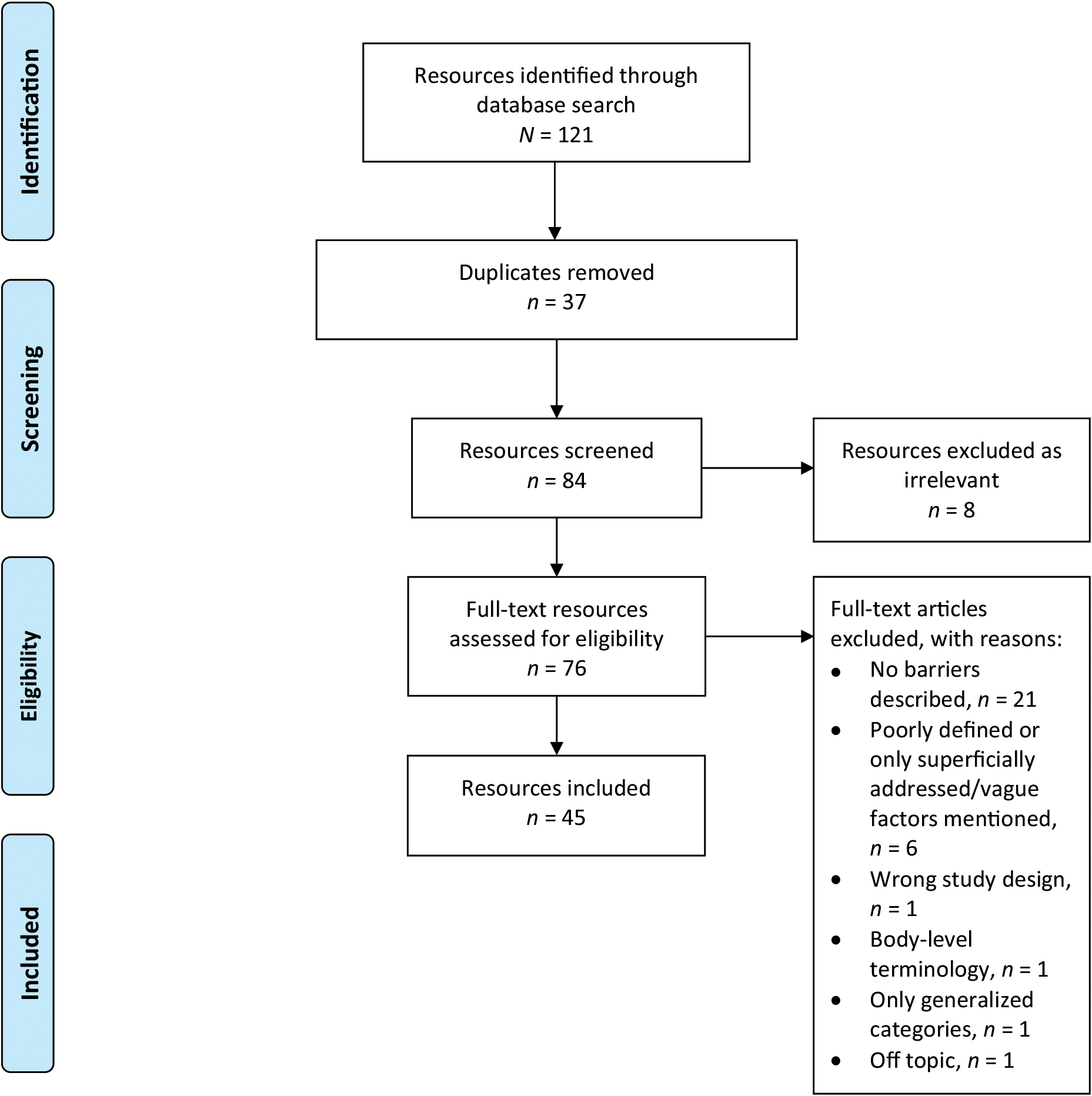
Flow diagram for inclusion and exclusion of studies in the systematic review.
Fourth, the 45 selected published resources were combed by Kirschner and Doyle for terminology that represented environmental and contextual factors that affect participation. These words were extracted and recorded for further consideration. Fifth, using this list of extracted words, similar general and specific contextual or environmental factors were iteratively collapsed into groups (see Kirschner [2020] for more details). Then the most relevant factor was selected to label each group; selection was based on frequency of appearance (i.e., how many articles included a given word or concept), similarity to other terms, and the strength of the term (i.e., terms that were the principal determinant in an article or research study). Groups of general and specific contextual and environmental factors were categorized and organized in a manner consistent with the OTPF–4 (AOTA, 2020). They were then put into areas, and the areas were aligned with the ICF framework (WHO, 2001) to create the typology.
Results
This scoping review includes 45 published resources that describe how environmental and contextual factors affect participation for individuals and groups. The resources are from a variety of disciplines, including medical, rehabilitation, engineering and design, public health, and related practices and sciences. The resources included 2 meta-analyses, 2 randomized controlled studies, 4 systematic reviews, 3 scoping reviews, 10 qualitative studies, 7 cross-sectional studies, 1 mixed-methods study, 1 instrument development study, 1 prospective study, 2 single-subject studies, 2 retrospective studies, 2 book chapters, 7 expert reviews or panels, and 1 position paper, and all but the book chapters were peer reviewed. They were from 12 different countries: Australia, Brazil, Canada, Ireland, Israel, the Netherlands, Spain, Sweden, Switzerland, Turkey, the United Kingdom, and the United States. They covered populations of all ages, disability status, and diagnoses and various contexts, including schools, homes, and communities.
We divided the extracted factors into general factors, which described several environmental or contextual aspects, and specific factors, referring to one aspect. For example, physical climate is a general factor, whereas inclement weather, temperature, humidity, and air quality are specific factors, because they represent more specific aspects of the physical climate. A total of 139 general factors and 292 specific factors were found among the articles.
The typology consists of 12 categories of general factors and 53 terms of specific factors. The 53 terms of specific factors were organized as examples under the 12 categories of general factors. The 12 categories of general factors were grouped into four overarching areas (i.e., physical factors, social factors, societal and organizational factors, and support and relationship factors), which are aligned with the ICF’s groupings of environmental factors (i.e., natural environment and human-made change; products and technology; attitudes; services, systems, and policies; and support/relationships; WHO, 2001) and defined colloquially. For example, we determined that the specific factors width, large/wide, and narrow passageways described the same thing and grouped them together under the term width. Then we placed the specific factor term width under the general factor category physical space. Finally, we placed the physical space category under the area physical factors, which aligns with the ICF’s natural environment and human-made change and products and technology groupings (these two groups were merged for this typology because they both address different aspects of physical access). The typology is presented in Supplemental Appendix Tables A.1 to A.4 (available online with this article at https://research.aota.org/ajot).
Discussion
The goal of this scoping review was to create a typology of terminology that occupational therapy professionals can use in clinical practice, education, and research. All terminology was extracted from published literature that discussed the impact of contexts and environments on human occupational participation. The resulting typology is structured into four main areas: physical factors, social factors, societal and organizational factors, and support and relationship factors.
Physical Factors
Physical factors is an area that includes the external tangible environment, the natural environment, all human-made change, and technology. Technology covers products or systems of products and equipment or technology that is used while participating in activities (WHO, 2001). Physical factors is an area commonly referred to as “the environment.” The physical factors area has five categories: physical space, sensory qualities of the environment, context-specific task parameters, physical climate, and natural and built environment–terrain (Table A.1).
The category sensory qualities of the environment can be explained by applying one of its terms, cognitive–sensory cues. For some street crossings, the cognitive–sensory cue provided for a safe crossing time is the lit-up walking person visual cue. For a person with reading or literacy difficulties, this may be perceived as a supportive feature. However, the same crossing signal without an auditory cue may impede a person with low vision from successfully crossing the street, potentially affecting their participation in community mobility. Another category, context-specific task parameters, can be understood by the term use of objects. A common article of clothing, a button-down shirt, might be difficult for a person with an upper extremity amputation to manage. A button-down shirt may be the dress code expected to engage in particular activities, thereby impeding this person from participating.
Social Factors
The area of social factors represents aspects of the social context and environment that affect a person’s participation (Fisher & Marterella, 2019). Social factors often act ecologically; that is, they influence a person’s choices about whether to attempt participation. For example, knowing that they may face discrimination, stigma, or even a language barrier, a person may choose not to participate in activities that they may otherwise have wanted to take part in. Three categories fall under the area of social factors: social circumstances, attitudes, and communications (Table A.2).
An example of the category social circumstances is the term social expectations–concerns. A family may expect that a child with a disability cannot use a toilet. This expectation may lead the caregivers to address toileting with diapers. This, however, can be a contextual factor that limits the child’s participation when they are in a setting without their usual caregivers present. An example of the category communications can be explained with one of its terms, information. One might consider a situation in which a student who is deaf has limited participation in a class because sign language interpretation has not been made available, and information is only accessible through verbal language.
Societal and Organizational Factors
The societal and organizational factors area refers to the factors that are part of the structures around which society and organizations are organized. They differ from the area of social factors in how they are manifested. Rather than coming from individuals or communities, these factors present themselves in those things shared within organizations, neighborhoods, or societies. Services provide benefits, structured programs, and operations in various sectors of society and are designed to meet the people’s needs. Systems are administrative control and organizational mechanisms that are established by governments at the local, regional, national, and international levels or by other recognized authority. Policies constitute rules, regulations, conventions, and standards established by governments at the local, regional, national, and international levels or by other recognized authorities. This area consists of three categories: financial situation, systems and policies, and safety concerns (Table A.3).
The category safety concerns can be described with the term security. An example is a person living close to a park who does not participate in leisure and wellness activities there because they feel that their security is compromised. The perception of the park as unsafe is likely caused by higher crime rates or community narratives about how the park is managed and maintained by civil authorities. Another category, systems and policies, can be understood with an example using the term availability of activities. An athlete who uses a wheelchair may not participate in sports as a result of a limited selection of geographically accessible activities that can accommodate their capabilities.
Support and Relationship Factors
The support and relationship factors area aligns with the ICF (WHO, 2001) in the support/relationships area and regards those people or animals that provide practical physical or emotional support, nurture, protection, assistance, and relationships to other persons in their home, place of work, school, or at play or in other aspects of their daily activities. This area can make a tremendous difference in how and whether a person participates in activities. There is one category in this area: social supports (Table A.4).
An example of the category social supports is opportunities for autonomy. In a group home setting, adults who are developmentally disabled may have few leisure activities or household tasks in which to engage. Similarly, people who are incarcerated face limited opportunities. Support for family, caregivers, or both reflects opportunities to remove some the caregivers’ responsibilities, providing the opportunity for a person to participate in activities in the absence of their caregiver. The schedule, availability, and feeling of culpability of the caregiver could be factors affecting the participation of a person who is being cared for.
Limitations and Future Directions
Our literature searches did not yield a specific method to guide the development of a typology; thus, we used a scoping review to identify relevant sources and to extract terms describing contextual and environmental factors that influence human occupational participation. This scoping review was limited to published resources that were academic or research based; future revisions of the typology may benefit from an expanded scope of resources, including engaging stakeholders, such as persons with disabilities, to add their perspectives and experiences when refining and validating the typology’s terminology. Finally, some terms included in this typology may be neither mutually exclusive (rule of precision) nor fully individual (one may be assigned to another—parsimony; Nelson, 2006). However, if occupation is considered to be a complex transactional interaction that differs in varying contexts and environments, it is not only expected but necessary for there to be some level of overlap and fluidity between the borders of categories and terms.
This typology would benefit from future research on the practicality (usability) and utility (usefulness) of the terminology to further refine it for occupational therapy practice. In addition, the typology could be used to develop a standardized assessment, perhaps using Likert scaling with intensive use of Rasch analysis (e.g., with the Assessment of Motor and Process Skills [Fisher, 2003] as a model) that quantifies the degree to which environmental and contextual factors support or limit occupational participation. Such a tool may facilitate research to build an evidence base for the effectiveness of environmental interventions to drive practice and influence third-party payers and government planning agencies to support environmental design and modifications as worthwhile and cost- effective interventions for improving occupational participation in life activities.
Implications for Occupational Therapy Practice
Occupational therapy practitioners, students, educators, and researchers can use the typology’s specific terminology to analyze the contextual and environmental factors that affect clients’ participation at all levels: individual, group, and population. The typology has the following implications for occupational therapy practice: ▪ The typology provides specific terms for assessing contextual and environmental factors affecting occupational participation. ▪ The typology provides detailed terminology for designing contextual and environmental interventions that promote clients’ occupational participation. ▪ The typology provides specific terminology to use to research, facilitate, and advocate for more accessible contexts and environments, benefiting clients and society at large.
The objective is to supplement the current occupational therapy terminology, not replace it or add complexity. We believe that the typology can assist with strengthening interprofessional education and collaboration by creating spaces where people are using the same language, understanding the contributions of each professional, and working together to address functional or ecological barriers to participation.
Conclusions
Occupational therapy is, at its core, about facilitating people’s participation in the activities that make up the roles in their lives. These activities occur in real contexts. Often, the environmental or contextual factors, rather than the individual characteristics or capacities, provide the support for or limit the participation of people in their chosen roles and activities. Thus, it is vital that occupational therapy professionals continue to build their understanding of how context and environment affect participation, potentially changing their perspective. This typology provides the language for occupational therapy professionals to enhance education, research, tool creation, and practice by better assessing and intervening with contextual and environmental factors that affect the occupational participation and engagement of individuals, groups, and populations.
Supplemental Material
Supplementary material for Uncovering the Obstacles—A Typology of Environmental and Contextual Factors Affecting Occupational Participation: A Scoping Review
Supplementary material, sj-pdf-1-aot-10.5014_ajot.2023.050043.pdf for Uncovering the Obstacles—A Typology of Environmental and Contextual Factors Affecting Occupational Participation: A Scoping Review by Leon Kirschner, Nancy W. Doyle and Brigitte C. Desport in The American Journal of Occupational Therapy
Footnotes
*
Indicates references included in the scoping review.
Acknowledgments
We acknowledge the inspiration and support of the many people without whom this work could not have been completed. Principal among those is Dr. Mychel Namphy. We also acknowledge the work of Lisa Jasienowski, OTR/L, who helped with the early formulation of the typology. Additional gratitude goes to all of the members of the Post-Professional Doctorate Program at Boston University, who facilitated the development of the program.
References
Supplementary Material
Please find the following supplemental material available below.
For Open Access articles published under a Creative Commons License, all supplemental material carries the same license as the article it is associated with.
For non-Open Access articles published, all supplemental material carries a non-exclusive license, and permission requests for re-use of supplemental material or any part of supplemental material shall be sent directly to the copyright owner as specified in the copyright notice associated with the article.
