





Abstract
This scoping review identifies meanings of occupation linked to the health and well-being of adults with advanced cancer to develop and improve occupation-based services in oncology.
Living a meaningful life is fundamental for people in general and arguably even more so for patients with a life-threatening disease (Masel et al., 2016). According to the Oxford Advanced Learner’s Dictionary, the term meaningful is defined as something full of meaning, valuable, important, significant, or that has a purpose (Oxford University, n.d.). One way that people create meaning for themselves and enrich the lives of others is through occupation (Jacques & Hasselkus, 2004). Occupation refers to the activities a person is required to, wants to, or is expected to do that bring personal and cultural meaning to their life or help them to achieve their goals (World Federation of Occupational Therapists [WFOT], 2012).
Occupation includes contributing socially and economically to one’s community (productivity), looking after oneself (self-care), and enjoying life (leisure; Law et al., 1998; Townsend & Polatajko, 2013). Occupation can be seen as a human right for people of all ages because evidence shows it enhances well-being and contributes to the quality of life of individuals, groups, and communities, whether they are healthy, with disabilities, or have life-threatening illnesses (Christiansen & Townsend, 2011; WFOT, 2016).
Advanced cancer is a cancer stage that cannot be cured or managed with treatment and presents a very high risk of causing death or limiting one’s life (American Cancer Society, 2020; World Health Organization [WHO], 2002). Cancer may have migrated from its original location to neighboring tissue or distant sections of the body. Treatment may be provided to help decrease the tumor size, inhibit cancer cell growth, or relieve symptoms (National Cancer Institute, n.d.-a). Cancer is a considerable barrier to life expectancy, and it accounted for an estimated nearly 10 million deaths in 2020 (WHO, 2022). However, end-of-life care can relieve physical, emotional, and spiritual concerns for more than 90% of patients with cancer in advanced stages (WHO, 2022).
For people living with advanced cancer, participating in necessary and personally meaningful occupations can influence their health and quality of life (WFOT, 2016). A study by la Cour et al. (2009) showed that occupations can be a source of meaning for patients with terminal cancer and that they can contribute to health-related outcomes and well-being at the end of life. Thus, participation in meaningful occupations continues to be necessary, even for people with advanced cancer (Jacques & Hasselkus, 2004). Moreover, strategies to maintain participation in meaningful occupations after a terminal diagnosis or life-limiting illness, such as advanced cancer, might extend people’s quality of life and well-being throughout their remaining lifespan (Sposato, 2016). Thus, even in the last phase of life, people may benefit from maintaining occupational roles and participating in meaningful occupations.
Interest in exploring meaningful occupations for people with advanced cancer in service or intervention settings has recently increased (Peoples et al., 2017). At the occupational therapy division of Dharmais National Cancer Hospital in Jakarta, we research and develop occupation-based services for our patients’ benefit. However, to the best of our knowledge, no published research has reviewed the current state of knowledge concerning the meaning of occupation in the life-limiting stages of cancer. Therefore, in this study, we aimed to identify the meaning of occupation for adults with advanced cancer through a scoping review of relevant peer-reviewed literature.
Method
In this study, we used a scoping review method to map the scope and breadth of the concept of the meaning of occupations; this preliminary study serves to justify further research and resources on advanced cancer and occupational meaning. In addition, we used a scoping review to provide an overview of the state of evidence and to discover gaps in the current literature on the meaning of occupation (Arksey & O’Malley, 2005). Therefore, we implemented Arksey and O’Malley’s (2005) five steps to answer our research question and to guide the scoping process: determining the research question, identifying the relevant literature, selecting the studies, charting the data, and analyzing and summarizing the data.
Determining the Research Question
We used the population, concept, and context elements suggested by Peters et al. (2020) to determine the research question. The population was defined as adults with advanced cancer, and the concept was the meaning of occupations. Because this research is a review study, we considered existing research as the context. Hence, we formulated the following research question: What are the meanings derived from occupation for adults with advanced cancer in existing studies?
Identifying Relevant Literature and Selecting the Studies
We searched the literature between January and April 2021. A systematic search was conducted with four electronic databases: Scopus, CINAHL, Medline, and PubMed. These databases cover the areas of health, public health, nursing, (para-)medical care, and clinical practice. The search strategy used relevant terms derived from Medical Subject Headings (MeSH), subject headings (code MH), and major subject headings (code MM). Terms were adapted for each database and were related to the keywords of occupation, meaning, and advanced cancer. The key terms used during the inquiry were as follows: “occupation” OR “activity” OR “meaningful occupation” OR “meaningful activity” OR “occupational therapy,” AND “meaning” OR “occupational meaning,” AND “cancer” OR “neoplasms” OR “advanced cancer” OR “terminal cancer” OR “palliative cancer” OR “life-threatening cancer” OR “incurable cancer.”
The process of selecting relevant studies was based on several inclusion criteria. First, all included studies were peer-reviewed publications published between 2011 and 2021, 10 yr after the American Occupational Therapy Association and the Canadian Association of Occupational Therapists (CAOT) officially issued position papers outlining the role of occupational therapy in oncology and end-of-life care (CAOT, 2011; Longpré & Newman, 2011). Second, the searches were limited to publications focusing on adult populations (filtered by participants’ age in the database). Third, to obtain a global review of the research topic, the search for and selection of materials was not geographically limited; however, journal articles published in languages other than English were excluded. Additionally, articles in which the participants were not at an advanced stage of cancer, or the research lacked occupational meaning, were also excluded.
Charting and Analyzing the Data
Subsequent to the study selection, the research team collectively developed a data-charting form as proposed by Arksey and O’Malley (2005). Each publication was read, and the following information was extracted: (1) author’s name and professional background, (2) publication year and country, (3) objective, (4) research design, (5) number and age range of participants, (6) occupation, and (7) meanings taken from occupation (Arksey & O’Malley, 2005). Microsoft Excel was used to organize these data.
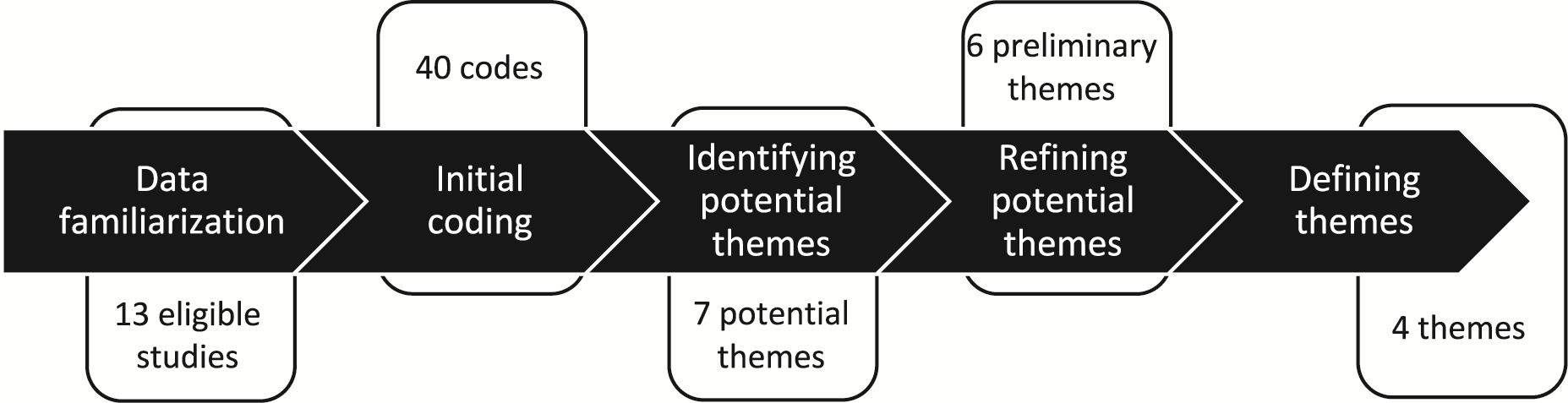
We conducted a five-phase thematic analysis process adapted from Braun and Clarke (2012), as shown in Figure 1. This analysis was done individually among the research team. However, consultation and discussions also occurred continuously during the data collection and analysis processes, and we agreed on all themes accordingly. First, 13 eligible articles were read several times for data familiarization, during which initial coding generated 40 codes. The process of initial coding then continued with interrelated grouping codes based on the similarities in central ideas. As a result, seven potential themes were identified. Afterward, the potential themes were reviewed, and six preliminary themes were generated. Preliminary themes were then linked, combined, merged, and analyzed to form a network of themes. Finally, the network themes were refined, resulting in four overarching themes.
Results
The initial literature search resulted in 4,772 potentially relevant articles. We used Endnote software (Version 20) to remove 32 duplications. Then, we collaboratively screened the titles and keywords. On the basis of inclusion and exclusion criteria, we omitted an additional 4,514 articles. This process left 226 articles that underwent abstract review. At this stage, 154 studies were eliminated, yielding 72 articles. Finally, each researcher carried out full-text reading, resulting in agreement on 13 articles that met the inclusion criteria. The steps leading to selecting the eligible studies followed the Preferred Reporting Items for Systematic Reviews and Meta-Analyses (PRISMA) flow diagram (Page et al., 2021) presented in Figure 2.
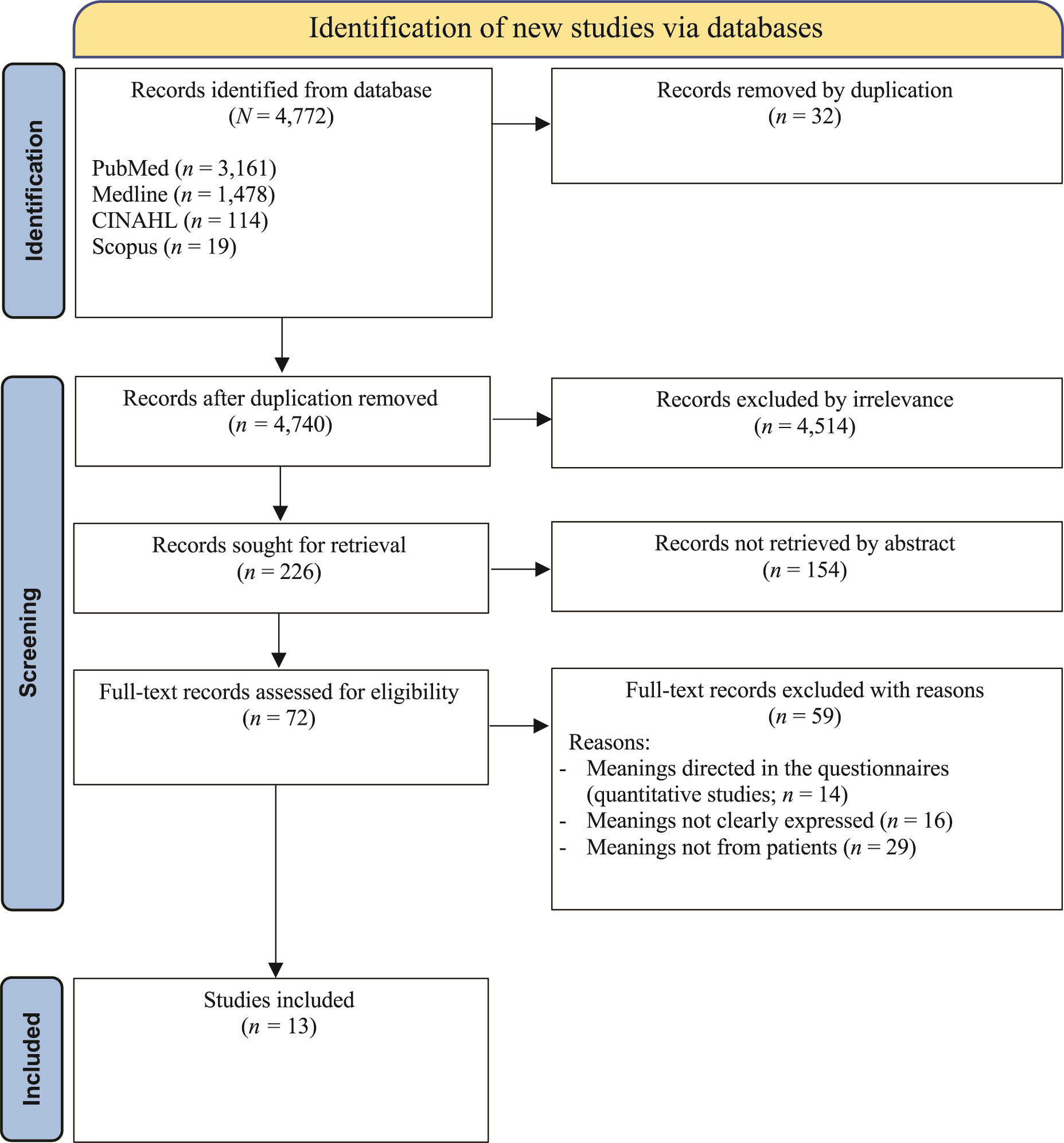
The Preferred Reporting Items for Systematic Reviews and Meta-Analyses (PRISMA) flow diagram for studies included in the scoping review.
Characteristics of the Included Studies
Thirteen eligible studies examining the daily occupations of adults with advanced cancer and their relationships with meaningful life were critically reviewed. The 13 included articles consisted of 9 qualitative studies, 1 mixed-methods study, 1 case study, 1 pilot study (pretest–posttest design), and 1 retrospective study (review of clinical data). The selected articles addressed participants with various types of cancer. The number of participants in the studies ranged from 1 to 42 patients. The authors of the 13 articles had diverse professional backgrounds (e.g., nurses, general practitioners, psychiatrists, occupational therapy practitioners, psychologists, social workers, nutritionists, and palliative care teams).
Eligible articles came from eight countries and four continents: Norway (n = 3), the United States (n = 2), the United Kingdom (n = 2), Germany (n = 2), Japan (n = 1), Indonesia (n = 1), Malawi (n = 1), and Denmark (n = 1). In addition, the results also provided information about types of occupations that give meaning to patients in the following areas: work–productivity, self-care, activities of daily living (ADLs)–instrumental activities of daily living (IADLs), leisure activities, or multiple areas of occupation. More detailed characteristics of the 13 articles reviewed are outlined in Table A.1 in the Supplemental Appendix (available online with this article at https://research.aota.org/ajot).
Emerging Themes
The occupational meanings reported in the 13 eligible studies were sorted into 40 codes from which four emerging themes were created: (1) occupation benefits important relationships and connections with others, (2) occupation as a source of physical or psychological comfort, (3) managing one’s identity through occupation, and (4) occupation as a religious expression.
Occupation Benefits Important Relationships and Connections With Others
The specific meaning of occupation in this scoping review emphasized the value of relationships and connections with others. Fourteen meanings from eight eligible studies described that meaningful occupation builds important relationships through connection with others (health care providers, caregivers, peers and cancer survivors, family members, relatives, friends, and spouses). This theme was extracted from articles with a group or social activity as the occupation in which the participants can benefit others and receive benefit from others (i.e., motivate, support, and inspire one another).
For example, through human interactions and engagement in an occupation, adults with advanced cancer can provide and receive motivation (Adorno & Brownell, 2014; Devik et al., 2013; Park et al., 2017), courage (Bates et al., 2018), inspiration (Haug et al., 2015), responsibility (Park et al., 2017), and help and support (Haug et al., 2015; Kawabata et al., 2018). Taylor (2014) mentioned that being in the arms of a partner while discussing many things is an example of real connection and bonding experienced through nonsexual touch.
Likewise, interacting with other(s) and engaging in a meaningful occupation seemed to renew affectionate bonds and allow the person to escape the reality of illness and impending death (Taylor, 2014). Warth et al. (2018) described that occupation (i.e., playing preferred songs) reminded people of special events with family, relatives, and friends and made them feel deep emotions. Haug et al. (2015) also highlighted the importance of occupation in maintaining a social life because, in social activity, people could have the same goal and could help one another achieve their goals.
Occupation as a Source of Physical or Psychological Comfort
An essential meaning identified in the analyzed articles was that engaging in occupations could give comfort to people with advanced cancer. In this context, comfort included experiences of physical and psychological ease. Therefore, this theme was split into two subthemes: physical comfort and psychological comfort.
Physical comfort
Twelve meanings derived from four included articles emphasized that meaningful occupations provide physical comfort. Nausea and vomiting are common symptoms reported by people with cancer. However, appropriate food and drink might alleviate the problems. For instance, research participants of a study by Kawabata et al. (2018) mentioned that engaging in a soup service program twice per week brought advantages such as warming the stomach, which reduced nausea and relaxed tensions.
In the study by Preissler et al. (2016), patients who participated in a music therapy session reported lighter body sensations and increased strength to regain their energy. Similarly, Warth et al. (2018) found that in the late stages of cancer, patients joining a music therapy session gained strength and experienced better sleep. Moreover, Haug et al. (2015) stressed that performing physical activities (exercises), domestic (household) activities, and hobbies prevented health decline, which led to better rest in clients with advanced cancer.
Psychological comfort
Occupation was also found to bring patients psychological comfort. Ten feelings were identified across six articles: reduced stress, relaxation, nostalgia, and heartiness (Kawabata et al., 2018); calmness and happiness (Bates et al., 2018); motivation (Adorno & Brownell, 2014); enthusiasm (Park et al., 2017); shared emotions (Taylor, 2014); and serenity (Preissler et al., 2016). These feelings were brought about by engaging in occupations in which patients could express their emotions and needs.
Happiness was one of the psychological comforts underlined by Bates et al. (2018). Their research participants expressed cheerfulness, pleasure, and satisfaction because of their ability to carry out daily occupations after being diagnosed with severe cancer. Likewise, occupations also gave emotional comfort to adults with advanced cancer by meeting their emotional needs for role and function. For example, Park et al. (2017) provided the instance that parenting children (while struggling with life-threatening cancer) gave them a feeling of enthusiasm and the motivation to survive for the sake of their families. The research participants in the study by Adorno and Brownell (2014) stated that they were able to “get up and do what [they] wanted to do,” and this feeling gave them psychological comfort because they realized they had control over what they desired to do.
Apart from being occupations that provide interpersonal connection (Theme 1), sexuality and intimacy were also sources of mental comfort because these occupations allowed participants to share emotions; these occupations also gave them positive feelings. For example, Taylor (2014) reported a patient saying, “After being disconnected from my partner because of a cancer diagnosis and treatments, I feel emotionally reconnected when we are ready and able to engage in intimate activities together.”
Managing One’s Identity Through Occupation
The theme “managing one’s identity through occupation” was used to explain how participants’ experiences led them to form new self-perceptions through occupation. Ten meanings of the self emerged from six studies and showed how patients with cancer perceive, recognize, and accept their strengths and their limitations. These meanings are being independent and being a good patient (Devik et al., 2013); self-acceptance (Devik et al., 2015); being self-sufficient (Haug et al., 2015); ability as a competent person, defining the self through occupation, and reassessing self and accepting limitation (Maersk et al., 2019); newly expanding sense of self (Taylor, 2014); and looking to the future for a new sense of self (Newman, 2013).
Moreover, participants in Maersk et al.’s (2019) study emphasized that occupation becomes a means for people to manage and accept their limitations and then to deal with them in a new way. For example, one participant had to stop her previous occupation of running with her dog in the forest because of her disease. However, she managed to occupy her time with other meaningful occupations, such as cooking (new activity) and (having more time) playing with her child (Maersk et al., 2019). This study helped people with advanced cancer to construct their reality around their new sense of self. Newman (2013) also highlighted identity management by reporting that study participants emphasized managing their identity with a “newly expanding sense of self.” People with advanced cancer understand and accept their current situation and manage their expectations to return to previous occupations (Newman, 2013).
Occupation as a Religious Expression
Five studies included occupation as a way of expressing religiousness (Devik et al., 2015; Haug et al., 2015; Kawabata et al., 2018; Rochmawati et al., 2018; Warth et al., 2018). Religiousness refers to “practices carried out by those who profess a faith” (Zinnbauer et al., 1999, p. 892). It often relates to people’s perspectives, meanings, and purposes associated with occupations. For example, by participating in religious music therapy, clients with advanced cancer were able to interpret songs as a symbol of faith that supported them throughout their disease (Warth et al., 2018). This religious sense arose from the lyrics and genre, combined with the song’s rhythm. The belief of helping others in need as an occupation was also interpreted as a good deed that would get a reward in the afterlife (Haug et al., 2015).
In Indonesia, where 99.96% of the population practices religion (Ministry of Religious Affairs, 2020), religious viewpoints in daily life are embedded and fundamental, even more so when people are sick. Therefore, participants might perceive occupations from a religious perspective. For instance, through the visits and care of the palliative team, a patient perceived that God answered prayers by sending medical personnel to treat his illness more effortlessly (without going to the hospital; Rochmawati et al., 2018).
Discussion
In this scoping review, we identified several meanings of occupation among adults with advanced cancer. The findings summarize the current understanding of the meaning of occupation for people with advanced cancer, linked to quality of life and well-being experiences at the end of life.
The theme of occupation benefits important relationships and connections with others reveals the interrelatedness between occupation and clients’ social experiences. This aspect highlights the theme of human connection, that is, meaningful occupation plays an important role in people’s social lives. The human connections theme aligns with previous research that showed that one of the purposes of occupation is to meet people and do things with others (Svidén et al., 2010). Additionally, this theme also directly supports research emphasizing the importance of social and relational perspectives in understanding meaningful occupation for adults with late-stage cancer (Pergolotti et al., 2015).
The findings of this scoping review also reveal that activities have the potential to give feelings of comfort to people with terminal cancer. Comfort care for patients with advanced cancer comprises physical, emotional, social, and spiritual assistance for patients and their families (National Cancer Institute, n.d.-b). Two studies included in this scoping review focused on comfort. Haug et al. (2015) underlined the meaning of feeling energetic and physically refreshed after engaging in household chores, exercise, and hobbies. Kawabata et al.’s (2018) research participants, after engaging in the soup program, reported that they “felt [removed] from stress.” These findings are similar to other research that showed that exercise, including routine activities, could provide physical and psychological health benefits for adults with terminal cancer (Hunter et al., 2017). In addition, Bieligmeyer et al.’s (2018) research supports the effect of physical and psychological comfort among clients with cancer by showing how patients with cancer who engaged in vibroacoustic music experienced better vital functions, vigilance, and mood.
This scoping review also generates a theme of managing one’s identity through occupation, which identifies that people with advanced cancer may reestablish their insight or sense of self. Three studies within this review emphasized that people with cancer often discovered a newly evolving sense of self by performing meaningful occupations (Maersk et al., 2019; Newman, 2013; Taylor, 2014). These results are congruent with findings of a former study indicating that people with cancer often reconstruct their sense of self by struggling independently and effectively to complete the occupations that define who they are (Lyons, 2006).
This study also highlights occupations from the perspective of religiousness because several participants considered occupations as faith-based activities. They also viewed themselves to be religious and spiritual beings. Selected articles explored meaningful occupations from religious perspectives that relate to people’s values, beliefs, and relationship with God (Rochmawati et al., 2018) as well as occupations as a symbol of faith (Warth et al., 2018). Helping others in need reflects that humans cannot live on their own, and the belief in the invisible reward of good deeds is also an essential practice of religion (Haug et al., 2015). In communities where religion or belief is a fundamental part of daily life, the perspective of faithfulness may become a central part of an occupation. Occupation can also signify the practical application of one’s religiousness concept and a self-reflection of one’s spiritual nature (McColl, 2011). Therefore, our results are parallel with research showing that the spiritual meaning of occupation of people with advanced cancer positively correlated with overall well-being and quality of life (Hematti et al., 2015). Additionally, spiritual well-being has also been shown to support quality of life and prevent the desire for a hastened death (Wang & Lin, 2016).
Occupational therapy practitioners and researchers may shape, fill, and support the occupational needs of people living with terminal cancer. In addition, because the development of meaning is influenced by personal, environmental, and cultural contexts (la Cour et al., 2009), the concept of occupational meaning in heterogeneous contexts (wider range of participants, settings, and occupations) needs advanced investigation. Hence, further research addressing these circumstances is required to understand the occupational meaning and support for clients’ occupational engagement during the end stage of cancer.
Limitations
In the search process, we used the main keyword occupation or activity. Therefore, this study may not have captured all articles or case studies with words precise to ADLs–IADLs or hobbies, for example, the meaning of cooking, reading, singing, yoga, or other specific activities. Moreover, researcher bias can also affect the interpretation of studies included in the review. Additionally, at the time of this study, we experienced limited access to an available librarian who could more precisely assist in the technical search and be a coresearcher. Additionally, because of time and resource limitations, we did not conduct searches for unpublished articles, theses, or dissertations, where the scope of this study could have been further explored.
Implications for Occupational Therapy Practice
Findings from this scoping review have the following implications for occupational therapy practice: ▪ Encourage occupational therapy practitioners in oncology-related settings to advocate for their roles in promoting the use of occupation for people with advanced cancer, ▪ Encourage occupational therapy practitioners to facilitate clients’ understanding of how occupations bring meaning through intentional and therapeutic relationships, ▪ Assist occupational therapy practitioners in delivering occupation-based therapy sessions across various contexts, and ▪ Encourage occupational therapy practitioners to use the resources in this scoping review as a reference in developing an occupation-based service for adults with advanced cancer.
Conclusion
From the existing research in this scoping review, we have identified the occupational meanings of adults with advanced cancer that may contribute to their quality of life. Study participants reported achieving satisfaction and gaining a sense of well-being through participating in valued occupations. Occupations are rooted in sociocultural contexts when people undertake selected activities alone or in groups, in personally meaningful, spiritually enriching, or culturally acceptable ways. Moreover, the meaningfulness of engaging in valued activities in a variety of domains can promote positive outcomes even at the end of life. Occupational therapy practitioners play a considerable role in enabling adults with live-limiting diseases to remain engaged in meaningful activities and to live meaningful lives through occupations. This study’s findings are important in promoting therapists’ insight into the quality of their counseling skills and thus the need to strengthen them to facilitate the patient’s understanding of the benefits (primary and secondary) of performing occupations.
Supplemental Material
Supplementary material for The Meaning of Occupation for Adults With Advanced Cancer: A Scoping Review
Supplementary material, sj-pdf-1-aot-10.5014_ajot.2023.050072.pdf for The Meaning of Occupation for Adults With Advanced Cancer: A Scoping Review by Cahya Buwana, Fifi Dwijayanti, Ninik Nurhidayah, Yuko Ito and Peter Bontje in The American Journal of Occupational Therapy
Footnotes
Acknowledgments
We sincerely thank all the individuals who participated in this study. We also extend our gratitude to the director, doctors, nurses, and occupational therapy colleagues at DNCC Hospital for their participation and unwavering support. Additionally, we thank Ibuk Siti Riswahyuni, Noviyantie, Alifia Darin, Naura Fatin, and Janeeta Nadhif for their prayers and invaluable encouragement.
*
Indicates studies included in the scoping review.
References
Supplementary Material
Please find the following supplemental material available below.
For Open Access articles published under a Creative Commons License, all supplemental material carries the same license as the article it is associated with.
For non-Open Access articles published, all supplemental material carries a non-exclusive license, and permission requests for re-use of supplemental material or any part of supplemental material shall be sent directly to the copyright owner as specified in the copyright notice associated with the article.
