






Abstract
This article adds to the understanding of using the strengths and interests of autistic people by incorporating their voices into occupational therapy research and practice in meaningful and purposeful ways.
Autism research and clinical practice primarily focus on studying or remediating autistic differences from the general population, reflecting medical model assumptions that these differences of the autistic child, youth, or adult are deficits that interfere with the quality of their life, functions, or skills (Brown et al., 2021; Kapp et al., 2013). Increasingly, the autism community argues that autistic differences in brain functions and behavioral characteristics are not always deficits and may serve as neutral traits or strengths in appropriate contexts (Kornblau & Robertson, 2021).
Researchers are developing a growing body of contemporary evidence that focuses on understanding the differences in autistic people’s strengths and interests that help them lead fulfilling and productive lives. The focus is now shifting toward examining environmental barriers and using strengths-based approaches that may improve their quality of life (Urbanowicz et al., 2019). Despite the lack of consensus on a single definition, strengths-based practice (SBP) can be characterized as a client-centered approach that enables practitioners to understand lived experience and use these perspectives to build holistic practices that provide a balance between capabilities (strengths) and challenges (deficits; Department for Health and Social Care & Social Care Institute for Excellence [SCIE], 2019; Patten Koenig, 2019; Saleebey, 1996).
Benevides et al. (2020) highlighted that autistic people face co-occurring mental health conditions; hence, interventions must be tailored to enhance mental health and well-being. Designing interventions focused on remediating deficits may have a negative impact on wellness because of the constant focus on the challenges or shortcomings of an autistic person (Davey, 2020; Milton & Sims, 2016). In many instances in which practitioners identify an autistic person’s strengths and interests, it is only done to use them as extrinsic reinforcers or motivate them to engage in nonpreferred activities (Patten Koenig, 2019, 2020; Patten Koenig & Shore, 2018).
On the contrary, authentic SBP propels practitioners to incorporate a person’s strengths and interests to convert a nonpreferred activity into an intrinsically reinforcing task or simply to recognize its inherent value for the person (Urbanowicz et al., 2019). As Shore argued in the roundtable discussion in Urbanowicz et al. (2019), focusing on an autistic person’s strengths, even if limited, propels understanding about what that person can do despite their challenges.
Using those strengths as a core tenet to address challenge areas can help practitioners design sensitive and respectful practices that value a person’s holistic characteristics, thus developing authentic person- centered practices. For example, a grade school student demonstrates little interest in mathematics, perhaps because they have difficulties in that subject. By means of an interest inventory, the therapist learns that using a flight simulator on a computer is the student’s favorite activity. A behavioral plan is then set up that requires the student to accomplish a goal in mathematics to earn time for using a computerized flight simulator as an extrinsic reinforcer with no connection to the activity at hand. In contrast, the ideal use of an SBP would be to incorporate the flight simulator into learning mathematics. Calculating miles, time, amount of fuel used, and speed to a destination are inherently mathematical. Gunn and Delafield-Butt (2016) emphasized that when a child’s interests are welcomed into the classroom, it “brings the child into the classroom” (p. 425).
The autistic research community continues to stress that practitioners need to move away from normalizing autistic people’s behaviors to match nonautistic standards and transition to developing practices that include the person’s unique features, ambitions, social and psychological circumstances, and contexts (Botha, 2021; den Houting et al., 2021). By doing so, practitioners can develop interventions that avoid viewing this community through a negative, deficit-focused lens (Department for Health and Social Care & SCIE, 2019). Thus, by creating ability or strengths-based models, strengths are understood to be areas of competence for developing potential vocational, relational, and participatory opportunities. Instead of viewing the challenges of autistic people as pathologies, SBP views challenges or deficits through a lens that focuses on reframing how individual characteristics and environmental barriers are shaped by empowering practitioners to move away from deficit-focused approaches (Patten Koenig, 2020).
The intended aims of this scoping review are to ▪ operationalize SBP by using an autistic first- person perspective, ▪ develop a taxonomy to map SBP on the basis of autistic people’s characteristics, and ▪ present the evidence for the use of SBP in the area of mental health and other outcomes among autistic people.
Method
Operationalizing Strengths-Based Practice
Because SBP does not have a standardized definition, we decided to first develop an operational definition, even before we designed the study. We conducted a content analysis of a peer-reviewed journal article (Urbanowicz et al., 2019) to operationalize the definition of SBP. This article included excerpts from a roundtable discussion of SBP from the perspectives of one autistic stakeholder, one parent of an autistic adult, and three experienced clinicians from the fields of psychology, design, and occupational therapy. The third author (Stephen Shore) of this scoping review was also a part of this discussion and provided his insights on SBP. We undertook this process to develop our definition of SBP by centering it on the autistic perspective. Each of us individually extracted units of words that characterized SBP, and upon comparison, we reached a 90% agreement rate among us. Some examples of words describing SBP (Urbanowicz et al., 2019) include “presuming competence” (p. 86), “meaningful inclusion” (p. 86), and “authentic autistic participation in research” (p. 83). We color-coded the phrases as yellow (when only two or three of us agreed on a phrase) and green (when we all agreed on a phrase). In developing our definition, we included only phrases coded green. The definition was developed by ranking the color-coded phrases on the basis of the number of times they appeared in the publication. For example, the phrase “meaningful and authentic engagement in research” appeared 10 times in the article and hence was ranked first, whereas the phrase “a triad of strengths” appeared only once and was ranked 10th. This analysis identified the following three critical components of SBP: Presume the competence of autistic people by focusing on their strengths (including abilities, talents, and interests) rather than emphasizing their deficits, using autistic strengths constructively instead of coercively or as a reward to obtain preferred behaviors. We define constructive use of strengths as organically embedding strengths in the treatment goals and process rather than only as a reinforcement strategy. Include autistic people as collaborators in research and practice through participatory research methodologies or collaboration with clients in the therapeutic process. Create supportive environments that maximize the strengths and interests of autistic people. Supportive environments include but are not limited to sensory, social, attitudinal, and physical environments.
We used these three components to guide our selection of studies that reflect SBP. Because very few studies reflect the second and third components, we used the first component as the primary criterion. All studies that met the first component were included, and their alignment with the other two components was analyzed and discussed.
Scoping Review Process
We chose a scoping review as our methodology because it aligned very closely with our research intentions of developing an operational definition and identifying, exploring, and mapping the literature instead of critiquing, synthesizing, or determining the effectiveness of SBP (Peters et al., 2020). Because there is no consistent definition of SBP for this population, we chose to incorporate Arksey and O’Malley’s (2005) methodological framework, Levac et al.’s (2010) clarification of the scoping review methodology, and the most recent enhancements proposed by Peters et al. (2015, 2020) to guide this review. In the following sections, we report the method and findings of the review following the Joanna Briggs Institute guidance for scoping reviews (Peters et al., 2020).
Objectives and Questions
On the basis of the objectives listed in the introduction, we identified two research questions for this scoping review: What SBP strategies and protocols have been implemented in research and practice with autistic people and reported in peer-reviewed, published scientific literature written in English? What is the available evidence on the outcomes of SBP with autistic people, including mental health and other outcomes?
Inclusion Criteria
Figure 1 delineates the process we used to select articles for this review. The inclusion criteria were as follows: ▪ Type of participants: Research with people in any age range who self-identified as autistic, received an autism diagnosis, or received an educational or disability classification of autism was included. ▪ Inclusion criteria: We operationalized the concept of SBP, as described earlier. Studies that included research or descriptions of clinical practice were focused on strengths rather than deficits. For each study, the decision on whether a study met the operationalized definition of SBP was made by two reviewers. Each reviewer independently reviewed the study and assigned one of the three color codes: red (do not include), yellow (to be discussed), and green (to include in final review). ▪ Context: Studies conducted in all settings were included. ▪ Type of sources: We included original research studies, practice protocols, and commentaries published in peer-reviewed scientific journals, in English, from 2000 to 2021. Articles published before 2000 were excluded because we wanted to include current data in this area. Although we wanted to focus on interventions, the searched literature revealed a lack of intervention studies. Thus, the scope of this study was expanded to include other types of research.
Search Strategy
We searched for relevant literature using the CINAHL, PsycINFO, EBSCOhost, MEDLINE, Web of Science, JSTOR, and ERIC electronic databases. Search terms were combined, truncated, and exploded to achieve broad yet relevant results. Table 1 shows the search terms associated with the definition of SBP, which were incorporated to ensure a comprehensive literature search.
Key Terms and Search Terms
Note. Terms within columns were connected with OR, and terms between columns were connected with AND. A combination of words from rows and columns was used to search for studies.
Extraction of Results
Data from the included studies were extracted using an extensive Excel spreadsheet with numerous thematic and numeric data points, including author name, year, country, professional field, study setting, and notable findings. The extracted data are presented in the Supplemental Appendix (Tables A.1–A.5, available online with this article at https://research.aota.org/ajot). For interventions, we also specifically added additional data extraction points, including a description of the intervention, its duration, and measures or assessments used.
We classified our studies into a taxonomy with four groups (intervention studies, descriptive studies, exploratory studies, and commentaries) on the basis of individual study objectives and characteristics, as presented in Table A.6 of the Supplemental Appendix. This taxonomy was developed through continued discussions between all authors, and the table was iterated as we expanded our focus to include studies other than intervention so that we could map a diverse variety of SBP in the current literature. Also, we used first-person commentaries from autistic authors and researchers as guides to inform our decision making, and the data from these articles were used to reflect characteristics of authentic SBP in practice and research.
Community Involvement
At every stage of this review, we valued the expertise and guidance of the third author (Stephen Shore), an autistic self-advocate who is an assistant professor in special education. There were differences in the way SBP was discerned by the nonautistic reviewers and the autistic reviewer. These differences were resolved using a dynamic, reflective approach to highlight and understand the neurotypical bias and center the autistic voice. For example, the fourth author (Kristie Patten) coded the Koegel et al. (2012) intervention study as yellow because she felt the intervention used strengths as a means to an end; Shore, however, felt that the study depicted authentic SBP because participants bonded over their interests and hence coded it as green. Such discussions highlighted authentic collaboration by moving away from the nonautistic ideologies of SBP.
Results
Our initial search yielded 1,616 studies, to which an additional 10 studies were added through hand searching reference lists. Ten studies were duplicates and were removed before the screening process began. A total of 1,487 studies were excluded because they either did not match our inclusion criteria or did not match our operational description of SBP. We conducted three rounds of full-text reviews of the remaining 129 studies. Thirty-three studies were excluded in the first round because they did not reflect authentic SBP or were duplicates; 45 were excluded in the second round because they emphasized normalization of autistic behaviors by using interests as a means of coercion, did not emphasize autistic participants’ well-being, or did not fit our taxonomy; and 13 studies were excluded in the final round because two or more authors disagreed on whether the outcome matched our operational definition of SBP (see Figure 1). Twenty-nine (76.3%) of the remaining 38 studies received independent agreement from the first or second author (Kavitha Murthi or Yu-Lun Chen) along with an agreement from the third or fourth author (Shore or Patten) about their placement in the taxonomy. For the other 9 studies, we held continued discussions to reach agreement on their placement in the taxonomy. Despite this scoping review’s focus on autistic strengths and interests, only 4 research studies authentically consulted autistic researchers as part of the research process to design assessments or engage in data analysis (Boven, 2018; Gillespie-Lynch et al., 2017; Hotez et al., 2018; Lee et al., 2020; Russell et al., 2019). The remaining studies were conducted by nonautistic researchers interpreting autistic strengths.
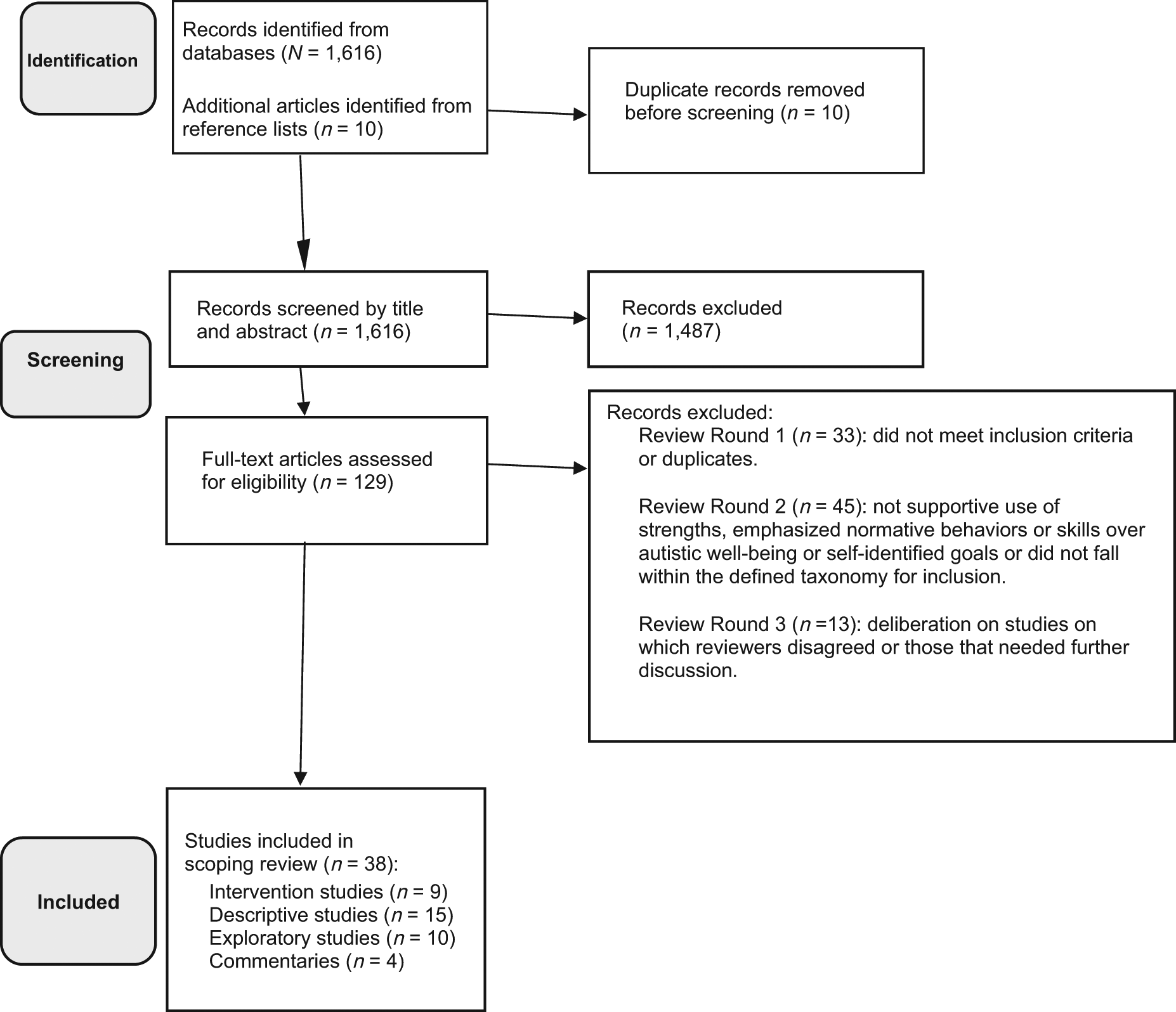
Flow diagram of the study selection process.
Of the final set of 38 studies, we categorized 9 as intervention studies, 15 as descriptive studies, 10 as exploratory studies, and 4 as commentaries. Of the 38 studies, 16 were quantitative, 14 were qualitative, 2 were mixed methods, and 6 had no specified methodology. Although the studies were designed to determine and examine autistic strengths and interests, only 35.84% of the total pool of 2,946 participants were autistic. Only 21 studies created a conducive environment for participants to practice newly acquired skills that harnessed their strengths. This is indicative of the gap in current research studies that could be bridged by the inclusion of participatory research approaches in designing studies that collaborate with autistic community. Most of the studies (56.09%) were conducted by interdisciplinary research groups from the fields of education, psychology, medicine, social science, and occupational therapy. This is indicative of the need for further collaboration between researchers and practitioners from different fields to develop comprehensive SBPs for this population.
Moreover, all the studies were scrutinized for the terminologies used to describe autistic participants, and we noted whether they incorporated identity-first or person-first language. Although 60.97% used person-first language, 39.02% of recent studies used identity-first language. These terminologies helped us to expand our search and find articles that incorporated SBP but used different terms to characterize it. We present the results in terms of specific outcomes that affect autistic adolescents: mental health outcomes, increased knowledge and skills in areas of interest, and creation of supportive environments that nurture strengths and interests.
Mental Health Outcomes
Two positive mental health outcomes were identified when SBP was used in research and practice: (1) reduction in anxiety and stress and development of positive mental health and (2) increased self-advocacy skills.
Reduction in Anxiety and Stress and Development of Positive Mental Health
All of the intervention studies (n = 9) reduced social anxiety, alleviated stress, and increased the well-being of autistic participants (Diener et al., 2016; Dunst et al., 2011; Gillespie-Lynch et al., 2017; Hotez et al., 2018; Kaboski et al., 2015; Koegel et al., 2012, 2013; Martin et al., 2020; Trivette & Dunst, 2011). Seven of 15 descriptive studies (Black et al., 2020; Boven, 2018 ; Gobbo et al., 2018; Lee et al., 2020; Patten-Koenig & Williams, 2017; Russell et al., 2019 ; Winter-Messiers et al., 2007), 2 of 9 intervention studies (Diener et al., 2016; Dunst et al., 2011), and 5 of 10 exploratory studies (Dunn et al., 2015 ; Teti et al., 2016; Winter-Messiers, 2007; Wood, 2019; Zilli et al., 2019) presented one or more mental health outcomes, including a focus on increasing participants’ subjective well-being, resilience and coping, positive emotional development, self-regulation, anxiety reduction, and increased happiness and feeling of content while maximizing engagement in interest-driven activities. Furthermore, Patten-Koenig and Williams (2017) noted that autistic participants in their study agreed that engaging in interests was calming and stress reducing.
Increased social skills acquisition was another outcome that consistently correlated with mental health outcomes. Participants in 6 of 9 intervention studies (Diener et al., 2016; Dunst et al., 2011; Kaboski et al., 2015; Koegel et al., 2012, 2013; Martin et al., 2020), 2 of 15 descriptive studies (Diener et al., 2015; Lee et al., 2020), and 3 of 10 exploratory studies (Dunn et al., 2015, Teti et al., 2016; Zilli et al., 2019) demonstrated improvement in social skills through peer engagement and collaborative learning. Social skills also improved when autistic participants could focus on sharing knowledge about their interests instead of focusing on developing nonautistic ways of interacting socially (Dunn et al., 2015; Dunst et al., 2011; Gillespie-Lynch et al., 2017; Hotez et al., 2018; Martin et al., 2020; Teti et al., 2016; Winter-Messiers et al., 2007; Wood, 2019 ; Zilli et al., 2019). Lee et al. (2020) reported that incorporating SBP propelled autistic participants to gain happiness by harnessing their strengths to socialize, realizing their capabilities, and experiencing better mental health and well-being. Humor, playful competition, casual meetings, and spending time with friends beyond the intervention was an outcome that led adolescents to bond with each other (Diener et al., 2016; Martin et al., 2020). Because the focus was on knowledge sharing, autistic participants developed organic relationships with their peers through sustained participation in these groups and activities.
Mothers from Diener et al.’s (2015) study reported that, outside of the technology program, they viewed their autistic children’s challenges as more impeding and compared them with those of their nonautistic children. Within the program, however, they viewed their autistic children as more competent than their nonautistic children. Siblings more readily and favorably recognized their autistic siblings’ strengths when interest-driven activities were used as interventions (Carter et al., 2020; Diener et al., 2015). Even in nonconducive situations, Russell et al. (2019) noted that autistic people considered their strengths as integral to their identity. Although some autistic people were stressed because of their strengths (e.g., hyperfocusing on minute details caused them anxiety and stress), they still valued them while viewing challenges as value-neutral traits rather than deficits.
Increase in Self-Advocacy Skills
It is noteworthy that only 2 intervention studies, Gillespie-Lynch et al. (2017) and Hotez et al. (2018), developed programs using participatory collaboration. These studies engaged autistic professionals to develop self-advocacy, self-efficacy (Martin et al., 2020), and a sense of accomplishment using their strengths (Dunn et al., 2015). Among the 4 commentaries, the opinion piece by Milton (2014) provided a unique first-person perspective on the importance of the authentic inclusion of autistic researchers in the research process by harnessing their self-advocacy skills.
Increased Knowledge and Skills in Areas of Interests
We found two subthemes under this theme: (1) skill acquisition and enhancement and (2) creation of assessments and interventions that value and use strengths in practice. Studies from three taxonomical categories—interventions, descriptive and exploratory components—were represented under this theme.
Skill Acquisition and Enhancement
Five of 9 intervention studies (Diener et al., 2016; Dunst et al., 2011; Kaboski et al., 2015; Martin et al., 2020; Trivette & Dunst, 2011) and 7 of 10 exploratory studies (Bianco et al., 2009; Bross & Travers, 2017; Davey, 2020; Gaudion et al., 2015; Lanou et al., 2012; Winter-Messiers, 2007; Wood, 2019) focused on expanding on participants’ interest areas or building new interests or skills. In contrast, only 1 of 15 descriptive studies (Boven, 2018) focused on improving autistic strengths to enhance skill development.
Creation of Assessments and Interventions That Value and Use Strengths in Practice
Although no intervention or exploratory studies developed or used strengths-based assessments, 5 descriptive studies (Braun et al., 2017; Cosden et al., 2006; Courchesne et al., 2015; Grove et al., 2016; Russell et al., 2019) developed or incorporated strength-based assessments. These studies also emphasized the importance of using such assessments in practice.
Creation of Supportive Environments That Nurture Strengths and Interests
Six intervention studies emphasized that the development of a safe and nurturing environment is a crucial aspect of SBP (Diener et al., 2016; Dunst et al., 2011; Kaboski et al., 2015; Koegel et al., 2012 ; Martin et al., 2020; Trivette & Dunst, 2011). These interventions created safe environments that enabled autistic participants to engage in their interests and use their strengths to learn skills such as social communication. Four descriptive studies (Black et al., 2020; Kirchner & Dziobek, 2014; Lee et al., 2020; Morris et al., 2015) also created an environment to support their participants either in the workplace or in informal workshops.
Discussion
To the best of our knowledge, no previous study has operationally defined SBP, mapped the literature, or delineated the advantages of using SBP to alleviate mental health challenges. Hence, while designing our scoping review process, our first step was to develop our operational definition using an autistic perspective. We excluded 91 studies that reduced autistic interests to rewards or normalized autistic behaviors (Bernardini et al., 2014; Campbell & Tincani, 2011; Mottron, 2017; Smith & Sharp, 2013). The case study by Bellini and McConnell (2010) is presented here as an example of the studies we excluded. They underscored the importance of video modeling as a SBP to develop positive behaviors in educational settings. Autistic students could watch themselves successfully performing an activity along with a visual representation of their behaviors. However, the study focused on using this approach to remediate and normalize problem behaviors instead of targeting the successful engagement of students in activities that piqued interests of their choice. Studies that use interests and strengths in this way could potentially coerce participants by reducing their autonomy and intrinsic motivation (Martin et al., 2019, 2020; Patten-Koenig, 2020; Ryan & Deci, 2000); hence, we developed the taxonomical framework in this scoping review to present a nuanced approach to classifying studies that incorporate SBP in an authentic and organic way.
Findings from our review matched the principles of Self-Determination Theory, which values client autonomy and a sense of belonging and enhancement of skills that leads to the development of intrinsic motivation and improved quality of life (Ryan & Deci, 2000). Such authentic practices can take the form of collaborative relationships in which autistic researchers analyze data, using organic, critical, and realist approaches as demonstrated by Russell et al. (2019); through the development of readable and accessible questionnaires (Lee et al., 2020); or in the form of refinement of a college transition curriculum (Hotez et al., 2018). In practice, it can take the form of mentorship programs, with autistic mentors training autistic mentees to develop mutually agreed-upon skills (Martin et al., 2017). It is imperative to note that studies in which autistic researchers collaborated were conducted within the past 6 to 7 yr, which aligns with the current shift in the paradigm of autism studies toward the inclusion of autistic perspectives (Keating, 2021; Patten Koenig, 2020). Occupational therapy practitioners are well positioned to engage in collaborative research and to act as facilitators to guide mentorship programs.
Recently, collaborative practices have led to a rising trend in using nonableist terminologies to describe autistic strengths. Words such as focused interests, passions, intense interests, preferences, favorites, and abilities are increasingly seen, compared with terminologies that used negative connotations such as special interests, circumscribed interests, perseverations, restricted interests, and repetitive interests. Bottema-Beutel et al. (2021) unpacked the power of negative language by emphasizing that using person-first language, especially by nonautistic researchers, can cause the perpetuation of a deficit-based portrayal of the autistic community. This can be the result of clinicians following historical conventions despite these terminologies being value-laden or even stigmatizing, which can lead to an undue focus on viewing interests as deficits. They further emphasized that through the adoption of participatory research models, autistic researchers can increasingly be included in the research process, and journal editors are increasingly promoting research that is informed by such collaboration, further augmenting autistic voices in research (Fletcher-Watson et al., 2019; Pellicano et al., 2014). Occupational therapists can position themselves as pioneers of SBP by leveraging their dual expertise in research and practice to lead the conversation in both clinical and academic spaces. The outcomes of harnessing strengths and interests in this manner can push these conversations ahead, especially while designing interventions to develop accessible mental health services, which is a crucial need for this population (Benevides et al., 2020).
Evidence from this review indicates that SBP greatly improved mental health among autistic participants specifically by reducing stress and social anxiety. This crucial finding aligns with those of Benevides et al.’s (2020) participatory research study, in which autistic participants’ priorities were to develop and enhance access to mental health services. As noted by Skaletski et al. (2021), autistic people also have lower quality of life as a result of social isolation, which has the potential to add to their mental health symptoms. Furthermore, because suicide has been noted to be the leading cause of mortality among this population (South et al., 2021), developing interventions to alleviate stress, anxiety, and other symptoms is crucial. Despite having intense training and education (AOTA, 2020), occupational therapy practitioners’ unique skills in delivering evidence-based mental health interventions are not used optimally. SBP can act as the bridge to help practitioners meet the needs of the autistic community.
Moreover, occupational therapy practitioners are adept at understanding the nuances of family and community dynamics, which can also be integrated while designing interventions. Showcasing autistic strengths can enable families to understand their family members’ potential and to view them as contributing members of the community (Carter et al., 2020; Diener et al., 2015; Lee et al., 2020). This can further change family members’ perspectives, including those of siblings, because they can focus on their autistic siblings’ strengths and view them as holistic individuals (Diener et al., 2015; Lee et al., 2020).
By harnessing the potential of SBP and including autistic people in intervention planning and implementation, interventions can be developed that increase self-advocacy and social communication (Onwumere et al., 2021; Patten-Koenig & Shore, 2018). Using interests-driven activities, the focus shifts from developing normative communication patterns, which can lead to peer-mediated learning and the development of social relationships (Chen et al., 2022). Diener et al. (2016) presented similar findings; autistic participants in their study engaged in knowledge-sharing processes that were organic and did not conform to nonautistic communication pathways.
Similarly, SBP can also boost autistic people’s capacity to seek and gain support, accommodations, and collaborations. As autistic coauthors Cook and Purkiss (2022) emphasized in their book, self-advocacy is the ability to voice concerns and receive support, which can change the way an autistic person moves in different spaces in an empowered manner. Moreover, by using assessments to highlight autistic clients’ strengths, as did 6 studies included in this scoping review, occupational therapy practitioners can present their clients as individuals with holistic talents and interests, rather than presenting only their challenges, which can negatively affect their self-efficacy (Braun et al., 2017; Cosden et al., 2006; Courchesne et al., 2015; Grove et al., 2016; Patten-Koenig & Williams, 2017; Russell et al., 2019).
To provide a guideline for the implementation of assessments with autistic clients, Patten-Koenig (2019) developed a frame of reference to integrate SBP into occupational therapy practice and emphasized the importance of using nonstandardized assessments that highlight these clients’ holistic strengths and abilities, especially nonspeaking autistic clients. This finding corresponds with those of our scoping review because Braun et al. (2017) also indicated that documentation can have impact on the way clients are perceived. It also aligns with Russell et al.’s (2019) study that underscored the value of person-centered narratives of autism. According to Russell et al. (2019), practitioners have the power to present their diagnosis as either a “gift” or a “tragedy” through their documentation.
Another crucial advantage of integrating SBP into occupational therapy interventions is that it can augment skill acquisition and expansion among autistic people (Chen et al., 2021). Interventions that were included in this scoping review highlighted that when using their strengths in activities that were interest driven, autistic participants could further enhance and refine skills related to their interests (Diener et al., 2016; Dunst et al., 2011; Kaboski et al., 2015; Martin et al., 2020). Moreover, learning to channel their abilities could instill early career skills in areas of interest, as demonstrated in studies conducted by Kaboski et al. (2015), Kirchner and Dziobek (2014), and Martin et al. (2020). Moreover, when interests were integrated into the academic curriculum, students demonstrated openness, willingness, and motivation to learn new topics that were less interesting or that increased their anxiety (Bianco et al., 2009). Integrating interests into the curriculum can optimally enhance it cost effectively and accessibly (Davey, 2020; Goldfarb et al., 2019; Gunn and Delafield-Butt 2016; Lanou et al., 2012).
Evidence also points to the importance of supportive environments for the success of SBP. In this review, more than half of the studies focused on developing safe environments; this finding aligns with the Social Model of Disability, in which autistic “deficits” are viewed as cognitive differences rather than individual deficits and that holds social contexts, societal attitudes, and beliefs accountable for not accommodating these differences (den Houting, 2019; Kapp et al., 2019). Moreover, physical and social environments profoundly affect autistic people; hence, they need the complete attention of and systematic analysis by occupational therapy practitioners. Environmental adaptations can augment the participation of nonspeaking autistic clients (Gaudion et al., 2015) and also have the potential to reduce social stigma (Black et al., 2020).
Occupational therapy practitioners are adept in using person–environmental models to determine a person’s skills and capacities by matching them with the needs of their environment; by incorporating autistic strengths and interests, this fit can be determined between autistic people and potential workplace environments to integrate them into spaces in which their talents are recognized and appreciated (Goldfarb et al., 2019; Patten Koenig, 2020; Urbanowicz et al., 2019). This finding is critical because autistic people experience a higher rate of unemployment (Hurley-Hanson et al., 2020; Shattuck et al., 2012; Snell-Rood et al., 2020); developing career interests has the potential to encourage autistic adolescents and young adults to pursue a college education (Lubin & Brooks, 2021).
Limitations
Although we regarded a scoping review as appropriate to answer our research question, this limited our review in some ways. Even though we developed a novel technique to operationalize the definition of SBP by capturing the autistic community’s perspective, we may have missed studies that used nonautistic descriptions of SBP. We acknowledge this as a limitation. However, we made a conscious choice to shape a definition that champions the autistic perspective. Further studies can expand this definition to include a broader perspective.
All our included studies were written in English and conducted in the United States, United Kingdom, Canada, Australia, the Netherlands, Switzerland, and Germany. Hence, our findings have limited generalizability when applied to contexts other than those cultures and societies. A future direction would be to include research on SBP from other cultures and geographical areas and studies written in languages other than English to map its full extent.
Besides being limited by geography, studies also lacked representation of autistic communities with people of color. In a roundtable discussion (Jones et al., 2021), it was noted that Black, Indigenous, and people of color are underrepresented in autism research, which was also reflected in this review. Furthermore, a gender gap was apparent because the ratio of girls and women to boys and men was lower. For example, among 216 participants recruited in 9 intervention studies, only 70 participants were girls, adolescent girls, or women (Sohn, 2019). Sohn (2019) advises that collaboration with autistic women can enable researchers to ask questions that address the needs of autistic girls, adolescents, and women and possibly create a safe space to address women-centered challenges.
Despite focusing on capturing all the terminologies that characterize SBP, we recognize that some studies could have been missed as a result of the heterogeneity of terminologies. To minimize this, we used an iterative process to include various terminologies and included terms that we gleaned from the included studies to conduct a second round of literature searching. Finally, we opted to exclude studies conducted before 2000 along with gray literature (e.g., unpublished papers in university library repositories, white papers, theses, or articles that were not formally reviewed). This could have resulted in the noninclusion of potentially vital articles that could have expanded the scope of this review.
Implications for Occupational Therapy Practice
Despite the limitations we have discussed, the motivation for this scoping review was to map SBP for autistic people. The results of this scoping review have the following implications for occupational therapy practice: ▪ Through SBP, practitioners can presume competence in their assessments and evaluations and authentically use their autistic clients’ strengths and interests to develop interventions that reduce anxiety and stress and promote self- advocacy skills. ▪ Practitioners should develop practices that increase knowledge in interest areas by incorporating autistic people’s interests in the therapeutic process. Moreover, occupational therapy practitioners must also use assessments to champion their autistic clients’ strengths and interests to showcase their impact. ▪ The incorporation of strengths and interests can also enable practitioners, educators, and employers to create a more inclusive and safer environment that endorses flexibility and creativity.
Conclusion
We mapped SBP by operationalizing its definition using an autistic perspective and developed a taxonomy to classify studies. Moreover, we identified crucial mental health outcomes such as anxiety reduction, developing positive mental health, and increasing self-advocacy skills when SBPs were integrated in both research and practice. The second and third outcomes, increasing knowledge in interest areas and developing a supportive environment, affect mental health by supporting autistic people to enhance their strengths and develop self- efficacy and self-determination. Gaps in the literature included a lack of consensus on a definition of SBP, the lack of a taxonomy that classifies these practices, and a clear divide on what practices constitute authentic SBP. Further research is needed in this area.
Supplemental Material
Supplementary material for Strengths-Based Practice to Enhance Mental Health for Autistic People: A Scoping Review
Supplementary material, sj-pdf-1-aot-10.5014_ajot.2023.050074.pdf for Strengths-Based Practice to Enhance Mental Health for Autistic People: A Scoping Review by Kavitha Murthi, Yu-Lun Chen, Stephen Shore and Kristie Patten in The American Journal of Occupational Therapy
Footnotes
*
Indicates studies included in the scoping review.
References
Supplementary Material
Please find the following supplemental material available below.
For Open Access articles published under a Creative Commons License, all supplemental material carries the same license as the article it is associated with.
For non-Open Access articles published, all supplemental material carries a non-exclusive license, and permission requests for re-use of supplemental material or any part of supplemental material shall be sent directly to the copyright owner as specified in the copyright notice associated with the article.
