






Abstract
This study supports the use of the Computer-Aided Measure of Chinese Handwriting Legibility (CAM-CHL) as an outcome measure with acceptable psychometrics for the comprehensive evaluation of the handwriting legibility of school-age children.
Handwriting is a major occupation for school-age children and also the primary modality they use to display their learning outcomes (McMaster & Roberts, 2016). A significant portion of children’s time in school is allocated to performing handwriting (Feder & Majnemer, 2007; McHale & Cermak, 1992). In many countries, particularly in those where children learn Chinese, children learn to write not only in school but also after school (Zhang & Bray, 2016).
For school-age children, handwriting difficulties can create barriers to fulfilling their academic potential and participating in school life (Engel-Yeger et al., 2009; Feder & Majnemer, 2007). Legibility is the main criterion for determining whether a child has handwriting difficulties (Hammerschmidt & Sudsawad, 2004). Therefore, a comprehensive assessment of legibility with sound psychometrics is essential for timely identification of handwriting difficulties and outcome measurement after handwriting interventions.
Because of the unique construction of Chinese characters, most legibility assessment tools for alphabetic languages (e.g., English) cannot be applied to Chinese handwriting. The proportion of children who face handwriting difficulties is higher in Chinese- learning than in English-learning populations (Tse et al., 2019). Chinese characters are compound, which means they can be divided into multiple graphic elements (Kao, 2000; Tseng, 1993). Unlike English words, in which letters of the alphabet are aligned in a sequential and linear direction, the graphic elements of Chinese characters are arranged in prescriptive constructions within an imaginary frame (Kao, 2000; Tseng, 1993).
In English, legibility is judged according to the distance between letters, words, and reference lines in terms of ascender, base, and descender lines (Feder & Majnemer, 2003). Legibility assessment in Chinese is much more complex because of the logographic nature of the characters (Kao, 2000; Tseng, 1993). In assessments of Chinese handwriting legibility, the more similar the handwritten character is to its template, the more legible it is (Chang et al., 2009). Constructional problems are reflected in size (too large or too small), orientation (excessive character slant), position (character shift to the corner of the frame or outside it), and deformation (distorted character structure or disproportional graphic elements). A handwritten character that has constructional problems is considered to be illegible in the assessment of Chinese handwriting legibility (Chang et al., 2009; Tse et al., 2019; Tseng, 1993).
Conventional legibility assessments that involve human visual inspection usually require nontrivial commitments of time and effort (Feder & Majnemer, 2003). The reliability of such assessments may be compromised by the examiner’s level of expertise and subjectivity. Applications of computer technology can overcome those disadvantages. Falk et al. (2011) developed a computer-aided assessment to objectively measure handwriting legibility on the basis of concepts of the Minnesota Handwriting Assessment (Reisman, 1993), a standardized writing assessment commonly used with children writing in English. To automate the scoring process, Falk et al. measured specific spatial parameters, including letter height, letter width, interletter distance, and interword distance, by computing the locations of every letter written. Falk et al. found that computers can comprehensively and multidimensionally assess handwriting legibility, eliminating the need for practitioners to use time-consuming, resource-intensive subjective assessments.
Currently available computer-aided assessments of Chinese handwriting focus mainly on writing speed and writing pressure (Chang & Yu, 2013; Li-Tsang et al., 2013), and their use is still limited. The constructional complexity of Chinese characters makes the development of a computer-aided measure of handwriting legibility challenging. Chang et al. (2009) adopted an image processing technique called template matching to develop the Chinese Handwriting Assessment Program (CHAP). The CHAP provides a legibility score (i.e., Resemblance) by estimating the match between handwritten characters and reference templates. Handwritten characters that better match the template receive better legibility scores. The use of image processing and similarity estimation to represent Chinese handwriting legibility was innovative. However, the CHAP renders the handwritten characters as blurred images by dilating the strokes of a handwritten character. This method can provide inaccurate similarity estimations and lead to bias in identifying constructional problems in Chinese handwriting. To eliminate the influence of blurring, Saha et al. (2016) proposed a possible solution that preserved the essential geometric structure of handwritten characters.
Resemblance, which we refer to as Deformation in the current study, alone may not fully represent Chinese handwriting legibility. In addition, the CHAP does not address Orientation and Position, two important domains frequently used for identifying poor legibility. Problems of Orientation and Position are common in children using Chinese in their early school years, for they may be unable to place the character properly and may even arbitrarily scrawl it within the square frame. A comprehensive measure of constructional problems could be useful for understanding the legibility characteristics of children with handwriting difficulties. A computer-aided measure is needed that considers the geometric structures of handwritten characters to accurately and comprehensively address all domains of Chinese handwriting legibility.
In this study, we used a computer-aided scoring method, the Computer-Aided Measure of Chinese Handwriting Legibility (CAM-CHL), to quantify Chinese handwriting legibility in a sample of school-age children. Given the unique logographic nature of Chinese characters, we addressed four legibility domains: Size, Orientation, Position, and Deformation. We also examined the reliability and validity of the CAM-CHL.
Method
Participants
To measure test–retest reliability, we recruited a convenience sample of 25 lower-grade children from an elementary school in Taipei, Taiwan. We used a convenience sample of 75 children (25 each in the lower, middle, and upper grades) to investigate handwriting legibility. To examine convergent validity, we recruited 10 senior schoolteachers, each with more than 10 yr of service in the classroom.
Children who had documented neurological, physical, emotional, or behavioral problems were excluded. All children were right-handed and had normal or corrected-to-normal vision. This study was approved by the research ethics committee of National Taiwan University Hospital. All children, caregivers, and schoolteachers provided written informed consent before the study procedures began.
Procedure
Participants were asked to use a 1.0-mm ballpoint pen to copy 26 Chinese character templates onto a square grid (3.6 cm × 3.6 cm) on an A4 sheet of paper. The set of templates was displayed on an A4 grid card, which was placed in front of the test sheet. Each template in the grid was printed in Kai Shu font, the official handwriting style for the curriculum in Taiwan. The template characters were drawn from a pool of characters taught in the first-grade curriculum in Taiwan and high-frequency characters reported by Taiwan’s Ministry of Education. Participants copied the characters at a self-paced speed and were instructed to write as legibly as possible. During the task, participants sat comfortably on a stool with the test sheet in front of them on the top of a table. After the task, each test sheet was scanned as a grayscale image at 300 dpi for further analysis.
For test–retest reliability, the copying task was administered to 25 children in two sessions 1 wk apart. The retest setting was arranged to replicate the test environment as much as possible. For convergent validity, 10 senior schoolteachers provided subjective scores of legibility for 75 children. The schoolteachers were instructed to score each child’s test sheet using a 3-point Likert-type scale (good, fair, and poor) as they usually did in school. For each test sheet, the schoolteachers’ scores were averaged to represent the character’s subjectively scored legibility. The CAM-CHL was then used to provide objective scoring of the legibility of each test sheet.
Measure
We based the CAM-CHL on the image registration technique, which was originally created to align an object with its ideal shape (Song et al., 2017). To assess handwriting legibility, the CAM-CHL optimally matches the handwritten character to its corresponding template by resizing, rotating, and moving the character. The CAM-CHL first extracts the essential geometric structure of each character through skeletonization (Saha et al., 2016). Then, for each character, it computes a bounding ellipse, identifying the geometric distribution of the character within a 3.6-cm2 square frame (Figure 1a–1d; Raine, 1978).
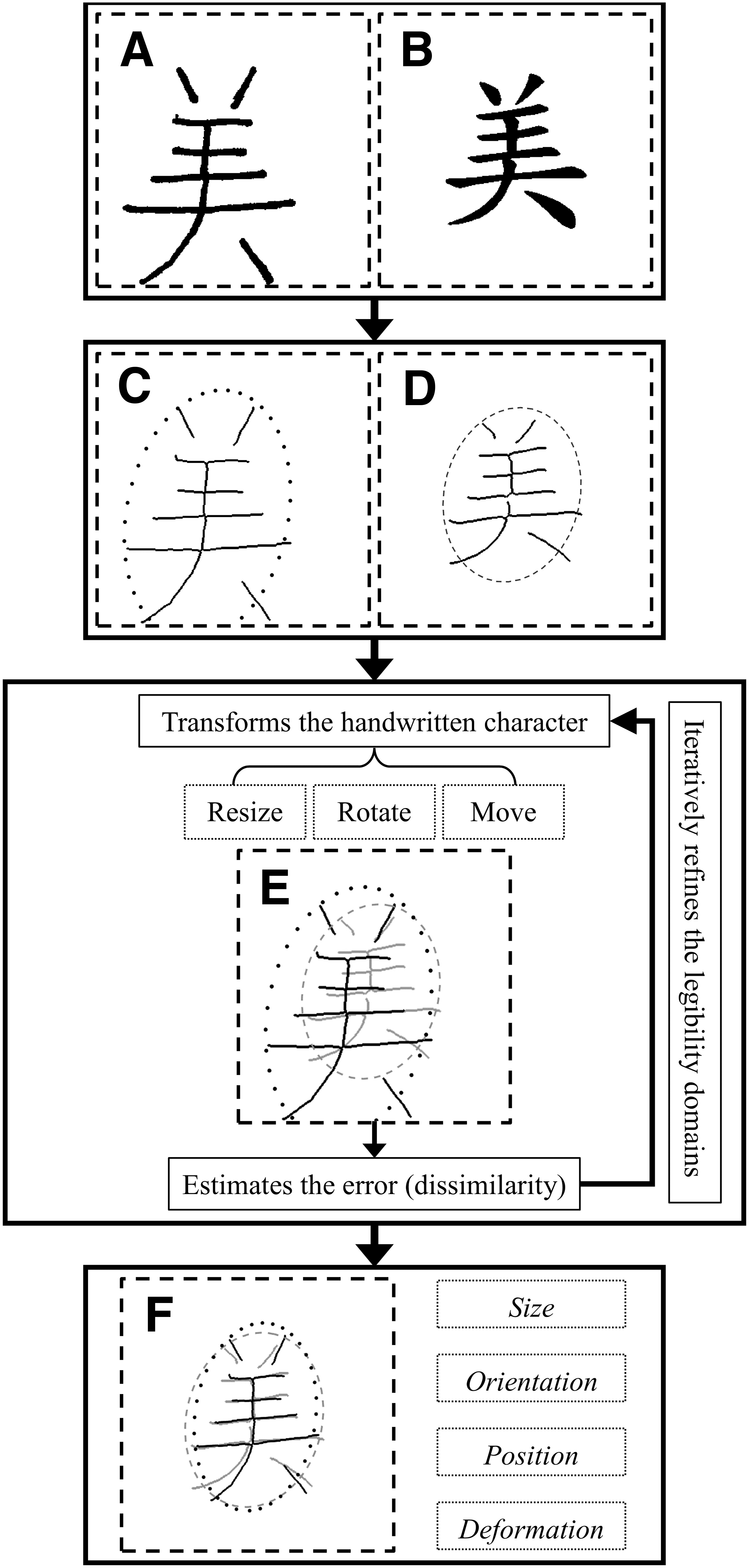
Flowchart of the CAM-CHL method of assessing a handwritten Chinese character. The essential geometric structure of the handwritten character (Panel A) and template (Panel B) are extracted through skeletonization. Then, bounding ellipses of the handwritten character (Panel C) and template (Panel D) are computed. Finally, an optimization routine is implemented (Panels E and F) to find the best-matching location of the handwritten character relative to its template.
To comprehensively describe handwriting legibility, the CAM-CHL assesses four domains, Size, Orientation, Position, and Deformation. Size is defined as the square root of the ratio of the bounding ellipse area of the handwritten character to that of the template (Figure 2a). Size is converted to a natural logarithmic form and taken in absolute terms to be commensurable. For example, if the handwritten character is twice or half the size of the template, the value of Size is 0.69 (|log 2| = |log 1/2| ≈ 0.69). Orientation is defined as the rotational angle between the major axis of the handwritten character’s bounding ellipse and that of the template (Figure 2b). A larger Orientation value indicates a greater slant in the handwritten character. Position is defined as the displacement between the bounding ellipse centroid of the handwritten character and that of the template (Figure 2c). A larger Position value indicates greater deviation from the center of the square frame. Deformation, or structural distortion of the handwritten character, is defined as a residual error between the geometric structures of the handwritten character and those of the template (Figure 2d). A larger Deformation value indicates greater difficulty in neatly arranging the graphic elements of the handwritten character within the square frame.
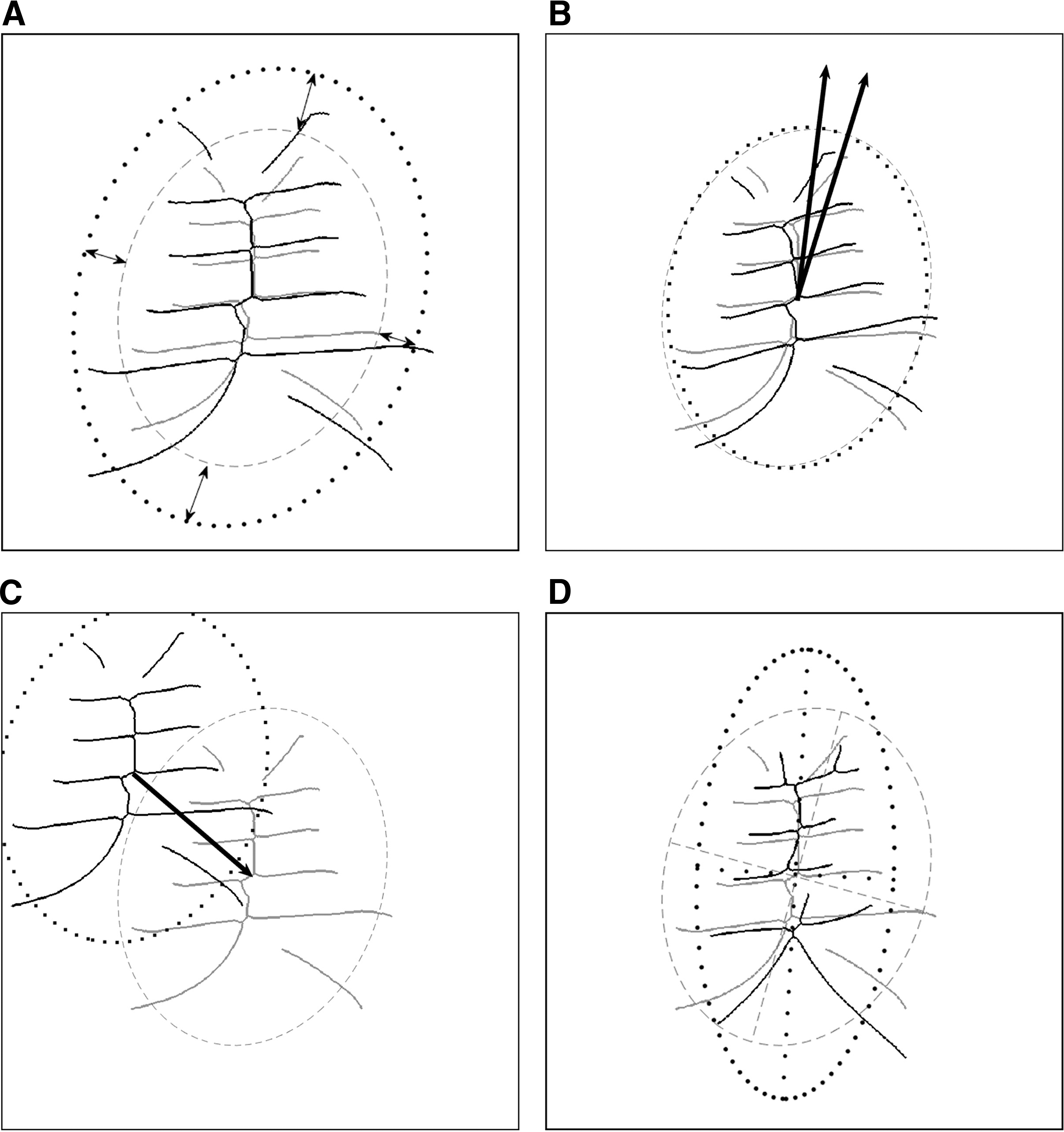
Illustrations of the four legibility domains: Size (Panel A), Orientation (Panel B), Position (Panel C), and Deformation (Panel D). The handwritten character is circled by a black dotted ellipse, and the template is circled by a gray dashed ellipse.
We adopted an optimization routine for the CAM-CHL to find the best-matching location of the handwritten character relative to its template (Figure 1e–1f). The optimization routine is mathematically represented as
For a given handwritten character, the CAM-CHL first performs an initial image registration by superimposing it onto its template and then provides preliminary estimates of the four legibility domains. Second, the optimization routine iteratively transforms the handwritten character to minimize dissimilarity with the template. In other words, the template is kept fixed and the handwritten character is tuned by resizing, rotating, and moving it in an iterative fashion to refine the error. When the best match of the handwritten character to the template is found, the CAM-CHL determines the Size, Orientation, Position, and Deformation values, thus precisely quantifying legibility.
Data Analysis
All statistical analyses were performed in IBM SPSS Statistics (Version 22). Test–retest reliability was examined using mixed-effect two-way intraclass correlation coefficients (ICCs) with a 95% confidence interval (CI; Portney & Watkins, 2015). ICCs >.90 indicate excellent reliability and .75–.90 good reliability (Portney & Watkins, 2015).
To further examine the measurement error, we calculated the minimum detectable change at a 95% CI (MDC95) for each legibility domain; the MDC95 was obtained according to the following formula (Portney & Watkins, 2015):
To explore characteristics of Chinese handwriting legibility in school-age children, we used one-way analysis of variance (ANOVA) to investigate differences among children in the lower, middle, and upper grades. Eta-squared (η2) was used to represent the effect size of one-way ANOVA, with η2 values >.14 indicating a large effect, .06 a medium effect, and .01 a small effect (Portney & Watkins, 2015).
Results
Reliability analysis showed that all ICC values were >.75 (95% CI [.85, .99]), indicating good to excellent test–retest reliability (Table 1). The MDC (MDC%) was 0.05 (21.71%) for Size, 1.25 (30.95%) for Orientation, 1.15 (8.33%) for Position, and 0.87 (9.69%) for Deformation, representing acceptable random measurement error. Validity analysis showed that the Spearman’s correlation coefficients between the four legibility domains and subjectively scored legibility were –0.33, –0.57, –0.52, and –0.72 for Size, Orientation, Position, and Deformation, respectively (p < .01), indicating fair to good convergent validities. ANOVA results showed that differences among grade levels were found only in Size and Position, F(2, 72) = 3.68 and 6.48, respectively, p < .05 (Table 2).
Test–Retest Reliability (N = 25) and Minimal Detectable Change (N = 75) of the CAM-CHL
Note. CAM-CHL = Computer-Aided Measure of Chinese Handwriting Legibility; CI = confidence interval; ICC = intraclass correlation coefficient.
Size is expressed as a natural logarithmic form.
Summary of Subjective and Objective Handwriting Legibility Scores, by Grade Level
Note. — = not applicable. CAM-CHL = Computer-Aided Measure of Chinese Handwriting Legibility.
Size is expressed as a natural logarithmic form.
p < .05.
p < .01.
Discussion
Development of the CAM-CHL was our attempt to provide a means to comprehensively and objectively assess Chinese handwriting legibility in school-age children using the image registration technique. The current study provides evidence that the CAM-CHL is able to quantify Chinese handwriting legibility in four domains—Size, Orientation, Position, and Deformation—and has sound test–retest reliability and fair to moderate convergent validity. In addition, the CAM-CHL detected developmental improvement in legibility in two domains, Size and Position.
The major contribution of the CAM-CHL is its objective and comprehensive scoring system. Conventionally, legibility assessments involve human visual inspection. The risk of subjectivity, the likelihood of human error, and the laboriousness of scoring procedures compromise the usability of such assessments and may lead to biased interpretation of handwriting difficulties. The CAM-CHL uses computer assistance to overcome the existing disadvantages of visual inspection. Assessing the Size, Orientation, Position, and Deformation domains of legibility allows multiple ways to assess legibility. In other words, a child who performs poorly in one legibility domain may not necessarily perform poorly in the other three legibility domains. In our study, of the children whose subjectively scored legibility was 0 (i.e., poor legibility), some had improper character sizes, others had excessive character slant, and still others arbitrarily shifted their characters to the corner of the square. The results suggest that constructional problems were heterogeneous among our school-age participants. Impressionistic judgment of a child’s handwriting legibility according to a general idea (i.e., subjective schoolteacher-scored legibility) might be too crude an approach to identify individual children’s problems with handwriting legibility. An objective assessment of Chinese handwriting legibility in terms of four domains is thus important and could be helpful in the design of individualized intervention programs for children with different handwriting difficulties.
The CAM-CHL demonstrated good to excellent reliability and acceptable random measurement error in all legibility domains. Regarding test–retest reliability, the high ICC values indicate that the CAM-CHL has a high degree of reproducibility between test and retest. In addition, the mean differences for all legibility domains in the test–retest assessments were not significant, indicating that the tool has no systematic bias between two successive assessments. The good to excellent test–retest reliability of the CAM-CHL supports its use as measure for monitoring potential changes in handwriting legibility in school-age children.
To improve the clinical utility of the CAM-CHL, we used the MDC95 to calculate the true change values for all legibility domains beyond measurement error. Orientation had the highest MDC value, indicating that a large improvement in Orientation is needed to surpass random error. The MDC% values of Position and Deformation were close to 10%, indicating a nearly excellent level of measurement error. However, the MDC% value of Orientation (i.e., 30.95%) was slightly higher than the suggested acceptance threshold of random measurement error (i.e., 30%), indicating that administrators should carefully interpret a change in Orientation. Moreover, to reduce the amount of random measurement error in the Orientation domain, the tool should be administered two or three times, and administrators should arrange a consistent environment for all measurement sessions and use the average score to offset unstable scores caused by random measurement error.
Convergent validity was demonstrated by fair to moderate associations between objectively scored (i.e., by the CAM-CHL) and subjectively scored (i.e., by schoolteachers) legibility. These results met our expectations. Compared with schoolteachers, the CAM-CHL may quantify more domains of legibility. A study by Chang et al. (2009) on modifying the CHAP used schoolteachers’ perceptions of legibility as a criterion measure, and Lee et al. (2016) found a fair association between a proposed legibility measure and schoolteachers’ perceptions. Among the four legibility domains, we found Deformation to be the most closely related to schoolteachers’ subjectively scored legibility, with a moderate association, consistent with Lee et al.’s results. Deformation is the structural distortion of a handwritten character, and our results reveal that schoolteachers might be more concerned with the geometric structures of the handwritten characters than with the other domains of handwriting legibility. However, the legibility problems in our sample were heterogeneous, so assessment of handwriting legibility should take into account multiple domains of legibility.
In addition to psychometric evaluation, we investigated developmental changes in handwriting legibility using the CAM-CHL. Significant differences between lower-grade and upper-grade children were found in the Size and Position domains, indicating that the upper-grade children were more capable of writing an appropriately sized character and aligning it with the center of the square than the lower-grade children. One explanation for this finding is that the test sheet used in this study was not marked with any reference lines as visual cues, so it did not resemble the workbooks used for lower-grade children in school settings. Participants in the lower grades were novice writers, with a tendency to arrange the graphic elements of Chinese characters in too scattered or compressed a fashion, and they may have found it difficult to align the characters with the center of the square.
Lam et al. (2011) tentatively ascribed the greater ability of upper-grade children to write appropriately sized Chinese characters to their better visual–motor skills. In the Orientation and Deformation domains, however, we found no significant differences between the grade groups. Lee et al. (2016) found a lack of developmental change in Deformation in children using Chinese; however, studies with children using an alphabet have shown deterioration in handwriting legibility (Duiser et al., 2020; Hamstra-Bletz & Blöte, 1993). The incongruence may be attributed to the curriculum goals of Taiwan elementary schools. Upper-grade children in Taiwan still need to learn new characters, and schoolteachers mainly focus on the Deformation domain. Thus, upper-graders need to focus continuously on their handwriting legibility, especially in the Deformation domain.
Limitations and Future Research
This study has some limitations that could help direct future research. First, our sample was a convenience sample, and the sample size was relatively small and might not be sufficiently representative, which may reduce the generalizability of our findings. Future research with a large sample is required to validate our findings. Moreover, we plan to conduct clinical validation of the CAM-CHL with occupational therapists to improve its clinical applicability. A second limitation is that we recruited only typically developing children for this study. Future studies are needed to compare differences in CAM-CHL results between children with and without handwriting difficulties and to improve discriminant validity. A third potential limitation is the lack of data to estimate the minimum clinically important difference (MCID). Estimation of the MCID may help improve the clinical utility of the CAM-CHL in evaluating the effectiveness of handwriting interventions for children with handwriting difficulties.
Implications for Occupational Therapy Practice
The results of this study have the following implications for occupational therapy practice: The CAM-CHL, a novel Chinese handwriting legibility scoring method, assesses four domains—Size, Orientation, Position, and Deformation—of handwriting legibility and can facilitate comprehensive evaluation of handwriting in school-age children who use Chinese. The CAM-CHL demonstrates acceptable psychometric properties for use as an objective and reliable assessment of handwriting legibility for school-age children using Chinese. Compared with novice writers (i.e., children in the lower grades), skilled writers (i.e., upper-grade children) demonstrated similar handwriting legibility in the Orientation and Deformation domains and better handwriting legibility in the Size and Position domains. The CAM-CHL is an image-based method and could be extended to evaluations that emphasize the logographic features of test items, such as legibility of the characters and the performance of the shape coping.
Conclusion
The CAM-CHL is a new, computerized method for comprehensively and objectively assessing the legibility of Chinese handwriting in school-age children. This method identifies constructional problems in multiple domains. The CAM-CHL showed good to excellent test–retest reliability, acceptable random measurement error, and fair to moderate convergent validity. In addition, the CAM-CHL results reflected developmental changes in Chinese handwriting legibility that may be attributed to improvement in the Size and Position domains. The CAM-CHL can complement clinical acumen in the evaluation of handwriting legibility and has the potential for use as an outcome measure to monitor progress after handwriting interventions. Further research is warranted to identify characteristics of difficulties with handwriting legibility, further validate the psychometric properties of the CAM-CHL, and investigate the underlying mechanisms of handwriting difficulties.
Footnotes
Acknowledgments
This project was supported in part by the Taiwan Ministry of Science and Technology (MOST 105-2221-E-002-089). We thank Tsung-Yuan Tsai for technical support.