






Abstract
The results of this scoping review identify the limited extent to which adult learning needs are considered in occupational therapy literature, specifically for parents of children with sensory processing and sensory integration (SP–SI) challenges, and point to the need for further investigation of parents’ learning needs in relation to occupational therapy intervention.
Sensory processing and sensory integration (SP–SI) challenges, also referred to as sensory processing dysfunction, are described as a difficulty responding to sensory information in an adaptive and efficient manner (Tavassoli et al., 2019). These challenges are commonly seen among children with varied neurodevelopmental disorders, and the intense behaviors associated with these challenges result in frequent referrals to occupational therapy (Reynolds et al., 2017). SP–SI challenges not only lead to deficits in adaptive behavior and social–emotional functions among children but often result in stressful encounters for their families (Ben-Sasson et al., 2013), leading to the need for occupational therapists to support parents as well as children.
Parent or caregiver engagement has been well documented as an essential component of pediatric occupational therapy since the early 1990s, when the health care profession began focusing on family- centered care (FCC) practices (American Occupational Therapy Association, 2000; Foster et al., 2013; Gee & Peterson, 2016; Kuo et al., 2012). In fact, FCC was reported in occupational therapy interventions even before the 1990s (Humphry, 1989; Lawlor & Mattingly, 1998). However, until recently, research focusing on parent-mediated interventions emphasized child outcomes, with only limited consideration of the impact on the parent (Karst & Van Hecke, 2012). In the past decade, it has become common to see studies examining the effects of both child- and parent- focused interventions, reporting outcomes such as parenting stress, parenting self-efficacy, and parent–child interactions (Hanna & Rodger, 2002; Karst & Van Hecke, 2012; Miller-Kuhaneck & Watling, 2018). This broader outcome focus is promising in that it reinforces the core role parents play in pediatric occupational therapy intervention. Given this, it is critical for therapists to understand parents as adult learners and address their learning needs.
Caregiver-focused intervention approaches, and the terminology attached to those approaches (Miller-Kuhaneck & Watling, 2018), vary. As such, we felt it was necessary to define the terminology used in this scoping review. Parent is used to reference all primary caregivers, including birth parents, adoptive parents, foster parents, and others in a primary caregiving role. Parent training is used broadly to encompass the common practices of training, coaching, and education.
The purpose of this scoping review was to examine the occupational therapy literature to identify the extent to which parents’ learning needs are considered as part of therapy for children with SP–SI challenges. This specific population was selected in part because of its high prevalence, currently documented to exceed 15% among elementary school–age children in the United States (Galiana-Simal et al., 2020). In addition, the increased family impairment associated with the intense behaviors and social–emotional challenges seen in this population (Ben-Sasson et al., 2009, 2013; Suarez et al., 2014) may be best addressed by educating parents during occupational therapy for their children. The overarching aim of this scoping review was to determine the extent to which parents’ learning needs are considered in the context of occupational therapy for their children with SP–SI challenges.
Method
This scoping study followed Arksey and O’Malley’s (2005) five-step methodological framework: (1) identifying the research question; (2) identifying relevant studies; (3) selecting studies; (4) charting the data; and (5) collating, summarizing, and reporting results. We included the additional sixth step suggested by Levac et al. (2010), stakeholder consultation, to increase rigor. Each step is delineated next. The Preferred Reporting Items for Systematic Reviews and Meta-Analyses extension for Scoping Reviews (PRISMA-ScR) checklist was used to improve structure and clarification for each step of the scoping review process (Tricco et al., 2018).
Identifying Research Question
The research question was broad in scope and linked to a clear purpose: To what extent are parents’ learning needs considered in the context of pediatric occupational therapy for their children with SP–SI challenges?
Identifying Relevant Studies
The search was limited to literature within occupational therapy to maintain relevance to discipline-specific practices. We chose not to limit the search by study design or location, allowing for a more inclusive picture of available research. The following electronic databases were searched: MEDLINE, PsycINFO, CINAHL, Web of Science, EMBASE, and ERIC. To further explore the related literature, hand searches were conducted for potentially relevant articles listed in the reference lists of the included articles. Supplemental Appendix Table A.1 (available online with this article at https://research.aota.org/ajot) provides samples of full electronic search strategies, including database, keywords, number of results, and investigator notes regarding search outcomes.
Study Selection
Two investigators (Lisa M. Porter and Breanne E. Kearney) ran the initial searches and reviewed relevant abstracts using the predetermined search criteria (see Supplemental Appendix Table A.2). The inclusion criteria specified population, intervention, outcomes, and date range (1990–2019). The start year, 1990, was chosen on the basis of the shift in health care to a family-centered focus in the early 1990s (Kuo et al., 2012). After identification of potentially relevant articles, abstracts were reviewed by Porter and Kearney to assess inclusion criteria and modify search terms as deemed necessary. For instance, to accurately identify the target population, the criterion was modified from children with disabilities, which proved to be too broad, to parents of children with SP–SI challenges. Autism was removed as an inclusion criterion, but studies of parents of children diagnosed with autism spectrum disorder were included when sensory challenges were mentioned in the article. To ensure methodological rigor and consistency in the study selection process, searches were run in all databases using a team approach, as suggested by Levac et al. (2010). We reviewed titles and abstracts, identifying articles for full-text review, which was conducted by Porter and Kearney. When questions arose, three investigators (Porter, Shelly J. Lane, and Kearney) met to discuss articles and collaborate in the decision-making process.
Study Design
All study designs were considered to include any and all relevant knowledge on the subject. Selected studies included qualitative, quantitative, mixed-methods, and exploratory methodologies.
Discipline
Because children with SP–SI challenges are most commonly identified and treated by occupational therapists, the decision to narrow the inclusion criteria to the field of occupational therapy was made early in the search process.
Charting the Data
Relevant data were extracted and charted by Porter and Kearney to operationalize and organize information for efficient and iterative review. Extracted data were then screened by Porter, Lane, and Kearney to ensure consistency and adherence to the scoping study purpose and inclusion criteria.
Consulting With Stakeholders
Stakeholders, parents of children with SP–SI challenges, took part in semistructured interviews, in which they were asked about their learning experiences as part of a larger study. Interviews were used as a means of validating qualitative themes discussed in the Results section.
Results
As shown in the PRISMA flowchart (Figure 1; Liberati et al., 2009), 133 abstracts were screened on the basis of the inclusion criteria; 112 did not meet the inclusion criteria. The remaining 21 articles were read in full by Kearney and Porter, and 16 were excluded because they did not address the concept of adult learning or did not relate to the research question. Five articles remained for full data extraction. Details of the quantitative and qualitative results are provided next.
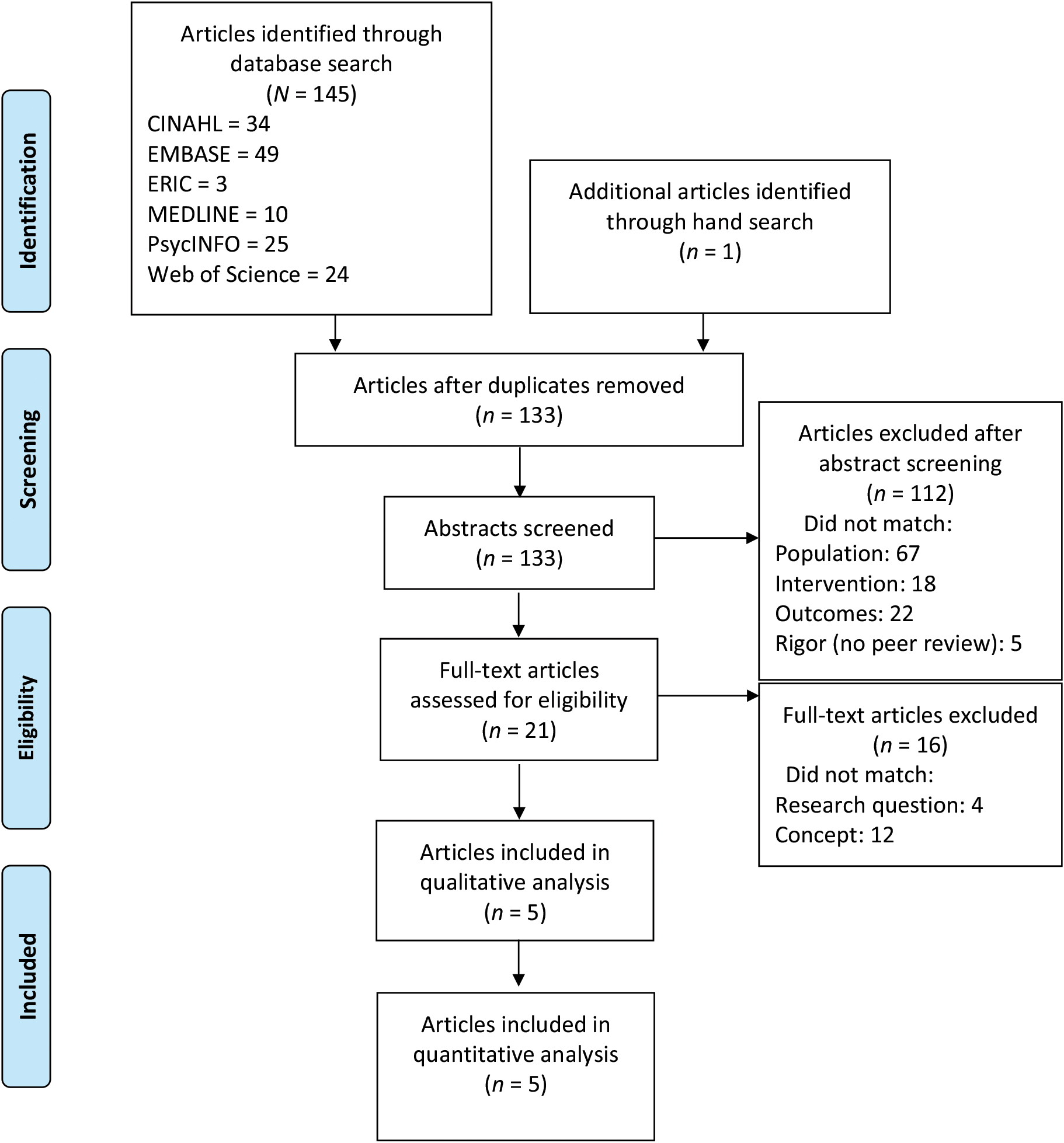
Preferred Reporting Items for Systematic Reviews and Meta-Analyses (PRISMA) flow diagram of the selection process.
Quantitative Results
The 5 articles included in this study varied in methodology, design, and geographic location. Research designs included 1 systematic review (Miller-Kuhaneck & Watling, 2018), 1 pretest–posttest design (Gee & Peterson, 2016), 1 mixed-methods study (An, 2017), 1 descriptive case study (Graham et al., 2010), and 1 qualitative study (Vertes et al., 2018). Of the 5 studies, 3 were conducted in the United States, 1 in Australia, and 1 in Korea. The broad scope of the research question was intended to span not only methodological but also cultural and environmental differences. Although critical analysis was not the intent of this scoping review, it is interesting to note that the broad search resulted in a range of rigor among included studies, from a descriptive case study to a systematic review. The 4 studies using experimental methods had small sample sizes; 2 had 10 participants (Gee & Peterson, 2016; Vertes et al., 2018), 1 had 4 participants (An, 2017), and 1 had 3 participants (Graham et al., 2010). Two of the studies included parents of children with secondary SP–SI challenges, and only 3 focused specifically on parents of children with SP–SI challenges. Supplemental Appendix Table A.3 provides a detailed description of the 5 included articles and extracted data, clearly delineating how each article met the search criteria and addressed the research question.
Qualitative Results
A qualitative thematic analysis was conducted using handwritten visual mapping and ATLAS.ti (Friese, 2020), a data management software. These tools were used to aid the process of extracting common themes from the selected articles. Initial coding, using color-coded concept mapping, was performed by Porter. Categories were then entered into ATLAS.ti, and axial coding, or grouping of open codes, was completed by Porter and Kearney during multiple coding meetings. The qualitative thematic analysis of the 5 selected articles revealed two themes: (1) parental focus on child outcomes and (2) emotional support. These two themes were repeated throughout the 5 included articles. Although these themes are not directly related to parents as adult learners, both are relevant to parents’ experiences in the training process and offer insight into the gap in current literature regarding parents’ learning needs.
Parental Focus on Child Outcomes
Of the 5 studies, 3 incorporated parent coaching methods (An, 2017; Graham et al., 2010; Miller-Kuhaneck & Watling, 2018); 2 had a specific focus on occupational performance coaching (OPC; An, 2017; Graham et al., 2010) but not directly on how parents learned. The 2 studies that used OPC included parent outcomes with mention of strategies that parents learned and shifts in parents’ attitudes and expectations regarding their children (An, 2017; Graham et al., 2010). Despite the researchers’ focus on parent outcomes, when parents were asked about their experiences of engaging in OPC, they almost exclusively focused on changes in their children rather than changes in themselves or their own learning process.
Emotional Support
The theme of peer support emerged in 3 of the 5 studies (An, 2017; Graham et al., 2010; Vertes et al., 2018). Parents reported benefiting from the support of others through coaching or small-group interventions, appreciating the ability to share and learn from the therapist or parents in similar situations, and knowing that they were not alone (Graham et al., 2010; Vertes et al., 2018). In the study conducted in Korea (An, 2017), participants noted cultural norms that restricted their ability to receive support from their community, thereby creating a feeling of powerlessness. These findings highlight the importance of community support often associated with small-group parent training or interventions promoting parent–therapist relationships (Cohn, 2001; Hames & Rollings, 2009; Vertes et al., 2018).
A gap in the literature emerged, because none of the 5 studies revealed themes clearly addressing parents as adult learners. Each of the 5 articles mentioned the use of strategies that might be deemed as andragogic, but only 1 actually used the term adult learning (An, 2017), and none directly referred to parent learning style or how parents learned. Parents in each of the 5 studies reported benefiting from these adult-learning strategies; however, only 1 article mentioned parents’ learning preferences.
Stakeholder Consultation
Parents of children with sensory processing challenges (stakeholders) took part in semistructured interviews, during which they were asked about their learning experiences after a training program. Each of the 9 participants confirmed findings from this scoping study, reporting that small-group peer interactions were beneficial in providing a sense of support and knowing that they were not alone. Similar to the findings in the included articles, 4 of the 9 interview participants were hesitant to talk about themselves, even when asked directly about their own learning. They preferred to discuss changes in their children and had to be directed back to questions about themselves.
Discussion
This scoping review was conducted to identify the extent to which adult learning needs are examined in the occupational therapy literature focused on parent training as a part of an intervention for children with SP–SI challenges. Findings indicated that parents who were engaged in some form of training demonstrated a change in attitude and expectations for themselves and their children (An, 2017; Graham et al., 2010; Miller-Kuhaneck & Watling, 2018). In addition, this study reveals that small-group learning is perceived positively by parents and that parents appreciated the emotional support they found in the group setting (Graham et al., 2010; Vertes et al., 2018).
Although all included studies seemed to embrace an andragogic approach, parents’ learning needs were rarely mentioned as outcome measures, or even as a consideration in parent-training interventions. Gee and Peterson (2016) examined changes in parents’ knowledge and perceived knowledge after a group intervention involving adult learning strategies (lecture, PowerPoint, and discussion) but did not explicitly explore parents’ learning preferences. Graham et al. (2010) used coaching methods consistent with adult learning, such as applying parents’ learning to real-life situations, providing opportunities to validate parents’ prior knowledge, and encouraging parents to practice new skills in a meaningful context. Vertes et al. (2018) provided opportunities for parental observation and small-group interactions in their intervention, and An (2017) used active learning techniques through coaching methods. Although these authors considered the experiences of parents during parent training programs, neither study overtly considered parents’ learning needs or parents as adult learners.
The systematic review by Miller-Kuhaneck and Watling (2018) synthesized 4 studies examining training interventions for parents of children with SP–SI challenges and comorbid autism spectrum disorder (Dunn et al., 2012; Rogers et al., 2014; Woo & Leon, 2013). Their review examined the efficacy of parent-training interventions, including both child- and parent-focused outcomes. Similar to the findings of this scoping review, only 1 study directly addressed parent learning outcomes (Rogers et al., 2014), and this study used parent coaching as the intervention method. Rogers et al. (2014) was excluded from this scoping study because it did not directly mention SP–SI challenges. Three of the 4 studies included in the Miller-Kuhaneck and Watling review (Dunn et al., 2012; Rogers et al., 2014; Woo & Leon, 2013) used parent outcome measures and reported findings that addressed parents’ desires for what they wanted to learn through intervention. Although these 3 studies explored both child and parent outcomes, interventions were child focused and did not consider the learning needs of parents beyond reflecting on the intervention outcomes. Without more careful and pointed consideration of what information parents need to best take in and assimilate to support their children, parent training may be limited, at best, in its effectiveness and longitudinal carryover (Miller-Kuhaneck & Watling, 2018).
Although the population of interest was narrow, it is relevant to the profession because occupational therapists are considered leaders in the assessment and treatment of SP–SI challenges in children (Bodison & Parham, 2018; Reynolds et al., 2017). Moreover, recent evidence indicates that there is a high percentage of SP–SI challenges across numerous neurodevelopmental disorders (Tavassoli et al., 2019), expanding the need to better understand parent-training approaches for this population. From a clinical perspective, it is of great importance for pediatric therapists to consider the learning needs and priorities of parents likely experiencing heightened parenting challenges as a result of their children’s SP–SI challenges (Rowe & Fitness, 2018; Schwabe & Wolf, 2010).
Future Research
The results of this scoping review indicate a gap in the occupational therapy literature. Consideration of parents as adult learners in pediatric therapy may serve to increase the efficacy of family-centered interventions for children with SP–SI challenges. Further research is clearly needed to directly examine parents’ learning preferences during intervention for their children (Harrison et al., 2007; Hurtubise & Carpenter, 2017). Malcolm Knowles (1984), adult educator and theorist, identified four principles of andragogy, or adult learning: (1) Adults should be involved in planning and evaluating their instruction, (2) experience is essential to the foundation of learning, (3) adults are motivated and engaged by topics that are immediately relevant to their lives, and (4) adult learning should be problem centered. Consistent with these principles is the idea that parents will have varied learning preferences that may directly affect their ability to take in information (Thompson et al., 2020). Current literature on interventions for children with SP–SI challenges and their parents has yet to consider that parents’ learning is dependent on the method of delivery and their individual learning needs. Ultimately, considering parents’ learning readiness and learning may serve to increase the effectiveness of parent-training and coaching programs.
Implications for Occupational Therapy Research and Practice
Family-centered care requires pediatric occupational therapists to work closely with parents of children receiving therapy. This scoping review indicates that the learning needs of parents of children with SP–SI challenges are not explicitly considered, even when parent training or coaching is included as a component of the intervention. These findings support the idea that future consideration of parents as adult learners is important for the development and implementation of parent-training strategies and programs.
This scoping review has the following implications for occupational therapy research and practice: ▪ When designing parent-training interventions, it is essential to consider not only educational content but also parent learning preferences. ▪ Therapists may consider offering multiple options for learning based on andragogic strategies and individual learning preferences within parent-training programs. ▪ Consideration should be given to the assessment of parents’ learning preferences when providing intervention for children with SP–SI challenges. ▪ Occupational therapy research should integrate information on adult learning theory to inform the development of parent-training programs. ▪ Parent-coaching methods, such as OPC, incorporate adult learning strategies that may be useful for future research examining parents as adult learners during pediatric therapy. These strategies include, but are not limited to, active learning, small-group reflection, peer support, and contextual learning activities.
Limitations
The number of articles meeting the inclusion criteria for this scoping study was greatly reduced by considering only research focused on a carefully defined population of parents. This narrow scope, although essential to the purpose of this study, restricted the number of included articles, thereby limiting potential generalizability. Although a definite gap in the literature was identified, the nature of this study was such that articles were not excluded on the basis of population size, methodology, or rigor. Therefore, results from the thematic analysis should be applied cautiously because they are based on studies that lack statistical power and generalizability.
Conclusion
The results of this scoping review offer meaningful considerations for pediatric therapists and researchers. Although it is widely accepted that parent training is essential to pediatric practice, these results highlight the absence in the existing occupational therapy literature of consideration of parents’ learning needs. By improving the understanding of what parents need in order to take in information, researchers and clinicians can foster more efficient and effective education programs for parents of children with SP–SI challenges. When therapists seek to understand parents’ learning needs, they may strengthen the parent–therapist relationship and foster a bidirectional learning process.
Supplemental Material
Supplementary material for Parents as Adult Learners in Occupational Therapy for Children With Sensory Challenges: A Scoping Review
Supplementary material, sj-pdf-1-aot-10.5014_ajot.2023.050078.pdf for Parents as Adult Learners in Occupational Therapy for Children With Sensory Challenges: A Scoping Review by Lisa M. Porter, Shelly J. Lane, Barbara B. Demchick, Jane K. Sweeney, Pamela A. Mullens and Breanne E. Kearney in The American Journal of Occupational Therapy
Footnotes
*
Indicates articles included in the scoping review.
Acknowledgments
We acknowledge Dr. Pamela A. Mullens for her contributions, support, and true spirit of lifelong learning.
References
Supplementary Material
Please find the following supplemental material available below.
For Open Access articles published under a Creative Commons License, all supplemental material carries the same license as the article it is associated with.
For non-Open Access articles published, all supplemental material carries a non-exclusive license, and permission requests for re-use of supplemental material or any part of supplemental material shall be sent directly to the copyright owner as specified in the copyright notice associated with the article.
