





Abstract
This study tests the effectiveness of a sensory integration intervention paired with teacher consultation, aligned with the principles of Ayres Sensory Integration® and the Sensory Therapies and Research Frame of Reference, to improve functional regulation and active participation in school for students with sensory integration and processing differences.
Sensory integration and processing differences, found in an estimated 5% to 16% of the general U.S. population (Gouze et al., 2009), can limit a child’s participation and performance in their occupations at school (Chien et al., 2016; Hertzog et al., 2019). In the education setting, the students’ occupations of social interaction, education, play, leisure, health management, and activities of daily living all fall under the occupational therapy practitioner’s domain (American Occupational Therapy Association [AOTA], 2020). When a child’s access to their education is limited because of their sensory integration and processing challenges, school-based occupational therapy practitioners are guided by laws, such as the No Child Left Behind Act of 2001 (Pub. L. 107–110), the Individuals With Disabilities Education Improvement Act of 2004 (IDEA; Pub. L. 108–446), and the Every Student Succeeds Act of 2015 (Pub. L. 114–95), which highlight multitiered systems of support and the least restrictive environment.
School-based occupational therapy practitioners should first look to provide Tier 1 support for the whole school and Tier 2 small-group integrated coaching and collaboration in the classrooms to align with the least restrictive environment (IDEA, 2004). However, some students with sensory integration and processing differences may continue to present with considerable challenges in occupational engagement in the school setting even after receiving this support. If a student qualifies for special education after a comprehensive occupational therapy evaluation, the school-based occupational therapy practitioner should then consider the full array of service delivery options, including sensory integration intervention with teacher consultation (Whiting et al., 2021). A multifaceted approach to supporting sensory integration and processing challenges has been encouraged in the literature (e.g., Reynolds et al., 2017). In addition, the environmental accommodations and modifications that can result from consultations are essential to designing a neurodiversity-affirming learning environment.
The use of a sensory integration frame of reference to support sensory integration and processing differences is recommended by AOTA and reportedly used by most school-based occupational therapy practitioners (Jasmin et al., 2018; Smith Roley et al., 2015). Moreover, schools have been noted as having both the potential and the capacity to provide sensory integration treatment with fidelity (May-Benson et al., 2014). However, there is a gap in the literature regarding intervention success in schools. Most studies of sensory integration intervention have been conducted in a clinic setting (Andelin et al., 2021; Pfeiffer et al., 2011; Schaaf et al., 2014). This may be due to that fact that sensory integration intervention requires specialized training. Limitations in access to space, equipment, and adequate training have been cited by school-based occupational therapy practitioners as barriers to implementation (Charles & Glennon, 2020). Previous research in the schools has reflected only the use of sensory-based approaches, protocols and environmental modifications, or the interventions were more theoretical in nature (Grajo et al., 2020; Kinnealey et al., 2012; Whiting et al., 2021). To provide evidence-based practice, school-based practitioners require there to be explicit research conducted in the school setting on the use of sensory integration intervention that has demonstrated a positive impact on students’ participation and performance.
The purpose of this study was to evaluate the effectiveness of a sensory integration intervention paired with teacher consultation with children ages 5 to 8 yr who had sensory integration and processing differences in improving occupational engagement in an education context. A single-subject multiple-baseline design was considered most appropriate for commencing evidence-based research on sensory integration intervention in the understudied school context (Cook et al., 2014).
The four specific research questions addressed in this study were as follows: Will a sensory integration intervention paired with a teacher consultation be effective in improving a student’s functional regulation and active participation in the general education classroom? Will a sensory integration intervention paired with a teacher consultation produce meaningful changes in occupations and individualized goals? What do teachers report as representing student progress and changes in their own competence that resulted from participating in the consultation? What do children report regarding their therapy and subsequent school experience after participation in occupational therapy?
The authors hypothesized that, as the result of intervention, the student participants would demonstrate meaningful improvement in the dependent variables of functional regulation and active participation. Moreover, increased occupational engagement, as denoted in pre–post measures, would be further corroborated by the multimethod approach.
Method
Research Design
This study had a concurrent multiple-baseline AB single-subject design across three students in a public school setting. Weekly measurements of the dependent variables were collected during a 5- to 7-wk baseline (Phase A) and a 15-wk intervention (Phase B). Baseline start dates were the same, and the students were randomly assigned to different baseline lengths. A minimum of five baseline data points were collected to align with What Works Clearinghouse (2017) standards. The study design and reporting method were guided by the Single-Case Reporting guideline In BEhavioural Interventions (SCRIBE; Tate et al., 2016). The students’ guardians and teachers provided consent, and the students provided assent. The study is registered with ClinicalTrials.gov (NCT04769674) and was approved by the Boston University institutional review board.
Participants
Each prospective participant between ages 5 and 8 yr with suspected sensory integration and processing challenges was first referred for Tier 2 support by their teacher. After an occupational therapy consultation and in-class support, the teacher’s data had to demonstrate that the student still experienced continued challenges, and the student’s profile had to suggest the need for direct individualized intervention so they could access their education. The student was then evaluated by the occupational therapist through the special education eligibility process. The comprehensive assessment consisted of (1) a developmental history, review of records, and occupational profile; (2) a standardized assessment using the Miller Function and Participation Scales (M–FUN; Miller, 2006); (3) unstructured and structured observations of the student’s sensory modulation, sensory discrimination, postural ocular control, visual–perceptual and fine motor skills, motor coordination, and praxis; (4) observations of performance in the classroom and other school environments; (5) home and school versions of the Sensory Processing Measure (2nd ed., SPM–2; Parham et al., 2021); and (6) notation of strengths and interests. A student was considered for inclusion in the study if (1) the evaluating therapist’s summary interpretation suggested that the student had sensory integration and processing differences that was affecting their ability to perform and participate in the school setting, directly correlating with the referring problems, and (2) their total score on three or more scales of the main classroom SPM–2, completed by the classroom teacher, was in the “moderate” or “severe difficulties” category. Students with an autism diagnosis; with a primary genetic, orthopedic, or neurological disorder; or who participated in occupational therapy outside of school were excluded.
The first three students to meet the criteria were included. All had already qualified for an individualized education program under the developmental delay category before the occupational therapy evaluation took place. The students’ demographic information and standard scores on the M–FUN are listed in Table A.1. in the Supplemental Appendix (available online with this article at https://research.aota.org/ajot). The evaluation results revealed that all three students demonstrated challenges in auditory and vestibular overresponsivity; vestibular, proprioception, and tactile discrimination difficulties; and impaired posture and praxis. Participant 1 also had sensory overresponsivity to tactile input and auditory discrimination challenges. In addition, all three participants had moderate or severe difficulty ratings on the SPM–2 for social participation, hearing, touch, body awareness, balance and motion, and planning and ideas, and Participants 2 and 3 also had vision difficulties. The authors hypothesized that these sensory challenges identified in the comprehensive evaluation were associated with the presenting problems in occupational performance and participation at school identified by their teachers. These problems included difficulties with both academic and nonacademic activities, trouble staying regulated, a lack of health and wellness routines, limited playing on the playground equipment at recess, and a low frequency of positive social interactions.
Independent Variable
The sensory integration intervention and teacher consultation used in this study aligned with the principles and manualized approaches of Ayres Sensory Integration® (ASI; Ayres, 1979; Schaaf & Mailloux, 2015) and the Sensory Therapies and Research (STAR) Frame of Reference (Miller et al., 2018). Interventions were guided by process elements outlined in the ASI Fidelity Measure© (ASIFM; Parham et al., 2011) by Schaaf and colleagues (2012, 2014) and included a deliberate focus on the domains of regulation and relationship for intervention incorporating Developmental, Individual-differences, and Relationship-based Model (DIR)/Floortime principles (Wieder & Greenspan, 2003) as outlined by the STAR Frame of Reference fidelity measure (Miller et al., 2018). Preliminary evidence of the effectiveness of the STAR Frame of Reference is available (Schoen, et al., 2018, 2019). Interventions included adjusting activities to the “just-right challenge” (determined through the evaluation process); arousal regulation; therapeutic use of self; and offering enhanced sensory opportunities for tactile, vestibular, and proprioceptive input. The three students received individualized one-to-one 30-min direct treatment sessions in the treatment room 2 times/wk for the 15-wk intervention phase. The treatment setting was an occupational therapy room with quiet, adequate space consistent with ASIFM parameters, including multiple ceiling hooks for swing suspension, various swings, a matted floor, a scooter and ramp, weighted objects, a ball pit, and props to support engagement in play. Consistent with both frames of reference, the intervention package also included consultations between the teacher and the occupational therapist, held weekly for 10 min. Consultations focused on teacher education through discussions of the influence of sensory integration and processing challenges on functioning in the classroom as well as explorations of sensory-supportive modifications to the environment and generalization of strategies.
Occupational therapy sessions were individualized to the child, child-directed, and play-based, guided by the advanced clinical reasoning of the therapist, identified challenges from the comprehensive evaluation, and the child’s preferences. For example, challenges in play captured within the goal of successfully navigating playground equipment were addressed by treating the primary underlying sensory discrimination (tactile, vestibular, and proprioceptive) and praxis difficulties identified in the evaluation. The therapist individually tailored the sensorimotor activities, including activities co-constructed by the child and therapist, such as having the student lift different weight blocks covered in various textures to make a tower, climbing onto a step to access the trapeze swing, and swinging to crash into the tower and then onto the mats and cushions before rebuilding. This activity actively engaged the student in rich proprioceptive, vestibular, and tactile experiences that facilitated adaptive responses and body awareness while also facilitating their ability to plan, sequence, and execute their body movements. On the other hand, when a primary sensory challenge to participating in the classroom was identified as tactile, vestibular, and auditory overresponsivity in the evaluation, the therapist used individually tailored therapeutic activities that centered around providing sensory input graded in intensity, at a slower pace, to allow adaptation of arousal and accommodation to the sensory experience. Interventions built on ASI by adding an intentional focus on regulation and relationship as a foundation for sensory integration and processing.
The interventionist was the first author (Colleen Cameron Whiting), an occupational therapist with 20 yr of experience in pediatrics and sensory integration. She has professional certifications for the Sensory Integration and Praxis Tests, from the STAR Institute, and in the DIR/Floortime approach. She provided all direct treatment sessions and teacher consultations, videotaped probes, and she conducted the end-of-study interviews.
Dependent Variables
The dependent variables were functional regulation and active participation. Operational definitions were derived from a review of the literature, observations of student behavior, and consultation with five content experts. These definitions were intentionally developed to be neurodiversity affirming while simultaneously representing behavioral parameters in a typical general education classroom. The finalized operational definitions were as follows: A student was deemed functionally regulated when their arousal level matched the behavioral expectations of the classroom activity, noted by (1) no large extraneous body movements while sitting up independently within a designated space, allowing for postural adjustments and nondisruptive fidgeting, and (2) a voice volume and pitch that matched the teacher’s instructions. Examples provided to the rater of not being functionally regulated included reaching or moving outside of the designated space, putting their head down on the desk, falling out of the chair, covering their ears, lying down, and whispering or shouting when a talking volume was expected. A student was deemed as actively participating when they interacted in an outcome-based purposeful and expected manner with the environment or activity, noted by (1) orienting and responding to teacher prompts or peer initiations with a reciprocal eye gaze, hand–body gesture, postural adjustments, or verbal response and (2) following activity expectations. Examples provided to the rater of not actively participating included not speaking when asked to, closing their eyes, needing multiple (two or more) individual teacher prompts, and not holding or using materials as instructed. For each dependent measure, if both conditions were observed, the student was assigned a rating of 1. If not, the student was assigned a rating of 0.
Measures
Dependent Variables
For repeated measurement of the dependent variables, each student was videotaped for 10 min in the general education classroom, during the same whole-class lesson and at the same time of day each week for both phases. A small video recorder was placed on a tripod in the classroom the week before baseline data collection to ensure student acclimation. Each 10-min video was reviewed by a trained observer and rated using momentary time sampling. Target behaviors were rated as of the last second of each 10-s interval for each of the dependent variables. A total percentage of intervals where the behavior was exhibited was recorded as a data point on a scale that ranged from 0 to 100. To reduce bias and increase interval validity, the trained observer was blinded to the participants’ identities, intervention protocol, session number, and treatment phase. The videos were assigned in random order.
To establish interobserver agreement and ensure that the operational definitions were reliable, the rater and first author together coded training videos. The trained observer was a graduate student in a behavior analyst program. During the training, disagreements were resolved through discussion. Ninety-two percent agreement for the functional regulation dependent variable, and 93% agreement for active participation, were reached during training. Interrater reliability checks of three videos for each student were also completed during the study. Ninety-six percent agreement for functional regulation, and 93% agreement for active participation, were achieved across students. Internal validity was ensured by videotaping three intervention sessions and three consultations for every student (10% of the total, as in Schaaf et al., 2014) for later fidelity ratings on the ASIFM and the STAR Fidelity Measure.
Pre–Post Intervention Measures
Data were collected before and after intervention to corroborate changes in functional regulation and active participation, which support occupational engagement. The students’ teachers completed the Short Child Occupational Profile (SCOPE; Bowyer et al., 2008) independently, to reduce bias, providing an understanding of the impact of challenges on a child’s participation in occupations. The SCOPE has adequate parametric characteristics (OBrien et al., 2019). The Behavior Assessment System for Children, Third Edition (BASC–3; Reynolds & Kamphaus, 2015), which also demonstrates adequate parametrics, was filled out by the participants’ main classroom teachers and measured the students’ adaptive and problem behaviors at school.
Goal Attainment Scaling
Goal Attainment Scaling (GAS) was used to further substantiate occupational engagement. Goals were developed collaboratively by the treating occupational therapist, each student’s parent, and the main classroom teacher for each student, to assess meaningful outcomes. The level of achievement for each goal was rated by the teacher with the assistance of the instructional aide after the intervention. A score of –2 was set to represent current performance, –1 as lower than expected, 0 as the predicted outcome, +1 as better than expected, and +2 as much better than expected. GAS has been noted in research to reliably demonstrate goal achievement from sensory integration intervention (Andelin et al., 2021; May-Benson et al., 2021).
Interviews
At the end of intervention, the teachers and students were videotaped as they engaged in a semistructured interview to offer an opportunity to share their lived experiences and a holistic view of the benefits of the intervention. For the teacher, the questions centered around whether they felt more competent in supporting sensory needs and what changes they saw in their student. For the student interviews, a closed card sort with moderated facilitation was used with pictures of activities and equipment used in the intervention (e.g., swings) or the school environment (e.g., classroom tasks). This was previously piloted with success. Students were presented with two open containers, each with a response category pictured on the front, and asked to place the card into the container that reflected whether they liked activities and their perceived level of difficulty.
Data Analysis
Visual inspection of the graphed data for each participant was used to analyze patterns within each phase and between phases. Changes in level, trend, variability, and immediacy of effect were included in the interpretation (Kazdin, 2020). The 2-SD band was used for the functional regulation dependent variable because the baseline data did not show any obvious trend (Nourbakhsh & Ottenbacher, 1994). If two or more consecutive intervention data points fell outside the band generated by the baseline mean and standard deviation of baseline data, the effect of the intervention would be considered significant at the probability level of p < .05 (Gottman & Leiblum, 1974). For the active-participation dependent variable, celeration line analysis was used because of a clear observable trend in the baseline data (Nourbakhsh & Ottenbacher, 1994), generated using the split-middle technique and extended into the intervention phase (Kazdin, 2020). Using the binomial test (Nourbaksh & Ottenbacher, 1994), the level of significance was set at p < .05, and a conclusion of significant change would be made if 12 out of the 15 intervention data points fell above the celeration line.
The SCOPE overall rating totals were compared, and occurrence of change in clinical category for any section of the BASC–3 scoring was noted. For GAS, students’ levels of performance were recorded. The first author transcribed the video-recorded teacher and student interviews. Insights into patterns of lived experiences were illustrated by means of selected quoted words and verbatim phrases.
Results
Intervention Attendance and Fidelity
All of the planned 30 intervention sessions and 15 consults for the three students were completed. All weekly probes were conducted. Three videos of direct treatment and three videos of consultation for each student were reviewed and rated by an external content expert who had undergone extensive training in ASI and the STAR Frame of Reference and was blind to the nature of the study. For the direct treatment videos, the intervention was calculated to be in 100% compliance with the ASIFM Process Elements and the STAR Fidelity Measure across the students. The videotaped consultations were 100% in compliance with the ASIFM and 98% with the STAR Fidelity Measure across the students.
Repeated Measure
Graphed data for the functional regulation dependent variable, and for the active participation variable, are presented in Figure 1 and Figure 2, respectively. The research team fully agreed on the interpretation of the graphs. The functional regulation dependent variable for Participant 1 (P1), Participant 2 (P2), and Participant 3 (P3) showed a significant change from baseline to intervention based on the standard deviation band analysis. Other indicators of a strong positive effect were change in level and decreased variability. Celeration line analysis for the active-participation dependent variable for P1, P2, and P3 showed significant change from baseline to intervention. This strong positive effect was also supported by a marked increase in level and decrease in variability.

Functional regulation data.
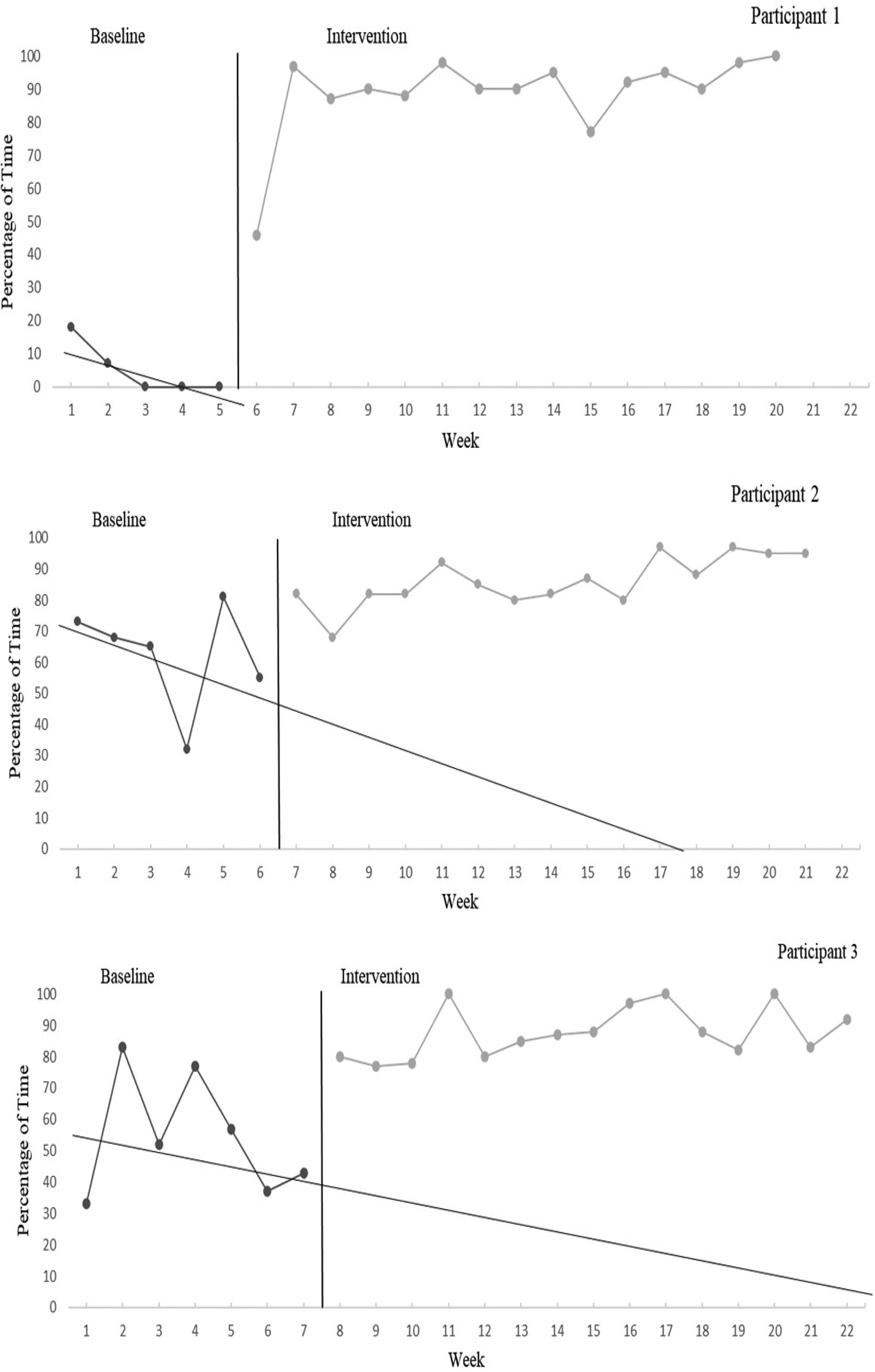
Active participation data.
Pre- and Postintervention Measures and Goal Attainment Scaling
All three students showed a positive change in SCOPE scores (Table A.2). A comparison of their pre- and postintervention overall score totals revealed that P1 improved in all categories; P2 improved in habituation and motor skills; and P3 improved in volition, communication and interactions skills, process, and motor skills. Progress on the BASC–3 was also evident, with multiple students’ scores demonstrating a change in impairment level from pre to postintervention (see Table A.2). Three individualized GAS goals were established for each student, focusing on increased participation and performance in the school setting for the occupations of play, social participation, health management, and education (Table A.3). All goals met or exceeded expectations, with one exception.
Teacher Interviews
Both teachers reported positive effects from the consult and intervention on their own sense of competence and the students’ participation and performance in the classroom, noting that the gains outweighed the students’ time lost in the classroom for the intervention. P1’s teacher reported the intervention “helped him to be aware of his body . . . to learn how to calm down . . . and improved his writing.” She said, “He has a nice relationship with you [the therapist], . . . that helps.” P2 and P3’s teacher reported receiving benefit from the consults in the use of language to discuss arousal levels, visual supports, and ideas for alternative seating. When asked about the results of direct service, their teacher said they both demonstrated improved focus . . . [being] more willing to participate . . . [showing] more effort in their work . . . overall slowed down . . . more independent . . . more engaged . . . [and] improved fine motor skills.
Student Interviews
P1 said that he liked to come to occupational therapy because “I like to play.” He noted that reading and writing were still hard and that he did not like them, but other aspects of the classroom, such as sitting at a desk, navigating the cubby area, and walking in the hallway, were now easy. He found all the equipment in the occupational therapy room to be “a good choice” for his body and said they made him feel “safe.” P2 noted that she now likes writing and the playground and finds them easy. The swings are “like a roller coaster,” and “it’s relaxing.” She reported that “everything in your room helps me” and that she liked coming to the occupational therapy room. Although P3 noted that there were things in school that were still hard, she reported that sitting at a desk and walking in the hallway had become easier. She commented that she liked everything in the occupational therapy room except musical instruments and play dough. She noted that in the sessions, “I learned how to balance [and] I learned how to hit the target.”
Discussion
This study provides preliminary evidence for use of a sensory integration intervention and teacher consultation, aligned with the principles of ASI and the STAR Frame of Reference, in a school context to promote occupational performance and participation for students with sensory integration and processing differences. The empirical nature of single-subject research allowed determination of meaningful change in the dependent variables, thus supporting the effectiveness of the study’s service delivery model for the first time in a school context. This study is also unique in that the participants did not have a comorbid diagnosis but instead had idiopathic sensory differences that were affecting their participation in school. Prior studies of sensory integration intervention effectiveness have primarily been conducted in a clinic setting with autistic children (Pfeiffer et al., 2011; Schaaf et al., 2014).
In this multiple-baseline study, all students showed improvement in the intervention phase for the dependent variables of functional regulation and active participation compared with the baseline. The definitions used in this study appeared to reliably quantify the behavior. The results suggest that the intervention was impactful because it generalized to the classroom setting, aligning with the occupation-based outcome improvement seen in prior studies of similar length and intervention duration in the clinic setting (Pfeiffer et al., 2011; Schaaf et al., 2014).
Improvement in proximal changes of functional regulation likely supported the changes seen at the distal occupation level by the dependent measure of active participation and the measures completed after intervention: increased occupational performance on the SCOPE, positive change in health management noted by the BASC–3, and goal achievement measured by GAS. This also confirms the sensitivity to change of the SCOPE and BASC–3 found in prior studies that have used these measures to explore the effect of sensory integration interventions (Kashefimehr et al., 2018; Schoen et al., 2018).
In their interviews, the teachers and children reported positive lived experiences from participating in the study. Although prior studies have included the voices of the teachers (Piller & Pfeiffer, 2016), this study is the first to interview the student participants. Comments the students made about enjoyment, comfort, and feelings of safety aligned with the intervention’s intentional focus on the domains of regulation and relationship. This type of intervention is consistent with trauma-responsive, sensory-informed care, which intersects with sensory integration theory regarding the therapeutic use of self and coregulation (Whiting et al., 2018). Given the short-term, intensive nature, it also indicates that the gains realized by the intervention could be valued higher than the cost of lost time in the classroom, as the teachers noted in their interviews. This is an important rationale for this more restrictive type of service delivery.
Limitations and Future Directions
Limitations of this study include the generalizability of the results given the small number of participants in a single-subject design and the lack of data on the longitudinal impact of the intervention. The comprehensive assessment used in this study included structured observations of sensory integration but not a standardized evaluation tool of sensory integration specifically. There was a potential source of bias because the practitioner who provided service delivery was not blind to the aims of the study or a blind evaluator. In addition, because the STAR Frame of Reference integrates a focus on relationship and regulation along with the principles of ASI, it is difficult to assess the individual contribution of each component or the impact these components have on one another (e.g., regulation, relationship, or sensory integration) in producing the observed changes. Future studies need to include a broader range of outcomes to capture generalized improvement in participation and performance in school, represent a larger sample size, and permit replication across additional settings. Moreover, researchers are encouraged to explore whether the same outcome can be realized when using a nontraditional setting, such as the school playground, as opposed to a room with sensory equipment, and what the impact of teacher education is independent of direct intervention.
Implications for Occupational Therapy Practice
This study has the following implications for occupational therapy practice: ▪ School-based occupational therapy practitioners should consider a short-term, intensive, direct one-to-one sensory integration intervention combined with teacher consultation. ▪ School-based occupational therapy services can align with fidelity to the principles of ASI and the STAR Frame of Reference. ▪ Interventions can improve functional regulation, active participation, and occupational engagement in the classroom for students with sensory integration and processing challenges.
Conclusion
This study was successful in its objectives of improving student engagement in occupations in the school setting after a short-term, intensive sensory integration intervention paired with teacher consultation, thus filling a gap in the literature. It outlines an achievable service delivery model in a school setting that aligns with laws governing special education when offered after integrated support has been unsuccessful in remediating challenges related to participation and performance. The methodology and outcome measures used were sensitive to the change and should be considered for use in future research regarding sensory integration intervention.
Supplemental Material
Supplementary material for A Sensory Integration Intervention in the School Setting to Support Performance and Participation: A Multiple-Baseline Study
Supplementary material, sj-pdf-1-aot-10.5014_ajot.2023.050135.pdf for A Sensory Integration Intervention in the School Setting to Support Performance and Participation: A Multiple-Baseline Study by Colleen Cameron Whiting, Sarah A. Schoen and Linda Niemeyer in The American Journal of Occupational Therapy
Footnotes
Acknowledgments
We acknowledge Dr. Lucy Jane Miller for her inspiration for this project. In addition, we express special thanks to Dr. Karen Jacobs for her support and leadership in the Boston University Post Professional OTD program, to Kara Strang for her diligent assistance as the trained observer, and to Michele Parkins for her generosity in serving as a content expert.
References
Supplementary Material
Please find the following supplemental material available below.
For Open Access articles published under a Creative Commons License, all supplemental material carries the same license as the article it is associated with.
For non-Open Access articles published, all supplemental material carries a non-exclusive license, and permission requests for re-use of supplemental material or any part of supplemental material shall be sent directly to the copyright owner as specified in the copyright notice associated with the article.
