





Abstract
This systematic review evaluates the clinical utility and psychometric properties of handwriting assessments, which could be used to identify and evaluate specific learning disorders (e.g., dysgraphia) if an early referral to occupational therapy is carried out.
From the beginning of primary education, handwriting problems are present in 10% to 30% of school-age children (Cermak & Bissell, 2014; Döhla & Heim, 2016; Karlsdottir & Stefansson, 2002). In most countries in the European Union, the beginning of primary education takes place at age 6 yr, and it coincides with the beginning of compulsory schooling (Carmena et al., 2002). Handwriting learning expands over time, and students obtain their maximum level of competence at age 15 yr (Šafárová et al., 2020). However, students are expected to gain proficiency in handwriting in the first 3 yr of primary school (Overvelde & Hulstinj, 2011).
Handwriting is a complex process that requires integrating motor, sensory, language, perceptual, and cognitive skills (Donica et al., 2013; Lust & Donica, 2011). Some of the key elements in the analysis of handwriting are body posture (Pade et al., 2018), wrist and finger motor control (Benbow, 2006), pencil grip adjustments (Schwellnus, 2012), visual–motor integration (Tse et al., 2019), pressure grading (Falk et al., 2010), kinesthetic feedback (Hong et al., 2016), bilateral integration, as well as writing paper and the tool used (Giroux et al., 2012). The development of handwriting in childhood can indicate possible developmental problems that can interfere with participation in the school environment. Since 2001, the World Health Organization has included handwriting difficulties as one of the impediments to school participation (Jiménez, 2017). In fact, the Diagnostic and Statistical Manual of Mental Disorders (5th ed.; American Psychiatric Association, 2013) reflects handwriting problems under Code 315.2 (F81.81: specific learning disorder, with impairment in written expression [clarity or organization of written expression] or developmental expressive writing disorder).
The percentage of handwriting problems increases among children with a different diagnosis (Mayes & Calhoun, 2006). Different causes may generate difficulties in children’s handwriting: neurological or musculoskeletal disabilities; difficulties with motor coordination in absence of the former, such as developmental coordination disorder (Biotteau et al., 2019; Chung et al., 2020); and other neurodevelopmental disorders, such as autism, attention deficit disorder with or without hyperactivity (Langmaid et al., 2014), or specific learning disorders (Barnett et al., 2018). Other groups of children could present with handwriting legibility and speed problems without other major problems in their general development. When these problems appear in the absence of other comorbidities, they could be more associated with a lack of experience or inadequate instruction (Barnett et al., 2018).
For any reason, when the components of legibility have not been automated as expected on the basis of age, students are forced to allocate cognitive resources to improve letter formation, size, linking, and orientation on lines, as well as the space left between two words. However, these resources are no longer available for higher cognitive function (Medwell & Wray, 2014). Thus, difficulties in handwriting are related to an increase in cognitive load, interfering with working memory and reducing the quality of handwritten content (Grissmer et al., 2010; McCarney et al., 2013). As the academic year advances, the volume and frequency of written work are greater (Wallen et al., 2013). Therefore, the academic learning difficulties related to handwriting problems are amplified (Cramm & Egan, 2015). In addition, when prolonged in time, these difficulties negatively affect self-concept and the sense of self-efficacy; moreover, they reduce the occupational identity within the role of the student, which can be prevented with early referral to occupational therapy (Barnett et al., 2018).
In this sense, it is essential to carry out a correct early evaluation of legibility and speed, which are the two components most widely used to assess handwriting problems (Šafárová et al., 2020). This evaluation is carried out through validated, reliable, and standardized instruments combined with observation (Prunty et al., 2016) through copying, dictation, alphabet writing, graphic writing, and free writing tasks (Feder & Majnemer, 2003).
Research on handwriting among children has recently been promoted (Engel et al., 2018), with the consequent development of assessment tools. However, since Feder and Majnemer’s (2003) study, no reviews have analyzed the psychometric properties of the new instruments. Their review was not conducted in a systematic way, and it was not based on the latest criteria of the COnsensus-based Standards for the selection of health Measurement INstruments (COSMIN; Mokkink et al., 2016). For this reason, the aim of this study was to identify the instruments for assessing handwriting among children and systematically analyze their clinical utility and psychometric properties according to the latest COSMIN criteria.
Method
This study is a systematic review of the development or validation of the measurement properties of instruments used to assess handwriting in terms of legibility and speed among children ages 3 to 16 yr. This systematic review was registered in the International Prospective Register of Systematic Reviews (PROSPERO) with registration number CRD42022300202. It was conducted according to the Preferred Reporting Items for Systematic Reviews and Meta-Analyses (PRISMA) guidelines (Page et al., 2021).
Search Strategy
A systematic review was conducted in April 2021 in the following databases: CINAHL, PubMed (MEDLINE), and Scopus. The search was updated in April 2022 with no additional articles added to the first search. In September 2022, following the recommendation of one reviewer, the search was conducted in the following education databases: Education Database (ProQuest), Library, ERIC (EBSCO), A+ Education (Informit), and AEI–ATSIS. The independent searches were carried out in English. The search strategy included a combination of the following keywords: handwriting, write, children, assessment, and validity; in addition, the search included their synonyms and MeSH (Medical Subject Headings) terms and combined them with Boolean operators. The selected search languages were English and Spanish. No time limits were set on the search because the last review published in 2003 (Feder & Majnemer, 2003) did not include all the tools published up to that date.
Retrieval of the Studies
We blindly selected the documents after agreeing on the selection criteria. Eligible studies were those that satisfied the following criteria: handwriting assessment through a pencil-and-paper activity; studies with measurement of psychometric properties of reliability or internal consistency; the age of application included children between ages 3 and 16 yr; the tool focused its measurement on some component of handwriting legibility and speed; and articles published in English, Italian, French, Portuguese, or Spanish. The exclusion criteria were studies of assessment tools that used electronic media (digital pencils or tablets) or that only evaluated alphabets other than Latin. The concordance in the selection of documents was analyzed through the κ index.
Data Abstraction
One of the researchers created a table to collect the structural characteristics of each assessment, with the following columns: instrument/study, population, school type/setting, original language/translation, outcome variables, handwriting style, assessment description, number of items, administration time, scoring time, and instruction required to administer the assessment (Table A.1 in the Supplemental Appendix, available online with this article at https://research.aota.org/ajot).
The selected handwriting assessments tools were analyzed according to the most recent (July 2019) COSMIN criteria (Mokkink et al., 2018). After the analysis with the COSMIN checklist, two of the authors (Rocío Vico and Jaime Martín) collected the quality of the design and the psychometric properties analyzed for each article in Table A.2 in the Supplemental Appendix. The psychometric properties analyzed were content validity, structural validity, internal consistency, reliability, criterion validity, and hypotheses testing.
The COSMIN checklist (Mokkink et al., 2018) represents a taxonomy of the different measurement properties to unify their terminology and definitions. Each psychometric property assesses a quality aspect of outcome measurement instruments that evaluate health conditions. Thus, the COSMIN checklist unifies the criteria used to assess the methodological quality of studies that evaluate the psychometric properties of measurement instruments, defining the most appropriate way to assess each psychometric property according to the type of study. The checklist contains 12 boxes, 10 of which are used to evaluate the methodological quality. In each box, the items are evaluated on a 4-point scale (very good, adequate, doubtful, and inadequate).
The lowest score obtained by any item defines the methodological quality of that box (Mokkink et al., 2018). For each of the analyzed psychometric properties, the methodological quality was collected in the “methodology” columns (M; see Table A.2). Another box is used to evaluate the quality of the outcomes collected in the “quality of results” columns (Q; see Table A.2). Finally, in the “quality of evidence” columns (QE; see Table A.2), the global recommendation of reliability was indicated on the basis of the results and the methodological quality of measurement of that property.
Results
The initial search yielded 1,748 records. Of these, 242 duplicate records were excluded. From the remaining pool of 1,506 records, 1,471 were excluded after the reading of the titles and abstracts, mainly because of the fact that they did not include the measurement of the psychometric properties’ reliability or internal consistency. The full text of 35 records was screened by the three authors. Of these 35 studies, 21 did not meet the inclusion criteria because they used digital support, were focused on cognitive components of handwriting, or evaluated exclusively non-Latin alphabets. A final sample of 14 eligible publications was obtained.
The steps for the selection of the studies following the PRISMA flow diagram (Page et al., 2021) are detailed in Figure 1. The concordance in the selection of the studies between the different authors (Rocío Vico and Jaime Martín) was very high. According to the methodology, the agreement values between the three reviewers ranged from .87 to .93. The average was determined, and a Fleiss κ index of .90 was obtained.
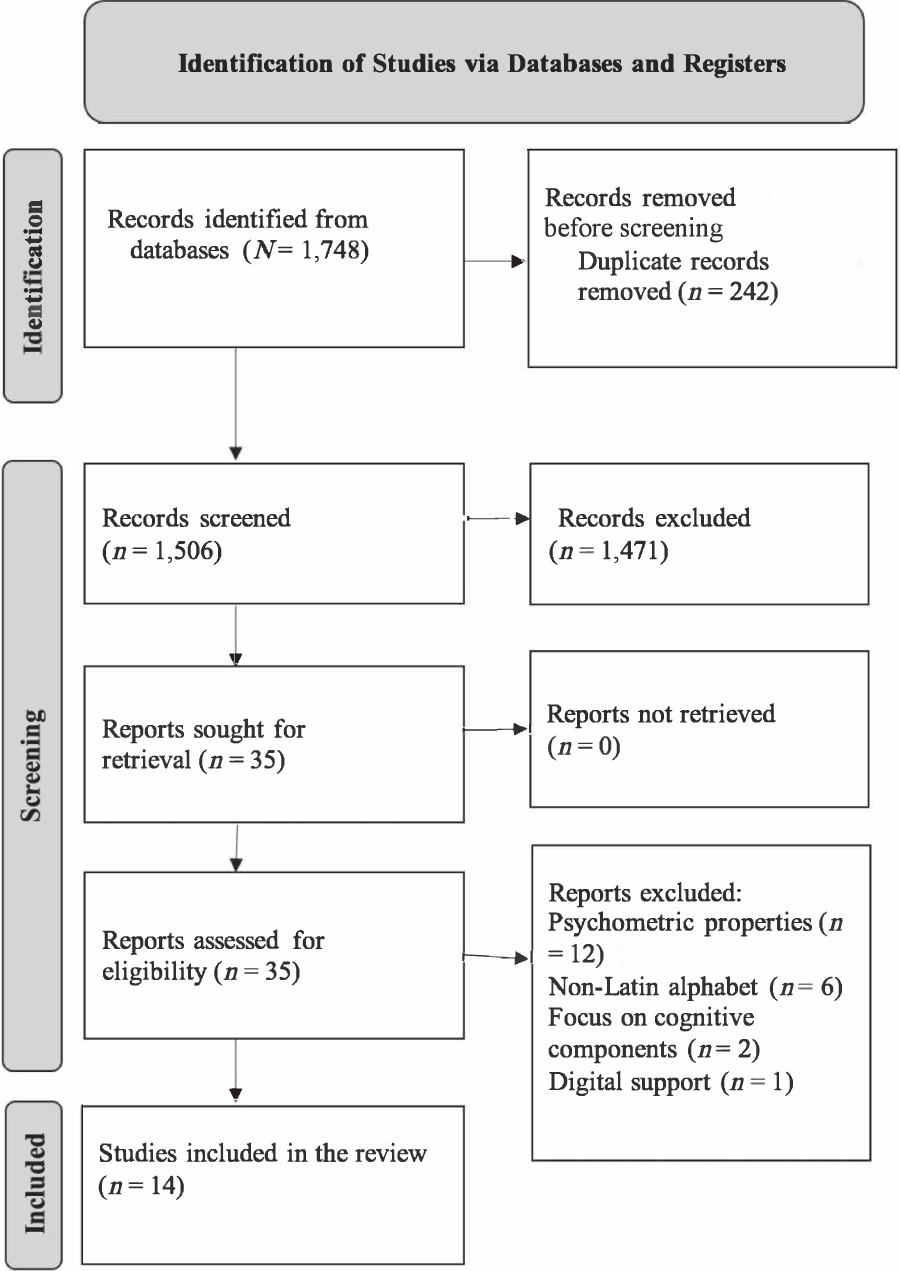
Preferred Reporting Items for Systematic Reviews and Meta-Analyses (PRISMA) study selection flow diagram.
Descriptive Characteristics
Table A.1 shows that the smallest sample size was 23 participants in the longitudinal study of Formative Evaluation of Handwriting Quality (FEHQ; Stefansson & Karlsdottir, 2003). In the rest of the cross-sectional studies, the sample sizes vary between 101 for the Evaluation Tool of Children’s Handwriting–Cursive (ETCH–C; Koziatek & Powell, 2002) and 1,163 for the Detailed Assessment of Speed of Handwriting (DASH; Simons & Probst, 2014). The 14 included assessments had a total sample of 4,987 children ages 3 to 16 yr. The most validated language was English. All assessment tools were administered in the school context. Twelve of the 14 studies were direct assessments (Barnett et al., 2018; Chow et al., 2003; Gil et al., 2021; Koziatek & Powell, 2002; Matta Abizeid et al., 2017; Puranik et al., 2013, 2017; Simons & Probst, 2014; Stefansson & Karlsdottir, 2003; van Hartingsveldt, de Vries, et al., 2014; Van Waelvelde et al., 2012; Wallen & Mackay, 1999). The Handwriting Proficiency Screening Questionnaire (HPSQ; Šafárová et al., 2020) is an indirect assessment, and the Handwriting Proficiency Screening Questionnaire for Children (HPSQ–C; Šafárová et al., 2020) is a self-assessment. The Writing Readiness Inventory Tool in Context (WRITIC; van Hartingsveldt, de Vries, et al., 2014) has a part for self-assessment (child domain) and a part for direct assessment (paper-and-pencil tasks domain).
Eight of the 12 direct assessments were group administered (Barnett et al., 2018; Chow et al., 2003; Gil et al., 2021; Matta Abizeid et al., 2017; Simons & Probst, 2014; Stefansson & Karlsdottir, 2003; Van Waelvelde et al., 2012; Wallen & Mackay, 1999), and 4 were individually administered (Koziatek & Powell, 2002; Puranik et al., 2013, 2017; van Hartingsveldt, de Vries, et al., 2014). None of them required special equipment because they were paper-and-pencil tasks. The sum of administration and scoring time was less than 1 hr (Barnett et al., 2018; Chow et al., 2003; Gil et al., 2021; Koziatek & Powell, 2002; Matta Abizeid et al., 2017; Puranik et al., 2013; Puranik et al., 2017; Simons & Probst, 2014; Stefansson & Karlsdottir, 2003; van Hartingsveldt, de Vries, et al., 2014; Van Waelvelde et al., 2012; Wallen & Mackay, 1999), although most of the studies did not include such information or provided information about only one of these two time-related aspects. Complete information about this topic was provided only for the Concise Evaluation Scale for Children’s Handwriting (BHK; Matta Abizeid et al., 2017), WRITIC (van Hartingsveldt, de Vries, et al., 2014), Handwriting Speed Test (HST; Wallen & Mackay, 1999), and Systematic Screening for Handwriting Difficulties (SOS; Van Waelvelde et al., 2012).
The most measured variable was legibility, with 7 of the tools measuring it (Barnett et al., 2018; Koziatek & Powell, 2002; Puranik et al., 2013; Šafárová et al., 2020; Stefansson & Karlsdottir, 2003; van Hartingsveldt, de Vries, et al., 2014), and 4 evaluating handwriting speed (Chow et al., 2003; Puranik et al., 2017; Simons & Probst, 2014; Wallen & Mackay, 1999). The Alphabet Writing Fluency (AWF; Puranik et al., 2017), BHK (Matta Abizeid et al., 2017), SOS (Van Waelvelde et al., 2012), and Writing Curriculum-Based Measurements (W–CBMs; Gil et al., 2021) measured both variables. All tools that evaluated handwriting speed included a copy task, except AWF (Puranik et al., 2017). The methodology for assessing legibility was more heterogeneous because not all the tools measured the same legibility components. The most frequent measurement component in the assessment of legibility was letter formation (see Table A.1).
Seven of the 14 assessment tools included information about the type of handwriting measured. Five of them evaluated handwriting in cursive (Koziatek & Powell, 2002; Matta Abizeid et al., 2017; Simons & Probst, 2014; van Hartingsveldt, de Vries, et al., 2014; Van Waelvelde et al., 2012), and the other two assessed it in any style (Barnett et al., 2018; Stefansson & Karlsdottir, 2003).
Psychometric Characteristics
For 5 instruments (BHK, DASH, HST, SOS, W–CBMs), two psychometric properties were analyzed; for 6 instruments (FEHQ, Handwriting Assessment Tool Speed Test [HATS], HPSQ, HPSQ–C, Letter Writing [LW], WRITIC), three psychometric properties were analyzed. Only the ETCH–C and Handwriting Legibility Scale (HLS) tested four psychometric properties (Koziatek & Powell, 2002). The evaluation was carried out once for all the instruments except one: The FEHQ was the only instrument that measured longitudinally, although it used a small sample (n = 23; Stefansson & Karlsdottir, 2003). Therefore, in most tools, the responsiveness is unknown.
Internal Consistency
Internal consistency was collected for 8 instruments (Barnett et al., 2018; Chow et al., 2003; Matta Abizeid et al., 2017; Puranik et al., 2013; Šafárová et al., 2020; Simons & Probst, 2014 , van Hartingsveldt, de Vries et al., 2014). In general, the internal consistency showed independence from the number of items in the tool. However, of the instruments that collected internal consistency, LW (Puranik et al., 2013) largely exceeded the rest in the number of items; it also obtained the highest internal consistency (.98). Glasgow and Riley (2013) suggested that a tool with good internal consistency may also have a large number of items. However, BHK (Matta Abizeid et al., 2017) with 14 items showed the lowest internal consistency (.65). Moreover, among the tools that analyzed the internal consistency, it was the only instrument that measured both components (i.e., handwriting legibility and speed).
Reliability
The reliability was collected for all the instruments. The highest value was 1.00 for the WRITIC (van Hartingsveldt, Cup, et al., 2014) and HST (Wallen & Mackay, 1999); the lowest value was .37 in the HPSQ and HPSQ–C (Šafárová et al., 2020). All the psychometric properties are gathered in Table A.2.
Discussion
The aim of this systematic review was to identify and evaluate the psychometric properties of handwriting instruments validated in the child population, available in paper-and-pencil format and in the Latin alphabet. Fourteen instruments were identified as tools that evaluated handwriting legibility and speed among children ages 3 to 16 yr. Their psychometric properties were evaluated with the most up-to-date COSMIN criteria.
Descriptive Characteristics
Of the 14 instruments, the BHK, WRITIC, HST, and SOS specify the administration and scoring time. LW mentioned the time for a global assessment, although the study assessed only the 26 letter-writing subtest.
Of the 7 assessments that included information about the handwriting style evaluated, 5 of them evaluated cursive, and 2 of them evaluated any style. Cursive and print are introduced at different times in different countries. In the Netherlands, children receive instruction in unjoined cursive script in Grade 1 (van Hartingsveldt, de Vries, et al., 2014). In Spain, children first receive instruction in joined cursive script. In the United Kingdom, schools may choose the writing style (Barnett et al., 2018). However, in the United States, many of the handwriting programs start teaching the print style: Learning Without Tears (Olsen & Knapton, 2021), Size Matters (Moskowitz, 2010), Printing Like a Pro! (Montgomery & Zwicker, 2019), and Write Start Handwriting (Holland & Case-Smith, 2008).
Psychometric Properties
Internal Consistency
The quality level for internal consistency according to the COSMIN criteria (Mokkink et al., 2016) was high for 2 of the 8 instruments that measured the internal consistency (Barnett et al., 2018; Puranik et al., 2013) and moderate in another 3 (Chow et al., 2003; Simons & Probst, 2014 ; van Hartingsveldt, de Vries et al., 2014). The internal consistency of these 5 instruments ranged from .73 (van Hartingsveldt, de Vries et al., 2014) to .98 (Puranik et al., 2013).
LW, with 26 items, had the highest value found in this systematic review (.98). It was the only tool that showed excellent internal consistency, being greater than .95 (George & Mallery, 2003). Four of the 14 analyzed instruments assessed handwriting legibility and speed (Gil et al., 2021; Matta Abizeid et al., 2017; Puranik et al., 2017; Van Waelvelde et al., 2012). The internal consistency was analyzed only for the BHK, which obtained the lowest value found in this systematic review. This finding may be because of the fact that both measurement variables are very heterogeneous, which was already pointed out by Engel et al. (2018), who cataloged handwriting legibility and speed as different constructs. The rest of the tools assessed handwriting legibility or speed unidimensionally, with better internal consistency results. To be able to interpret the internal consistency, the instrument has to be unidimensional (Glasgow & Riley, 2013). Otherwise, a factor analysis must be applied to the full scale or used to evaluate the unidimensionality of the different subscales or constructs (Mokkink et al., 2016). None of these analyses were applied for the BHK, which can explain its low internal consistency.
Reliability
The quality level for reliability according to the COSMIN criteria was high for 4 instruments and moderate for 3. The interrater reliability values of the 11 direct assessment instruments ranged from .77 (Van Waelvelde et al., 2012) to 1.00 (Wallen & Mackay, 1999).
Greater reliability values produce greater effect sizes and make it easier to determine the minimal clinically important difference (Glasgow & Riley, 2013). Except for FEHQ, the rest of the analyzed tools did not measure changes over time. Future studies should be designed to analyze longitudinal psychometric variables, such as responsiveness. No correlation was observed between the number of items and the reliability value. However, this property showed a correlation with the methodology of the tool. Reliability was significantly lower for the indirect assessment tools, HPSQ and HPSQ–C (.37; Šafárová et al., 2020), than for the direct assessment tools (.69–1.00; Barnett et al., 2018; Chow et al., 2003; Koziatek & Powell, 2002; Matta Abizeid et al., 2017; Puranik et al., 2013, 2017; Simons & Probst, 2014; Stefansson & Karlsdottir, 2003; van Hartingsveldt, de Vries, et al., 2014; Van Waelvelde et al., 2012; Wallen & Mackay, 1999).
Other Psychometric Properties
Content validity and criterion validity were the least valued psychometric properties of the different tools. Content validity was analyzed for the HLS (Barnett et al., 2018) and WRITIC, and criterion validity was analyzed for the ETCH–C and HATS (Chow et al., 2003).
Other Assessments
The internal consistency values are higher than those found for the Persian Handwriting Assessment Tool (PHAT; Meimandi et al., 2020; .72–.99) and Handwriting Test for Preschool Children (HT–PRE; Hong et al., 2020; .74). These tools assess handwriting among children in non-Latin alphabets. PHAT assesses handwriting legibility and speed among school-age children in the Persian alphabet, and HT–PRE evaluates the handwriting ability of preschool children ages 5 to 6 yr in the Chinese alphabet.
Moreover, these values are in line with the internal consistency of another tool widely used with children to measure visual–motor integration: the Beery–Buktenica Developmental Test of Visual–Motor Integration (6th ed.; VMI), which showed an internal consistency of .84 (Beery & Beery, 2010). It includes graphomotor activities in two of its three subtests, a tracing activity and a geometric figure copying activity, with a total of 48 items.
Reliability values of the assessments in this review are similar to those found for the PHAT (.76–.99; Meimandi et al., 2020) and higher than those found for the HT–PRE (.38–.80; Hong et al., 2020). However, these values are lower than those found for the VMI (Beery & Beery, 2010), where the values for interexaminer reliability ranged between .93 and .98. In the tracing subscale of the Movement Battery for Children–2 (MABC–2), called “Drawing Trail,” the interexaminer reliability was .97, and the test–retest reliability was .62 (Chow et al., 2002). Regarding test–retest reliability, the values found in the analyzed instruments were higher, ranging from .69 (Van Waelvelde et al., 2012) to .90 (Wallen et al., 2013). This finding may be because of the fact that greater stability exists in the execution of memorized stroke patterns, such as letters, than in new stroke patterns. Stability in the practice of a movement promotes the consolidation of motor patterns and improves motor learning (Batalla, 2005). The combinations of geometric figures or irregular paths constitute less practiced graphomotor patterns than letters. This finding may explain the greater stability in writing evaluations, where letters are valued, compared with the Drawing Trail subscale of MABC–2 or VMI, where irregular paths are traced at both evaluations or combinations of geometric figures are copied in addition to the VMI.
Clinical and Research Utility
This study can help the clinical professional and researcher to select the optimal evaluation on the basis of objective criteria. The information provided about the structural characteristics of the different tools facilitates choice on the basis of the result variable, time available according to the administration format and its duration, scoring time, complexity of use, and the results. The instruments that directly assess handwriting speed (BHK, DASH, HATS, HST, SOS) have fewer items in general and allow group administration. Except for the DASH, the rest of the instruments are administered in less than 10 min. The DASH is the only tool that assesses handwriting speed for different handwriting tasks; it measures handwriting speed in five types of handwriting tasks (Simons & Probst, 2014). Except for AWF, the rest of the handwriting speed evaluations allow group administration (Chow et al., 2003; Matta Abizeid et al., 2017; Simons & Probst, 2014; Van Waelvelde et al., 2012; Wallen & Mackay, 1999).
The instruments that measure handwriting legibility and speed, Writing Curriculum-Based Measurements, SOS and BHK, are administered in 5 to 10 min. SOS and BHK have shown good reliability, although SOS obtained poor results in structural validity, and BHK showed low internal consistency. W–CMBs have shown good hypothesis testing but inadequate reliability. The tools that directly measure only handwriting legibility (ETCH–C, FEHQ, HLS, LW, WRITIC) require more administration time (15–40 min), and 3 of them require individual administration (ETCH–C, LW, WRITIC).
Legibility can be measured individually among preschoolers from age 3 yr with LW and from age 5 yr with WRITIC. To individually measure speed, the minimum age of administration is 5 yr (Puranik et al., 2017). However, in this study, Puranik et al. (2017) recognized that the alphabet writing untimed task, compared with AWF, showed stronger psychometric properties and may be more useful (Puranik et al., 2017).
The first and most obvious observable change in new motor learning is the acquirement of a new skill (Schmidt & Lee, 2011), which in the field of writing would be equivalent to forming letters. In the course of motor learning, other changes appear, such as more precise and faster execution. These variables often come into conflict in the learning process (Sugden & Henderson, 2012). Fast handwriting requires sacrificing legibility, and vice versa. In neurotypical development, legibility reaches higher values of competence before speed (Karlsdottir & Stefansson, 2002), suggesting a previous development. Thus, evaluations in the preschool stage include only one variable, which is handwriting legibility (Puranik et al., 2013 ; van Hartingsveldt, de Vries, et al., 2014). At this stage, this variable is evaluated through activities according to evolutionary development, such as writing one’s own name or letters and numbers in dictation, or copying tasks (Puranik et al., 2013 ; van Hartingsveldt, de Vries, et al., 2014). On the basis of the neurodevelopment of this motor learning, it could be hypothesized that at an early stage of handwriting learning, evaluating the speed component would be illogical (Puranik et al., 2017).
Some instruments also collect observations of the physical (ETCH–C, WRITIC), emotional (HPSQ, HPSQ–C, WRITIC), and social (WRITIC) environments. The use of the collected tools can be extrapolated to the school context, especially for those tools that allow group administration: BHK, DASH, FEHQ, HATS, HLS, HST, SOS, and W–CMBs. In addition, the indirect assessment tool HPSQ (Rosenblum, 2008) was specifically designed to be completed by teachers. Many tools require no prior instruction for administrators other than reading the manual. The studies that included instructions did not indicate whether it was essential to receive such instructions to use the instruments. The objective and clear criteria for both administration and correction promote the attainment of results with the same reliability from the educational field.
Strengths and Limitations
To the best of our knowledge, this is the first study to systematically collect the tools available for the assessment of handwriting in childhood and compare their psychometric properties on the basis of the latest COSMIN criteria. However, some limitations exist that should be taken into account when interpreting the results presented in this study. Although we searched and selected the included studies in five different languages and using databases of global clinical and educational relevance, articles published in other languages or in other databases may not have been identified. It is also important to highlight that only studies using the Latin alphabet were evaluated. Therefore, those languages with other types of alphabet, such as Arabic or Asian (Chinese, Japanese, Thai, etc.), were not taken into account in this study.
Implications for Occupational Therapy Practice
The results of this study have the following implications for occupational therapy practice: ▪ Latin alphabet direct handwriting assessments for children and adolescents ages 3 to 16 yr show good psychometric properties. For screening handwriting difficulties among school-age children, indirect and self-assessments demonstrate poor psychometric properties. ▪ Standardized and validated handwriting assessments using a pencil-and-paper activity are available in English, French, Dutch, Spanish and German. ▪ The majority of tools require no prior instruction for administrators other than reading the manual. ▪ Instruments that directly assess handwriting speed have fewer items, in general, and they allow group administration. ▪ On the basis of the tools analyzed in this study, the legibility component can be measured at preschool age, but speed is not measured until school age. To measure speed, the minimum age of administration should be 6 yr.
Conclusion
The tools found to directly assess handwriting legibility and speed in the Latin alphabet among children show good psychometric properties. On the basis of our search criteria, we found that handwriting tools are available in English, French, Dutch, Spanish, and German. Cultural differences in language and education system require different tests for different countries. For indirect assessment and self-assessment, existing screening tools demonstrate poor psychometric properties. Further research should be carried out to develop screening tools that can identify the need for a comprehensive direct assessment, especially evaluations in indirect and self-assessment formats. In clinical and educational practice, professionals should choose measurement instruments on the basis of their psychometric characteristics in the context of the population they plan to assess.
Supplemental Material
Supplementary material for Functional Assessment of Handwriting Among Children: A Systematic Review of the Psychometric Properties
Supplementary material, sj-pdf-1-aot-10.5014_ajot.2023.050174.pdf for Functional Assessment of Handwriting Among Children: A Systematic Review of the Psychometric Properties by Rocío Vico, Jaime Martín and Manuel González in The American Journal of Occupational Therapy
Footnotes
*Indicates studies included in the systematic review.
References
Supplementary Material
Please find the following supplemental material available below.
For Open Access articles published under a Creative Commons License, all supplemental material carries the same license as the article it is associated with.
For non-Open Access articles published, all supplemental material carries a non-exclusive license, and permission requests for re-use of supplemental material or any part of supplemental material shall be sent directly to the copyright owner as specified in the copyright notice associated with the article.
