





Abstract
This study provides an overview of literature regarding interventions to improve the financial capability of clients with acquired functional impairments.
Finances are important to everyday living, health, and well-being. The ability to manage expenses, meet needs, and build wealth underlies all facets of daily living, with evidence demonstrating that it is a measurable social determinant of health and important to occupational participation (Weida et al., 2020). Occupational therapy practitioners and researchers are involved in addressing financial management skills and outcomes for individuals with various disabilities (Bottari et al., 2011; Goverover et al., 2019; Swarbrick & Stahl, 2009). The American Occupational Therapy Association (AOTA; 2020) Occupational Therapy Practice Framework: Domain and Practice (4th ed.) identifies financial management as a key instrumental activity of daily living that occupational therapists target with intervention.
A growing body of evidence demonstrates that those living with health conditions or disabilities that are associated with acquired functional impairments experience more challenges and issues with financial capability (FC) and financial well-being than those living without such impairments (Brown & Emery, 2010; Elbogen et al., 2011; Fang & Gunderson, 2016; Wall, 2017; Whetten-Goldstein et al., 2000). Additionally, people with disabilities are more likely to have low income, which can negatively influence financial well-being. For example, Canadians living with disabilities make up 41% of low-income individuals (Wall, 2017); in the United States, the poverty rate for adults with disabilities is more than twice the rate for adults without disabilities (Goodman et al., 2019). Lower income poses increased risk in cases of poor FC, because fewer financial resources are available in cases of financial errors and less funds are available to manage expenses, plan ahead, make choices, and get financial-related help (Kempson et al., 2005). Hence, intervention to improve capability in financial-related occupations, as one avenue to address financial well-being, is a salient occupational performance practice issue for many clients. However, to date the literature for intervention to address financial occupations, specifically interventions related to FC, has not been synthesized. The purpose of this study was to map the literature related to FC intervention with five diagnostic populations living with health conditions or disabilities that are associated with acquired functional impairments and FC difficulties: brain injury, mild cognitive impairment (MCI) or dementia, diagnosed mental health conditions, HIV/AIDS, and multiple sclerosis (MS). This synthesis provides an overview of intervention components, determines whether a systematic review of intervention effectiveness is warranted, and identifies gaps and future avenues for research.
Literature Review
Many financial terms are used in the literature to describe FC (Goyal & Kumar, 2021). The concept of FC stems from the earlier idea of financial literacy, which connotes a person’s knowledge about financial-related information (Goyal & Kumar, 2021). However, from theoretical and empirical work in the areas of finance and economics, the concept of FC arose to acknowledge that financial knowledge was not enough to lead to effective financial behaviors in everyday life and that financial knowledge (literacy) was not predictive of everyday financial behaviors. The most well-known and frequently used model of FC emerged through the extensive internationally based studies of Kempson et al. (2005). In this framework, FC is defined as the ability to make informed financial decisions and perform applied behaviors and includes a person’s financial knowledge (i.e., literacy), skills, and attitudes related to four areas of financial management: (1) managing money, defined as being able to live within one’s means (e.g., paying bills, keeping and using financial records, budgeting and keeping track of finances); (2) planning ahead, defined as being able to cope with unexpected events and make plans for the long term (e.g., saving for retirement); (3) making choices, defined as being able to select the financial transactions or development products for which one is eligible (e.g., being aware of the financial products that are offered, accessing eligible resources or funds, choosing the most appropriate for individuals’ circumstances, identifying scams or fraud); and (4) getting help, defined as gathering information (e.g., comparing information and products and using third parties for advice; Kempson et al., 2005). However, this model has rarely been used in the occupational therapy, health, or rehabilitation literature, in which other terms that are less defined or operationalized have often been used, such as financial management, financial capacity, or money management. Throughout this article, we use the term FC, according to the definition and framework of Kempson et al. (2005).
Kempson and Poppe (2018) later went on to describe the concept of financial well-being, which is the ability to meet current financial commitments, feel financially comfortable, and demonstrate financial resilience for the future. Good financial well-being is seen as a positive outcome of having adequate FC within a specific socioeconomic environmental context. However, within this model of financial well-being, Kempson and Poppe (2018) highlighted that financial well-being is the interaction between FC and the context. It is through the financial outcome of financial well-being, which includes the concepts of income, assets and debt level, poverty, and financial stress or strain, that the relationship between finance and health becomes evident. When one experiences a low level of financial well-being, they are at increased risk for worse health and overall well-being outcomes (Brzozowski & Spotton Visano, 2020; Elbogen et al., 2020; Hamilton et al., 2019; Meyer, 2017; Turunen & Hiilamo, 2014; Weida et al., 2020). Therefore, to address health and general well-being, it may be important for many people to address FC.
Evidence suggests that a variety of interventions available to the general population, such as community-based programs, online programs, and financial education courses in university settings, can improve FC and outcomes (Lusardi et al., 2017; Riitsalu, 2018; Xu, 2018). FC intervention–related literature for the general population has been systematically reviewed and synthesized in three meta-analyses (Fernandes et al., 2014; Kaiser & Menkhoff, 2017; Miller et al., 2015). The general findings of these meta-analyses were that the effects of delivering financial education through various avenues on improving financial knowledge (i.e., literacy) and behaviors were found to be positive, however small, with one meta-analysis of 168 studies reporting an effect size of r = .032 (Fernandes et al., 2014) and another of 126 studies reporting Hedges’ g = .148 (Kaiser & Menkhoff, 2017). Although these studies provide salient information related to financial-related interventions, none of these reviews were inclusive of the potentially unique intervention needs and outcomes for populations with disability or health conditions.
Evidence has shown that those with certain diagnoses that are related to an acquired functional impairment can experience greater difficulty with FC than the general population. Specifically, studies have highlighted that diagnoses such as brain injury, MCI or dementia, mental health conditions, HIV/AIDS, and MS are related to increased rates of challenges and errors in one’s knowledge, skills, attitudes, and behaviors related to managing financial affairs and activities (Giannouli & Tsolaki, 2019; Goverover et al., 2016; Heaton et al., 2004; Martin et al., 2012; Sheppard et al., 2017; Sudo & Laks, 2017; Sunderaraman et al., 2019; Thames et al., 2011). Although FC has been identified as an issue for these five diagnostic populations, the intervention literature for improving FC among them has yet to be synthesized, thereby limiting evidence-based practice in this area and with these populations.
The overall aim of this scoping review was to identify the peer-reviewed published FC intervention–related literature across five diagnostic conditions that have documented increased rates of activity limitations related to FC and that are typically acquired during adulthood: brain injury, MCI or dementia, mental health conditions, HIV/AIDS, and MS. This review further aimed to identify whether a systematic review and meta-analysis are possible, based on the state of the literature, and current research gaps and possible areas for future research (Arksey & O’Malley, 2005).
The objectives were to identify (1) where, when, and by whom (i.e., profession) the published literature is being produced; (2) the specific disability or diagnostic groups targeted for these interventions, discussions and empirical research; and (3) the intervention components. Moreover, for empirical evaluation studies (i.e., outcome studies), the objectives were to map the samples, outcomes examined, and outcome measures used in these studies.
Method
We used a scoping review approach following steps outlined by Arksey and O’Malley (2005) and recommendations from Levac et al. (2010) to explore peer-reviewed literature relevant to the objectives of this study. Scoping review methods aligned with the aims of this review to enable mapping the extent, range, and nature of the literature in the topic area (Levac et al., 2010). This review method enabled us to examine all of the literature related to a topic area, regardless of evidence level, and could include literature on intervention frameworks or discussions that can give a broader understanding of possible intervention approach beyond just the empirical studies that would be included in a systematic review (Arksey & O’Malley, 2005; Levac et al., 2010). The broader nature of a scoping review could then also demonstrate whether a future systematic review is warranted by mapping the extent of comparable intervention efficacy or effectiveness studies based on the number of identified empirical studies and the hetero- or homogeneity of intervention components and outcome measures used within the identified studies (Levac et al., 2010; Page et al., 2021).
We also followed a reporting guidance for the conduct and reporting of scoping reviews, the Preferred Reporting Items for Systematic Reviews and Meta-Analyses extension for Scoping Reviews (PRISMA-ScR; Tricco et al., 2018). This scoping review was guided by an a priori developed review protocol, which can be requested from Lisa Engel. This research received no specific grant from any funding agency in the public, commercial, or not-for-profit sectors.
Search Strategy
A broad search strategy was used to identify all relevant articles. First, searches were conducted in five databases of peer-reviewed literature: MEDLINE (Ovid), CINAHL (EbscoHOST), PsycInfo (Ovid), EconLit (EbscoHOST), and EMBASE (Ovid). The search structure was developed using exemplary published articles already known to us (i.e., Goverover et al., 2016; Grant et al., 2012; Jiménez-Solomon et al., 2016) and consultation with a university information specialist and librarian. The database search, conducted in March 2021, included a broad spectrum of terms related to the constructs of finance, health diagnoses of focus for this review, and interventions, and no limiters or filters were applied to the search (e.g., years, language, age groups; see Table A.1 in the Supplemental Material, available online with this article at https://research.aota.org/ajot). The focus on specific diagnoses was required because the literature in this area is diagnosis specific and not specific to functional impairment areas. The aforementioned five specific diagnoses were chosen as search parameters because of the documented challenges with FC experienced by people with these diagnoses. Using the SCOPUS database, we then completed backward citation searching and forward citation searching of any article included after full-article selection to identify additional articles relevant to the topic. Additionally, we reviewed the included articles and reference lists for three systematic reviews or meta-analyses published for FC or outcomes used in the general or nondisabled population (Fernandes et al., 2014; Kaiser & Menkhoff, 2017; Miller et al., 2015); no articles applicable to disability or diagnostic health conditions were noted in these published reviews. Finally, we contacted three expert authors (those with three or more authorship credits in final article selection for this review) to ask whether they were aware of other articles related to the aim of this study.
Screening and Selection
Article screening, selection, and extraction was performed with the online review software Covidence (Veritas Health Innovation, 2014). On the basis of a priori inclusion criteria, articles included were peer reviewed, written in English, and described any intervention directed toward FC for any one of the five target diagnostic populations (see Table A.2 in the Supplemental Material). Two independent reviewers completed title and abstract screening and subsequent full-text selection for each article; a third reviewer resolved any disagreements.
Data Extraction
Extraction was completed by five different reviewers, both researchers and research staff who had various educational, professional (i.e., occupational therapy, physiotherapy, speech-language pathology), and cultural backgrounds. All reviewers had additional training and knowledge related to FC. Two of these five reviewers independently extracted data from each article and then came to agreement about extraction using an Excel-based data extraction form. This form was created by the authors on the basis of the study objectives and then piloted, based on scoping review methods guidance (i.e., Tricco et al., 2018), by the first and last authors (Sofia Salsi and Lisa Engel) with 6 included articles; minor revisions in clarity for extraction were made after piloting, and then all articles were included in the final extraction process.
The extraction form included sections related to study characteristics, intervention components, and intervention and outcome measures; various extraction fields were included as columns within each section. Separate rows were created for each reviewer per article. After separate review, reviewers met with each other and discussed each column in detail and came to agreement on the characteristics and components extracted from each article. In alignment with scoping review methodology, a critical appraisal of the included literature was not completed (Arksey & O’Malley, 2005; Levac et al., 2010). Therefore, the actual results of the outcome measures reported in the empirical studies were not analyzed or reported and a recommendation based on these results could not be made; this would require a future systematic review or meta-analysis if our scoping review finds homogeneous and comparable empirical studies (Levac et al., 2010; Page et al., 2021). Our review focused on the outcome areas examined and the outcome measures used as a way to indicate whether a systematic review, or more specifically a meta-analysis, was warranted for future study.
We synthesized information about the studies through categorization and narrative descriptions in the areas related to the study objectives, including the authors’ country and profession, disability or diagnostic groups, study design, and intervention components. The components of intervention categories were determined after reading through the included articles and creating a categorical framework inclusive of all interventions and intervention components discussed.
Results
Database searches yielded 7,066 titles; 24 peer-reviewed articles were included in the scoping review (Figure 1). Article characteristics are described in Table A.3 in the Supplemental Material.
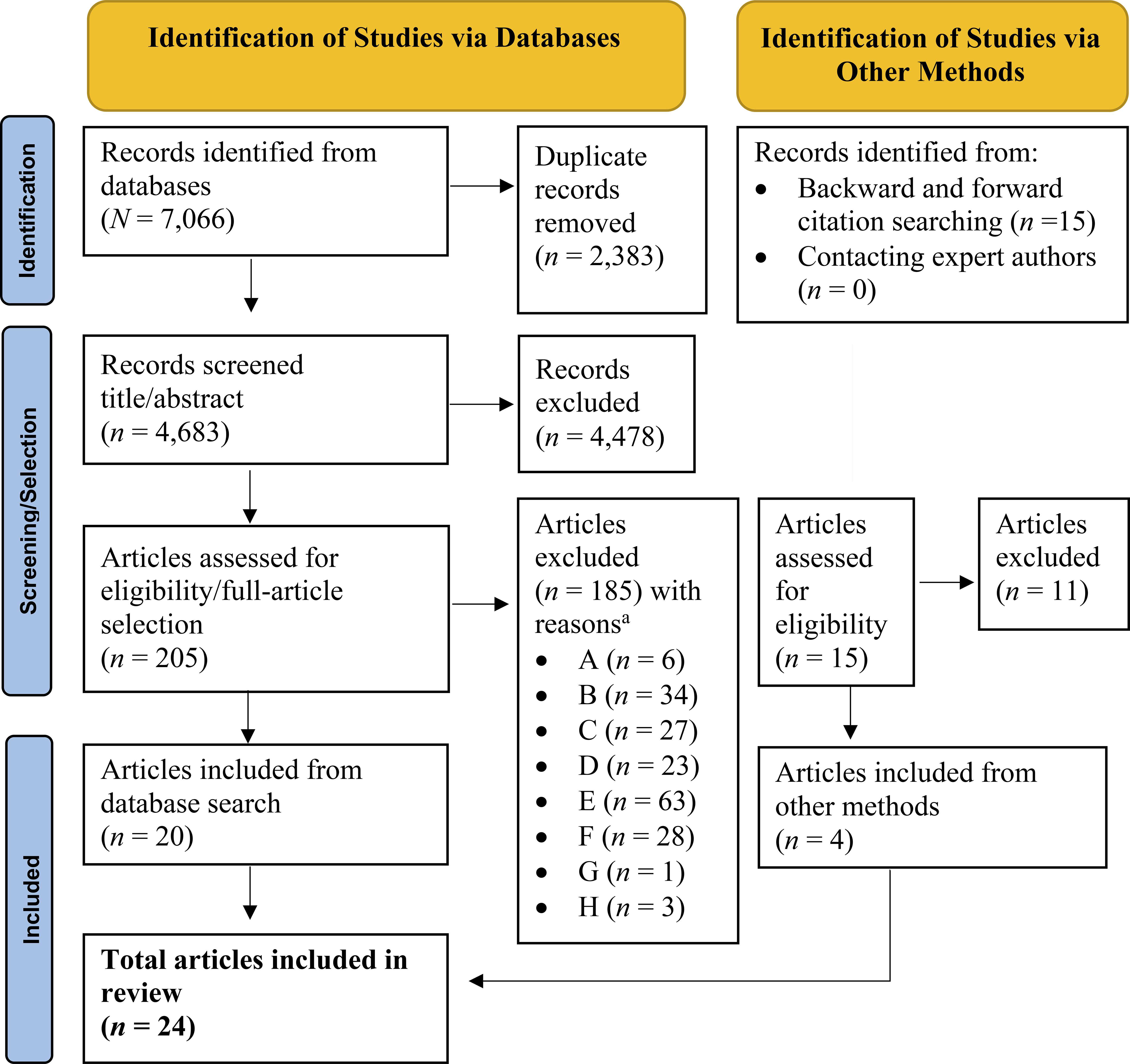
Flow of articles through the Preferred Reporting Items for Systematic Reviews and Meta-Analyses (PRISMA) systematic review process.
Article Production Characteristics
On the basis of the stated country of each article’s contact author, included articles were from the United States (n = 22), Australia (n = 1), and Canada (n =1). The year of publication ranged from 1981 to 2018 with almost half of the articles (n = 11) published from 2010 to 2018. Credentials of the contact authors listed in the included articles were psychiatry (n = 6), psychology (n = 6), occupational therapy (n = 5), health policy and administration (n = 3), social work (n = 1), and computer science (n = 1); two authors did not provide credentials. Funding sources for articles ranged from public research grants (n = 13), private institutions (n = 1), or nonprofit agencies (n = 1), with many articles not reporting funding (n = 8) and 1 article having no funding source.
Target Population
Twenty articles had a target population of people living with a mental health condition, substance use disorder, or both; 2 articles’ target population was people living with brain injury, and 1 article’s target population was people living with MS. One article had a target population with mixed health conditions, including people living with mental health conditions, brain injury, and stroke (McMordie, 1982).
Types of Literature and Levels of Evidence
The 24 included articles had varying levels of evidence following the Oxford Centre for Evidence-Based Medicine (OCEBM, 2009): randomized controlled trial or experimental design (Level 2; n = 4); nonrandomized controlled cohort or follow-up study design (Level 3; n = 1); case-series, cohort, or observational study design (Level 4; n = 5); case study or single-case design (Level 4; n = 5); and opinion, editorial, mechanistic reasoning, framework, model, or intervention protocol study designs (Level 5; n = 8). Although qualitative designs are not explicitly discussed in the OCEBM levels of evidence, there was also 1 qualitative study examining participants’ subjective thoughts postintervention; this was counted as a Level 4 study.
Types of Interventions
Various intervention components were described or tested across the 24 included articles, with most articles addressing complex interventions with more than one intervention component (Table A.4). Interventions described in the articles used a wide variety of components: skills training or practice (n = 21), tailored budget review or financial counseling (n = 18), representative payee (n = 11), education-based interventions (n = 10), structured goal setting (n = 7), asset or savings building (n = 5), metacognitive strategies (n = 2), and assistive technology (n = 1). Sixteen articles described interventions that were solely individual based, 1 article’s intervention was done solely in a group format, and interventions in 7 articles had a combination of individual and group components. Of the interventions that had a group component, 3 focused on skills training, 2 had a course or education format, and 3 used a combination of skills training and educational group.
Further Examination of Empirical Studies
Sample Characteristics
Of the 24 articles included in the review, 16 were empirical studies in which data were collected from human participants (i.e., Levels 2, 3, and 4; Table A.5). Of these 16 empirical studies, 6 had a sample size of 1 to 19, 7 had a sample size of 20 to 99, and 3 had a sample size of 100 or more. Three studies did not specify the age range or mean age of their sample. The study populations primarily had mental health condition or addiction diagnoses (n = 12); 2 studies included participants living with brain injury, 1 included participants living with MS, and 1 included participants with two different diagnoses (2 participants living with mental health conditions and 1 participant living with stroke).
Location of Interventions
Within the 16 empirical studies, 12 interventions took place in a clinical or community setting. One study took place in a clinical setting as well as the participant’s home when participants were trialing the assistive technology (Groussard et al., 2018). One study took place in a clinical setting and included phone conversations with participants (Burke-Miller et al., 2010). One study took place in a clinical setting and a public setting (shopping mall; Grant et al., 2012), and 1 study took place in a community setting and a specialized community bank (Conrad et al., 1999). One study did not specify the location (Elbogen et al., 2013).
Outcomes Examined and Outcome Measures Used
In the 16 included empirical studies, the outcomes being evaluated and outcome measures used varied between studies, and studies collected information by various means (e.g., questionnaires, observation tools, interviews; Table A.5). Five articles provided only quantitative outcome data (Bickes et al., 2001; Goverover et al., 2008; Grant et al., 2012; Groussard et al., 2018; Rosen et al., 2009), 6 presented only qualitative outcome data (Burke-Miller et al., 2010; Conrad et al., 1999; Kaseman, 1981; McMordie, 1982; Stoner, 1989; Swarbrick & Stahl, 2009), and 5 presented both quantitative and qualitative outcome data (Conrad et al., 2006; Elbogen et al., 2013, 2016; Rosen et al., 2010; Serowik et al., 2013). All but 1 study (i.e., the one included qualitative study using participant interviews) had at least one outcome related to FC (i.e., financial knowledge or literacy, attitudes, skills, or behaviors) or financial well-being (i.e., subjective or objective financial outcomes). Seven studies solely evaluated finance-related outcomes, and 8 studies evaluated both finance- and non–finance-related outcomes, such as the presence of psychiatric symptoms, employment status, cognitive skills, or substance use.
To assess finance-related outcomes, 4 studies used only standardized measures that cited a measurement manual or a measurement evidence study (see Table A.5 for names of instruments). Ten studies used measures that were developed solely for the study with no related measurement evidence cited, and 1 study used a mix of standardized and study-developed tools. The Money Mismanagement Measure, a scored structured interview of money management behaviors, was used by 2 studies as an outcome measure (Conrad et al., 2006; Elbogen et al., 2013). Otherwise, no studies used the same assessment or measurement instruments to examine outcomes.
Discussion
The aim of this review was to identify and map the current peer-reviewed published FC intervention–related literature across five diagnostic groups. Our findings demonstrate a dearth of literature on this topic, with only 24 articles identified. However, this field of study is recent and slowly growing, with half (n = 12) of included articles published from 2010 to 2018. The search was not limited by year, and the oldest article found was published in 1981 (Kaseman, 1981), indicating that this topic has been noted for more than four decades. Interestingly, this oldest article (Kaseman, 1981) specifically linked FC intervention with occupational therapy practice. However, before 2010 the growth of the literature was small, and publications were infrequent until 2000.
Furthermore, interventions used with populations other than those with mental illness or substance use were not published before 2008, except for one case study of a participant with stroke (i.e., McMordie, 1982). The increase in literature may be due to multiple factors. Some of the overall increase in research may be because there is more FC intervention literature across more diagnostic populations beyond those with mental illness or substance use. Moreover, literature reviews of FC interventions in the general population indicate a growing interest in this topic by financial institutions and researchers over the past decade because of an increase in improving consumers’ overall financial knowledge (Miller et al., 2015). It has been suggested that interventions for improving financial knowledge are being studied more because of increasingly complex personal finances (Fernandes et al., 2014). Growth may also be due to the rise in the past decade of governmental strategies, policies, and funding to improve the financial literacy, FC, and financial well-being of citizens in North America and other countries around the world (e.g., Financial Consumer Agency of Canada, 2021; Financial Literacy and Education Commission, 2016; Organisation for Economic Co-operation and Development, 2017). As interest in improving general FC and financial well-being increases, the interest in studying and improving the FC of diagnostic populations and persons living with disabilities may also be increasing. Thus, this scoping review represents an important step in mapping the literature in this area as a foundation for growth in this research area.
Despite growth, only 16 of the 24 articles identified included empirical research studies to evaluate intervention outcomes quantitatively, qualitatively, or both, and only 4 of these studies were randomized controlled trials. Comparisons between the included studies proved challenging, as most of the interventions discussed were complex (multicomponent), with varied intervention components between studies (Craig et al., 2008), and there was large variance between studies’ outcomes and outcome measures. Complex intervention, defined as containing several interacting components, including the number and variability of outcomes addressed, and the degree of flexibility or tailoring of the intervention (Craig et al., 2008) and variance in how outcomes are measured makes it challenging to analyze the efficacy or effectiveness of these interventions and increases the difficulty of determining the active ingredients of these complex interventions (Whyte, 2014). Secondary to the decreased amount of empirical evidence and even fewer studies that could be compared on the basis of results demonstrating heterogeneity of interventions, intervention components, and outcome measures (both on measured purposes and concepts and specific instruments used), at this time a systematic review, and specifically a meta-analysis, is not possible given the current literature (Page et al., 2021). Of particular concern was the increased number of studies that used “made-for-study” finance-related measures; these measures do not have reliability, validity, or responsiveness evidence to support their use and cannot be compared in a systematic review or meta-analysis. This difficulty was also found in a meta-analysis of financial interventions in the general population, which stated that the diversity in both general outcomes (e.g., savings, credit performance, record keeping, financial knowledge) and how they are measured reduces the number of comparable studies for the meta-analysis (Miller et al., 2015). Clearly more consistency across studies in this area, with more emphasis on replication of findings, would strengthen this area of research. However, this scoping review does highlight some key points that are relevant to occupational therapy practice and future research.
Although most of the included articles discussed or studied complex interventions, the articles have identified many possible intervention options that current practitioners may want to incorporate into their practice with caution because the outcome evidence is not conclusive. Overall, the interventions discussed target basic practical knowledge and skills, using components that lend to this. Skills training, tailored budgeting, and financial counseling were the types of components found in most interventions, which is not surprising because the concept of FC focuses on the individual’s knowledge, skills, attitudes, and applied behaviors (Kempson et al., 2005). However, complex interventions in this area may be a function of the individualization and flexibility needed to address the highly variable occupations related to FC (Brandow et al., 2020; Kaiser & Menkhoff, 2017). A common overall finding of this review was that, depending on the client’s personal finance needs, many interventions combined more general components (e.g., education sessions, payeeship program, structured asset building program), along with tailored and individualized components (e.g., individual financial counseling and budget sessions) for that particular client. This implied flexibility in what was being taught, based on the personal finances of the participant. Indeed, the literature included in this review provides an example of the ineffectiveness of short-term interventions that are not individualized, as reported by the authors of the article (Elbogen et al., 2016). Elbogen et al. (2016) provided participants who were living with a mental health condition with one education and skills practice session known as the $AFE program. They concluded that one-time educational interventions may not be effective, and as such the $AFE program did not work because of the lack of skills training specific to the client’s particular needs.
Unsurprisingly, then, the flexibility and individualization discussed in many of the included articles may point to a new intervention approach: financial coaching. Financial coaching is a growing area of FC interventions; it has been studied in the general population (Collins & O’Rourke, 2012; Collins et al., 2021; Lander, 2018) and has been reported in other health literature external to work with the five diagnostic populations of interest in this review (e.g., Bell et al., 2020; Hall et al., 2022). Interestingly, financial coaching was reported in only 1 article included in this review (i.e., Jiménez-Solomon et al., 2016), but it aligns with many of the intervention components discussed in the included articles. However, financial coaching, in which the person is guided in creating and following through on action-oriented goals over multiple sessions and often for an extended time (i.e., weeks or months), goes beyond short-term financial education or counseling to more adequately address the real-world activities and goals people have related to financial occupations (Collins & O’Rourke, 2012; Theodos et al., 2018). Furthermore, financial coaching aligns with many other intervention approaches used by occupational therapists, including occupational performance coaching (Askari et al., 2022; Kessler et al., 2017, 2021; Nott et al., 2021) and occupation-focused metacognitive strategy training approaches, such as Cognitive Orientation to daily Occupational Performance intervention approaches (Henshaw et al., 2011; Hunt et al., 2022; McEwen et al., 2009), that have also been used with these diagnostic populations. Financial coaching could be an emerging area of occupational therapy practice and research, because occupational therapists seem well poised to address this complex occupational area, given the holistic, comprehensive, individualized tradition and models of the profession.
An area for further development in FC intervention is addressing real-world behaviors and the individual’s economic, technological, physical and sensory, and social environment. Most of the included intervention studies were completed in a clinical setting or community organization location rather than in a public setting used by the participants (e.g., banks or other financial environments), the participants’ homes, or other real-world community contexts. Yet, the real-world environment or context has been identified as important to FC and financial well-being, including financial decision-making, financial behaviors, financial inclusion, and financial exploitation (Engel et al., 2019; Jiya et al., 2021; Lichtenberg et al., 2020; Stewart et al., 2020). One included study discussed a mobile application that participants used in their home (Groussard et al., 2018). The authors noted that this was beneficial because participants were able to regularly use the application at home and thus could integrate the budgeting feature into their daily habits.
In regard to social environment, 1 article provided examples of educating and training the caregiver of the individual on how to improve that individual’s FC (Elbogen et al., 2008), and 1 article discussed the use of peer emotional and social support (Jiménez-Solomon et al., 2016). Interestingly, only 1 article included in the review explicitly provided a brief description of the physical layout of the bank and included case managers and banking staff working together as a team (i.e., the banking social environment; Conrad et al., 1999). This is noteworthy considering the many barriers people with disabilities face when accessing financial institutions, ranging from banks’ physical environment, physical set-up of banking machines, lack of awareness of available benefits, or lack of appropriate individualized advice (Engel et al., 2019; Goodman & Morris, 2019). Future research in this area should further study the role of real-world training contexts because these few studies indicate that the intervention environment may have a role in outcomes. Further understanding and addressing the role of training contexts may also be an avenue for occupational therapists to collaborate with financial institutions and personnel in making financial contexts more inclusive and adapted to the needs of individuals living with disabilities or diagnostic conditions. These medical–financial partnerships have been noted as beneficial to improving FC in other health literature (Bell et al., 2020). Occupational therapists are well equipped to understand how to accommodate the environment and have the expertise to rehabilitate skills with those with functional impairments, including cognitive impairment. However, they do not necessarily have the expertise to know what financial services are available, consumers’ rights, and the nuances of savings programs. Thus, partnerships with financial programs and professionals may be another area in which occupational therapy practitioners and researchers could be trailblazers in addressing client occupations related to FC and financial well-being.
Future Areas for Occupational Therapy Research
The current gaps in the literature provide many opportunities for further research on and reviews of financial occupations and FC intervention. As mentioned earlier, intervention outcome studies in this area and with these populations are needed, with a focus on building the evidence through consistency of intervention approaches, outcomes measures, and replication. In addition to the limited published literature in this area, many interventions for improving FC discussed in these articles and with these five target diagnostic populations have not been empirically studied. Future research has multiple avenues to experimentally test intervention ideas, such as financial coaching and medical–financial intervention partnerships, for their effectiveness in improving FC in these populations and to increase the effectiveness of interventions to improve FC in these populations.
The scarcity of literature targeting populations other than those with mental health or substance use disorders is surprising, considering the breadth of published literature on the high rates of cognitive impairment among individuals with brain injury, MCI or dementia, and MS and the risk for decreased FC (Bottari et al., 2011; Giannouli & Tsolaki, 2019; Goverover et al., 2016; Martin et al., 2012; Sudo & Laks, 2017; Sunderaraman et al., 2019). Expanding research in these diagnostic populations should be a focus of future research.
Of note, literature in this area is economically and geopolitically homogeneous, with most literature being published in the United States, meaning that this increased information is beneficial from an American and global north or westernized perspective, but it may not be generalizable to other countries. That most articles have been published in the United States could be due in part to the exclusion of articles not written in English. However, many English-speaking countries are not represented in this review. One meta-analysis of FC interventions with the general population has suggested that most of the research in this area is concentrated in the United States because of its less regulated financial markets and higher levels of consumer lending than other countries (Miller et al., 2015). More research on FC interventions in different settings and cultures would be beneficial to add to evidence to this area of study.
Furthermore, future reviews could build on the work of this review by exploring related areas that were not within the scope of this review. This could include identifying and mapping the literature for other diagnostic populations or disability groups, including those with childhood-onset conditions such as cognitive developmental delays or impairments. Other reviews could explore interventions aimed at caregivers or close others who often provide FC and financial occupation support to the person living with the diagnostic condition. Because caregivers and close others are vital to the social–environmental context of many adults living with these diagnostic conditions and caregivers’ experience is related to the FC of the people to whom they provide care, a review examining interventions that target caregivers would provide a more fulsome understanding of addressing the FC and financial well-being of individuals living with health conditions or disabilities.
Strengths and Limitations of This Review
This review was conducted using many strategies for rigor and quality. The literature search was conducted with the assistance of an experienced university information specialist and librarian with expertise in scoping review methods. The search structure (terms) and inclusion criteria were broad and included a wide range of study designs, allowing for a comprehensive analysis of the published thought, knowledge, and evidence in this area. Furthermore, as a scoping review, this study used a systematic process to identify and synthesize the literature, resulting in higher confidence that all relevant literature was found.
As is the case with all reviews, this review does have limitations. There is a chance that relevant articles were missed. However, multiple strategies were used to limit the chance of missing relevant literature: a broad database search structure, multiple search strategies (database, backward citation, forward citation), and use of multiple independent reviewers. This review also did not include unpublished literature or gray literature or all disability and diagnostic groups, because a search across all disability or health diagnostic groups was not feasible or within the scope of this review.
Implications for Occupational Therapy Practice
Managing finances is an important instrumental activity of daily living that is within the scope of occupational therapists to assess and improve (Swarbrick & Stahl, 2009). FC influences the participation and performance of many life occupations. Within current capitalistic contexts of most world countries, finance is foundation to almost every area of life. As a result, FC can have implications for almost all other occupations a person needs or wants to do. The literature suggests that those living with various disabilities and chronic health conditions have decreased FC and face challenges with financial management. Because occupational therapists can work with multiple populations and in various settings in which improving FC could be a priority of clients, it is important for occupational therapists to understand the interventions currently being discussed in the literature and for which populations they are intended. Understanding the state of intervention literature is important to occupational therapy practice and to the growth of research and evidence-informed practice in this area.
Conclusion
To our knowledge, this is the first review to synthesize the FC intervention–related literature for individuals living with disabilities, specifically brain injury, dementia or MCI, mental health conditions, HIV/AIDs, and MS. FC is integral to financial outcomes and financial well-being, which in turn are essential to the health and well-being of most individuals (Brzozowski & Spotton Visano, 2020; Elbogen et al., 2020; Hamilton et al., 2019; Meyer, 2017; Turunen & Hiilamo, 2014; Weida et al., 2020). Considering the vital importance of finance in the lives of most individuals and to occupational participation, financial occupations and FC should be at the forefront of occupational therapy practice and research. Addressing and improving FC among individuals living with diagnostic conditions who have documented FC challenges is imperative to the health and general well-being of these individuals, their families and dependents, and their communities.
Supplemental Material
Supplementary material for Financial Capability Interventions Used for Specific Diagnoses Related to Functional Impairment: A Scoping Review
Supplementary material, sj-pdf-1-aot-10.5014_ajot.2024.050254.pdf for Financial Capability Interventions Used for Specific Diagnoses Related to Functional Impairment: A Scoping Review by Sofia Salsi, Emily Ariano, Jennifer Casey, Morgan Loewen and Lisa Engel in The American Journal of Occupational Therapy
Footnotes
*Indicates studies included in the scoping review.
References
Supplementary Material
Please find the following supplemental material available below.
For Open Access articles published under a Creative Commons License, all supplemental material carries the same license as the article it is associated with.
For non-Open Access articles published, all supplemental material carries a non-exclusive license, and permission requests for re-use of supplemental material or any part of supplemental material shall be sent directly to the copyright owner as specified in the copyright notice associated with the article.
