





Abstract
This article describes the lived experience of identity disruption and occupational identity disruption with an emphasis on the transformative nature of occupation.
Survivors of a traumatic brain injury (TBI) experience interruption in their personal life narrative and understanding of the self, which is referred to as identity disruption (Candlish et al., 2022; Hofstra, 2021; Levack et al., 2014). Identity refers to an individual’s theory of self, encompassing both one’s view of the self and view of the self in the community (Sabat et al., 2006). One part of identity is occupational identity, one’s identity as a doer of occupations (Carlson et al., 2014; Hansson et al., 2022). In the words of Brott et al. (2016), “Human beings are defined by what they do” (p. 27).
The occupational identity we explore in this article is that of a writer. For many writers, the act of writing is essential for understanding the world and making sense of lived experiences; however, deficits in written expression are common after a TBI (Dinnes et al., 2018; Dinnes & Hux, 2022). Sabat et al. (2006) stated that “The experience of communication is embedded within the process of self-identity formation. The irony lies in the problem itself, in that communication, which is required as a form of expression of self- identity, is compromised” after TBI (p. 17). In this way, the inability to participate in the occupation of writing disrupts both the identity and occupational identity. Because of the foundational impact of writing for our participant, we termed it a keystone occupation.
Identity disruption and occupational identity disruption can be challenging to address in occupational therapy practice (Cotton, 2012; Morris, 2004). According to Muenchberger et al. (2008), “Making sense of this profound change and identifying the processes of identity transition following injury is necessary if individuals are to experience a sense of control and fulfillment in their lives” (p. 980). It is incumbent upon occupational therapists to understand the impact of these disruptions and seek to address the reconstruction of identity with clients (Snell et al., 2017).
In this article, we describe the impact of identity disruption and occupational identity disruption that followed Andi Brown’s TBI. We then explore the interrelated nature of identity disruption and occupational identity disruption. Finally, we discuss implications for practice based on our study. We coconstructed this autoethnography over the course of 3 yr while Andi Brown recovered.
Here we introduce ourselves: ▪ Andi Brown: I am a 39-yr-old occupational therapist and writer. I love to write fiction and nonfiction and have been doing so since I was a child. In October of 2019, I sustained a TBI. I had significant visual, vestibular, and cognitive issues after this and was unable to work, drive, or write. ▪ Devin C. Barth: I am a 33-yr-old doctoral student at Colorado State University currently working as a community- and home-based occupational therapist in supported education, pediatrics, and mental health. I am passionate about research and plan to make an impact in the field via program development and knowledge dissemination as a “pracademic.” ▪ Amanda R. Leslie: I am a 33-yr-old occupational therapist working in an outpatient pediatric clinic in an inclusive preschool, focusing on school readiness and caregiver education. My background includes direct care and case management for adults with intellectual disabilities, along with the personal experience of my biological parents caring for foster children.
We met as students at Colorado State University while completing our master’s degrees in occupational therapy. During that time, we conducted research with Dr. Barbara Hooper on occupation-centered education. We developed a shared love of occupation and the transformative process of doing. After Andi’s car accident, which resulted in a TBI, he contacted Devin and Amanda for assistance navigating his new disability. We wrote this article throughout that shared process. Our purpose is to sensitize readers to the experience of identity disruption and occupational identity disruption and describe how those two experiences are interrelated and transactional in nature.
Method
Process
This study began in January 2020, when Andi reached out to Devin and Amanda after his brain injury to express the difficulty he was experiencing in making sense of his emotions, in particular grief and feelings of isolation. As stated, the three of us were part of a research team as graduate students, so we had knowledge of each other’s writing styles and how to incorporate Andi’s voice and strengths throughout the project.
At the time, Andi was still experiencing expressive language deficits and dysgraphia. He found the power imbalances during his recovery to be distressing because he felt unheard and undervalued by various health professionals. Therefore, we deemed that conducting a study in which Andi’s perspective as the participant was weighted equally to Devin’s and Amanda’s was essential (Denshire, 2014). A coconstructed autoethnographic approach was most appropriate because our relational trust provided a safe space for Andi to explore personal and vulnerable experiences with the support of peers (Anderson, 2016; Cann & DeMeulenaere, 2012; Rose & Hughes, 2018).
Autoethnographic studies examine the lived experience of the participant researcher and situate these experiences within a broader scope of the literature (Cann & DeMeulenaere, 2012; Chang, 2008; Denshire, 2014). Instead of a positivist perspective with the researcher as impartial observer, autoethnography privileges the insider perspective of participants by having them fully engage as members of the research team (Chang, 2008; Sabat et al., 2006). We chose to complete an autoethnography because our purpose was to sensitize readers to the experience of occupational identity disruption.
We feel it is important to be forthcoming about how our preexisting relationship affected our process. As Cann and DeMeulenaere (2012) noted in their own coconstructed study, “This work is messy and complicated; it would be disingenuous to write a sanitized version of it from a falsely objective and dispassionate distance” (p. 147). Autoethnography is an intimate process that was enhanced by the closeness of our relationships (Custer, 2014).
Data Collection
To create a comprehensive picture of Andi’s experience, we collected data from multiple sources, including interviews, written text, images, and artifacts in the form of medical records. Interviewees are listed in Table 1, and all provided verbal consent to participate in this research project. Lloyd et al. (2006) mentioned that extemporaneous speech and expressive language deficits that follow TBI can reduce the efficacy of traditional qualitative interview approaches, so Amanda and Devin took a more directive role in the interviews to accommodate these while still providing an opportunity to deepen and coconstruct a narrative (Ellis et al., 2017). Primary questions were used as a general guide, with Devin and Amanda asking clarifying questions and assisting in maintaining the structure of the interviews.
Interviewees
Note. TBI = traumatic brain injury.
We incorporated Andi’s artwork in the form of visual data (artwork), which is appropriate when a participant has difficulty precisely describing their experiences (Wang & Burris, 1997). Wang (1999) stated that image-based research is beneficial because “images contribute to how we see ourselves, how we define and relate to the world, and what we perceive as significant or different” (p. 186). Because our goal was to understand how Andi experienced his world and the changes that were occurring, image-based data were particularly valuable.
Data Analysis
All three of us contributed to the transcription process by splitting interviews into equal portions and manually transcribing each interview into a Word document for review. Andi used an outside service when auditory processing became a barrier. We discussed textual and nontextual data during team meetings, which occurred approximately 3×/mo over 3 yr. This allowed us to take time to fully explore Andi’s experience. We began a few months after his TBI and concluded as he returned to part-time employment. Data analysis initially occurred through an iterative process in which transcripts were hand-coded to organize findings and enable us to look for patterns (Chang, 2008; Kekeya, 2016). Next, we organized the observed patterns into themes and identified salient text for the purpose of constructing a narrative (Cann & DeMeulenaere, 2012; Rose & Hughes, 2018). When we disagreed, themes were kept in a master document and revisited periodically. We maintained open discussions, allowing for cohesive analysis until saturation was reached.
Formatting Our Findings
In writing this article, we sought to balance two forms of autoethnography, what Chang (2008) termed confessional–emotive writing and analytical–interpretive writing (pp. 145–146). In confessional–emotive writing, authors share personal experiences as an “open invitation to mutual vulnerability” (p. 145), whereas analytical–interpretive writing aligns more closely with traditional qualitative methods. In this article, we balance these elements by first sharing a written account of identity disruption by Andi and then describing an analysis organized by the themes that emerged from the data. We hope that by arranging our findings in this matter, our work will serve to both sensitize readers to the experience of occupational identity disruption and elucidate the transactions between occupational identity disruption and identity disruption for Andi.
Results
Prelude
“In the Days Following My Brain Injury, It Was Not Immediately Apparent That I Had Died”
I was in constant pain. I laid blankets down in our walk-in closet, the only place where I could block out all the light. My dog would plaster his long body against mine, and we rested together in the darkness. Everything was too much. Light, sound, heat. I woke up long enough to take pain medication, and then went back to sleep.
“In the Weeks Following My Brain Injury, It Was Not Apparent That I Had Died”
The first doctor I went to did not know what to do with a queer person. His nurse looked at me and said, “The government says we have to take everyone’s sexual history, but if they want yours they’ll have to come down here and take it themselves.” The doctor ignored my wife entirely.
The second doctor I found by asking queer friends about what doctors they recommended in Oklahoma. Dr. V had worked extensively with people with brain injuries, and he helped me get connected to a neurologist and a neuro-optometrist. I had meticulously collected a list of my symptoms and rehearsed them over and over, so that when he asked I could tell him what was happening.
Sometimes my whole mind would blank out, and I couldn’t think of words or tell people I was struggling. I couldn’t read more than a couple of sentences at a time, and writing quickly gave me violent headaches, but I knew I would have no ability to advocate for myself without language. I repeated the list strategy with each health care professional I worked with.
Because of my short-term memory deficits, my wife had to be present at all of my appointments. When assigning my homework, the vision therapist would speak to my wife and ignore me entirely. My difficulties with language and memory rendered me functionally invisible.
Some animal part of me knew that I should not be alive. I would sit on the scrubby carpet in our spare bedroom and stare into the mirror, trying to feel a connection to my face. I knew it was mine, but there was a wrongness to me, like a reanimated corpse. I was irreparably not me.
“In the Months Following My Brain Injury, It Was Not Apparent to Anyone But Me That I Had Died”
I slowly regained my ability to write, but it was difficult, like reeling in an old boot from the bottom of a lake. Something that had been so easy for me was now exhausting. I couldn’t tell anyone how I was feeling and couldn’t make sense of it myself.
The feeling that I was no longer myself didn’t fade. I remembered who I used to be: intelligent, insightful, calm. I was now so angry it felt like my fury would burn me alive, inside to out. Everything felt meaningless.
I finally went to a support group for brain injury survivors. The group was facilitated by a speech-language pathologist and a brain injury survivor. When it was my turn to speak, I said, “People think I’m doing better than I am.” I started crying. “I feel like I died. I know that doesn’t make sense, but the person I was is dead.”
The speech therapist tried to be comforting. “You’re going to get it back,” she said.
The other facilitator stopped her. “You did die,” he said to me. “You’re someone different now.”
Identity Disruption
Identity disruption has been documented after neurological events, such as stroke and TBI (Candlish et al., 2022; Hofstra, 2021; Martin-Saez & James, 2021). Nochi (1997) defined identity disruption as, “the void . . . the disturbing ‘unknown’ that people with TBI may find when they try to understand themselves” (p. 538). This feeling of inconsistent personhood has been attributed to emergent physiological difficulties, psychological changes, and cognitive deficits (Landau & Hissett, 2008; Levack et al., 2014; Snell et al., 2017). Andi experienced these factors through vestibular and visual deficits, short-term memory deficits, decreased frustration tolerance, and interrupted occupational participation.
During the process of identity disruption, TBI survivors report feeling dissonance between their pre- and postinjury selves (Levack et al., 2014; Myles, 2004; Sabat et al., 2006). Cotton (2012) explained that “The experience of identity disruption can leave a person in a tenuous state of uncertainty about who they were, who they are, and who they project themselves to be in the future” (p. 272). During conversations, Andi frequently referenced who he “used to be”—someone who was intelligent, patient, able to work, and an equal partner in his marriage. As presented in the “Prelude” section, Andi reported feeling that his past self had died. Carroll and Coetzer (2011) conducted a quantitative study and used correlations to measure perceived changes in identity related to psychological adjustment after a TBI. Their results showed that “greater perceptions of change in identity were associated with higher levels of depression and grief” (p. 299); specifically, they identified the connection between changes in self-concept and grief.
Psychological Changes
Psychological changes frequently experienced after a brain injury include depression, anxiety, low frustration tolerance, and dissociation (Landau & Hissett, 2008). Andi experienced depersonalization—“feeling like you are removed from yourself or as if you are in a dream” (Godwin, 2013)—which is present in up to 60% of people who have sustained a TBI (Grigsby & Kaye, 1993). Andi reported looking at himself in the mirror but feeling more like a puppet than a real person. His body was going through the motions of life, but he did not feel like he was actually living. Andi painted “Not a Person,” depicted in Figure 1, to show his experience: “It was about not feeling like a person. That’s the basic outline of what a person could be, but it’s scratched off.”
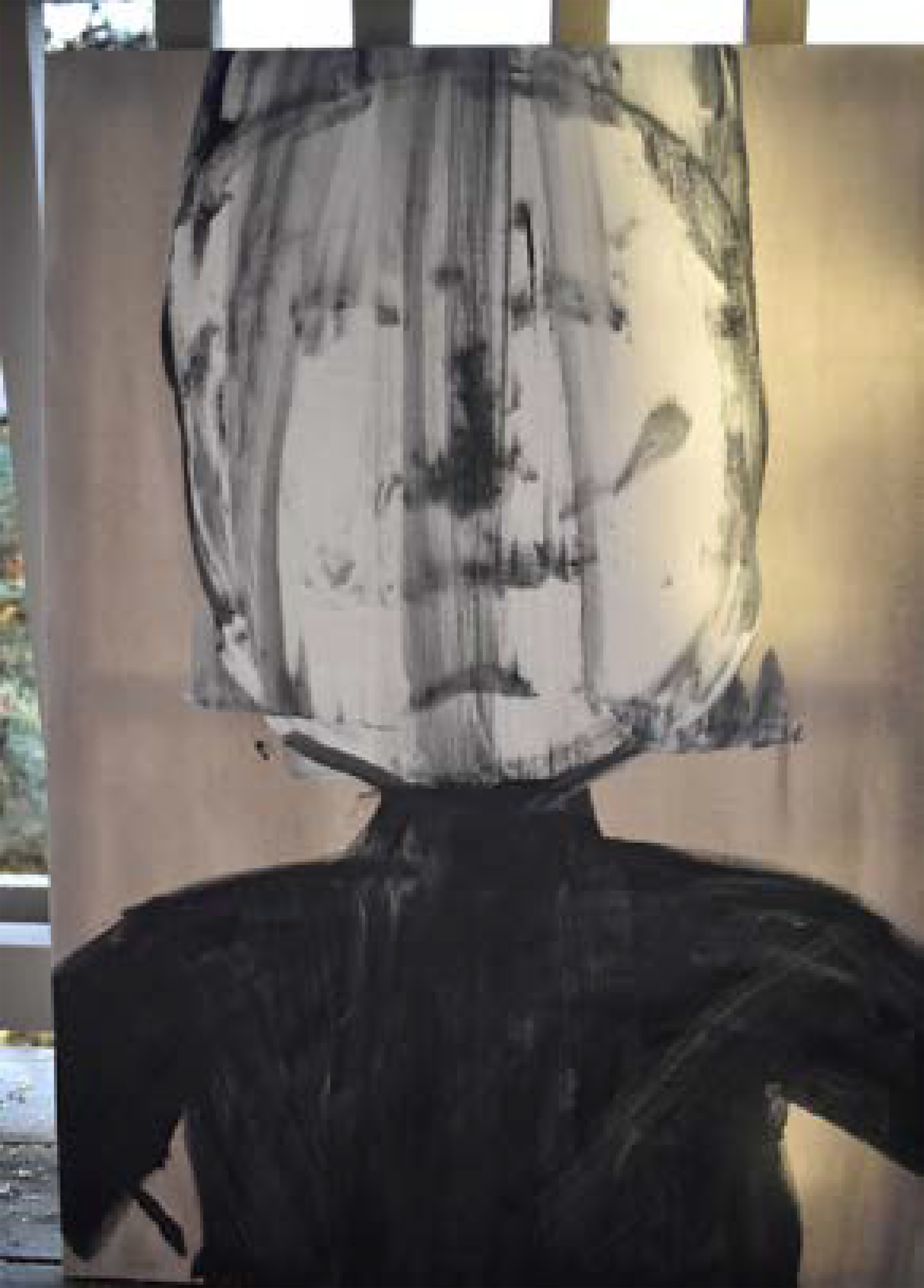
Not a Person.
These feelings of being an altered and incomplete person persisted for months. Andi’s brother Griffin recounted a moment of shared grief: I remember I was sitting . . . at a coffee shop booth talking to you. I can remember where I was, and we just sat in the devastation, kind of the existential threat. Andi is this beautiful thinker, and who is Andi, and who am I, if my sense of consciousness is gone? There’s just, kind of that raw, alive vulnerability of just having to actually face the loss.
Additional psychological changes people experience after TBI include deficits in emotional regulation (Landau & Hissett, 2008; Myles, 2004). Hofstra (2021) noted that “One consequence of brain injury that can be especially difficult to grapple with is anger: sudden, unpredictable outbursts of intense rage that can arise without any clear provocation” (p. 131). Andi described his anger taking the form of “Murderbird,” a four-beaked creature that showed up without warning. When visiting friends in Texas, a car sped through a parking lot, putting Andi and his friends in danger. He stated, I shouted expletives at the driver, something I had never done before. When I turned back to my friends, one of them said, “Oh, that’s Murderbird. I see it now.” I was so embarrassed that I lost control like that in front of them.
Before his injury, Andi conceived himself as a calm, measured person, and this rapid shift in emotional regulation made him question who he was.
Post–TBI anger can arise from hopelessness (Hofstra, 2021). Andi experienced intense frustration and grief because of the interruption in his life and loss of physical and cognitive capacities. Because of his aphasia, he struggled to communicate his needs. In his journal, Andi wrote, “I’m so angry I think it might eat me up inside. Eaten from the inside out. Self-immolation.” Andi’s friends and family noticed changes in behavior and emotion regulation that were out of character. Andi’s wife, Shan, stated, “He’s never seemed that frustrated and afraid before for as long as I’ve known them. . . . That was a scary thing for me to see.”
Cognitive Deficits
People who have sustained a TBI report changes in cognitive functioning, further compounding the grief and identity disruption (Klinger, 2005). Nochi (1997) found that gaps in memory lead to a decreased sense of a unified self. Andi and his loved ones identified deficits in short-term memory, requiring closer monitoring and reduced autonomy. Shan shared, “There were things that happened that were indicators . . . on repeat for quite a while; if the stove or the oven got turned on, it would not get turned off.” Experiencing this drastic shift of role and independence led Andi to question his existence and his understanding of self. He stated, “If I can’t remember what I’ve done in the course of a day, did I exist then?” Identity is developed over time, through experience. Therefore, disruptions in memory can lead to disruptions in the sense of belonging and self-awareness as the process of gathering new experiences and recalling previously meaningful experiences is paused, and the construction of identity is halted.
Occupational Identity Disruption
Beyond the drastic changes in personal identity that follow a TBI, survivors face interruptions in occupational participation that affect their identity as doers (Bryson-Campbell et al., 2013; Cotton, 2012). This is occupational identity disruption (Carlson et al., 2014; Kielhofner, 2008). Andi’s ability to engage in the occupation of writing was severely impeded because of challenges related to vision, cognition, and attention. Deficits in written expression are common after TBI (Dinnes et al., 2018; Wheeler et al., 2014). Dinnes and Hux (2022) found that difficulty with content generation, organization, and coherence were the most common problems for participants who had sustained a TBI. Levack et al. (2014) found that loss of writing led to a loss of identity in participants with TBIs. One participant stated, “I can’t write. So now, who am I?” (p. 4). Similarly, Andi struggled to define his identity without writing. Andi and his friend Alana described themselves as “word people.” Alana stated, “For us, it’s like, ‘This is the thing I do; I don't have multiple hobbies. [Writing] is the thing I do that if in a perfect world, this would be the thing, the only thing I do.” Because of this, she said Andi’s brain injury “didn't just take a hobby; it took . . . a large chunk of identity.” Because writing was a formative and meaningful occupation, his loss of writing resulted in an occupational identity disruption.
Occupation-Specific Grief
The loss of written expression experienced by Andi and other people who have sustained a TBI highlights how grief is shaped by a subjective experience of a specific occupation. Cotton (2012) reminded his readers of the importance of occupational therapists addressing grief over loss of self when supporting clients who have suffered a TBI. Andi’s specific experience of losing his use of words and attachment to his writing community after his injury supports the unique grief associated with occupational deprivation.
Andi struggled to tell others how it felt not to be able to write, the barrier he felt between himself and others: “I just couldn’t write, I couldn’t talk, and I felt like I was drowning.” Andi was mourning his deep personal and spiritual connection with the world and himself that was typically established through written expression. Alana said, regarding Andi’s difficulty writing, “It doesn't matter that everything else is perfect; that's the thing that is the linchpin, and it’s going to tear the whole castle down.” Andi reported that taking time to grieve writing, his most intrinsic and defining occupation, was a critical stage of processing his occupational identity disruption.
Transactions
Although occupational identity is one part of the broader concept of identity, the relationship between the two is still being explored (Hansson et al., 2022). Engaging in the occupation of writing had previously been Andi’s primary way of managing strong emotions, and many authors express a shared connection to writing. Alice Walker (1994) stated, “Writing saved me from the sin and inconvenience of violence” (p. 108). Similarly, Isak Dinesen (1957) wrote, “All sorrows can be borne if you put them into a story or tell a story about them” (p. 175). For Andi, the interruption in his ability to use writing as a coping tool compounded his experience of identity disruption.
Writing was not only an occupation Andi used to make sense of the present; he also used it to plan for the future. He stated, “I felt rudderless. Like I couldn’t figure out what direction my life was supposed to be taking.” Using writing in this way is common for writers. According to Richard Cohen (1995), “Writers are people who become themselves by writing” (p. 6). To use Wilcock’s (1999) language, the act of doing writing develops the being of writerly identity and opens writers to future growth and possibility. Vonnegut and McConnell (2021) wrote, “What you can become is the miracle you were born to be through the work that you do” (p. 92).
These quotes and comments demonstrate how engagement in the occupation of writing fulfills a spiritual need for Andi. Andi struggled to explain precisely how impactful not being able to write felt, but using spiritual language helped. During an interview, he stated, “Writing was like breathing, like prayer.” Many writers view the process of writing to be a spiritual one. Pat Schneider (2013) wrote, “Putting pen to paper has become my most essential spiritual practice, my most effective prayer” (p. 15).
Keystone Occupation
We struggled to find language that sufficiently captured how writing was fundamental to Andi’s occupational identity. During a research meeting, Andi recalled signs at Horsetooth Reservoir in Fort Collins, Colorado, that described prairie dogs as a “keystone species.” According to the National Parks Service (2020), “Keystone species are incredibly important to their ecosystems, and if removed, the ecosystem itself may collapse.” They have low functional redundancy, meaning specific benefits to the ecosystem cannot be re-created by any other species. In the same way, writing played a role in the ecosystem of Andi’s identity, such that no other occupation could fill.
We decided to use the term keystone occupation to describe the function of writing for Andi. He reported feeling tremendous relief and exhilaration once we created the term. He stated, “I hadn’t understood why writing was so important to me, why the grief felt so profound.” Having language to describe what he was feeling helped Andi understand his own experience and explain it to others. Andi stated, “Writing wasn’t an occupation; it was the occupation. Nothing else could take its place.” It was not until he was able to resume writing and regain his occupational identity that Andi was able to reconstruct his sense of self.
Implications for Occupational Therapy Practice
Our findings inform treatment by supporting practitioners’ alignment with the holistic nature of occupational therapy while treating a client who has experienced occupational identity disruption. Occupational therapists are often involved immediately, as soon as the acute level of care of injuries or illnesses resulting in identity disruption, showing the importance of the profession to clients’ physical and emotional well-being. However, depending on the setting and the nature of a client’s acute needs, incorporating occupational identity within practice can be challenging. In these instances, even bringing awareness to and facilitating discussions of occupational identity and keystone occupations can support the client and family in having a common goal and understanding the purpose behind chosen therapeutic activities or strategies.
We encourage practitioners, throughout the rehabilitation process, to not pathologize grief and anger but instead facilitate opportunities for clients to express themselves and explore this process. In addition, we recommend that occupational therapists address higher level cognitive capacities within the treatment process. For Andi, some practitioners assumed he was performing at his baseline because of his ability to have simple conversations and implement communication strategies. If higher level functioning in any capacity had been assessed, the gaps in prior occupational performance would have been identified.
It is essential to identify keystone occupations and allow them to be the focal point of treatment, making clear connections back to these occupations throughout the process. It is also necessary to establish a focus on moving forward to the next level of independence and fulfillment. We hesitate to use the word “recovery” because it is important to maintain a focus on moving forward rather than returning to a prior level of function given that this may not always be the outcome (Gelech & Desjardins, 2011). For example, rather than setting the expectation to “get back to” writing, Andi maintained an emphasis on occupational identity and personal satisfaction.
Conclusion
In this article, we have explored the interrelated and transactional nature of identity disruption and occupational identity disruption after a TBI. Using autoethnographic methodology, we have sought to sensitize readers to the manifestations of grief after a TBI and the ways in which identity is created by occupational engagement. We hope this research encourages occupational therapy practitioners to better serve their clients by providing opportunities to discuss identity disruption and occupational identity disruption and collaborate on ways to reconstruct a sense of self (Snell et al., 2017).