





Abstract
This study yielded the first consensus among people with Parkinson’s disease regarding their sense of responsibility in performing occupations as well as a classification system for charting the complexity of responsibility in occupations.
Parkinson’s disease (PD) is a progressive neurological disorder manifested by motor symptoms and difficulties in initiating and controlling voluntary movements (Moore et al., 2010; Tofani et al., 2020). Given these difficulties, patients with PD (PwPD) experience disruptions in their sense of agency (SoA; Moore et al., 2010; Ricciardi et al., 2017; Saito et al., 2017). An SoA (i.e., a feeling of control and causation) is the belief that we are aware of and responsible for action outcomes as “an immediate subject of experience” (Gallagher, 2000; Saito et al., 2017). This awareness is closely intertwined with the tendency to perform occupations (Haggard, 2017; Saito et al., 2017; Yano et al., 2020) and to have sense of responsibility (Beck et al., 2017; Haggard, 2017; Yoshie & Haggard, 2013).
A sense of responsibility can be found in relation to the performance of occupations (Yano et al., 2020). Goal-directed occupations happen because of an intention-to-act motor program executed in the pursuit of an intentional goal (David et al., 2008; Yano et al., 2020). An altered SoA and a sense of responsibility may cause a person to perform an occupation insufficiently and thus experience a mismatch between the actual and intended consequences and outcomes (Haggard, 2017). Moreover, the SoA can be influenced by a person’s future expectations while engaging in activities. SoA is a dynamic (i.e., comprising an interaction between internal cues and the environment) and multifactorial (David, 2012) construct with two distinct forms of (1) a feeling of agency (i.e., a low-level nonconceptual feeling of being an agent for voluntary actions) and (2) a judgment of agency (i.e., a high-level conceptual judgment about attributing agency to the self or others; Synofzik et al., 2008).
The comparator model (how the brain monitors and corrects goal-directed movements; Haggard, 2017) and a person’s sense of responsibility share certain similarities, but there are uncertainties in the literature about how and why they overlap. Responsibility may be the result of SoA and reside on a continuum with it. The neural circuits that underpin SoA play an important role in determining responsibility (El Zein et al., 2019). Responsibility, characterized as accountability for performed activities and their outcomes (Bednar et al., 1974), has two sets of values: personal (effort and self-direction) and social (helping others; Lee et al., 2012). SoA and responsibility have been studied under unrealistic and ambiguous conditions with a consistent self-bias noted (i.e., overestimation of agency; Moretto et al., 2011; Tsakiris et al., 2007; Wegner & Wheatley, 1999). Agency attributions depend on the occupation’s social or moral context (Woolfolk et al., 2006). Previous studies of agency have examined meaningless activities (Haggard et al., 2002; Libet et al., 1993), but meaningful activities, such as daily or social occupations, have been overlooked.
SoA abnormalities (e.g., hyper- or hypoagentic conditions; Haggard, 2017) cause disturbances in daily activities and role-related responsibilities, resulting in a decreased quality of life (Eggers et al., 2018; Haggard, 2017; Taylor & Kielhofner, 2017). The principles of moral treatment place importance on the use of occupations to instill a sense of responsibility (Ikiugu & Ciaravino, 2007). According to the Model of Human Occupation, role-related responsibilities are “self-defined and shaped by interrelated and ongoing nature of a set of tasks” (Taylor et al., 2023, p. 45) and emerge from personal situations. Specific roles (e.g., parent, worker, carer) require certain responsibilities that are correlated with volition, habituation, and performance capacity (Kielhofner, 2002). As PD progresses, the person experiences difficulties with occupational performance as well as a diminished quality of life (Eggers et al., 2018), motivation (Ikemoto et al., 2015), and volition (Haggard, 2008). On the other hand, SoA and responsibility are associated with greater intrinsic motivation, volition, and occupational participation (Beck et al., 2017; Li et al., 2011).
The merits of occupational therapy interventions for PwPD in maintaining and improving daily roles and routines have been documented in the literature (Dixon et al., 2007; Foster et al., 2021; Radder et al., 2017; Sturkenboom et al., 2013, 2014). However, the concept of responsibility in occupational therapy interventions has yet to be investigated. This gap was closed by Meimandi et al. (2023), who, using a Delphi consensus method, developed a list of occupations with varying levels of responsibility. The concept of responsibility has a graded feature that is dependent on the severity of action outcomes. This graded quality can affect intervention dosage and ultimately promote occupational participation in PwPD (Meimandi et al., 2023; Moretto et al., 2011). Although experts in diverse professions contributed to the generation of Meimandi et al.’s list, the perspectives of the intervention recipients, the patients themselves, were not involved. Whether expert opinions sufficiently reflect what is most relevant to patients is a matter of debate. The most important aspect of the intervention design is missing when it is not informed by the patients’ points of view.
Practitioners must take into account all aspects of a skill when planning therapy regimens. Taxonomies (i.e., classification systems for organizing components) can foster skill performance by progressing through a systematic sequence of activities from less to more complex. Taxonomies guide therapists in selecting functionally appropriate activities for rehabilitation (Arend & Higgins, 1976). Evidence-based practice decisions are based on patient preferences, clinician expertise, and best research evidence (Sackett et al., 1996). Hence, it seems that clinicians need a specified taxonomy for evaluating and charting patients’ progress toward a sense of responsibility.
Our aim in this study was to explore the level of responsibility for each occupation for PwPD. Our purpose for determining a consensus was to gather groups’ outlook on the level of responsibility in each occupation, which can inform the design of future interventions. Our second aim was to propose a taxonomy to assist rehabilitation specialists, especially occupational therapists, in assessing clients and selecting occupations with appropriate and challenging responsibility characteristics.
Method
Ethical Considerations
The research ethics committee at the Iran University of Medical Sciences approved this study (ID IR.IUMS.REC.1400.753) before data were collected. We followed the ethical standards by carefully ensuring the anonymity of the patients’ identities and their attributed responses throughout the Delphi process. All patients were fully informed about the study procedures and provided informed consent.
Study Design
To address our research aims, we conducted a Delphi study with two and one rounds PwPD and international experts, respectively, consistent with the Guidance on Conducting and Reporting Delphi Studies (CREDES), respectively (Jünger et al., 2017). The Delphi method is a unique way of using an iterative process to gather information for participants’ resolution about, as well as prioritization of, a particular issue (Keeney et al., 2017). The Delphi technique is a reliable method for collecting real-world information (Ferreira et al., 2015).
Participants
PwPD were enrolled from a list of those who had previously participated in our research projects. In addition, an invitation to take part in the study was announced via Iran’s Parkinson Association. The inclusion criteria were as follows: (1) a diagnosis of idiopathic PD according to UK Brain Bank criteria (Authoring Team, 2018); (2) a Hoehn and Yahr (1967/1998) stage of I to V; and (3) a score >24 on the Mini Mental Status Examination (Caballol et al., 2007). Patients with concurrent neurological or psychiatric disorders were excluded. The expert panelists were international occupational therapists and physical therapists with at least 5 yr of clinical or research experience in neurorehabilitation management. These experts were chosen via a list of previous experts who had been recruited for a previous study (Meimandi et al., 2023). They were recognized through research interests, published articles, academic or clinical profiles, and occupational therapy and physical therapy association lists. The size of a Delphi panel can be as small as 8 to 12 (Keeney et al., 2017) or as large as 80 (Ogbeifun et al., 2016). A homogeneous population chosen by strict inclusion criteria could yield reliable results (Akins et al., 2005). Hence, a sample of 75 PwPD was enrolled in the first round of this study (see Figure 1). Because the experts were relatively homogeneous, 8 international specialists were recruited for the expert panel.
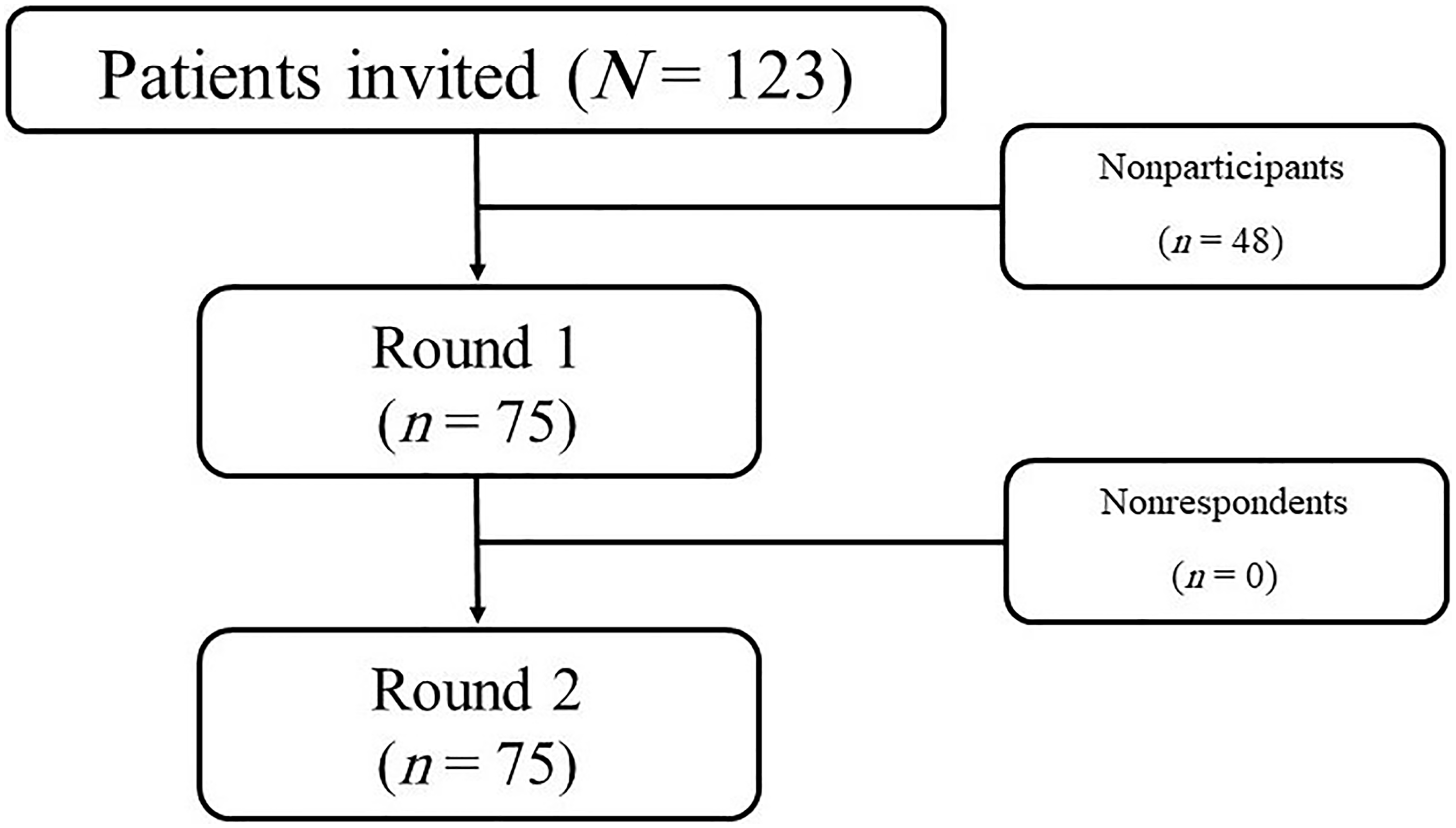
Flowchart of panelist participation.
Data Analysis and Delphi Consensus Criteria
Descriptive statistics (means, standard deviations, and dispersion indices) were computed with Microsoft Office Professional 2010. Ratings for each occupation category and taxonomy components were estimated as medians and interquartile ranges (IQRs) on a 5-point Likert scale. We analyzed data Round 1 data and presented them to the panelists for the next round. The criteria for a consensus were determined a priori. A consensus was considered to have been reached if an IQR was ≤1 for occupation categories and taxonomy components (Jünger et al., 2017). It is most common for Delphi studies to define a consensus as the extent to which the panelists agree in a particular rating range (Diamond et al., 2014; van Balen et al., 2019). Therefore, the level of consensus was approved with at least 70% ratings falling into two adjacent categories of the Likert scale for occupations with a very high to moderate inherent sense of responsibility (Antonini et al., 2018; Hasson et al., 2000).
According to the literature, there may be variations in SoA between genders (Jejeebhoy et al., 2010; Jones et al., 2008; Valås, 2001), with women tending to report lower levels of SoA compared with men. We examined the effect of a patient’s gender for occupations with a very high and high inherent senses of responsibility. We also used a Mann–Whitney test to examine differences in patients’ median ratings, with p < .05 deemed a significant level.
Consensus on Occupations’ Level of Responsibility
Round 1
We first conducted pilot testing of the survey questionnaire on three PwPD, to ensure clarity and comprehensibility. The occupation categories were understandable, and no changes were made to the survey. A list of occupation categories that have the potential for inherent responsibility toward oneself and others (family, friends, or community) was presented to participants in the main study (Meimandi et al., 2023). Decisions regarding the inclusion and exclusion of occupations were made on the basis of previous literature, our own clinical experience, and expert opinions. The initial list included occupations that possessed attributes such as high value, autonomy, health maintenance, and meaningfulness (American Occupational Therapy Association, 2020; Meimandi et al., 2023). Next, participants were contacted, and the concept of responsibility and the study’s goals and procedures were explained to them. The concept of responsibility was defined as ascribing one’s actions and their effects to oneself. Attributability (i.e., when contextual factors play an important role in choosing a behavior while one takes ownership for an activity) and accountability (i.e., assignable punishment or encouragement for activities for which an individual is accountable) were also described (Brown et al., 2019). In addition, examples regarding the concept of responsibility were provided to the PwPD. To ensure comprehension, we asked them to paraphrase the described definition. If they did not grasp the concept adequately, they were excluded from the study. Moreover, they were asked to give another example to ascertain their understanding. The survey was scheduled to be completed at a convenient time after demographic characteristics had been gathered. Participants received the survey questionnaires via Google Forms. Ninety-two occupation categories, derived from the Delphi study with experts (Meimandi et al., 2023), were presented to the participants. They were asked to express the level of inherent sense of responsibility for each occupation on a 5-point Likert scale (1 = very low responsibility, 2 = low responsibility, 3 = moderate responsibility, 4 = high responsibility, 5 = very high responsibility). They also were asked to provide comments on occupation categories presented to them and to add any occupations they felt had been overlooked. A participant’s judgment regarding health status and their attitude toward the success or failure of an occupation can be affected by the degree of sense of responsibility they feel for a specific occupation. Environmental, cultural, and contextual factors also may affect the degree of responsibility felt by PwPD.
Because of the participants’ unique perspective by virtue of personal experience, they might propose other occupations not mentioned by experts. In line with the Delphi methodology, occupation categories that reached a consensus in this round were removed from the following round (Jünger et al., 2017). The survey in this round was provided to the participants in September 2022. This round was completed within 4 wk.
Round 2
The participants neither provided any comments on the occupation categories nor proposed further occupations. No Delphi panelists opted out of participation throughout the study procedure. Therefore, the remaining occupation categories that did not reach a consensus in Round 1 were sent to the participants alongside graphical illustrations showing the responses from Round 1. They were asked to reconsider their previous ratings and rate occupation categories again to reach a consensus with other participants. This was done in accordance with the CREDES guidelines. This round was completed in 2 wk. All PwPD received a pamphlet that listed routine exercises to help with PD after the completion of both rounds.
Developing the Taxonomy of Preliminary Responsibility
First, we elaborated the use of a taxonomy (i.e., scheme of classification) in science for 11 national experts in a focus group. Previous research regarding the concept of responsibility conducted with extensive examples (Caspar et al., 2018; Demanet et al., 2013; Moretto et al., 2011) in other disciplines was discussed with experts in a 2-hr session. Several factors related to responsibility that had been examined in previous studies were debated. The consequences of actions can affect a sense of responsibility. People have a self-serving bias toward positive outcomes while opposing negative outcomes (Yoshie & Haggard, 2013). People choose to bring about fewer negative consequences by valuing their action decisions and acting in a utilitarian way (Moretto et al., 2011). Some scholars have proposed that the SoA is enhanced in moral compared with nonmoral (i.e., economic) contexts (Moretto et al., 2011; Takahata et al., 2012). A higher SoA in moral circumstances could be due to predictive (knowing the significance of an action in advance) or reconstructive (later confirmation of the action’s outcome) processes of agency (Moretto et al., 2011). Moreover, increased physical effort has been found to be related to an increased SoA (Demanet et al., 2013) . The subjective experience of being in control is reinforced by the unique phenomenological signature of effort in intentional actions. Physical effort affects intentionality systems and promotes SoA experiences (Caspar et al., 2018; Demanet et al., 2013). In addition, the presence of other people and coercion can attenuate SoA (Beyer et al., 2017; Caspar et al., 2018). The bystander effect (i.e., presence of other people) reduces responsibility for authorship by making it more ambiguous.
Mentalization of others’ potential behavior may increase uncertainty about possible outcomes, which could reduce the sense of responsibility (Beyer et al., 2017). The sense of responsibility can be extremely affected by coercion. Sensorimotor signals play a crucial part in generating both an SoA and responsibility. Coercive situations split the action control system between the commander and the executor of the action executor. Higher cognitive processes take place in the coercer’s brain, and low-level motor processes are activated in the coerced agent (Caspar et al., 2018). We discussed and analyzed this information and constructed the preliminary draft of the two-dimensional responsibility taxonomy. This preliminary taxonomy draft, along an information sheet, was presented to 8 international experts (7 women, M age = 55.75 yr, SD = 13.59). Examples regarding responsibility features (i.e., moral or nonmoral, physical effort, presence of others, discretion) in occupations were presented to experts if they encountered questions or confusions. They were asked to state their level of agreement with each taxonomy component using a 5-point Likert scale (5 = strongly agree, 4 = agree, 3 = neutral, 2 = disagree, 1 = strongly disagree).
Results
Of the 75 PwPD who completed the survey, 52 (69.3%) were male. The majority (n = 61, 81.3%) were in Hoehn and Yahr Stages I and II. Their mean age was 65.4 yr (SD = 10.9). Detailed characteristics of the PwPD are presented in Table 1. The mean number of years of experience of the expert panelists was 15.25 (SD = 10.66). Of all the international experts, 75% were occupational therapists. These experts were from Africa, the United Kingdom, the United States, East Asia, the Middle East, Europe, and Australia. The subdivision of responsibility-related factors yielded 16 categories, listed in Table 2.
Demographic Characteristics of the PwPD
Note. N = 75. PwPD = patients with Parkinson’s disease.
Taxonomy of Responsibility Taxonomy for Occupations
Note. Number and letter labels represent subdivisions. The sense of responsibility becomes more complex and increases from the 1A to the 4D subdivisions. Examples of subdivisions follow: 1A = financially supporting dependents coercively with low physical effort in the presence of others to meet unnecessary needs; 1B = financially supporting dependents with discretion with low physical effort in the presence of others to meet unnecessary needs; 1C = financially supporting dependents coercively with low physical effort in the absence of others to meet unnecessary needs; 1D = financially supporting dependents with discretion with low physical effort in the absence of others to meet unnecessary needs; 3A = financially supporting dependents coercively with low physical effort in the presence of others to meet necessary needs; 3B = financially supporting dependents with discretion with low physical effort in the presence of others to meet necessary needs; 3C = financially supporting dependents coercively with low physical effort in the absence of others to meet necessary needs; 3D = financially supporting dependents with discretion with low physical effort in the absence of others to meet necessary needs.
Consensus on Occupations’ Level of Responsibility
Round 1
A consensus was obtained for 42 (45.6%) of 92 occupation categories. Two occupation categories—“maintaining personal hygiene” and “personal device care”—were ranked as having a very high inherent sense of responsibility. In addition, “gathering information about the disease,” “planning the time and place of family gatherings,” and “doing therapeutic exercises/activities” were regarded as having moderate inherent sense of responsibility. Moreover, PwPD reached a consensus on 37 occupation categories as having a very low sense of responsibility (Table 3).
Level of Responsibility for Each Occupation in Parkinson’s Disease Management
Note. N = 75 for both Round 1 and Round 2. Occupations are arranged in descending order of responsibility. Values are based on a 5-point Likert scale. Scores ranged from 1 (very low responsibility) to 5 (very high responsibility). IQR = interquartile range; NA = not available; NGO = nongovernmental organization; PD = Parkinson’s disease.
Round 2
A consensus was reached on 50 (54.3%) of the remaining discordant occupation categories. As presented in Table 3, ratings were approximately parallel to those in the first round, and medians did not change, except for five occupation categories. Responsibility for “remembering one’s own medication hours” was deemed as having a very high inherent sense of responsibility. Moreover, PwPD reached a consensus on a high inherent sense of responsibility for the following occupation categories: “dressing and undressing oneself,” “financially supporting dependents,” “keeping daily life as autonomous as before PD,” “buying/providing medicine for oneself,” and “ensuring safety.” Twenty-two occupation categories, such as “doing physical activities or walking,” “medication dose management based on daily activity,” and “buying small and large groceries needed for a day/week/month,” were deemed as having a moderate inherent sense of responsibility. The remaining occupation categories in the questionnaire were considered as having low (e.g., Occupation Category 13) and very low (e.g., Occupation Category 9) inherent sense of responsibility. Some examples of these occupation categories are “feeding pets at home”; “participating in volunteer or charity activities (e.g., fundraising) through online advertising, active participation, going to NGOs [nongovernmental organizations], or consulting individuals who do charity work”; “gardening” (for both 1 wk and 1 mo); and “cooking hot food for family members.” PwPD votes varied from 70% to 84% for 33 occupations that were deemed as having a very high to moderate inherent sense of responsibility.
Subgroup Analysis
We carried out the subgroup analysis to establish whether panel subgroups (i.e., males and females) differed significantly in their ratings. We examined the ratings for occupations with a very high and a high inherent sense of responsibility (i.e., “remembering one’s own medication hours,” “maintaining personal hygiene,” “personal device care,” “dressing and undressing oneself,” “financially supporting dependents,” “keeping daily life as autonomous as before PD,” “buying/providing medicine for oneself,” “ensuring safety”) with regard to gender. Female PwPD reached a consensus on all of these occupations except for “keeping daily life as autonomous as before PD” and “ensuring safety” (Mdn = 4.0, IQR = 2.0). Moreover, male PwPD reached a consensus on these occupations except for “remembering one’s own medication hours” Mdn = 4.5, IQR = 1.7), “maintaining personal hygiene” (Mdn = 5.0, IQR = 1.7), “personal device care” (Mdn = 5.0, IQR = 2.0), and “dressing and undressing oneself” (Mdn = 4.0, IQR = 2.0). No significant difference (p = .071–.756) was found for these occupations between female and male PwPD.
Preliminary Responsibility Taxonomy
The initial step of this study involved a thorough analysis of the literature, followed by discussions with national experts to identify various variables associated with responsibility. The most relevant variables were selected to help create the taxonomy. The configuration of the variables was determined by scrutinizing existing taxonomies in the literature. In the final step, the preliminary taxonomy was sent to international experts to gather their viewpoints on the taxonomy variables. Two general dimensions related to responsibility broadened the taxonomy: (1) consequences of actions and (2) the presence of others. The first dimension of the taxonomy can be seen in the first column of Table 2. This dimension includes moral and nonmoral (i.e., economic) outcomes and the physical effort exerted while performing the occupation. Presence of others is the second dimension on which the taxonomy is based. An occupation can be performed in the presence or absence of other people. In addition, a person can perform an occupation regardless of whether it is discretionary. The subdivisions in Table 2 follow a simple-to-complex progression with regard to level of responsibility from the top left corner of the table to the bottom right corner. The simplest category is 1A, which then systematically progresses to more complex categories (i.e., B, C, and D) for enhanced responsibility. The experts reached a consensus (moral or nonmoral; attendance or non attendance, Mdn = 4 [SD = 0.75]; discretionary or nondiscretionary; high physical effort or low physical effort, Mdn = 4 [SD = 1]) on all taxonomy components. An example of grading responsibility while performing an occupation is presented in Table 2.
Discussion
To our knowledge, this is the first study to provide insight into the opinions of PwPD on the inherent sense of responsibility toward daily and social occupations. We uncovered how PwPD experience responsibility in their occupations. A preliminary taxonomy of responsibility was introduced for the first time. These results can be used by health care professionals while administering occupation-based interventions. In addition to taking into account the capabilities and limitations of PwPD, consideration of the concept of responsibility increases the potential for intervention success. The taxonomy presented herein provides a means to understand the factors that influence complexity and requirements for enhancing responsibility.
Approximately half of the occupation categories reached a consensus in each round of this study. The low consensus in Round 1 could be attributed to the challenging and complex nature of the concept of responsibility as well as the attributes of different occupations. A second reason may be PwPD factors, such as disease severity, age, and gender. The results showed that 33 occupation categories were deemed as having a very high to moderate inherent sense of responsibility. Responsibility for “remembering one’s own medication hours” was deemed as having a very high sense of responsibility. In addition, responsibility for “dressing and undressing oneself,” “financially supporting dependents,” and “keeping daily life as autonomous as before PD” were considered occupations with a high sense of responsibility. PwPD median ratings for these items were similar to experts’ ratings (Meimandi et al., 2023).
Adherence to medication timing (i.e., remembering when to take medication) is of paramount importance in PD management (Grosset & Grosset, 2007) in light of the strict timing of doses and multiple anti-PD medications (Leopold et al., 2004). Suboptimal use of, for example, levodopa medications can result in life-threatening adverse effects, such as increased muscle rigidity, abnormal elevation of body temperature, raised creatine kinase with leucocytosis, and fatality (Newman et al., 2009). Therefore, the present result may be due to educational approaches provided for patients by the neurologists and rehabilitation team regarding the importance of timely medication usage. Occupational therapy interventions can enhance medication management (Foster et al., 2021). Dressing difficulties occur at the onset of the disease. Dressing is problematic for people who score ≥30 on the Unified Parkinson’s Disease Rating Scale (Shulman et al., 2008). A person’s ability to dress and undress themself is a key indicator of their functional independence, and their inability to dress themself increases their dependence on their caregivers (Rahman et al., 2008). Therefore, PwPD attach a high sense of responsibility to this occupation. A considerable financial burden is faced by caregivers of PwPD (Bhimani, 2014). Financial constraints on spouses or their children limits life balance and affects their recreational activities (Hounsgaard et al., 2011; McCabe et al., 2008). Moreover, loss of autonomy in daily life after a PD diagnosis leads to dependency on caregivers (Thieken & van Munster, 2021). Hence, PwPD feel a high sense of responsibility to lessen their caregivers’ financial, physical, and psychological burden.
We explored a moderate sense of responsibility for instrumental activities of daily living, such as “putting garbage into outdoor trash containers,” “washing small dishes for a day/week,” and “dusting own room.” These occupations were consistent with the results of Meimandi et al.’s (2023) study of experts in diverse professions. These results are also in line with a Delphi survey of best occupational therapy practice for PwPD (Deane et al., 2003). According to Deane et al. (2003), more than 95% of occupational therapists design their intervention process around occupations such as domestic and kitchen skills. Moreover, taking responsibility for daily and self-care occupations helps PwPD become more independent, autonomous, and healthy (Wannheden & Revenäs, 2020).
Compared with Meimandi et al.’s (2023) results, we observed slight changes in the level of responsibility attached to occupations such as “maintaining personal hygiene,” “personal device care,” and “doing therapeutic exercises/activities.” For example, PwPD reported a more inherent sense of responsibility for maintaining personal hygiene and taking care of personal devices, but doing therapeutic exercises/activities was reported as involving more of a sense of responsibility by experts compared with the PwPD. These inconsistencies may be explained by the fact that the experts may have had a generalized impression of an inherent sense of responsibility for occupations (van Rijssen et al., 2019).
Fifty-nine occupation categories, such as “handling finances for family members”; “participating in volunteer or charity activities through online advertising, active participation, going to NGOs, or consulting individuals who do charity work”; and “buying/providing medicine for friends” were deemed as having a very low to low sense of responsibility. These occupation categories were mostly geared toward other people. Social behavior requires a fundamental neurocognitive capacity that is disrupted in PD. This disruption presents clinically with impairments in theory of mind, empathy, and social perception (Henry et al., 2016). Hence, a sense of responsibility may be perceived to be lower in occupations that are related to other people. Another possible explanation could be that PwPD deemed these occupations less valuable, meaningful, or important in terms of maintaining patient health.
A subgroup analysis revealed no statistically significant differences between male and female PwPD. This indicates that the level of consensus achieved was strong across PwPD subgroups. Apparently, there was common ground between male and female PwPD with regard to how an inherent sense of responsibility is perceived.
The results Meimandi et al. (2023) obtained, and those of the current study, led us to take a step forward and generate a taxonomy of responsibility. Several taxonomies have been used in health care in the past 20 yr, such as Gentile’s (Magill & Anderson, 2010), Bloom’s (Krathwohl, 2002), and the taxonomy of disability (Leveille et al., 2004). Gentile’s taxonomy was used to classify motor skills with two general dimensions of actions. Bloom’s taxonomy was designed to classify learning stages for acquiring knowledge. The taxonomy of disability classifies disability according to symptoms and impairments.
This taxonomy of responsibility can be used to chart a person’s progress in attaining occupational goals in rehabilitation. Such a progress chart would provide a basis for detecting deficiencies and increasing capabilities. This is an effective way for task analysis and profile creation to aid clinicians when planning assessments or interventional programs. The taxonomy also provides a means for understanding factors (i.e., presence of others, existence of authority, consequences of actions, and physical effort) that influence responsibility and the requirements placed on a person while performing occupations with different levels of responsibility complexity. This taxonomy can serve as a valuable tool for selecting appropriate occupations to enhance responsibility in persons seeking occupational therapy. By using this taxonomy as a tool, clinicians can scrutinize a patient’s occupational profile and evaluate the occupations according to their degree of responsibility. As a result, patients’ motivation and volition to participate in various occupations can be enhanced. In addition, this taxonomy can serve as a useful tool to instill a sense of responsibility as an intervention strategy to enhance occupational participation. However, it should not be used in isolation because of other existing, individually based variables, such as interest, values, the environment, and awareness of one’s obligations. Another conceptual client-centered framework or model, such as the Model of Human Occupation (Kielhofner, 2002), should be used alongside this taxonomy.
This Delphi study will facilitate future patient-centered trials because we gathered viewpoints from stakeholders (i.e., PwPD) and systematically analyzed the concept of responsibility characteristics. A gradual increase in sense of responsibility while providing occupation-based interventions keeping the concept of responsibility in mind will lead to better treatment adherence and outcomes (Che Daud et al., 2015). Moreover, providing occupations with a more inherent sense of responsibility can play a key role in increasing motivation for participation (Li et al., 2011).
The concept of responsibility alongside the taxonomy can convert rehabilitation outcomes from ableism oriented to increased occupational participation. It also can expand practitioners’ viewpoints and evolve the rehabilitation outcome assessment and decision-making process when choosing occupations with a greater sense of responsibility.
Limitations and Strengths
The strength of Delphi studies lies in the absence of group dynamics and hierarchical structures; however, the evidence provided by a Delphi process is limited because of its reliance on consensus and qualitative analysis (Akins et al., 2005; Becker & Roberts, 2009). Participants did not interact directly with each other; therefore, group discussions were not dominated by certain individuals. A predefined set of occupation categories derived from a previous Delphi study with experts was presented to the participants. This predefined list of occupations provided a solid base for our study. Not providing the list might have been too cognitively demanding or resulted in some occupations being overlooked. Nevertheless, this predefined set of occupation categories may have led the patients to not think about other occupations. However, they had the opportunity to provide comments or add further occupations. We lacked in-person meetings with patients during rounds to address ratings, explore areas of disagreement, and obtain more comprehensive insights. In addition, all patients were recruited from Iran, which limits the generalizability of the findings given that culture and different contexts may affect the sense of responsibility for occupations. It is important to note that our sample represents persons residing in rural areas, potentially limiting its applicability to the perspectives of those residing in suburban areas. Future international Delphi studies may provide more external validity for our findings. As Che Duad et al. (2015) stated, while administering interventions occupational therapists must consider a client’s capacities and current abilities. For this purpose, occupations should be graded and modified to suit each person’s capabilities. We suggest that future studies consider this taxonomy in determining intervention designs. In addition, further research could document occupational therapists’ experience by considering the concept of responsibility in clinical settings.
Implications for Occupational Therapy Practice
The findings of this study have the following implications for occupational therapy practice: ▪ Occupations regarding one’s self reflect a high sense of responsibility. These occupations will help occupational therapy practitioners instill responsibility in clients and improve their motivation for occupational participation. ▪ Social cognition is often affected in PwPD. Occupations that involve interactions with others in society may not be suitable for the commencement of interventions. ▪ Occupational participation and independence can be enhanced by an increased sense of responsibility in occupations that are practiced independently (in absence of others) and require high physical exertion. Practitioners should tailor these effective occupations to their intervention designs.
Conclusion
This study produced the first consensus agreement among PwPD on the level of an inherent sense of responsibility in occupations. Thirty-three daily occupations were deemed as having a very high to moderate sense of responsibility. These findings may be useful for use in PD rehabilitation. This responsibility taxonomy can provide a precise and comprehensive description of clinical decisions communicated via the client–therapist relationship.
Footnotes
Acknowledgments
We thank the participants for their contribution and commitment to the study.