





Abstract
The study findings build on evidence that supports the use of a visual aid to improve autistic children’s independence with daily living skills.
Ongoing changes in the current educational climate reflect an increase in the use of technology as a tool for instruction. Evidence-based methods of intervention, specifically those involving technology, are important for all students but can be even more so for children with autism spectrum disorder (ASD; Shic & Goodwin, 2015). Children with ASD often require individualized instruction designed to promote independence (Mechling & Ortega-Hurndon, 2007). Research has focused on promoting these children’s independence by decreasing direct prompts, such as verbal or physical cues from a support person, while they participate in school, home, and the community (Kellems et al., 2016, 2018). The use of static picture (SP) cues to create a visual schedule as a consistent prompt to teach various daily living skills is an established form of intervention (Bates et al., 2001; Genc-Tosun et al., 2023; Giles & Markham, 2017; Moran et al., 2022). Video modeling (VM) is an instructional approach that uses technology to show a video of the desired task. Although several studies have been conducted, the body of research on VM with the ASD population is limited. To validate the effectiveness of VM for autistic children, continued research is necessary. This study aims to determine the effectiveness of VM prompting versus SP prompting for children with ASD and to see whether one is more effective than the other for improving their daily living skills. This study assessed both number of cues required for each step and independence for each step of a task.
Literature Review
ASD is a neurodevelopmental condition that presents with deficits in communication, social participation, and development and maintenance of relationships (American Psychiatric Association, 2013). Furthermore, children with ASD often experience difficulty in completing activities of daily living (ADLs) and instrumental activities of daily living (IADLs) when compared with typically developing peers (Yela- González et al., 2021). Research shows that in addition to deficits in ADL performance, autistic persons also require greater assistance from a caregiver, increased modifications in their immediate environment, and other support products to assist in completing their ADLs or IADLs (Yela-González et al., 2021). One factor that challenges independent participation is difficulty with executive functioning skills, which consist of shifting, inhibition, working memory, and planning (Friedman & Sterling, 2019). The abilities to focus on a task, plan out the steps, retrieve recalled information, and block out other information are all required to complete tasks such as ADLs or IADLs. Executive functioning deficits among the ASD population depend on age, characteristics of the task, and comorbidities (Friedman & Sterling, 2019). Kimhi et al. (2014) found that children with autism had difficulty with the executive functioning skills of cognitive shifting and planning.
SP prompting (or schedules) has proved to be an effective intervention technique to aid in promoting independence in completing daily living skills among autistic children (Bates et al., 2001; Genc-Tosun et al., 2023; Giles & Markham, 2017; Moran et al., 2022). SP schedules support executive functioning by providing a step-by-step visual representation of the task. The therapist completes a task analysis of the activity and breaks the task into steps to support task completion. The number of steps in a task may vary according to the needs of the individual. For example, shoe tying can be broken down into 5 or 10 steps depending on the child’s needs. SP prompting is often used in conjunction with cues (e.g., verbal, physical, gestural) to increase independence in task completion. Completing daily tasks with the use of SP prompting in addition to verbal cues is more effective than using only verbal cues as a form of intervention to complete a task (Duttlinger et al., 2012; Giles & Markham, 2017; Moran et al., 2022). Strategies now include the use of electronic devices such as a tablet to support task completion. In their study, Giles and Markham (2017) compared book- and tablet-based SP schedules and found no functional difference in skill acquisition between how the schedule was presented (paper picture vs. tablet-based SP). Research consistently supports the use of SP schedules presented in various formats to promote independence of autistic individuals (Genc-Tosun et al., 2023).
A growing body of literature supports the use of VM as an intervention method to improve skill acquisition and independence (Abd Aziz et al., 2021; Thomas et al., 2020). VM is a form of intervention aimed at supporting executive functioning and promoting independence in completing daily living skills for autistic children. Similar to SP prompts, VM requires a task analysis of the activity, with each step recorded on a tablet or other electronic device. Children then watch the recorded steps on the device while performing the task. Current literature supports the use of VM as an effective form of teaching daily living skills to autistic children (Aldi et al., 2016; Bross et al., 2020; Giles & Markham, 2017; Kellems et al., 2018). Children participating in a VM study demonstrated an increase of 50.5% in steps completed correctly (Meister & Salls, 2015). In a pilot study by Bimbrahw et al. (2012), results indicate that prompting via a computer device can improve overall handwashing skills in children with ASD.
Creating both VM schedules and SP schedules requires a task analysis of the occupation. Whereas SP schedules are low tech and cost-effective, VM schedules require an electronic device (such as a tablet) for both creating and viewing the videos. Also, although using technology is a daily task for many people, using an electronic device and associated software applications to create videos of ADL and IADL tasks requires training, confidence, and time of the therapist or teacher. Meister and Salls (2015) reported that most teachers participating in their study requested training on the use of a device before attempting to make video models. Despite positive outcomes, the additional resources required to implement VM prompts may be a deterrent. Therefore, we posed the following research question: Is SP prompting or VM prompting using a tablet the more effective strategy for acquisition of daily living skills for autistic students?
Method
Design
We used an experimental alternating treatment design to examine the effects of VM prompts and SP prompts on acquisition of daily living skills for each participant. This design allowed us to compare the effects of the conditions while examining independent task performance. This study was approved by the Duquesne University institutional review board. Following a baseline phase, each participant was randomly assigned (see later) to the treatment schedule (SP or VM) and intervention session to distribute the interaction effects across conditions. If three consecutive applications of the same treatment occurred, the third treatment was changed to the unused method (Manolov, 2019).
Participants
We chose a convenience sample of children from four classrooms at The Education Center at The Watson Institute. All children in the four classrooms (N = 32) were invited to participate in the study. As per school records, each potential participant had a diagnosis of ASD and had individualized educational program (IEP) goals that included daily living skills. The educational team (occupational therapist, special education teacher, and school administrators) agreed to undertake the study. Parents provided written informed consent, and students provided written assent.
Nineteen children initially consented to participate in the study; all the children had ASD (100%) as well as other co-occurring medical diagnoses. Seventeen participants completed the required number of sessions and were included in data analysis. The participants consisted of 13 boys (76.5%) and 4 girls (23.5%) between the ages of 9 and 18 yr (M = 12.8, SD = 3.6). Most participants (n = 15) were White or Caucasian (88.2%), 1 was African American (5.9%), and 1 was Asian (5.9%). Participant 9 completed VM and SP sessions with two different target tasks, and data were provided for both. Six of the 7 nonverbal participants used an iPad for communication purposes. One of the 10 verbal participants used an iPad to augment communication. All participants had access to an iPad for leisure, although 90% of the verbal participants reported an increase in iPad use as a primary leisure activity.
Procedure
The research team consisted of the primary investigator (Jeryl D. Benson), an occupational therapy practitioner; a graduate occupational therapy student (Alivia Cartwright); and three occupational therapy practitioners (Deborah Smitsky, Erica Chippich, and Lauren Roebuck), who contributed to the development of the procedures, participant recruitment, development of the SP and VM library, and data collection.
Preparation
The occupational therapy practitioners identified a daily living task for each participant to focus on in treatment. This target task was specific to the participant and their IEP goals. We recorded each task on an iPad (using an adult model) and used the iModeling VM app to edit the videos. After video editing was complete, we used screen shots of the steps of each task from the video to create the SP schedules. A library of SP and VM schedules was created and made available to the occupational therapy practitioners. The library contained folders for each ADL or IADL (e.g., brush teeth, fold clothes, wash dishes). Within each folder, the videos and picture schedules were saved according to the number of steps of the task breakdown. For example, “brush teeth 5” indicated the task analysis of brushing teeth completed in 5 steps, and “brush teeth 10” indicated the analysis of brushing teeth completed in 10 steps. All ADL and IADL tasks were identified before data collection, and all SP and VM schedules were created before intervention. Each occupational therapy practitioner was provided with an iPad for recording videos of the tasks. Each classroom was provided with an iPad mini in a protective case for student use that was loaded with the SP and VM schedules.
Baseline
Before beginning the intervention, we observed baseline performance of the target task. The participants performed five trials of the task in the setting where intervention typically occurred (e.g., classroom, bathroom). The occupational therapy practitioner gave the participant verbal instruction to complete the target task. The occupational therapist recorded the type (verbal, physical, or gestural) and frequency of cues required for each step of the task for each trial. The number of steps completed independently was also recorded.
Participant Training Preintervention
Before the intervention conditions, the occupational therapist taught each participant to use the SP schedule and the VM prompts on the iPad mini. The occupational therapist modeled their use and then guided the participant through the process of using both the SP schedule and the videos on the iPad. Training occurred until the participant was able to functionally use the prompting system (SP or VM). The task used during training was different from the target task.
Intervention Procedures
The occupational therapist guided the child to the intervention area (e.g., to the sink for hand washing after toileting) and flipped a coin to determine treatment condition (SP or VM). The materials needed for task completion (e.g., for hand washing) were available for both conditions.
SP Procedures
In the SP condition, the occupational therapist provided a task demand (i.e., “wash your hands”). The child accessed the iPad mini to view the SP schedule. The SP prompts corresponded to the steps of the task. The occupational therapist recorded the type and frequency of cues provided for each step of the task.
VM Procedures
In the VM condition, the occupational therapist provided a task demand (i.e., “wash your hands”). The child accessed the iPad mini to view the video. The VM prompts corresponded to the task. The occupational therapy practitioner observed and documented the type (e.g., gestural, verbal, physical) and frequency of prompts required for each participant to complete each step of the task.
Data Collection
The procedures were conducted for all participants during two phases according to their academic schedule. Phase 1 occurred for 8 wk in the fall before the school’s holiday break, and Phase 2 occurred after the holiday break. Intervention data were collected for up to 10 wk in Phase 2 to accommodate for extended absences of some participants.
During each phase, the occupational therapy practitioner collected data via observation during naturally occurring opportunities for the participant to complete the target task. The target number of sessions for each participant was 24. Because data were collected during naturally occurring opportunities, the number of sessions per participant varied, ranging from 22 to 36 sessions. For example, if the target task was “wash hands,” data were collected more frequently than if the target task was “wash dishes.” Six participants (Participants 2, 3, 4, 5, 8, and 9) performed the basic ADL of handwashing or brushing teeth, three participants (Participants 1, 10, and 12) performed the more complex ADL of tying shoes, five participants (Participants 6, 7, 11, 14, and 15) performed IADLs for their target task, and the remaining participants performed ADLs for their target task. Type and frequency of the prompts required to complete the steps of the task were documented for each participant during each intervention session.
Data Analysis
Given the study design, inferential statistics to compare data between participants were not completed. We calculated descriptive statistics for each participant for baseline and treatment sessions and calculated the total number of task steps completed independently. The frequency of each type of cue (verbal, physical, or gestural) was summed across all task steps and then summed across all types of cues, resulting in the total number of cues for that session. We averaged baseline data across the five trials for number of independent steps and number of cues, and we summed the frequency of cues across all steps of the task for each type of cue. The sums were then added across all five trials and averaged to obtain the average number of cues (regardless of type) for the five baseline trials.
We compared the number of independent steps and total number of cues of the last session per condition with the baseline. Visual analysis using graphs was completed for change in level of independence across conditions and number of cues required across condition.
Results
Visual analysis of the data indicates that both types of prompts (SP and VM) resulted in improved performance of skills for most participants. Participant data are presented in Figures 1–4. Given the study design, between-participants comparisons were not completed; however, we grouped data together by participant communication style to consolidate the visual analysis.
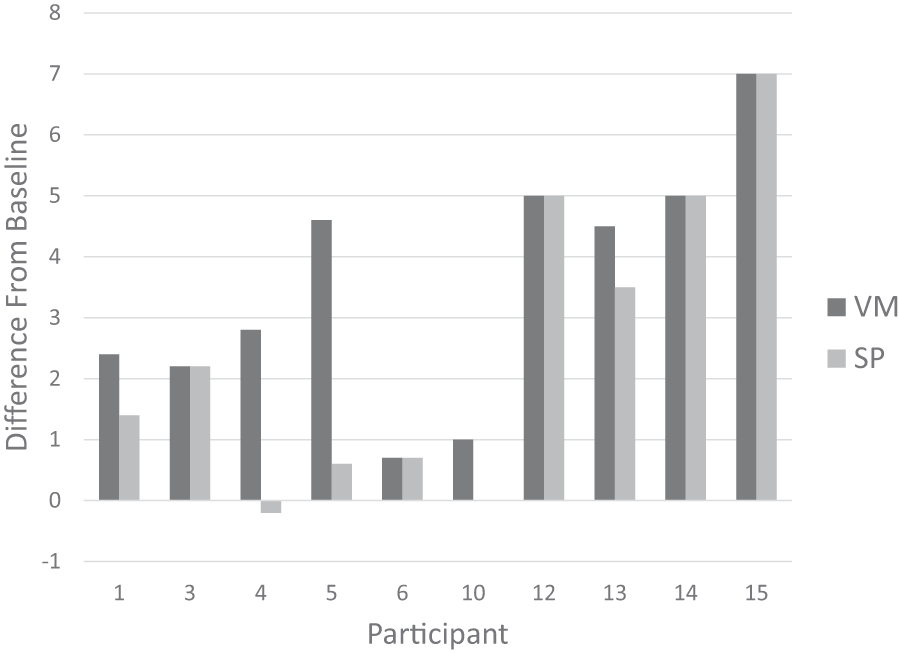
Change in independent steps from baseline: Verbal participants.
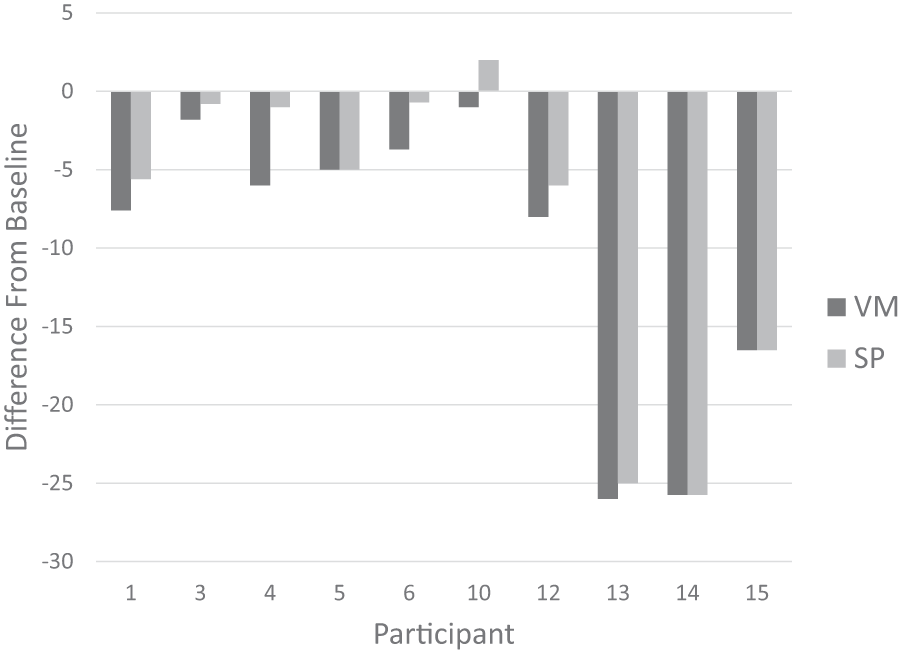
Change in total number of cues from baseline: Verbal participants.
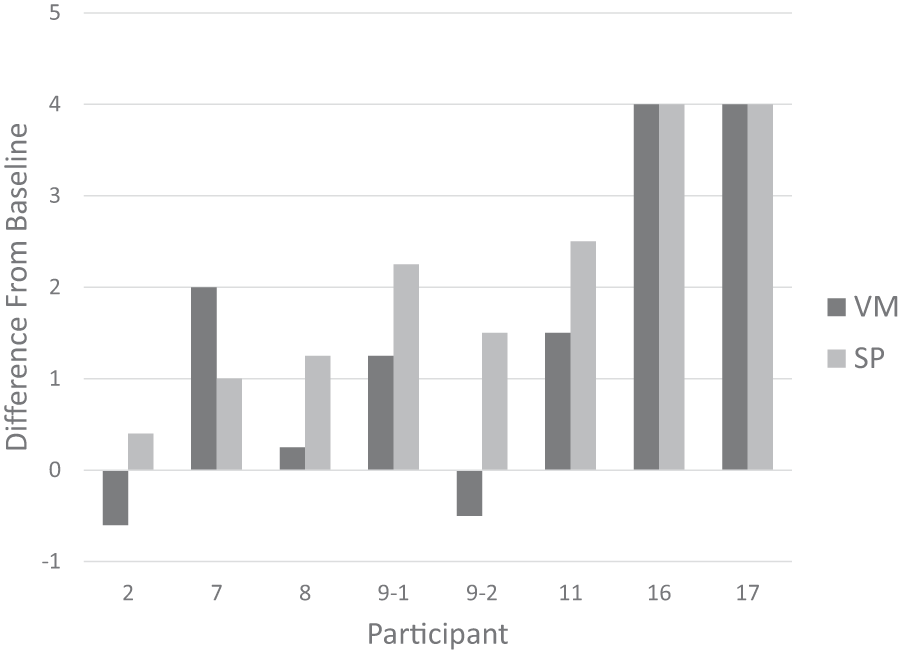
Change in independent steps from baseline: Nonverbal participants.
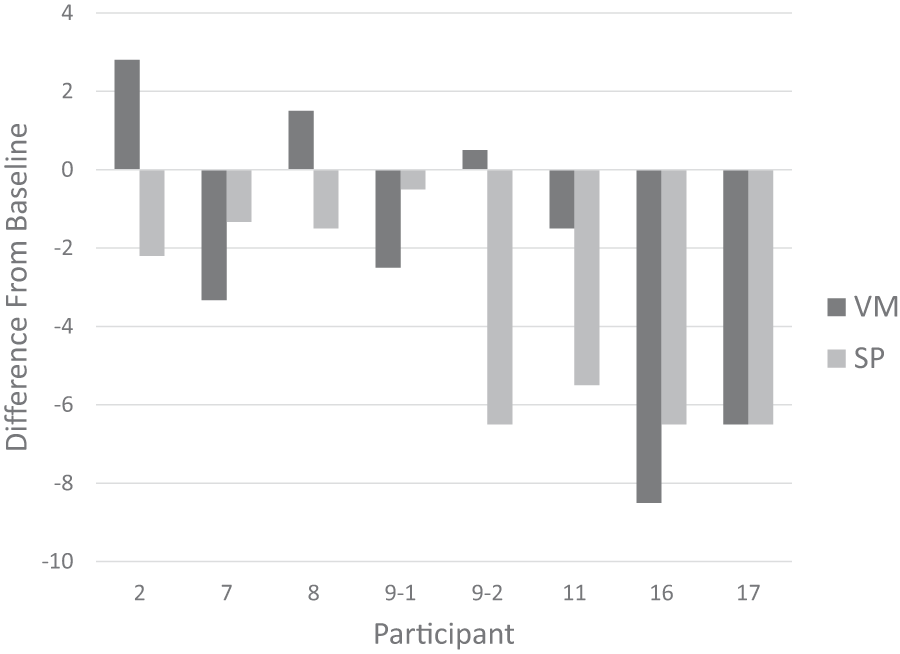
Change in total number of cues from baseline: Nonverbal participants.
Number of Independently Performed Steps
VM and SP prompts resulted in more independently performed steps for most participants (Figures 1 and 3). Fourteen participants demonstrated this improvement with both types of prompts, and 6 participants demonstrated an equal increase in independent steps for both conditions. Participants 4 and 10 increased their independent steps with VM prompts only, whereas Participants 2 and 9 (toothbrushing) demonstrated an improvement with SP prompts only. Participant 9, who completed both handwashing and toothbrushing, demonstrated a different response to VM for each of these tasks (fewer independent steps for toothbrushing and more independent steps for handwashing with VM) and demonstrated more independent steps for both tasks when using SP prompts (Figure 3).
Number of Required Cues
Fourteen participants demonstrated a decrease in number of cues required to complete their task for both conditions (Figures 2 and 4). Four participants demonstrated a decrease in total number of cues for one condition only (either SP or VM).
For both independent steps and required cues, 13 participants demonstrated a meaningful improvement in performance, with both an increase in number of steps performed independently and a decrease in number of required cues. Eleven of these participants showed this improvement with both VM and SP prompting.
Participant 9 showed a similar pattern in cues as in independently performed steps. When using VM for toothbrushing, this participant did not demonstrate more independence or require fewer cues. However, when using SP prompts for this task, this participant performed the task with more independent steps and fewer required cues.
Discussion
The purpose of this study was to determine the effectiveness of VM prompts compared with SP prompts as an intervention to improve autistic children’s and adolescents’ participation in daily living skills. Results indicated that most participants showed a decrease in the total number of required cues to complete the target task and an increase in independence to complete the task compared with their baseline performance. The improvements resulting from VM versus SP may be due to variability in the characteristics of ASD and may therefore be idiosyncratic across participants. For example, Participant 9 completed two ADL tasks—handwashing and toothbrushing—and completed handwashing with less cuing when supported by VM prompts and demonstrated an increase in independence when using SP prompts. However, this participant completed toothbrushing at a higher level of independence and with decreased cues when supported by SP prompts. Overall, Participant 9 responded better to the SP prompts. Considerations that may potentially affect the difference may be attributed to the complexity of the task (steps for handwashing are more concrete than those for brushing teeth), the frequency of the task (handwashing is done more frequently throughout the day than brushing teeth), or individual differences in how information is processed at different times throughout the day. The occupational therapy practitioners noted that some participants’ performance and participation were affected by their mood or behavior on a particular day.
Another consideration is the complexity of the task (ADLs vs. IADLs) with regard to the type of visual prompt (Lee et al., 2023). There were some differences in acquisition of a new skill. Participants who completed an ADL task (e.g., brushing teeth, washing hands) in most cases performed better with SP prompts or showed equal improvement with both prompts. Two participants (Participants 4 and 5) improved ADL performance with VM prompts. Participants who completed an IADL task (e.g., folding laundry, managing morning routine) in most cases performed better with VM prompts or showed no difference in improvement between the conditions. Only Participant 11 improved an IADL using SP prompts.
Each participant’s current level of functional performance was also a consideration related to performance outcomes. Participants who were nonverbal appeared to respond slightly better to the SP prompts or equally to both prompts. Three of the nonverbal participants needed increased cues in comparison with baseline under the VM condition. One nonverbal participant performed better with the VM prompts. Furthermore, there was more variability in relation to cues needed under the two treatment conditions for participants who were nonverbal compared with those who were verbal. However, all verbal participants’ performance improved with the support of the VM prompts, or they responded the same to either prompt. This may indicate that information processing is a factor in the type of cues that support performance. Participants with functional verbal communication skills seemed to prefer and to respond to VM prompts more compared with nonverbal participants.
This research is consistent with previous studies that support the use of SP schedules to promote independence in daily living skills among children with ASD (Lee et al., 2023; Moran et al., 2022). Furthermore, it adds to the growing body of literature supporting the use of VM to increase autistic children’s independence in ADLs and IADLs (Aldi et al., 2016; Bross et al., 2020). This study found that most participants demonstrated an increase in independence regardless of the mode of the visual prompts (SP or VM). This is relevant to current practice, because it indicates that visual prompts, regardless of the media (picture or video), are the agent of change, with most participants demonstrating improvement. Approximately 33% of our participants demonstrated improvement equally regardless of the condition, 39% demonstrated improvement with VM prompts, and about 28% demonstrated improvement with SP prompts. Children with functional verbal communication skills seemed to perform better with VM prompts, whereas nonverbal children seemed to perform better with SP prompts.
However, these differences need further exploration. Some children may learn better with SP prompts, whereas others may learn better with VM prompts. The use of SP schedules is a simple and cost-effective way to support engagement in occupation. SP schedules are easily created and used by the team. Although the availability of tablets has increased, the use of a tablet as a source of prompting requires higher level preparation in creating, editing, and training of the recordings (Meister & Salls, 2015). Autistic individuals, families, and teams with both the interest and the resources may choose to use videos; however, if the ease of an SP schedule is aligned with team dynamic, the results indicate that SP is equally as effective as VM for most autistic persons. Therefore, both SP and VM are effective means of increasing participation in ADLs and IADLs among autistic children (Kellems et al., 2018; Lee et al., 2023), and the choice to use either prompt depends on the individual needs and preferences of the child (Giles & Markham, 2017). Findings from our study support the use of a visual aid (either SP or VM) to improve acquisition of daily living skills by autistic children and encourage occupational therapy practitioners to consider the individual characteristics, strengths, and needs of each child in determining what type of visual prompt will best support participation.
Limitations and Future Directions
Occupational therapy practitioners should carefully interpret the results of this study within the clinical context and needs of an autistic child. Limitations of this study include a small convenience sample within one school and four classrooms. Convenience sampling affected the representativeness of the study, which had mostly White participants and only 1 African American participant and 1 Asian participant. Results should be interpreted with caution, because sampling bias affects transferability of the results to other populations.
In addition, occupational therapy practitioners should consider the potential for carryover of skill development between conditions. Although the intervention conditions were randomized, learning could be carried over. Also, participants regularly engaged in the daily living tasks (such as hand washing) outside of the study conditions, so we must consider the possibility of participants learning the tasks between conditions through repetition. The variability of function within the diagnosis of ASD is also a limiting factor because the participants had varying levels of function.
Because of the lack of geographic, socioeconomic, and educational diversity, data may not be reflective of the general U.S. population. Future research should include more diverse participants, explore the types of ADLs and IADLs that benefit from SP or VM prompts, and examine the impact of variability and functional characteristics within the diagnosis of ASD and its effect on learning.
Implications for Occupational Therapy Practice
Within clinical practice, it is effective to use visual prompts—either VM or SP—with autistic children. Occupational therapy practitioners should use clinical reasoning and practice skills and judgment to choose the best modality for individual clients and teams.
Conclusion
The results of this study suggest that both SP and VM prompts were successful in increasing independence in ADLs and IADLs among autistic children. Some children did better with SP prompts, whereas others did better with VM prompts. This may be because of variability within the diagnosis of ASD, the mood or behavior of participants on a given day, or contextual factors such as the location of the intervention and the impact of the immediate environment. Some emerging differences were found in both the level of communication and processing and the level of task complexity. Overall, results support the use of visual aids, whether via SP or VM, to support independence. When choosing either of these conditions to support participation, occupational therapy practitioners should consider the child or person factors, contextual factors, and available resources.
Footnotes
Acknowledgments
We acknowledge the Charles Henry Leach II Foundation for providing financial support to complete this study. We would also like to thank the administration, staff, students, and families at the Education Center at the Watson Institute for their support of this study.