





Abstract
This study explored how parent and teacher caregivers supported children (both with and without disabilities) during a therapeutic playgroup at an early childhood center.
“Toys are children’s words and play is their language” (Landreth, 2002, p. 132). Children spend much of their time exploring objects in play, peaking between ages 18 mo and 3 yr (Wynberg et al., 2022). Play activities establish and enhance caregiver–child relationships, fostering growth in ways that are not easily taught (Yogman et al., 2018). A child’s relationship with primary caregivers is a protective factor for healthy growth and development (Julian et al., 2017). Therapeutic playgroups (TPGs) build caregiver competence and confidence during group play activities that are developed to support children who are at risk or who have special needs (Armstrong et al., 2020). TPGs have the potential to facilitate positive caregiver–child interactions through the intentional use of play objects and activities in a variety of settings. How play activities and objects can be used to support parents and early childhood educators (caregiver types for children from birth to age 5) recognize and expand on play interactions is of interest and of value to explore.
Developmental Play Activities and Objects
Play Types
Play types can be operationally defined as the objects used and activities chosen when engaged in play. The specific play types described in this study are shared reading, sensorimotor play, pretend play, and constructive play. In shared reading, caregivers read to children, physically interacting with the book, rhyming, singing along with the story, using props, and engaging in social interactions (Kenney, 2016; Quach et al., 2017; Torr, 2019; Towson et al., 2016). Scholars support shared reading as a play activity to reduce socioeconomic disparities and improve child behavior and prosocial skills (Goble et al., 2017; O’Farrelly et al., 2018). When mothers, fathers, and teachers read and play, they enjoy and sustain interactions that develop children’s language and literacy (Quach et al., 2017; Torr, 2019; Weisleder et al., 2019). Sensorimotor play is the mechanism in which children explore the properties, intention, and function of objects in the environment through their senses (Kuhaneck et al., 2023; Scott & Cogburn, 2023). Children develop imitation during caregiver–child interactions in sensorimotor play, much as they do in the transactional relationships seen in shared reading (Goble et al., 2017; de Klerk et al., 2019; O’Farrelly et al., 2018; Weisleder et al., 2019).
Constructive play is organized, goal-oriented, and exploratory in nature, involving the manipulation of various materials for the purpose of creating something (Park, 2019). During block play, caregivers facilitate problem-solving, cooperation, and collaborative learning, providing a foundation for math, visuospatial development, and science (Chung, 2019; Ness & Farenga, 2016; Park, 2019; Weber et al., 2020). Pretend play (i.e., symbolic, sociodrama, make-believe, imaginative, or fantasy) allows children to transform objects, actions, and toys; impose meanings beyond the literal meaning; and interact socially, developing the inhibitory skills necessary for executive functioning and preschool success (Scott & Cogburn, 2023; White et al., 2021). Caregivers can provide the structure for pretend play by presenting a theme and basic play activities and objects (White et al., 2021).
Play Context
Therapeutic Playgroup
TPGs provide a soft entry point to early childhood supports and facilitate caregiver–child interaction to increase social–emotional development, play and playfulness, and social participation (Armstrong et al., 2020; Fabrizi & Hubbell, 2017; Fabrizi et al., 2016, 2023). TPG facilitators invite caregivers and children to join in and enjoy play in as natural a state as possible, in community locations where the child takes the lead and caregivers match and follow along. Facilitators ensure that caregivers focus their attention on the child’s interest during play. Strategies such as setting up the environment with interesting and readily available play objects and activities, affirming caregiver competence, providing developmental information, and coaching to expand and extend play increases caregiver self-efficacy and social support (Armstrong et al., 2019, 2021; Bektas et al., 2021; Fabrizi et al., 2023; Fuller et al., 2019; McClain et al., 2022; Parent Interaction with Infants Project, 2021). Across all natural environments where a TPG may take place, it is vital to understand that caregivers are more likely to implement consistently what they learn when it is intentionally structured to consider their unique culture, language, and interactive style (Holme et al., 2022).
Physical and Social Environments
Adult caregivers can promote affordance and consistency by structuring the play environment to plan, support, and review play (Fabrizi et al., 2023; Kleppe, 2018). Affordance provides an opportunity to create a safe play space that will allow for exploration, creativity, and taking risks in play (Kleppe, 2018; Sandseter et al., 2021; Thunder et al., 2023). Edwards and colleagues (2022) define play materials in their school-based TPGs as “the range of toys, equipment, craft resources and/or indoor and outdoor options available to support children’s play and caregiver interactions with the children” (p. 609). Prior studies in early childcare centers describe the use of purposefully selected play objects for a planned play activity; for example, art materials and dramatic play for the expression of ideas, words, actions, movements, and outdoor environments for risky play (Kleppe, 2018; Linder, 2008; Sandseter et al., 2021). What children consider to be interesting and fun is influenced by the physical and sociocultural environment and changes with age and developmental level (Kuhaneck & O’Brien, 2023).
The social environment for play is influenced by time spent in sensitive play interactions early in life and the beliefs that the caregiver holds about caregiving (Duncan et al., 2019; Laurin et al., 2021). High-quality parent–child interactions predict improved outcomes for children across developmental domains (Beckwith et al., 2023; Laurin et al., 2021). A warm, predictable, and responsive early childhood educator–child relationship is associated with children’s cognitive, emotional, and social development into middle childhood and adolescence (Narea et al., 2022). Primary caregivers in early childhood, families, and early childhood teachers, along with specialists (e.g., occupational therapists), can create effective caregiving partnerships that support individual family and child outcomes (McMullen et al., 2015). Thunder et al. (2023) describe play as a strategy for caregivers to create relationships in which children feel safe and included, empowered, and ready to learn.
Positive Caregiving Strategies
Developmental caregiving strategies can be organized into four domains: affection, responsiveness, encouragement, and teaching, a set of behaviors that are measured during adult–child interactions using the Parenting Interactions with Children: Checklist of Observations Linked to Outcomes, PICCOLO (Roggman, et al., 2013). Affection provides both physiological and psychosocial benefits that contribute to immune functioning, coregulation, bonding, social cognition, cooperation, well-being, and overall behavior (Carozza & Leong, 2020). Responsiveness is the caregiver’s ability to read and respond to children’s cues, which influences coregulation and how children manage stressful situations, including school transitions (Jia et al., 2023; Pratt et al., 2016). Encouragement targets cognitive stimulation during play, prosocial skills in toddlers, and overall well-being in later development (Alston et al., 2022; Kärtner et al., 2021; Laurin et al., 2021). Teaching behaviors include scaffolding the play environment and partnering for play, using joint attention and instruction; partnering is caregiver led in infancy and shifts to more toddler-initiated activities and sustained play (Lippard et al., 2016; Medina & Sobel, 2020).
This Study
This study was a preliminary investigation that explored the relationship between play activities and objects (play types) and positive caregiving strategies during caregiver–child play in TPGs for children ages 15 mo to 3 yr.
We considered the following research questions: What is the relationship between play type (objects and activities) and positive caregiving strategy during TPG? Does play or caregiver type predict positive caregiving strategies during TPG at an early childhood center?
The aim of this study was to establish a greater understanding of the influences of the physical and social environment in the context of a TPG at an early childhood center.
Method
Research Design
In this study, we used an exploratory correlational nonexperimental design that utilized archived research data obtained during the SEE Me (Social–Emotional Education) Therapeutic Playgroup project at an early childhood center in the southeastern United States. We used this approach to describe the relationship and predict the effects between play type (play activities and objects) and positive caregiving strategies.
Participants
We used convenience sampling to recruit two types of caregiver participants, described as caregiver types—parents and early childhood educators—through the regional early intervention program and early childhood center. The caregiver sample consisted of 8 parents (4 fathers, 3 mothers, and 1 nanny included in the parent caregiver group), and 6 female early childhood educators. All caregivers reported age in the range of 30 to 39 yr. Caregivers reported having some college, college degrees, and one master’s degree. Of the caregivers, 7.1% (n = 1) were Black, 35.7% (n = 5) were Hispanic, and 57.1% (n = 8) were White. Caregivers attended one to five of the seven TPG sessions (M = 2.21, SD = 1.63); parent caregivers attended a mean of 2.12 (SD = 1.46) TPG sessions and early childhood educator caregivers attended a mean of 2.33 (SD = 1.97) TPG sessions. TPG sessions consisted of a variety of developmental topics, with the shared focus on caregiver–child interaction during play. Caregivers could participate in a stand-alone session or attend any number of sessions in the series of seven. To qualify for participation in TPGs, children were required to be between the ages of 15 mo and 3 yr and have parental consent. Fourteen children (9 girls and 5 boys) participated in this study. Five child participants were referred from early intervention, and the other 9 attended the early childhood center where the TPG took place. All children recruited from early intervention and 22.2% of children enrolled at the early childhood center had a reported diagnosis of developmental delay (n = 5), autism spectrum disorder (n = 3), or genetic disorder (n = 1).
Instrumentation—Positive Caregiving Strategy
We assessed positive caregiving behaviors using the Parenting Interactions with Children: Checklist of Observations Linked to Outcomes (PICCOLO; Roggman et al., 2013), an observational measurement tool developed to track and support adult–child interactions. Although the tool was developed for parents, PICCOLO scores from observations of caregiver interactions with a group of children in childcare were highly correlated with scores from other widely used measures of classroom and caregiver–interaction quality, suggesting strong construct validity of the PICCOLO for use in childcare settings (Norman & Christiansen, 2013). Parents or early childhood educators are observed as they interact in a variety of selected activities with a child for 10 min. Observations are later rated (0 = absent, 1 = barely, and 2 = clearly) according to the four positive caregiving domains: affection, responsiveness, encouragement, and teaching. Video recording the observation is suggested, and each of the four domains is scored separately and also combined for a total positive caregiving strategies score. The PICCOLO has strong reliability and validity in observations of fathers as well as multiple ethnic groups in the United States for children ages 10 through 47 mo (Innocenti et al., 2018). Higher summary scores indicate the use of developmentally supportive behaviors in interactions.
Procedure
Children and caregivers were invited to participate in seven TPG sessions that took place on an outdoor playground at an early childhood center. Each TPG was 1 hr long and video-recorded for later analysis. Ten-minute video clips of the caregivers and children interacting during the play activities provided in the TPG were saved and coded as either Play Type 1 or Play Type 2. Video clips were coded according to the type of play activity and objects used: Play Type 1 was the code used for shared reading and sensorimotor play, and Play Type 2 was the code used for constructive and pretend play. Sixty video observations of caregivers were analyzed, 30 observations of each play type. Both the order of the video analysis and the raters varied and were determined by simple randomization. To confirm the reliability of the PICCOLO, three graduate student raters were trained to score the 10-min observations. After reading each of the items and scoring interactions from videos in a group setting, two raters scored each video observation independently. Consensus coding was used with video review where disagreements existed, and an average domain score and total score were used for analysis. A high degree of reliability was found with the raters suggesting excellent agreement, with an intraclass correlation coefficient of .963 (95% confidence interval [.952, .971]).
Play Type and Caregiver Type
Play type was determined using occupational analysis (American Occupational Therapy Association, 2020) and observation of the play objects and activities used during the TPG. The play activities (shared reading, sensorimotor play, constructive play, pretend play) were divided into two groups with a minimum of 10 min of caregiver–child observation time each. Play Type 1 included a shared reading activity and sensorimotor play. The sensorimotor play activity included centrally placed containers filled with objects of various textures, along with tools used for exploring. Play Type 2 consisted of a constructive and pretend play activity. Constructive play objects were selected for building, manipulating, and organizing. Pretend play activities used objects to encourage creativity and imagination. Table 1 presents a sample TPG with play type, along with descriptions of the play activities and objects used. The caregiver type included both parents, one nanny (included in parent type), and early childhood educators. The parent group was referred from early intervention, and the early childhood educators had children in class whose parents consented for them to participate in the TPG.
Sample Therapeutic Playgroup Session Format
Data Analysis
Data were analyzed using IBM SPSS Statistics for Windows (Version 28.0). To answer our first research question, we conducted a point-biserial correlation to explore the relationship between play type and positive caregiving strategies used by adults during the TPG. For this analysis, domain and total PICCOLO scores were used, and the adult caregivers were included together as one group. We hypothesized that positive caregiving strategies would have a positive relationship and that a strong significant correlation between play type and PICCOLO score would exist. To address our second research question, we performed multiple regression analyses to examine whether play or caregiver type could predict the use of positive caregiving strategies by adults during the TPG. The play type and caregiver type were used as predictor variables, and the total PICCOLO score was the dependent variable, or outcome. For this analysis, adult caregivers were divided into two types, parents and early childhood educators. We conducted post hoc analysis t tests to investigate whether there were differences between parent and early childhood educator positive caregiving strategies during the TPG on the PICCOLO total and subscale scores.
Results
Is There a Relationship Between Play Type and Positive Caregiving Strategy?
The point-biserial correlation coefficient for the play type (play activities and objects) and PICCOLO did not show statistical significance for affection (r pb = −.065, n = 60, p = .623); responsiveness (r pb = −.122, n = 60, p = .354); encouragement (r pb = −.026, n = 60, p = .842); teaching (r pb = .038, n = 60, p = .771); or total (r pb = −.039, n = 60, p = .765). Our hypothesis was rejected, and the results show no relationship between play type and positive caregiving strategy. There was a positive, significant correlation between all caregiving strategies (affection, responsiveness, encouragement, teaching, and total (r pbs = .766–.970, n = 60, p = .001). Figure 1 presents the correlation between positive caregiving strategy and play type, and Table 2 presents the correlation matrix.
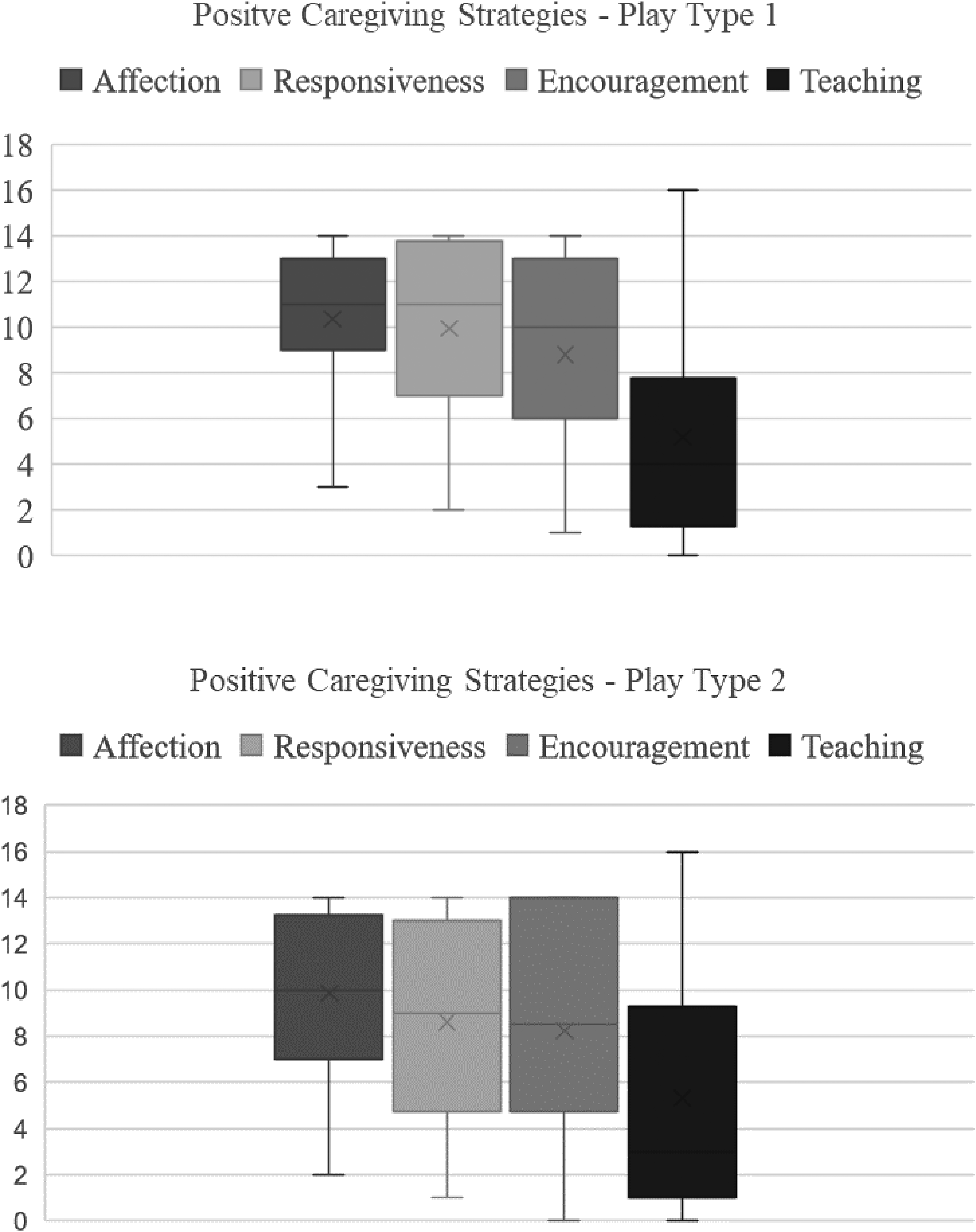
Correlation of positive caregiving strategy with play type.
Means, Standard Deviations, and Correlation Matrix for Play Type and Positive Caregiving Strategy
Note. Play Type 1 consists of reading and sensorimotor play, and Play Type 2 consists of constructive and pretend play. PT = Play type; r pb = point-biserial correlation.
*p < .01.
Can Play Type Predict Positive Caregiving Strategy?
The results of the multiple regression indicate the degree to which play type and caregiver type can predict total PICCOLO scores, or combined positive caregiving strategies such as affection, responsiveness, encouragement, and teaching. The variables of play type and caregiver type did not predict total positive caregiving strategies, F(2, 57) = 2.147, p = .126. One variable, caregiver type (parent or early childhood educator), added statistical significance to the prediction, p = .045.
Differences in Caregivers’ Use of Strategies in a Therapeutic Playgroup
The results of an independent t test found that parent caregivers had scores that were higher in teaching (M = 6.79, SD = 6.26) and total positive caregiving strategies (M = 36.35, SD = 17.69) compared with scores for early childhood educators during the TPG: For teaching, M = 2.96 (SD = 2.22), t(58) = 2.98, p ≤ .001; for total positive caregiving strategies, M = 27.85 (SD = 12.90), t(58) = 2.07, p = .013, reaching statistical significance. No significant differences were seen in the use of affection, responsiveness, and encouragement strategies as measured by the PICCOLO. Table 3 presents a comparison of positive caregiving strategies by caregiver type during a TPG.
Comparison of Positive Caregiving Strategy by Caregiver Type
*p = .01. **p < .001.
Discussion
In this exploratory study, we investigated whether there is empirical evidence of a relationship between play type (activities and objects) and positive caregiving strategies used by parents and early childhood educators during a TPG. Both positive caregiving strategies and the use of play types support early childhood educators and help families and children transition into the school environment (Goble et al., 2017; O’Farrelly et al., 2018; Pratt et al., 2016). The variety of play types promotes the development of academic skills in children, as evidenced by studies describing the effects of constructive and pretend play (Christie & Roskos, 2006; Chung, 2019; Holmes et al., 2019; Ness & Farenga, 2016; Stagnitti & Jellie, 2023; Weber et al., 2020). The present study is, to our knowledge, the first step in developing a better understanding of the connection between play type and the use of positive caregiving strategies by both parents and early childhood educators during a TPG. The findings from this study inform the careful development and implementation of TPGs that include both parents and early childhood educators alongside infants and toddlers in early childhood centers.
Relationship Between Play Type and Positive Caregiving Strategy
In this study, we found no significant correlation between play type and caregiver strategy. Caregivers used the same or similar strategies across play types, regardless of activities or objects used. This suggests that caregivers who use positive caregiving strategies are likely to use these strategies across play types. Our findings show that the positive caregiving strategy domains (affection, responsiveness, encouragement, teaching, and total) are positively and statistically significantly correlated. The significant correlations between the PICCOLO domain scores provide construct validity for this assessment and the utility of observations of caregiver–child play interactions. Caregivers who use positive caregiving strategies in any domain during play interactions may be more likely to use other positive strategies as well.
The inclusion of specific play types in TPGs is in harmony with existing literature that describes play type and the benefits of shared reading, sensorimotor play, pretend play, and constructive play for children’s behavior, sensory needs, and executive functioning (Kuhaneck et al., 2023; Weisleder et al., 2019; White et al., 2021). Additionally, occupational therapy practitioners can use occupational analysis to set up play opportunities using intentional play types that support child development embedded in early childhood school routines. Occupational therapy practitioners who work in early childhood centers should consider the implementation of TPGs to support how parents and early childhood educators use positive caregiving strategies during play. TPG facilitators can be occupational therapy practitioners or other members of the early childhood team.
Predictive Ability of Positive Caregiving Strategy by Play Type and Caregiver Type
In this study, we were surprised to find that different types of play did not predict positive strategies used to support play by caregivers. Other researchers found that there was a significant difference in caregiver–child interaction and type of play. Creaghe et al. (2021) found that symbolic play elicited greater conversational turn-taking, asking questions, and making sounds from caregivers when compared with functional play. They also found that parents used teaching strategies during functional play, whereas during symbolic play, the child initiated the play ideas.
During play observations in this study, parents and early childhood educators used positive caregiving strategies in all the domains assessed on the PICCOLO. The extant body of research supports positive caregiving strategies as social support for child development, particularly for cognitive, social, and emotional development for a child and self-efficacy and sense of competence for the caregiver (Alston et al., 2022; Armstrong et al., 2019; Beckwith et al., 2023; Case-Smith, 2013; Kärtner et al., 2021; Laurin et al., 2021; Norman & Christiansen, 2013; Roman-Oyola et al., 2018; Thunder et al., 2023). During a TPG in which multiple types of caregivers are participating, the caregiver type has a significant predictive effect on the positive caregiving strategy used. All caregivers used teaching as a positive caregiving strategy, with parent caregivers using this strategy significantly more often. Shared conversational turn-taking during play is seen when caregivers use teaching as a positive caregiving strategy (Roggman et al., 2013). The findings of this study suggest that caregiver type predicts positive caregiving strategy; however, the mechanism underlying this association is unclear and warrants further exploration and explanation.
Supporting Caregivers During Therapeutic Playgroup
TPG facilitators can acknowledge and affirm the identified domains of strength (affection, responsiveness, encouragement, teaching, and total) and coach parents and early childhood educators in the use of positive caregiving strategies during play activities. TPG facilitators set up the physical environment, using careful selection of play activities and objects to provide opportunities for playful interaction. Play activities are structured to require the least amount of direction, encouraging caregivers to notice what their child enjoys and to join in the play. To address the unique social context involving multiple types of caregivers, TPG facilitators can use a tiered approach to support caregivers in play where TPG facilitators provide play activities that have been developed to encourage early childhood educators and parents to support and extend play as children initiate it; early childhood educators support parents and children as they coplay; and parents match and follow the child’s lead during play.
Limitations and Future Directions
This study is exploratory in nature and has several limitations; for example, the small sample size, the power to detect change, and the extent to which these findings would generalize to other adult caregiver groups. Adult caregivers attended only a few sessions out of the total number provided; future studies might explore the impact of the number of sessions on caregivers’ use of positive caregiving strategies. These observations occurred during a TPG, a facilitated intervention that is not available at all early childhood centers. The physical and social environment of this early childhood center and TPG facilitators likely influenced play activities and interactions, and this should be considered when replicating. Culture, language, and interactive style can vary by TPG location and can affect the carryover of positive caregiving strategies into other environments. We expected to see differences by play type, but it is possible that the play types need to be carefully defined for observation and separated out more specifically by activity and object. For example, pretend play can be imposed during other types of play. Separate play activity analysis and observations of shared reading, sensorimotor play, constructive play, pretend play, and even unstructured play may provide more rich and detailed information about the positive caregiving strategies used by the adults.
Implications for Occupational Therapy Practice
The findings of this study have the following implications for occupational therapy practice: ▪ Although limited research exists about the use of play types in early childhood centers, the evidence does support the intentional and specific use of play types for child development. ▪ The TPG provides a context for play where parents and early childhood educators can use positive caregiving strategies with children.
Conclusion
Our results provide preliminary information about the nature of the relationship between play type and positive caregiving strategies used during play. This study found that, during a TPG, there is no relationship between the type of play and the positive caregiving strategies used. Our results are consistent with studies describing play activities that support parents’ and early childhood educators’ use of positive caregiving strategies. Findings suggest that when parents and early childhood educators interact during a TPG, parents use teaching as a positive caregiving strategy more often than early childhood educators do. Furthermore, interventions that include intentional play types targeted to enhance positive caregiving strategies during play, such as TPGs, may support caregiver–child interactions and enhance child development.