





Abstract
This study highlights factors that affect the well-being of ethnic Chinese mothers who have children with disabilities and provides cultural insights for occupational therapists who work with Chinese families.
Literature has documented the high stress, mental health symptoms, and multiple challenges experienced by many mothers of children with disabilities (Masefield et al., 2020; Ng et al., 2021; Sim et al., 2021b). There is emerging research on mothers of children with disabilities from East Asian backgrounds and their experiences of stress, poor quality of life, and reduced self-efficacy (Chen et al., 2014; Ng et al., 2021; Siu & Hui, 2021; Yang, 2015), but little is known about the factors that influence specifically their occupations and well-being. In this article, the population of interest is ethnic Chinese mothers who were raised with East Asian or Chinese values. These values, influenced by Confucianism, Buddhism, and Taoism, reflect a culture that transcends nationality.
Health and well-being has been referred to as physical, mental, and emotional health, including a sense of positivity, quality of life, and the ability to contribute to the world with meaning and purpose (World Health Organization, 2021). Health and well-being are integral to the fulfillment of one’s life, and engaging in meaningful occupations has been found to contribute to one’s overall health and well-being (Reitz et al., 2020). In this article, we explore the relationships between maternal participation in health-promoting activities and other factors that might influence the well-being of ethnic Chinese mothers who have children with disabilities.
Systematic reviews and analyses on mothers of children with different disabilities from various cultures have documented that mothers of children with disabilities (hereinafter termed mothers) experience higher perceived stress, poorer mental health, and higher chances of developing health problems than mothers who have children without disabilities (Brekke & Alecu, 2023; Masefield et al., 2020; Ng et al., 2021). Occupational balance refers to a subjective sense of competency and satisfaction from a combination of purposeful occupations that contribute to one’s health and well-being (Wagman et al., 2012), but mothers are rarely able to achieve this balance. A study found that mothers spent a significant amount of time on their caregiving occupations and had 1.5 hr less free time per day than mothers with typically developing children because of higher care demands (Luijkx et al., 2017). Studies have found that mothers have little time for their personal activities and self-care occupations (Dhas et al., 2023; McAuliffe et al., 2019), which leads to occupational imbalance and could continue into their child’s teen and adult years, depending on the type and severity of their child’s disability (Dhas et al., 2023; Luijkx et al., 2017). These findings imply that long-term caregiving coupled with compromised self-care could lead to chronic stress, thus placing mothers at risk for declining health and well-being.
Health-promoting occupations are activities and roles that contribute to enhancing and maintaining one’s health and well-being. Examples include personal health tasks, physical or leisure activities performed alone or with others, social activities, spiritual activities, having time alone (Bourke-Taylor et al., 2012), and engagement in valued roles that bring about enjoyment and fulfillment (Sim et al., 2021a). A study of 71 Australian mothers who attended a face-to-face workshop, conducted with the goal of increasing mothers’ participation in health-promoting activities, reported a reduction in depressive and anxiety symptoms; an increase in well-being; and an improvement in lifestyle goals, which included managing personal stress, effecting dietary changes, leisure engagement, and positive changes in self-perception (Bourke-Taylor et al., 2022). A qualitative study on a group of mothers with East Asian roots found that participants felt empowered by their engagement in meaningful roles outside of their caregiving tasks (Sim et al., 2021a). These studies imply that engaging in health-promoting occupations could have positive effects on ethnic Chinese mothers of children with disabilities (hereinafter referred to as Chinese mothers), but there is currently a lack of empirical evidence to support this postulation.
Qualitative studies on Chinese families have reported not only on the negative effects of stigma on caregivers of children with disabilities (Huang et al., 2020; Yang, 2015) but also on the importance of social support in mitigating the stressors and lower quality of life experienced by caregivers (Lei & Kantor, 2021a, 2021b; Lu et al., 2018). Research on Chinese mothers tends to focus on mental health, parenting stress, parenting styles and coping strategies (Ng et al., 2021; Siu & Hui, 2021), with less reporting on their activity engagement and occupations. A scoping review on a culturally similar group of mothers reported the presence of cultural stigma and self-stigma among mothers and discussed how these negative experiences could affect mothers’ choice of occupations, perceptions of their maternal roles, and co-occupations with their children (Sim et al., 2021b). A follow-up study provided a glimpse into the caregiving occupation of Chinese mothers living in different geographic areas (Sim et al., 2024). These studies highlight the role of Chinese culture in shaping the mothers’ caregiving activities and roles, and they provide preliminary evidence on the impact of culture on mothers’ time use and well-being. However, there are no empirical studies to date that report on the relationships between Chinese mothers’ participation in health-promoting occupations, perceived stigma, social support, and maternal well-being, thus justifying the need for further study in this specific population.
The interconnectedness between the well-being of children, their mothers, and their families is well acknowledged. Interventions concerning childhood disabilities used to be primarily child focused but now increasingly include interventions that promote mothers’ wellness (Bourke-Taylor et al., 2021) and family quality of life (Dhas et al., 2023). Mother- and family-focused interventions are especially relevant in tight, closed, collective, and communal communities such as the Chinese culture, where Confucianism emphasizes the family as the basis of society for the development of “proper” social and political behavior (Zhang & Rosen, 2018). We argue that little is known about the relationship between Chinese mothers’ occupational participation and well-being, whether in the context of immigrants or natives in their own countries. Exploring this relationship within their cultural context could identify cultural-specific strategies that could improve maternal health behaviors and overall well-being, giving providers who work with Chinese families a better understanding of their needs. Furthermore, much of the research in the field has been based on studies from more individualistic societies; therefore, studying ethnic Chinese mothers as a cultural group might be useful in gaining insight into other collective cultures and for practitioners involved in cross-cultural work.
In this project, we aimed to explore the relationships between Chinese mothers’ participation in health-promoting activities, perceived support, perceived stigma and their well-being. This article is a part of a larger study on Chinese mothers of children with disabilities, which included participants from Australia, Singapore, and Taiwan (Sim et al., 2024). The research questions are as follows: What were the relationships between Chinese mothers’ frequency in participation of health-promoting activities, mental and personal well-being, psychological distress, perceived stigma, and perceived support? Which factor(s) predicted change in Chinese mothers’ frequency of participation in health-promoting activities, mental and personal well-being, and psychological distress?
Method
This project was approved by the Monash University Human Research Ethics Committee (Approval No. 19647).
Data Collection
A cross-sectional survey was developed on Qualtrics and included demographic questions and six measures that assessed participation in health-promoting activities, mental and personal well-being, psychological distress, perceived social support, and perceived stigma. Bilingual recruitment flyers with survey links were advertised on social media platforms, carer support groups, two disability agencies, a community newspaper, and community bulletin boards between January 2021 and August 2021. The data were stored in encrypted files and would be deleted after 5 yr.
Participants
Participants were recruited by means of convenience snowball sampling. For inclusion, participants had to be self-identified ethnic Chinese mothers, with a child of any age and any type of disability, who lived in Australia, Singapore, or Taiwan. Participants who did not indicate their location or their child’s disability were excluded.
The anonymous e-survey first allowed participants to select their preferred language (English, simplified Chinese, or traditional Chinese), and then access the explanatory statement and consent form before they could begin the survey. Participants were identified only by serial numbers that were randomly generated by Qualtrics.
Measurements
All of the scales had validated measures that were used with the Chinese population, except for the Parental Perceptions of Public Attitudes Scale (PPPAS). The PPPAS was included because it was developed from a collectivist culture and also provided measures of perceived stigma that included feelings of being blamed as well as affiliate stigma.
Health Promoting Activities Scale
The Health Promoting Activities Scale (HPAS) is an eight-item scale that measures the frequency of participation in health-promoting activities. Respondents rate their frequency of participation on a scale ranging from 1 (never) to 7 (one or more times per day); the total score indicates the overall frequency of participation in health-promoting activities (α = .78; Bourke-Taylor et al., 2012). The Chinese translation of the HPAS has been cross-culturally validated (Sim et al., 2022). For the present sample, α = .75.
Warwick–Edinburgh Mental Wellbeing Scale
The Warwick–Edinburgh Mental Wellbeing Scale (WEMWBS) has 14 items measuring mental well-being, including subjective psychological functioning and aspects of positive mental health. Respondents rate each item on a scale ranging from 1 (none of the time) to 5 (all of the time); the total score indicates overall mental well-being (Taggart et al., 2013; Tennant et al., 2007). For the present sample, α = .91.
Personal Wellbeing Index
The Personal Wellbeing Index (PWI) measures overall life satisfaction and satisfaction across seven life domains—standard of living, health, achieving in life, relationships, safety, community connectedness, and future security—as well as an optional eighth item, spirituality (International Well-Being Group, 2013). Each item is rated on a scale ranging from 0 (no satisfaction at all) to 10 (very satisfied). The mean score (total divided by seven or eight items) represents overall life satisfaction. Cronbach’s α lies between .70 and .85 (International Wellbeing Group, 2013). For the present sample, α = .90.
Kessler Psychological Distress Scale
The 10-item Kessler Psychological Distress Scale (K10) is a self-reported measure of psychological distress that is associated with anxiety and affective symptoms (Bu et al., 2017; Kessler et al., 2002). Respondents rate each item on a scale ranging from 1 (none of the time) to 5 (all of the time). Higher total scores indicate higher psychological distress and the presence of mental health symptoms (Australian Bureau of Statistics, 2012). Cronbach’s α ranged from .73 to .90 (Webb et al., 2018). For the present sample, α = .92.
Parental Perceptions of Public Attitudes Scale
The Parental Perceptions of Public Attitudes Scale (PPPAS) has seven items that are rated on a scale ranging from 0 (completely disagree) to 5 (completely agree) and measures the perception of public stigma on parents of children with disabilities (Čolić & Milačić-Vidojević, 2020). A higher mean score suggests a greater degree of perceived stigma (α = .87; Čolić & Milačić-Vidojević, 2020). (This scale underwent forward-backward translation into Chinese by the research team.) For the present sample, α = .87.
Multidimensional Scale of Perceived Social Support
The Multidimensional Scale of Perceived Social Support (MSPSS) has 12 items that measure the perceptions of support and are rated on a scale ranging from 1 (very strongly disagree) to 7 (very strongly agree). The mean score represents overall perceived support (Zimet et al., 1988). The MSPSS has good internal consistency (α=.88) and validity. For the present sample, α = .93.
Data Management and Analysis
The data were exported from Qualtrics to Excel and imported into IBM SPSS Statistics for Windows (Version 27). Data screening and checking were first completed with checks for outliers and data completeness. All scales were scored according to published directions. We completed a missing-value analysis, and Little’s Missing Completely at Random test indicated that values were missing at random. Data imputation using series mean yielded similar analysis results; hence, results derived from the original data were reported. Normality tests including the Shapiro-Wilks test were performed. Five of eight scales were not normally distributed; hence, we used nonparametric tests in the analyses. We tested the internal reliability of all scales using Cronbach’s coefficient α.
Correlational Analyses
Bivariate correlations (Spearman’s ρ) were calculated between the six variables with the strength of the correlation as r = .7 to .9 (strong), .4 to .6 (moderate), and .1 to .3 (weak) (Akoglu, 2018; refer to Table 2 in the Results section).
Regression Models
Four regression models were configured to identify significant predictors of frequency of participation in health-promoting activities (the HPAS), mental well-being (the WEMWS), personal well-being (the PWI), and psychological distress (the K10). Theoretical alignment, high bivariate correlations between the independent variables (>.7), high tolerance statistics (>.4), and a low variance inflation factor (<.25) were considered when we included predictors together in the models (Tabachnick et al., 2019).
Regression Model 1 included personal well-being, psychological distress, perceived support, and perceived stigma as predictors tested for frequency of participation in health-promoting activities. Regression Model 2 tested whether frequency of participation in health-promoting activities, perceived support, and perceived stigma predicted mental well-being. Regression Model 3 tested whether frequency of participation in health-promoting activities, psychological distress, perceived support, and perceived stigma significantly predicted personal well-being. Regression Model 4 had four predictors: frequency of participation in health-promoting activities, personal well-being, perceived support, and perceived stigma; and the dependent variable was psychological distress (See Tables A.1–A.4 in the Supplemental Appendix, which is available online with this article at https://research.aota.org/ajot).
Results
There were 261 survey respondents from Australia (n = 80), Singapore (n = 95), or Taiwan (n = 86). See Table 1 for the participants’ characteristics.
Demographics of Participants from Australia (n = 80), Singapore (n = 95), and Taiwan (n = 86) and Their Children
Note. N = 261.
aPercentages were calculated over the total number of mothers per country.
bFor education, n = 259. Australia, n = 79; Singapore, n = 95; Taiwan, n = 85.
cFor employment, n = 256. Australia, n = 76; Singapore, n = 95; Taiwan, n = 85.
dFor age of child with disability, n = 216. Australia, n = 57; Singapore, n = 85; Taiwan, n = 74.
eMultiresponse set questions. Respondents may select more than one item; hence, the number and percentage of participants answering “yes” to this question is reflected. For child diagnosis, n = 212. Australia, n = 56; Singapore, n = 84; Taiwan, n = 72.
Table 2 reports the intercorrelations among the six variables. The significant positive correlations between frequency of participation in health-promoting activities, mental well-being, personal well-being, and perceived social support (as measured with the HPAS, WEMWS, PWI, and MSPSS, respectively) meant that mothers who reported higher frequency of participation in health-promoting activities also tended to report better mental well-being, personal well-being, and perceived support. The significant negative correlations between frequency of participation in health-promoting activities, psychological distress, and perceived stigma (as measured with the HPAS, K10, and PPPAS, respectively) meant that mothers who were less likely to participate in health-promoting activities were also more likely to have higher levels of psychological distress and higher perceived stigma.
Nonparametric Correlations Between Variables Using Spearman’s ρ (N = 261)
Note. HPAS = Health Promoting Activities Scale; K10 = 10-item Kessler Psychological Distress Scale; MSPSS = Multidimensional Scale of Perceived Social Support; PPPAS = Parental Perceptions of Public Attitudes Scale; PWI = Personal Wellbeing Index; WEMWS = Warwick–Edinburgh Mental Wellbeing Scale.
*p < .05. ** p < .01. ***p < .001.
The results of Regression Model 1 indicated that perceived support and perceived stigma (as measured with the MSPSS and PPPAS, respectively) significantly predicted the frequency of participation in health-promoting activities, R2 = .18, F(4, 166) = 10.03, p < .001, and accounted for 18% of the variance of HPAS. Perceived support (as measured with the MSPSS) emerged as the strongest predictor of frequency of participation in health-promoting activities (β = 0.25, p = .005; see Table A.1 in the Supplemental Appendix).
The results of Regression Model 2 showed that all of the independent variables—frequency in participation of health-promoting activities, perceived support, and perceived stigma (as measured with the HPAS, MSPSS, and PPPAS, respectively)—significantly predicted mental well-being (as measured on the WEMWS), R 2 = .43, F(3, 167) = 43.43, p < .001, and accounted for 43% of the variance in mental well-being. The strongest predictor of mental well-being (as measured with the WEMWS) was perceived support (β = .39, p < .001; Table A.2).
The results of Regression Model 3 indicated that psychological distress and perceived social support (as measured with the K10 and MSPSS, respectively) significantly predicted personal well-being (as measured with the PWI), accounting for 43% of the variance of personal well-being, R 2 = .43, F(4, 166) = 32.94, p < .001. Perceived support (as measured with the MSPSS) was the strongest predictor of personal well-being (β = .45, p < .001; Table A.3).
The results of Regression Model 4 indicated that the regression model explained 28% of the variance and was significant, R 2 = .28, F(4, 166) = 17.57, p < .001. When all the predictors were accounted for, only perceived stigma and personal well-being (as measured with the PPPAS and PWI, respectively) significantly predicted psychological distress (as measured with the K10). The strongest predictor of psychological distress was perceived stigma (β = .32, p < .001; Table A.4).
Figure 1 summarizes the predictive relationship between factors. The frequency of participation in health-promoting activities was a predictor of mental well-being (β = .21, p = .001). Perceived support was the strongest predictor of participation in health-promoting activities (β = .25, p = .005), mental well-being (β = .39, p < .001), and personal well-being (β = .45, p < .001). Perceived stigma predicted psychological distress (β = .32, p < .001) and mental well-being (β = −.29, p < .001).
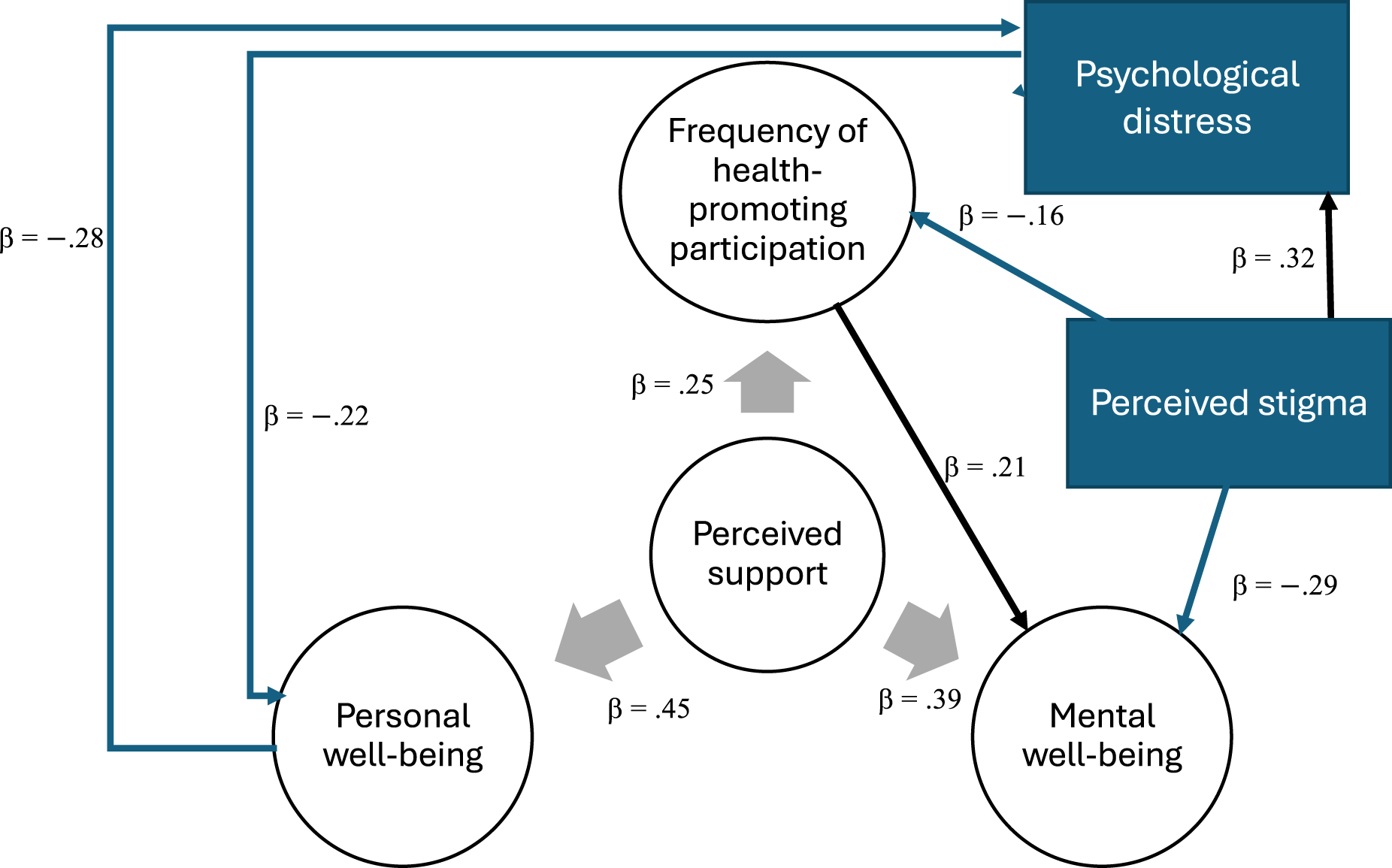
Significant predictive relationships between maternal variables based on regression models.
Discussion
This study reports on the relationships between participation in health-promoting activities, perceived support, perceived stigma, personal well-being, mental well-being, and psychological distress of Chinese mothers. The moderate to high correlations and predictive relationships between the factors have provided insight for recommendations that could contribute to the overall well-being of Chinese mothers. Our findings point to three possible ways to promote maternal well-being: increasing mothers’ participation in health-promoting activities, creating a sense of support and community around mothers, and reducing mothers’ perceived stigma.
Engagement in Health-Promoting Activities
Our results show that engaging in health-promoting activities predicted maternal mental well-being, which concurred with study findings that participation in health-promoting activities contributed to better maternal mental health and well-being (Bourke-Taylor et al., 2022). Harris et al. (2022) reported that mothers found routine coaching by occupational therapists helpful in achieving their health-promoting goals and engagement. The authors argued that occupational therapists are important advocates for mothers, because mothers are often not the priority in the gamut of their children’s services (Harris et al., 2022) and are mostly perceived as caregivers who “follow up” on their children. Examples of mother-focused interventions in pediatric occupational therapy practice could include facilitating Chinese mothers to set goals for healthy behaviors, engaging them in identifying meaningful and health-promoting activities, and coaching them to incorporate health-promoting occupations into their busy caregiving routines in a culturally sensitive manner (Bourke-Taylor et al., 2023).
Qualitative studies have described that Chinese mothers tend to prioritize their children over themselves (Sim et al., 2021b) and tend to neglect themselves; therefore, the focus on maternal goals could be an uncomfortable proposition as opposed to reframing their self-care goals into longer term benefits for their children. The “self-focused activities” could potentially be perceived as self-indulgent and could generate maternal guilt and blame by other family members (Sim et al. 2021b). Therefore, mothers’ beliefs in self-care occupations would need to be sensitively addressed alongside their children’s goals.
Management of Perceived Stigma
The relationship between higher perceived stigma and lower frequency of participation in health-promoting activities as well as higher psychological stress were congruent with existing literature reporting on the negative effects of stigma on maternal participation and on emotional and mental health (Ng et al., 2021; Sim et al., 2021; Yang, 2015). Sim et al. (2022) postulated that Chinese mothers tend to participate more in solo health-promoting activities over activities that involve others, which could indicate reduced opportunities to engage in communal activities or avoidance of experiences of being stigmatized. Our findings imply the importance of developing mothers’ personal strategies to stand strong in less inclusive environments and the creation of “stigma-free” environments to encourage their community participation.
Occupational therapists could facilitate opportunities for safe interaction for mothers through a variety of occupations that could address mothers’ occupational needs, such as developing meaningful roles within accepting communities and encouraging mothers to participate in self-care, leisure, or productive occupations, together with other mothers with similar experiences. Occupational therapists could also be involved in developing community programs that improve the public’s understanding of childhood disabilities and the inclusion of families who have children with disabilities, thus promoting acceptance and encouraging mothers’ and their children’s participation in social and community activities.
Enhancing Perceived Support
Our findings have established that perceived support predicted maternal participation in health-promoting activities, which is consistent with literature that suggests that Chinese mothers find a sense of belonging within support groups and perceive the group as a space for information exchange and mutual support (Lu et al., 2018). Groups could exist in a variety of formats, such as carer groups, interest groups, parent–child groups, and faith-based groups. Support groups within faith communities have received positive feedback (Tam & Poon, 2008), and online platforms have reported that social media–based parenting training has helped to reduce anxiety, depression, and stress among Chinese mothers during the global COVID-19 pandemic (Liu et al., 2021), which implies that these trainings have potential impact and appropriateness among Chinese mothers. Support groups can also be delivered through a structured mentoring network, where “senior” mothers journey with “junior” mothers. This form of peer mentoring could occur online or in person to suit individual mothers’ circumstances, with a focus on connecting mothers effectively and flexibly. Occupational therapists could be involved in training and monitoring such peer networks and in developing programs aimed at reducing isolation and improving social support.
There is evidence that the beliefs of Chinese caregivers about receiving adequate support are more important than the actual support received (Lei and Kantor, 2021a, 2021b). This suggests that creating a sense of support through shared occupations could improve the mothers’ sense of connectedness and belonging. Meaningful activities could be organized in community spaces for mothers, children, and their families, thus providing both practical support and respite for mothers. In addition, online options for group interaction opportunities could ease mothers into joining groups and could also be beneficial for those who are unable to attend the activities in person.
Perceived acceptance and support could be enhanced by improving mothers’ access to programs and choices with efforts such as providing useful caregiving information in their language and designing inclusive physical community spaces where families with children with disabilities could gather without worrying about the possible behaviors and meltdowns that might occur.
Working With Chinese Families
In this article, we report findings from our study of a sample of Chinese mothers who are culturally similar but living in three different countries. The reduced maternal engagement in health-promoting activities and in social and community participation may be closely related to their collective shame, denial, pain, and loss when they have children with disabilities (Huang et al., 2020). These beliefs could affect families’ help-seeking behaviors and perpetuate additional stress on mothers, who tend to self-blame, are blamed by others, and are most affected by affiliate stigma (Sim et al., 2021b; Yang, 2015).
Although we acknowledge the difficulty of being a part of a collective society in which individual differences are often not tolerated, we also acknowledge that families from collective cultures can also be very close knit; therefore engaging significant family members of authority could be a powerful way to improve the well-being of mothers and children. Studies on Chinese families who have children with disabilities found that higher subjective support, increased family cohesion, and family adaptability could enhance family quality of life (Lei & Kantor, 2021a, 2021b) and, thus, improve family well-being. Hence, a multiprofessional integrated family approach involving mothers, fathers, and grandparents could be effective when working with Chinese families.
Another strategy that occupational therapists could use when working with Chinese families could be to address valued family occupations as opposed to child-focused goals, because Chinese families value communal activities such as family meals, customs, and festivals. Addressing the important but disrupted family occupations and coaching relevant family members on supporting their children together, organizing important family activities, and problem solving with regard to the family’s capacity to participate in larger family gatherings are examples of culturally sensitive occupational therapy interventions.
Health Promotion and Coaching Approach
When working with children, occupational therapists can consider a health promotion approach that includes screening, monitoring (Reitz et al., 2020), and facilitating the well-being of mothers (Bourke-Taylor et al., 2023). Occupational therapists could be trained to coach Chinese mothers to incorporate health-promoting activities into their daily routines (Bourke-Taylor et al., 2023) and assist them in exploring their personal capacities to fulfill their own occupational needs (Sim et al., 2021a). Understanding the subtle cultural inclinations of the Chinese culture could assist occupational therapists in being more effective life coaches (Bourke-Taylor et al., 2023) when working with Chinese mothers and their children.
Limitations
The measurement tools used were mainly self-reports, and data were collected over the COVID-19 pandemic, which might have affected participants’ perceptions of their well-being status and usual activity patterns. This project was based on a sample population from ethnic Chinese communities drawn from three countries; therefore, the interpretation of data cannot be generalized to all Chinese communities. The chosen method of online data collection may have excluded mothers who did not use social media or were very isolated.
Future Research
Similar studies with fewer measures that utilize PATH analysis or structural equation modeling could build useful causal models. Future research could use codesign to develop cultural-specific programs for Chinese mothers that target their well-being outcomes. The effectiveness of our recommendations in using the family approach to improve maternal and child outcomes warrants further investigation. The applicability of our research to other collective cultures is also worthy of investigation.
Implications for Occupational Therapy Practice
The findings of this study have the following implications for occupational therapy practice: ▪ Facilitating engagement in health-promoting activities and appropriate environmental interventions can improve maternal well-being. ▪ Maternal-focused coaching and improving mothers’ occupational participation are relevant to pediatric occupational therapy practice. ▪ Families who have children with disabilities from collective cultures would benefit from cultural-specific strategies to improve their well-being.
Conclusion
Our research found that perceived support and perceived stigma were factors that affected the Chinese mothers’ participation in health-promoting activities and their well-being. Occupational therapists can coach Chinese mothers to engage in health-promoting occupations while paying attention to cultural influences and their family values. Mothers could also be guided to manage the negative feelings that accompany their experiences of stigma and to develop their support network. Occupational therapists could use their knowledge in occupations, health promotion, and family-centered practice to make a difference in the participation and well-being of Chinese mothers.
Supplemental Material
Supplementary material for Participation and Well-Being of Chinese Mothers Who Have Children With Disabilities
Supplementary material, sj-pdf-1-aot-10.5014_ajot.2024.050650.pdf for Participation and Well-Being of Chinese Mothers Who Have Children With Disabilities by So Sin Sim, Helen Bourke-Taylor, Mong-Lin Yu, Ellie Fossey and Loredana Tirlea in The American Journal of Occupational Therapy
References
Supplementary Material
Please find the following supplemental material available below.
For Open Access articles published under a Creative Commons License, all supplemental material carries the same license as the article it is associated with.
For non-Open Access articles published, all supplemental material carries a non-exclusive license, and permission requests for re-use of supplemental material or any part of supplemental material shall be sent directly to the copyright owner as specified in the copyright notice associated with the article.
