





Abstract
The study authors developed a smart home modification program to improve daily living and quality of life for people with physical disabilities.
Mainstream smart home technology (MSHT) is widely seen as a transformative solution for people with physical disabilities (PwPD) and elderly individuals. However, there is still slow progress in ratifying the United Nations Convention on the Rights of Persons with Disabilities, and there is a lack of monitoring and evaluation of policy implications. It is essential to standardize the provision of AT and develop criteria for evaluating the processes and service models that support smart devices and services worldwide (Colombo et al., 2011; Ding et al., 2023).
Smart home assistive technology (AT) emphasizes using MSHT as an AT designed to enhance the participation and health of people with disabilities. This includes control interfaces, platforms, and smart devices (Kim, 2019; Moon et al., 2021). Smart home AT significantly promotes independence, self-management, and aging while improving safety and quality of life. Nonetheless, more research is needed to better understand the long-term effects and cost benefits. Smart devices, part of smart home AT, have become more accessible and diverse (Layton & Steel, 2019; Song & van der Cammen, 2019). However, research has yet to be conducted on the modifications and requirements needed to integrate smart home AT successfully. To meet the needs of PwPD, the health care and long-term care systems should accordingly introduce smart home environment modification programs that are based on a suitable smart home AT.
Home modification programs allow people in the community to remain in their home environment as long as possible (Jones et al., 2008). Occupational therapy is concerned with the appropriate interaction of a person’s environment, body functions, and occupation to create meaningful work (Gitlin, 2003; Wahl et al., 2009). Occupational therapists visit the subject’s home to assess their needs and abilities to perform daily activities and to assess, modify, and monitor the home environment to meet the subject’s needs and promote occupational participation. By providing an environment that is suitable for the functional level and occupations within the environment of PwPD or older adults, home modifications have been shown to have positive effects (Gitlin, 2003; Jones et al., 2008; Tanner et al., 2008).
Baum and Christiansen (2005) indicated, in the Person–Environment–Occupation–Performance model, that the degree of occupational performance changes because of the appropriate interaction between a person, their environment, and their occupation. Increasing occupational performance can generate meaningful work, promote occupational participation, and improve quality of life (Baum & Christiansen, 2005; Fisher & Marterella, 2019; Gitlin, 2003). In 1995, Cook and Hussey proposed the human activity AT model, suggesting that various ATs should be considered in light of the tasks that a person wants to perform within his or her environment (Cook & Polgar, 2014). They asserted that these elements interact, influencing the selection and success of assistive devices (Cook & Polgar, 2014; Giesbrecht, 2013). According to previous studies, smart home services have been distributed as a compensation technology as electronic aids for daily living; according to the literature, smart home technology is also used interchangeably. It is used daily through interfaces, such as voice recognition, switches, remote controls, and touch screens. The remote controlling of household appliances includes using the phone, setting alarms, turning lights on and off, and opening and closing windows and doors for daily activities (Parish, 1979; Tam et al., 2003; Widehammar et al., 2019). A previous pilot study modified a smart home environment by incorporating smart devices in each space to ensure a satisfactory everyday life for PwPD (Moon, Jung, & Kim, 2022). Smart home services for PwPD can be configured using only AT and indoor activities. These include entertainment, opening and closing doors and windows, safety, and indoor activities of daily living (ADLs; Bridge et al., 2021). The smart home is a system that assists PwPD in daily life. It is important for controlling the home environment (An et al., 2012). However, there is still a need to use smart home AT that considers interactions between body functions, environment, and work; there are very few cases where this has been applied.
Smart home technologies are increasingly being recognized as ATs in the world. Research in this field is gaining momentum, because it is seen as a potential and cost-effective way to enhance independence and improve the quality of life of PwPD (Morris et al., 2021; Walthers & Zimmer, 2020). The development of smart home ATs is rapidly evolving to provide more dynamic and affordable devices. Anecdotal reports indicate that different disciplines are providing smart home ATs as designed for PwPD (Waite, 2015). The use of smart home technology for severe PwPD has been studied, demonstrating that such a technological approach could significantly improve the autonomy and quality of life of PwPD in their daily lives. This is particularly important for people with physical limitations, such as those with spinal cord injury and stroke (Aloulou et al., 2022; Moon et al., 2023). Smart home systems play a crucial role in improving the quality of life of PwPD by assisting them in ADLs, improving their psychosocial well-being, and providing an environment where they can live independently. There have been several studies on smart home applications overseas. Still, in Korea, smart home technology is mainly being deployed in testing facilities rather than in the homes of people with disabilities (Bae, 2020; Cha, 2021; Lim & Lee, 2013; Lim et al., 2016). Moreover, because of complex use methods, lack of information awareness, expensive smart devices, technical restrictions, insufficient institutional support, and the perception that they are not medically necessary, PwPD have various challenges in accessing smart home technology. A home modification program that considers occupation, physical, environment, and smart home AT should be developed. These challenges should be addressed at the beginning of the applications to ensure that PwPD are able to use smart home technology. A literature review has further confirmed the need to address this issue (Lim & Lee, 2013; Lim et al., 2016; Moon et al., 2021; Rigby et al., 2005; Verdonck et al., 2014).
This Delphi study aims to present the basis for guidelines for improving smart home modification for PwPD living in the community. As discussed earlier, in Korea, smart home AT is not often used in private homes, and this can create challenges when this type of AT is introduced to users. This creates difficulties and confusion for users. Therefore, this study seeks to contribute to developing a smart home modification program that can improve the daily life and quality of life of PwPD by collecting opinions from various stakeholders and considering the characteristics of each occupation.
Method
Study Design
Our study used a modified Delphi survey technique, a widely accepted methodology. This approach seeks to reach a consensus among a group of experts through a structured survey that contains open and closed questions (Boulkedid et al., 2011; Hasson et al., 2000).
Participants
A group of multidisciplinary experts—including occupational therapists, nurses, social workers, and engineers—participated in our study. The experts were carefully selected on the basis of their extensive experience and knowledge in disability and smart home research. The panel members invited experts from Korea with over 5 yr of experience in the field to join the team so that a comprehensive and holistic approach could be taken to develop smart home solutions. To be eligible to participate in the Delphi survey, experts had to meet three criteria: ▪ have access to the Internet and e-mail ▪ be proficient in using a computer ▪ be able to complete three surveys within 2 mo.
A consent form and explanation were prepared and e-mailed to obtain written consent from the Delphi research panel. Participants also submitted their written permission by email.
Delphi Method Process
The Delphi method involved collecting and analyzing data iteratively. The Delphi survey section specifically comprised four questions in the occupation category, 10 questions in the physical category, six questions in the environment category, and three questions in the smart home AT category. These items were designed on the basis of previous research (Moon et al., 2021; Moon, Lee, et al., 2022).
During each round, experts were asked to give their opinions, suggestions, and recommendations on various aspects of the smart home modification program. The Delphi survey consisted of three rounds (Figure 1).
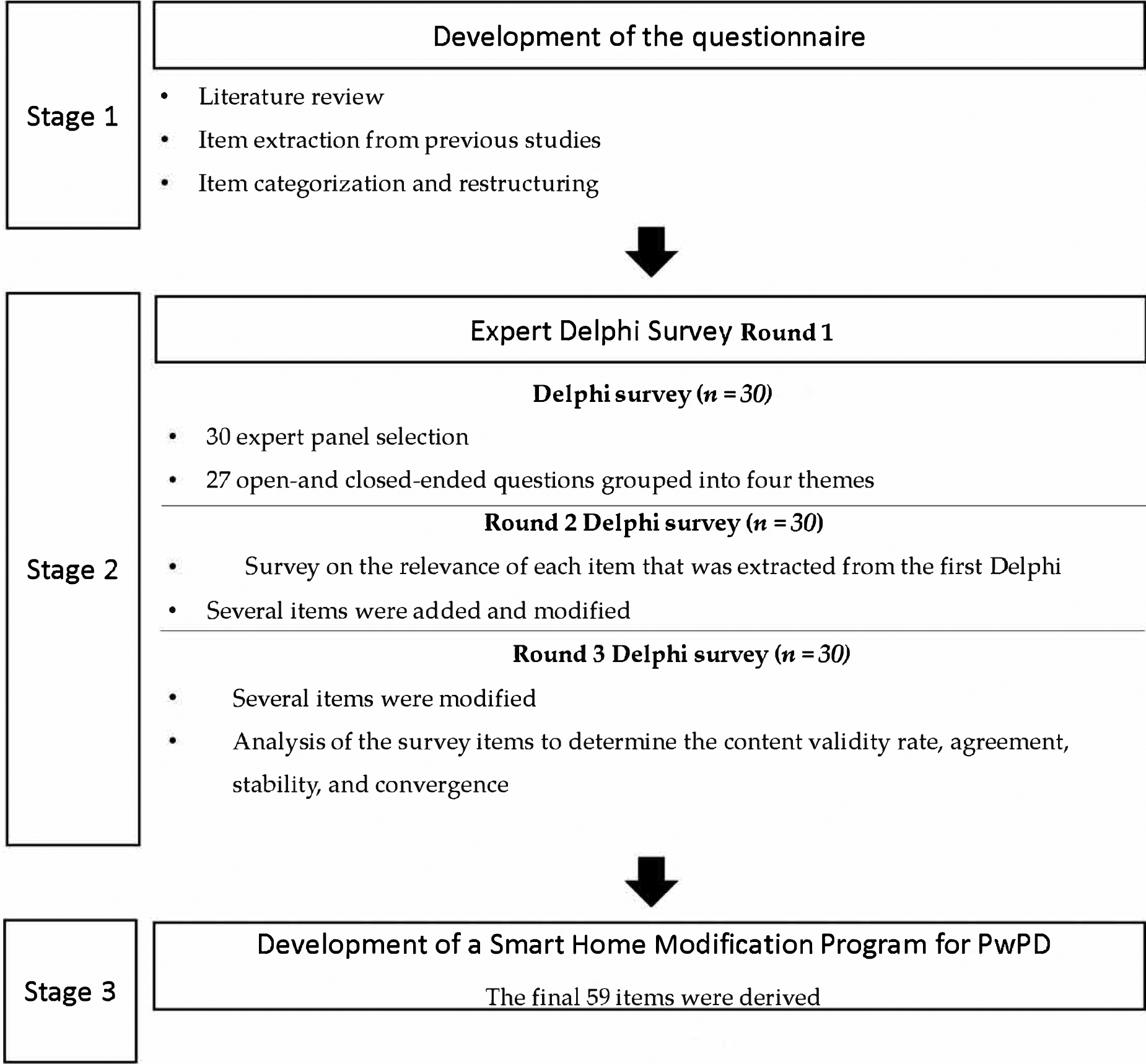
Research process.
In the first round of the survey, 26 open-ended questions were divided into four themes. The questions were designed to gather expert opinions and account for various types of feedback; they have been introduced into this survey with open-ended questions. Participants were also encouraged to provide additional recommendations or ideas related to the questionnaire. It took approximately 50 to 60 min for the survey to be completed. On the basis of the analysis of the participants’ feedback in Round 1, we developed a new survey for Round 2. A total of 59 closed-ended questions were included in the study, grouped into four categories—occupation, physical, environment, and smart home AT. Participants received the survey by e-mail and were required to rate the relevance of each proposed element using a 5-point Likert scale ranging from 1 (strongly irrelevant) to 5 (strongly relevant). Moreover, in addition to the questions asked in Round 1, 32 new items were included in Round 2. A total of 59 items achieved an 85% agreement rate. As stated by Sempik et al. (2003) and Lee (2001), the level of consensus was set at 80% of respondents indicating agreement. There was already a high level of agreement in the second round, with a coefficient of variation of .18, so there was no need for additional rounds. Round 3 was conducted to confirm the content validity ratio (CVR) values of the five items with high average scores.
Participants could access and complete the first, second, and third questionnaires by e-mail. In the next round, feedback from previous rounds was summarized and presented to experts. This iterative process continued until a consensus was reached on the program’s major components. The survey lasted 4 wk, and reminder messages were sent to participants who had not responded the day after the deadline to maximize the response rate.
Data Analysis
Experts presented their opinions and analyzed them in the first Delphi survey through content analysis to identify common elements. Subtopics were added, and unclear expressions were cleaned up. We used CVRs to analyze secondary and tertiary outcomes. The minimum value of CVR was determined on the basis of the number of experts participating in each round. On the basis of the established criteria, all items had a CVR value of .33 for secondary and tertiary experts. The coefficient of variation was analyzed by dividing the standard deviation for each item by the arithmetic mean. A coefficient of variation less than .5 indicates that a Delphi study is no longer needed (a range of .5–.8 indicates relative stability). The convergence index indicates the level of agreement among experts in a Delphi survey. A smaller convergence index indicates a smaller range of expert opinions (Lawshe, 1975; Lee, 2001).
Experts were asked open- and closed-ended questions in each round related to the smart home program’s activity areas, program components, and program processes. To ensure convenience and accessibility for the expert panel, the Delphi survey was conducted electronically.
Results
Demographics of the Panel Experts
We invited 34 potential participants, of which 30 provided written consent. During the three phases, all 30 experts who participated in the study completed the first, second, and third surveys without any withdrawals. Table 1 presents the characteristics of the final sample of 30 participants. Among the participants, 16 (53%) were female, and 14 (47%) had more than 10 yr of experience in their respective fields. The expert panel included professionals from a diverse range of disciplines, such as occupational therapists, social workers, engineers, nurses, and researchers. Each member brought to the panel their unique expertise in dealing with different types of disabilities, as well as their experience with various smart home technologies.
Demographic Characteristics of the Respondents
Note. N = 30. Response rate = 100%.
Results of Round 1
The first round of the survey included 26 open-ended questions divided into four groups. The first open-ended survey reduced the initial 26 items to 22. During home modification in which smart home technology is considered, the “kitchen” and “balcony” items were removed because of insufficient application of smart home technology in Korea. Additionally, the “perception of discomfort in the living environment” item was removed, because it was anticipated that most users would encounter discomfort. Last, the ‘connection’ item was eliminated based on information that could be obtained from the “use of information and communication” item. (Figure 2).
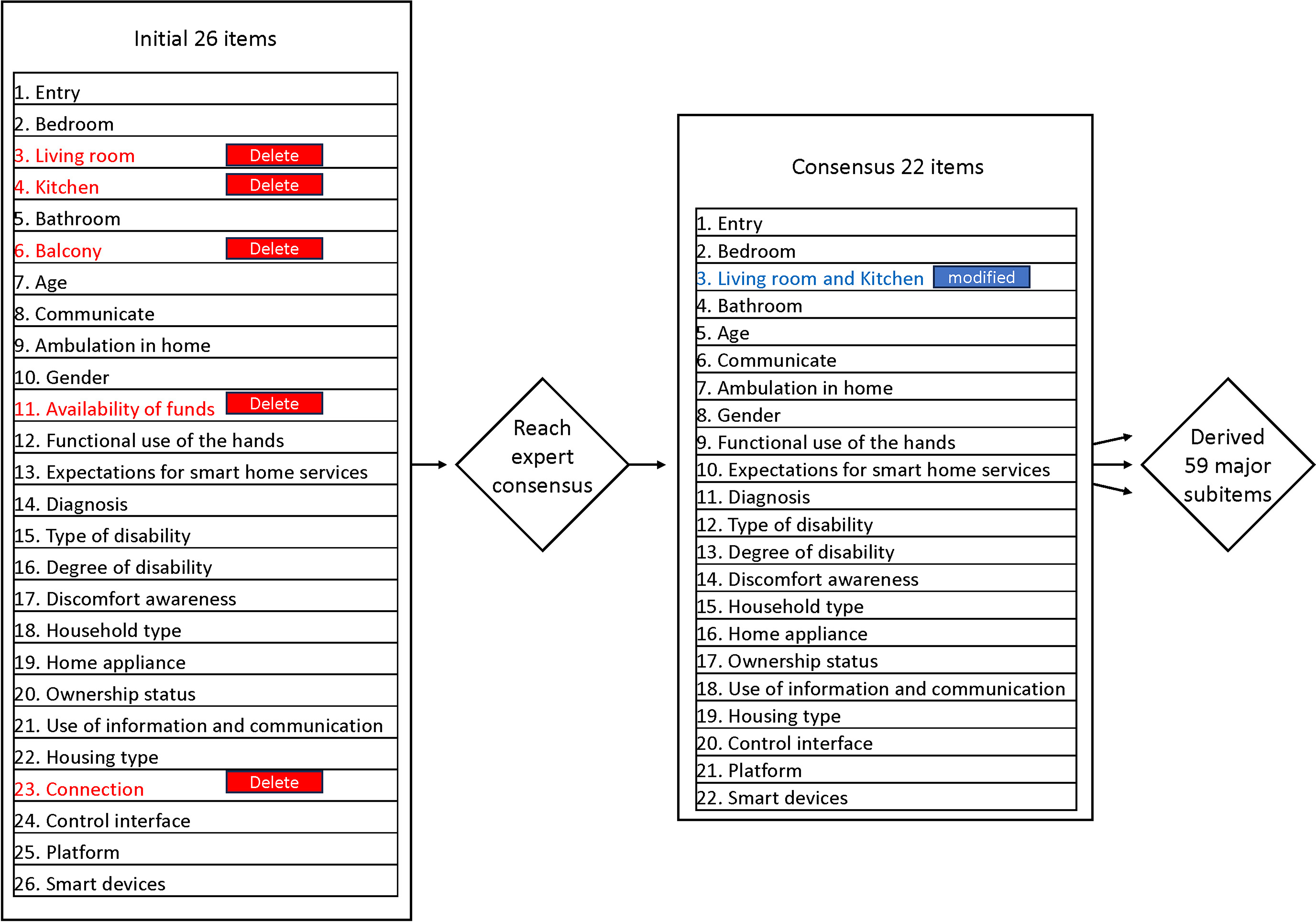
Round 1 results: the process of reducing the initial 26 items to 22 items.
Results of Round 2
The categories and items included in the Delphi panel survey are listed in Table 2. The content validity was verified in the occupation, physical, environment, and smart home AT for PwPD with a CVR > .33. There was already a high level of agreement in the second round, with a coefficient of variation of .18, so there was no need for an additional round. However, additional rounds were needed to confirm the CVR values of the five detailed items (Items 7, 10, 25, 31, 42) with high average scores.
Contents of the Smart Home Modification for People With Physical Disabilities in the Survey for Rounds 2–3
Note. CVR = content validity ratio of all subitems; IOS = iPhone operating system; OS = operating system.
Additional rounds were needed to confirm the CVR values of the five detailed items (Items 7, 10, 25, 31, and 42) with high average scores.
Results of Round 3
Participants articulated their assessments by assigning an overall percentage to gauge the appropriateness of each item. This was further supported by scores on the basis of statements from the preceding round where consensus was absent—specifically, five discrepant statements—and the subsequent statistical analysis of the second round. A provision for correction was also made. Of the 59 items scrutinized, none exhibited a minimum CVR of less than <.33. As depicted in Table 3, the CVR—along with the coefficient of variation, consensus, and convergence—manifested relatively high levels. Notably, all statements discussed in this round achieved unanimous agreement among the participants.
Average Opinions of the Expert Panel
Note. N = 30. CV = coefficient of variation; CVR = content validity ratio of all subitems.
Discussion
This Delphi study produced a series of statements that may be useful in developing smart home environment modification programs for PwPD.
It was conducted over three rounds, and the CVRs for most items increased or remained constant from Round 2 to Round 3, indicating a growing consensus among experts that these items are important in designing smart home environments for PwPD.
This study differentiates itself from existing research by emphasizing the importance of occupation-based smart home features. Although previous analyses by Chen et al. (2023) and Islam et al. (2022) focused on the feasibility of implementing smart home technologies and systems, this study conducted tasks in each space, addressing the importance of this in more detail. The smart home is an important element, because AT for participation in occupation depends on the area. Research has shown that the application of environmental modifications that are appropriate to the functional level and the activities of disabled people or older adults with physical limitations (Gitlin, 2003) can reduce environmental pressures on adults and older adults, making the home a place of security and safety (Tanner et al., 2008), improving protection and increasing the ability to perform daily activities (Aplin et al., 2015), reducing the burden on caregivers such as family, and bringing about positive changes in relationships with others (Gitlin et al., 2001). Although there is evidence that it influences the creation of a satisfying daily life, there is a lack of research examining smart home AT, occupation, physical function, and environmental factors. In this study, the expert panel agreed on the core elements of smart home AT and tasks, physical functions, and environmental factors to be included as key elements of smart home environment modifications for PwPD. Verdonck et al. (2014) pointed out that smart homes are an important environmental modification method for independent performance of ADLs and should be applied early.
The high CVR for each home space detail item indicates a strong consensus among experts that these tasks are important in a smart home environment for PwPD. Our findings affirm the earlier research by Elçi et al. (2021), emphasizing that the functions to open and close the front door, as well as operate the door lock, significantly influence daily safety and accessibility and, therefore, should be given priority in smart home environment design. Items such as managing windows and curtains or blinds, managing food and meals, and controlling home appliances are critical for privacy, comfort, and user independence. Likewise, personal hygiene tasks in the bathroom are key for maintaining user dignity. Therefore, smart home AT should support these functionalities (Thapliyal et al., 2017). These task-based items provide disabled users with the opportunity to manage their lives better, interact with their surroundings, and live independently.
Physical aspects such as age, gender, communication, moving around the house, hand function, and expectations of smart home services are very important parts of modifying the smart home environment. The high agreement on these items suggests that smart homes should carefully reflect individuals’ physical characteristics and functional needs. Specifically, age can influence a user’s accessibility and comprehension of technology. Thus, modifications in smart homes must offer an intuitive, user-friendly interface, considering the ease of use for each age group (Zhang et al., 2009). Effective interaction between the user and the smart home is directly affected by communication and the functional use of hands. Therefore, user interface selection is crucial, allowing easy operation of smart devices. Although smartphones and remote controls are convenient, they can be inconvenient to carry or find when needed. As research on gesture-based user interfaces suggests (Bhuiyan & Picking, 2011; Kim et al., 2011; Kühnel et al., 2011; Neßelrath et al., 2011; Ng et al., 2011), an appropriate control interface is important to consider the user’s hand function when choosing. Additionally meeting user expectations is key to improving user experience and motivation. Smart home environment modifications must reflect users’ physical characteristics and abilities, meet their needs, and provide a convenient and accessible environment for all users. This foundation allows smart homes to go beyond simple technology products and become important tools that improve users’ quality of life.
The expert panel agreed that environmental factors are key in modifying the smart home environment. Single-family households may require technology that is tailored to the individual’s specific needs, whereas multiperson families should consider flexible solutions that can meet the demands of multiple users simultaneously (Shirali et al., 2020). Our findings, supported by the research of Moon, Lee, et al. (2022), demonstrate that using information and communication technologies, such as personal devices, is essential for effective interaction with smart homes. A Bluetooth-based smart home kit should be configured if the Internet is unavailable. In Korea, which has a high apartment culture, smart home services have recently been provided in new apartments. Accordingly, apartment residents wanted extensive and precise control rather than automation (Yang et al., 2018). Additionally, because single-family homes do not provide networked and automated functions to control the household, homeowners may want the automation and reliability of smart home services. These environmental considerations suggest that smart home environment modifications for PwPD should be deeply tailored to technical aspects and the environment in which users live (Ma et al., 2022). The application of smart home AT should proceed in a direction that understands the context of users’ lives, respects their living space as much as possible, and improves the convenience and quality of life through technology.
The expert panel agreed that Smart Home AT is a core part of the smart home environment to support the daily lives of disabled users. Control interfaces such as touchscreens, smart speakers, remote controls, and large switches allow users to manipulate the environment without physical constraints. These interfaces must be intuitive and user-friendly so users can easily access and use them. Smart home platforms such as SmartThings, LG ThinQ, Hejhome, and GigaGenie help users manage their smart homes more efficiently by integrating various devices and services. These platforms enable customization and automation tailored to users’ needs, giving them more control over their environment. Smart devices such as sensors, smart plugs, and smart home appliances allow users to monitor their environment in real time and take appropriate actions. Door sensors can improve accessibility while enhancing security, and smart plugs can help users manage their energy use more efficiently (Isyanto et al., 2020; Mtshali & Khubisa, 2019; Tajadod et al., 2021).
In Korea, a multidisciplinary team is formed to conduct a home environment modification program for discharge planning at rehabilitation medical institutions (Moon, Jang, et al., 2022). Individuals with physical disabilities because of stroke or spinal cord injury have an increased need for sensor lighting, dimming, improved outlet accessibility, and automatic doors. Their living environments are often quite difficult because of home modification. However, smart home ATs are not widely viewed as essential medical devices by rehabilitation professionals, which results in low adoption rates (Lee et al., 2015; Lim & Lee, 2013). In the “new normal” era, the need and demand for building new home environments, such as home automation systems for PwPD, is increasing (Bae, 2020; Cha, 2021). Therefore, the participation of various sectors and stakeholders is necessary to apply PwPD to smart homes. To achieve this, it is essential to introduce a smart home environment modification program that is tailored to the daily lives of PwPD by incorporating smart home AT into existing home environment modification programs.
The key elements can help occupational therapists apply smart home modifications for PwPD. First, the need to develop a smart home modification program must be recognized. To our knowledge, this study is the first Delphi study to identify key elements of modifying the smart home for PwPD. On the basis of the 59 key features agreed on by the expert panel, the user’s tasks, physical functions, environmental factors, and smart characteristics can be used in future smart home design, emphasizing the importance of home AT.
Second, we must aim to improve practical daily life through smart home technology. Unlike previous studies that focused on the possibilities of smart home technology, this study presents PwPD’s specific space-specific activities, smart home AT, physical functions, and environment. Through this, it is necessary to understand that smart home technology can improve the independence and quality of life for PwPD and develop programs tailored to this.
Third, the social acceptance of smart home technology must be enhanced, and a multidisciplinary approach must be strengthened. As shown in this study, PwPD are highly aware of the discomfort caused by their housing structures and are willing to modify their homes to improve them. However, these technologies are not fully used because of a lack of awareness of the necessity and utility of smart home AT. Therefore, it is time to raise social awareness of the benefits of smart home AT and establish a smart home environment modification program that meets the needs of PwPD through teamwork involving experts from various fields. This will support PwPD in leading safer and more independent lives through smart home technology.
This study shows a growing consensus among experts about the importance of home modifications and smart home AT to improve the quality of life of PwPD. The participating experts were active in both clinical settings and research. Therefore, they may have used clinical and research experience to evaluate the statements. We did not conduct face-to-face meetings with participants to discuss ratings and discrepancies between Delphi rounds. This allowed panelists to respond without bias and pressure from others. These results can be leveraged to integrate these items into smart home designs to ensure an environment that is functional, inclusive, and supports users’ independence and well-being.
Implications for Occupational Therapy Practice
The results of this study have the following implications for occupational therapy practice: ▪ Using smart home ATs to create personalized living spaces that increase the autonomy of PwPD should be considered as a means of promoting greater independence in performing daily activities. ▪ Occupational therapy plays a critical role in overcoming barriers to technology adoption and uptake by educating PwPD on the features and benefits of smart home technologies. ▪ This emphasizes the importance of interdisciplinary teamwork in developing and evaluating smart home modifications. ▪ If current health care or reimbursement policies limit the feasibility of smart home interventions, occupational therapists can advocate for policy changes that increase the accessibility of these technologies for PwPD.
Conclusion
The Delphi method was used to reach a consensus on important aspects to consider when improving smart home environments for people with physical disabilities. Through this process, we agreed on 59 items that were divided into four categories. These items can help people with physical disabilities configure their smart homes and can help identify people who may need more extensive environmental modifications and interventions.