





Abstract
This scoping review explored the development of a doctoral capstone research agenda that articulates best practices as well as the distinct purpose and value of the doctoral capstone in occupational therapy education and for the profession.
In entry-level occupational therapy doctoral (OTD) degree programs, the capstone is an essential curricular component that allows students to engage in an individual project and gain experience by providing in-depth exposure on a specific topic. Entry-level OTD programs have existed since 1999 (at Creighton University), and the doctoral capstone has been incorporated into the curriculum according to Accreditation Council for Occupational Therapy Education (ACOTE®; 2007) 2006 standards. As of 2023, there were 219 OTD programs (90 accredited, 71 candidate or preaccreditation, and 58 applicant programs), representing more than 32% of all occupational therapy programs across the country. For this article, we conducted a scoping review of the literature to examine the essential elements of the entry-level OTD doctoral capstone; to understand best practices in the development, implementation, and assessment of the doctoral capstone; and to identify gaps in evidence related to the entry-level OTD doctoral capstone. Our intent was to gain an understanding of what research evidence and gaps currently exist related to the doctoral capstone so as to guide the development of a research agenda.
Research Agenda Background
A research agenda—the identification and prioritization of specific research and pertinent research questions—can provide a framework for engaging in clinically relevant research and establishing a robust knowledge base for a practice, profession, or topic (Lee et al., 2022). A research agenda serves as a means for prioritizing future research on the basis of current questions about or known gaps in evidence or clinical practice (Lee et al., 2022). The goal of a research agenda is not to undermine or devalue any one person within the research process but rather to provide a plan so the needs of the profession can be met (American Physical Therapy Association, 2000). The result can be a body of rigorous and cumulative evidence for a practice, profession, or topic. In health disciplines, including allied health fields and the medical community more broadly, research agendas are often responsible for informing funding and resource allocation decisions (Lee et al., 2022). A research agenda can move beyond the asking of singular questions in silo and can instead provide a framework for spanning the breadth and depth of a practice, profession, or topic. In this way, it can benchmark the scientific progress made by the collective, which can then drive enhancements and facilitate an understanding of the distinct value of that practice, profession, or topic. This is especially important for a profession such as occupational therapy, which is rooted in evidence-based practice that values both clinical expertise and the integration of the best available evidence when making decisions (Marr, 2017).
Occupational Therapy Education Research Agenda
The Occupational Therapy Education Research Agenda (American Occupational Therapy Association [AOTA], 2018) was created to identify and prioritize research goals for occupational therapy education. It is organized into seven major categories: (1) theory building; (2) signature pedagogies; (3) instructional methods; (4) learner characteristics and competencies; (5) socialization to the profession; (6) faculty development and resources; and (7) promotion of diversity, equity, and inclusion throughout the education pipeline and in curricula that are important for driving research activities. Although experiential learning can be considered in several of these categories, it is important to call out the importance of broadening and specifically addressing the need for research in this specific area. As AOTA (2023) mentioned in its statement about the purpose and value of the doctoral capstone, there is a lack of evidence both globally, about the doctoral capstone, and more specifically, about identifying the distinct purpose and value of the doctoral capstone. A doctoral capstone research agenda can help prioritize and guide research that can supplement the current paucity of evidence.
In a review of the revised version of the Occupational Therapy Education Research Agenda, five major categories were identified as being specific and relevant to the doctoral capstone. (Appendix A contains a comparison of categories across the research agendas.) The Occupational Therapy Doctoral Capstone Research Agenda is organized into five categories to drive research activities inclusive of the didactic and experiential learning associated with the whole process of the doctoral capstone, including planning, implementation, and evaluation: (1) teaching and learning; (2) learner characteristics and competencies; (3) shaping professional identity; (4) faculty/mentor development and resources; and (5) promotion of diversity, equity, and inclusion. Appendix B lists the research priorities and sample research questions that exemplify the type of research activity that is pertinent to the Occupational Therapy Doctoral Capstone Research Agenda we created in this review.
The Occupational Therapy Research Agenda (American Occupational Therapy Association & American Occupational Therapy Foundation, 2011) works to “define, refine, and validate occupational therapy best practice models” (Bear-Lehman, 2012, p. 251). With this in mind, it is our hope that this Occupational Therapy Doctoral Capstone Research Agenda will both inform the process of collecting evidence about the occupational therapy doctoral capstone and facilitate the assessment of its distinct value and resulting best practices.
The Occupational Therapy Research Agenda served as a guide throughout the process of reviewing doctoral capstone evidence and creating a doctoral capstone research agenda. We conducted a scoping review as we sought to understand the current evidence and gaps related to the doctoral capstone. We sought to use the Occupational Therapy Research Agenda, overlaid with the results of our scoping review, to develop this Occupational Therapy Doctoral Capstone Research Agenda.
Method
Our comprehensive scoping review addressed key research questions, including the identification of essential elements of the entry-level OTD capstone; exploration of best practices in development, implementation, and assessment of the doctoral capstone; and identification of gaps in the evidence related to the entry-level OTD doctoral capstone. We used the Preferred Reporting Items for Systematic reviews and Meta-Analyses extension for Scoping Reviews reporting guidelines (Tricco et al., 2018) to conduct the scoping review. We also performed a content analysis as part of the scoping review to enhance the depth of understanding and insights we derived from the gathered literature.
Identification of Relevant Studies
We searched the peer-reviewed literature published between 1999 and June 2023 using four databases: CINAHL, PsycINFO, PubMed, and Embase. To ensure all appropriate articles were included, we also completed a hand search of the articles’ reference lists for potential inclusion. The search strategy included the following keywords: occupational therapy OR occupational therapy doctorate AND doctoral capstone OR capstone OR capstone education OR doctoral experience OR capstone experience NOT baccalaureate NOT post professional.
Articles were included if they met the following four criteria: (1) described the entry-level doctoral capstone, (2) focused on entry-level doctoral capstones within the U.S. context, (3) were peer reviewed and published between 1999 and 2023, and (4) were written in English.
Articles were excluded for any of the following six reasons: (1) focused on the perspective of the postprofessional doctoral capstone; (2) were not located within the U.S. context; (3) the full text was not available in English; (4) focused on perspectives of health care providers outside of occupational therapy; (5) was a nonscientific article, study protocol, conference abstract, dissertation or thesis, editorial, poster, or commentary; and (6) was published in a nonacademic journal.
Study Selection
We used a systematic approach to retrieve articles from the four databases, and we organized the downloaded articles in an electronic folder. After we removed duplicates, the articles underwent a thorough evaluation based on predefined inclusion and exclusion criteria we had established. We independently screened abstracts and titles, categorizing them as “yes,” “no,” or “maybe,” with any discrepancies resolved through discussion. Persistent disagreements led to the retention of the article for full-text review. Abstracts that did not meet the inclusion criteria were excluded from further consideration. The eligibility of full-text articles was assessed, and both authors conducted a comprehensive review of each article. Next, we conducted a hand search of reference lists to identify additional references beyond the initial database search. We applied the same screening approach to the identified references. This process continued until no new references were discovered. The search and selection process is depicted in Figure 1.
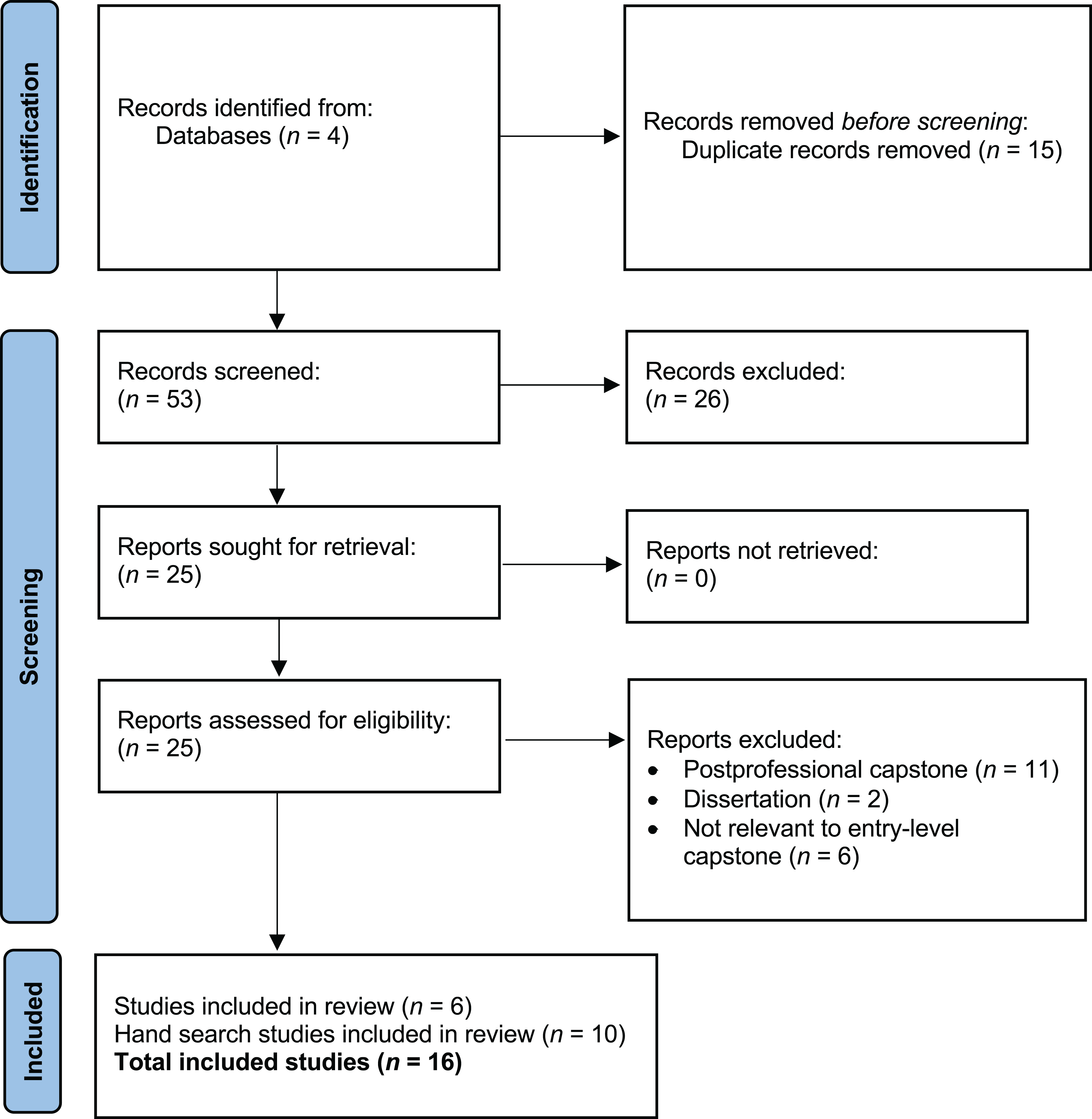
Flow of articles through the PRISMA-ScR process.
Results
We reviewed 16 articles to answer the research questions, which addressed the identification of essential elements of the entry-level OTD capstone; exploration of best practices in development, implementation, and assessment of the doctoral capstone; and identification of gaps in the evidence related to the entry-level OTD doctoral capstone. After reviewing the articles, we organized the themes into five categories to drive research activities inclusive of the didactic and experiential learning associated with the planning, implementation, and evaluation of the doctoral capstone process. As mentioned, the five categories were (1) teaching and learning; (2) learner characteristics and competencies; (3) shaping professional identity; (4) faculty/mentor development and resources; and (5) promotion of diversity, equity, and inclusion. In addition, the articles were reviewed for identified gaps in the literature to inform the development of the research agenda.
The majority of articles retrieved were categorized as providing a primarily low quality of evidence according to the Oxford Centre for Evidence-Based Medicine (2009). Table 1 lists the themes that emerged. Teaching and learning were identified in 8 of the 16 articles (AOTA, 2023; Clair et al., 2022; Delbert et al., 2020; Kemp et al., 2020, 2021; Kiraly-Alvarez et al., 2022; Rivera et al., 2022; Stephenson et al., 2020). Examples included the pedagogy/heutagogy, instructional design, instructional methods, and instructional environments used to promote learning related specifically to the doctoral capstone. Learner characteristics and competencies were identified in 6 of the 16 articles (AOTA, 2023; Clair et al., 2022; Kemp et al., 2022; Rivera et al., 2022; Smallfield & Wood, 2019; Stephenson et al., 2020). Examples encompass the individual learner attributes, including abilities, experience, and personal or professional identity, that influence and can be influenced by the learning environment. Shaping professional identity was found in 11 of the 16 articles (Bekmuratova et al., 2022; Clair et al., 2022; Kemp et al., 2021, 2022; Kiraly-Alvarez et al., 2022; Kreider-Letterman & Schmelzer, 2021; Kroll et al., 2022; Recigno et al., 2020; Rivera et al., 2022; Smallfield & Wood, 2019; Stephenson et al., 2020). Examples include recognizing the multitude of dynamic influences (student/mentor/site/occupational therapy program knowledge, skills, abilities, culture) that shape the individual student’s professional identity as well as the collective profession’s scope and identity. Faculty/mentor development and resources were identified in 10 of the 16 articles (AOTA, 2023; Clair et al., 2022; Delbert et al., 2020; Harris et al., 2023; Kemp et al., 2020; Kreider-Letterman & Schmelzer, 2021; Rivera et al., 2022; Smallfield & Wood 2019; Stephenson et al., 2020, 2023). This includes how mentors acquire the knowledge, skills, and attitudes necessary to support the doctoral capstone process. The category also includes processes and resources that support academic and site mentors to develop the knowledge, skills, and capacity needed to mentor doctoral students through the capstone process. Promotion of diversity, equity, and inclusion was identified in 2 of the 16 articles (Bekmuratova et al., 2022; Kreider-Letterman & Schmelzer, 2021); this category refers to the aim of exploring these dynamic constructs as the outcome of the doctoral capstone for students, sites, programs, and the profession. In this way, the promotion of diversity, equity, and inclusion can be both a means to and an end of the doctoral capstone.
Occupational Therapy Doctoral Capstone Scoping Review Themes
Note. 1 = teaching and learning; 2 = learner characteristics and competencies; 3 = shaping professional identity; 4 = faculty/mentor development and resources; 5 = promotion of diversity, equity, and inclusion.
Oxford Centre for Evidence-Based Medicine (2009).
Discussion
With this scoping review, we are bringing forth a research agenda that clearly articulates the purpose and value of the doctoral capstone that aligns with the Occupational Therapy Education Research Agenda. The Occupational Therapy Research Agenda served as a guide throughout the process of reviewing doctoral capstone evidence and creating specific focus questions for this agenda. Our review of the evidence identified current gaps in the research. The Occupational Therapy Research Agenda, overlaid with the results of the scoping review, supported the development of the themes, goals, and specific questions. The overarching goals represent the most prominent aspects of the research category that emerged from the evidence. We intentionally crafted sample research questions to offer a starting point for engagement with the research agenda and to build the evidence that supports the distinct value of the doctoral capstone for the occupational therapy profession.
Occupational Therapy Doctoral Capstone Research Agenda
Teaching and learning are inclusive of the pedagogy/heutagogy, instructional design, instructional methods, and instructional environments used to promote learning related specifically to the doctoral capstone. We identified three goals related to teaching and learning: Identify, evaluate the implementation of, test the effectiveness of, and analyze the heutagogy appropriate for the doctoral capstone (i.e., backward design). Identify best practices in instructional methods of the capstone process. Identify the impact and influence of doctoral-level training on occupational therapy education teaching and learning practices.
Learner characteristics and competencies encompass the individual learner attributes, including abilities, experience, and personal or professional identity, that influence and can be influenced by the learning environment. We identified four goals related to learner characteristics and competencies: Identify characteristics that are needed for success across the doctoral capstone (i.e., self-directed learning). Identify specific skill development and added value resulting from each doctoral capstone category (i.e., program development, research, education). Identify supports for and barriers to collaborations among students and mentors, academic mentors, and students. Create and assess evaluative tools for measurements of doctoral capstone outcomes.
Shaping professional identity recognizes the multitude of dynamic influences (student/mentor/site/occupational therapy program knowledge, skills, abilities, culture) that shape the individual student’s professional identity as well as the collective profession’s scope and identity. We identified four goals related to shaping professional identity: Shape professional identity outside of traditional practice areas, from the level of student, mentor, or profession. Understand the impact of the doctoral capstone and how it shapes the global, diverse, and effective occupational therapy workforce. Identify points of influence of the doctoral capstone on professional identity. Understand the impact of the doctoral capstone on the pillars of Vision 2025 (AOTA, 2017).
Faculty/mentor development and resources influence how mentors acquire the knowledge, skills, and attitudes to support the doctoral capstone process. This category includes processes and resources that support academic and site mentors to develop the knowledge, skills, and capacity needed to mentor doctoral students through the capstone process. We identified four goals related to faculty/mentor development and resources: Identify the recommended resources that can meet the educational needs of students, mentors, and sites. Establish effective methods to prepare mentors to implement best practices in the doctoral capstone process. Evaluate the impact of doctoral capstones on programmatic scholarship agendas. Understand the essential functions of the doctoral capstone and develop resources to support workforce development.
Promotion of diversity, equity, and inclusion refers to the aim of exploring these dynamic constructs as the outcome of the doctoral capstone on the students, sites, programs, and profession. In this way, the promotion of diversity, equity, and inclusion can be both a means to and an end of the doctoral capstone. We identified one goal related to the promotion of diversity, equity, and inclusion: Evaluate the impact of the doctoral capstone on the following: ° improved access to occupational therapy services ° increased awareness of health disparities across practice contexts ° development of the practice of cultural humility by students, sites, and mentors ° effective services for diverse individuals, groups, and populations ° effective programs for ensuring the success of students with disabilities ° preparing diverse candidates trained at the doctoral level for faculty, leadership, and management positions.
Implications for Occupational Therapy Education
In this article, we have outlined the Occupational Therapy Doctoral Capstone Research Agenda so the profession can continue to identify the distinct value and purpose of the doctoral capstone. In line with what was identified in the Occupational Therapy Education Research Agenda, “It is important that occupational therapy educators not only draw on education research outside the profession but also develop occupational therapy’s own body of research” (AOTA, 2018, para. 10) as they relate to the doctoral capstone. To distinguish between the master’s and doctoral entry-level points of occupational therapy education, a body of research needs to be developed that will contribute to an understanding of how the capstone can further develop the profession across contexts. This Occupational Therapy Doctoral Capstone Research Agenda provides an array of areas in which research is needed to inform the distinct value and purpose of the doctoral capstone for students, sites, programs, and the profession.
Conclusion
The development of a research agenda for the doctoral capstone is a critical step in advancing the field of occupational therapy education. By identifying and prioritizing specific research goals, the Occupational Therapy Doctoral Capstone Research Agenda aims to provide a structured plan for future research related to the doctoral capstone. This agenda was built on a comprehensive scoping review that identified five key categories pertinent to the doctoral capstone: teaching and learning; learner characteristics and competencies; shaping professional identity; faculty/mentor development and resources; and promotion of diversity, equity, and inclusion.
The agenda provides a road map for generating valuable insights and best practices that will inform educational strategies, mentor development, and student outcomes. The implementation of this research agenda can yield a body of rigorous and cumulative evidence that enhances the quality and impact of occupational therapy doctoral capstones. This, in turn, can support the profession’s commitment to evidence-based practice and can support the profession in meeting the needs of diverse populations and practice contexts. This research agenda offers a clear and actionable framework for researchers, educators, practitioners, and students to collaborate and contribute to the collective knowledge base of the doctoral capstone within occupational therapy education.
Footnotes
*Indicates studies included in the scoping review.
Appendix B. Research Categories, Major Research Goals, and Sample Research Questions in the Occupational Therapy Doctoral Capstone Research Agenda
| Research Category | Major Research Goals | Sample Research Questions |
|---|---|---|
| Teaching and learning | • Identify, evaluate the implementation of, test the effectiveness of, and analyze the heutagogy appropriate for the doctoral capstone (i.e., backward design) • Identify best practices in instructional methods of the capstone process • Identify the impact and influence of doctoral-level training on occupational therapy education teaching and learning practices |
• What curriculum designs (or methods, or instructional processes) best support successful capstones? • What heutagogy/andragogy best supports successful capstones? • What constitutes effective heutagogy/andragogy for the capstone (i.e., assessment)? |
| Learner characteristics and competencies | • Identify characteristics that are needed for success across the doctoral capstone (i.e., self-directed learning) • Identify specific skill development and added value resulting from each doctoral capstone category (i.e., program development, research, education) • Identify supports for and barriers to collaborations among students and mentors, academic mentors, and students • Create and assess evaluative tools for measurements of doctoral capstone outcomes |
• What learner characteristics or needs relate to student success in the capstone? • What is the longitudinal impact of mentorship on student performance, knowledge, or skills, from student to entry-level practitioner and beyond? • What supports (to sites, to students, to mentors) are needed for student success in the capstone? • What evaluative tools for measurement are needed for programs to understand the impact and value of the doctoral capstone? |
| Shaping professional identity | • Shape professional identity outside of traditional practice areas, from the level of student, mentor, or profession • Understand the impact of the doctoral capstone and how it shapes the global, diverse, and effective occupational therapy workforce • Identify points of influence of the doctoral capstone on professional identity • Understand the impact of the doctoral capstone on the pillars of Vision 2025 |
• What skills or knowledge gained through the capstone support nontraditional practice? • What professional contributions does the doctoral capstone bring to developing roles in nontraditional settings? • How does the doctoral capstone support access and exposure to occupational therapy for underrepresented minority groups? • How does the doctoral capstone support the development of the student’s professional identity? • How do doctoral capstone outcomes demonstrate or support that the profession is evidence based, client centered, and cost-effective? • How do doctoral capstone outcomes demonstrate or support change in policies, environments, or complex systems? • How do doctoral capstone outcomes demonstrate or support the value of occupational therapy to various stakeholders? |
| Faculty/mentor development and resources | • Identify the recommended resources that can meet educational needs of students, mentors, and sites • Establish effective methods to prepare mentors to implement best practices in the doctoral capstone process • Evaluate the impact of doctoral capstones on programmatic scholarship agendas • Understand the essential functions of the doctoral capstone and develop resources to support workforce development |
• What supports (to sites, to students, to mentors) are needed for student success in the capstone? • What constitutes effective mentorship in the capstone process? • What constitutes effective support in building the necessary mentorships in the capstone process? • How do doctoral capstones contribute to the program’s scholarly agenda? • What essential functions are needed for the role of the doctoral capstone? |
| Promotion of diversity, equity, and inclusion | • Evaluate the impact of the doctoral capstone on the following: ° improved access to occupational therapy services ° increased awareness of health disparities across practice contexts ° development of the practice of cultural humility by students, sites, and mentors ° effective services for diverse individuals, groups, and populations ° effective programs for ensuring the success of students with physical disabilities ° preparing diverse candidates trained at the doctoral level for faculty, leadership, and management positions |
• What is the impact of the doctoral capstone on improving access to occupational therapy services? • What is the impact of the doctoral capstone on increasing awareness of health disparities? • What is the impact of the doctoral capstone on the development of cultural humility among students, sites, and mentors? • Has the doctoral capstone provided opportunities for training and preparing students for faculty, leadership, and management positions? |