





Abstract
This study found that autistic preschoolers face physical and social barriers to outdoor play and that they need parents, schools, and communities to create supportive and inclusive play environments and opportunities for freedom of expression.
Play is widely recognized as the primary occupation of childhood, a window into children’s well-being and development, and a human right for all children (Lynch & Moore 2016; United Nations Committee on the Rights of the Child [UNCRC], 2013). In particular, the importance of unstructured free play in the lives of all children was acknowledged by the UNCRC (2013) in recognition of its essential contribution to a healthy childhood. Within this context, the need to understand young children’s views and preferences in relation to free, unstructured play has become essential if occupational therapy practitioners are to truly understand diverse play needs of the children they serve. Studies have highlighted children’s preference for playing outdoors (Lynch, 2023) and indicate that children enjoy opportunities there for physical movement and situations that challenge them (Fahy et al., 2020; Miller & Kuhaneck, 2008; Sandseter, 2009), with the natural world affording greater opportunities for risky play in comparison with built or indoor environments (Sandseter, 2009). For clinicians who value family- centered practice, understanding outdoor play challenges and the preferences of children with disabilities is therefore an important consideration (Coughlan & Lynch, 2011).
Autism spectrum disorder is one of the most prevalent worldwide neurodevelopmental disorders (Boyd et al., 2010), and play has been a particular focus of study because of the social and communication challenges experienced by autistic children. Although much of this research has been experimental or comparative in nature, a growing body of knowledge about autistic play culture itself is emerging (Ray-Kaeser et al., 2017). Autistic play has its own unique characteristics and differences. For example, in unstructured play situations autistic children demonstrate higher incidences of sensory play with objects than functional or pretend play (Dominguez et al., 2006; Kangas et al., 2012; Manning & Wainwright, 2010), and they often gravitate toward materials that provide intense and explicit sensory feedback as well as repetitive motions (Doody & Mertz, 2013). These play styles and differences in play preferences can cause restrictions in their play participation with other children (Kuhaneck et al., 2020; Ray-Kaeser et al., 2017) and can result, for example, in the avoidance of outdoor play at school or in the community (Lynch et al., 2018). However, outdoor play offers children the opportunity to build social skills (Ripat & Becker, 2012) and increase confidence and self-esteem (Bloeman et al., 2015), as well as enhance motor and cognitive skills (Gill, 2014). Therefore, the potential avoidance of outdoor play is a societal concern because significant evidence exists demonstrating the benefits for child development and family life (Tremblay et al., 2015; Wyver et al., 2010).
Although many researchers have described the characteristics of autistic play, the perspectives of autistic children remain one of the most underrepresented viewpoints in the literature (Pritchard-Rowe et al., 2023). Recent efforts to address this gap are evident in studies that have prioritized the autistic voice, to understand autistic play from a neurodiversity-informed perspective (see, e.g., Conn, 2015; Fahy et al., 2020; Pritchard-Rowe et al., 2023). However, the voices of autistic children are not yet well represented in studies of outdoor free-play participation, where parent or carer self-report measures, or reflections from older autistic people, rather than observations from the child’s perspective, are commonly relied on (Fahy et al., 2020). Without this knowledge, therapists may revert to traditional developmental approaches when addressing autistic play in childhood instead of designing interventions on the basis of evidence of how autistic children engage in play for fun and social participation. Moreover, at a societal level, this knowledge gap continues to contribute to the identified lack of inclusive play provision for autistic children in communities internationally (Lynch et al., 2018, 2019).
To advance our knowledge of autistic play, in this study we used a neurodiversity-informed perspective to explore autistic preschoolers’ outdoor free play. Preschoolers were identified as a special focus of concern because play is “one of the most distinctive features of early childhood” and a dominant force for learning and well-being, in part because of its pivotal role in forming first friendships (UNCRC, 2005, p. 15). Researching the meanings and experiences of play for autistic children is often challenging because of the communicative difficulties associated with autism. Because of this, other methods beyond interviews are needed when seeking to understand the purpose, form, and meaning of autistic children’s play experiences (Conn, 2015; Spitzer, 2003). This requires an exploration of autistic children’s play culture in naturalistic settings, including school and community environments (Holmes & Willoughby, 2005). Therefore, in this qualitative study we aimed to explore autistic preschoolers’ participation in outdoor free play to answer the following two questions: (1) What are the play preferences, opportunities, and challenges of autistic preschoolers in outdoor free play? (2) How is outdoor free play enabled in community and preschool settings? According to the International Classification of Functioning, Disability and Health, Children and Youth Version (World Health Organization, 2007), participation in play is defined as involving oneself with something or someone, in a meaningful play situation, while feeling included and in control (Hoogsteen & Woodgate, 2010, p. 330).
Method
This qualitative study was informed by an ethnographic approach (Spitzer, 2003), sometimes called a microethnography (the study of “small moments” [Erickson, 1995]), to guide the exploration of autistic children’s play culture and inform our understanding of their outdoor play in everyday contexts. A multimethod, child-centered design was developed, combining semistructured interviews with parents, participant observation, walking reflections, behavior mapping, and videography, to create a mosaic of children’s lives (Einarsdóttir, 2005; Spitzer, 2003). The use of diverse child-centered methods in data collection helped position the child’s voice at the center of this study, where voice does not imply words and expressive language but instead refers to insight gained from participant observation and shared occupation (Spitzer, 2003). Qualitative, rigorous observation of play occupation in naturalistic contexts was adopted as a key approach to identifying play preferences because it is evidence of what a child chooses to do when free to do so (Lynch, 2018). Ethical approval was granted by the Social Research Ethics Committee, University College Cork (Log No. 113), with a particular focus on research that has partnered with children and vulnerable persons (Department of Children and Youth Affairs [DCYA], 2012). The research was conducted by Maeve Coughlan, who was supported by two experienced academics who provided research supervision and analytical support. Two members of the team had experience with autism research and practice and had worked directly in special-needs preschool services for more than 20 yr.
Coughlan used a purposive sampling strategy to recruit participants from preschool classes in Ireland for autistic children via the National Council for Special Education. Preschooling for autistic children in Ireland is currently provided in the form of special classes in local primary schools, where six children form a class, supported by an educator and two special-needs assistants. Ten such autistic preschools were identified, and snowball sampling techniques were then adopted for accessing key informants at these preschools, who provided links to individuals interested in the study and who met the inclusion criteria (Teddlie & Yu, 2007). Seven families (not known to Coughlan) from seven different preschools were recruited, consisting of seven parents (mothers) and seven children (N = 14); 6 of the children were male and 1 was female (Table 1). Mothers self-selected as the adult participant because each was the main carer for the child in their family. Children were ages 3–5 yr and used varied communication styles, ranging from gesture/single-word expression (n = 4) to phrased speech (n = 3). Informed parental consent was obtained from parents, who also consented on behalf of their child. A protocol ensuring ongoing assent of child participants was used because of their limited verbal abilities. Child assent was addressed by adopting an ongoing process of observation of behavioral and verbal indicators communicating discomfort or disengagement, which were interpreted as an indication of withdrawing consent.
Participant Information
Note. All children were professionally diagnosed with autism.
Pseudonyms.
Data Generation
The multimethod design was implemented over 3 mo to maximize the children’s participation in the study and to enhance the interpretation of the subjective meaning of outdoor play activities for these children (National Disability Authority [NDA], 2015; Spitzer, 2003). After pilot testing of the interview guide, data generation was initiated with parents, by means of semistructured interviews, to gain insight into the child’s play style before observing the child at home/in the community and in preschool outdoor settings. Parents were asked to describe their child’s outdoor play, including preferences, dislikes, opportunities, and barriers, comprising where they liked to play, what they liked to play, and with whom or what they liked to play. Interviews were audio recorded and were conducted formally at home and repeated informally in subsequent community settings, amounting to >2 hr of interview data per child. This supported triangulation of data whereby parents provided feedback on initial interview data and elaborated further on play characteristics (Table 2). Each child was observed in outdoor play by Coughlan, in a community outdoor play space (either at home or in a community setting), selected by the parent as their child’s preferred outdoor play space. Five of the seven community observations took place in a local park, with two taking place in an outdoor area or a garden at the participants’ homes. This was followed by observations at preschool. Two of the seven preschool sites had access to playground equipment. All seven outdoor preschool play sites were separated from the main school and the children attending mainstream education. The observation play spaces varied from concrete empty expanses to places that included play equipment. Before each observation, Coughlan photographed the outdoor play space and generated a map of the area. Observations were video recorded, with community observations lasting, on average, 16.15 min; the average length of observation at the preschool sites was 14.7 min. This is in line with the 15-min time frame recommended for video observation of playfulness in children (Harkness & Bundy, 2001). All observations were completed with an adult familiar to the child present (i.e., two adults present; DCYA, 2015; NDA, 2015). National vetting and local school consent policies for on-site video recording and photography were adhered to (DCYA, 2011).
Playability Features and Design Characteristics: Grainne’s Outdoor Play Environments
In accordance with the ethical requirements of University College Cork, all data were converted into electronic versions and stored in the data management facility in the Department of Occupational Science and Occupational Therapy, which provided data protection alongside shared access for data analysis and an audit trail for the research team. Key stages in thematic analysis (Braun & Clarke, 2006) were combined with a microethnographic analytical approach (Erickson, 1995) to conduct the inductive analysis, with rigorous examination of each form of data by the three members of the research team (Vaismoradi et al., 2013). First, transcripts were prepared from interview data and field notes, and videos were reviewed and play episodes transcribed from video data to describe each play event, which formed the unit of analysis (Lynch & Stanley 2017). Maps and photographs were organized into tables and used to supplement the transcripts. Data were coded manually, which generated reflective notes that were then used to inform further categorization and refinement of themes and subthemes after further team reflections and elaboration of emerging themes to strengthen interpretation. Tables were constructed to identify links between the data sets (words, video-recorded observations, behavior maps, field notes) with identified themes and then compared and contrasted across the data sets. Examples extracted that contained key meanings for the children were extracted. These themes formed the foundation of the findings.
Results
Two significant themes were identified: (1) outdoor play forms and meaning and (2) the physical and social environments of outdoor play.
Theme 1: Outdoor Play Forms and Meaning
This theme identified core play forms that characterized autistic play for these children. Four dominant subthemes emerged from analysis: (1) free running and playing chase, (2) playing with nature, (3) active watching, and (4) climbing up high.
Subtheme 1: Free Running and Playing Chase
Running was the most dominant play form observed at each of the 14 observation sites and the most frequently cited play form by parents in interviews with all participating children, regardless of the design, size, or location of the outdoor space. Engagement in this occupation was characterized by an intensity, absorption, and exhilaration of movement: When he’s outside, he’s running, running, running, running, running. . . . Oh, running, he could run there for hours. I could literally sit there for a half a day, I’d say, and he wouldn’t get tired inside there. He loves it. (Niamh, mother of Fionn, age 3)
The meaning and pattern of running itself took on many forms and functions. For some children, the action of free running was the goal; for others, the patterns of running facilitated greater interaction with the physical environment. For each child, early social play emerged directly from running. Being chased by others, or simply running together, provided the children with opportunities to communicate and interact with their peers and family in a more meaningful and reciprocal manner. “He’s running around, and if you chase him, he’ll look back and he’ll make eye contact with you, and he’ll keep running. . . . He loves being chased.” (Niamh, mother of Fionn, age 3). Although socializing was part of this form of play, it seemed secondary to the bodily enjoyment of the physical thrill of free movement in open air.
Subtheme 2: Playing With Nature
In addition to free running, children demonstrated a preference for playing with the sensory features of natural elements present in their outdoor environments. Parents consistently noted that the quantity of time spent, and the intense interest their children displayed, in natural elements on playgrounds was significantly more than with playground apparatus or manufactured materials: “If he finds a muck spot, he’d be stomping away in it” (Jill, mother of Brendan, age 4). Actions included jumping in puddles/mud, picking up/throwing stones, feeling leaves/grass, and picking up/dropping sand: “He’ll sit down and rub the . . . you know, rub his fingers around the grass, feeling the grass going through his fingers” (Katie, mother of Ciaran, age 5). Observations confirmed that for these children nature play was more accessible in community and home settings compared with preschool settings.
When the opportunity arose, engagement with natural elements was initiated and chosen by the children rather than influenced or directed by others, and the children’s actions changed according to the sensory affordances of the play experiences: If there are leaves, he will pick them up and he’ll throw them up in the air to see them come back down. . . . When he’s throwing the leaves up, he likes the fact that they’re coming down slow. (Ide, mother of Aidan, age 4)
Subtheme 3: Active Watching
Playing with others was most evident through a form of play involving active watching. Children were observed to be consistently and intensively actively watching others as a method of meaningful participation, and this was confirmed by parents as a common play preference (Figure 1). Patterns of play in active watching included observing, approaching, imitating, or looking close up or from a distance over prolonged periods. Parents noted that many of their children watched their peers for pleasure: “He loves the kids, he loves watching them, and I think it’s just the whole thing, the noise and the hustle and bustle” (Ide, mother of Aidan, age 4). Children were observed to identify key areas in the environment that afforded the best vantage points to facilitate their watching, such as the end of a slide or a raised platform. Children watched and imitated the play of their peers in relation to equipment affordances; for example, when Fionn was observed watching a peer go down the slide and Grainne watched her peers play on ride-along cars before replicating the actions. The presence of other children on the playground was deemed motivating and desirable and was directly related to extended play periods at the playground as well as at home, in the community, and in preschool. Many of the children adopted a follower role of onlooker participation in outdoor play, tracking and tailing their peers from a distance rather than making attempts to approach peers or play together: “He’ll follow them; he’ll want to see what they’re doing” (Katie, mother of Ciaran, age 5).

Active watching.
Subtheme 4: Climbing Up High
Climbing up on larger equipment at the playground was another key child preference. The children were drawn to larger structures and quickly outgrew what the parents referred to as “preschool-size” apparatus. The occupation of climbing was directly linked to the size and increased height of the structures: “He likes being up high.. . . What I . . . think is that he likes being up high, so he does, because he gets up onto garden sheds and everything; he just really enjoys it” (Jill, mother of Brendan, age 4). Some parents described their child’s climbing behaviors as risky: “I always think he’s looking for danger . . . thrill . . . or does it give him some sort of a rush?” (Ide, mother of Aidan, age 4). On observation, climbing high was possible only in community or home settings compared with the preschool settings for these children.
Theme 2: Physical and Social Environments of Outdoor Play
Theme 2 consisted of three subthemes: (1) participation supports, (2) participation barriers, and (3) social inclusion and stigma in society.
Subtheme 1: Participation Supports
Most parents valued the outdoors because, overwhelmingly, they experienced the benefits to their child engaging in outdoor play. These varied from enhanced sleep, to calmer temperament, and to improved mood. This meant that home and community playgrounds were consequently important to these families, with most families visiting playgrounds 4 to 7 times/wk and staying 45 to 90 min, often traveling up to 30 miles to find a suitable playground. Supports in facilitating engagement in outdoor play included the presence of security features and enclosed environments involving railings, secure gates, and walls of sufficient heights that the children could not escape over: “All of the ones that we do go to are secured” (Jill, mother of Brendan, age 4). Enclosed outdoor play spaces were present at all seven preschool sites. All parents equated these spaces with more successful periods of outdoor play. This success included increased child-directed play as well as feelings of parental confidence: “I can go in there and lock the gates. I know they can’t get out, and it’s easier for me” (Katie, mother of Ciaran, age 5).
The size of the equipment in community playgrounds influenced children’s participation, and higher incidences of independent play were observed when more varied equipment was available. Most parents sought equipment that provided diverse opportunities to challenge their child as well as opportunities for success, “What I like . . . is that every time we go there, there’s something new that she can do that she couldn’t have done before (Orlaith, mother of Grainne, age 4). Similarly, during the preschool observations participation was enhanced with the presence of varied playground equipment and manufactured loose parts. This is evident in most behavior maps, which demonstrated that, in the two preschool spaces where ride-on toys were available, the children were observed to interact more together, playing simple games in which they raced each other from one end of the yard space to another, or followed each other around a chosen route. When varied equipment was present, more child-led and social play was evident, with the child involved in actively exploring and moving through the spaces more in comparison to spaces that lacked play materials or equipment (Figure 2).
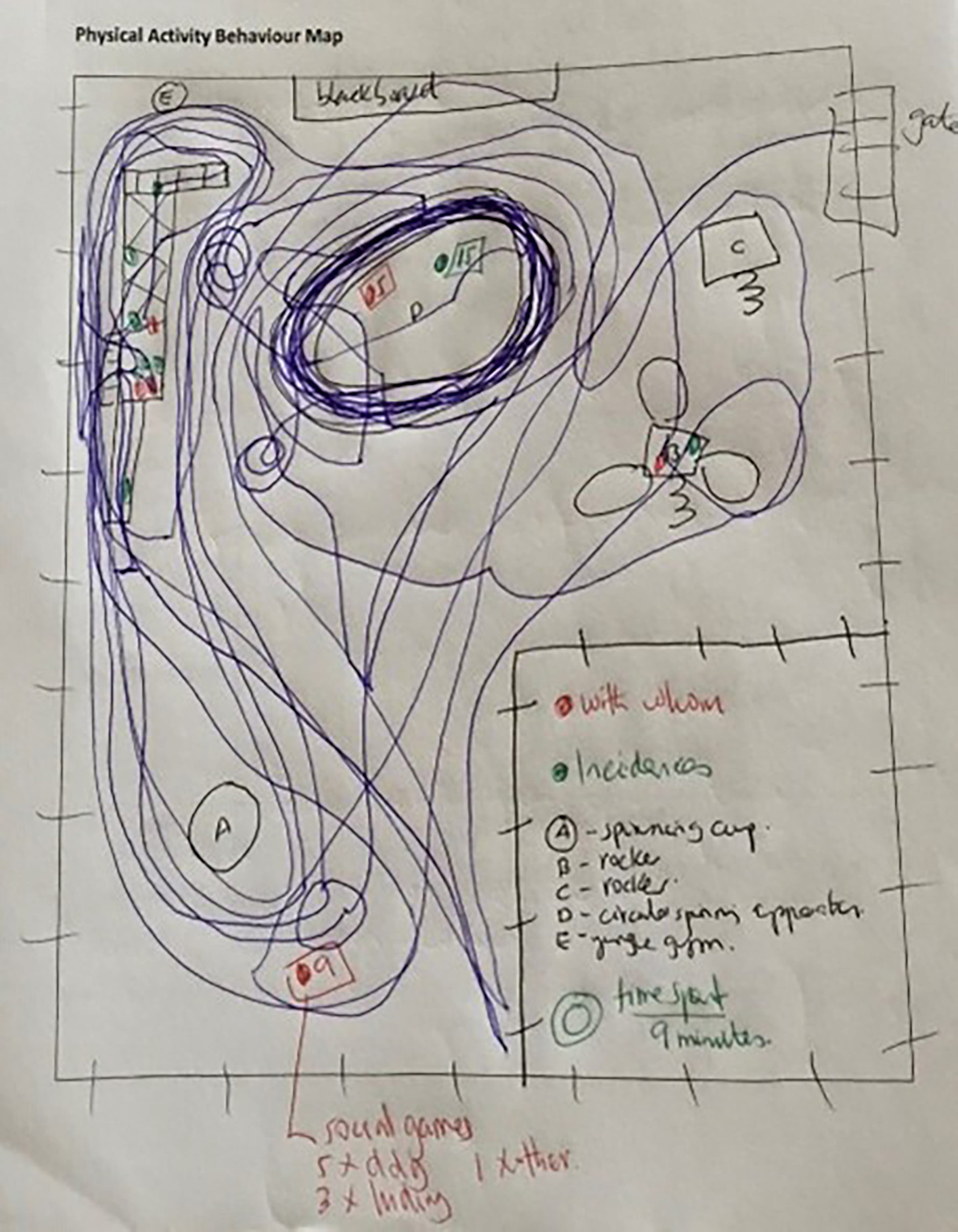
Preschool behavior map with equipment.
Subtheme 2: Participation Barriers
Safety was identified as the principal barrier to accessing outdoor play across all contexts and was the first consideration in preschools, where all playgrounds were fenced off. In contrast, the lack of an enclosed space and the absence of secure gates were key constraints for families both at home and when visiting playgrounds. Road safety was a key concern, with some parents choosing to visit community playgrounds at off-peak times when traffic was reduced: “Sometimes he might try to climb over a railing or escape if it’s quite low. . . . Sometimes I take a tie down with me and I’ll tie the gate if there’s no one there” (Lily, mother of Diarmuid, age 5). Consequently, community playgrounds were not usable for some: “I don’t go there much with him because it’s just, it’s too much of a risk” (Katie, mother of Ciaran, age 5), yet this was the child’s favorite place to play.
Parents expressed considerable apprehension with regard to their child’s safety in accessing larger playground structures: Open space at the top of slides was a key area of contention for all parents, who could see the play value of playing up high, but the equipment did not seem to provide such affordances safely: “When they go up the big slides, there are huge, massive opening things.. . . what if a kid fell out? I’m actually standing below him . . . with my hands out” (Lily, mother of Diarmuid, age 5). Conversely, parents noted that the physical affordances of some playground apparatus did not provide sufficient challenges for the children. Nevertheless, families still accessed these sites because of convenience.
At preschool, constraints on outdoor play participation included the small size of the outdoor space as well as an absence of play materials and natural elements. Social participation was also limited by separating the preschool yard from the outdoor play spaces accessed by the other children at the school (Figure 3).
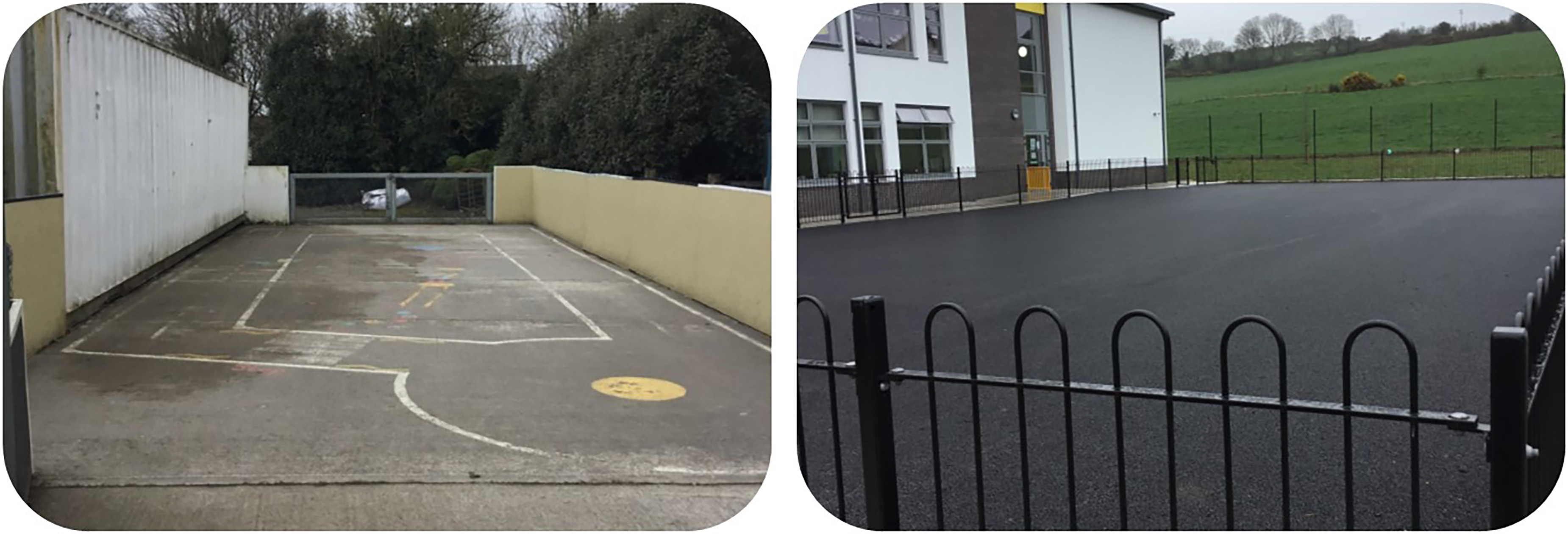
Sample preschool play space.
Subtheme 3: Social Inclusion and Stigma in Society
Social exclusion was evident in both preschool and community playground settings. In preschool, social exclusion from the wider peer group was observed. The preschool autistic classes were separated from the other children attending the school at all seven sites during designated outdoor breaks, with one school mixing the preschool attendees with infant classes at one break time. Separate, gated areas were designated for these children, and in some cases separate yard times were also in place.
Community playgrounds were considered a potential site for inclusion because being together as a family and experiencing the outdoors collectively was viewed as important: “It’s something that we can all do together, and we are very limited in what we can do together as a family” (Niamh, mother of Fionn, age 3). However, maximizing inclusion and avoiding exclusion were constant concerns. For example, although the presence of other children was identified as a means for the children to develop social interaction skills, peak times were avoided to limit the social demands placed on the children and, in turn, minimizing challenging behaviors: “He doesn’t know how to take turns, he’s at the top of the slide and the kids are like “Move; we can’t get down the slide with you” (Katie, mother of Ciaran, age 5).
For these kinds of experiences, many of the families associated visits to the community playground with feelings of anxiety and being stigmatized. They directly experienced other adults and teens watching their child and commenting negatively in relation to the child’s behavior: Fionn would do a vocalization, and then you’d hear it again, and some teenager going “Oh my God.” But I’m used to it, and it’s like water off a duck’s back now, but when my husband has come, he finds it very difficult. [He] doesn’t like it at all. (Niamh, mother of Fionn, age 3)
Discussion
The aim of this study was to explore the nature of outdoor play occupation among autistic preschoolers and examine how participation in outdoor play is enabled in community, home, and preschool settings. We took a neurodiversity-informed perspective with the goal of capturing descriptions of autistic play culture while recognizing that autism is “a different kind of consciousness that does not automatically translate experience as it is lived into words” (Conn, 2015, p. 1194). To that end, our findings illuminate play forms, preferences, and opportunities for child participants to engage in outdoor play: The preschool children in this study demonstrated a strong desire to engage in varied outdoor play occupations, encompassing motor, social, and sensory components evident in free running and playing chase, active watching, natural experiences, and climbing up high. In this study, free running was a form of intensive play that was freely chosen, meaningful, and enjoyed as running for the sake of running (Besio, 2017). Observations of the occupation of running identified that our common understanding of running did not adequately encapsulate the potential meaning of these children’s actions, occupational patterns, or schemas (Athey, 2007). Instead, as Spitzer (2003) observed, there is a need to park our assumptions about what constitutes an occupation. For these children, the occupation of running was observed in free running: running to/away, running together, running around perimeters, running after or being the lead runner, and so on. Although it is well documented that children of this age, with and without disabilities, favor gross motor play, free running for these autistic children differed from the running of neurotypical children in its intensity, absorption, and duration and in how it seemed to provide them with forms of sensory highs and a physical thrill that have been documented in biographies of autistic persons, through the intensity of free movement (Conn, 2015). The presence of other autistic children engaging in their own running schemas also provided scaffolding to each other in expanding the play schema and enabling sustained engagement.
The form of autistic socializing was also described in our findings. Although these children did not engage in the same social play and interactions as their neurotypical peers, they did participate socially in their own style, which was predominantly in the form of onlooker participation (Bagatell, 2012; Graham et al., 2018). Although the children in this study could not verify this, onlooker participation is a way of involvement that has been documented by other children with disabilities, whereby they confirm that they feel included (Graham et al., 2018). Active watching represented this key style of onlooker participation for the children, which included watching on the periphery of the play space or climbing high to watch; imitating the interactions of other children with playground equipment; and joining in and, at times, initiating the social running described earlier. Interestingly, in other studies these play behaviors are often defined as solitary, parallel, or nonsocial play (e.g., Coplan et al., 2015). Such commentary has been informed in part by the application and general adoption of Parten’s (1932) social play hierarchy. However, as the children in this study demonstrated, being on the sidelines does not mean that the child is apart from their peers but instead is participating differently, engaging in their own unique way of participation with their peers at the playground, as has been noted in other autistic play research (Lynch et al., 2018; Yuill et al., 2007). Such behaviors can be deemed as key social initiation forms for autistic children; some findings suggest more attunement with the social world than previously thought, with active watching facilitating the social play skills of waiting, turn taking, imitation, and attempts to approach and shadow other children (Yuill et al., 2007). From this perspective, this finding serves to extend our knowledge of and insight into the application of social play hierarchies to autistic children, who may have a play development trajectory that differs from that of neurotypical children.
On the basis of narratives from autistic persons, Conn (2015) identified the significance of sensory affordances more than the social affordances of people or objects in autistic play cultures. Similarly, in this study children were observed to become highly engrossed in the sensory aspects of nature, watching how leaves fall or repeatedly fingering blades of grass, seeming to experience a heightened and pleasurable awareness (Conn, 2015). Moreover, parents noted that their child’s strong sensory connection with nature had a positive impact on their child’s mood and participation in the playground when they were provided with access to self-selected play opportunities in nature outdoors. Therefore, understanding autistic sensory experiences was an essential component for enabling occupational participation for families outdoors (Daly et al., 2022).
Although the community playground may have been a primary source of opportunity for outdoor play, families did not always feel welcome. To ensure successful participation, they frequently orchestrated visits to diverse playgrounds locally and at a distance to ensure successful participation. Although this was sometimes associated with the need to access safe and usable play opportunities, it was most often done to avoid stigma, as has been noted in other studies (e.g., Lam et al., 2010 ; Lynch et al., 2018). For some families, playing at home, where the child could choose what and how to play with nature in their own way, without fear of judgment or ridicule, provided the best opportunities for free play. There remains a considerable challenge at a community level for enabling and protecting social inclusion for families of autistic children.
Exclusion was also a notable issue in the preschool settings, with a lack of school provision for outdoor play evident. As noted, preschool sites consisted of small, outdoor spaces, most of which were devoid of play materials and all of which were enclosed by walls or fences, thus separated from the outdoor yard spaces of the mainstream school environment. As a consequence, social exclusion was evident on all preschool playgrounds through this physical segregation of autistic children from children attending mainstream settings. Such segregation has been noted to limit the potential development of play schemas because the number of play partners is further limited (Nabors et al., 2001). Of note, this was not self-imposed, as is so often reported (Naber et al., 2008), but was adult led and policy informed: Exclusion was not the goal of the decision makers; instead, safety and containment took precedence. Overall, the outdoor preschool play spaces in this study have been shown to afford limited play opportunities as well as restricted access to the same opportunities as neurotypical peers. Therefore, school playgrounds are currently contributing to the exclusion of these children by limiting and restricting their play experiences and reducing opportunities to interact with and participate in their wider peer group.
Implications for Occupational Therapy Practice
The findings of this study support the premise that outdoor play is valued by autistic children and their families. They have the following implications for occupational therapy practice: ▪ There is a need to examine more closely what autistic children like to play with, and how they like to play, and to acknowledge their play behaviors as meaningful play occupations rather than assuming them to be nonfunctional or deficient. By valuing these preferred occupations, caregivers, educators, and clinicians can assist these children in fostering relationships, developing new interests, and building skills. The playground is one of the key contexts in which to cultivate this development. ▪ The challenge in capturing the form and meaning of play when a child cannot communicate the subjective meaning is evident, yet other methods, from observing play and partnering autistic children in natural settings, to seeking insight from those close to them, can help bridge this gap. Informed by autobiographies of autistic adults, we know that the relationship with objects, bodily experiences, and sensory elements among autistic children differs from that of neurotypical children, and occupational therapy practitioners are challenged to consider alternative ways and meanings that can be attributed to the observations they make when conducting research with autistic children. ▪ Designing play-based interventions needs to be informed by evidence; for occupational therapy, this needs to include consideration of autistic children’s preferences and include outdoor free play. Yet, in a review of 388 play-based interventions for autistic children, Gibson et al. (2021) found that none targeted the personal preferences of autistic children. Moreover, the occupational therapy literature contains few intervention studies. More research on designing play-based occupational therapy interventions from a neurodivergent-informed perspective is required. ▪ Restricted opportunities in preschool settings was found to be the primary barrier in this study, with the social inclusion of autistic children most at risk and in need of action from both policy and design perspectives. This is particularly concerning given research findings that support the role of the playground as a site for the development of disability awareness and social inclusion (Ripat & Becker, 2012; Talay et al., 2010). Future research needs to develop clear and coherent guidelines for developing challenging play spaces that foster social inclusion and afford a range of play opportunities and experiences for all children (Moore et al., 2023).
Conclusion
In this study, we explored the nature of outdoor play occupation among autistic preschoolers and examined how participation in outdoor play is enabled in community, home, and preschool settings. It was apparent that outdoor play was highly valued by the participating children and adults. When given the opportunity, children chose to participate in outdoor play frequently, across contexts, both alone and with social partners. They sought out and enjoyed active, sensory-rich experiences of outdoor play, including free running and onlooker participation as examples of meaningful play occupation. Our findings highlight that autistic children face particular challenges with regard to access to and inclusion in diverse play spaces with peers in preschool. Although the importance of relationships and social play cannot be overlooked, infrastructural supports for parents, schools, and communities are required if we are to create supportive and inclusive outdoor play environments for autistic children to play freely. More efforts are needed in research and practice to advocate for outdoor play provision and participation, in particular in community and educational settings.