





Abstract
The Hand Accumulation aNd Dexterity FUnctional Limits–Shriners (HANDFULS) offers a new, clinically feasible outcome tool for measuring in-hand manipulation.
Fine motor dexterity is central to normal hand development for children and is important in many functional tasks (Needham & Nelson, 2023). Therefore, it is important to be able to quantify hand function of children with traumatic and burn injuries or congenital hand malformations or deformities. In our work with children and adolescents who sustained traumatic or burn injuries to their hands, we perceived the lack of a simple, fast, and inexpensive performance-based outcome tool to measure in-hand manipulation and palmar workspace volume, two important aspects of hand function that are affected by injury or hand differences. To fill this gap, we developed a hand outcome measure called Hand Accumulation aNd Dexterity FUnctional Limits–Shriners (HANDFULS). For this study, we tested HANDFULS on children and adolescents with typically developed and noninjured hands to examine face validity, feasibility, and test–retest reliability and to provide reference values for 2- to 20-yr-olds as a foundation for further study.
HANDFULS aims to measure two constructs: in-hand manipulation and palmar workspace volume. The foundational work introducing the concept of in-hand manipulation was originally published by Elliott and Connolly (1984), and later the term in-hand manipulation was coined and further defined by Exner (1997). In-hand manipulation refers to the adjustment of an object within the hand after grasping, with or without stabilization of other objects in the hand (Exner, 1990). This fine motor skill is needed for tasks such as collecting, holding, and releasing coins in one’s hand or grasping grapes or candies and releasing them one at a time into one’s mouth (Pont et al., 2009). In-hand manipulation is currently assessed using a variety of different instruments (Kruger et al., 2022). These instruments were designed on the basis of classification systems that describe in-hand manipulation (Pont et al., 2009) and generally involve three main components: translation, which involves the linear movement of an object from the palm to the fingers or vice versa; shift, which involves the linear movement between and among fingers; and rotation, which describes the fingers rotating an object around its own axes. Accomplishing any of these actions while holding other objects in the hand is described as stabilization (Exner, 1990). Currently, available measures of in-hand manipulation offer valuable information, but the test procedures target narrow age ranges, have limited availability for use, and require clinician training; findings are not comparable across tests; and none of the test procedures target the injured or deformed hand (Kruger et al., 2022; Pont et al., 2009). Furthermore, most available tests are too complex or lengthy to administer quickly in an acute care setting (Smith-Suzovsky & Exner, 2001), require complex scoring based on subjective observations (Breslin & Exner, 1999; Klymenko et al., 2018), and demonstrate inadequate test–retest reliability (Pont et al., 2008). None of the current in-hand manipulation tools consider the functional workspace of the hand, which is relevant to patients with hand trauma and deformity.
The second aspect of hand function targeted with the HANDFULS tool is functional workspace, called palmar workspace volume for this study. Because palmar workspace volume has not been specifically quantified in the literature, we are proposing the definition as the functional workspace created within the hand by the positions of the fingers and thumb, in combination with the soft tissue shape of the palm and healthy transverse, longitudinal arches. This definition is based on similar concepts of the workspace defined for thumb functional workspace (Curran et al., 2019) and finger precision workspace (Bullock et al., 2015; Kuo et al., 2009). Curran et al. (2019) developed a kinematic model of the hand to measure the position of the thumb and fingers during functional tasks, allowing for calculation of the volume of space in which prehension can occur. That study primarily focused on joint position and did not include space within the palm formed by soft tissue structures. We used the available literature to refine the proposed description of the construct. Tissue damage, structural injury, or scarring from an injury often reduces this functional space (Figure 1 and influences one’s in-hand manipulation ability to hold or adjust objects within the hand. Therefore, we aimed to develop a test that examined both constructs simultaneously.
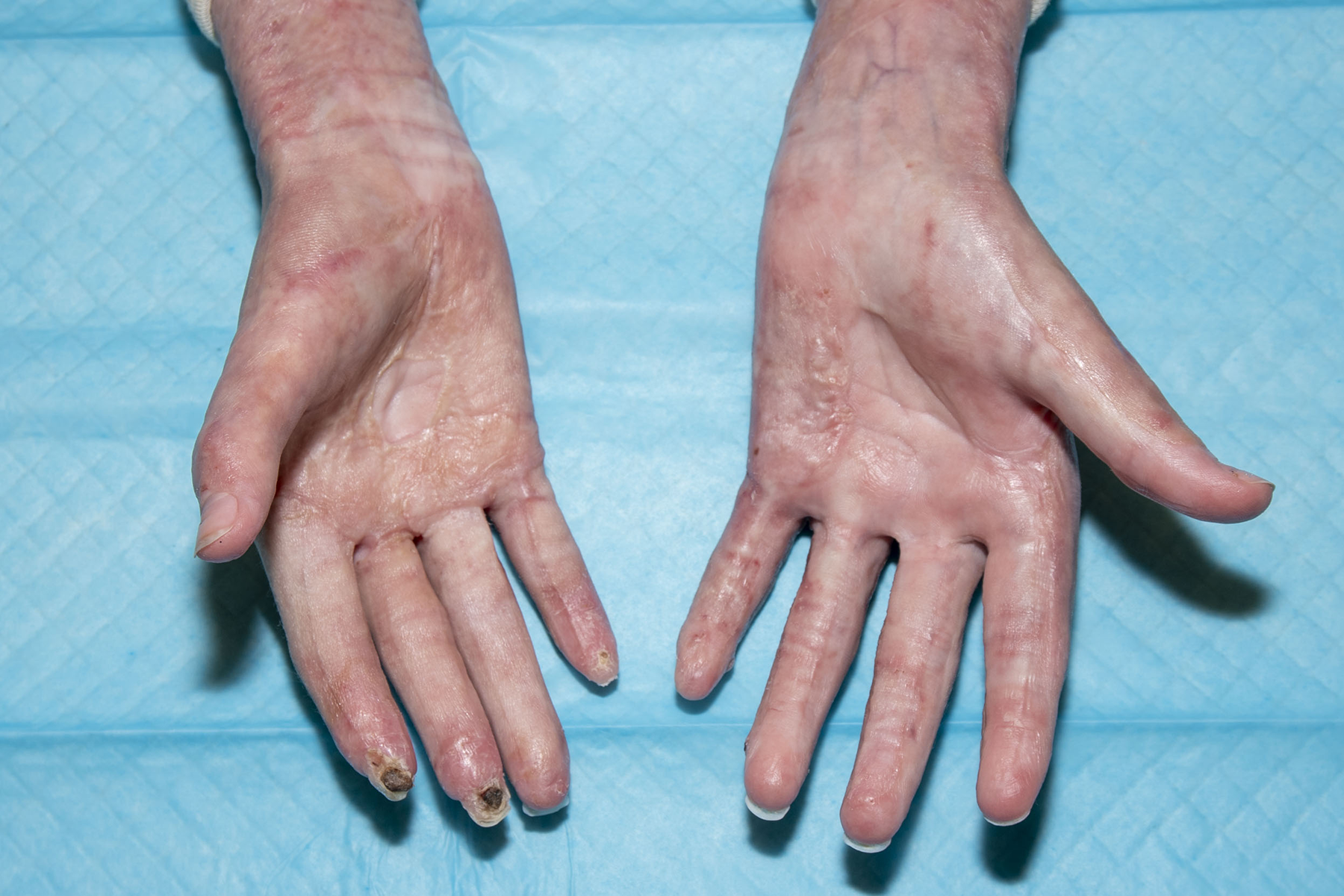
“Cupping” hand deformity after a burn injury.
In this article, we describe development of the HANDFULS outcome measure, including evaluation of face validity and test–retest reliability. We developed the tool as a means of capturing the aforementioned constructs relevant to injured and deformed hands. However, for this study, we administered HANDFULS to children and adolescents with typically developed, noninjured hands as a first step in examining validity, reliability, and feasibility and to provide reference values as a foundation for further study.
Method
Participants and Enrollment Criteria
Children and adolescents were recruited for the study from within the hospital and the surrounding community. To participate, they were required to be between 2 and 20 yr old, have developmentally age-appropriate hand function confirmed by parent report (or self-report for older participants), and have normal hand and finger range of motion confirmed by parent or participant report and visual observation at consent. Participants were excluded if they were outside of the stated age range; had finger amputation; had finger–hand contracture or deformity, a diagnosis known to affect hand or upper extremity function; or had a developmental delay or cognitive disorder that prohibited their ability to follow instructions.
HANDFULS Test
The test kit consisted of an 8- × 8- × 1-in. felt-lined tray and at least 30 commercially available regular-sized (14 mm) glass marbles (Figure 2a). The continuous shape, standardized size, familiarity, and easy access of marbles offered a practical means to quantify palmar workspace volume. Caution should be taken, however, with younger children when using marbles because they can present a choking hazard.
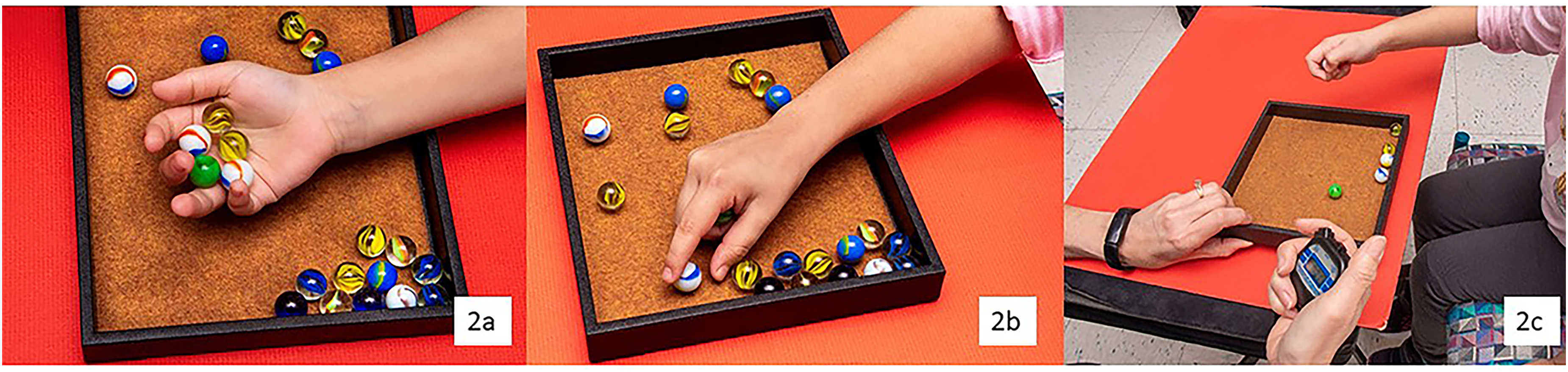
Testing with the HANDFULS hand outcome tool.
During testing, the tray was placed in front of the child, who was seated at a height that allowed approximately 90° bend in the angle of the elbow while resting the hands on the table. Several marbles were placed in the tray to begin. The amount of initial marbles placed in the tray was estimated to be more than what the child could initially hold in the hand based on visual assessment and ranged from five to 20 depending on the child’s hand size but always estimated to exceed the anticipated palmar workspace volume. The test was performed with one hand at a time, and the nontesting hand was placed on the child’s lap or held gently by an adult to avoid involvement. We used an electronic randomization application to determine which hand was tested first. The test consisted of two parts.
For the first part, the tester demonstrated the testing procedures and provided the child with the following verbal instructions:
Using the fingers of the chosen hand, pick up the marbles one at a time until your hand is comfortably full but not overstuffed. You should be able to hold all of the marbles in one hand with your knuckles pointing down and no marbles falling out. (Figure 2b)
This part was not timed, and the maximum number of marbles that the child could fit comfortably in their hand signified the palmar workspace volume for that hand. The marbles that fit in the child’s hand were counted and placed into the tray for the next step of testing.
The second part included the child picking up the marbles (the number of marbles determined from the first part of the test) while being timed. The child was given the following instructions:
Using the same hand you just used, pick up the marbles one at a time again, but this time you will be timed. Pick them up as fast as you can but be sure you are only picking up one at a time. The timer stops when you can hold all of them in your hand with your fingernails facing down and without dropping any. (Figure 2c)
The stopwatch started when the first marble was touched and ended when all marbles were secured in the hand with the fingernails facing down. The test was repeated three times with the same hand, and then both parts of the test were repeated for the other hand. The HANDFULS score was calculated separately for each hand using the total number of marbles that fit in the hand as the denominator and the time (averaged from three attempts) as the numerator for the following equation:
Average time (in seconds)/number of marbles = HANDFULS score (time per marble)
A lower score signifies greater proficiency with the test.
Other Test Procedures
For this study, we collected additional data to determine other associations with in-hand manipulation time and palmar workspace volume. We collected height and weight data using a standard and calibrated scale and stadiometer. We recorded age, hand dominance, and gender for each participant. Five measures of hand size were taken and recorded for each hand: (1) distal wrist crease to tip of middle finger (fingers fully extended, wrist neutral), (2) hand width at palmar crease, (3) hand span thumb tip to small fingertip (hand maximally splayed along ruler), (4) long finger metacarpal length (palpated), and (5) hand circumference around metacarpal heads. We tested grip strength with a Jamar hydraulic hand dynamometer (Cedarburg, WI) and pinch strength with a Jamar hydraulic pinch gauge (Cedarburg, WI). Both devices were calibrated, fitted to the child’s hand before testing, and applied using standard testing positions and instructions per the manufacturer’s instruction manuals. Grip, tip pinch, and lateral pinch were each tested three times.
Face Validity
The Consensus-based Standards for the Selection of Health Measurement Instruments (COSMIN) guidelines describe face validity as the degree to which an instrument is an adequate reflection of the constructs to be measured (COSMIN, 2023). During the development of the tool and before testing on participants, the face validity of HANDFULS was established through a literature review and feedback from seven subject matter experts (SMEs) experienced in the rehabilitation of children with hand trauma and burn injury. Two of the experts were actively involved in developing the test. We reviewed literature regarding the two constructs that HANDFULS aimed to capture: in-hand manipulation and palmar workspace volume as described previously.
The seven SMEs, including five occupational therapists (two of whom were certified hand therapists), one physical therapist, and one hand surgeon, observed the test procedures and responded to three questions of face validity: 1. Is the test useful for measuring the number of marbles that a child could fit and hold in their hand? 2. Does the action of picking up one marble at a time to fill the hand incorporate the in-hand manipulation abilities (i.e., translation, shift, and rotation) as defined by Exner (1990)? 3. Is this a test that can be accomplished by children and adolescents ages 2 to 20 yr?
For Question 1, all SMEs reported that the HANDFULS test was useful for measuring the number of marbles that a child could fit and hold in their hand. For Question 2, the SMEs expressed complete agreement that the test required the child to perform translation and shift, but only five out of seven clinicians reported that they consistently observed rotation for task completion. For Question 3, all SMEs responded in the affirmative that the test could be accomplished with children and adolescents ages 2 to 20 yr, but some clinicians noted that not every child age 2 or 3 may be able to follow the directions because of varying levels of maturity. In addition, the clinicians provided informal feedback about the wording of the instructions to optimize performance. For example, “pick up the marbles … until your hand is comfortably full” to avoid overstuffing that could affect the collection time.
Test–Retest Reliability
We examined test–retest reliability for the HANDFULS score by testing participants three times on each hand within the same session. We used the Shrout and Fleiss (1979) reliability index for a random set using the results for the three repeated tests.
Statistical Analysis
We conducted a power analysis before beginning the study. From preliminary data, we found that 30 patients per age group allowed estimation of the age group mean with a 95% confidence interval (CI) with standard deviation of approximately 0.75, and 15 participants per age group per sex allowed for a 95% CI with no more than 1 standard deviation.
Summary statistics are reported as mean and standard deviation for continuous variables and as percentages for categorical variables. To establish age-normative values, we categorized age groups as 2–3 yr, 4 yr, 5–6 yr, 7–9 yr, 10–12 yr, 13–15 yr, and 16–20 yr and reported means, standard deviations, and 95% CIs. The age categories were determined based on periods of developmental changes related to hand function. We examined differences between age categories and the HANDFULS variables using one-factor analysis of variance (ANOVA). We analyzed associations with sex using the two-sample unequal variance t test. Multiple regressions were fitted to test for associations between age (as a continuous variable) and the HANDFULS variables after controlling for the child’s height and hand characteristics, including span, width, length, and circumference. We implemented a stepwise selection procedure, holding age in the model and removing otherwise nonsignificant variables. We assessed model assumptions for the ANOVA and regression models using residual diagnostic plots, mainly quantile–quantile (QQ) plots and histograms of the residuals. We performed all analyses using SAS (Version 9.4) for Windows; ps ≤ .05 were considered significant (ps < .001 are reported as such).
Ethics
This study was reviewed and approved by the Western Institutional Review Board. Written informed consent was obtained by a parent for children and adolescents younger than 18 yr old, with additional assent for children and adolescents ages 8 to 17 yr. Participants 18 yr and older signed their own consent.
Results
A total of 192 children and adolescents between the ages of 2 and 20 yr were tested using the HANDFULS test. The average height, weight, hand span and circumference, and grip and key pinch strength for each group are presented in Table 1. There were statistically significant differences between the age groups for all these parameters (ps < .001).
Differences by Age Group for Anatomical and Strength Variables (N = 192)
Note. All ps < .001. CI = confidence interval.
The average palmar workspace volume (i.e., average number of marbles grasped) for all participants was 8.7 marbles (SD = 4.0, p ≤ .001), and the number of marbles grasped ranged from 3.3 to 14.2 across the age groups (Table 2). Average HANDFULS score (i.e., seconds per marble) across all participants was 1.4 s per marble (SD = 0.4, p ≤ .05) and ranged from 1.2 to 1.8, again most interpretable by age category. A lower score demonstrates greater proficiency with the test. The ANOVA showed significant differences by age (Table 2).
Palmar Workspace Volume as Measured by Number of Marbles and In-Hand Manipulation Time per Marble (HANDFULS Score) for Each Age Group
Note. Right and left hands are reported together. CI = confidence interval.
* p ≤ .05.
Normative values were reported by age group only and were not differentiated by dominant and nondominant or right and left hand because statistical significance for these comparisons was not consistent throughout the age groups, and the differences found were clinically unremarkable (see Tables A.1 and A.2 in the Supplemental Material, available online with this article at https://research.aota.org/ajot).
By linear regression, age, hand span, and hand circumference were significant predictors of palmar workspace volume and were included in the final model. For every year increase in age, palmar workspace volume increased by 0.16 marbles (p = .011), and for every 1 cm increase in hand span and hand width, participants were able to pick up 0.47 (p < .001) and 0.9 (p = .0025) additional marbles, respectively. Because hand size can vary by age, the following equation is provided as an alternative to using the suggested normative values, instead estimating the individual child’s expected palmar workspace volume based on anthropomorphic characteristics:
Palmar workspace volume = −6.8 + 0.16 * age + 0.47 * span + 0.9 * width
We found no significant associations between age, grip strength, pinch strength, or hand circumference and HANDFULS score (time per marble). By using the baseline palmar workspace volume in the equation for the HANDFULS score, age was indirectly considered through hand size; therefore, age was added back into the model with all other variables removed. With only age in the final model, for every year increase in age, HANDFULS score decreased by 0.02 s per marble (p < .001). Residual analysis for both the ANOVA and regression models revealed no problems with distributional assumptions. Histograms were approximately normal, and QQ plots showed conformity with the normal distribution with almost all points lying on the diagonal line.
Test–Retest Reliability
For test–retest reliability, we used the Shrout and Fleiss (1979) reliability index to evaluate data from three test repetitions. The test–retest reliability was 0.84, indicating moderately high reliability.
Clinical Feasibility
During study implementation, participants of all ages understood the testing instructions without difficulty, and no modifications were made. There were no participants who could not complete the test at least once, and most (188 out of 192) completed all three trials for both hands. Occasionally, physical or verbal cues were required to prevent bilateral hand use.
The timed portion of the HANDFULS test took an average of 11.7 s per hand to complete. Including the first part of the test to establish palmar workspace volume, repeating the timed portion three times, and providing instructions or demonstration resulted in participants requiring no more than 5 min to complete the test. HANDFULS test equipment consisted of three readily available items: a felt-lined tray, commercially available regular-sized (∼14 mm) glass marbles, and a stopwatch (estimated total cost of supplies was about $30).
Discussion
This study described HANDFULS, a newly developed hand function outcome measure that quantifies in-hand manipulation and palmar workspace volume. It can easily and quickly be administered in a clinical setting, demonstrates face validity, has moderately high test–rest reliability, and has been evaluated with children and adolescents ages 2 to 20 yr with typically developed, noninjured hands to provide age-normative reference values.
Similar to other available in-hand manipulation tests, we recorded the time to complete the HANDFULS test (Kruger et al., 2022). We found significant differences in speed between the age groups corresponding to results by Pehoski et al. (1997), who identified periods of rapid change with age and described how children at some ages substituted refined finger movement when performing the tasks. Other in-hand manipulation tests prioritize assessment of the quality of movement over time completion and incorporate multiple tasks, in some cases up to 55 activities (Klymenko et al., 2018; Kruger et al., 2022; Smith- Suzovsky & Exner, 2001). We did not specifically assess the qualitative aspects of how children of different ages accomplished the tasks, and although the quality of performance on a variety of tasks is important, the more complex and lengthy a test, the more challenging for test administration, in particular with pediatric patients who have decreased attention span (Klymenko et al., 2018). Furthermore, tests that require subjective observation or complex scoring can further limit the feasibility and interrater consistency. HANDFULS was designed to be a simple test with familiar items that could be completed by participants of a wide age range (2–20 yr) in a short amount of time.
Most of the current literature investigating in-hand manipulation was conducted with typical children or children with neurological or neuromuscular diagnoses such as developmental delay or upper extremity cerebral palsy, so those tests may not be applicable or feasible with children who have more acute hand injuries (Kruger et al., 2022). Although this study tested HANDFULS with children who had typically developed, noninjured hands as an initial research step, the test was designed to fill a clinical and research gap for a hand function measure useful with injured or deformed hands. In theory, the test offers assessments relevant to those populations but still requires specific testing and validation.
Unique to HANDFULS is that it offers a way to quantify palmar workspace. Through our clinical work, we observed that in-hand manipulation abilities may be impaired because of limitations in the physical functional space of the hand (Figure 1). This phenomenon is often observed as a result of soft tissue or scarring changes in the palmar area after traumatic or burn injury. Previous studies that have tried to quantify this space have involved either complex three-dimensional analysis (Curran et al., 2019) or mathematical equations within robotics (Kuo et al., 2009), which are not readily useful to clinicians. Therefore, to capture the construct of palmar workspace volume, a simple and clinically feasible method was needed. Using standard-size glass marbles and consistent testing instructions, HANDFULS provides a quantifiable measure of palmar workspace volume that can be considered in conjunction with in-hand manipulation.
One of the most commonly used measures of in-hand manipulation, the Test of In-Hand Manipulation (Pont et al., 2008), showed poor stability in test–retest reliability among typically developing children over a 2-wk interval. We evaluated test–retest reliability for HANDFULS for three performances within the same session and showed that HANDFULS demonstrated moderately high test–retest reliability for that interval. This serves as a start for testing the reliability of HANDFULS, but applying and testing it with children and adolescents over multiple time points and through growth and development are important next steps.
This study is an initial introduction to HANDFULS and was conducted with participants who had typically developed, noninjured hands and typical anatomy and range of motion. HANDFULS was developed as an alternative to current hand function tests and was meant to be clinically feasible and applicable to children and adolescents of varying ages and with varying hand problems. It is not known yet whether HANDFULS is appropriate for hands with atypical morphology (e.g., missing or amputated fingers), injuries, or impairments. A previous study testing hand function of children with symbrachydactyly found that children with fewer fingers were less likely to be able to complete an in-hand manipulation test according to the exact rules of the test (Goodell et al., 2016). Therefore, HANDFULS still needs to be tested and validated with people of all ages with injured and atypical hands.
The test was considered generally feasible for administration with children. However, younger children or children with attention difficulties may take longer to complete the test. HANDFULS scoring can be done immediately by mathematically calculating per the equation described earlier. The score is easily interpretable across different hand sizes and can be referenced for age-normative values with this article.
Limitations and Future Work
Data for this study were collected from children and adolescents from just one geographic area, which may present selection bias, and the results may not be generalizable to children and adolescents from other geographic areas and cultures or to adults. The size and material of the marbles were based on the manufacturer labeling and not independently verified; small variations may exist among manufacturers of 14-mm glass marbles. HANDFULS does not test every aspect of in-hand manipulation and is not representative of the breadth of tasks in many hand function test (Klymenko et al., 2018), but it does appear to capture the key components of translation and shift and, less often, rotation. The in-hand manipulation components tested with HANDFULS may not be as comprehensive as some of the currently available measures that address multiple functional tasks and quality of movement (Kruger et al., 2022). However, it provides a simple assessment of core components of in-hand manipulation, uses a familiar and relevant activity that can be applied across ages, and has the potential to be feasibly administered in clinical settings, including acute care.
We determined age groups with the intent to capture key periods of change in hand development; although the age groups were determined by experienced pediatric clinicians, there may be variations in hand development within the age groups. We evaluated only face validity and test–retest validity; therefore, HANDFULS should undergo additional evaluation of other forms of reliability, validity, sensitivity, and usefulness. HANDFULS should also be correlated with other functional tests and patient-reported outcome measures because the link between in-hand manipulation and functional measures is not well established (Kruger et al., 2022; Pont et al., 2009). Finally, although age-normative reference values were provided for individuals ages 2 to 20 yr, it is possible that the age groups with less than the anticipated 30 participants were underpowered and may not be fully representative of children of those ages.
Implications for Occupational Therapy Practice
This study offers a clinically feasible tool to measure two aspects of hand function: in-hand manipulation and palmar workspace volume. This study has the following implications for occupational therapy practice: ▪ HANDFULS can be used in clinical practice with children and adolescents as a quick and feasible tool to measure and monitor these hand function parameters. ▪ HANDFULS can be used to test people with a variety of hand problems and compare their scores with normative values.
Conclusion
This study introduced the basic testing procedures for HANDFULS, provided face validity and test–retest reliability, and offered reference values for children and adolescents with typically developed, noninjured hands as a foundation for further study. We propose HANDFULS as a simple, clinically feasible alternative for measuring in-hand manipulation as well as palmar workspace volume. The HANDFULS test can be used in clinical practice for patient evaluation or as a foundation for future research addressing hand function.
Supplemental Material
Supplementary material for The Hand Accumulation aNd Dexterity FUnctional Limits–Shriners (HANDFULS): A New Clinically Feasible Measure of Hand Volume and In-Hand Manipulation for Children
Supplementary material, sj-pdf-1-aot-10.5014_ajot.2024.050773.pdf for The Hand Accumulation aNd Dexterity FUnctional Limits–Shriners (HANDFULS): A New Clinically Feasible Measure of Hand Volume and In-Hand Manipulation for Children by Ingrid Parry, Machelle Wilson, Ana Starcevich, Kory Bettencourt, David Greenhalgh and Michelle James in The American Journal of Occupational Therapy
Footnotes
Acknowledgments
We thank the clinicians and research assistants at Shriners Hospitals for Children, Northern California, for their support of this project.
References
Supplementary Material
Please find the following supplemental material available below.
For Open Access articles published under a Creative Commons License, all supplemental material carries the same license as the article it is associated with.
For non-Open Access articles published, all supplemental material carries a non-exclusive license, and permission requests for re-use of supplemental material or any part of supplemental material shall be sent directly to the copyright owner as specified in the copyright notice associated with the article.
